Author: afp

  • Thousands in heatwave-hit Bangladesh pray for rain

    Thousands in heatwave-hit Bangladesh pray for rain

    Dhaka (AFP) – Thousands of Bangladeshis gathered to pray for rain on Wednesday in the middle of an extreme heatwave that prompted authorities to shut down schools around the country.

    Extensive scientific research has found climate change is causing heat waves to become longer, more frequent and more intense.

    Bangladesh’s weather bureau says that average maximum temperatures in the capital Dhaka over the past week have been 4-5 degrees Celsius (39-41 degrees Fahrenheit) higher than the 30-year average for the same period.

    Muslim worshippers gathered in city mosques and rural fields to pray for relief from the scorching heat, which forecasters expect to continue for at least another week.

    “Praying for rains is a tradition of our prophet. We repented for our sins and prayed for his blessings for rains,” Muhammad Abu Yusuf, an Islamic cleric who led a morning prayer service for 1,000 people in central Dhaka, told AFP.

    “Life has become unbearable due to lack of rains,” he said. “Poor people are suffering immensely.”

    Police said similarly sized prayer services were held in several other parts of Bangladesh.

    The country’s largest Islamist party, Jamaat-e-Islami, issued a statement calling its members to join the prayer services planned for Wednesday and Thursday.

    Authorities ordered all schools last week to cancel classes until the end of the month.

    Temperatures across Bangladesh have reached more than 42C (108F) in the past week.

    “April is usually the hottest month in Bangladesh. But this April has been one of the hottest since the country’s independence (in 1971),” government forecaster Tariful Newaz Kabir told AFP.

    Kabir said fewer rainstorms than average for the period had contributed to the heat.

    “We expect the high temperature will remain until the end of this month,” he said.

    Hospitals in the southern coastal district of Patuakhali had recorded local outbreaks of diarrhoea due to higher temperatures and the resulting increased salinity of local water sources, state medical officer Bhupen Chandra Mondal told AFP.

    “The number of diarrhoea patients is very high this year,” he said. “This is all linked to climate change.”

  • He hippo in Japan zoo turns out to be a she

    He hippo in Japan zoo turns out to be a she

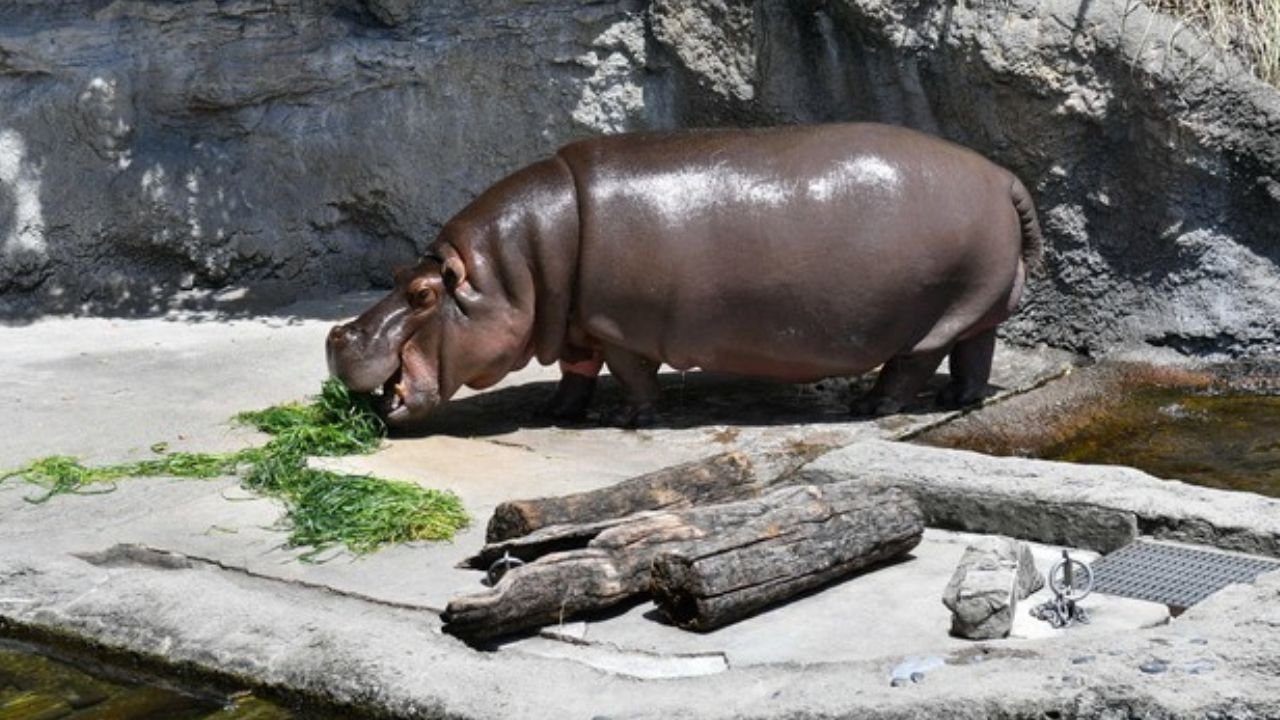
    Tokyo (AFP) – Betrayed by its DNA and unmanly toilet habits, a hippopotamus in Japan thought for seven years to be a he is in fact a she, the zoo where the wallowing giant lives said Tuesday.

    The 12-year-old came to Osaka Tennoji Zoo in 2017 from the Africam Safari animal park in Mexico, where officials attested on customs documents that the then five-year-old was male.

    But zookeepers long scratched their heads, a spokeswoman told AFP.

    In particular, Gen-chan did not display the typical male hippo behaviour of splattering faeces around while defecating — with a propeller-like tail motion — in order to mark territory.

    Nor did it make courtship calls to females and zookeepers were unable to visually identify any male genitalia, a dangerous task in such a large and potentially aggressive beast.

    “Therefore, we requested a DNA test at an external institution, and the result showed it was female,” the zoo said in a statement posted last week.

    “We will keep doing our best to provide comfortable environment to Gen-chan, so everyone, please come and see,” it said.

  • Tensions flare at US universities over Gaza protests

    Tensions flare at US universities over Gaza protests

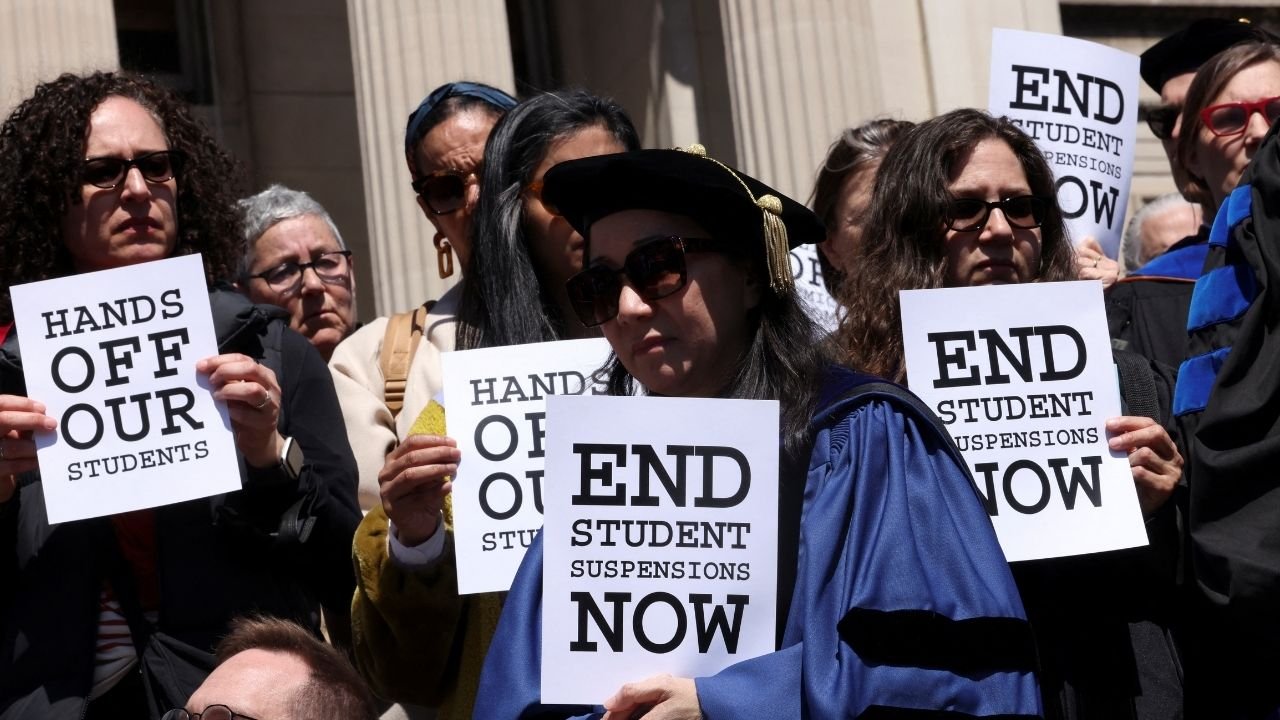
    New York, United States – Tensions flared between pro-Palestinian student protesters and school administrators at several US universities Monday, as in-person classes were cancelled and demonstrators arrested.

    The protests, which began last week at Columbia University with a large group of demonstrators establishing a “Gaza Solidarity Encampment” on school grounds, have spread to other campuses, including Yale, MIT and others.

    Some Jewish students at Columbia have reported intimidation and anti-Semitism amid the days-long protest, which is calling for the prestigious New York institution to divest from companies with ties to Israel.

    Classes were moved online Monday, with university president Nemat Shafik calling for a “reset” in an open letter to the school community.

    “Over the past days, there have been too many examples of intimidating and harassing behavior on our campus,” she said.

    “Anti-Semitic language, like any other language that is used to hurt and frighten people, is unacceptable and appropriate action will be taken.

    “To deescalate the rancor and give us all a chance to consider next steps, I am announcing that all classes will be held virtually on Monday,” she added.

    Last week, more than 100 protesters were arrested after university authorities called the police onto the private campus Thursday, a move that seemingly escalated tensions and sparked a greater turnout over the weekend.

    Mimi Elias, a social work student who was arrested, told AFP on Monday: “We are going to stay until they talk to us and listen to our demands.”

    “We don’t want anti-Semitism or Islamophobia. We are here for the liberation of all,” Elias said.

    Joseph Howley, an associate professor of classics at Columbia, said the university had reached for the “wrong tool” by involving police, which had attracted “more radical elements that are not part of our student protests.”

    “You can’t discipline and punish your way out of prejudice and community disagreement,” Howley told AFP.

    Disciplinary action

    As the holiday of Passover began Monday night, social media images appeared to show pro-Palestinian Jewish students holding traditional seder meals inside the protest areas on multiple campuses, including at Columbia.

    Further downtown, police began detaining protesters who had set up their own encampment at New York University at around 8:30 pm, the New York Times reported, after the school called the students’ behavior “disorderly, disruptive, and antagonizing.”

    There were also demonstrations at MIT, the University of Michigan and Yale, where at least 47 people had been arrested on Monday after refusing requests to disperse.

    “The university made the decision to arrest those individuals who would not leave the plaza with the safety and security of the entire Yale community in mind,” the Ivy League university said in a statement.

    At Harvard, university officials on Monday suspended the Palestinian Solidarity Committee, the student group said on Instagram.

    They were ordered to “cease all organizational activities” for the rest of the term, or risk permanent expulsion after holding an unregistered demonstration last week, student newspaper the Harvard Crimson reported, citing an email to the group.

    Universities have become the focus of intense cultural debate in the United States since Hamas’s October 7 attack and Israel’s overwhelming military response, as a humanitarian crisis grips the Palestinian territory of Gaza.

    President Joe Biden on Monday said he condemned “the anti-Semitic protests.”

    “I also condemn those who don’t understand what’s going on with the Palestinians,” he told reporters, without further details.

    hg/amz/bjt/des/caw/mtp

    © Agence France-Presse

  • Asia hit hardest by climate, weather disasters in 2023: UN

    Asia hit hardest by climate, weather disasters in 2023: UN

    Geneva, Switzerland – Asia was the world’s most disaster-hit region from climate and weather hazards in 2023, the United Nations said Tuesday, with floods and storms the chief cause of casualties and economic losses.

    Global temperatures hit record highs last year, and the UN’s weather and climate agency said Asia was warming at a particularly rapid pace.

    The World Meteorological Organization said the impact of heatwaves in Asia was becoming more severe, with melting glaciers threatening the region’s future water security.

    The WMO said Asia was warming faster than the global average, with temperatures last year nearly two degrees Celsius above the 1961 to 1990 average.

    “The report’s conclusions are sobering,” WMO chief Celeste Saulo said in a statement.

    “Many countries in the region experienced their hottest year on record in 2023, along with a barrage of extreme conditions, from droughts and heatwaves to floods and storms.

    “Climate change exacerbated the frequency and severity of such events, profoundly impacting societies, economies, and, most importantly, human lives and the environment that we live in.”

    The State of the Climate in Asia 2023 report highlighted the accelerating rate of key climate change indicators such as surface temperature, glacier retreat and sea level rise, saying they would have serious repercussions for societies, economies and ecosystems in the region.

    “Asia remained the world’s most disaster-hit region from weather, climate and water-related hazards in 2023,” the WMO said.

    Heat, melting and floods

    The annual mean near-surface temperature over Asia in 2023 was the second highest on record, at 0.91 degrees Celsius above the 1991-2020 average, and 1.87 C above the 1961-1990 average.

    Particularly high average temperatures were recorded from western Siberia to central Asia, and from eastern China to Japan, the report said, with Japan having its hottest summer on record.

    As for precipitation, it was below normal in the Himalayas and in the Hindu Kush mountain range in Pakistan and Afghanistan.

    Meanwhile southwest China suffered from a drought, with below-normal precipitation levels in nearly every month of the year.

    The High-Mountain Asia region, centred on the Tibetan Plateau, contains the largest volume of ice outside of the polar regions.

    Over the last several decades, most of these glaciers have been retreating, and at an accelerating rate, the WMO said, with 20 out of 22 monitored glaciers in the region showing continued mass loss last year.

    The report said 2023 sea-surface temperatures in the northwest Pacific Ocean were the highest on record.

    ‘Urgency’ for action

    Last year, 79 disasters associated with water-related weather hazards were reported in Asia. Of those, more than 80 percent were floods and storms, with more than 2,000 deaths and nine million people directly affected.

    “Floods were the leading cause of death in reported events in 2023 by a substantial margin,” the WMO said, noting the continuing high level of vulnerability of Asia to natural hazard events.

    Hong Kong recorded 158.1 millimetres of rainfall in one hour on September 7 — the highest since records began in 1884, as a result of a typhoon.

    The WMO said there was an urgent need for national weather services across the region to improve tailored information to officials working on reducing disaster risks.

    “It is imperative that our actions and strategies mirror the urgency of these times,” said Saulo.

    “Reducing greenhouse gas emissions and adapting to the evolving climate is not merely an option, but a fundamental necessity.”

    rjm/nl/rlp

    © Agence France-Presse

  • World’s largest private firms fail to set climate targets: report

    World’s largest private firms fail to set climate targets: report

    Paris, France – Only 40 of the world’s 100 largest private firms have set net-zero carbon emissions targets to fight climate change, according to a report released Monday, lagging far behind public companies.

    But for the world to meet the 2015 Paris Agreement to limit global warming 1.5 degree Celsius, all companies need to reduce their planet-heating emissions, the report by the group Net Zero Tracker noted.

    The lack of market and reputational pressures on private firms compared to those publicly-listed, along with an absence of regulation are to blame for their slow uptake of climate commitments, John Lange of Net Zero Tracker told AFP.

    “I think things are changing on all three of those fronts,” he added.

    The report compared 200 of the world’s largest public and private companies based on their reported emissions reductions strategies and net-zero targets.

    It found that only 40 of the 100 private firms assessed had net zero targets, compared to 70 of 100 publicly-listed companies.

    Of the private companies that have set targets, just eight have published plans on how they will meet them.

    “A pledge without a plan is not a pledge, it is a naked PR stunt,” the report said.

    Regulations coming

    Only two firms — furnishing giant Ikea and US engineering giant Bechtel — ruled out using controversial carbon credits to achieve their net-zero goals, the report said.

    Carbon credits allow businesses to offset their emissions by directing money toward a project that reduces or avoids emissions, such as protecting forests, but critics say they allow companies to keep polluting.

    Meanwhile, none of the eight fossil fuel companies included in the report was found to have a net-zero target, compared with 76 percent of the sector’s largest public firms.

    There was also little improvement in the figures compared with a previous analysis done in 2022, “despite a massive uptick in regulation around the world”, Lang said.

    Several jurisdictions including the United Kingdom have adopted climate disclosure regulations.

    Others have regulations on the horizon, with business hubs of California and Singapore requiring greenhouse gas emissions reporting from 2027.

    The European Union also introduced two climate regulations — the Corporate Sustainability Reporting Directive (CSRD) and the Corporate Sustainability Due Diligence Directive (CSDDD) — which will soon require thousands of large companies to report their climate impacts and emissions, and to take action to curtail them.

    “We’re trying to get private firms to understand what’s coming for them,” Lang said.

    ‘Trickledown effect’

    The EU policies will have far-reaching effects in particular, targeting firms not only based in the bloc but those that may be headquartered elsewhere with branches or subsidiaries within the member states.

    Yet two European private firms, including French hypermarket chain E. Leclerc, were singled out in the report for having set any emissions reduction targets.

    E.Leclerc told AFP that the company has made efforts toward more sustainable practises like eliminating the use of single-use plastic bags, and is “committed to setting near-term company-wide emissions reduction targets”.

    But with the enforcement of EU regulations looming, firms will not be able to “dodge” climate targets much longer, Sybrig Smit of the NewClimate Institute told AFP.

    “It’s actually quite watertight. If companies want to do business in Europe, they are going to have to face the consequences,” she said.

    The firms analysed account for roughly 23 percent of the global economy, with the majority based in either China, the United States or EU states — the biggest emitters of greenhouse gases, Lang said.

    Any changes the firms make to meet new regulations will have substantial benefits for the environment.

    “They have such a trickledown effect. Whenever such a big company is implementing something real, it will have a huge effect on the rest of the sector that they operate in,” Smit said.

    giv/cw

    © Agence France-Presse

  • Women journalists bear the brunt of cyberbullying

    Women journalists bear the brunt of cyberbullying

    Perugia (Italy) (AFP) – Women journalists face greater threats online in the course of their work, and the trend is increasing, one expert told an international conference in Italy this weekend.

    “There is significant potential for online violence to escalate to offline harm,” said Julie Posetti research director of the International Center for Journalists (ICFJ).

    “Women tend to face greater threats online,” she told delegates at the Perugia International Journalism Festival on Saturday. And, she added, “the kind of threats they face are increasing”.

    That toxic environment was being “facilitated by Big Tech companies”, she added, accusing them of “a failure to take responsibility”.

    In a joint UNESCO/ICFJ study in 2022, nearly three-quarters of women journalists interviewed said they had experienced online violence or abuse in connection with their work. They interviewed 900 journalists from 125 countries.

    Attacks online include insults, sexist and sexual comments, and physical threats, including death threats to journalists and their families, the conference heard.

    Increasingly sophisticated attacks include blocking accounts, hacking, publishing private photos and creating “deep fakes” — fake sexual images of people without their consent.

    Violent threats tend to increase when combined with discrimination linked to skin colour, religion or sexual orientation.

    Physical violence

    Posetti and two other researchers have built a guide and toolbox on the topic targeting journalists, together with the Organization for Cooperation and Security in Europe (OSCE).

    Filipino journalist Maria Ressa, the 2021 Nobel Peace Prize winner, was a victim of online abuse, as she explained in the ICFJ-UNESCO report.

    “I was a CNN war correspondent for two decades, but nothing in the field prepared me for the orchestrated, misogynistic attacks on me and our women-led news outlet, Rappler,” she said.

    BBC disinformation specialist Marianna Spring received an avalanche of abusive tweets last year, threatening to kidnap her or slit her throat.

    Much of the abuse followed her investigation into the takeover of social media network X, then known as Twitter.

    In some cases, online threats can translate into physical violence.

    A fifth of women surveyed said they had suffered attacks or insults in real life that were linked to online abuse.

    The consequences can be far-reaching, with some journalists potentially dissuaded from covering sensitive topics and some choosing to opt out of the industry altogether.

    Paris-based media rights campaigners Reporters Without Borders (RSF) has warned that this type of harassment forms a new threat to press freedom.

    Developing counter measures

    French journalist Nadia Daam told AFP that she received a flood of hateful messages in 2017 after a column that criticised an online forum.

    Since then, she has moved house twice and tends to stay away from social media, but says she still gets cyber-bullying messages and “doesn’t work the same anymore”.

    However, she thinks there is more awareness of the problem now, saying that she believes the wider industry “talks more about cyberharassment”, with more severe legal sentences.

    Freelancer Melina Huet covered the war in Ukraine as well as the Israel-Hamas conflict, and said she regularly gets online threats related to her coverage.

    “I received threats of beheading and rape on Instagram,” she said. “The perpetrators can easily re-create accounts, there is impunity.”

    Some media have put protocols in place to try and tackle cyberbullying.

    Jessica Ziegerer is an investigative journalist for the daily HD Sydsvenskan, and regularly receives hostile messages.

    “Before publishing a sensitive article, we have a meeting with security specialists and review all the aspects” both online and offline, she said.

  • ‘Conspiracy theorist’ sets self on fire outside Trump trial

    ‘Conspiracy theorist’ sets self on fire outside Trump trial

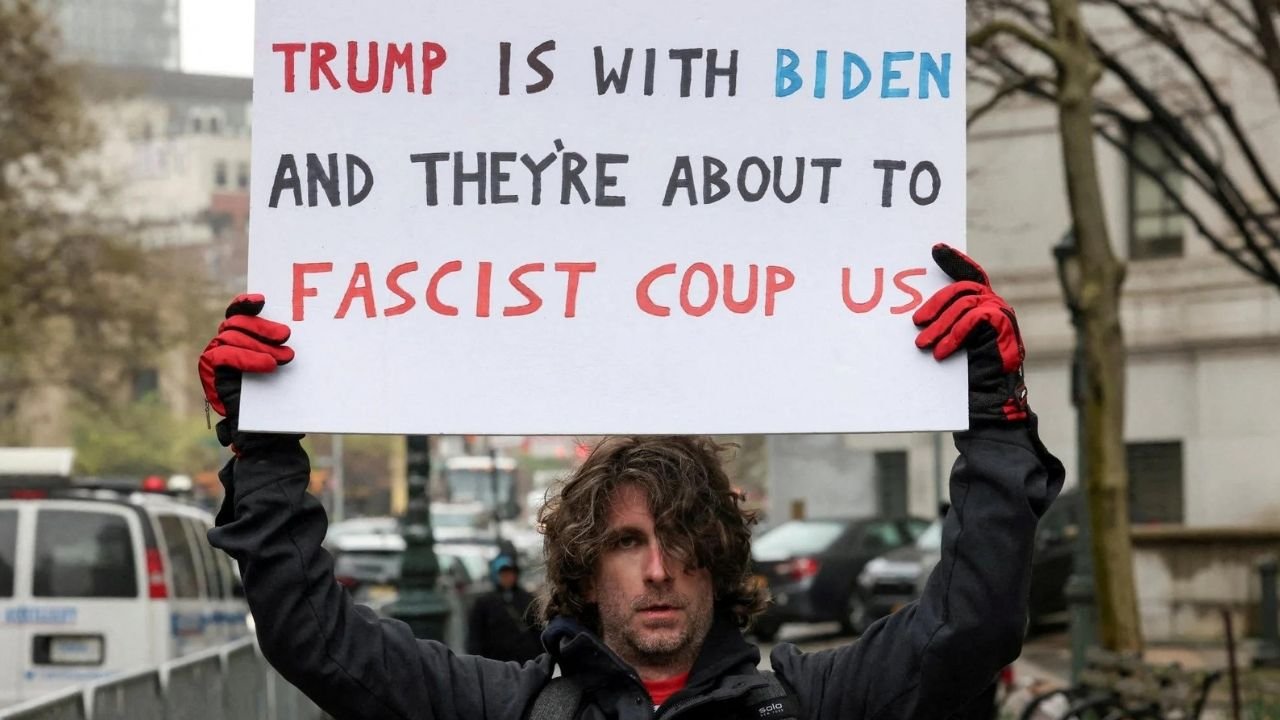
    A man set himself ablaze Friday outside the court where Donald Trump is standing trial, throwing pamphlets that police said contained conspiracy theories before he was taken to a hospital in critical condition.

    Police named the man as Maxwell Azzarello from St Augustine, Florida and said the pamphlets he sought to disseminate “seem to be propaganda-based.”

    “(They were) almost like a conspiracy theory type of pamphlet, some information in regards to Ponzi schemes, and the fact that some of our local educational institutes are a front for the mob,” NYPD chief of detectives Joseph Kenny told reporters.

    “His condition is not good, but as of now he is still alive.”

    Deputy police commissioner Tarik Sheppard said “we just right now labelled (him) a sort of conspiracy theorist, and we’re going from there.”

    Burning clothes were strewn in the park, which was locked down by authorities, while ambulances lined up nearby on standby, an AFP correspondent at the scene saw, describing a strong smell of burning chemicals.

    Laura Kavanagh, the New York City fire commissioner, said four officers were lightly injured in the incident. She described Azzarello’s condition as “critical.”

    Video seemingly taken by witnesses and posted on social media showed a person standing engulfed in flames, then falling to the ground as police officers, including one with a fire extinguisher, rushed to beat out the blaze.

    A witness who gave his name as Dave, 73, told AFP he saw a man throwing pamphlets before dousing himself with an unspecified liquid and lighting himself on fire.

    TV reporters described the incident unfolding moments after the full panel of 12 jurors and six alternates was selected for the trial of the former president in a hush money cover-up case.

    A CNN reporter described a heavy stench of burning flesh in the aftermath of the blaze.

    Hearings in the case resumed after lunch despite the incident. Trump declined to respond to questions about Azzarello as he returned to court after the break.

    The self-immolation happened in a park opposite the 100 Centre Street courthouse, which has been used by authorities to corral protesters, both pro-Trump and anti-Trump, as well as well as by some members of the media.

    Trump’s criminal trial, the first of a former president, is being conducted amid tight security in a 15th floor courtroom swarming with Secret Service officers as well as court police.

  • A hundred pro-Palestinian protesters arrested at New York’s Columbia University

    A hundred pro-Palestinian protesters arrested at New York’s Columbia University

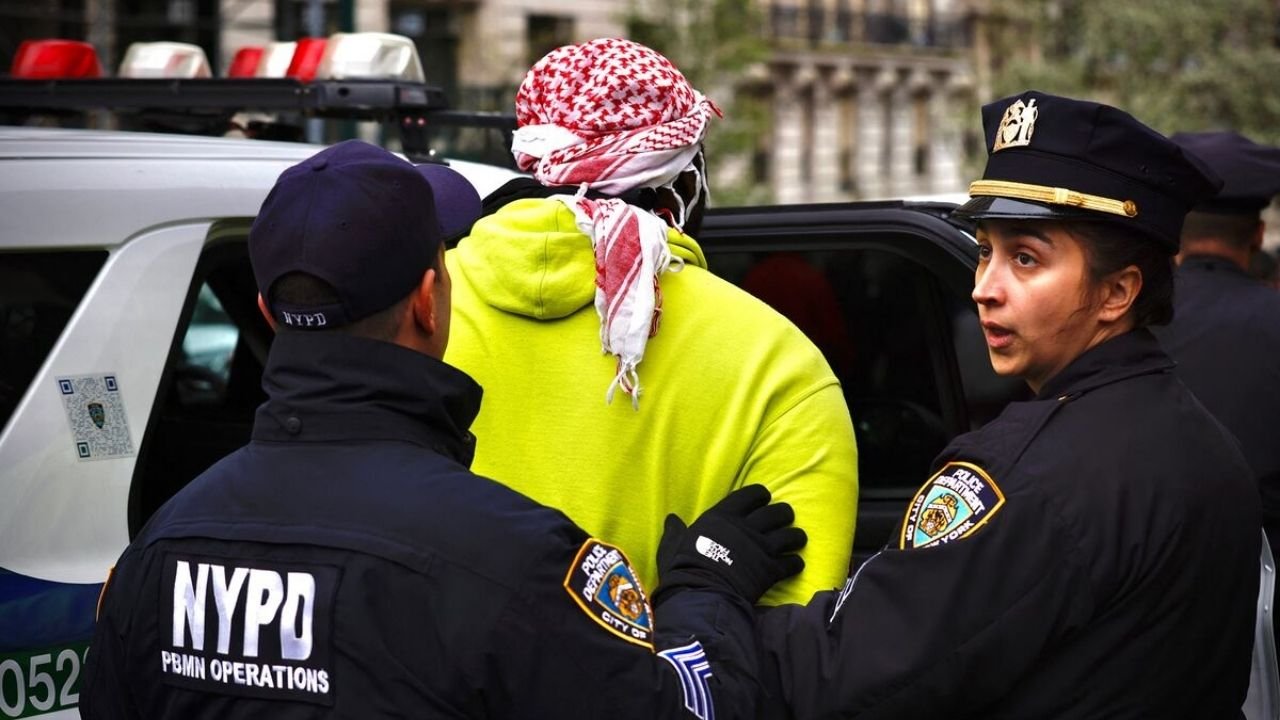
    Police arrested more than 100 pro-Palestinian student protesters at New York’s Columbia University Thursday, a day after the president of the prestigious school was grilled in Congress over accusations of anti-Semitism on campus.

    “NYPD officers moved in to ensure the safety of the campus, the students and the staff made more than 108 arrests, and the NYPD ensured that there was no violence or injuries during the disturbance,” New York Mayor Eric Adams said during a press conference.

    The arrests and dismantling of tents that had been erected Wednesday also attracted a crowd of other demonstrators in support, according to an AFP journalist.

    According to The New York Times, the daughter of Democratic Representative Ilhan Omar was among those detained and she has been ordered to appear in court.

    The students were calling for the school, which has an exchange program with Tel Aviv University, to boycott all activities associated with Israel in light of the country’s war with Hamas and the ensuing humanitarian crisis in Gaza.

    University president Nemat Shafik requested police intervention to disperse the protesters, who she said had violated campus security regulations.

    Universities have become the focus of intense cultural debate in the United States since the October 7 attack and Israeli genocide in Gaza, as many students’ pro-Palestinian sentiments drew accusations of anti-Semitism.

    Congressional Republicans have taken up the issue, calling the presidents of the University of Pennsylvania and Harvard University to testify, and Harvard’s president Claudine Gay resigned shortly after.

    Shafik herself appeared in Congress Wednesday, where she said “anti-Semitism has no place on our campus.”

  • Disney stepping into R-rated zone with Gladiator 2

    Disney stepping into R-rated zone with Gladiator 2

    In an extended trailer for the long-awaited “Gladiator” sequel, star Paul Mescal does battle in a Colosseum filled with rhinos, bloodthirsty baboons and even floating Roman warships, egged on by Denzel Washington’s shadowy advisor.

    “It is possibly more extraordinary than the first,” said director Ridley Scott, speaking via video link.

    The footage was met with an enthusiastic thumbs up at CinemaCon, an annual gathering at which Hollywood studios showcase their upcoming titles for movie theater owners and managers from around the world.

    Ridley Scott’s sequel will hit theaters in November, nearly 25 years after the release of the original, Oscar best picture-winning historical epic “Gladiator.”

    All this week, promotional marble statues for “Gladiator 2” have adorned the casino floors of Caesars Palace, the Ancient Rome-themed casino and hotel in Las Vegas where CinemaCon is held.

    As the previous film’s main characters, played by Russell Crowe and Joaquin Phoenix, were killed off, a new crop of actors step in.

    Mescal portrays gladiator Lucius, the nephew of Phoenix’s villainous emperor, who was seen briefly as a child in the original film.

    Pedro Pascal plays a military general, while Denzel Washington’s mysterious character is seen in the extended footage plotting to topple the Roman Empire.

    “Rome must fall. I need only to give it a push,” he says in one scene.

    The lavish presentation raised cheers even as both Paramount and the wider big-screen industry face uncertain times.

    The parent company of Paramount — one of Hollywood’s oldest studios — is currently locked in merger talks with Skydance, a media company founded by the billionaire Ellison family.

    Meanwhile overall Hollywood box office receipts are expected to fall in 2024, largely due to last year’s actors and writer strikes, which shuttered and delayed film productions.

    On Thursday, Paramount executives also showcased titles such as “A Quiet Place: Day One,” “Smile 2,” “Transformers One” and “IF” — a new comedy from John Krasinski and starring Ryan Reynolds.

    Paramount film chief Brian Robbins even joked about the merger talks, suggesting one of his executives had launched a crowd-funded Kickstarter campaign to buy the studio.

    R-rated Disney

    Later on Thursday, Disney rounded off CinemaCon with its own star-studded presentation — which took an unexpectedly adult turn.

    The showcase included appearances from Dwayne “The Rock” Johnson — promoting this November’s “Moana 2” release — and Amy Poehler, who returns in “Inside Out 2” this June.

    Oscar-winning “Moonlight” director Barry Jenkins previewed his animated prequel “Mufasa: The Lion King,” which hits theaters in December.

    Disney unveiled footage of Harrison Ford making his Marvel superhero film debut in next year’s “Captain America: Brave New World.”

    But the family-friendly studio’s presentation departed from the usual script with a glimpse of “Deadpool & Wolverine,” Disney’s first R-rated superhero movie.

    The film sees Reynolds’ potty-mouthed antihero team up with Hugh Jackman’s beloved “X-Men” star.

    Both characters were previously owned by 20th Century Fox.

    ut Disney bought that rival studio and its properties in 2019, and is now weaving them into its hugely popular Marvel film series.

    That has resulted in a Disney superhero movie that features adult language, explicit sexual references, and several meta jokes about the studios themselves.

  • Oil jumps, equities fall as Israeli attacks fan MidEast fears

    Oil jumps, equities fall as Israeli attacks fan MidEast fears

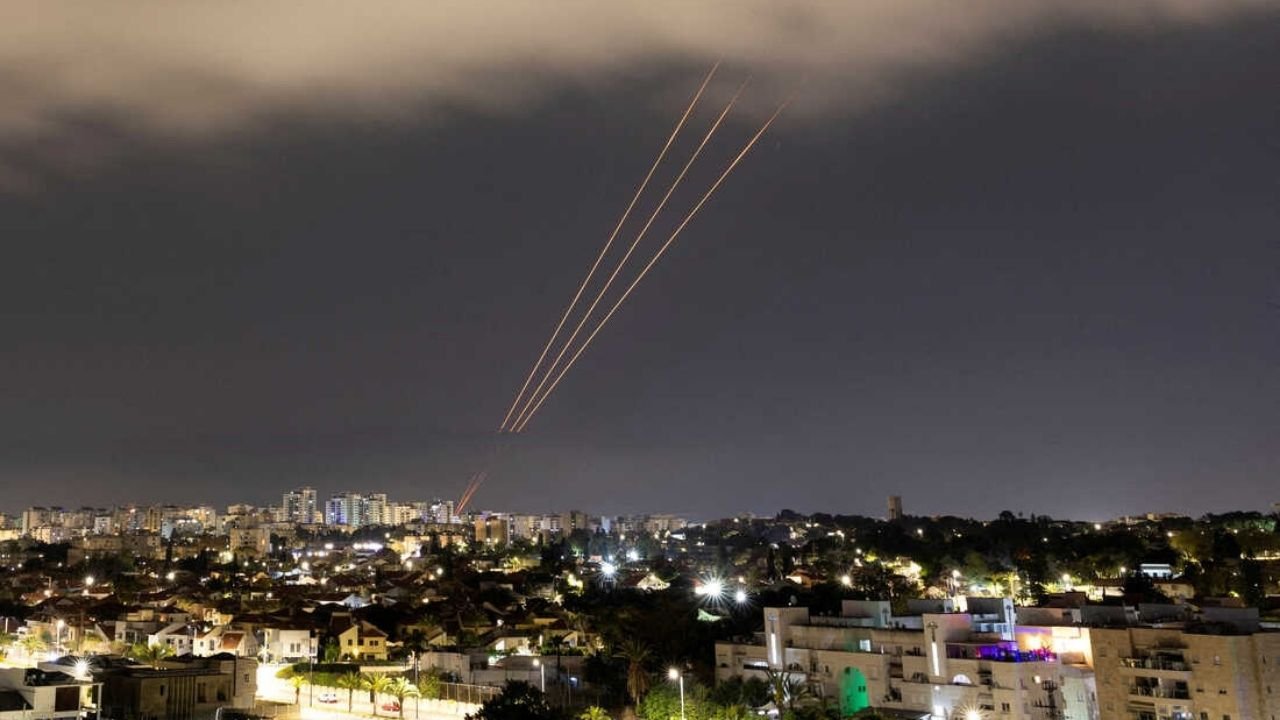
    Hong Kong, China – Oil prices rallied and equities fell Friday as reports said explosions had been heard in Iran and Syria, fuelling fears of an escalation of the Middle East crisis after last weekend’s retaliatory missile attack on Israel by Tehran.

    The reports followed another batch of data indicating the US economy remained in rude health and compounded concerns that the Federal Reserve will hold off cutting interest rates this year or even hike them again.

    Traders have been on edge since Saturday’s barrage by Iran, which Israel’s army chief General Herzi Halevi warned would be met with a response.

    Leaders in Tehran said the strike was a legitimate response to a deadly attack on an Iranian embassy building in Damascus that it blames on Israel.

    Iran’s Fars news agency reported “three explosions” were heard near Qahjavarestan, near Isfahan airport and the 8th Shekari army airbase, while space agency spokesman Hossein Dalirian said “several” drones had been “successfully shot down”.

    Dalirian said on social media platform X there were “no reports of a missile attack”.

    Nuclear facilities in Isfahan were reported to be “completely secure”, the Tasnim news agency said.

    ABC and CBS News reported the strikes had been carried out by Israel, quoting US officials.

    There was no immediate comment from the White House or Pentagon, and the Israeli military told AFP: “We don’t have a comment at this time.”

    The news sent shivers through markets, with crude briefly surging as much as four percent on worries about supplies from the oil-rich region, while fears of a regional conflict saw equities tumble.

    However, the gains were pared as Iran appeared to play down the matter. Tasnim denied the reports and said the Isfahan nuclear facility was safe, while the International Atomic Energy Agency added that it had not been damaged.

    Asia equities fell but were well off their early lows.

    Tokyo plunged more than two percent and Taipei shed more than three percent, while there were also losses in Hong Kong, Sydney, Shanghai, Singapore, Seoul, Wellington, Manila, Mumbai, Bangkok and Jakarta.

    London, Paris and Frankfurt were also in the red.

    The rush for safety also saw the yen rally against the dollar and gold jump back past $2,400, while US Treasuries climbed.

    “It is now clear that the escalating shadow warfare between Israel and Iran… has finally ignited the powder keg in the Middle East, and we have moved decisively out of the shadows and into the glaring light of open conflict,” said Stephen Innes of SPI Asset Management.

    “It should be noted that this is not a staged response to an Iranian drone attack but rather an indication that we have entered a new phase of this conflict, one that is likely to have significant and far-reaching consequences for Middle East peace and least of all risk markets.”

    The mood among traders was already downbeat as they contemplated the prospect of the Fed staying pat on interest rates this year following data showing jobless claims came in below expectations while a gauge of business activity hit a two-year high.

    Meanwhile, Atlanta Fed boss Raphael Bostic said inflation is “too high” and he felt there was no need to cut borrowing costs until later in the year.

    “I’m comfortable being patient,” he added.

    New York Fed chief John Williams and governor Michelle Bowman also said they saw fewer reductions than expected, if at all, this year.

    Michael Landsberg, of Landsberg Bennett Private Wealth Management, said: “We are firmly in the camp of no rate cuts in 2024.

    “We believe investors should prepare for a higher-for-longer regime when it comes to both inflation and interest rates.”

    Key figures around 0810 GMT

    West Texas Intermediate: UP 1.4 percent at $83.85 per barrel

    Brent North Sea Crude: UP 1.1 percent at $88.10 per barrel

    Tokyo – Nikkei 225: DOWN 2.7 percent at 37,068.35 (close)

    Hong Kong – Hang Seng Index: DOWN 1.0 percent at 16,224.14 (close)

    Shanghai – Composite: DOWN 0.3 percent at 3,065.26 (close)

    London – FTSE 100: DOWN 0.7 percent at 7,825.73

    Dollar/yen: DOWN at 154.40 yen from 154.67 yen on Thursday

    Euro/dollar: DOWN at $1.0643 from $1.0645

    Pound/dollar: DOWN at $1.2429 from $1.2438

    Euro/pound: UP at 85.64 pence from 85.57 pence

    New York – Dow: UP 0.1 percent at 37,775.38 (close)

    – Bloomberg News contributed to this story –

    dan/sco

    © Agence France-Presse