Author: afp

  • ‘Good Boy!’ Dogs do understand us, says new study

    Whether dogs truly understand the words we say – as opposed to things like tone and context clues – is a question that has long perplexed owners, and so far science hasn’t been able to deliver clear answers.

    But a new brain wave study published Friday in Current Biology suggests that hearing the names of their favorite toys actually activates dogs’ memories of those objects.

    “It definitely shows us that it’s not human-unique to have this type of referential understanding,” first author Lilla Magyari of the Eotvos Lorand University in Hungary, told AFP, explaining that researchers have been skeptical up to this point.

    With a couple of famous exceptions, dogs have fared poorly on lab tests requiring them to fetch objects after hearing their names, and many experts have argued it isn’t so much what we say but rather how and when we say things that pique our pooches’ interest.

    Yelling “Go get the stick!” and having a dog successfully bring the object back doesn’t conclusively prove they know what the word “stick” means, for example.

    Even scientists who concede that dogs do pay attention to our speech have said that, rather than really understanding what words stand for, they are reacting to particular sounds with a learned behavior.

    In the new paper, Magyari and colleagues applied a non-invasive brain imaging technique to 18 dogs brought to their lab in Budapest.

    The test involved taping electrodes to the dogs’ heads to monitor their brain activity. Their owners said words for toys they were most familiar with — for example “Kun-kun, look, the ball!” — and then showed them either the matching object or a mismatched object.

    After analyzing the EEG recordings, the team found different brain patterns when dogs were shown matching versus mismatched objects.

    This experimental setup has been used for decades in humans, including babies, and is accepted as evidence of “semantic processing,” or understanding of meaning.

    The test also had the benefit of not requiring the dogs to fetch something in order to prove their knowledge.

    “We found the effect in 14 dogs,” co-first author Marianna Boros told AFP, proving the ability is not confined to “a few exceptional dogs.” Even the four that “failed” may have simply been tested on the wrong words, she added.

    Holly Root-Gutteridge, a dog behavior scientist at the University of Lincoln in England, told AFP that the ability to fetch specific toys by name had previously been deemed a “genius” quality.

    Famous border collies Chaser and Rico could find and retrieve specific toys from large piles but were deemed outliers, she said.

    But the new study “shows that a whole range of dogs are learning the names of the objects in terms of brain response even if they don’t demonstrate it behaviorally,” said Root-Gutteridge, adding it was “another knock for humanity’s special and distinct qualities.”

    The paper “provides further evidence that dogs might understand human vocalizations much better than we usually give them credit for,” added Federico Rossano, a cognitive scientist at UC San Diego.

    But not all experts were equally enthusiastic. Clive Wynne, a canine behaviorist at Arizona State University, told AFP he was “split” on the findings.

    “I think the paper falls down when it wants to make the big picture claim that they have demonstrated what they call ‘semantic understanding,’” he said, though he praised the “ingenious” experimental setup as a new way to test the full extent of dogs’ “functional vocabulary.”

    For example, Wynne said, he needs to spell out the word “w-a-l-k” when he’s in front of his dog — lest his pet get excited for an outing there and then — but he doesn’t need to take the same precautions in front of his wife, whose understanding of the word goes beyond simple association.

    “Would Pavlov be surprised by these results?” asked Wynne, referencing the famous Russian scientist who showed dogs could be conditioned to salivate when they heard a bell signaling meal time. “I do not think he would be.”
  • Afghan IS branch top suspect in Moscow attack

    The Islamic State group (IS) has claimed responsibility for Friday’s attack on a Moscow concert hall that killed more than 100 people – terrorism experts say its Afghan branch is likely responsible.

    Since the fundamentalist Taliban took over Kabul, the ISKP – the Afghan branch of IS – has managed to poach members from its rival movement and has repeatedly shown off its will and capability to strike outside Afghanistan’s borders.

    An August 2021 blast claimed by the group killed 100 civilians and 13 American soldiers at Kabul airport – just as the United States was withdrawing from the Afghan capital and the Taliban laid their hands on power.

    It was the deadliest-ever attack by IS against the US.

    Washington offered a $10 million reward for information on ISKP’s leader Sanaullah Ghafari, also known as Shahab al-Muhajir.

    Born in 1994, he is “responsible for approving all ISIS-K operations throughout Afghanistan and arranging funding to conduct operations,” according to the US State Department, which uses an alternative acronym for the ISKP.

    The US foreign ministry placed Ghafari on its foreign terrorist blacklist in November 2021.

    Afghanistan’s IS branch was built by the group’s envoys arriving from Iraq and Syria – unlike almost everywhere else in the world, where pre-existing outfits pledged to its cause, said Hans-Jakob Schindler, director of the Counter Extremism Project (CEP) research outfit and a former UN terrorism expert.

    “They have very close connections to the centre, much more than the other affiliates,” Schindler told AFP, adding that this gives them access to ample funding.

    Lucas Webber, co-founder of specialist website Militant Wire, highlighted that the “ISKP has emerged as the most internationally minded IS branch… producing propaganda in more languages than any other branch since the height of the caliphate in Iraq and Syria.”

    It has been mounting an “ambitious and aggressive campaign to bolster its external operations capabilities and strike its various enemies abroad,” he added.

    Both Western and Russian security services have long been monitoring ISKP.

    On Tuesday, German authorities arrested two Afghan suspected jihadists, believed to have been planning an attack on the Swedish parliament.

    Public burnings of the Koran have increased the terrorist threat against Stockholm.

    One of the two men is alleged to have travelled from Germany to join ISKP.

    Germany had previously dismantled a Russian-Tajik network in 2020, with more groups targeted in 2022 and 2023.

    Russian authorities said on March 7 they had killed suspected ISKP members in an operation in the Kaluga region southwest of Moscow.

    Officials said the people had been planning an attack on a synagogue in the capital.

    Kazakhstan said two of its citizens were killed in the operation.

    Russia has become a priority target for ISKP, which condemns its invasion of Ukraine and its military interventions across Africa and in Syria, Webber said.

    A 2022 suicide bombing targeted Russia’s embassy in Afghanistan.

    ISKP “is working to extend its reach throughout Central Asia and Russia,” Webber added, putting together “a Russian language media wing to build support and incite violence inside the country”.

    Schindler said that with Moscow’s attention on the invasion of Ukraine, Russia is a more tempting target.

    Friday’s attack – relatively cheap and straightforward to put together – was “a big symbol”, he added.

    “Its hard to overestimate how important today’s attack in Moscow is for the Islamic State and what it tells about its evolution,” Tore Hamming of the International Centre for the Study of Radicalization posted on X, formerly Twitter, on Friday.

    “IS had worked since 2019 to reestablish an institutional unit in charge of external operations,” Hamming added, “first in Turkey and later in Afghanistan with Central Asians as key actors.”

    “Based on a recent high number of foiled plots and today’s attack, it appears they are succeeding,” Hamming said.

    ISKP now has “Afghanistan and Central Asia as a hub to target Russia/Asia and Turkey as a gateway to Europe,” he added.

  • Gaza cancer patients fear Israel move to force them back ‘to hell’

    Gaza cancer patients fear Israel move to force them back ‘to hell’

    JERUSALEM: In a small hotel near the Augusta Victoria Hospital in Israeli-annexed East Jerusalem, where she received radiation therapy for breast cancer, Palestinian Rim Abu Obeida waits anxiously.

    She is among a group of Palestinian patients living in limbo while a top Israeli court weighs whether they can be sent back to war-torn Gaza now that their treatment is completed.

    Like dozens of Gazans before Israel began its intensive military operations after October 7, she was granted permission to leave the territory for care because hospitals in the Gaza Strip did not have the necessary equipment.

    “This week, we were suddenly told we had to return to Gaza. This is sending us to hell, to death!” Abu Obeida said.

    If she is forced to leave, she will not have much to return to — her house in southern Gaza’s Khan Younis has been destroyed in Israeli’s offensive.

    The roughly 20 patients from Gaza, most of them battling cancer, have been receiving treatment in Tel Aviv and East Jerusalem for the past six months.

    COGAT, the Israeli Defense Ministry body that governs civilian affairs in the occupied Palestinian territories, said this week that because the patients “don’t need any continued medical treatment, they are being returned to the Gaza Strip.”

    But at the last minute, the Israeli Supreme Court, responding to a petition by the NGO Physicians for Human Rights, suspended COGAT’s order.

    The court is expected to rule on the case, though the timeline is unclear. The government has until April 21 to file its arguments.

    In the next room, along with Abu Obeida, Manal Abu Shaaban was busy stashing food into her bags.

    “I have rice, sugar, everything they are deprived of there. I hope they won’t stop me from bringing them in,” she said.
    Abu Shaaban, a breast cancer patient like Abu Obeida, said she was not opposed to returning.

    Still, she knew the security situation meant she would be unable to reach her home in Gaza City, in the besieged territory’s north.

    “I want to go back. But to my home, in my house! Not in Rafah, in the south, where they want us to go, I don’t know anyone there,” she said.

    Large swaths of the north have been flattened by Israeli bombardment, and a UN-backed assessment said the area faces famine by May unless substantially more aid reaches it.

    Meanwhile, in Gaza’s south, up to 1.5 million displaced Palestinians are crammed into Rafah and live under the threat of a full-scale Israeli ground offensive.

    Asked about the fate of the patients who face being returned to Gaza, Augusta Victoria Hospital director Fadi Mizyed paused for a few seconds.

    “I don’t know. They will go back in a war zone, they will be at risk, they will be living in catastrophic conditions,” he said.

    “The situation in Gaza is beyond description, with no guaranteed healthcare services that can do what is needed for any cancer patients.”

    “We said we don’t think it’s the right thing to do but at the end of the day it’s not our call,” he added.

  • Businesses suspected of criminal activities involved in donating for ruling BJP in India

    Businesses suspected of criminal activities involved in donating for ruling BJP in India

    Last week, India’s election commission published a list detailing buyers of electoral bonds, a contentious funding scheme that has helped Prime Minister Narendra Modi’s party build an immense campaign war chest dwarfing rivals.

    Electoral bonds account for more than half of all political donations and were anonymous until India’s top court ruled them illegal weeks before the start of national elections next month.

    An AFP review of the list found that of the $1.5 billion donated through the scheme, at least $94 million was donated by 17 companies after they faced — either directly or through their subsidiaries — investigations for tax evasion, fraud or other corporate malfeasance.

    “The electoral bond scheme was sinful in conception, faulty in design and intended to prevent transparency,” lawmaker Abhishek Singhvi of the opposition Congress party told AFP.

    “Each of these vices stand exposed… by the huge disclosures tumbling out of the closets.”

    ‘Knocked at their doors’

    Opposition party lawmakers claim the electoral bonds list shows that firms were donating to Modi’s ruling Bharatiya Janata Party (BJP) in the hopes of influencing the outcome of criminal probes.

    The BJP was far and away the single biggest beneficiary of the scheme, receiving $730 million or around 47 percent of total bonds cashed since April 2019.

    Its main competitor Congress received around $171 million over the same period.

    Among the companies named as donors are Hero MotoCorp, the country’s biggest motorbike maker by sales. It donated $2.4 million to the BJP seven months after confirming its finances were being investigated by the tax department.

    Glenmark Pharmaceuticals, a top drug firm, bought $1.17 million worth of electoral bonds for the BJP eight months after Indian media reported an investigation for alleged tax evasion.

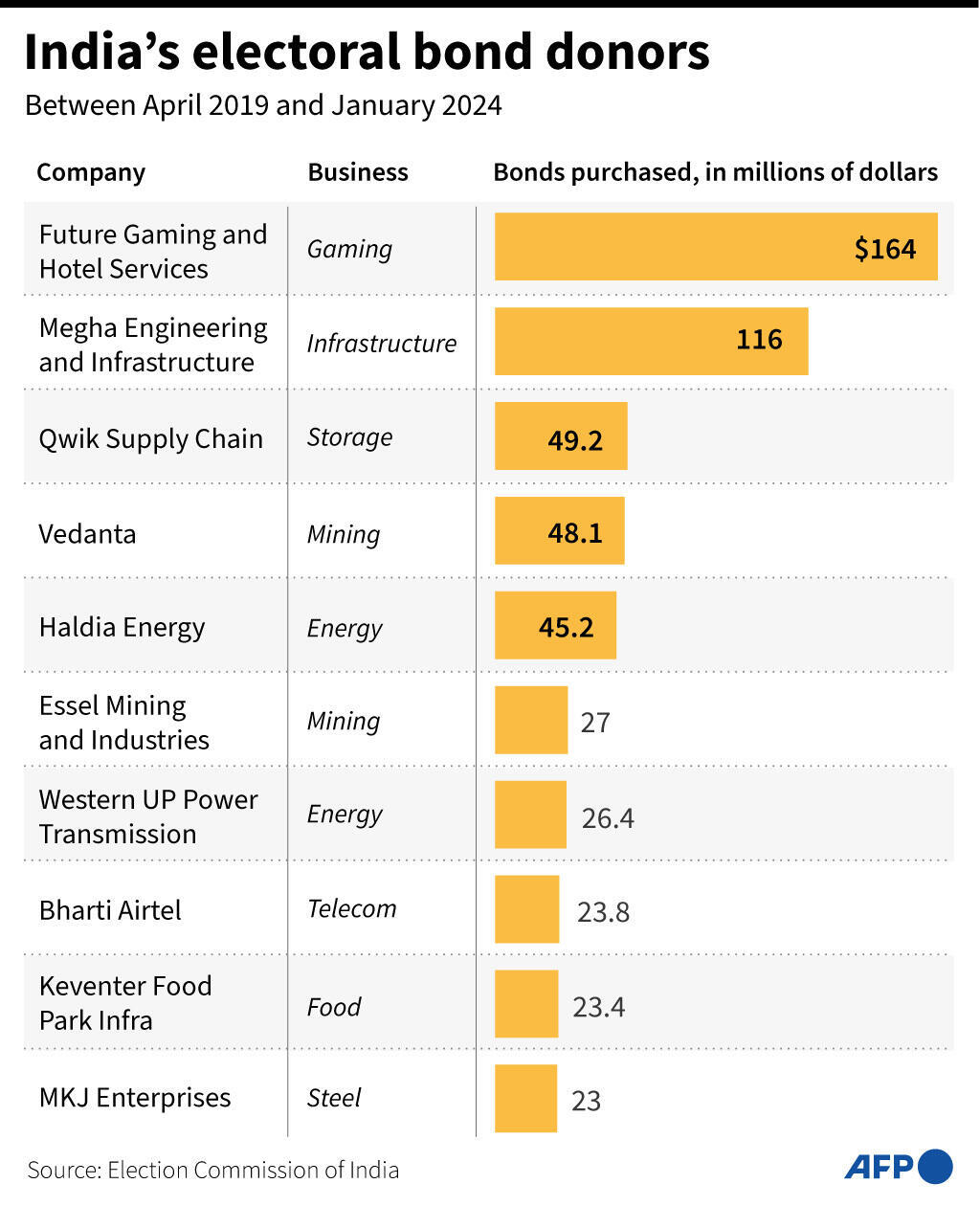
    Indian miner Vedanta, whose parent company was once listed on the London Stock Exchange, donated more than $40 million spread across half a dozen parties over the past five years.

    Local media reported in 2022 that the country’s main financial crime agency began investigating the company in 2018 for allegedly paying bribes to facilitate Indian visas for Chinese technicians.

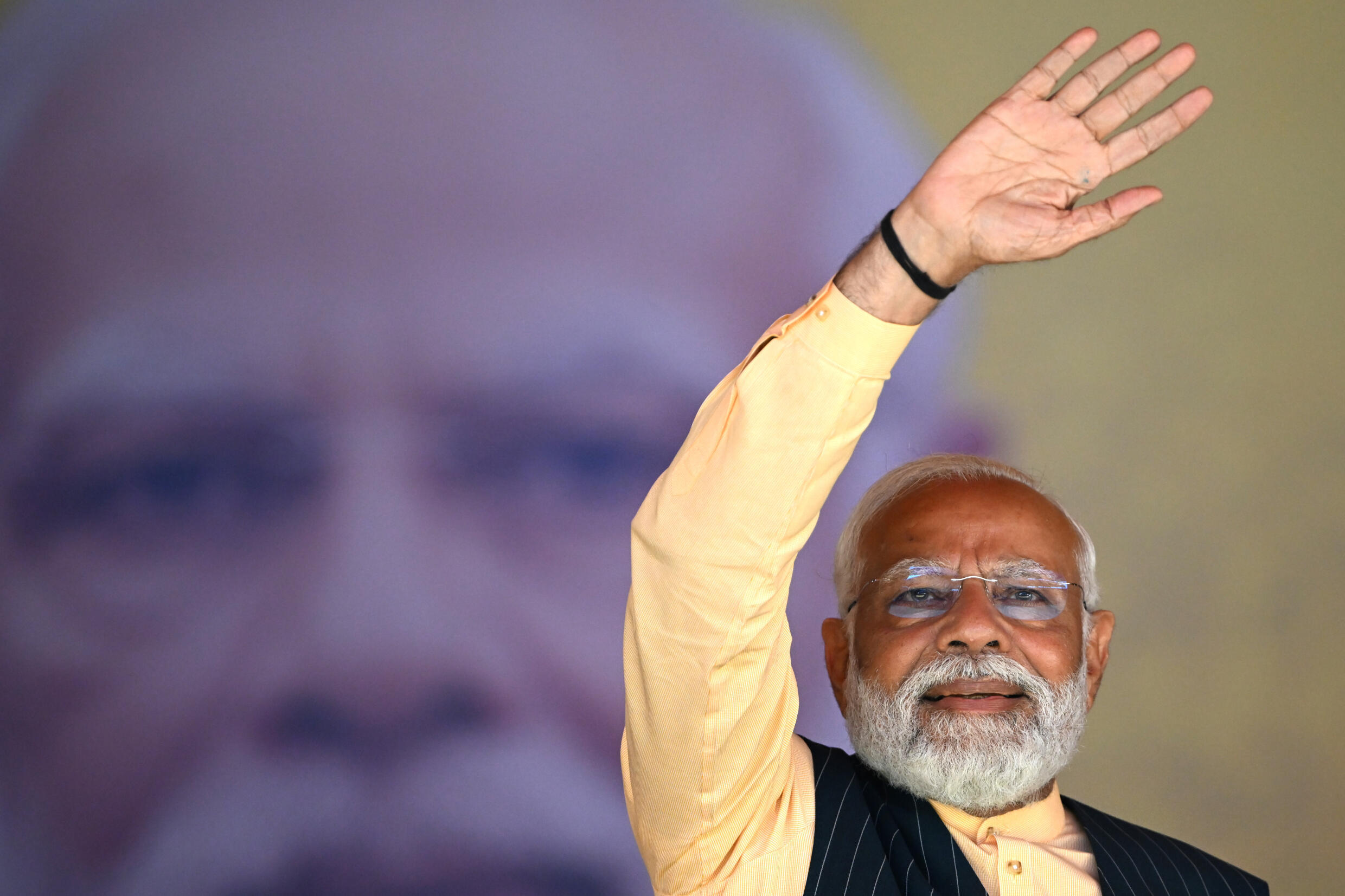
    The contentious electoral bond funding scheme has helped Prime Minister Narendra Modi's party build an immense campaign war chest dwarfing rivals
    The contentious electoral bond funding scheme has helped Prime Minister Narendra Modi’s party build an immense campaign war chest dwarfing rivals © DIBYANGSHU SARKAR / AFP/File

    Hero, Glenmark and Vedanta did not respond to requests for comment.

    No definitive proof of such a quid pro quo has surfaced. Authorities have also not publicly announced whether investigations against donor companies have been closed or withdrawn.

    Nirmala Sitharaman, Modi’s finance minister, said last week that any allegation of a link between criminal investigations and political donations was based on “huge assumptions”.

    India's electoral bond donors
    India’s electoral bond donors © Nicholas SHEARMAN / AFP

    “What if the companies gave the money, and after that, we still went and knocked at their doors?” she told a panel hosted by television channel India Today.

    The BJP was not the only party to receive electoral bonds from companies facing legal investigation.

    Among the several parties funded by lottery company Future Gaming — the biggest single donor under the scheme with a spend of $164 million — were the government and opposition of southern Tamil Nadu state.

    Future Gaming has since 2011 been the subject of several investigations on suspicion of unpaid income tax, money laundering and fraud, according to media reports.

    ‘Black money’

    Ties between corporate India and the country’s political class have previously blown up into public scandal — including to the benefit of Modi, who was swept to office a decade ago on a wave of public discontent over corruption.

    Modi made hay from a number of corporate bribery accusations directed against his opponents, including allegations that ministers and bureaucrats had taken money from telecom companies in return for favourable licensing deals.

    His government introduced electoral bonds in 2017, pledging the scheme would clear up the illicit “black money” donated to parties in return for political favours.

    But the new scheme did not close off other avenues of funding, including anonymous cash donations or tax-deductible electoral trusts in which multiple companies can pool money together for parties without public scrutiny.

    Indian media also identified several other irregularities with the electoral bond scheme, reporting that several companies donated amounts far in excess of their annual profit or revenue.

    Others were loss-making or had been freshly incorporated, suggesting they had been used as front companies to make donations on behalf of an unidentified third party.

    Milan Vaishnav, of the Carnegie Endowment for International Peace, said the donation list vindicated the election commission’s objections to the scheme when it was first unveiled.

    “This is precisely what the EC had warned, (that) the creation of this opaque instrument could allow for shell companies, foreign firms, and unknown third parties to give to parties without detection or outside scrutiny.”

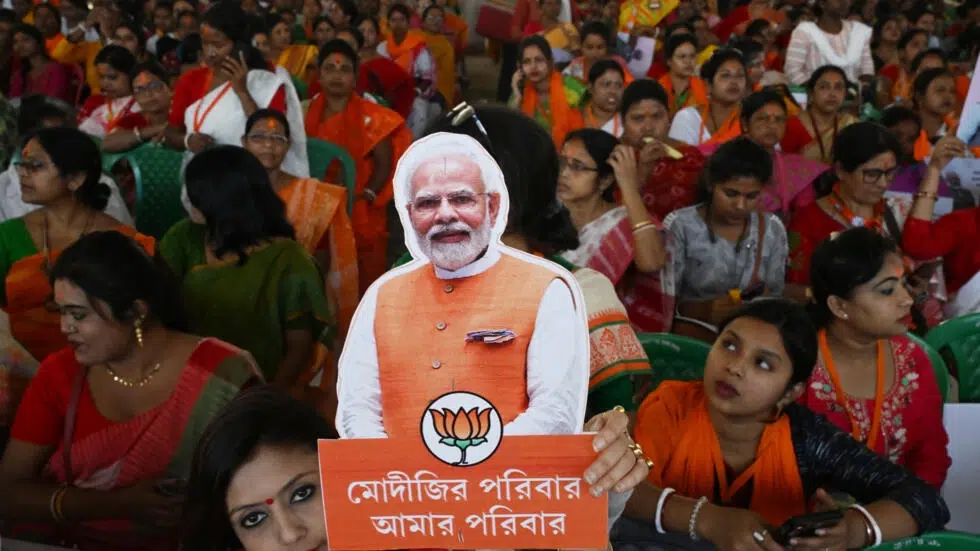
    India’s ruling Bhartiya Janata Party (BJP) was far and away the single biggest beneficiary of the electoral bond scheme © DIBYANGSHU SARKAR / AFP/File
  • Canada to reduce number of temporary foreign workers

    Ottawa, Canada – Canada for the first time is planning to curb the number of temporary foreign workers it welcomes, officials announced Thursday, after years of lofty immigration levels.

    Ottawa is proposing to reduce the number of temporary residents to five percent of the population over the next three years, down from the current 6.2 percent (2.5 million people).

    That target will be firmed up after consultations with Canada’s provinces, some of which have been pushing back on large migrant inflows amid a housing crunch and soaring demands for services.

    Restrictions on temporary foreign worker permits will start on May 1.

    This follows a recently announced cap on new permits for international students and visa requirements for some Mexican travellers.

    “Canada has seen a sharp increase in the volume of temporary residents in recent years, from a rise of international students to more foreign workers filling job vacancies to those fleeing wars and natural disasters,” Immigration Minister Marc Miller told a news conference.

    However, Canada’s labour market is now much tighter, with its population growth, fueled by massive immigration, outpacing job creation.

    According to government data, job vacancies fell 3.6 percent to 678,500 in the last three months of 2023, marking the sixth straight quarterly decline from a record high of 983,600 reached in the second quarter of 2022.

    “Changes are needed to make the system more efficient and more sustainable,” Miller said.

    Employment Minister Randy Boissonnault urged employers to consider hiring refugees before seeking to bring in temporary foreign workers.

    He said businesses that are currently allowed to have temporary foreign workers make up to 30 percent of their workforce will see that proportion drop to 20 percent, except in the health care and construction sectors.

    Canada’s immigration department, meanwhile, has been ordered by Miller to conduct a review of existing programs that bring in temporary labourers to better align them with labour needs and weed out abuses.

    amc/bfm

    © Agence France-Presse

  • Modi opponent challenges arrest ahead of India election

    Modi opponent challenges arrest ahead of India election

    New Delhi, India – A top Indian opposition politician appeared in court Friday to fight his arrest in a case supporters say is aimed at sidelining challengers to Prime Minister Narendra Modi before next month’s election.

    Arvind Kejriwal, chief minister of the capital Delhi and a key leader in an opposition alliance formed to compete against Modi in the polls, was detained on Thursday in connection with a long-running corruption probe.

    He is among several leaders of the bloc under criminal investigation and one of his colleagues described his arrest as a “political conspiracy” orchestrated by the ruling Bharatiya Janata Party (BJP).

    Kejriwal was escorted into a courtroom in the capital by officers from the Enforcement Directorate, India’s main financial crimes agency, to petition for bail while the case proceeds.

    His legal team had originally sought to challenge the legality of his detention in the Supreme Court but Shadan Farasat, a lawyer for Kejriwal, told AFP they would instead contest his remand in a lower court.

    Hundreds of supporters from Kejriwal’s Aam Aadmi Party (AAP) took to the streets on Friday to condemn the leader’s arrest, with police breaking up one crowd of protesters who attempted to block a busy traffic intersection.

    Several demonstrators were detained including Delhi education minister Atishi Marlena Singh and health minister Saurabh Bhardwaj, according to an AFP journalist at the scene.

    Small rallies in support of Kejriwal were held in several other cities around India.

    Kejriwal’s government was accused of corruption when it implemented a policy to liberalise the sale of liquor in 2021 and give up a lucrative government stake in the sector.

    The policy was withdrawn the following year, but the resulting probe into the alleged corrupt allocation of licences has since seen the jailing of two top Kejriwal allies.

    Kejriwal, 55, has been chief minister for nearly a decade and first came to office as a staunch anti-corruption crusader. He had resisted multiple summons from the Enforcement Directorate to be interrogated as part of the probe.

    Singh, the education minister, said Thursday that Kejriwal had not resigned from his office.

    “We made it clear from the beginning that if needed, Arvind Kejriwal will run the government from jail,” she told reporters.

    ‘Decay of democracy’

    Tamil Nadu chief minister M.K. Stalin, a fellow member of the opposition bloc, said Kejriwal’s arrest “smacks of a desperate witch-hunt”.

    “Not a single BJP leader faces scrutiny or arrest, laying bare their abuse of power and the decay of democracy,” he said.

    Modi’s political opponents and international rights groups have long sounded the alarm on India’s shrinking democratic space.

    US democracy think-tank Freedom House said this year that the BJP had “increasingly used government institutions to target political opponents”.

    Rahul Gandhi, the most prominent member of the opposition Congress party and scion of a dynasty that dominated Indian politics for decades, was convicted of criminal libel last year after a complaint by a member of Modi’s party.

    His two-year prison sentence saw him disqualified from parliament for a time until the verdict was suspended by a higher court, but raised further concerns over democratic norms in the world’s most populous country.

    Kejriwal and Gandhi are both members of an opposition alliance composed of more than two dozen parties that is jointly contesting India’s national election running from April to June.

    But even without the criminal investigations targeting its most prominent leaders, few expect the bloc to make inroads against Modi, who remains popular a decade after first taking office.

    Many analysts see Modi’s reelection as a foregone conclusion, partly due to the resonance of his assertive Hindu-nationalist politics with the members of the country’s majority faith.

    abh-sai/gle/mca

    © Agence France-Presse

  • Global fertility rate to keep plummeting, major study warns

    Global fertility rate to keep plummeting, major study warns

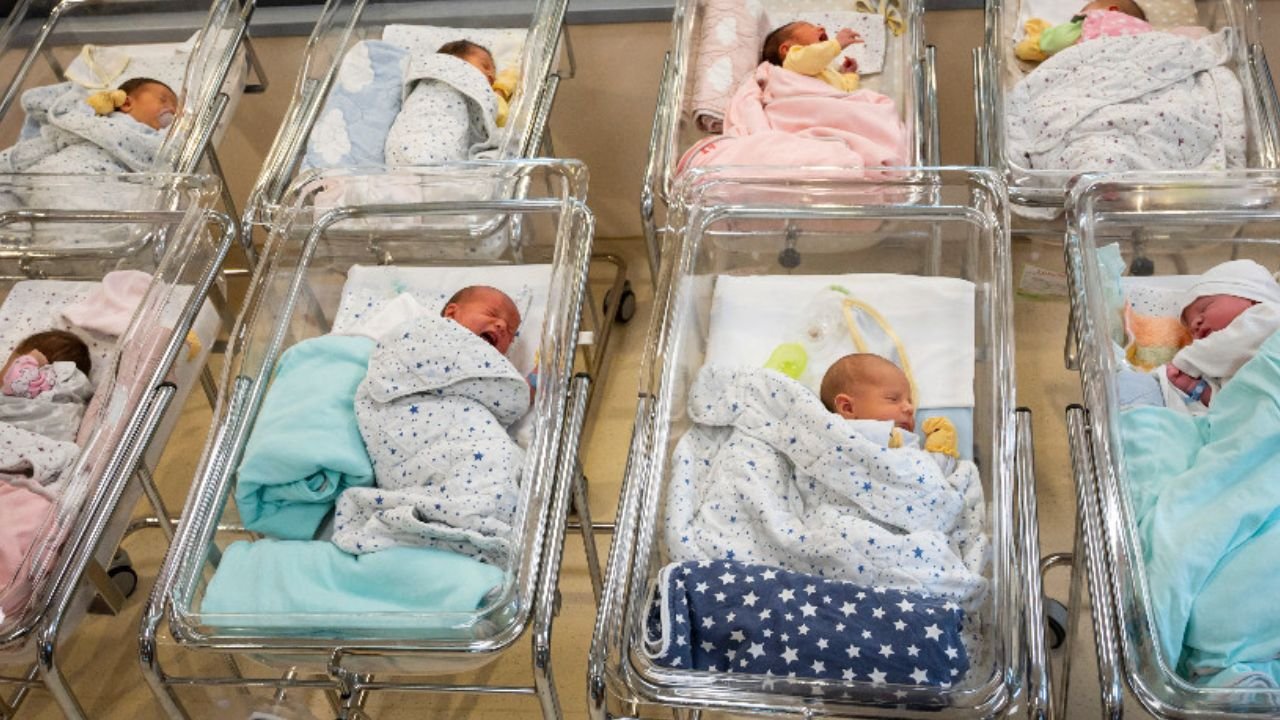
    Paris (AFP) – The population of almost every country will be shrinking by the end of the century, a major study said Wednesday, warning that baby booms in developing nations and busts in rich ones will drive massive social change.

    The fertility rate in half of all nations is already too low to maintain their population size, an international team of hundreds of researchers reported in The Lancet.

    Using a huge amount of global data on births, deaths and what drives fertility, the researchers tried to forecast the future for the world’s population.

    By 2050, the population of three quarters of all countries will be shrinking, according to the study by the US-based Institute For Health Metrics and Evaluation (IHME).

    At the end of the century, that will be true for 97 percent — or 198 out of 204 countries and territories, the researchers projected.

    Only Samoa, Somalia, Tonga, Niger, Chad and Tajikistan are expected to have fertility rates exceeding the replacement level of 2.1 births per female in 2100, the study estimated.

    During this century, fertility rates will continue to increase in developing countries, particularly those in sub-Saharan Africa, even as they tumble in wealthier, ageing nations.

    “The world will be simultaneously tackling a ‘baby boom’ in some countries and a ‘baby bust’ in others,” senior study author Stein Emil Vollset of the IHME said in a statement.

    ‘Implications are immense’

    “We are facing staggering social change through the 21st century,” he said in a statement.

    IHME researcher Natalia Bhattacharjee said the “implications are immense”.

    “These future trends in fertility rates and live births will completely reconfigure the global economy and the international balance of power and will necessitate reorganising societies,” she said.

    “Once nearly every country’s population is shrinking, reliance on open immigration will become necessary to sustain economic growth.”

    However World Health Organization experts urged caution for the projections.

    They pointed out several limitations of the models, particularly a lack of data from many developing nations.

    Communication about the figures “should not be sensationalised, but nuanced, balancing between gloom and optimism,” the WHO experts wrote in The Lancet.

    They also pointed out that there can be benefits of having a smaller population, such as for the environment and food security. But there are disadvantages for labour supply, social security and “nationalistic geopolitics”.

    Teresa Castro Martin, a researcher at the Spanish National Research Council not involved in the study, also emphasised that these are just projections.

    She pointed out that the Lancet study predicts the global fertility rate will fall below replacement levels around 2030, “whereas the UN predicts this to occur around 2050”.

    The study was an update of the IHME’s Global Burden of Disease study. The organisation, set up at the University of Washington by the Bill and Melinda Gates Foundation, has become a global reference for health statistics.

  • Afghan schools restart, with girls barred for third year running

    Afghan schools restart, with girls barred for third year running

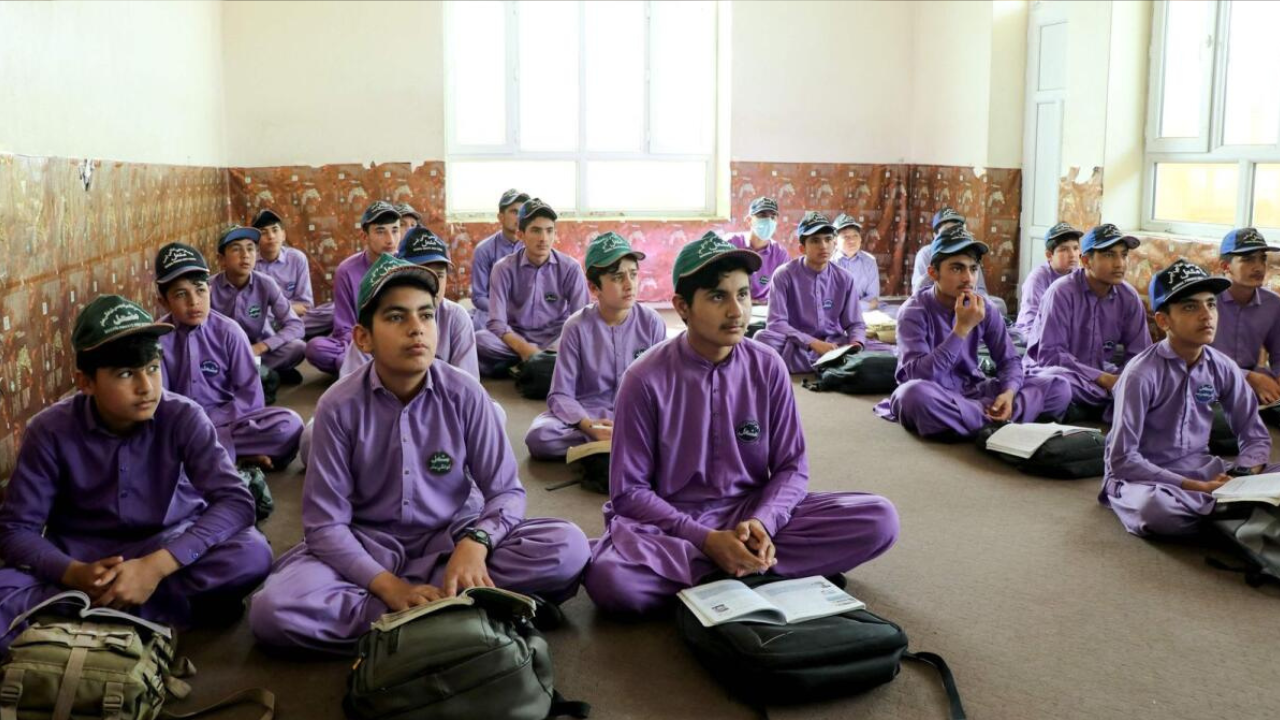
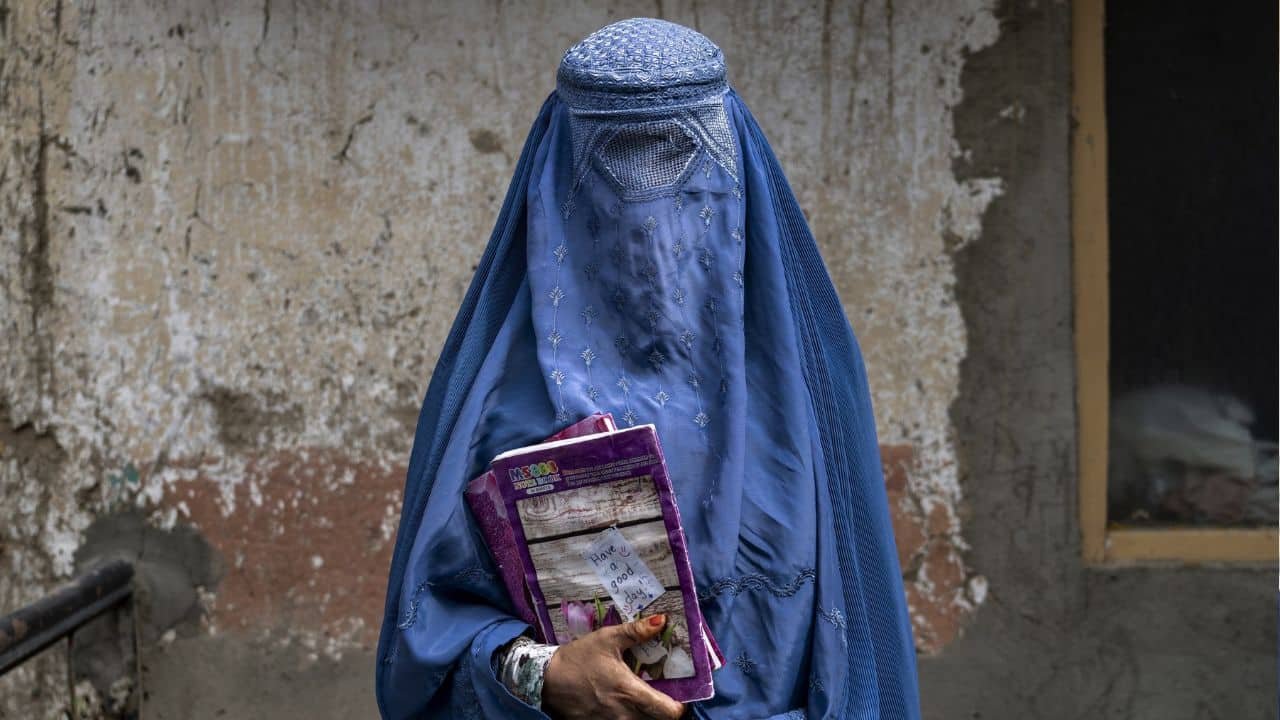
    Kabul, Afghanistan – Schools in Afghanistan opened for the new academic year on Wednesday, with girls lamenting being banned from joining secondary-level classes for a third year in a row.

    Taliban authorities barred girls from secondary school in March 2022, after surging back to power in 2021 and imposing an austere vision of Islam with curbs the United Nations labels “gender apartheid”.

    On Wednesday morning, uniformed boys carried black and white Taliban flags as they lined the entrance of Kabul’s Amani school, where local officials arrived for the ceremonial start of the school year.

    But 18-year-old Kabul resident Zuhal Shirzad had to stay home when the school bell rang.

    “Every year when my brother went to school, I felt very disappointed,” she told AFP.

    “I was happy for him and sad for myself,” she said.

    “This winter, my brother was studying and preparing for the university entrance exam,” she added.

    “I looked at him desperately and said that if I had been allowed to go to school, I would also be preparing for the university entrance exam now.”

    Afghanistan is the only country where girls’ education has been banned after elementary school.

    “None of the girls like me can continue our education and studies, and it is excruciating that boys can continue,” said 18-year-old Asma Alkozai, from the western city of Herat.

    “When there are barriers to education in society, such societies can never progress,” she told AFP.

    Online classes have sprung up in response to restrictions but a dearth of computers and internet, as well as the isolation of learning via screen, makes them a poor substitute for in-person learning, students and teachers say.

    Education ‘essential’

    The education ministry announced the new school year on Tuesday, a day before the start of the Afghan calendar’s new year, in a media invitation that expressly forbade women journalists from covering the ceremony at the Amani school.

    At the ceremony, Taliban government Deputy Prime Minister Abdul Salam Hanafi praised education, saying, “A nation without education will always be dependent on others”, local media reported.

    Universities also recently started the new academic year, but women have been blocked from attending since December 2022.

    Under the Taliban authorities, women have been excluded from many spheres of public life. Beauty salons have been shuttered and women have been barred from parks, funfairs and gyms.

    Women’s rights remain a key obstacle to international recognition of the Taliban government, which has not yet been recognised by any country.

    The United Nations mission in Afghanistan (UNAMA) called on the authorities to “end this unjustifiable and damaging ban”.

    “Education for all is essential for peace & prosperity,” the agency said in a post on social media platform X.

    ‘Half of society’

    Taliban authorities have insisted since girls were barred from secondary school that they are working on establishing a system that aligns with their interpretation of Islamic law.

    Thirteen-year-old Mudasir in eastern Khost province said girls and women should be given their rights to education “in the Islamic framework”.

    “They can go to school wearing Islamic hijab (covering),” he told AFP.

    “They must be given their rights, because if a sister is educated, she can be the reason for the whole family to be educated.”

    Faiz Ahmad Nohmani, who started secondary school at a private institution in Herat on Wednesday, was excited to start the new academic year but said he was “very sorry” that girls were not also returning.

    “Today, when I came to school, I wanted our sisters to come as well because they are half of society,” the 15-year-old told AFP. “They should study like us.”

    Ali Ahmad Mohammadi, an 18-year-old student in his final year of secondary school, also in Herat, said he’s aware of the chance he has to study.

    “Literacy helps us progress, it saves society,” said the teenager, who hopes to go on to university.  “An illiterate society will always face stagnation.”

    qb-sw/ssy

    © Agence France-Presse

  • Canada FM confirms halting arms shipments to Israel

    Canada FM confirms halting arms shipments to Israel

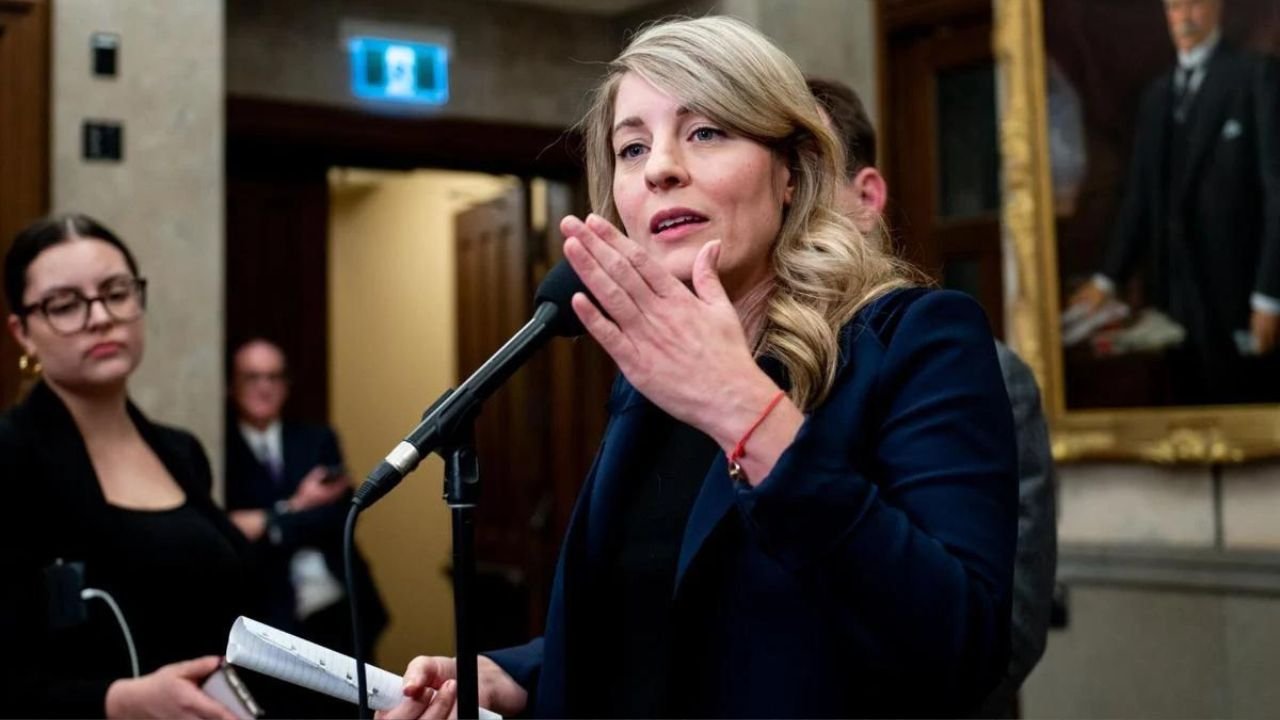
    OTTAWA: Canada will halt all arms shipments to Israel, Foreign Minister Melanie Joly’s office confirmed Wednesday, a decision that has drawn the ire of Israeli leaders facing growing international scrutiny over the war in the Gaza Strip.

    The besieged Palestinian territory is facing a mounting humanitarian crisis, and months of war have pushed hundreds of thousands of Gazans to the brink of famine.

    Canada, a key ally of the United States, which provides Israel with billions of dollars a year in military aid, had already reduced its shipments to Israel to only include non-lethal equipment, such as radios, following the October 7 Hamas attack.

    “Since January 8th, the government has not approved new arms export permits to Israel and this will continue until we can ensure full compliance with our export regime,” said a statement from Joly’s office.

    “There are no open permits for exports of lethal goods to Israel,” it added.

    Export permits approved prior to January 8, however, would “remain in effect,” Joly’s office said, explaining that canceling them risked “important implications for both Canada and its allies,” including NATO and the Five Eyes intelligence alliance.

    A senior Canadian official had on Tuesday told AFP that “the situation on the ground makes it so that we can’t” export any equipment that could have a potential military use.

    Israel slammed the decision, with foreign minister Israel Katz saying it “undermines Israel’s right to self-defense against Hamas terrorists.”

    “History will judge Canada’s current action harshly,” he said in a post on social media platform X.

    US Senator Bernie Sanders welcomed the move, saying in his own post on social media: “Given the humanitarian catastrophe in Gaza, including widespread and growing starvation, the US should not provide another nickel for (Prime Minister Benjamin) Netanyahu’s war machine.”

    The issue of arms deliveries to Israel has triggered legal proceedings in several countries around the world.

    In Canada, a coalition of lawyers and citizens of Palestinian origin filed a complaint against the government in early March to suspend arms exports to Israel, accusing Ottawa of violating both international and domestic law.

    Israel has historically been a top receiver of Canadian arms exports, with Can$21 million worth of military materiel exported to Israel in 2022, according to government data, following Can$26 million in shipments in 2021.

    That places Israel among the top 10 recipients of Canadian arms exports.

    Israel offensive in Gaza has killed at least 31,923 people, most of them women and children, according to Gaza’s health ministry.

    While affirming Israel’s right to defend itself, Canadian Prime Minister Justin Trudeau has taken an increasingly critical stance toward Israel as civilian deaths have mounted in Gaza.

    On Monday, the Canadian Parliament passed a nonbinding resolution calling for the international community to work toward a two-state solution between Israel and the Palestinians.

  • Seven BLA militants killed storming Gwadar port: officials

    Seven BLA militants killed storming Gwadar port: officials

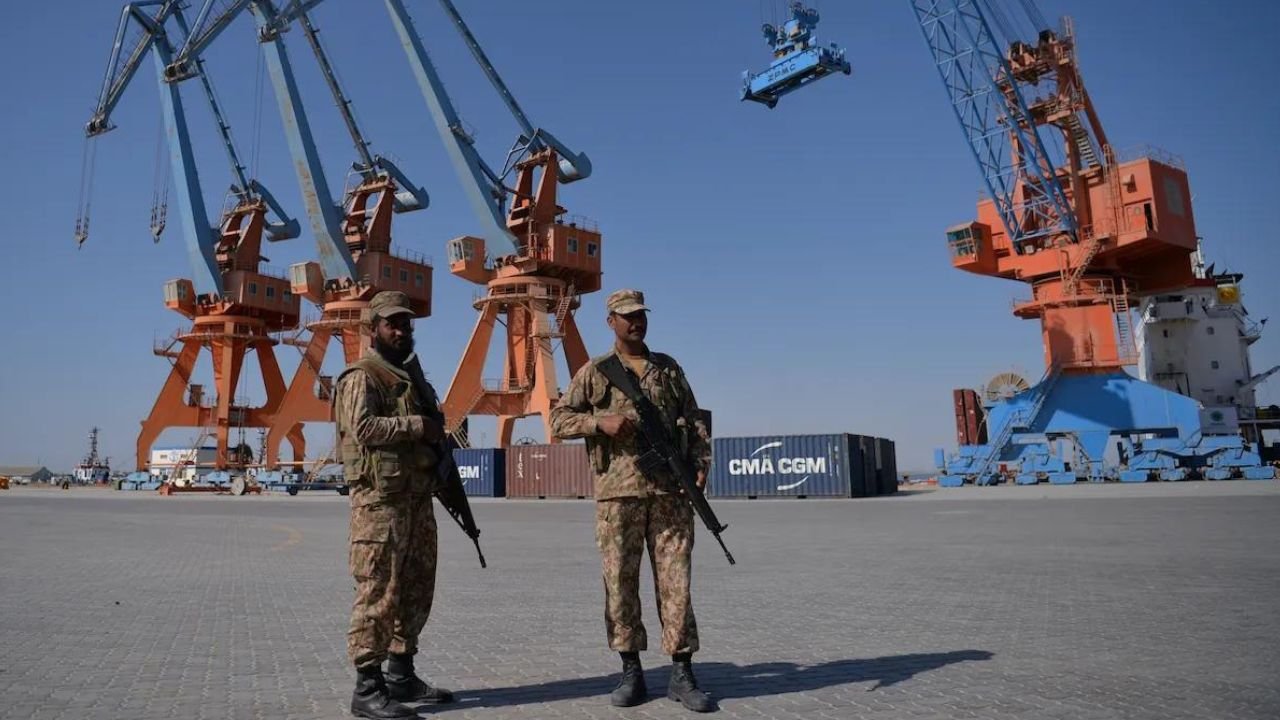
    Security forces killed at least seven militants on Wednesday as they tried to storm the offices of a Pakistan port considered a cornerstone of China’s investment in the nation, officials said.

    Pakistan has for decades battled a simmering insurgency in southwestern Balochistan province, where separatists hostile to Islamabad have often targeted foreign investment projects.

    Local official Saeed Ahmed Umrani told AFP seven militants had been killed in an attempt to “infiltrate” the compound of Balochistan’s Gwadar Port Authority.

    Gwadar Port, which sits on the Arabian Sea, is managed by a Chinese firm and considered the crown jewel of Beijing’s investment in Pakistan under its gargantuan Belt and Road infrastructure project.

    An army source who asked to remain anonymous also said seven militants had been killed, alongside four soldiers defending law-enforcement posts inside the compound.

    “The terrorists attacked with grenades, rocket launchers and Kalashnikovs,” he said. “The area is cleared now.”

    Chief minister of Balochistan province Sarfraz Bugti said on social media platform X that eight militants had been killed.

    The attack was claimed by separatist group the Baloch Liberation Army (BLA) in an email statement, and spokesman Jeeyand Baloch said military intelligence offices had been targeted.

    “The operation was launched at 3:30 pm (1030 GMT) and is still underway”, he said in a message sent early Wednesday evening.

    Last August, the BLA also claimed an attack on a convoy carrying Chinese engineers to the port.

    Ethnic Baloch separatists have long claimed their communities are not getting a fair share of wealth from the region, which sits atop huge reserves of natural resources.

    They have frequently targeted Pakistani security forces protecting foreign investment projects.

    China has inked over two trillion dollars in contracts around the world under its Belt and Road scheme, but projects in Pakistan have been plagued by security concerns.

    In 2022, a BLA suicide bomber killed four people, including three Chinese language teachers, in Karachi city.

    A year earlier, a bus carrying engineers to a construction site near a dam in northwestern Pakistan was hit by a bomb, killing 13 people including nine Chinese workers.

    Islamabad has been accused of committing abductions and extrajudicial murder of Baloch citizens in retaliation for their campaign of separatism.

    bur-jts/sco

    © Agence France-Presse