Author: afp

  • India’s solar observation mission reaches its final orbit

    India’s solar observation mission reaches its final orbit

    India’s solar observation mission on Saturday entered the Sun’s orbit after a four-month journey, the latest success for the space exploration ambitions of the world’s most populous nation.

    The Aditya-L1 mission was launched in September and is carrying an array of instruments to measure and observe the Sun’s outermost layers.

    India’s science and technology minister Jitendra Singh said on social media that the probe had reached its final orbit “to discover the mysteries of Sun-Earth connection”.

    The United States and the European Space Agency have sent numerous probes to the centre of the solar system, beginning with NASA’s Pioneer programme in the 1960s.

    Japan and China have both launched their solar observatory missions into Earth’s orbit.

    But the latest mission by the Indian Space Research Organisation is the first by any Asian nation to be placed in orbit around the Sun.

    Prime Minister Narendra Modi hailed it as yet another “landmark” in the country’s space programme.

    “It is a testament to the relentless dedication of our scientists,” he said on social media.

    “We will continue to pursue new frontiers of science for the benefit of humanity.”

    Aditya, named after a Hindu Sun deity, has travelled 1.5 million kilometres (932,000 miles) from the Earth — still only one percent of the distance between humanity’s home planet and the star at the centre of our solar system.

    It is now at a point where the gravitational forces of both celestial bodies cancel out, allowing it to remain in a stable halo orbit around the Sun.

    The orbiter, which reportedly cost $48 million, will study coronal mass ejections, a periodic phenomenon that sees huge discharges of plasma and magnetic energy from the Sun’s atmosphere.

    These bursts are so powerful they can reach the Earth and potentially disrupt the operations of satellites.

    The mission also aims to shed light on the dynamics of several other solar phenomena by imaging and measuring particles in the Sun’s upper atmosphere.

    India has a comparatively low-budget space programme, but one that has grown considerably in size and momentum since it first sent a probe to orbit the Moon in 2008.

    In August last year, India became the first country to land an uncrewed craft near the largely unexplored lunar south pole, and just the fourth nation to land on the Moon.

    India became the first Asian nation to put a craft into orbit around Mars in 2014, and it is slated to launch a three-day crewed mission into Earth’s orbit later this year.

    It also plans a joint mission with Japan to send another probe to the Moon by 2025 and an orbital mission to Venus within the next two years.

  • Israeli Minister Lays Out Post-war Gaza Plan As Fighting Rages

    Israeli Minister Lays Out Post-war Gaza Plan As Fighting Rages

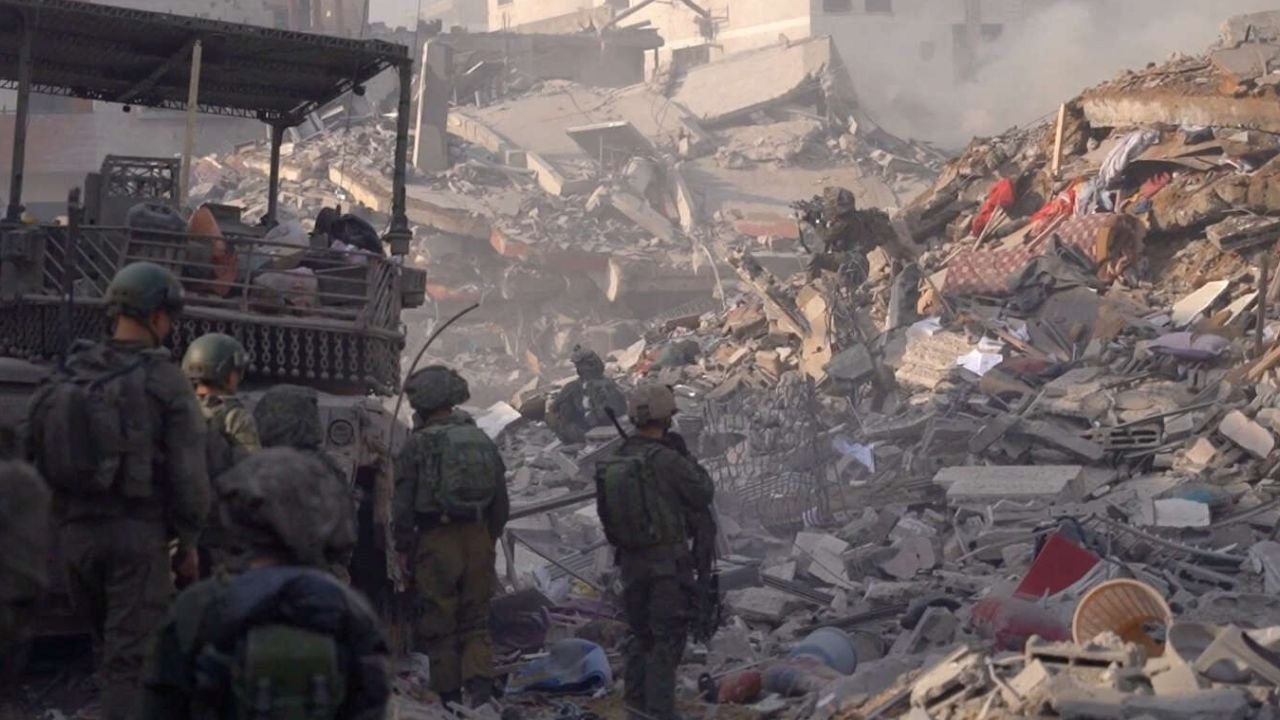
    Israel’s defence minister has publicly presented for the first time proposals for the post-war administration of Gaza, where officials said Friday unrelenting bombardment has killed dozens over 24 hours.

    Defence Minister Yoav Gallant’s plan for the “day after”, shared with the media late Thursday but not yet adopted by Israel’s war cabinet, says that neither Israel nor Hamas will govern Gaza and rejects future Jewish settlements there.

    The minister’s broad outline was unveiled on the eve of US Secretary of State Antony Blinken’s fourth trip to the region since October 7.

    Questions over the future of the besieged Palestinian territory have multiplied as Israel insists it will continue with its military operations despite international calls for a ceasefire.

    Much of the Gaza Strip has been reduced to rubble, while civilian deaths have soared and the UN has warned of a humanitarian crisis that has left hundreds of thousands displaced, facing famine and disease.

    Bombing continued through the night in the southern areas of Khan Yunis and Rafah as well as parts of central Gaza, according to AFP correspondents.

    The Israeli army said its forces had “struck over 100 targets” across Gaza over the past 24 hours, including military positions, rocket launch sites and weapons depots.

    The health ministry said it had recorded 162 deaths also over the past 24 hours.

    A fighter jet hit the central area of Bureij overnight, killing “an armed terrorist cell”, the army said, after what it described in a statement as an attempted attack on an Israeli tank.

    And “a number” of Palestinian militants were killed in clashes in Khan Yunis, a major city in southern Gaza that has become the focus of the fighting, the army said.

    According to Gallant’s proposed outline, the war will continue until Israel has dismantled Hamas’s “military and governing capabilities” and secured the return of hostages.

    After Israel achieves its objectives — for which the proposal sets no timeline — Palestinian “civil committees” will begin assuming control of the territory’s governance, it said.

    “Hamas will not govern Gaza, (and) Israel will not govern Gaza’s civilians,” the plan said, while offering little concrete detail.

    “Palestinian bodies will be in charge, with the condition that there will be no hostile actions or threats against the State of Israel.”

    Israel launched its campaign against Hamas after the militant group’s October 7 attack, which resulted in the deaths of around 1,140 people, most of them civilians, according to an AFP tally based on official Israeli figures.

    The militants also took around 250 hostages, 132 of whom remain in captivity, according to Israel, including at least 24 believed to have been killed.

    Israel’s relentless bombardment and ground invasion have killed at least 22,600 people, most of them women and children, according to the Gaza health ministry.

    Conditions for Gaza’s civilians are precarious, with the United Nations estimating 1.9 million people are displaced.

    AFPTV footage showed entire families, seeking safety from the violence, arriving in the southern border city of Rafah in overloaded cars and on foot, pushing handcarts stacked with possessions.

    “We fled Jabalia camp to Maan (in Khan Yunis) and now we are fleeing from Maan to Rafah,” said one woman who declined to give her name. “(We have) no water, no electricity and no food.”

    A spokesman for the UN agency for Palestinian refugees, UNRWA, told AFP that Rafah is overwhelmed by the influx.

    “The city is usually home to only 250,000 persons. And now, it’s more than 1.3 million,” said Adnan Abu Hasna.

    “We have recently noticed a major collapse in health conditions” and a “significant spread” of disease, he added.

    Ahmad al-Sufi, head of the Rafah emergency committee said there was an urgent need for 50,000 tents to house the refugees.

    At Al-Amal hospital in Khan Yunis, one of Gaza’s few medical facilities still operating, the Palestinian Red Crescent Society said seven displaced people, including a five-day-old baby, were killed while sheltering in the compound.

    Dozens more were killed in nearby strikes during three days of bombardment, the Red Crescent said, reporting renewed artillery shelling and drone fire in the area on Friday.

    During his visit, Blinken plans to discuss with Israeli leaders “immediate measures to increase substantially humanitarian assistance to Gaza”, State Department spokesman Matthew Miller said.

    Germany’s top diplomat Annalena Baerbock will also travel to the region, foreign ministry spokesman said, beginning Sunday in Israel and also meeting with Palestinian leaders.

    She plans to discuss “the dramatic humanitarian situation in Gaza” and tensions on the Israel-Lebanon border, spokesman Sebastian Fischer said.

    Aid entering the besieged territory has slowed to a trickle during the war.

    The UN’s humanitarian office OCHA said on Thursday that it had been unable to deliver “urgently needed life-saving” aid north of Wadi Gaza — an area including Gaza City — for four days “due to access delays and denials” and active fighting.

    The war in Gaza and almost daily exchanges of fire across the border since October 7 have threatened to draw Israel’s northern neighbour into a regional conflagration.

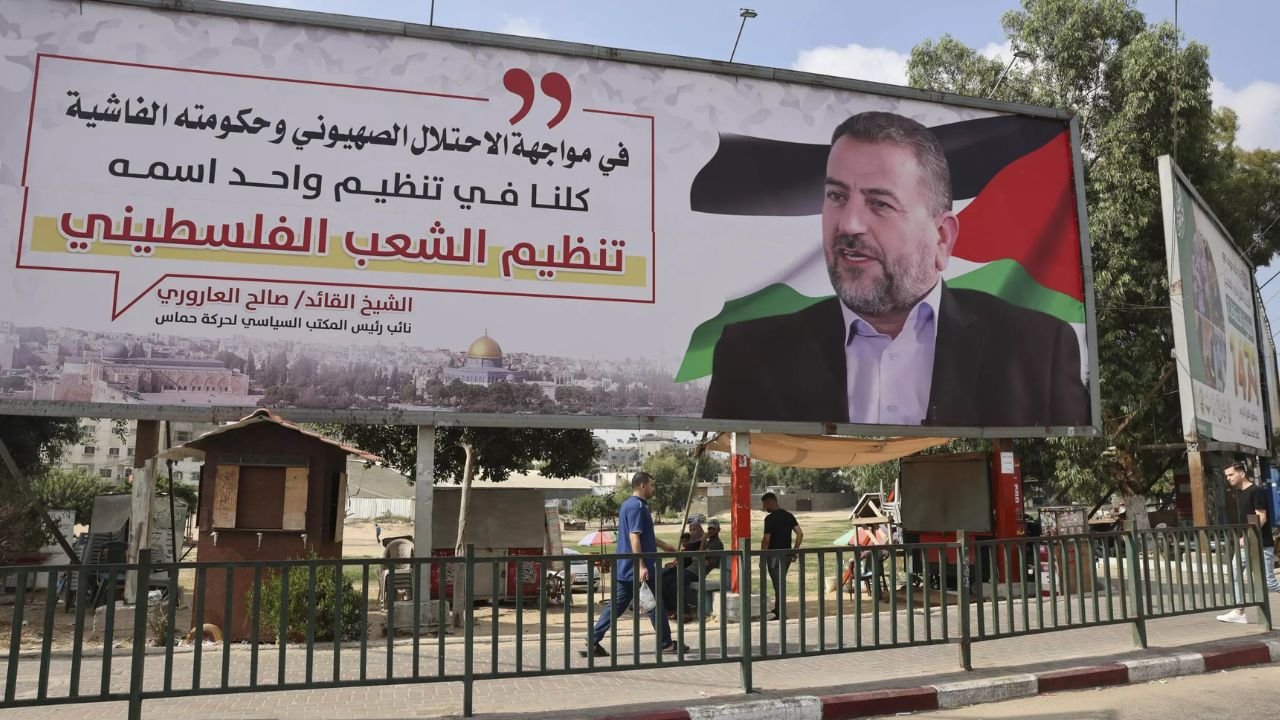
    A strike on Tuesday in Lebanon, widely assumed to have been carried out by Israel, killed Hamas deputy leader Saleh al-Aruri.

    It hit the south Beirut stronghold of the powerful Iran-backed Hezbollah movement.

    Hezbollah has vowed that the killing on its home turf will not go unpunished, while Israeli army chief Herzi Halevi said troops on the border were “in very high readiness”.

    Israel’s military said on Friday its fighter jets had conducted fresh strikes against Hezbollah targets just across the border in Lebanon.

    The frequent bombardments has driven 76,000 people from their homes on the Lebanese side of the border, the UN’s migration agency said on Thursday. Israel evacuated thousands of its civilians from the border area in the early weeks of the war.
  • Japan quake death toll rises to 92, missing 242

    Japan quake death toll rises to 92, missing 242

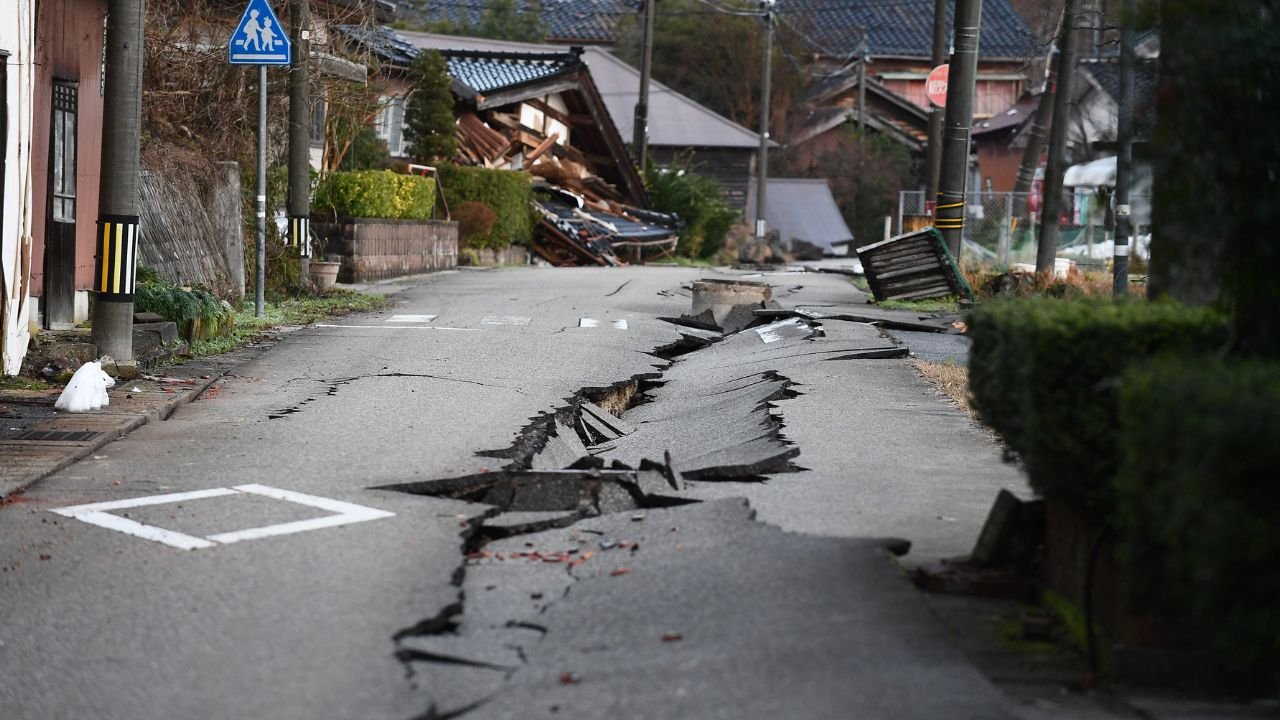
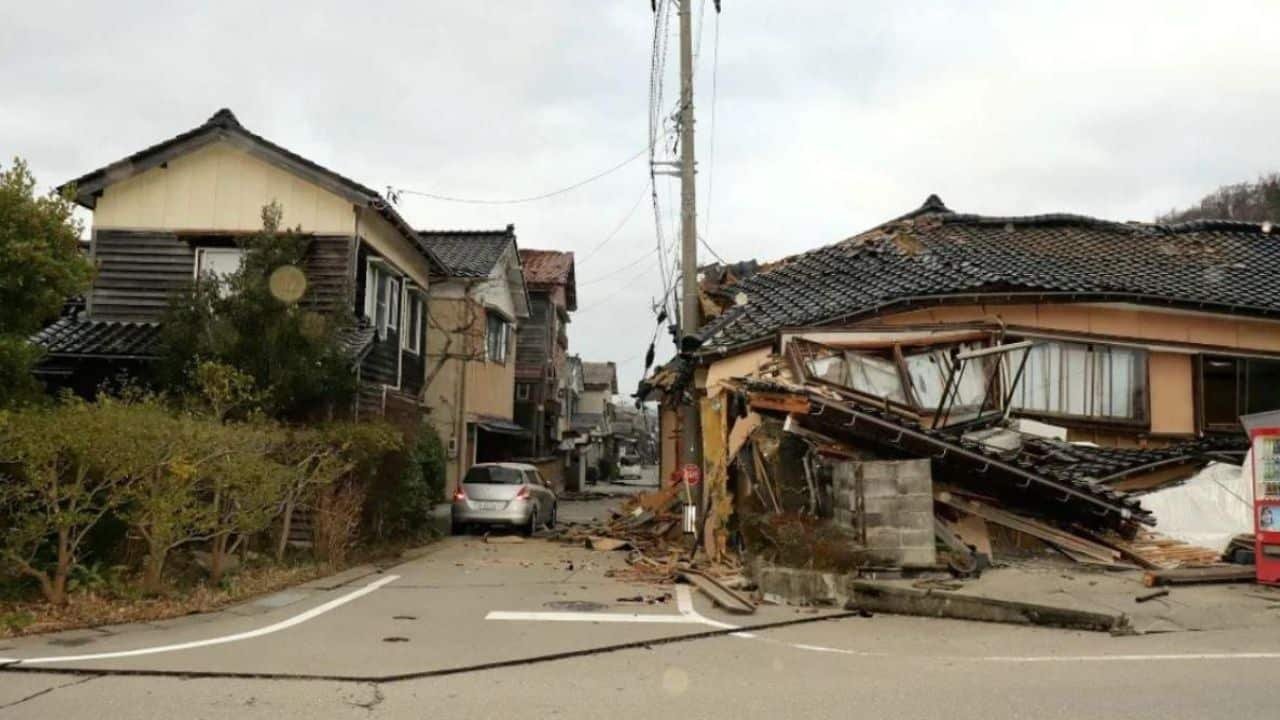
    Anamizu (Japan) (AFP) – The death toll from a devastating earthquake in central Japan rose to 92 on Friday, regional authorities said, with the number of missing jumping to 242.

    Two elderly women were pulled from the rubble, but hopes of finding other survivors faded as thousands of rescuers raced against the clock four days after the 7.5-magnitude quake on New Year’s Day.

    Thousands of rescuers from all over Japan have been battling aftershocks and roads littered with gaping holes and blocked by frequent landslides in the Ishikawa region to reach hundreds of people in stranded communities.

    On Thursday afternoon, 72 hours after the quake, the two older women were miraculously pulled alive from the remains of their homes in Wajima, one of them thanks to a sniffer dog called Jennifer.

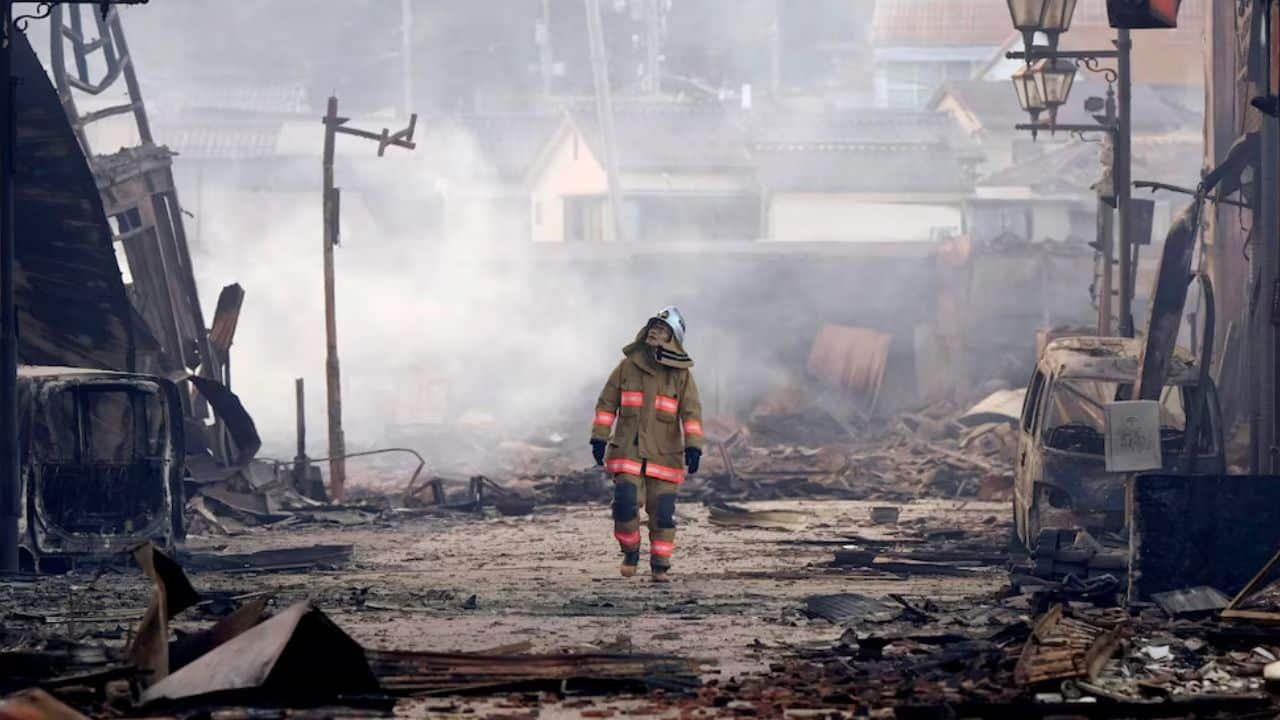
    The port city of Wajima on the Noto Peninsula was one of the worst hit, with a pungent smell of soot still in the air and faint columns of smoke visible from a huge fire that destroyed hundreds of structures on the first day.

    “I was relaxing on New Year’s Day when the quake happened. My relatives were all there and we were having fun,” Hiroyuki Hamatani, 53, told AFP amid the burnt-out cars, wrecked buildings and fallen telegraph poles.

    “The house itself is standing but it’s far from livable now… I don’t have the space in my mind to think about the future,” he told AFP.

    Grief

    The powerful main tremor, followed by hundreds of aftershocks, injured at least 330 people, local authorities said.

    Around 30,000 households were without electricity in the Ishikawa region, and 89,800 homes there and in two neighbouring regions had no water.

    Hundreds of people were in government shelters.

    The Suzu area was also devastated, with fishing boats sunk or lifted like toys onto the shore by tsunami waves that also reportedly swept one person away.

    Noriaki Yachi, 79, fought back tears after his wife was pulled from the rubble there and confirmed dead, the Asahi Shimbun daily reported.

    “My life with her was a happy one,” Yachi said.

    Earthquakes have hit the Noto region with intensifying strength and frequency over the past five years.

    The country is haunted by a massive 9.0-magnitude undersea quake in 2011, which triggered a tsunami that left around 18,500 people dead or missing.

    It also swamped the Fukushima atomic plant, causing one of the worst nuclear disasters in history

  • Spain police investigate suspected poisoning of 47 cats

    Spain police investigate suspected poisoning of 47 cats

    Spanish police said Thursday they had opened an investigation into the suspected poisoning of nearly 50 street cats that could see the perpetrators serving several years’ jail time under a new animal welfare law.

    The incident occurred in La Carlota village just outside the southern city of Cordoba, with local residents discovering the bodies of at least 10 cats on December 31 at the local dump where the colony was based.

    They alerted the animal rights party PACMA which on Tuesday filed a complaint with the Guardia Civil police over “the mass poisoning of a 47-strong feline colony”.

    “Some of the animals were found inside nearby containers while others were lying in the street with only one survivor, a young male cat which is in very poor state,” said the complaint, a copy of which was seen by AFP.

    The rest of the cats had disappeared, with a PACMA spokeswoman saying they were believed to have died in the nearby woods after the poison took hold.

    In response, officers from the Guardia Civil’s nature protection service Seprona were dispatched to the scene on Wednesday to investigate, a spokesman for the force said.

    “They are looking into whether the deaths were due to poisoning or from other causes. And if there was a crime, to identify the culprits,” he added.

    Under terms of a new law that came into force in September, anyone found guilty of cruelty leading to an animal’s death could face up to three years behind bars, up from a previous penalty of 18 months.

    In a separate operation, police said Thursday they had smashed a ring which allegedly imported puppies from Hungary and Slovakia and then sold them in Spain with forged documents.

    Officers arrested eight people and rescued over 100 animals during four searches they carried out as part of the operation, a police statement said.

  • Iran blames Israel, US for deadly blasts near grave of Guards general Soleimani

    Iran blames Israel, US for deadly blasts near grave of Guards general Soleimani

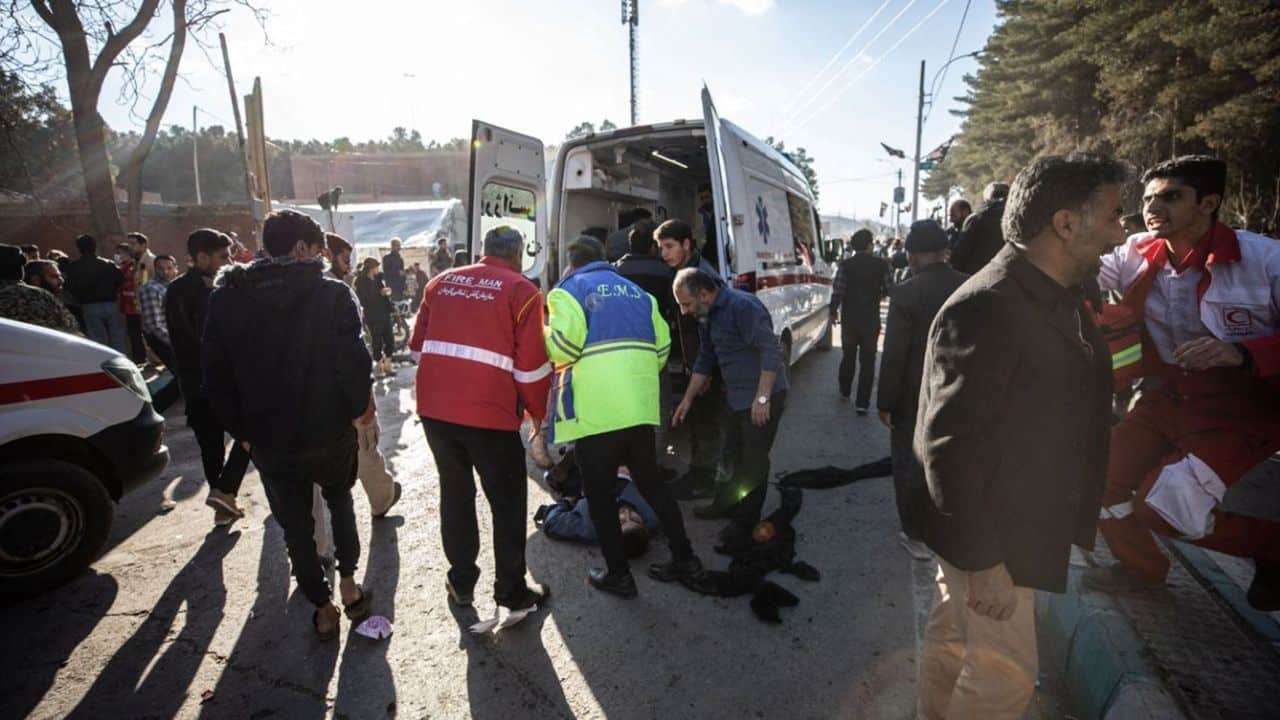
    Iran blamed Israel and the United States on Wednesday for twin bomb blasts that killed more than 100 people in the country’s south, ripping through a crowd commemorating Revolutionary Guards general Qassem Soleimani four years after his death in a US strike.

    The two explosions – labelled a “terrorist attack” by state media and regional authorities – came amid high Middle East tensions over the Israel-Hamas war in Gaza and the killing of a Hamas senior leader in Lebanon on Tuesday.

    The unclaimed attacks, which sparked fears of a widening conflict in the region, rattled global markets, where oil prices jumped more than three percent and sparked global condemnation.

    “Washington says USA and Israel had no role in terrorist attack in Kerman, Iran. Really? A fox smells its own lair first,” the Iranian president’s political deputy, Mohammad Jamshidi, wrote on X, formerly Twitter.

    “Make no mistake. The responsibility for this crime lies with the US and Zionist regimes (Israel) and terrorism is just a tool,” he added.

    The United States had earlier rejected any suggestions that it or ally Israel were involved while Israel declined to comment.

    “The United States was not involved in any way … We have no reason to believe that Israel was involved in this explosion,” State Department spokesman Matthew Miller said.

    Asked about the blasts, Israeli army spokesman Daniel Hagari said: “We are focused on the combat with Hamas”.

    Iran’s supreme leader Ayatollah Ali Khamenei blamed “evil and criminal enemies” of the country for the attack and vowed a “harsh response”.

    President Ebrahim Raisi, who scrapped a visit to Turkey on Thursday, condemned the “heinous” crime as Iran declared Thursday a national day of mourning.

    The blasts, about 15 minutes apart, struck near the Martyrs Cemetery at the Saheb al-Zaman Mosque in Kerman, Soleimani’s southern hometown, as supporters gathered to mark his killing in a 2020 US drone strike in Baghdad.

    Tehran’s official news agency IRNA quoted Interior Minister Ahmad Vahidi as saying that “according to forensic statistics, the number of martyrs from this incident has been announced as 84 so far”.

    The death toll was also confirmed by the head of Iran’s emergency services, Jafar Miadfar, who said an earlier tally of 95 was due to the fact that some bodies had been dismembered and counted “several times”.

    Miadfar said 284 people had been injured and “195 are still hospitalised”.

    Three paramedics who rushed to the scene after the first explosion were among those killed, said Iran’s Red Crescent.

    IRNA said the first explosion took place around 700 metres from Soleimani’s grave while the other was around 1 kilometre away.

    Tasnim news agency, quoting what it called informed sources, said that “two bags carrying bombs went off” and “the perpetrators … apparently detonated the bombs by remote control”.

    Online footage showed panicked crowds scrambling to flee as security personnel cordoned off the area.

    ‘Shocking cruelty’ 

    State television showed bloodied victims lying on the ground and ambulances and rescue personnel racing to help them.

    “We were walking towards the cemetery when a car suddenly stopped behind us and a waste bin containing a bomb exploded,” an eyewitness was quoted as saying by the ISNA news agency.

    “We only heard the explosion and saw people falling.”

    By nightfall, crowds returned to the Martyrs Cemetery in Kerman chanting: “Death to Israel” and “Death to America”.

    In Tehran, thousands gathered at the Grand Mosalla Mosque to pay tribute to Soleimani.

    “We condemn today’s bitter terrorist incident … I hope the perpetrators of the crime will be identified and punished for their actions,” Soleimani’s daughter, Zeinab, said.

    Soleimani headed the Quds Force, the foreign operations arm of the Islamic Revolutionary Guards Corps, overseeing military operations across the Middle East.

    The United Nations, European Union, and several countries including Saudi Arabia, Jordan, Germany and Iraq denounced the blasts.

    UN chief Antonio Guterres “strongly condemns” the blasts, his office said, and the EU said: “This act of terror has exacted a shocking toll of civilian deaths and injuries.”

    The EU’s top diplomat, Josep Borrell, said that he spoke to Iranian Foreign Minister Hossein Amir-Abdollahian to “convey condolences” and “condemned this terrorist attack in the strongest terms and expressed solidarity with the Iranian people”.

    Russian President Vladimir Putin wrote to Raisi and Khamenei that “the killing of peaceful people visiting the cemetery is shocking in its cruelty and cynicism”.

    Iran ally Hamas denounced the “criminal attack” while the Saudi foreign ministry in Riyadh voiced “solidarity with Iran in this painful event”.

    The blasts came a day after Hamas deputy leader Saleh al-Arouri – an Iran ally – was killed in a strike, which Lebanese officials blamed on Israel, in a southern Beirut suburb that is a stronghold of Iran-backed armed group Hezbollah.

    Wednesday’s bomb blasts were Iran’s deadliest since a 1978 arson attack at the Cinema Rex in the southwestern city of Abadan, which killed at least 377 people, according to AFP archives.

    Previous plots 

    Iran has long fought a shadow war of killings and sabotage with archenemy Israel while also battling various jihadist and other militant groups.

    In September, the Fars news agency reported that a key “operative” affiliated with the Islamic State (IS) group, in charge of carrying out “terrorist operations” in Iran, had been arrested in Kerman.

    In July, Iran’s intelligence ministry said it had disbanded a network “linked to Israel’s spy organisation” that had been plotting “terrorist operations” across Iran, IRNA reported.

    The alleged plots included “planning an explosion at the grave” of Soleimani, it said.

    Soleimani, whom Khamenei years ago declared a “living martyr”, was widely regarded as a hero in Iran for his role in defeating IS in both Iraq and Syria.

    Long seen as a deadly adversary by the United States and its allies, Soleimani was one of the most important powerbrokers across the region, setting Iran’s political and military agenda in Syria, Iraq and Yemen.

  • US judge begins to unseal Epstein contacts

    US judge begins to unseal Epstein contacts

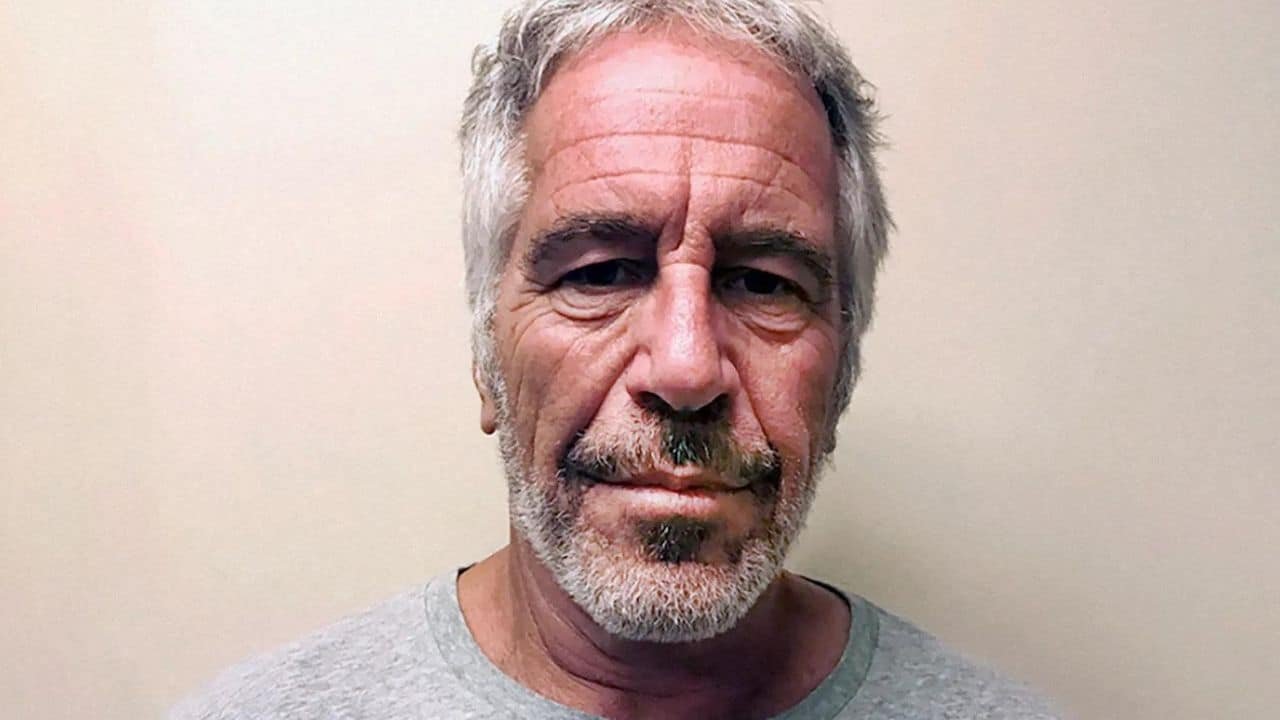
    A New York judge on Wednesday began to unseal the identities of people linked in court documents to Jeffrey Epstein, the US financier who killed himself in 2019 as he awaited trial for sex crimes.

    Notably included in the unsealed documents, which include almost 1,000 pages of depositions and statements, were former US presidents Bill Clinton and Donald Trump, who have not been accused of any wrongdoing in the case.

    The list of around 150 people includes a host of Epstein associates previously identified as John or Jane Does in a lawsuit brought against Epstein’s former mistress, Ghislaine Maxwell. It carries no allegation of complicity in Epstein’s crimes.

    The disclosure is part of a defamation proceeding between Maxwell, sentenced in 2022 to 20 years in prison, and a plaintiff against the duo, Virginia Giuffre.

    Last month a judge listed in a 50-page document some 180 cases — under pseudonyms — ordering that their identities be made public within 14 days of the order.

    Some individuals have objected to the disclosure of their identities in the case.

    Lawyers for one individual, “Doe 107”, wrote to the judge in the case arguing they could face victimization in their home country, and requested time to submit grounds for their name to remain sealed.

    Accomplices in sex crimes

    According to British media, Giuffre’s defamation claim against Maxwell, 62, dates back to 2016 and was settled the following year. But the Miami Herald then took legal action to access the file and investigate the Epstein network.

    A number of documents in the case were made public in 2019, days before Epstein hanged himself in prison while awaiting trial on sex trafficking charges.

    Maxwell and Epstein were a couple in the early 1990s before becoming professional collaborators and accomplices in sex crimes for almost three decades.

    Epstein, a financier with a powerful network in the United States and abroad, was himself accused of raping young girls, but his suicide by hanging in a New York prison in August 2019 halted his prosecution.

    Fabricated lists and doctored photos of Epstein have circulated in conspiratorial internet circles for years, fueling speculation about the financier’s potential associates.

    The anticipated release of names from court documents reignited that frenzy.

    Comedian Jimmy Kimmel threatened Aaron Rodgers with legal action after the American football star suggested the late night host could be on the list.

    It was a baseless allegation echoed across platforms such as X, where numerous posts also drew actor Tom Hanks into the fold.

  • Turkey detains 34 suspected of spying for Israel

    Turkey detains 34 suspected of spying for Israel

    Istanbul (AFP) – Turkey announced on Tuesday it had detained 34 people suspected of planning abductions and spying on behalf of Israel’s Mossad intelligence service.

    The raids came just weeks after President Recep Tayyip Erdogan warned of “serious consequences” should Israel try to target figures from Hamas living or working in Turkey.

    Unlike Israel, Turkey does not view Hamas as a terrorist organisation and has hosted the Islamic group’s political leaders for much of the past decade.

    A Turkish security source told AFP that most of the 34 people detained were foreign nationals whom Mossad recruited for “operations targeting Palestinians and their family members”.

    “We are determined to ensure that absolutely no foreign intelligence agency can operate on Turkish soil without proper authorisation,” the security source said.

    Turkish government released video footage showing armed security service agents breaking down doors and handcuffing suspects in their homes.

    The Istanbul public prosecutor’s office said 12 additional suspects remained at large.

    “There is an insidious operation and sabotage attempts being made against Turkey and its interests,” Erdogan said after the raids were announced.

    Breakdown in ties

    Relations between Turkey and Israel imploded following the outbreak of the war in Gaza nearly three months ago.

    Erdogan has turned into one of the world’s harshest critics of Israeli Prime Minister Benjamin Netanyahu.

    The Turkish leader last week compared Netanyahu to Adolf Hitler and demanded that Israel’s Western allies drop their support for the “terrorism” being conducted by Israeli troops in Gaza.

    Erdogan has also recalled Ankara’s envoy to Tel Aviv, and pushed for the trial of Israeli commanders and political leaders at the International Criminal Court in The Hague.

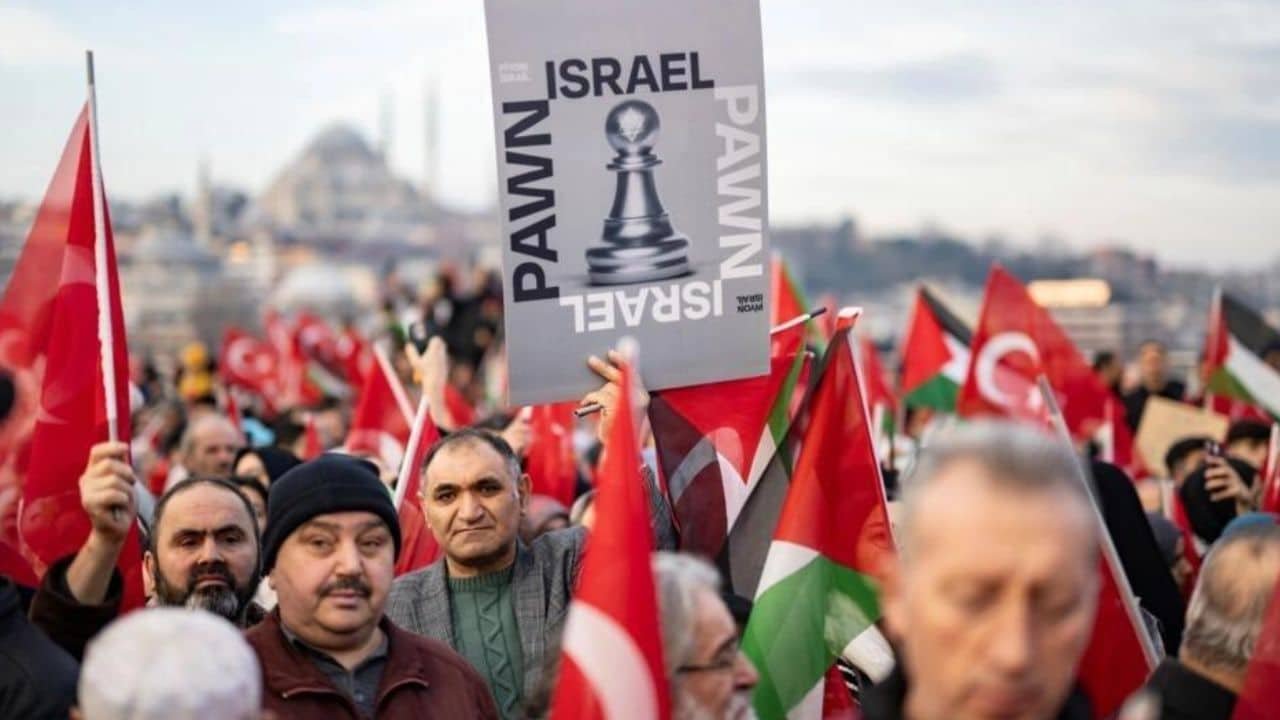
    The president’s ruling Islamic, conservative AKP party also led tens of thousands of protesters out on the streets of Istanbul on Monday for one of Turkey’s biggest rallies against the Israeli government of the entire war.

    The war in Gaza has put an end to a gradual thawing in Turkish-Israeli relations that culminated with the reappointment of ambassadors in 2022.

    Israel and Turkey resumed long-stalled talks about a major Mediterranean Sea natural gas pipeline project that could have reshaped geopolitical alliances across parts of the Middle East.

    Turkey won words of gratitude from Israel in 2022 for detaining a group of Turkish and Iranian nationals were allegedly planning to murder and kidnap Israeli tourists in Istanbul.

    Erdogan and Netanyahu met briefly on the sidelines of a United Nations meeting in New York in September and were discussing holding a formal summit this year.

    Periodic raids

    The Turkish MIT intelligence service conducts periodic raids against suspected Israel operatives working in major cities such as Ankara and Istanbul.

    Most are accused of conducting surveillance work on Palestinians living in Turkey.

    Istanbul served as one of Hamas’s foreign political offices until the outbreak of the Gaza war.

    Turkey informally asked Hamas leaders to leave, days after militants conducted raids into southern Israel on October 7.

    The Gaza health ministry says Israel’s relentless military campaign targeting Hamas has killed around 22,000 people in Gaza since October 7 – mostly women and children.

    UN agencies have voiced alarm over a spiralling humanitarian crisis facing Gaza’s 2.4 million people.

    Most have seen their homes destroyed and now face dire shortages of food, water, fuel and medicine, and are surviving in tents and shelters amid the rubble.

  • Japan quake toll rises to 62 as weather hampers rescuers

    Japan quake toll rises to 62 as weather hampers rescuers

    Japanese rescuers scrambled to search for survivors on Wednesday (January 3) as authorities warned of landslides and heavy rain after a powerful earthquake that killed at least 62 people.

    The 7.5-magnitude quake on January 1 that rattled Ishikawa prefecture on the main island of Honshu triggered tsunami waves more than a metre high, sparked a major fire and tore apart roads.

    The Noto Peninsula of the prefecture was most severely hit, with several hundred buildings ravaged by fire and houses flattened in several towns, including Wajima and Suzu, as shown by before-and-after satellite images released on Wednesday.

    The regional government announced Wednesday that 62 people had been confirmed dead and more than 300 injured, 20 of them seriously.

    The toll was expected to climb as rescuers battle aftershocks and poor weather to comb through rubble.

    More than 31,800 people were in shelters, the government said.

    “More than 40 hours have passed since the disaster. We have received a lot of information about people in need of rescue and there are people waiting for help,” Prime Minister Fumio Kishida said Wednesday after an emergency task force meeting.

    “Rescue efforts are being made by the local authorities, police, firefighters and other operational units, while the number of personnel and rescue dogs is enhanced.

    “However, we ask you to remain fully mindful that we are in a race against time and to continue to do your utmost to save lives, putting people’s lives first,” Kishida said.

    The Japan Meteorological Agency (JMA) has issued a heavy rain warning in the area.

    “Be on the lookout for landslides until the evening of Wednesday,” the agency said.

    In the coastal city of Suzu, mayor Masuhiro Izumiya said there were “almost no houses standing”.

    “About 90 per cent of the houses (in the town) are completely or almost completely destroyed… the situation is really catastrophic,” he said, according to broadcaster TBS.

    A woman at a shelter in the town of Shika told TV Asahi that she “hasn’t been able to sleep” due to aftershocks.

    “I’ve been scared because we don’t know when the next quake will hit,” she said.

    Nearly 34,000 households were still without power in Ishikawa prefecture, the local utility said.

    Many cities were without running water.

    Shinkansen bullet trains and highways have resumed operations after several thousand people were stranded, some for almost 24 hours.

    The US Geological Survey said the quake had a magnitude of 7.5, while the JMA measured it at 7.6, triggering a major tsunami warning.

    The powerful quake was one of more than 400 to shake the region through Wednesday morning, the JMA said.

    Japan lifted all tsunami warnings after waves at least 1.2m high hit the town of Wajima and a series of smaller tsunamis were reported elsewhere.

    Japan experiences hundreds of earthquakes every year and the vast majority cause no damage.

    The number of earthquakes in the Noto Peninsula region has been steadily increasing since 2018, a Japanese government report said last year.

    The country is haunted by a massive 9.0-magnitude undersea quake off northeastern Japan in 2011, which triggered a tsunami that left around 18,500 people dead or missing.

    It also swamped the Fukushima atomic plant, causing one of the world’s worst nuclear disasters.

  • Israel ready ‘for any scenario’ after strike kills Hamas deputy in Lebanon

    Israel ready ‘for any scenario’ after strike kills Hamas deputy in Lebanon

    Jerusalem (AFP) – The Israeli army has said it is “prepared for any scenario” after a strike in Beirut that killed Hamas’s deputy chief, stoking fears that it could boil over into wider regional conflict.

    A high-level security official in Lebanon told AFP that Saleh al-Aruri was killed along with his bodyguards in a strike by Israel.

    A second security official confirmed the information, while Hamas TV also reported Israel had killed Aruri in Lebanon.

    Israeli army spokesman Daniel Hagari did not directly comment on the killing, but said afterwards that the military was in “very high state of readiness in all arenas, in defence and offence. We are highly prepared for any scenario.”

    Israel has previously announced the deaths in Gaza of Hamas commanders and officials during the war, but Aruri is the most high-profile figure to be killed, and his death came in the first strike on the Lebanese capital since hostilities began.

    The strike adds to widespread fears that it could lead to a wider regional conflagration.

    Hamas said Aruri’s death would not lead to its defeat, while its Lebanon-based ally Hezbollah vowed the killing would not go unpunished, calling it “a serious assault on Lebanon… and a dangerous development”.

    Lebanese Prime Minister Najib Mikati condemned the killing and said it “aims to draw Lebanon” further into the war.

    Aruri, who lived in exile, is accused by Israel of masterminding numerous attacks.

    Following his death, Hamas chief Ismail Haniyeh said that a movement “whose leaders fall as martyrs for the dignity of our people and our nation will never be defeated”.

  • Japan quake death toll rises to 48: official

    Japan quake death toll rises to 48: official

    At least 48 people are confirmed dead following a major earthquake in Japan, a local official said.

    The official in Ishikawa prefecture, who spoke on condition of anonymity, told AFP the “death toll has reached 48”.

    Japanese rescuers battled against the clock and powerful aftershocks Tuesday to find survivors of a major earthquake that struck on New Year’s Day, killing at least six people and leaving a trail of destruction.

    The 7.5-magnitude quake, which hit Ishikawa prefecture on the main island of Honshu, triggered tsunami waves over a metre high, toppled buildings, caused a major port fire and tore apart roads.

    As daylight arrived, the scale of the destruction in Ishikawa emerged with buildings still smouldering, houses flattened and fishing boats sunk or washed ashore.

    “Very extensive damage has been confirmed, including numerous casualties, building collapses and fires,” Prime Minister Fumio Kishida said after a disaster response meeting.

    “We have to race against time to search for and rescue victims of the disaster.”

    Police said six people had been killed although the toll was almost certain to climb. The Kyodo news agency reported that 13 people had died, including seven in the badly hit port of Wajima.

    Aerial news footage showed devastation from a major fire at the port, where a seven-storey building collapsed.

    Almost 45,000 households were without power in the region which saw temperatures touch freezing overnight, the local energy provider said. Many cities were without running water.

    The US Geological Survey (USGS) said the quake had a magnitude of 7.5. Japan’s meteorological agency measured it at 7.6, and said it was one of more than 150 to shake the region through Tuesday morning.

    Several strong jolts were felt early Tuesday, including one measuring 5.6 percent that prompted national broadcaster NHK to switch to a special programme.

    “Please take deep breaths,” the presenter said, reminding viewers to check for fires in their kitchens.

    Tsunami warning lifted

    On Monday waves at least 1.2 metres (four feet) high hit Wajima on Monday, and a series of smaller tsunamis were reported elsewhere.

    But warnings of much larger waves proved unfounded and on Tuesday Japan lifted all tsunami warnings.

    Images on social media showed cars and houses in Ishikawa shaking violently and terrified people cowering in shops and train stations. Houses collapsed and huge cracks appeared in roads.

    A team of firefighters crawled under a collapsed, large commercial building in Wajima, television footage showed.

    “Hang in there! Hang in there,” they shouted as they battled through piles of wooden beams with an electric saw.

    “There were shaking that I have never experienced before, a local elderly man told NHK.

    “Inside my house, it was so terrible… I am still alive. Maybe I have to  be content with that.”

    The fire in Wajima engulfed a row of houses, video footage showed, with people being evacuated in the dark, some with blankets and others carrying babies.

    A duty officer at Wajima Fire Department said they still were being overwhelmed Tuesday by rescue requests and reports of damages.

    A total of 62,000 people had been ordered to evacuate, according to the fire and disaster management agency.

    About 1,000 people were staying at a military base, the defence ministry said.

    Bullet trains suspended

    Defense Minister Minoru Kihara said 1,000 military personnel were preparing to go to the region, while 8,500 others were on standby. Around 20 military aircraft were dispatched to survey the damage.

    Monday’s quake shook apartments in the capital Tokyo some 300 kilometres away, where a public New Year greeting event that was to be attended by Emperor Naruhito and his family members was cancelled.

    Several major highways were closed around the epicentre, Japan’s road operator said, and bullet train services from Tokyo were also suspended.

    Japan experiences hundreds of earthquakes every year and the vast majority cause no damage.

    The country has strict regulations intended to ensure buildings can withstand strong quakes and routinely holds emergency drills.

    But the country is haunted by the memory of a massive 9.0-magnitude undersea quake off northeastern Japan in March 2011, which triggered a tsunami that left around 18,500 people dead or missing.

    The 2011 tsunami also sent three reactors into meltdown at the Fukushima nuclear plant, causing Japan’s worst post-war disaster and the most serious nuclear accident since Chernobyl.

    Japan’s nuclear authority said there were no abnormalities reported at the Shika atomic power plant in Ishikawa or at other plants after Monday’s quake.

    In Washington, US President Joe Biden was briefed on Monday’s quake and offered Japan “any necessary assistance” to cope with the aftermath.

    French President Emmanuel Macron expressed “solidarity” while Italian Prime Minister Giorgia Meloni offered condolences and assistance.