The Ba-Ikhtiyar Naujawan Internship Program (BNIP) was established by the Ministry of Planning, Development, and Special Initiatives at the request of Prime Minister (PM) Shehbaz Sharif, to ensure Pakistani youth is economically empowered.
The program aims to provide 60,000 paid internships to recent graduates across Pakistan.
“Despite lengthy stints at educational institutes, gaps remain among Pakistan’s young graduates in terms of marketable skills and practical experience. This serves as a barrier to their entry in the job market and underlies their high unemployment rate. The Prime Minister’s Ba-Ikhtiyar Naujawan Internship Program is breaking these barriers for young graduates by equipping them with requisite skills through off-job and on-job training, and providing them with the work experience they require for entering the job market. Please create an account on this portal through the ‘Register’ feature, login to your personalised dashboard, and apply to internship opportunities available in various fields.”
Who is eligible for the program?
Graduates up to the age of 30 holding a Diploma, Bachelor’s degree, or higher from an HEC-recognized university or institution in Pakistan, or abroad are eligible to apply for BNIP internships.
Is the internship paid?
The monthly stipend for the internship is Rs25,000-40,000.
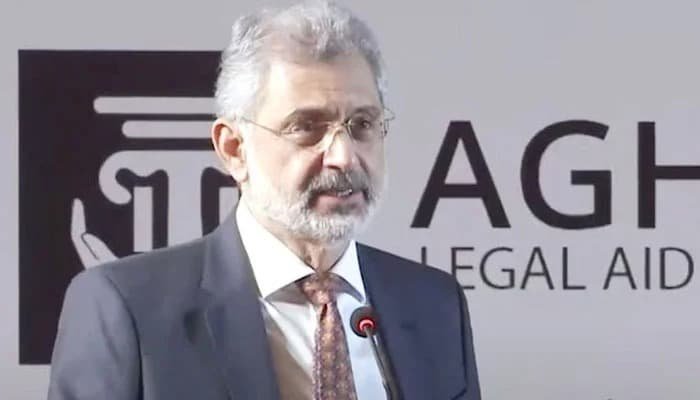
Supreme Court (SC) Justice Qazi Faiz Isa has raised multiple questions over the verdict of a six-member larger bench of the Supreme Court which deposed his order that all suo motu proceedings should be stopped.
In a nine-page note issued on Saturday, Justice Isa maintained that as the gathering in a court of six distinguished judges was not permissible under the Constitution or under any law, “the Supreme Court’s order dated 29 March 2023 passed in Case No 4 could not have been set aside by the 4 April Note”.
Justice Isa noted that the Constitution did not confer jurisdiction on a bench or on judges of the SC (no matter how many in number) to sit in an appeal over an order of the top court.
The judge further pointed out that Ishrat Ali, a federal government employee, was sent on deputation to the SC to work as its registrar.
He maintained that Ishrat Ali was “withdrawn” by the federal government, however, he refused to abide by the order.
It is pertinent to mention here that Justice Faiz had asked the registrar to resign for issuing a circular, discarding his judicial order related to suo motu proceedings.
Earlier, a six-member bench of the Supreme Court was formed in unusual haste to deliberate on Justice Faez Isa’s order freezing all the suo motu notices. The bench closed the case after a hearing that lasted a total of five minutes.
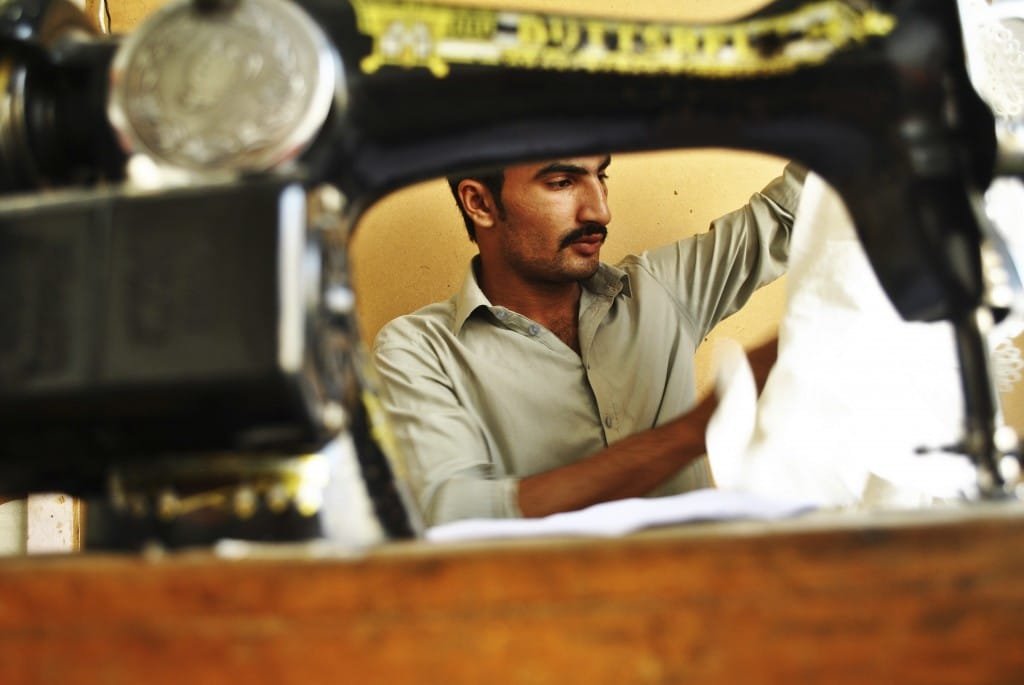
Twenty-five outfits were stolen from a tailor’s shop in a unique robbery case.
As per the details, the incident took place in Rahwali, Gujranwala.
The thieves entered the shop pretending to be customers and then held the tailor and his employees hostage at gunpoint.
Twenty-five outfits that were given to the tailor by various customers for stitching were stolen by the criminals. Additionally, they took away the employees’ cell phones before running away from the crime scene.
The shopkeeper has requested authorities to act quickly and bring the thieves to justice.
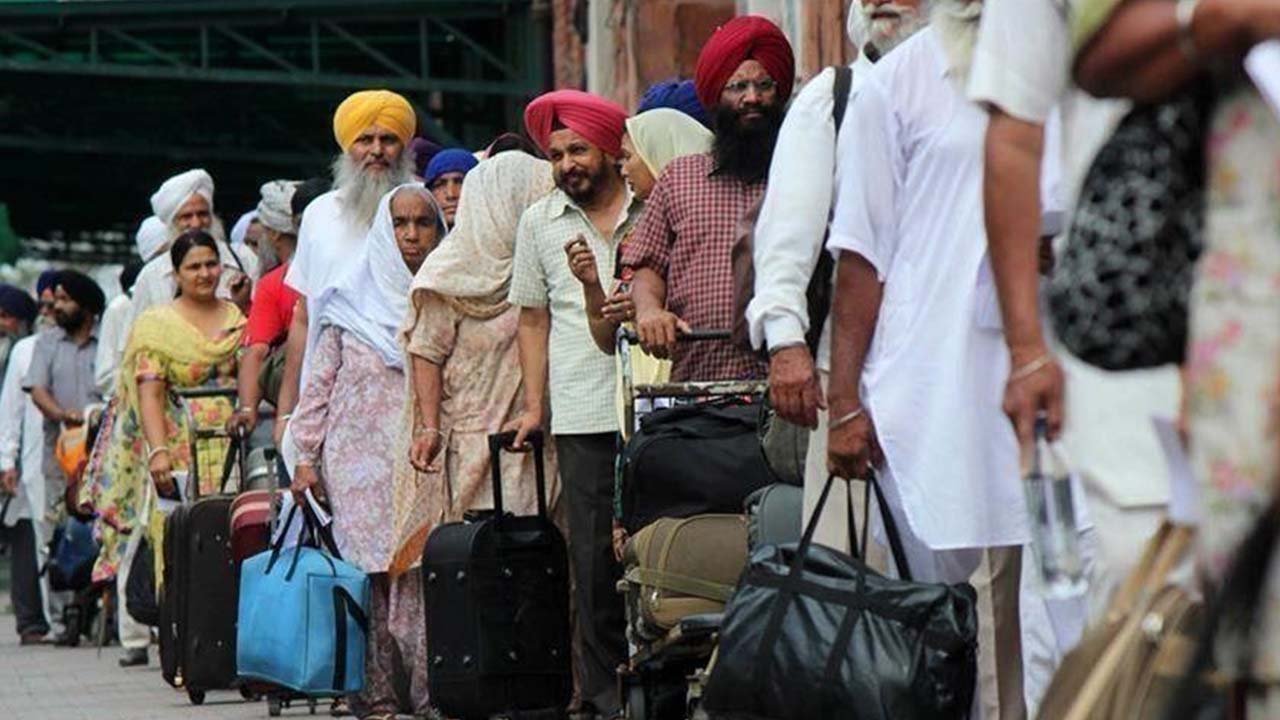
Pakistan’s High Commission in New Delhi has announced that it has issued 2,856 visas to Sikh pilgrims from India. The visas will allow the pilgrims to travel to Pakistan and participate in the annual Baisakhi festivities, which are set to take place from April 9-18, 2023. The issuance of these visas falls under the Pakistan-India Protocol on Visits to Religious Shrines of 1974.
Every year, many Sikh Yatrees from India travel to Pakistan to observe different religious festivals and occasions. The High Commission’s issuance of visas to these religious pilgrims is in accordance with the Pakistani government’s commitment to fully implement the Bilateral Protocol on Visits to Religious Shrines between the two countries.
Pakistan’s Charge d’Affaires, Salman Sharif, congratulated the pilgrims on the occasion and wished them a fulfilling journey. He added that Pakistan is dedicated to preserving sacred religious places and ensuring that visiting pilgrims are provided with necessary facilitation.
The pilgrims will visit several sites, including Dera Sahib, Panja Sahib, Nankana Sahib, and Kartarpur Sahib. They will arrive Pakistan on April 9 and return to India on April 18.
As part of their ‘Cost Of The Crown’ series, investigating the British Royal Family’s wealth and finances, The Guardian has extracted a 46 page report from the Indian government which provided details of jewelry and other precious items stolen by the colonial British Empire during their reign over the sub-continent. Most of the gifts were handed over as gifts to Queen Victoria, the reigning monarch at the time.
The investigation was commanded by the late Queen Elizabeth II’s grandmother, Queen Mary, to find out about the origins of her jewels.
The report details the names of the jewels as well as their colonial origins and how they were stolen by the East India Company.
1 Koh-i-Noor
The legendary diamond Koh-i-Noor was taken from Maharaja Ranjit Singh’s kitty. The ruler of Lahorr had signed a treaty of friendship with the British in 1831, and six years later the then Governer-General of India, George Eden, and his sister, Fanny, visited him at his palace. The Guardian writes that Fanny had later written about Singh’s diamond collection, detailing how he decorated his horses with the finest diamonds she had ever seen:
“If ever we are allowed to plunder this kingdom, I shall go straight to their stables.”
in 1849, Singh and his heir, Duleep, were forced to sign over Punjab to the British army, who stole all of his jewels as a part of their conquest, along with the Koh-i-Noor.
The diamond is part of the Imperial Collection, imbedded into Queen Elizabeth, the Queen Mother’s crown, worn by consorts.
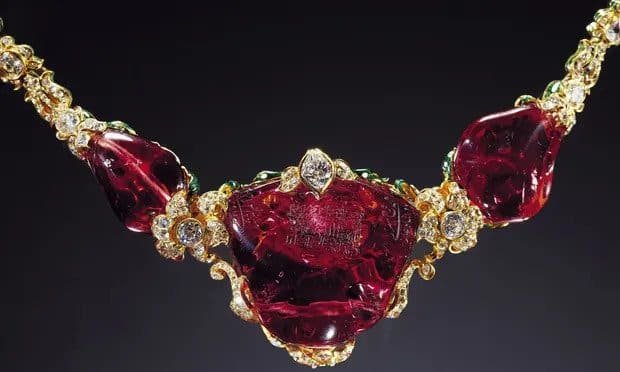
2 The Timur Ruby gemstone
Named after Timur, the founder of Timurind Empire in Central Asia, the gemstone is etched with the names of the five men who owned it: Jahangir (1569-1627), the 4th Mughal Emperor, Shah Jehan (1592-1666), the 5th Mughal Emperor, Farrukhsiyar (1685-1719), the 10th Mughal Emperor; Nader Shah (1688-1747), Shah of Iran; and Ahmad Shah Durrani (1722-1772), King of Afghanistan.
By 1813, the gemstone was under the possession of Maharaja Ranjit Singh, who ruled over the Sikh Empire, and later was passed down to his heir Maharaja Sher Singh. From there, the necklace was inherited by his brother Duleep Singh, who became Maharaja when he was only five years old.
During 1948- 49, when the British Empire waged wars over the Sikh Empire, the East India Company took over Punjab and forced the then ten-year-old Maharaja to hand over his possessions. Duleep Singh was placed under a Scottish guardian, isolated from contacting his fellow countrymen.
3 Pearl necklace
Comprising of 244 pearls and a clasp of two magnificent rubies, the necklace had originally belonged to a ruler in Punjab, until it was stolen by the British. Queen Elizabeth II was spotted wearing this necklace at the Royal Opera House in London to celebrate her diamond jubilee.
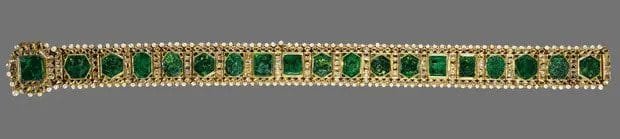
4 Emerald girdle of Maharaja Sher Singh
The gold girdle inlaid with 19 emeralds first came to the public’s attention during Buckingham Palace’s celebration of Prince Charles’ 70th birthday, with a display of his favorite pieces from the royal collection. The item had previously belonged to an Indian Maharaja, Sher Singh, who used it to decorate his precious horses.
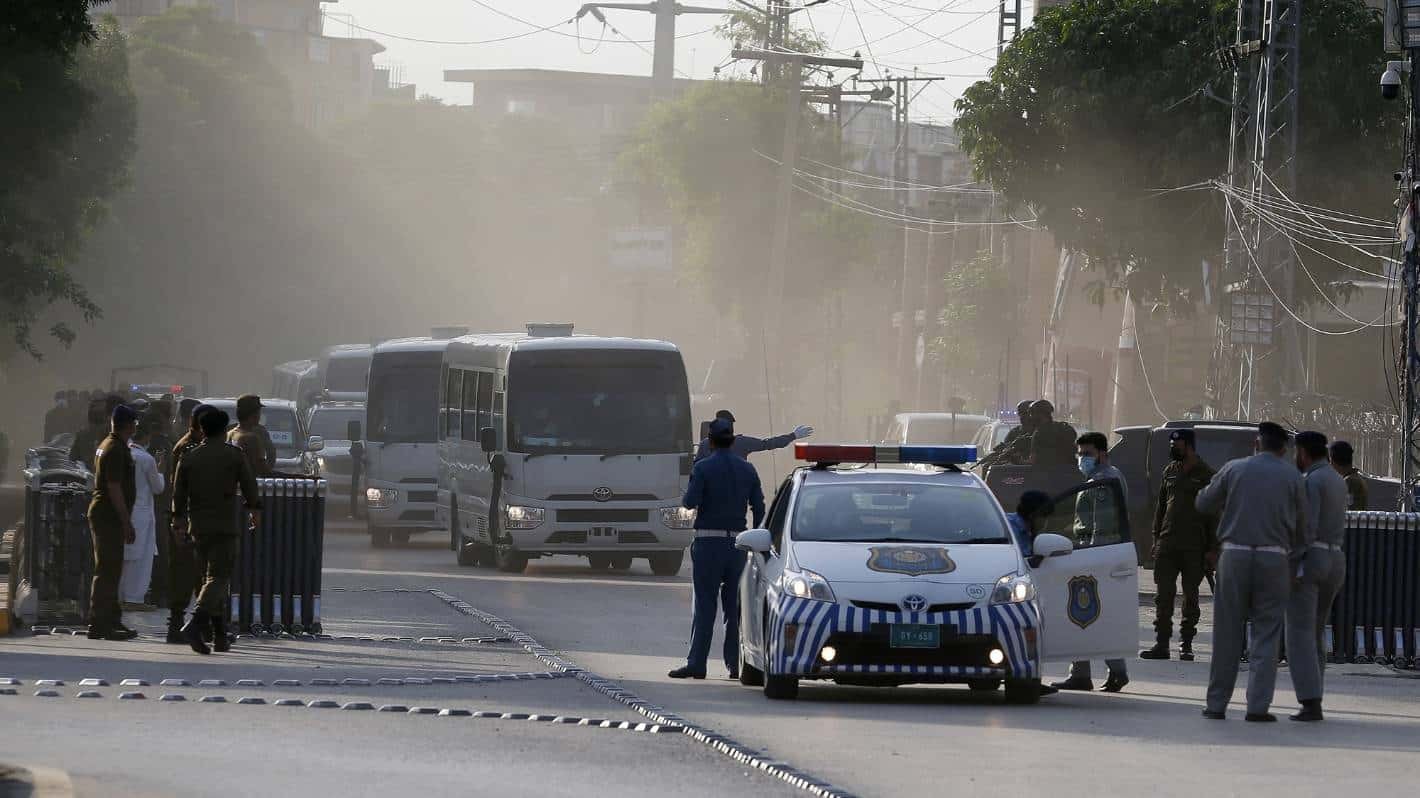
The Islamabad police has said on Sunday that they were “fully equipped” to provide end-to-end “fool-proof and world-class” security to the New Zealand cricket team during their upcoming series in which five T20I and five One Day International (ODI) matches will be played.
The Black Caps are scheduled to arrive in Pakistan on April 9 (today) for the limited-overs series set to begin on April 14 in Lahore.
A day earlier, sources in the police department told Geo News that police have refused to provide security, saying they “do not have resources” and claimed that it is the responsibility of the Pakistan Cricket Board (PCB) to provide the same for security.
The sources said that police personnel are busy with deployment at free flour distribution centres, ongoing census and other activities related to the holy month of Ramadan.
However, Inspector General of Police Dr Akbar Nasir Khan has now said that the Islamabad police have provided the highest level of security during the visit of the English cricket team and Pakistan Super League’s (PSL) eighth edition “flawlessly” in 2022-23.
“Police shall be playing a key role for provision of flawless security in collaboration with other stakeholders in Islamabad and Rawalpindi,” he assured.
The touring teams stay at a hotel in the capital and travel to the Pindi Cricket Stadium for matches.
Pakistan v New Zealand schedule: April 14 — 1st T20I, Lahore
A 13-year-old boy in India has committed suicide after a barber cut his hair extremely short.
As per Indian media news reports, the incident took place in Indian state Maharashtra.
The boy committed suicide by jumping from the window of a bathroom.
Media reports state that the boy was unhappy about his hair being cut short and not according to what he wanted. His parents tried to calm him down but the boy remained unsatisfied.
The boy went to the bathroom and allegedly jumped out of the windo when all the family members of his family had gone to sleep.
An 18-year-old Indian girl swallowed a cell phone during an argument with her brother to keep him from getting to it.
The siblings were reportedly fighting over the gadget when the sister decided no one was going to have it. The girl was rushed to hospital after she experienced severe abdominal pain and vomiting. She underwent a surgery in the hospital where the phone was safely removed from her stomach. The girl received ten stitches in a two-hour long surgery.
The physician who examined the girl said that he had encountered such a case for the first time. He further requested parents to stay cautious while handing over cellphones to their children.
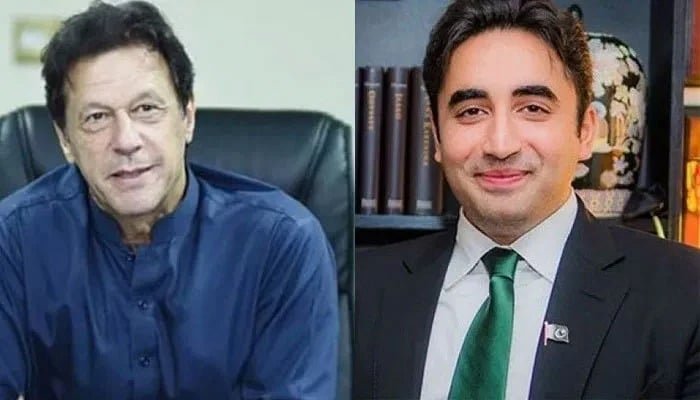
Pakistan People’s Party (PPP) is reportedly ready to hold talks with Pakistan Tehreek-e-Insaf (PTI) while Pakistan Muslim League-Nawaz (PML-N) and Jamiat Ulema-e-Islam Fazl (JUI-F) have rejected the idea.
Stressing the importance of resolving conflicting court verdicts promptly and without impinging on the judiciary’s honour and prestige, PPP, in the interest of fair and free elections, called for general elections for all assemblies to be held on the same day.
JUI-F leader Asad Mahmood, in a statement on Friday, said that no negotiations will take place with Imran Khan and called for imposing Article 6 on him. Interior Minister Rana Sanaullah on multiple occasions has also rejected the idea of holding talks with the PTI.
On the contrary, it seems like the former ruling party is ready to talk, albeit only on the matter of elections.
Pakistan Tehreek-e-Insaf (PTI) Senior Vice President Fawad Chaudhry said that the “ideal” situation to deal with the crisis surrounding Punjab and Khyber Pakhtunkhwa (KP) elections is for the ruling parties, establishment, and the PTI to hold a meeting together.
“The parties will have to sit together and bring a constitutional amendment with consensus to conduct elections at one time,” said Fawad.
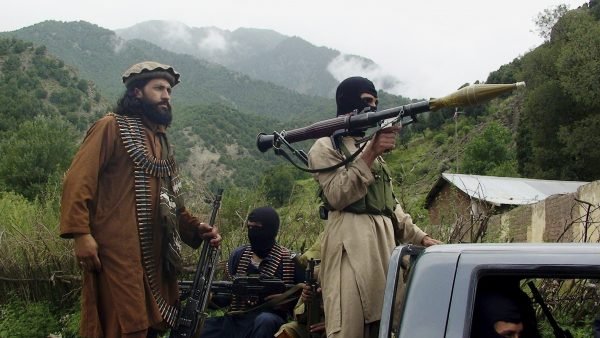
Military weapons worth $7 billion that were left behind by the United States (US) after its exit from Afghanistan are being used by banned Tehreek-e-Taliban Pakistan (TTP) and Baloch separatist groups for terrorism in Pakistan, claimed a report by Radio Free Europe.
The report said that the US left behind firearms, communications gear and armored vehicles which gave the militants a “vast war chest”.
The Taliban government has rejected claims that it has supplied TTP fighters with US weapons and equipment, however, the report stands contrary to their assertion.
Abdul Sayed, a Sweden-based researcher who tracks the TTP, said the group’s access to sophisticated combat weapons has had a “terrifying” impact, especially on the lesser-equipped police force in Pakistan.
Since government talks with the TTP broke down in November, the militant group has intensified its attacks across Pakistan including attacks on the police.
According to statistics released by the Pakistan Institute for Conflict and Security Studies (PICSS), January 2023 remained one of the deadliest months for terrorism since July 2018.