According to the International Monetary Fund (IMF), Pakistan’s government did not seek advice from the multilateral lender regarding the discounted petrol for the low-income group.
The government’s plan to increase fuel costs for more affluent drivers to pay for a subsidy for those with lower incomes, according to Esther Perez, the IMF’s resident representative for Pakistan, was not discussed with the international lender.
“Fund staff are seeking greater details on the scheme in terms of its operation, cost, targeting, protections against fraud and abuse, and offsetting measures, and will carefully discuss these elements with the authorities,” said Perez.
Earlier, the federal government announced that it would reduce the price of petrol up to Rs100 for motorcycle riders and owners of vehicles up to 800 cc in order to lessen the impact of rising petrol costs on people who are already suffering from inflation. According to Malik, Prime Minister Shehbaz Sharif has ordered that low-income individuals receive petrol subsidies of up to Rs100 per liter instead of Rs50.
Under a comprehensive strategy, cheap petrol will be offered to motorcyclists and owners of vehicles up to 800 cc, while owners of vehicles beyond 800 cc will be charged full price. The minister made it clear that this is not a subsidy but a cross-subsidy.
According to Malik, “the owners of big vehicles will pay more for petrol.” The rich will pay Rs100 more for petrol, while the poor will pay Rs100 less. 210 million people are poor in a population of 220 million, and we stand with poor Pakistanis.”
He said the decision to provide fuel at lesser rates will be implemented within six weeks.
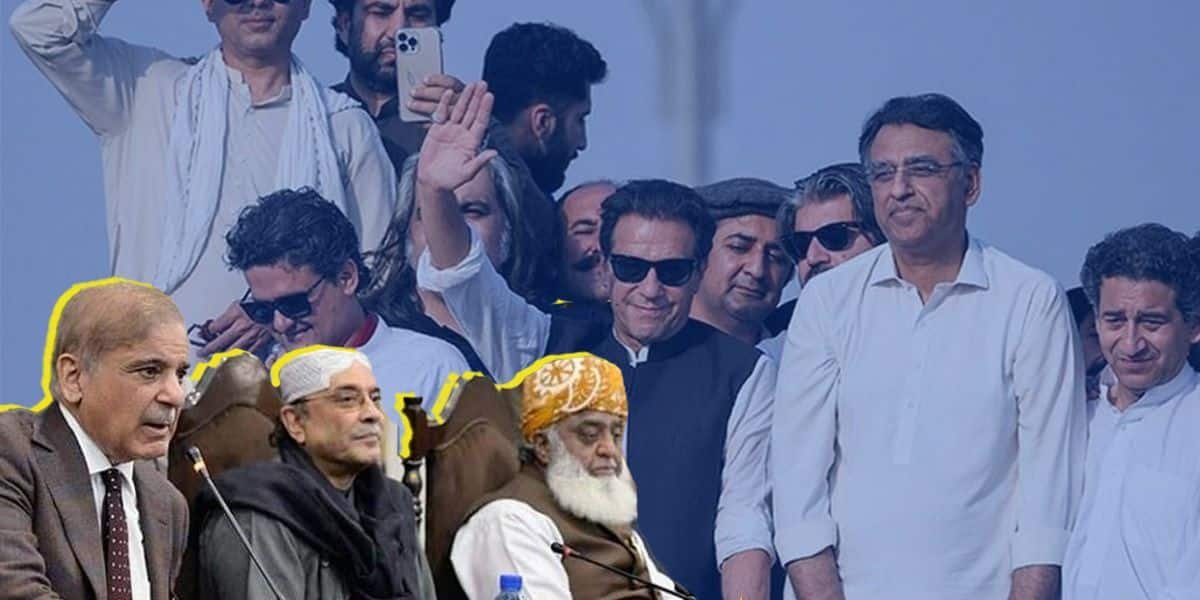
The Pakistan Democratic Movement (PDM) on Monday called for strict action against the Pakistan Tehreek-e-Insaf (PTI).
According to an official statement, the decision was made during a six-hour meeting of the PDM, heads of coalition parties with Prime Minister (PM) Shehbaz Sharif in the chair.
The meeting also decided to take action against those involved in maligning state institutions, including the armed forces and judiciary, through a “smear campaign”.
“The meeting strongly condemned attacks on police and Rangers, who were obeying court orders, and called it an enmity against the state,” the statement said.
“All evidences and proofs are available, under which stern action will be taken against those involved in the unrest,” it added.
PDM strongly condemned the attacks on the police and Rangers personnel who were complying with the court’s orders on the direction of the PTI chairman and termed it “unacceptable”.
Expressing solidarity with officers and jawans, the meeting resolved that strict action should be taken against the law-breaking elements as per the law. The session also termed the attacks on the law enforcers as enmity with the state which cannot be tolerated.
“The entire nation witnessed that the PTI is not a political party but a group of trained militants,” the declaration read, adding that given the evidence and proof, it has been decided to take action as per the law.
When Sar-e-Rah aired its fourth episode, the story shifted to the struggles of an intersex boy who struggled to get love and acceptance from his family, and was determined to work hard and make his father proud. A significant moment in this episode which had caused social media users to declare it as the best television series of the decade, was an interaction between father and son when he explained to his child that it was okay to embrace gender fluidity.
I wasn’t expecting this but what an INCREDIBLE message by Nabeel Zafar! He beautifully talked about gender differences to his son, something which should’ve been taught WAY before but we couldn’t, all because of extremist elements in the society.pic.twitter.com/kKCRTopdGB
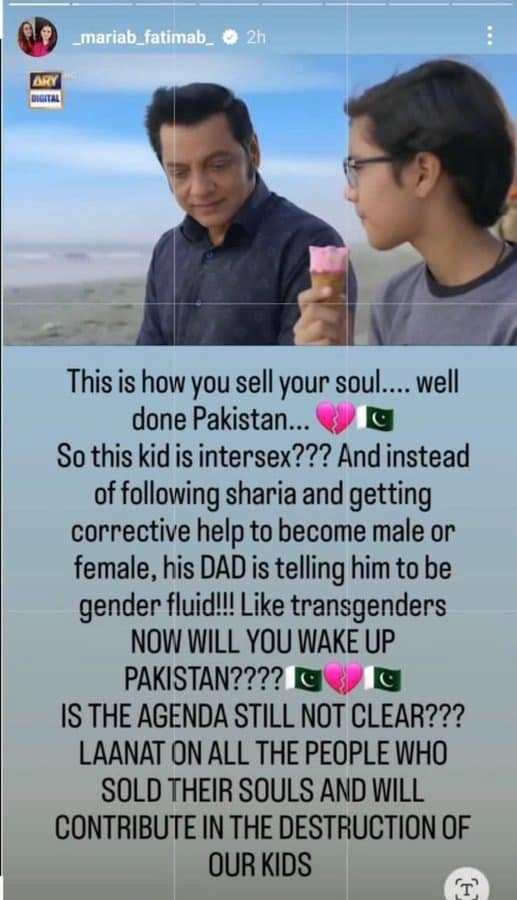
However, fashion designer Maria B had criticized the episode for encouraging acceptance of the transgender community, and called the actors who had taken part in the show ‘sell outs’ who were contributing to the destruction of Pakistan.
In an interview with Maliha Rehman, actor Muneeb Butt addressed the criticism of the episode being ‘anti-Islamic’ by calling it wrong and entirely taken out of context.
“I was disappointed to listen to her accusation because we are not anti-Islamic, we are Muslim, as well as the writers who wrote this script. We have a problem that we are quick to label other people as having agendas, or we distribute certificates that they’re anti- Muslim or taking an anti-Islamic stance. We think that we’re right, and the other people around them are wrong…When I read this drama, I was analyzing that there is nothing insensitive being spoken, clashing with my Islamic beliefs, and I didn’t think it was contradicting any Islamic value.”
Butt addressed the scene which was slammed by B and other right wing critics as promoting ‘vulgarity’, by explaining that these critics had not taken into account the back story of these characters to understand the scene properly:
“You should listen to the context behind this clip. If you watch a clip and judge an entire drama from this, then you’re completely wrong. No one can predict an entire drama from just a clip, because you don’t remember what happened before it. Before this, the father had seen his son dancing like a woman and wearing makeup, and his mother was forcing him to do this. The dad simply asked him did he want to do all of this in the bathroom, to which the son responded yes he does. The father is silent for a minute, then again asks ‘Beta, if you like doing this then tell me. I won’t feel bad at all.’ Then the son says ‘Baba, I don’t want to do this.’ It’s after that the father gently explains to him that right now his son is young but when he grows up that’s when you will learn to understand the feelings inside your body. He wasn’t saying that it’s your choice if you want to become a girl or a boy. The father was trying to make his son understand that the feelings your body is trying to tell you, whether you’re a male or female, that is something you will decide on your own. Right now it’s not necessary for you to figure out these things, you have to focus on your studies. This is the entire context, and it was beautiful how the father was encouraging his son to keep moving forward and study hard.”
Given the entire context, Butt slammed critics for labeling him and the rest of the ‘Sar-e-Rah’ crew, saying it could have placed his life in danger.
While social media overflowed with different takes on Sarang’s character, Butt had chosen to remain silent and did not address the allegations on social media. Butt explained that he had planned to write a note as soon as episode 6 came out, when Sarang gives a speech at a convocation.
Butt revealed that the wife of a prominent actor had reached out to him when this episode had aired, and had sent him an audio note which said some things that proved she wasn’t happy with the drama.
“It was her right to say all of these things because we make shows for the public. It’s their right to tell us about their opinions about our dramas, but for that you need to watch the complete episode to understand the context rather than judging it from a small video clip.”
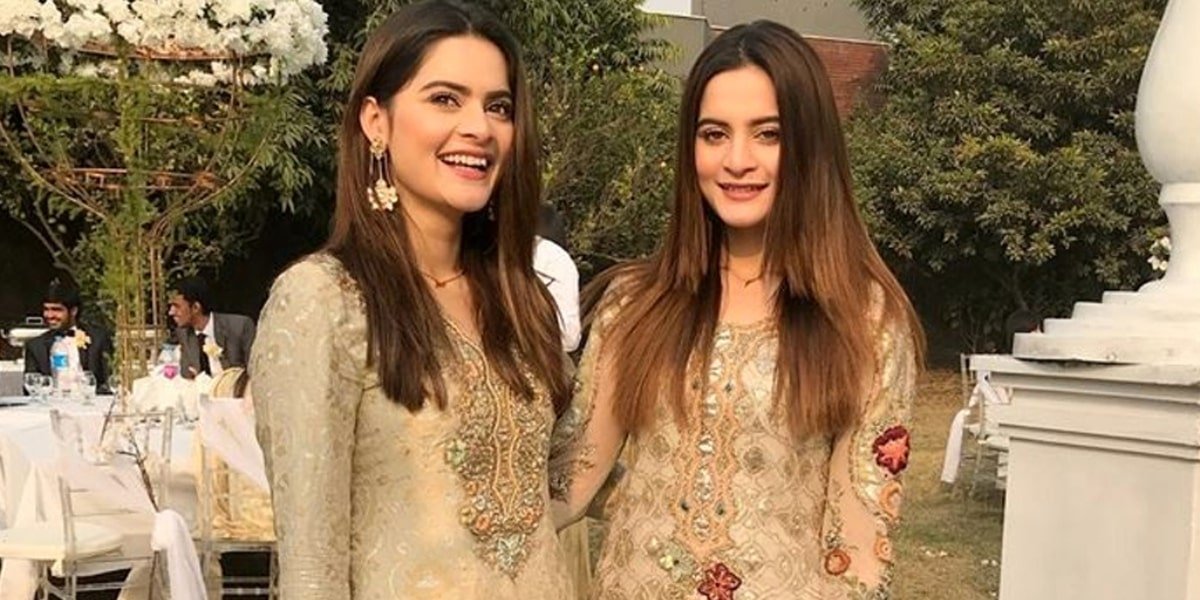
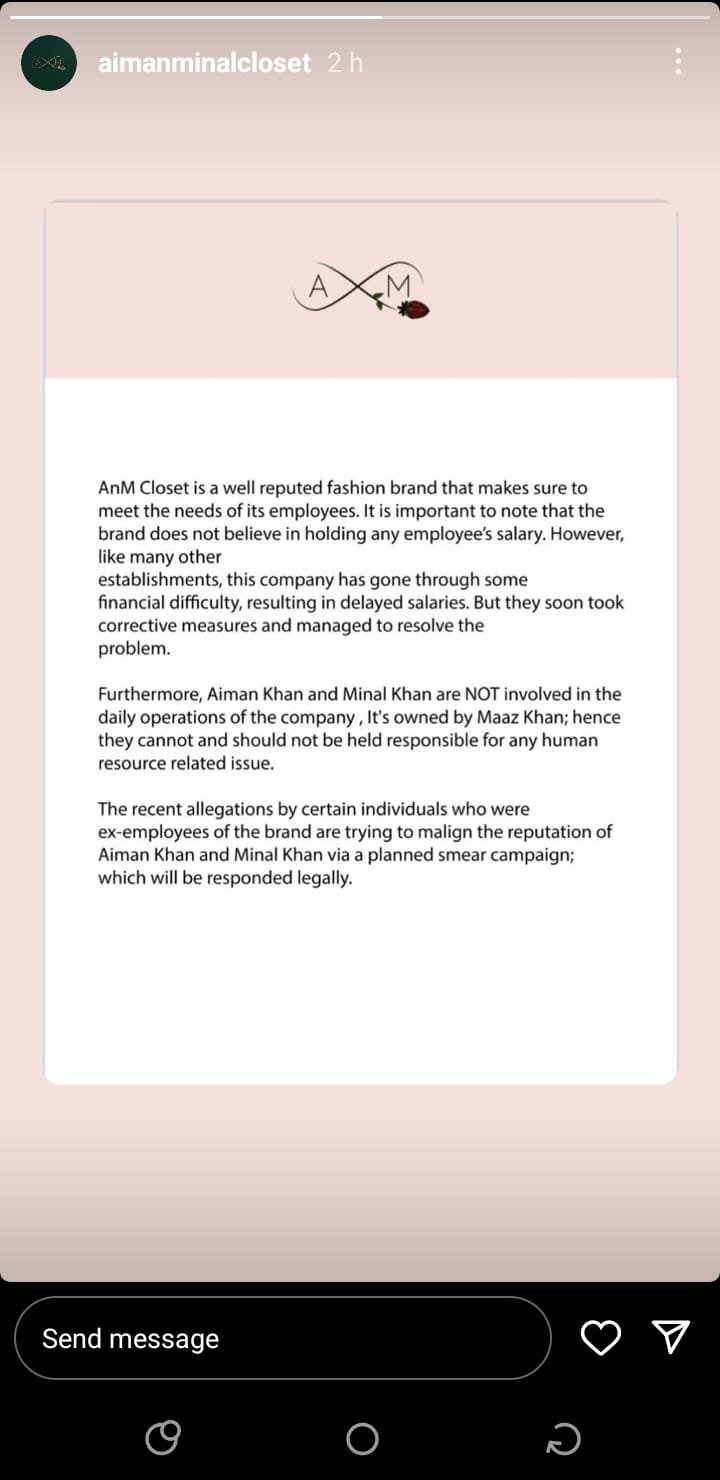
Yesterday, an Instagram post from a user named Ali Hamid has been going viral on social media because it accused actors Aiman Muneeb and Minal Khan of exploiting workers, delaying salaries and unprofessional behavior at their organization ‘Aiman Minal Closet’.
The user had written that he had worked at the organization for a year and during his time he witnessed how employees were exploited and over-worked, but were not provided with a salary:
“They never paid me on time. Despite being such big names. They never pay their employees and whenever you message Maaz (their brother) about salary, he’d say he’ll transfer it the next week but you never really get the salary.
They owe me my six months salary and there are many employees who didn’t get their salary but didn’t do anything out of respect.
They treat their employees like slaves and disrespect them all the time but never pay them. They’re earning millions from their brand but when it comes to paying their employees, they take a back seat.”
However, the organization has responded to the allegations by clarifying that Muneeb and Khan were not innvolved in the daily operations of the company:
“Aiman Khan and Minal Khan are NOT involved in the daily operations of the company, it’s owned by Maaz Khan; hence they cannot and should not be held responsible for any human resource related issue.”
Furthermore, the statement called the allegations an attempted “smear campaign” to malign the reputation of the actors, and will be dealt with through a legal procedure.
“The recent allegations by certain individuals who were ex-employees of the brand are trying to malign the reputation of Aiman Khan and Minal Khan via a planned smear campaign ; which will be responded legally.”
The mandatory minimum fee of 1.5 per cent that banks were required to charge merchants on financial transactions made with debit and credit cards has been eliminated by the State Bank of Pakistan (SBP), and financial institutions are now permitted to charge even less than that amount to encourage the use of digital banking.
According to a notification released on Friday, the central bank has kept the fee’s upper ceiling at 2.5 per cent.
Also, the SBP mandated that all online merchants and payment recipients in Pakistan begin taking card payments no later than June 30, 2023.
Before, petrol outlets stopped taking payments made with debit and credit cards and asked that the 1.5 per cent fee be eliminated.
The elimination of the minimal fee has long been demanded.
Eliminating the minimal fee is a good thing for digital transactions, according to experts. The State Bank’s plan to boost the use of digital cards includes this, as this decision would also improve the documentation of the economy and help decrease cash-based transactions.
Across the nation, there are about 45 million debit and credit cards. Nonetheless, the majority of cardholders use their cards to make ATM withdrawals. Just 5–10 per cent of POS users utilise cards.
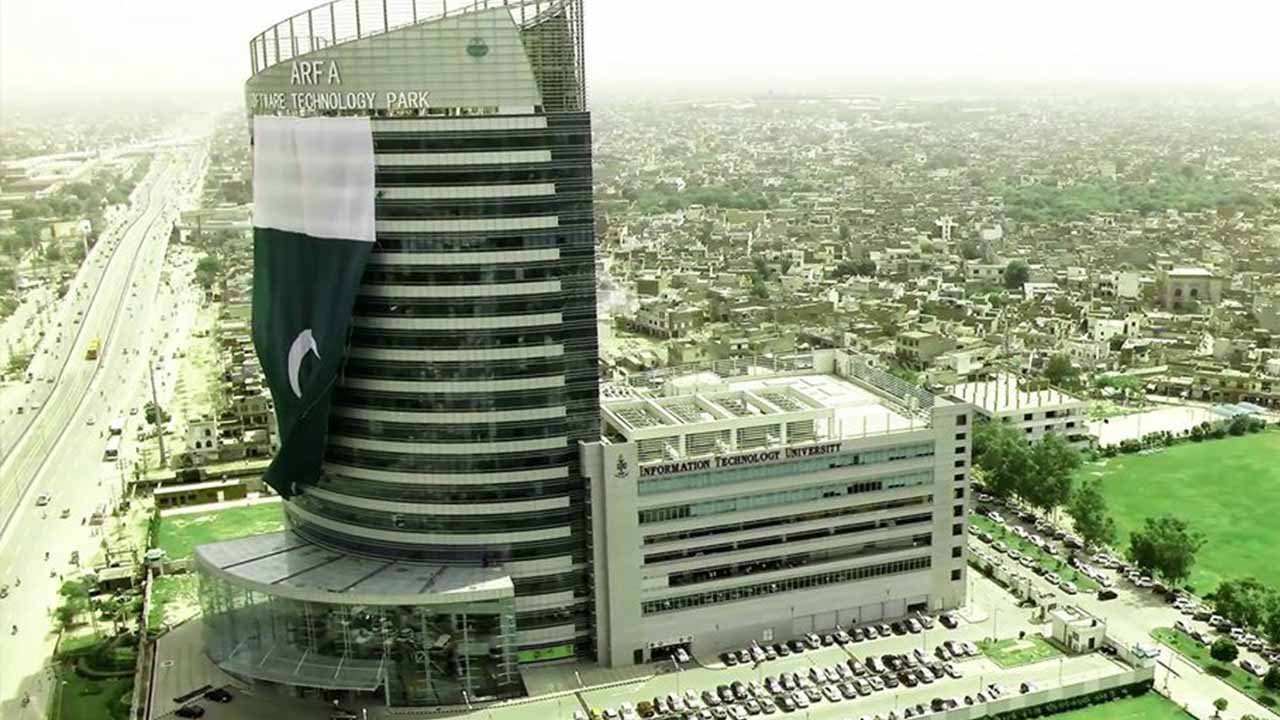
Pakistan has earned US$1,523.280 million by providing different Information Technology (IT) services to various countries during the first seven months of the current fiscal year 2022-23, according to the Pakistan Bureau of Statistics (PBS).
This represents a growth of 2.38 per cent as compared to US$1,487.865 million earned during the same months of the fiscal year 2021-22.
During July-January (2022-23), the export of computer services climbed by 2.87 per cent as it increased from US$1,191.575 million last fiscal year to US$1,225.730 million this year.
The exports of software consultancy services saw an increase of 5.57 per cent, from US$430.309 million to US$454.283 million while the exports of hardware consultancy services also rose by 158.07 per cent from US$1.357 million to US$3.502 million.
According to APP, the export and import of computer software-related services surged by 11.89 per cent, from US$312.484 million to US$349.635 million whereas the exports of repair and maintenance services increased to US$1.594 million from US$0.770 million.
The export of telecommunication services also witnessed an increase of 0.60 per cent as these went up from US$293.180 million to US$294.950 million during the months under review, the data revealed.
Among the telecommunication services, the export of call centre services rose by 2.30 per cent during the period as its exports increased from US$118.669 million to US$121.398 million whereas the export of other telecommunication services decreased by 0.55 per cent, from US$174.511 million to US$173.552 million during the period under review, the PBS data revealed.
Moreover, the exports of other computer services witnessed a decline of 6.70 per cent going down from US$446.655 million to US$416.716 million.
Meanwhile, the export of information services during the period under review declined by 16.40 per cent going down from US$3.110 million to US$2.600 million.
Dr M. Suresh Kumar who is currently serving as the Charge d’Affaires at the Indian Embassy in Islamabad, has arrived in Lahore for the first time since his appointment two years ago. Jang reported that the diplomat had breakfast with senior journalists, where he revealed an interesting tibit about food prices in the capital. He was recently purchasing groceries and was shocked to find out that the price of onions was Rs 300/kg, when in New Delhi it was Rs 20/kg.
Dr Kumar also addressed the matter of improving business ties between India and Pakistan, by saying that Pakistani businessmen are refused a business visa in India because of the fact that there are no business ties between the two countries. To which Pakistani businessmen asked how will business ties between both countries improve if they aren’t given a visa. To which Dr Kumar responded its like asking which came first- the chicken or the egg?
To answer another question, Dr Kumar said that Gujranwala is the city of wrestlers, and felt that there should be wrestlying and kabadi competitions between the two countries.
Dr Kumar also said that he will talk to the higher authorities in New Delhi to send an invitation to a delegation of journalists from Pakistan to visit India.
Jang also reported about a conversation with a senior official from the foreign office in New Delhi who remarked that after the restoration of relations between Saudi Arabia and Iran in the region, efforts should be made to improve the relation between Islamabad and New Delhi.
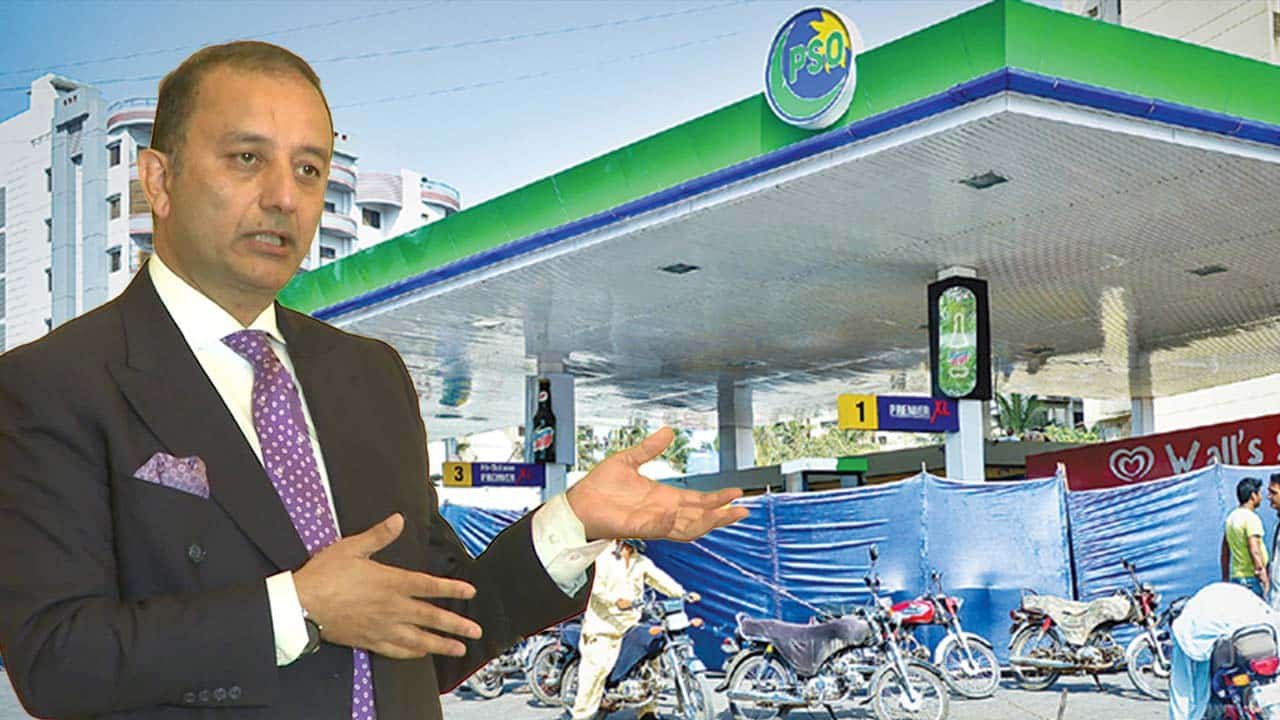
The State Minister for Petroleum, Musadik Malik, announced on Monday a significant reduction of Rs100 in the price of petrol for low-income people.
The minister stated during a news conference held in Islamabad that the wealthy will pay Rs100 more for petroleum products while the underprivileged will receive the same amount in relief.
The specifics of this execution strategy will probably be made public by the administration within the upcoming week.
In addition, the government would provide low-income groups with gas subsidies.
Prior to this, Prime Minister (PM) Shehbaz Sharif stated that low-income individuals would pay Rs50 less for petrol. However, Musadik Malik declared on Monday that the Prime Minister had now ordered to provide a Rs100 discount on petrol to low-income citizens instead of a Rs50 discount.
While chairing a review meeting on Sunday, PM Shehbaz said that the petroleum relief would be given to low-income consumers who have motorcycles, rickshaws, and other small vehicles (less than 800cc).
He said the program of petroleum subsidies would be started soon, and a comprehensive strategy would be formed with the cooperation of relevant departments for effective implementation of the subsidy program.
He said motorcycles, rickshaws, and small cars were used by low-income people, and the petroleum subsidy would give relief to the poor.
The government was making efforts to provide all possible help to the poor people despite its economic difficulties, he added.
. We are all familiar with the stereotypical Pakistani lead couple, a toxic and underwhelming boy who is ‘edgy’ and ‘dark’ because of his traumatizing past, and the hoor-pari good girl who has never walked outside apnay ghar ki chaar dewariyan, and has apparently never interacted with a man in her life. They meet, stalk, harass, fall in love, shaadi, divorce, phir pyar and then happy ending.
But quiet rarely, Pakistani dramas take a step to break these stereotypes and introduce us to a couple where either both or one person is a middle-aged woman. It’s a rare stand against stereotypical depictions of women disappearing after they turn forty.
But it’s important now that women are reminded that their beauty and desirability doesn’t finish the moment they turn thirty. Life doesn’t end.
Thankfully, Pakistani dramas have slowly been catching up on breaking this stigma by giving us a few very poignant and well-written dramas that had cast a middle-aged woman in a romantic relationship as the central lead of their drama.
1 Dobara
Dobara was embraced with open arms by Pakistani audiences when it debuted. Hadiqa Kiana starred as Mehru Nisa, a woman in her forties with two grown children who was learning to re-live her life on her own terms after being forcibly married when she was sixteen years old and deprived of doing everything she had ever loved. Mehru Nisa’s relationship with Maahir, a man who was in his twenties, is the most heart warming aspect of this drama because of the way he helps her gain confidence in doing whatever she wanted to do, and also defends her from her family members who consistently bully her.
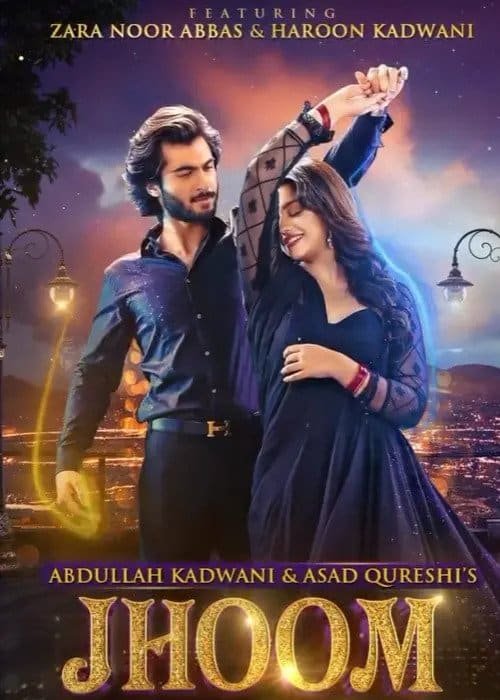
2 Jhoom
This upcoming drama features Zara Noor Abbas and Haroon Kadwani as lovers with a wide age gap between them. According to the trailer, the premise revolves around backlash from society who cannot accept an older woman marrying a younger man.
3 Samjhota
Shahista Lodhi’s on-air drama revolved around an old man’s marriage. After his wife passes away, he decides to marry Nargis. But his re-marriage at this age doesn’t bode well with his children, who refuse to treat Nargis with kindness.
Speaking on the importance of approaching this topic, Lodhi who starred as Nargis in the drama, said that she wanted to do this project because of how it reminds that the elderly that life doesn’t end when they grow old:
“It showed that at a certain age when we think our elderly mother and father are only around to take care of our children, but instead you’ll witness the love story between these two main characters in the drama. I thought this was such a great example being set. The other thing is in our society at a certain age our parents are left lonely while we get busy building our own lives. We seem to think that our parents can’t find a new partner after their own spouse and they don’t have a life of their own.”
4 Teri Raah Mein Rul Gayi
Samiya Mumtaz essays the role of a middle aged woman whose husband passed away a year after their marriage, leaving her in grief. Her brother-in-law stands up to society by providing for her every single need, and declares that he has fallen in love with her.
Former Chief Justice of Pakistan (CJP) Saqib Nisar and former Governor and Pakistan Tehreek-e-Insaf (PTI) Chairman Imran Khan’s lawyer, Khawaja Tariq Rahim’s alleged audio leak has surfaced on the internet.
In the alleged audio clip both Nisar and Rahim are talking about Pakistan Muslim League- Nawaz (PML-N) Vice President Maryam Nawaz.
The transcript of audio is as follows;
Nisar: Asalam o alikum sir.
Rahim: Waalikum Aasalaam, Sir we need to … need … need… to give a proper answer. We should file a case against her what she says. This woman [Maryam Nawaz] who speaks.
Nisar: I recalled the words of the elder Tarar Saab. He used to say that when dogs bark some people stand afar.
Rahim: This is also okay. You have given a good answer to ARY.
Nisar then went on to praise himself and said that he thankfully is very courageous, and can bear anything. He further adds that he will not get confused or go in depression.
Nisar: Whenever I need you for help, I will ask.
Rahim: You just have to tell me and I will do accordingly.
Prime Minister Shehbaz Sharif condemning the audio tweeted, “Society, especially women, should strongly condemn this speech and abusive thinking about women. Only collective condemnation can stop this negative thinking in the society.”
سابق چیف جسٹس ثاقب نثار اور PTI وکیل خواجہ طارق رحیم کی آڈیو لیک میں بیٹی مریم نواز کے بارے میں گھٹیا گفتگو انتہائی قابل مذمت ہے۔خواتین کے بارے میں اس لب و لہجے اور گھٹیا سوچ کی معاشرے بالخصوص خواتین کو پر زور مذمت کرنی چاہیے۔ اجتماعی مذمت ہی معاشرے میں یہ منفی سوچ روک سکتی ہے