Claim: Imran Khan misquoted President Ronald Reagan’s statement at the UN General Assembly session
Fact: Imran Khan misquoted President Ronald Reagan’s statement at the UN General Assembly session
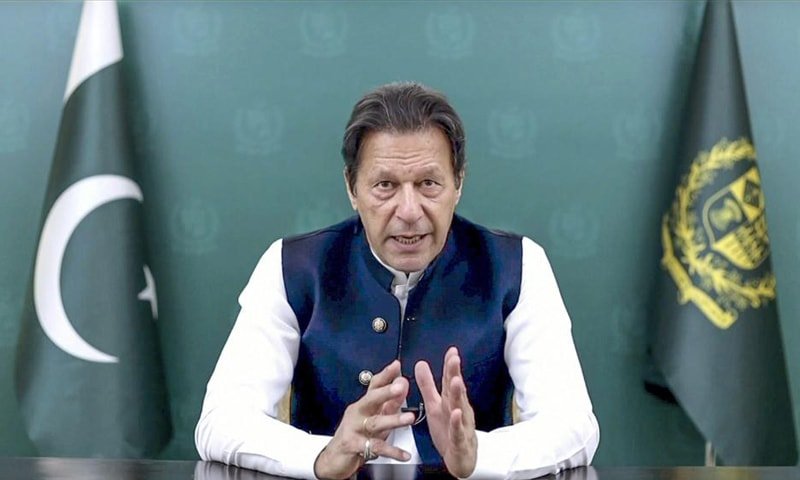
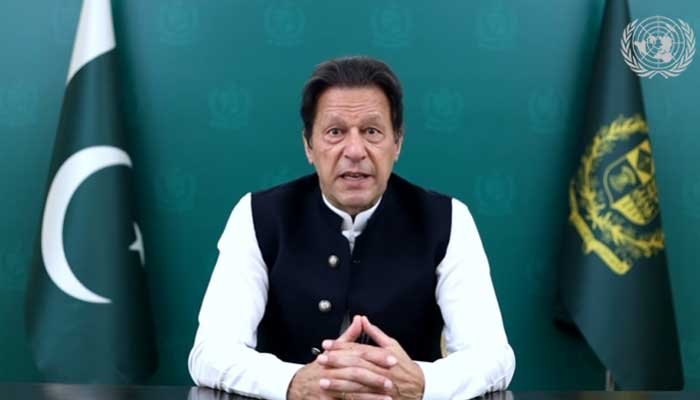
Prime Minister Imran Khan misquoted United States President Ronald Reagan’s statement, while delivering his address to the 76th session of the United Nations General Assembly (UNGA) on September 25, 2021,
PM Khan claimed that in the 1980s, former US President Ronald Reagan compared the Afghan mujahideen fighting against Soviet forces to the Founding Fathers of the United States.
Focal person to Chief Minister Punjab, Azhar Mashwani, took to Twitter and shared the video clip where the former president can be heard comparing Afghan Mujahideen as “moral equals of founding fathers of USA”.
If you watch the video attentively, you will find a minor glitch. The video is 0:48 seconds long.
At 0:37-0:45 seconds, Reagan says: “They are our brothers, these freedom fighters, who we owe them our help. You know the truth about them, you know who they are fighting and why.”
However, from 0:45 seconds to 0:48 seconds, there is a slight change in the sound of the president. The pitch of the sound is a bit higher as compared to the entire video. The words spoken by the president during these seconds are, “They are the moral equal of our founding fathers.”
Actual quote of the former US President, “In making mention of freedom fighters, all of us are privileged to have in our midst tonight one of the brave commanders who lead the Afghan freedom fighters—Abdul Haq. Abdul Haq, we are with you.”
And the non doctored, un-edited video where President Reagan describing Nicaraguam rebels (not Afghan freedom fighters) as moral equivalent of American founding fathers….
“They are our brothers, these freedom fighters, and we owe them our help. I’ve spoken recently of the freedom fighters of Nicaragua. You know the truth about them. You know who they’re fighting and why. They are the moral equal of our Founding Fathers and the brave men and women of the French Resistance,” said Reagan.
The anecdote that PM Khan shared about Ronald Reagan comparing the mujahideen to the Founding Fathers is a commonly made mistake and there is actually no truth to it. Reagan had actually compared Nicaraguan rebel fighters to the Founding Fathers, a comment which has since been wrongly connected to the mujahideen.
However, this is not the first time that the premier made this mistake. In 2019, PM Khan while speaking at an event at the Council on Foreign Relations (CFR) think tank in New York on Monday, September 23, claimed that in the 1980’s former Ronald Reagan compared the Afghan Mujahideen fighting against Soviet forces to the Founding Fathers of the United States.
Journalist Gharidah Farooqi raised this issue initially. She took to Twitter and said, “What an international embarrassment that too at the #UNGA forum this time. US Pres RonaldRegan NEVER compared ‘mujahideen’ to Founding Fathers. It’s a FAKE NEWS. PM Khan refers to a fake “news item” to launch a case at such a prestigious forum! Who wrote speech for PM Khan? Fire him.”
What an international embarrassment that too at #UNGA forum this time. US Pres RonaldRegan NEVER compared ‘mujahideen’ to Founding Fathers. It’s a FAKE NEWS. PM Khan refers to a fake “news item” to launch case at such a prestigious forum! Who wrote speech for PM Khan? Fire him. pic.twitter.com/UaSLOOkeea
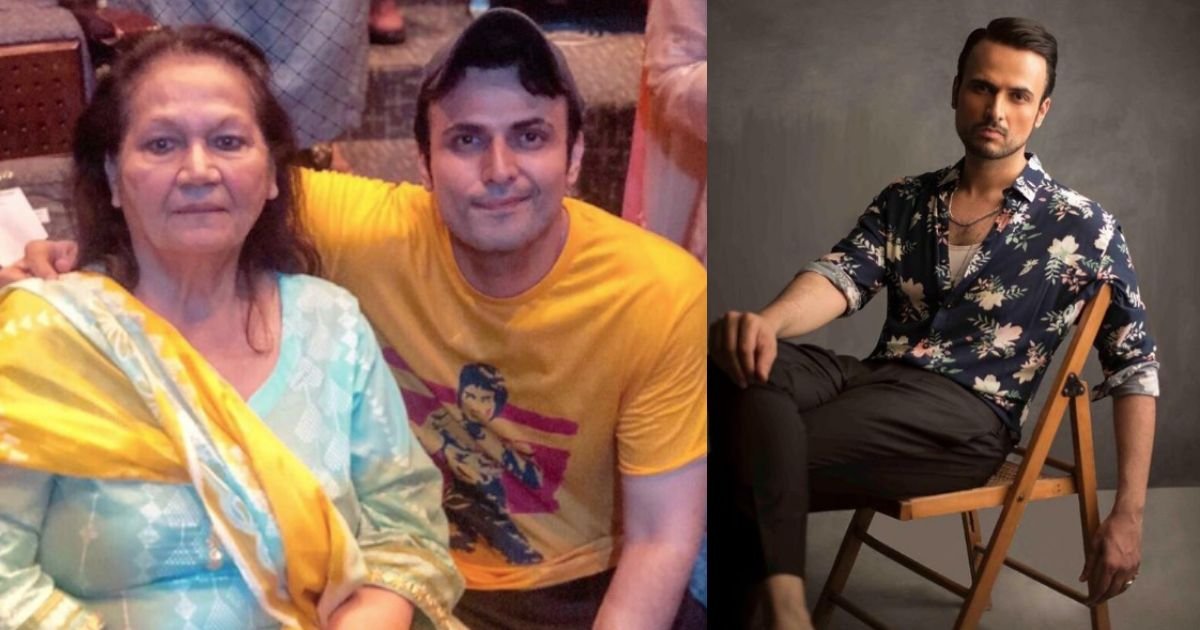
Actor Usman Mukhtar recently stated in an interview that he would rather think of other career options than disturbing his mother and shift to Karachi for more acting opportunities.
The Sabaat actor appeared on Gloss Etc by Maliha Rehman and talked about his current drama Hum Kahan Ke Sachay Thay, his role and other aspects of the story.
While talking about more work opportunities, the Anaa actor said: “I have lost some projects but for me, my mother comes first before anything else. and she’s unwell so I can’t leave her in Islamabad and come,”
He said, sharing that he has taken up very few projects where he had to travel to Karachi for longer periods of time.
“I would rather consider other career options and move to Karachi for more acting work . It is my duty to be there for her and I don’t think that’s anything inspirational or out of this world. She is the most important person of my life and she needs to be comfortable in the situation she is in.”
The Parchi star has also lost projects due to his reluctance to move to the port city. He is, however, willing to travel for about two-four weeks for projects only when there’s someone to look after his mother in his hometown.
Usman will be seen next in Sinf e Aahan, a collaboration between Six Sigma Plus, Next Level Entertainment, and ISPR. It will air on ARY Digital.
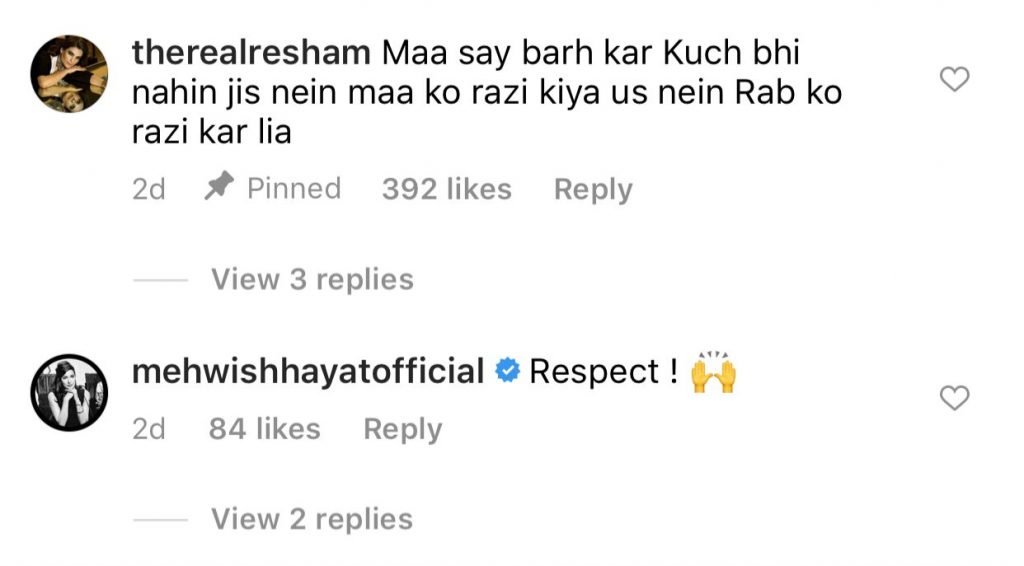
Meanwhile, female stars Mehwish Hayat and Resham cheered the actor for his love of his mother.
Actor Syed Jibran has clarified the reason for not posting pictures with his wife on social media. A netizen asked the Ranjha Ranjha Kardi star, “Where is afia kia aap un se pehli jitni mohabbat nhu krte?” to which Jibran replied : “Pehle se bhee zayada.”
Another user asked Jibran, “But aap unkay sath picture kyun upload nahi karte aur na wog krti hain? Aisa kyun?” (But why don’t you upload pictures with her nor does she? why is it so?”
To which he responded, “Takey buree nazar naa lagay” (To be protected from evil eye).
Syed Jibran can be seen currently in Geo Tv’s drama serial Mohabbat Dagh Ki Soorat along side Neelum Munir and Sami Khan.
Actor Muneeb Butt is being praised by his fans on social media for his impressive performance in ARY’s Baddua. The Koi Chand Rakh star is being appreciated for his looks, styling and performance in this Ramish Rizvi’s directorial.
The Baandi hero is playing a character with grey shades.
Fans took to the official YouTube channel of ARY to praise Muneeb:
Netizens also praised Mohsin Abbas Haider and Amar Khan’s acting.
Penned by Samina Ejaz of Yariyaan fame the drama is another project of Abdullah Seja’s iDream Entertainment Production. It also features Samina Ahmed and Mehmood Aslam.
Thousands of players in around 30 different sports disciplines are expected to be unemployed after the federal government issued a notice calling on all government departments, businesses and autonomous bodies to stop funding sports teams, reported Dawn.
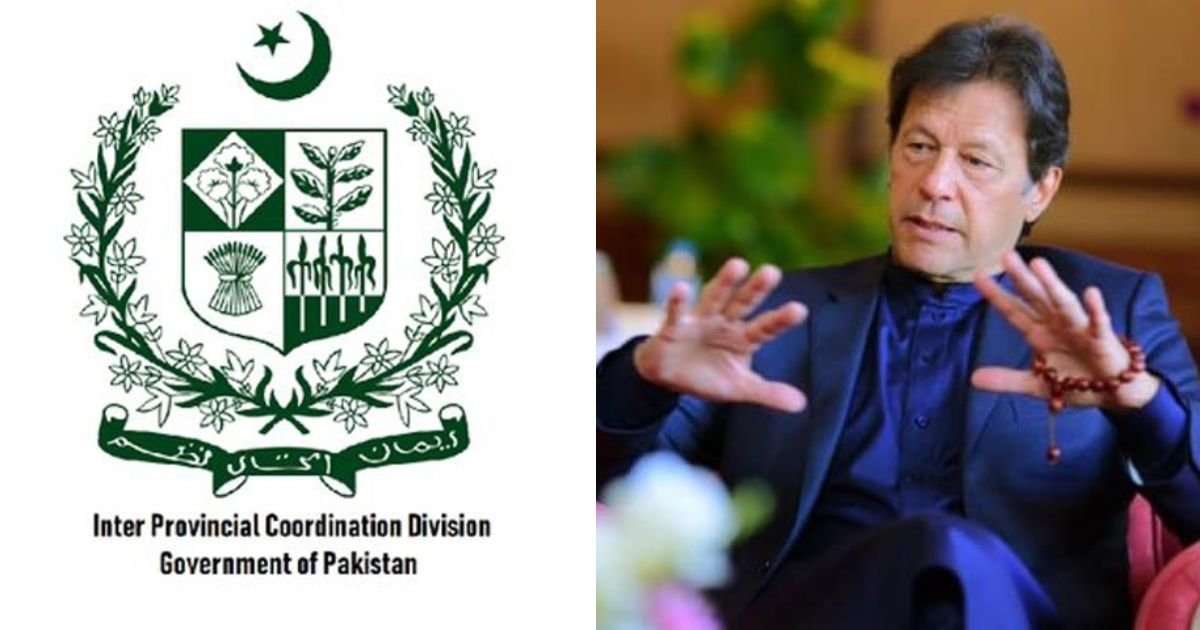
“During a meeting on the overhaul of the sport governance structure in Pakistan held under the chairmanship of the Pakistani Prime Minister on September 1, the Honorable Prime Minister wished to end the funding of departmental sports teams of various organizations / companies / autonomous government bodies. and, instead, these funds can be used for the promotion of regional sports teams,” wrote the additional secretary of the Ministry of Interprovincial Coordination, Mohsin Mushtaq Chandna, in a letter that was received in different departments working under the government. .
He further asked them to divert funds to regional teams.
“In order to implement the orientations of the Honorable Prime Minister, you are therefore asked to prepare a practical transition plan to divert funding from departmental teams to regional teams, within two months, which should be implemented. Work within six months of March 1, 2022,” the letter concluded.
As per Dawn, one of the main features of the national sports policy that the IPC ministry has proposed is to discourage departmental sports.
A copy of this letter was sent to the Presidents of Pakistan International Airlines, Islamabad, Wapda, Higher Education Commission, Railways, FBR, IGs of Punjab, Sindh, Khyber Pakhtunkhwa, Balochistan, Gilgit-Baltistan, Azad Jammu & Kashmir and President National Bank from Pakistan.
The move came after Prime Minister Imran Khan abolished the departmental cricket configuration, which resulted in thousands of cricketers losing their jobs.
Although ministries have been asked to divert funds to sponsor the six newly formed provincial cricket associations, instead of spending this amount on their own teams, no ministry has been able to set rules for transferring these funds.
Pakistan has historically produced athletes who have excelled in their disciplines through the departmental system.
An official in one of the departments, who received the letter revealed that it was not possible for them to transfer their funds to the regional teams. Most of the athletes in Pakistan are employed by departments, including javelin thrower Arshad Nadeem and Talha Talib, who impressed with their performances at this year’s Tokyo Olympics. Both represent the department, Wapda.
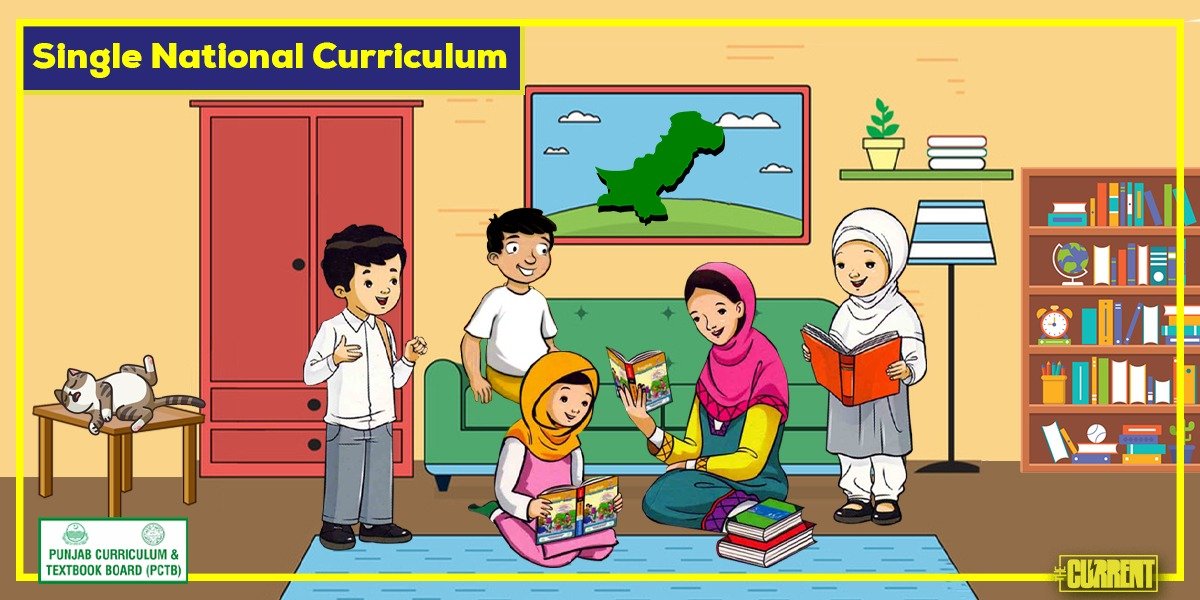
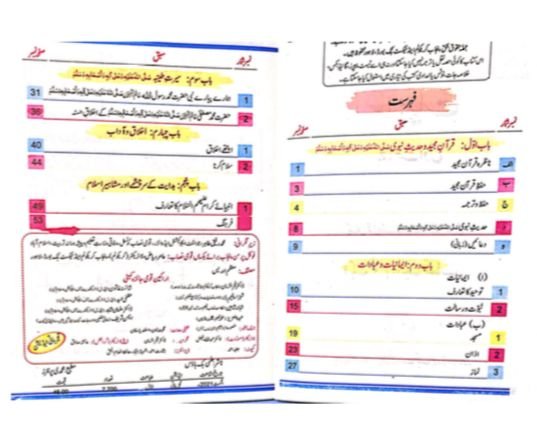
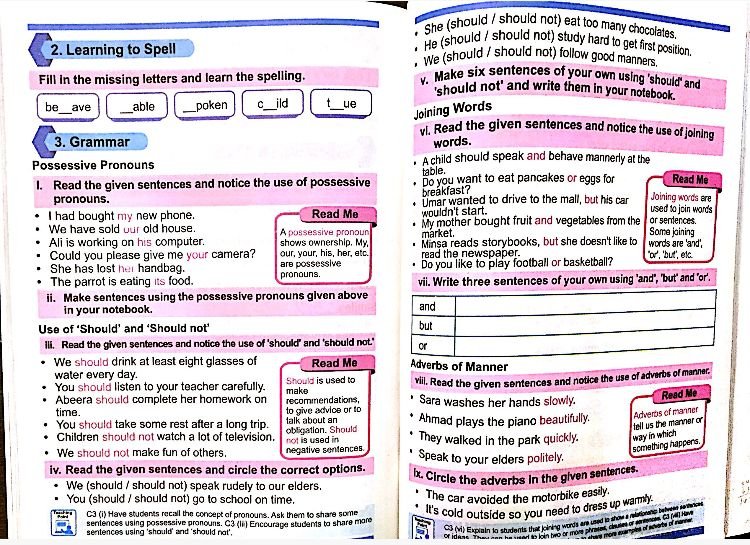
On August 16, 2021, Prime Minister Imran Khan officially launched the Single National Curriculum (SNC). The newly launched curriculum was prepared by the National Curriculum Council (NCC) and the Ministry of Federal Education, in consultation with the provinces. According to PM Khan, “SNC would transform the nation into a unified one.”
What is SNC?
According to the Ministry of Federal Education and Professional Training, the SNC is a ‘uniform’ system of education, which means the same curriculum for everyone. All public schools, private schools, and madrassas were meant to have the same curriculum so that the learning outcomes are similar and without any discrimination in teaching standards. This is not the first time SNC was imposed in Pakistan. It was previously introduced in 2006 by Former President Musharraf. Whereas the previous SNC was a curriculum-based initiative, the one introduced by the PTI government is imposing the use of the textbooks produced by the provincial boards.
Is it being implemented across the country?
No. Sindh has decided not to implement the curriculum since education is a provincial issue. Only Punjab and Khyber Pakhtunkhwa have enforced it so far. However, many schools in both provinces — including the prestigious Aitchison College, Lahore — expressed their concerns over the books in the curriculum. The Director of the National Curriculum Council (NCC), Dr Mariam Chughtai, has also said that madrassas will implement the SNC syllabus in five to six years, which undermines the reason why the government had wanted to introduce the SNC in Pakistan – to bring madrassas into the mainstream so students would be able to get jobs in other professions after they graduated.
Controversies surrounding the SNC
After the SNC syllabus was imposed on schools across Punjab, many controversies surrounding the books and the curriculum came forward. From the disparity in gender representation, the reinforcement of patriarchal gender roles, the lack of female heroes, and religious texts in the non-religious books.
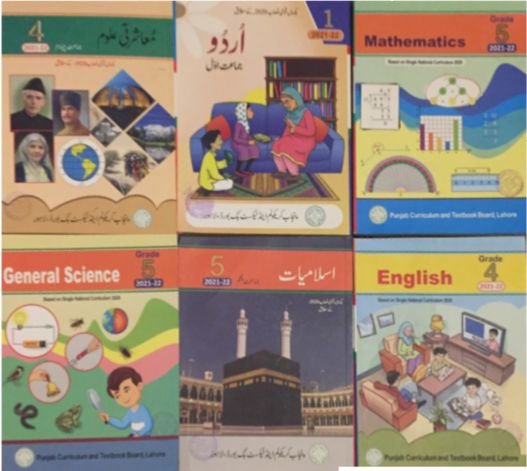
To see if the criticism is valid, The Current analysed the following books published under the Punjab Textbook Board (PTB):
Urdu books from grades 1 to 5, English books from grades 1-5, Mathematics books grades 1, 2, 4, and 5, General Science grades 4-5, Waqfiyat Aama grade 1 and 3, Social Studies 4-5, and Islamiat grade 1- 5.
Two books were not available at the time of research. Grade 3 Math and Waqfiyat Aama grade 2, which have not been included in the study.
The analysis here has been divided into two parts.
Part one comprises the data analysis of all the books included in the SNC by the Punjab Text Book board.
Part two comprises the data analysis of individual subjects being taught to the students.
We studied the total number of male and female representations in the books, a comparison of the eastern and western wear of both genders, the presence of religious (Islam and others) content in non-religious books, and studying the distribution of power roles assigned to both men and women.
Here is the list of most common criticism against the curriculum and the evidence we found:
SUMMARY OF CONTENT IN ALL SNC BOOKS
1- Disparity in Gender Representation:
One of the most debatable points in the entire SNC is the representation of men and women.
After a thorough evaluation, we found that the concerns about the disparity in gender representation are TRUE.
The study reveals that a total of 60.2 percent of the books have images of men, including boys and only 39.4 percent of the books have images of women, including girls.
2-Women represented in hijab vs non-hijab, and women in western clothes:
What the women are wearing became a source of contention in the discussion about the SNC, with critics suggesting that the women should equally represent the country in terms of the hijab, eastern clothes, and the choice to wear western wear.
It is TRUE that there is no equal representation of women’s appearance in the books.
Women’s appearance was divided into three categories.
A) Number of women wearing eastern clothes with hijab.
B) Number of women wearing eastern clothes without hijab.
C) Number of women wearing western clothes.
Our research shows that 41.6% of all women and girls in the SNC books are wearing a hijab, 28.9% are wearing eastern clothes without a hijab, and 29.4% of the images show girls wearing western wear. It is important to note that in the western wear percentage, almost all of the images are of young girls. Older women are not shown wearing western wear.
3-Men represented in eastern vs western clothes:
Since the appearance of women in eastern wear and hijab became controversial, we also studied how many times men appeared in western or eastern wear.
A massive 79.9 percent of men were seen wearing western clothes, in comparison to 20 percent dressed in eastern clothes.
4- More men in ‘power roles’ compared to women:
Another controversy suggested that the books did not show women in positions of ‘power’, and they were mostly listed as helpers or homemakers. While there were many images that showed women in ‘inferior roles’ to men, there were women that were shown in roles of power.
This controversy is TRUE.
We defined power roles shown in the books as doctor, pilot, lawyer, police officer, traffic warden, army sports personality, etc and after analysing all the books, we found that a men are given power roles three times more than women. The results in the graphic below are based on the total number of images shown of men and women in all the SNC Punjab books.
I
5. Religious content in non-religious books
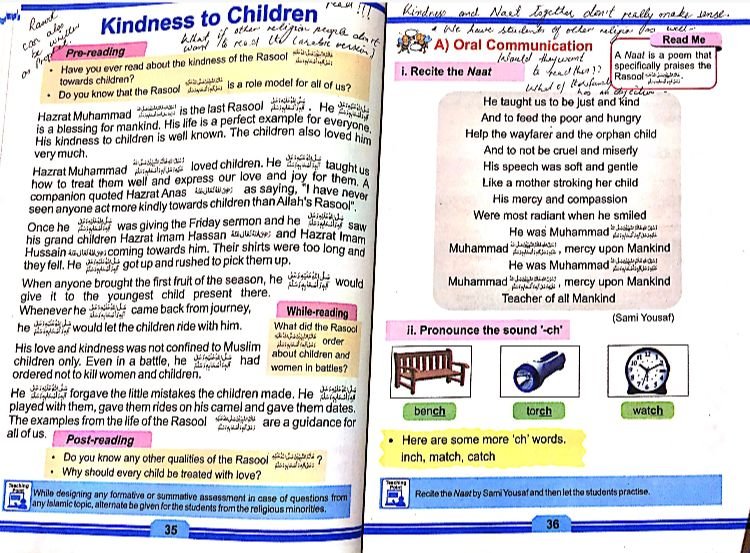
In almost all the books which were studied, we saw the presence of religious references or mentions in non-religious books. Minorities felt their rights were being compromised since books that are not for religious studies should not have references to a specific religion, which may come under the context of ‘preaching’.
In our analysis, we saw a total of 7.77 percent of religious text in all SNC non-religious books, which lends TRUTH to the fact that there is religious content in non-religious books.
Religious content is present in 7.7 percent of English, Math, Social Studies, Urdu, Science, and General Knowledge books.
7.47 percent of books have references to Islam while 0.27 percent mention other religions in all non-religious books.
Dr Mariam Chughtai, while answering a question for The Current about the religious references in non-religious books, did not provide a clear answer but stated that these are model books that require changes.
SNC BOOKS ANALYSIS – SUBJECT ANALYSIS
This section of the report comprises an analysis of individual subjects being taught to students. The subjects under study were, Urdu books from grades 1-5, English books from grades 1-5, Mathematics books grades 1, 2,4, and 5, General Science grades 4- 5, Waqfiyat Aama (General Knowledge) grades 1-3, Muashrati Uloom (Social Studies) grades 4-5.
The graphical representation of the subject-wise evaluation is as follows:
English:
In 668 pages of English books, 58.1 percent have male representation while females have 41.8 percent.
29.7 percent of women are seen with Hijab and 70.2 percent are without Hijab.
There is a total of 9.8 percent presence of religious text in English books. This is based on the total number of pages in English books.
Mathematics:
In 672 pages of the Math books, when gender representation was analysed, 51.1 percent of the books have male representation and 48.8 percent have female representation.
A total of 53.9 percent of females are seen without hijab and 46 percent are seen wearing hijab.
The Math books have a 4.1 percent presence of religious text. This is based on the total number of pages in Math books.
Urdu:
The five Urdu books comprising 791 pages. A total of 59.7 percent presence of males are seen as compared to 40.4 percent of females.
58.5 percent of women/girls are seen wearing hijab and 41.4 percent are seen without hijab.
12.8 percent of religious text is present in Urdu books. This is based on the total number of pages in Urdu books.
General Science:
Out of 310 pages, 76.8 percent have male representation as compared to 23.1 percent female representation.
64 percent of women/girls are seen without hijab and 36 percent of women/girls are seen with hijab.
The General Science books have a 0.96 percent presence of religious content. This is based on the total number of pages in Science books.
Waqfiyat Aama (General Knowledge):
49.5 percent of male images are seen in comparison to 50.15 percent of females.
23.1 percent of females are seen with hijab and 76.8 percent without hijab.
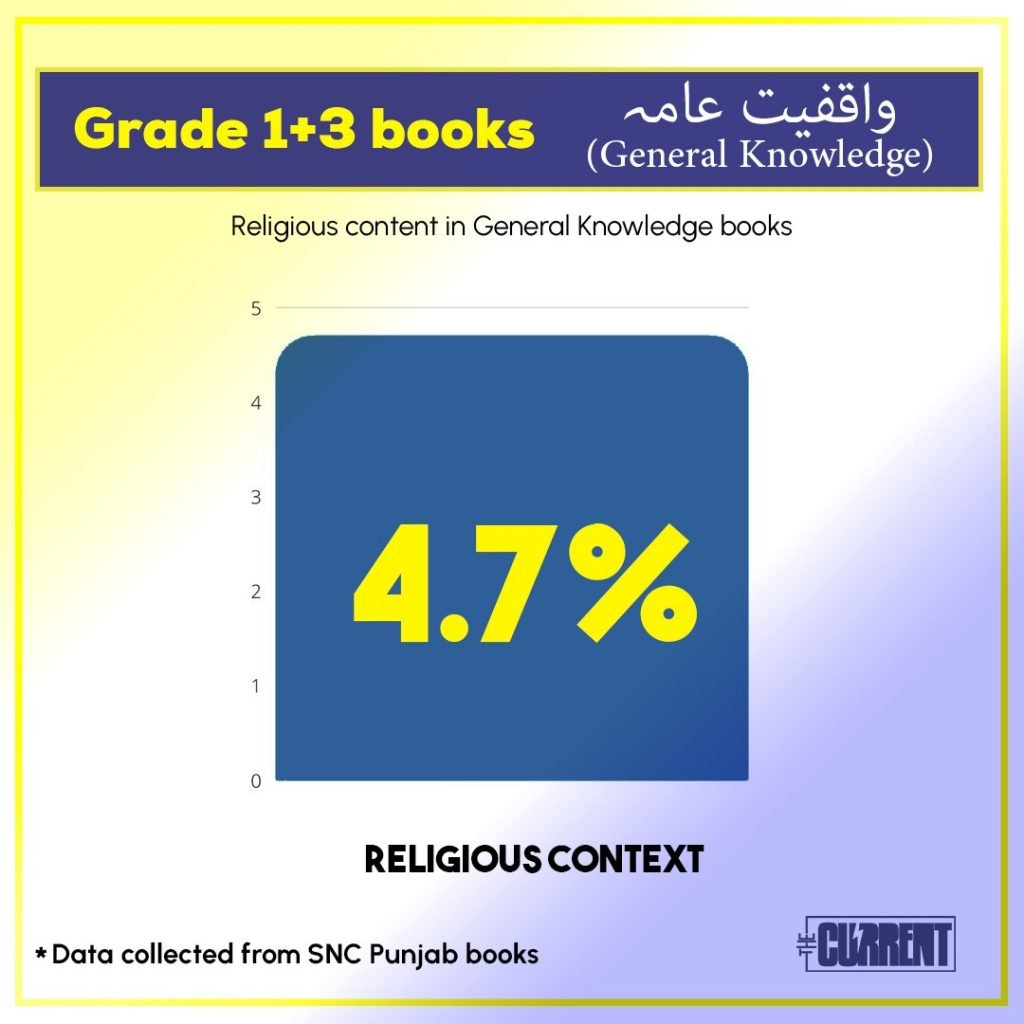
There is a 4.7 percent presence of religious text in the books studied. This is based on the total number of pages in General Knowledge books.
Muasharti Uloom (Social Studies):
From 234 pages analysed, 65.1 percent of men/boys are represented in the books and 34.8 percent of females are shown.
36.8 percent of females are seen without hijab and 63.1 percent are seen with hijab.
10.2 percent of religious content is present in the books. This is based on the total number of pages in Social Studies books.
The last portion of the report highlights the pros and cons, which we have observed in almost all the books. We have provided both positive and negative outcomes deduced from the books after careful analysis.
The positive outcome deduced from the books:
1. The books are locally published and designed. The books are affordable, with a total set for one grade set at Rs. 800 per child according to Dr Chughtai.
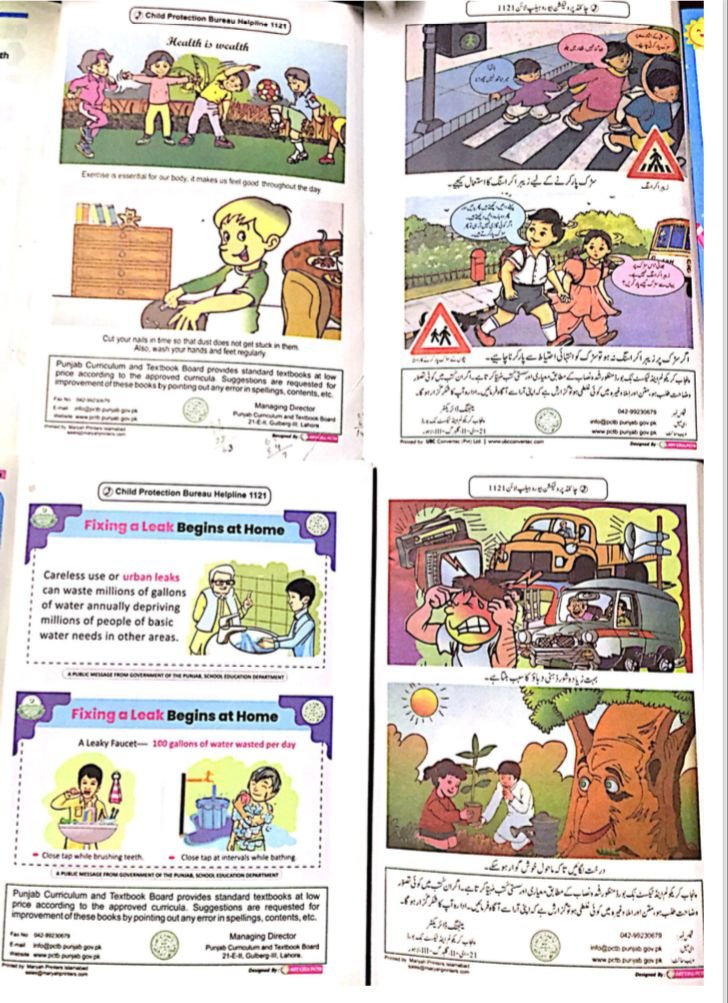
2. There is a public service message printed at the end of each book to raise awareness against talking to strangers, crossing the road, exercising, and even information about fighting dengue.
The possible negative impact of the books
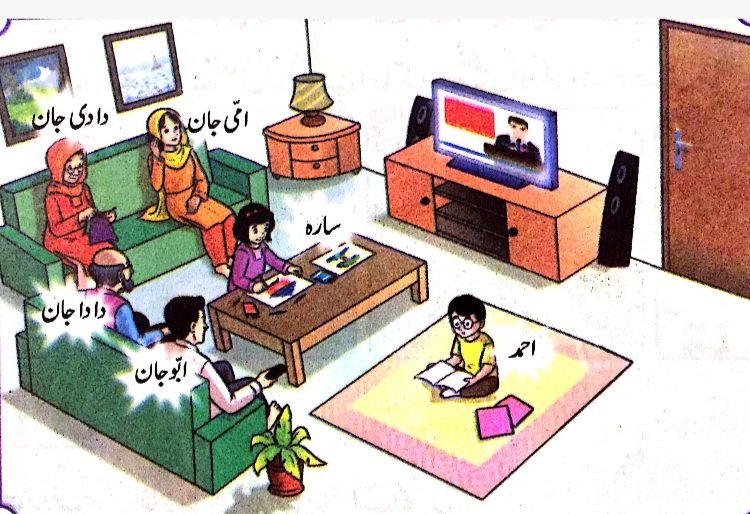
1. After analysing the books, we deduced that mostly nuclear families have been shown in the books. No representation of single parents or children being raised by guardians is seen. Moreover, the presence of both parents is seen as almost essential in all stories in the books.
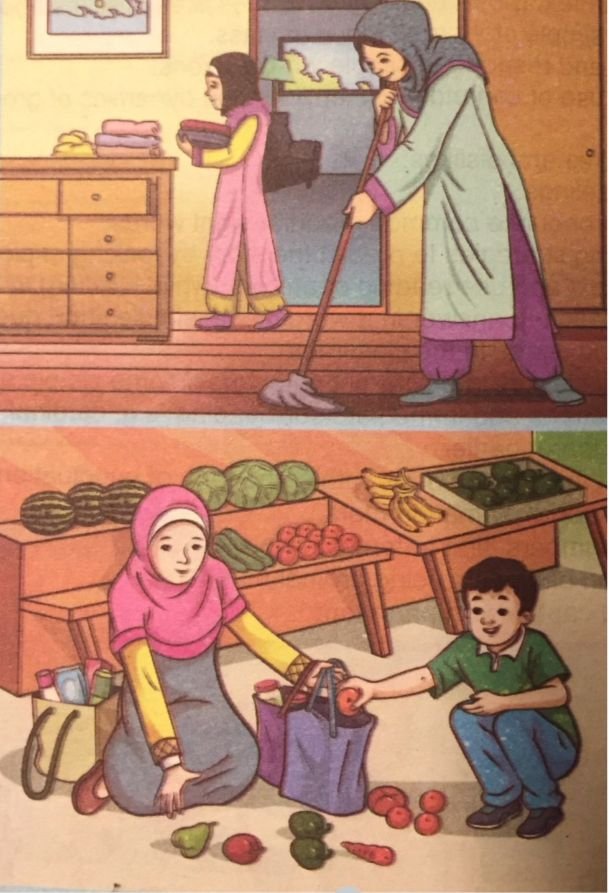
2. Women are mostly shown doing domestic work, taking care of the family, and looking after their children. In stories as well, they seem to come second to their male counterparts.
3. As discussed in detail above, there is the presence of religious text in non-religious books.
4. The stylisation of the books are difficult to understand, fonts and texts are way too clustered. The quality of the pages is not refined, making them unattractive and confusing for students.
CONCLUSION:
According to NCC director, Dr Chughtai, the curriculum is an evolving process and the books can be changed in future publications, based on the response by schools and parents. The biggest hurdle to the books is that the teachers have not been trained in teaching these new books and according to Dr Chughtai, it is up to the school to teach and implement the books. There are no worksheets given with the books and from initial student reactions, students are confused and wary of books that are laid out in a clustered fashion. There is also the subject of a language change. Where students study general knowledge, a precursor to Science, in Urdu, they switch to difficult English in grades 4-5.
While the government should be commended in trying to create a national syllabus, the forced enforcement of the books along with the lack of supplemental information and training will make this very difficult for teachers and students. Moreover, parents should be given a choice as to what they want their children to study. This implementation should be a free choice rather than that of enforcement. What would have been a practical approach is that the government should have improved the structure of the government/public schools, provided better teacher training, spent more on financially improving the conditions rather than lowering the standard for all.
*Graphics credits: Asma Ahmad (Graphic Designer)
How did we collect the data?
The percentage of male characters in the books: Divided the total number of male by the total number of characters. The percentage of female characters in the books: Divided the total number of female by the total number of characters.
The percentage of Islam: Divided the Islamic pictures or references given in the books by the number of total pages of all books. The percentage of other religion: Divided the other religions pictures or reference given in the books by the number of total pages of all books.
The percentage of female power roles: Divided the number of female by the total number of characters (female and male). The percentage of male power roles: Divided the total number of male by the total number of characters (female and male).
The same process/calculation/method was applied to the findings of each book.
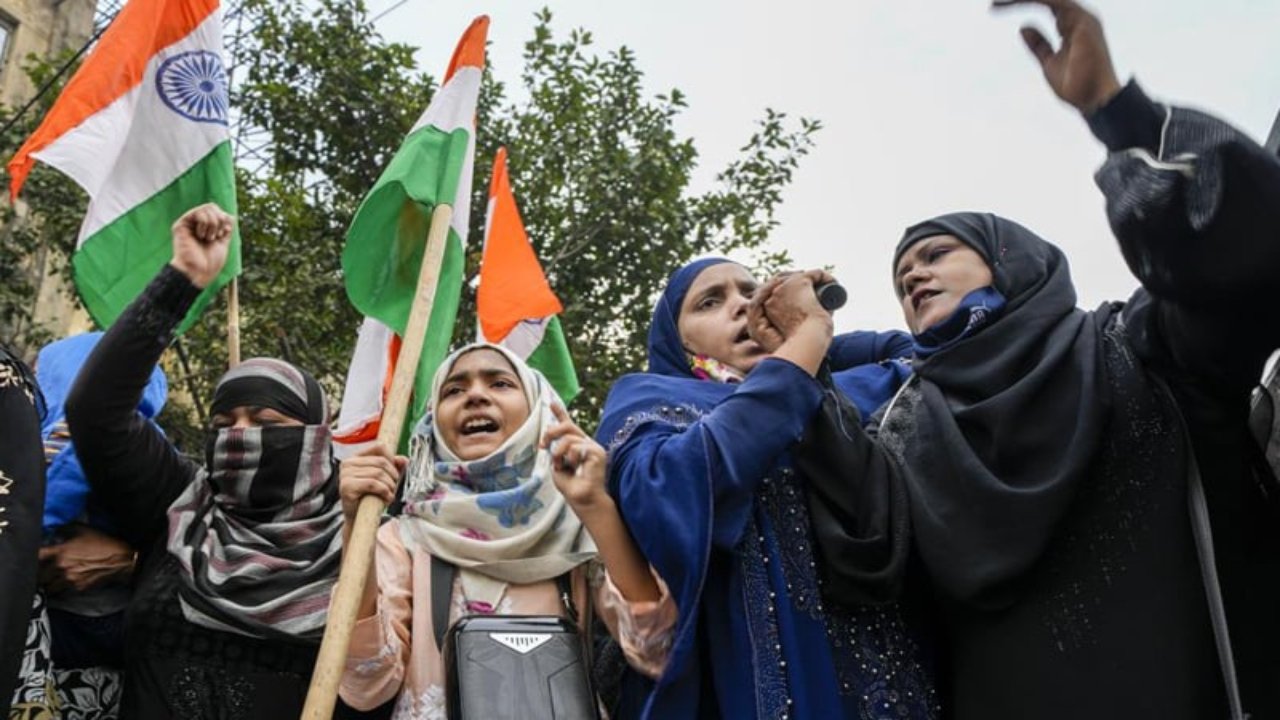
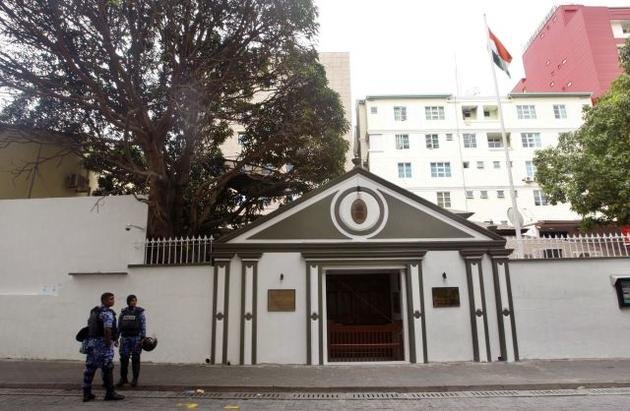
The Foreign Office (FO) summoned the Indian Charge d’ Affaires on Friday and conveyed the government’s concern over the recent target killing of Muslims in the Indian state of Assam.
In the incident, two people were reported dead. It took place in the Sipajhar area of Assam’s Darrang district, where most of the residents are Muslims, reports Dawn.
In the video, several cops can be seen beating a man with sticks even as he lay motionless on the ground. It went viral on Twitter after which Indian Prime Minister (PM) Narendra Modi came under fire.
Earlier, Pakistan’s federal minister Fawad Chaudhry condemned the incident, and said, “Today, Prime Minister Imran Khan will once again draw the attention of the United Nations to the atrocities taking place in India. #ModiFascism.”
Actor Shahroz Sabzwari appeared on Nida Yasir’s morning show to celebrate the success of his drama serial Nand. The Hassad star stated that every brother should be like his character Saqib from Nand in real life.
The character slaps and divorces his wife (essayed by Minal Khan) because his sister had issues with her. Shahroze believes that men should prioritize siblings over spouse.
A visually impaired Pakistani female diplomat Saima Saleem raised her voice against India violating human rights in Indian occupied Kashmir during the 76th United Nations General Assembly (UNGA) session.
In her speech, Saima said that India’s violation of human rights in India occupied Jammu and Kashmir are well documented in the two reports of the high commissioner for human rights.
“Since 5th August 2019, the High Commissioner has urged India to unlock the situation and fully restore the rights that are currently being denied to the people of the occupied territory,” she added.
— Permanent Mission of Pakistan to the UN (@PakistanUN_NY) September 25, 2021
She further said that “major human rights organisations including the Human Rights Watch and Amnesty International have expressed similar serious concerns about India’s human rights violation including in the occupied territory.”
“Not surprisingly, Indian authorities have failed to respond to any of these communications.”
Federal minister for information and broadcasting, Fawad Chaudhry, lauded Saima for highlighting the Kashmir issue.
Prime Minister Imran Khan delivered his address to the 76th session of the United Nations General Assembly (UNGA) earlier today. He said, “There is only one way to go. We must strengthen and stabilise the current government, for the sake of the people of Afghanistan.”
“Strengthening the current Afghan government for the sake of people of Afghanistan is the only way forward,”
“Right now the whole international community should think what is the way ahead. There are two paths that we can take. If we neglect Afghanistan right now, according to the UN half the people of Afghanistan are already vulnerable, and by next year almost 90 per cent of the people in Afghanistan will go below the poverty line.”
“If the world community incentivises them, and encourages them to walk this talk, it will be a win-win situation for everyone. Because these are the four conditions that the US-Taliban dialogue in Doha was all about,” PM Imran Khan said.
“You cannot waste time. Help is needed there. Humanitarian assistance has to be given there immediately. The Secretary-General of the United Nations has taken bold steps. I urge you to mobilise the international community, and move in this direction,” he said.
ON ISLAMAPHOBIA
The premier also discussed Islamophobia and said that the UN Global Counter-Terrorism Strategy has recognised as an emerging threat, as it increases the tendency of right-wing, xenophobic, and violent nationalists, extremists, and terrorist groups to target Muslims.
“We hope the Secretary-General’s report will focus on these new threats of terrorism posed by Islamophobes and right-wing extremists,” the prime minister said.
“Islamophobia is pernicious phenomena that we all need to collectively combat,”
“I call on the Secretary-General to convene a global dialogue on countering the rise of Islamophobia. Our parallel efforts, at the same time, should be to promote interfaith harmony, and they should continue,” he added.
The prime minister went on to underscore how New Delhi has also embarked “on what it ominously calls the ‘final solution’ for the Jammu and Kashmir dispute”.
“Indian actions violate the resolutions of the UN Security Council on Jammu and Kashmir. The resolutions clearly prescribe that the ‘final disposition’ of the disputed territory should be decided by its people, through a free and impartial plebiscite held under the UN auspices,” the premier added.
PM Imran Khan stated for the record that last February, both countries reaffirmed the 2003 ceasefire understanding along the Line of Control.
“The hope was that it would lead to a rethink of the strategy in New Delhi. Sadly, the BJP government has intensified repression in Kashmir and continues to vitiate the environment by these barbaric acts,” the premier said.
“The onus remains on India to create conducive environment for meaningful and result oriented engagement with Pakistan,”
He said the onus remains on India to create a conducive environment for meaningful and result-oriented engagement with Pakistan.
ON KASHMIR
PM Imran Khan highlighted the forcible snatching of the mortal remains of the great Kashmiri leader, Syed Ali Shah Geelani, from his family, denying him a proper Islamic funeral and burial, in accordance with his wishes and Muslim traditions, as the most recent example of Indian barbarity.
“Devoid of any legal or moral sanction, this action was even against the basic norms of human decency,” he said, adding: “I call on this General Assembly to demand that Syed Geelani’s mortal remains be allowed to be buried in the Cemetery of Martyrs with the appropriate Islamic rites.”
The prime minister also warned of another conflict between Pakistan in India, which he said is essential to prevent. “India’s military build-up, development of advanced nuclear weapons, and acquisition of destabilising conventional capabilities can erode mutual deterrence between the two countries,” he said.
ON CLIMATE CHANGE
Turning his focus to climate change, he termed it one of the “primary existential threats” that the world faces today.
“Being fully aware of our social responsibility, we have embarked upon game changing environmental programs,”