Athletes who participated in the Punjab Rising Games have returned their medals to the office of caretaker Sports Minister Punjab Wahab Riaz as a protest. The players returned their medals to expose the “false promises” of cash prizes by the Punjab Sports Board and Wahab Riaz.
All the national and international players participating in the tournament won medals by competing with heart and soul and they deserve better treatment. When the players tried to meet former cricketer and caretaker sports minister Wahab Riaz, his office was locked.
Riaz had earlier announced that the mega event will continue for 16 days and will include sports like volleyball, hockey, football, badminton, athletics, and table tennis.
The ongoing Punjab Rising Games started on January 18 and the final of the games will be held on February 2.
Wahab Riaz had announced before the tournament that the top performers in the mega event would be given a monthly stipend of Rs 70,000, Rs 50,000 and Rs 30,000 for a year based on their performance. The former cricketer also announced that a prize money of Rs 25 lakh will be given for each game during the mega event, but all these promises and announcements have not been fulfilled yet. A total of 950 players from all divisions of Punjab have registered for the event.
In today’s financial update, the Pakistan Stock Exchange (PSX) opened the week on a downbeat note, as the benchmark KSE-100 index experienced a decline of 628.33 points, or 0.98 per cent, settling at 63,184.74 by 10:20 am PST.
Investor focus is keenly directed towards the impending Monetary Policy Committee meeting later today.
Expectations loom large that the central bank will maintain the policy rate unchanged, although some are optimistic about the possibility of a marginal rate cut.
The KSE-100 index witnessed a trading volume of 19.534 million shares. Notably, the underperformance is attributed to key sectors, with fertiliser, commercial banks, oil and gas exploration companies, oil and gas marketing companies, and cement collectively contributing to the index’s dip by 138.49, 135.75, 111.02, 40.79, and 39.84 points, respectively.
Specific companies weighing down the index include EFERT with 81.35 points, PPL with 56.52 points, OGDC with 45.06 points, MEBL with 39.27 points, and MCB with 30.37 points.
In the broader market scenario, the All-Share index is trading at 42,871.61, witnessing a net loss of 341.49 points.
It is noteworthy that during the fiscal year, the KSE-100 displayed substantial growth, gaining 21,732 points, or 52.43 per cent. In the ongoing calendar year, there has been a cumulative increase of 734 points, equivalent to 1.17 per cent.
Investors are navigating a dynamic landscape, closely monitoring the evolving economic indicators and anticipating the outcomes of the central bank’s policy decisions.
Japan’s Moon lander has come back to life, the space agency said Monday, enabling the craft to proceed with its mission of investigating the lunar surface despite its rocky start.
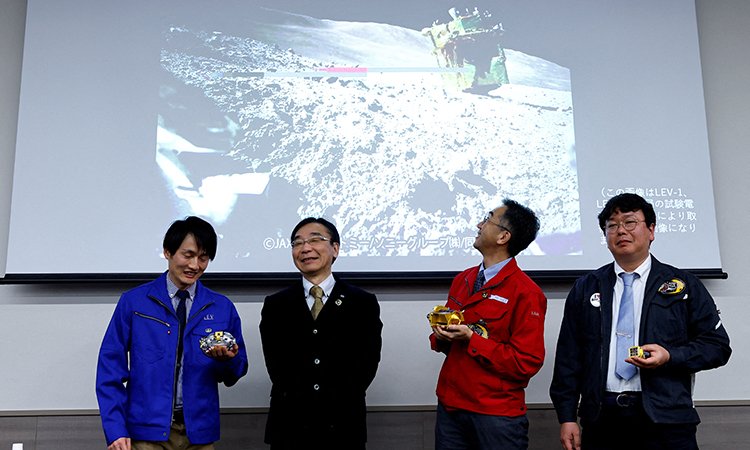
Officials from the Japan Aerospace Exploration Agency (JAXA), smile in front of a screen showing an image taken by LEV-2 on the moon, after their press conference on SLIM’s moon landing mission, in Tokyo, Japan. Reuters
The surprise announcement was a boost to Japan’s space programme, nine days after the Smart Lander for Investigating Moon (SLIM) touched down at a wonky angle that left its solar panels facing the wrong way.
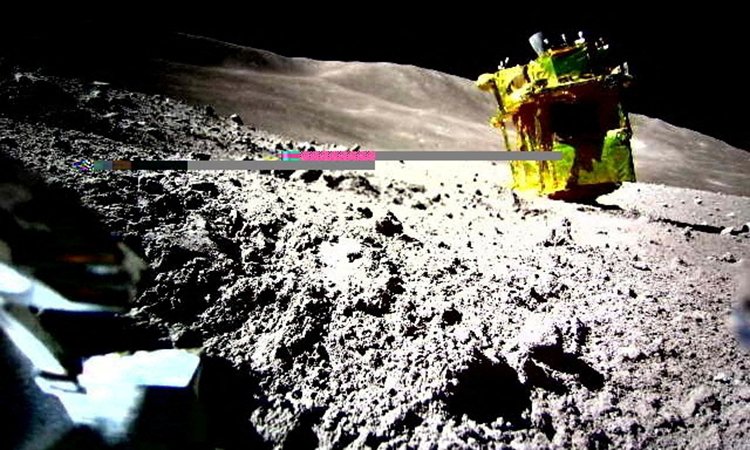
“Last evening we succeeded in establishing communication with SLIM, and resumed operations!” JAXA said on social media platform X, posting a grainy image of a lunar rock known as a “toy poodle”.
The Smart Lander for Investigating Moon (SLIM) is seen in this handout image. Reuters
“We immediately started scientific observations with MBC, and have successfully obtained first light for 10-band observation,” it said, referring to the lander’s multiband spectroscopic camera.
Terrifying minutes
SLIM’s January 20 touchdown made Japan only the fifth nation to achieve a “soft landing” on the Moon after the United States, the Soviet Union, China and India.
But on its descent, dubbed the “20 minutes of terror”, the craft suffered engine problems and ended up at a skewed angle, images released by JAXA showed.
This meant the solar panels were facing west instead of up, and it was uncertain if they would still get enough sunlight to function.
Last week JAXA said it had switched the elevator-sized SLIM off with 12 per cent power remaining, hoping that the craft would wake up this week.
A JAXA spokesman told the media on Monday that the SLIM operation resumed “presumably because power generation resumed in its solar battery as it received sunlight”.
“We will prioritise what we can do now — observing and collecting information — rather than adjusting SLIM’s position since adjusting the position could lead to a worse situation,” he said.
“The daytime (where SLIM is on the Moon) will last until around the end of January and it will be at night from around February,” he said.
Unknown men targeted the election offices of the Pakistan People’s Party (PPP) and the National Party (NP) in Balochistan on Sunday, ahead of the highly anticipated nationwide elections set to take place on February 8.
The two grenade blasts have sparked concerns about security measures leading up to next month’s general polls, while election campaigns of all political parties are underway throughout the country.
Unknown men lobbed a grenade at the NP election office in Mastung district, leaving two people wounded following its explosion at Muhammad Shahi Road, police said, noting that the attackers managed to flee from the scene.
The police quickly took the injured people to the hospital. The police force launched a search operation in the area to catch the culprits.
The NP spokesperson strongly condemned the “cowardly” grenade attack, stating that despite such “cowardly acts,” they will continue to push forward with campaign efforts at an accelerated pace.
On the other hand, unidentified miscreants threw a hand grenade at a PPP election office in the Qalat district, specifically in the Mangocher area. There were no reported casualties in this incident.
An Indian tennis team has reached Pakistan to play Davis Cup Group 1 tie of the Davis Cup competition after 60 years.
An Indian tennis team last visited Pakistan in 1964. Pakistan Tennis Federation (PTF) Secretary Colonel (retd) Gul Rehman and other officials of the federation welcomed the Indian team on their arrival.
The team arriving in Pakistan includes five players, two physios, one coach, one manager, and one coordinator. The two-day India-Pakistan Davis Cup will begin on February 3 at the Pakistan Sports Complex in Islamabad.
It should be noted that the All-Indian Tennis Association (AITA) tried to use all options to deprive Pakistan of hosting rights, first approaching the Davis Cup Committee and then the Chair of the Independent Tribunal to move the tie to a neutral venue. However, his efforts went in vain and he was left with only two options: either to travel to Pakistan to play the tie or forfeit the tie and face the wrath of the International Tennis Federation (ITF) and pay fines.
Fearing fines and possible repatriation, the Indian team eventually decided to travel to Pakistan and arrived in the federal capital.
In January, a discerning shift towards disinflation is anticipated, as headline inflation is poised to soften to 27.2 per cent year-over-year (YoY), attributed to a favourable base effect.
This decline from the previous month’s 29.7 per cent is primarily influenced by a higher base in the preceding year, while monthly pressures on consumer prices are expected to persist.
Despite the overall yearly decrease, monthly inflation is projected to rise by 0.93 per cent month-over-month (MoM), contrasting with the 12-month average of 2.2 per cent MoM.
Consequently, the average yearly inflation for the first seven months of fiscal year 2024 is estimated at 28.57 per cent YoY, up from 25.40 per cent YoY in the same period last fiscal year.
The surge in monthly inflation is predominantly fueled by a rise in the food and housing index. Food inflation is expected to increase by 1.76 per cent MoM, driven by inflated prices of essential commodities such as onions, chicken, tomatoes, eggs, and pulses.
Meanwhile, the housing index is projected to experience a 1.54 per cent MoM increase, primarily due to quarterly rent adjustments. In contrast, the transport index is anticipated to decrease by 2.69 per cent MoM, attributed to relief in fuel prices.
Looking ahead, a 0.5 per cent MoM inflation rate in February could result in an annual headline inflation of around 22 per cent, with a gradual decline below 16 per cent by June 2024.
Even a 1 per cent MoM inflation rate, significantly lower than the 12-month average, is expected to maintain real interest rates from turning positive until March 2024, as illustrated in the accompanying chart depicting various monthly inflation scenarios.
Starting in January, the disinflationary trend is expected to accelerate due to the favourable base effect, the lagged impact of monetary tightening, and other administrative measures.
However, potential risks include unforeseen climate events, volatility in global commodity prices—especially oil—and external account pressures.
Rising global oil prices amid geopolitical tensions pose a threat to the inflation outlook, and an additional gas price adjustment, as suggested by the International Monetary Fund (IMF), may further intensify pressure on consumer prices.
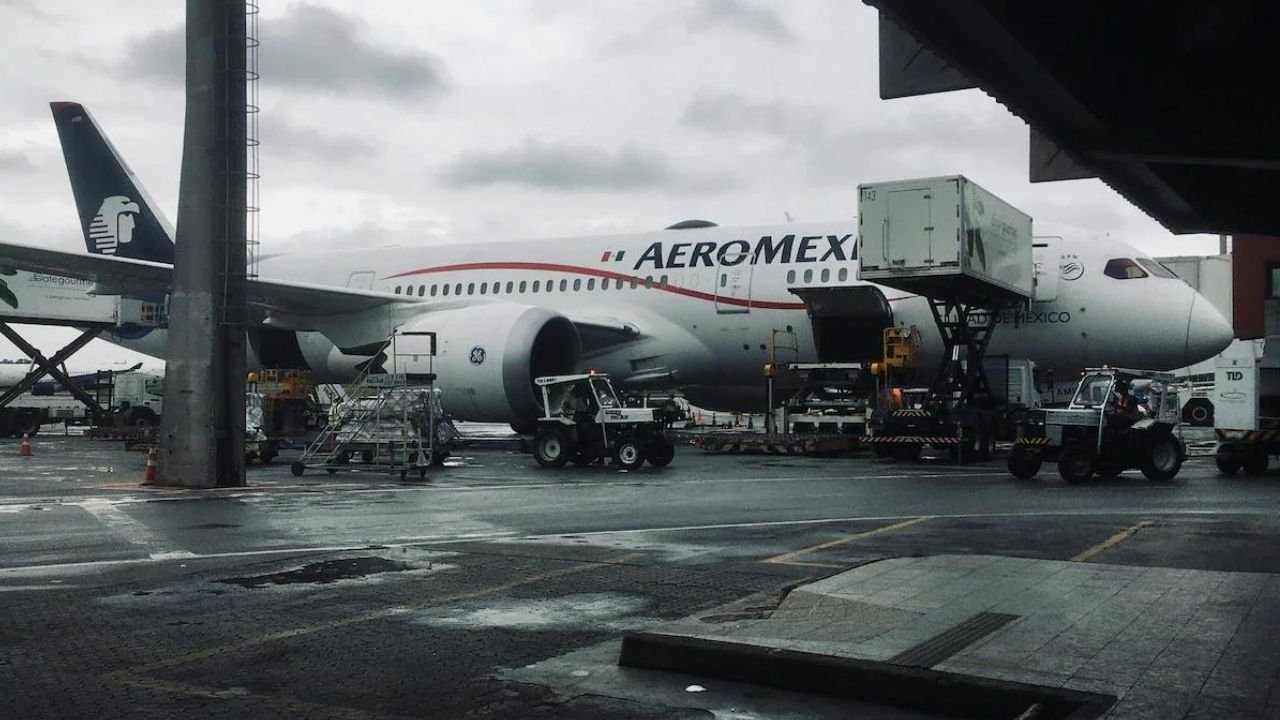
A Guatemala-bound flight from Mexico City faced an unusual twist when a passenger, frustrated by a lengthy delay and hot weather, opened the emergency door and walked onto the wing.
The Aeromexico flight, scheduled to depart at 8:30 am, was grounded on the tarmac for three hours due to a maintenance issue. With no air conditioning or water available, tempers flared high among passengers.
In a dramatic turn of events, one unidentified passenger took matters in his own hands, opening the emergency door and stepping onto the wing to register his protest. While the Mexico International Airport authorities confirmed no harm was caused, the man was detained by police.
The airport said in a statement, “Yesterday a passenger on a flight to Guatemala opened an emergency door on a plane while it was stationary at a remote position, stood on a wing, and then re-entered the cabin, without affecting the aircraft or anyone else.” The statement added that in line with international security regulations, this person turned himself over to the authorities.
Los pasajeros del vuelo 672 de Aeromexico fueron retenidos durante 4 horas, sin acceso a agua y con poca ventilacion, un pasajero abrió una puerta de emergencia y se paro sobre el ala del avion,La Guardia Nacional lo arrestro. pic.twitter.com/dJAO2wN7ds
However, dozens of passengers signed a written statement protesting the airport’s decision to turn the man over to the authorities. At least 77 passengers onboard the aircraft signed the statement demanding the passenger’s immediate release. They said the man’s outburst was ”to protect everyone, with the support of everyone.”
“He saved our lives,” the note declared, emphasizing the dangerous conditions caused by the delay and lack of air. The passengers expressed their support for the man’s actions, arguing they were taken for everyone’s protection.
A report on the incident said that a change of plane had become necessary after the passenger’s dramatic move. It was not clear whether the man was still in custody, or what charges he may face.
Indian stand-up comedian Munawar Faruqui won Big Boss 17 by defeating Abhishek Kumar in the grand finale. He has gone home with a trophy, prize money of INR 50 lacs, and a luxury car.
Dongri resident, stand-up comedian and rapper Munawar Faruqui gained popularity as the winner of Kangana’s controversial reality show ‘Lock Up’. The comedian stay in the news every day with an endless series of controversies following him.
Munara Chopra walked out of the Bigg Boss 17 house before them. Earlier, Ankita Lokhande was evicted from the house, shocking Salman Khan, who said that he was expecting that he would be the winner of the show.
Munawar may rule millions of hearts today but there was a time when his family was facing financial problems. Before he moved to Mumbai in 2007, his family faced a financial crisis and at that time the comedian had to support his family by selling samosas. Given the circumstances of the family, Manwar Faruqui used to work in a pottery shop in Mumbai. For this work, he was paid only 60 rupees per day.
Munawar has also worked as a graphic designer. In the year 2017, he started working in comedy, and now he is the most loved stand-up comedian in India and is very popular in Pakistan too.
Social media is heavily flooded with election-related content as the country is heading towards poll in less than two weeks. All the major political parties and even independent candidates have released songs and campaigns on social media to impress the audience with catchy tunes.
For us, the Haqooq-e-Khalq Party takes the trophy. Ammar Ali Jan’s “Loudspeaker” is riveting and hits all the right chords. “Haqooq-e-Khalq hai awaz muzdooron aur kisanaon ki” ticks the boxes of aims and ambitions needed to be a part of a manifesto.
Ammar’s social media team is also venturing into using popular songs as they put famous Punjabi song like “Teer te taj” as a background score to appeal the voters of all backgrounds.
So proud of all the people who are participating in our grassroots campaign in PP160 and NA127. We will keep the red flag flying high! pic.twitter.com/NUkWiLjJDB
Haha. Not sure why social media team chose this song but they tell me I don’t understand tik tok. So I guess/hope they know what they are doing. https://t.co/hPGsNDCY1N
Following Ammar Jan’s effort is the PTI, the party without a symbol. Their campaign is screaming creativity as they have got their songs made separately for the symbols allotted to them be it a fork (kaanta) or a radio.
یار حد ہوگئی۔۔۔ ایسے بھی بھلا کوئی کیمپین کا سوچ سکتا تھا ؟ ریڈیو کیلئے ایسے بھی ووٹ مانگے جا سکتے تھے ؟ pic.twitter.com/1Rsx7PhvHp
Saif ur Rehman is a contesting election from NA 235. He incorporated a Bollywood song ‘Kaanta laga’ for his campaign. It is hilarious and attention-grabbing at the same time.
Usman Dar’s mother Rehana Dar is contesting on PTI’s ticket under the symbol of baby cot for which they have twisted Arif Lohar’s party song, “Aa tenon mouj karawan” seamlessly as “Maan tujhe Salam”.
Folk singer Malko’s ‘Nak da Koka’ went viral for his one verse about “Qaidi 804”. This prompted him to sing part two, titled ‘Murshid’, dedicating it to Imran Khan. This went on to create a spree of songs, all dedicated to PTI, acquiring millions of views.
The popularity of this song influenced PML-N to make a rip-off for their party’s election campaign.
https://youtu.be/sJGK1aPfmYs?si=kpnrImL1ANlPXIhk
‘Umeed se Yakeen Tak’ is slowly growing on the people.
Another rip-off of Malko’s ‘Chas Bari Aye Ae’ is groovy all thanks to the original song.
https://youtu.be/xiqx-wjnBaE?si=8N2-IjE_UnnkhMc-
N-League deserves the credit of having an integrated campaign as a YouTube channel is dedicated to songs but most are just rip-offs.
Pakistan People’s Party has recently released a newer version of their widely popular ‘Utho Utho’.
‘Chuno Nayi Soch Ko’ has all there needs to be to appeal to gen-z audience and all the elements of a catchy election campaign.
PPP is not using this song in jalsas anymore but we found a hidden gem with the name of ‘Jiyalay Teer Chala’ on YouTube. It is not just uber-cool but has all the potential for mass appeal.
In a nutshell, the campaigns are in full swing and all the parties are trying their best to have more reach but our observation says that the one that explores more mediums and does not hesitate in experimenting manages to gather more ears and eyeballs.
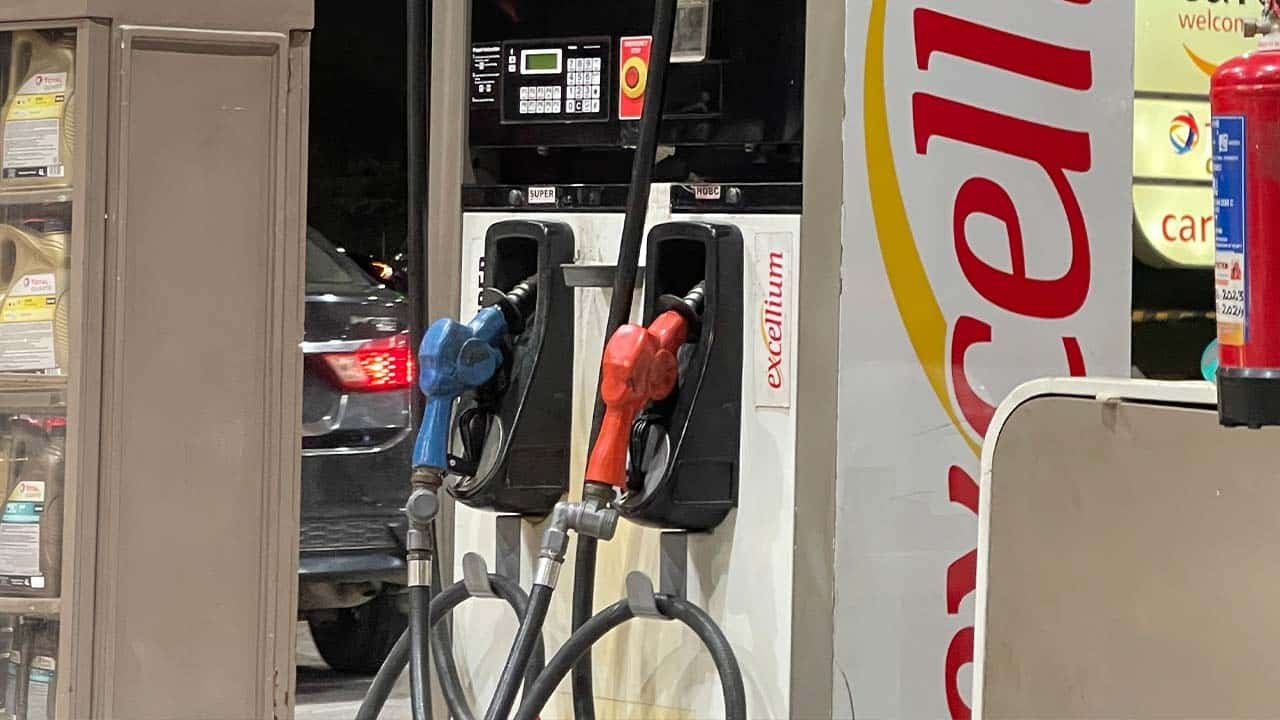
In response to the recent surge in global oil prices, the government is anticipated to raise petrol and diesel prices by Rs11 and Rs6 per litre, respectively, for the first half of February.
The significant 11 per cent and 25 per cent increases in the premium on petrol and diesel contribute to the upward adjustment.
Recent pricing estimates until January 26 reveal a 5 per cent rise in finished petroleum prices to $87.7 per barrel and a 1 per cent gain in finished diesel prices to $97.4 per barrel.
Despite a slight appreciation of the local currency, which stands at a weighted average rate of around PKR 279.87 per USD since the last pricing decision, it remains insufficient to counterbalance the substantial international price hikes.
It’s crucial to note that there are three more sessions before the next pricing update, and final prices will be contingent on global market movements and exchange rate fluctuations.
The government is set to unveil the revised prices at midnight on January 31, 2024, and these adjustments will be effective for the first half of February.
Notably, in the previous fortnight, the government reduced petrol prices by Rs8 per litre to Rs259.34 while keeping diesel prices steady at Rs276.21 per litre.