Author: newsdesk

  • Why homemade cable cars matter in Battagram: Safety steps for future

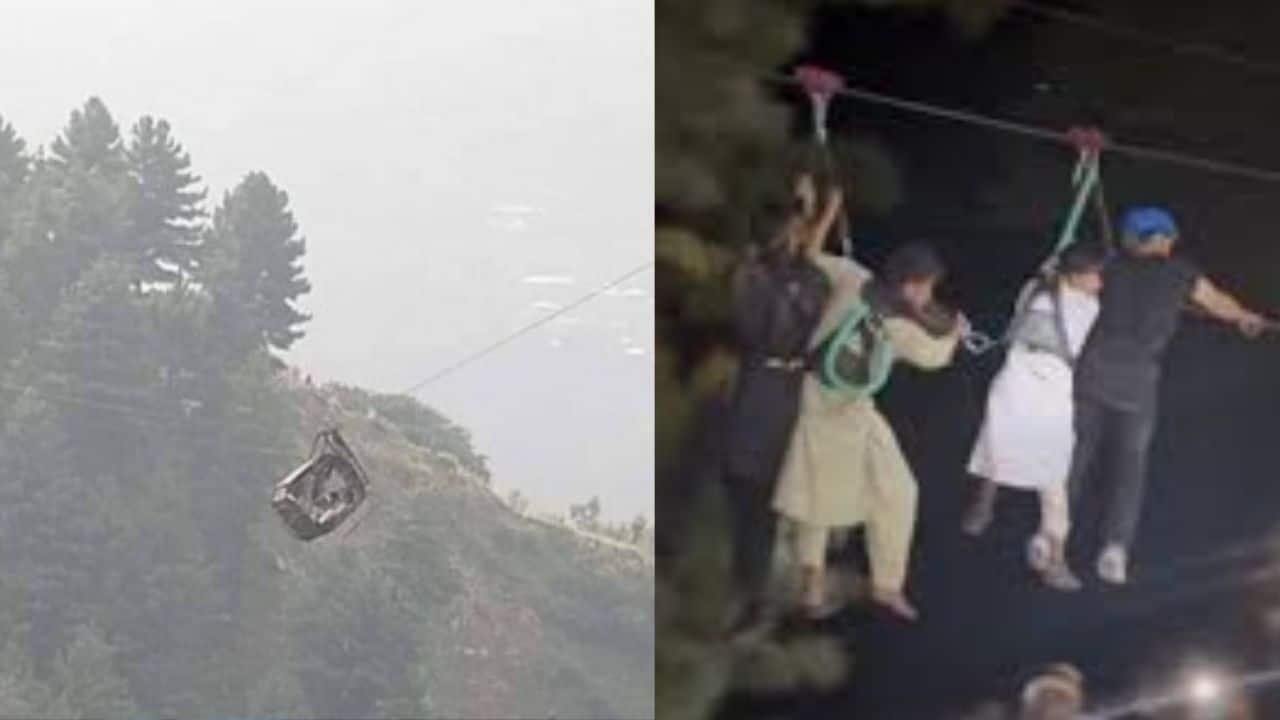
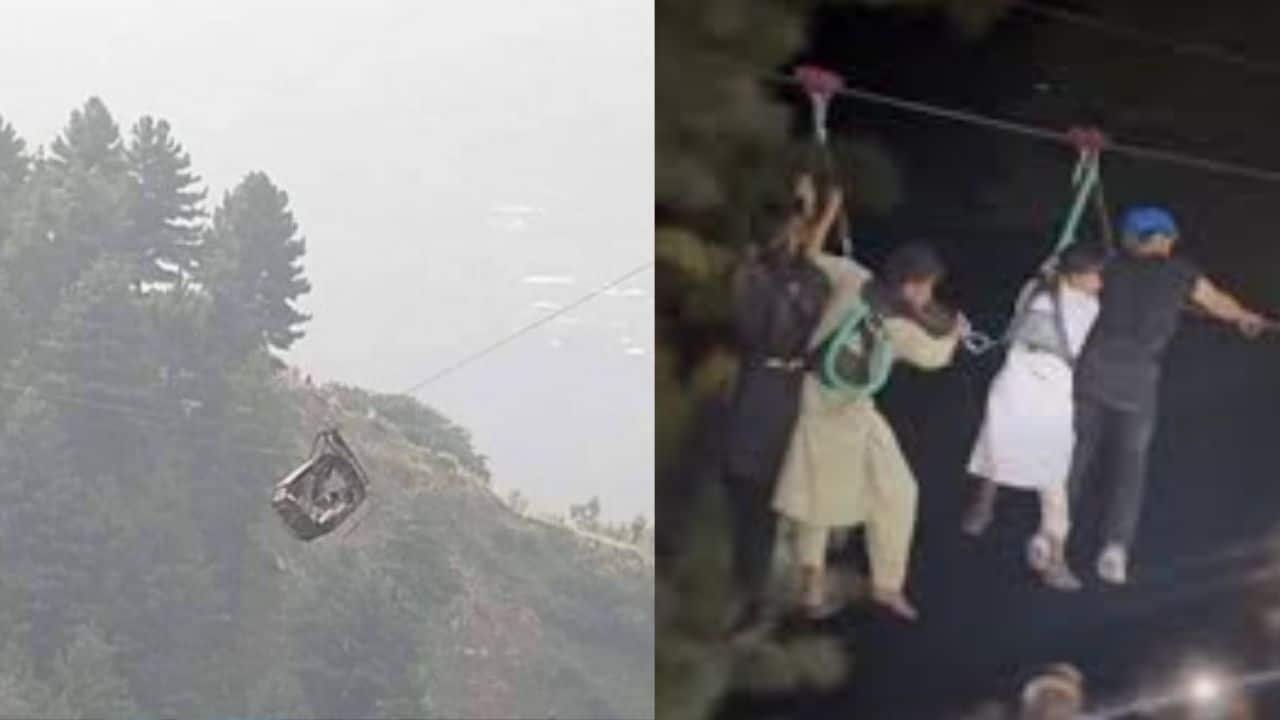
    In a daring rescue operation, the Pakistan Army’s Special Services Group (SSG) successfully saved eight stranded passengers from a cable car mishap in Allai Tehsil, located in Khyber Pakhtunkhwa’s Battagram district. This incident sheds light on the widespread use of homemade cable cars in the northern regions of Pakistan. These improvised transportation systems, though risky, play a crucial role in connecting remote communities that lack traditional infrastructure.

    Homemade cable cars have become a familiar sight in the remote corners of Pakistan, where conventional infrastructure is absent. While venturing onto these makeshift contraptions involves risks, they offer an indispensable solution to transportation challenges faced by communities with limited alternatives. This trend is particularly prevalent in eastern Mansehra, Azad Jammu and Kashmir (AJK), and Gilgit Baltistan, areas marked by geographical obstacles and scarce amenities such as schools and roads.

    Necessity breeds innovation, and in the absence of official provisions, locals in these remote regions have taken it upon themselves to construct cable cars using scrap materials. These rudimentary structures are often assembled from the discarded upper bodies of pickup trucks or Suzuki vehicles. These cabins are then affixed to cables, sometimes comprised of scrap iron, using ropes. The impromptu nature of these constructions often flouts legal requirements, but the cost-effectiveness and lack of viable alternatives drive the locals to resort to this approach.

    Risking it for convenience: Benefits and hazards

    The risks of using these cable cars are undeniable, yet they remain a popular choice for crossing rivers and shortening travel distances between mountain valleys. Take, for instance, the Allai region, where the recent incident unfolded. A local resident secured permission to construct a cable car named “Dolly,” transforming a two-hour, arduous trek into a mere four-minute cable car ride. The affordability factor, with fares as low as Rs20, renders these cable cars the preferred mode of transportation for numerous residents.

    While offering a practical solution, these cable cars have an unsettling history marred by safety concerns. In 2017, an illegal cable car crash in Murree, Punjab, led to the tragic loss of 11 lives. Similarly, in Abbottabad, Khyber Pakhtunkhwa, last December, a cable car’s rope snapped, prompting a rescue operation to save 12 stranded children. These incidents underscore the dangers associated with these makeshift transportation systems.

    In the wake of the recent mishap, Pakistan’s caretaker Prime Minister Anwaar-ul-Haq Kakar has taken a decisive step. He has ordered safety inspections for all private chairlifts, ensuring their safe operation. This move underscores the need to balance the convenience these cable cars offer with ensuring the safety and well-being of the passengers who rely on them.

    Despite the recurring safety concerns, these homemade cable cars are unlikely to disappear from the landscape anytime soon. The absence of substantial investments in new infrastructure means that these improvised transportation systems will remain the primary mode of conveyance for residents living in the rugged terrains of the mountainous regions. The onus lies on the authorities to find a way to harness the advantages while mitigating the risks associated with these makeshift marvels.

    The incident that unfolded in Allai Tehsil serves as a stark reminder of the significance and perils of homemade cable cars in northern Pakistan. These resourceful creations bridge the gap between isolated communities and essential services, even though they come with inherent risks. As Pakistan grapples with balancing necessity and safety, it becomes evident that while these makeshift cable cars fill a void in infrastructure, their continued usage necessitates a renewed focus on ensuring passenger safety and exploring long-term solutions for transportation in remote regions.

    What should Pakistan do to prevent something like this from happening again?

    To prevent incidents like the recent cable car mishap from happening again, the government can take several proactive measures:

    1. Regulatory Framework: 

    The government should establish comprehensive regulations governing the construction, operation, and maintenance of homemade cable cars. These regulations should include safety standards, inspection procedures, and penalties for non-compliance. The guidelines should be communicated clearly to the local communities involved in building and operating these cable cars.

    2. Safety Inspections: 

    Regular safety inspections of all cable cars, both existing and under construction, should be conducted by qualified engineers or inspection authorities. These inspections should identify potential risks, structural weaknesses, and maintenance needs, ensuring that the cable cars are in optimal condition for operation.

    3. Technical Training and Support: 

    The government can provide technical training and support to the local communities involved in building and operating cable cars. This training could cover proper construction techniques, rope and cable maintenance, emergency procedures, and passenger safety measures.

    4. Permits and Approvals: 

    The government should streamline the process of obtaining official permits and approvals for constructing cable cars. This would help ensure that the cable cars are built according to safety standards and guidelines, minimising the use of substandard materials and makeshift construction.

    5. Public Awareness Campaigns: 

    Launching public awareness campaigns about the risks and safety precautions associated with using homemade cable cars is crucial. Informing both passengers and operators about proper conduct, emergency procedures, and potential hazards can contribute to safer transportation practises.

    6. Subsidies for Safer Materials: 

    To discourage the use of substandard materials, the government can provide subsidies or incentives for purchasing safer materials and equipment for constructing cable cars. This can encourage communities to invest in higher-quality materials that enhance the overall safety of the transportation system.

    7. Alternative Infrastructure Development: 

    While homemade cable cars address an immediate need, the government should prioritise the development of safer and more sustainable transportation infrastructure in remote areas. This could involve building bridges, roads, and official cable car systems that meet safety standards and provide a reliable mode of transportation.

    8. Emergency Response Planning:

    Establishing clear and efficient emergency response plans for cable car incidents is crucial. Local authorities and rescue teams should be trained to respond quickly and effectively in case of accidents or cable car malfunctions.

    9. Collaboration with NGOs:

    Collaborating with non-governmental organisations (NGOs) and international agencies that specialise in infrastructure development and safety can provide valuable insights and resources for implementing safer transportation solutions in remote regions.

    10. Monitoring and Enforcement:

    The government should enforce the regulations and guidelines consistently to ensure compliance. Regular monitoring of cable car operations, construction sites, and safety measures will help identify potential risks and ensure corrective actions are taken.

    By implementing these measures, the government can work towards minimising the risks associated with cable cars and ensuring the safety of passengers and operators in remote areas of Pakistan.
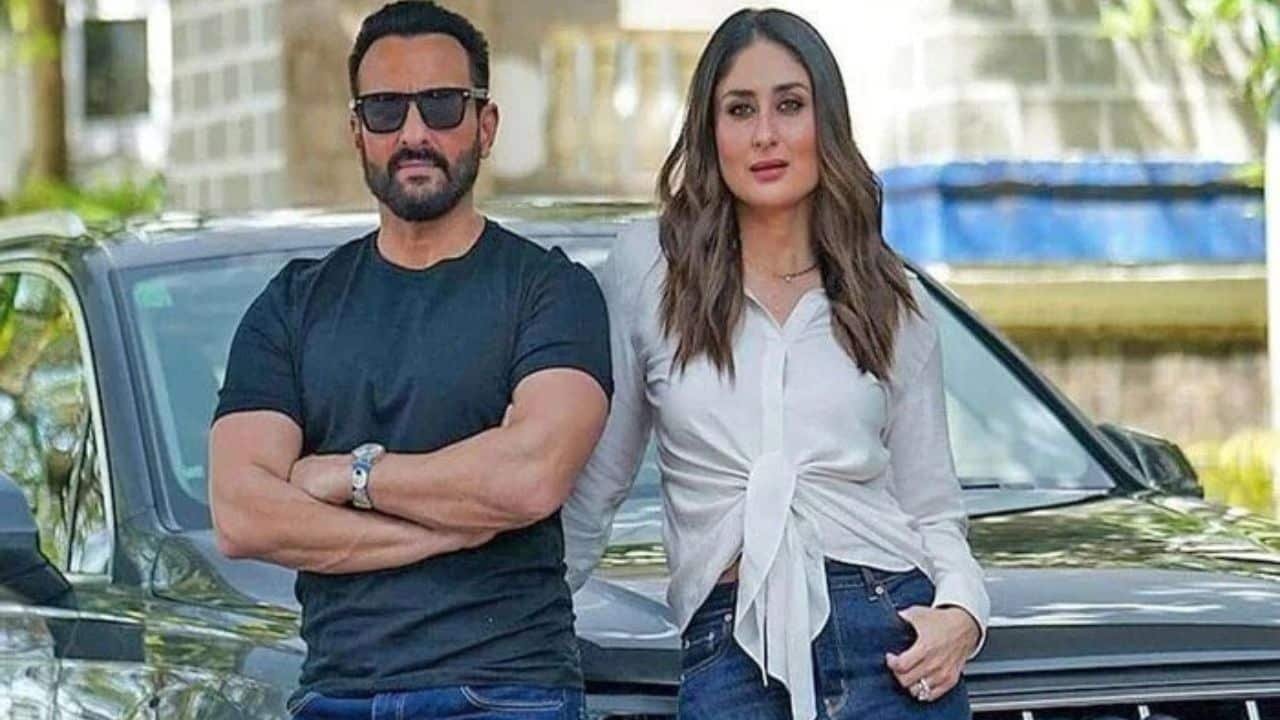
  • ‘I can’t even boil water’: Kareena Kapoor says Saif Ali Khan is the cook of the family

    ‘I can’t even boil water’: Kareena Kapoor says Saif Ali Khan is the cook of the family

    Once a diva, always a diva

    Is there anyone who has embodied the Queen Bee persona more than the Bollywood beauty Kareena Kapoor? The actress recently gave an interview at an event in New Delhi where she hilariously revealed that she can’t cook, and it is her husband, actor Saif Ali Khan, who handles that department.

    “I can’t even boil water,” the actress joked. “I am a Swiggy and Zomato person. I have a husband and a cook who make the food in this household.”

    The ‘Don’ actress went on to praise her husband, whom she married in 2012 and shares two kids with.

     “Saif is an amazing cook. He cooks everything. He cooks all types of cuisine, including Italian, like pasta, and pizza. We go through a recipe together and then try to cook it.”

    The ‘Veer Di Wedding’ actor also opened up about how the couple are actually home birds, despite being A-list power couple. The two are more fond of cooking at home rather than eating out at restaurants. Kareena said the two spend more time at home during weekends to spend time with their children.

     “We try not to work. We try to be at home on weekends. Taimur often says I want to be with my friends”. This is proof that he is growing up fast. We like to cook meals, play games, and play UNO. We also love to cuddle up and be together.”

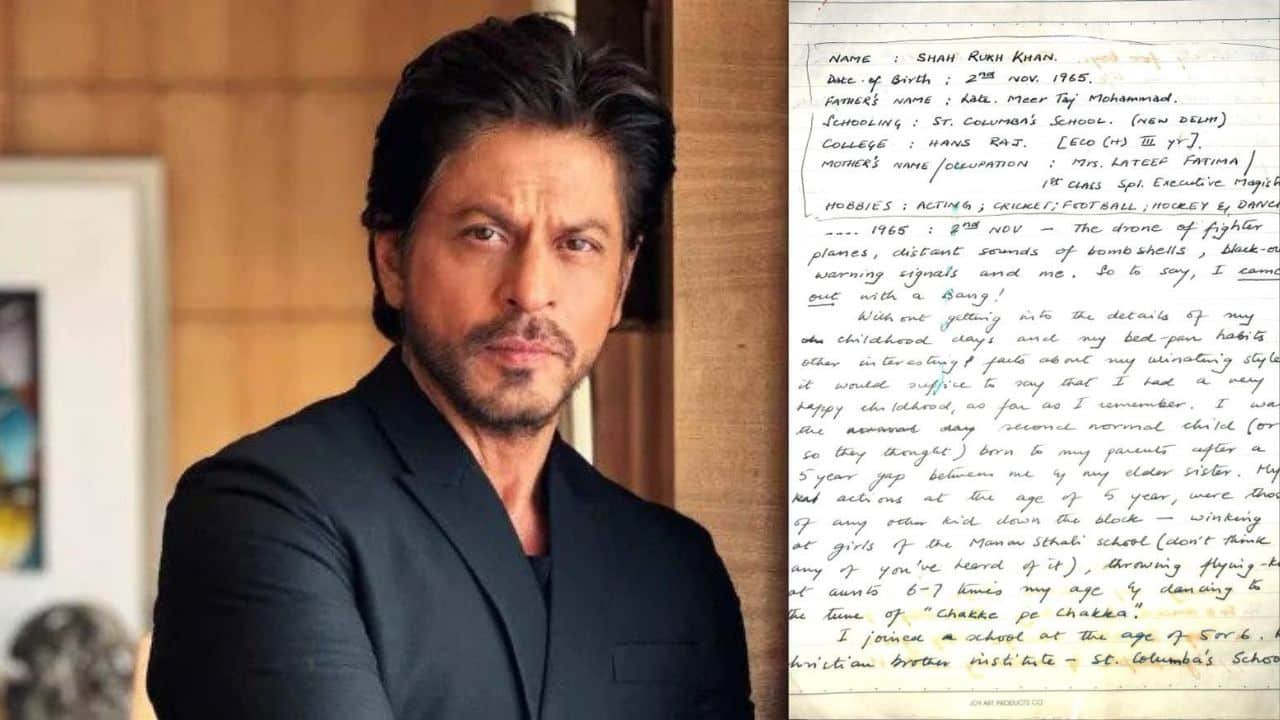
  • Shah Rukh Khan’s handwritten college essay about childhood has moved Twitter to tears

    Shah Rukh Khan’s handwritten college essay about childhood has moved Twitter to tears

    It turns out Shah Rukh Khan was fated to become an entertainer because even when he wasn’t famous, he could move people with his wit and charm. An X (formerly Twitter) user posted an essay written by the Bollywood Badshah when he was in college.

    The “Badshah” actor began the essay by hilariously writing that without going into details about his “bed-pan habits” or other interesting facts about his “urinating styles”, he could safely say he had a happy childhood.

    The actor reminiscences about how cheeky he was as a child: “My actions at the age of 5 years were of those of any other kid down the block-winking at girls of the Manavsthali School, throwing flying kisses at aunts 6-7 times my age, and dancing to the tune of Chakke pe Chakka.”

    The essay also talks about the actor’s interest in sports, including football, hockey and cricket. The ‘Pathaan’ actor wrote about how he was chosen to be a wicket keeper for cricket matches, played centre, forward for hockey and also received the ‘Best Player Award’ at the All Delhi Schools Hockey Competition. In football, Shah Rukh says he was the captain of the school team for the Youth Review Soccer Tournament.

    The essay went viral on Twitter, moving social media users with its wit and elegant prose

    https://twitter.com/deewana_man/status/1467110660211417095?s=20
    https://twitter.com/fsharkz/status/1466995391321149440?s=20

  • Inspection of all chair lifts in KP mandatory

    Inspection of all chair lifts in KP mandatory

    The caretaker government in Khyber Pakhtunkhwa (KP) has directed authorities to inspect all chairlifts installed in the province and conduct safety audits following the cable car incident in Battagram. A chairlift got stranded hundreds of feet above the ground midway through its journey across a valley on Tuesday morning as children were making their way to school inside the pod in Allai Tehsil.

    The dramatic and dangerous rescue began with army helicopters and SSG commandos saving two children via a sling, with locals joining in for the ground operation which began when darkness fell. The rescuers used a cable as a zipline to rescue the remaining people later in the night.

    Directives from the provincial government were issued on Tuesday after the rescue operation was completed, asking all the deputy commissioners in KP to carry out a safety audit of chairlifts within their jurisdictions.

    It further instructed them to immediately check chairlifts at all commercial, domestic and recreational places, adding that the inspection of cable cars installed over rivers and canals should also be done by the relevant authorities.

    DCs have to submit a report within a week after reviewing the design, capacity and safety measures of all chairlifts.

    It has also been made mandatory to get a No Objection Certificate from the district administration before the installation of cable cars.

  • Battagram incident: What, When, Where, Who?

    Battagram incident: What, When, Where, Who?

    After a long and tense 14 hours, all the eight passengers stuck on a cable car were rescued around 10: 45 p.m. on Tuesday night. Interior Minister Sarfaraz Bugti confirmed the mission’s completion on X (formerly Twitter).

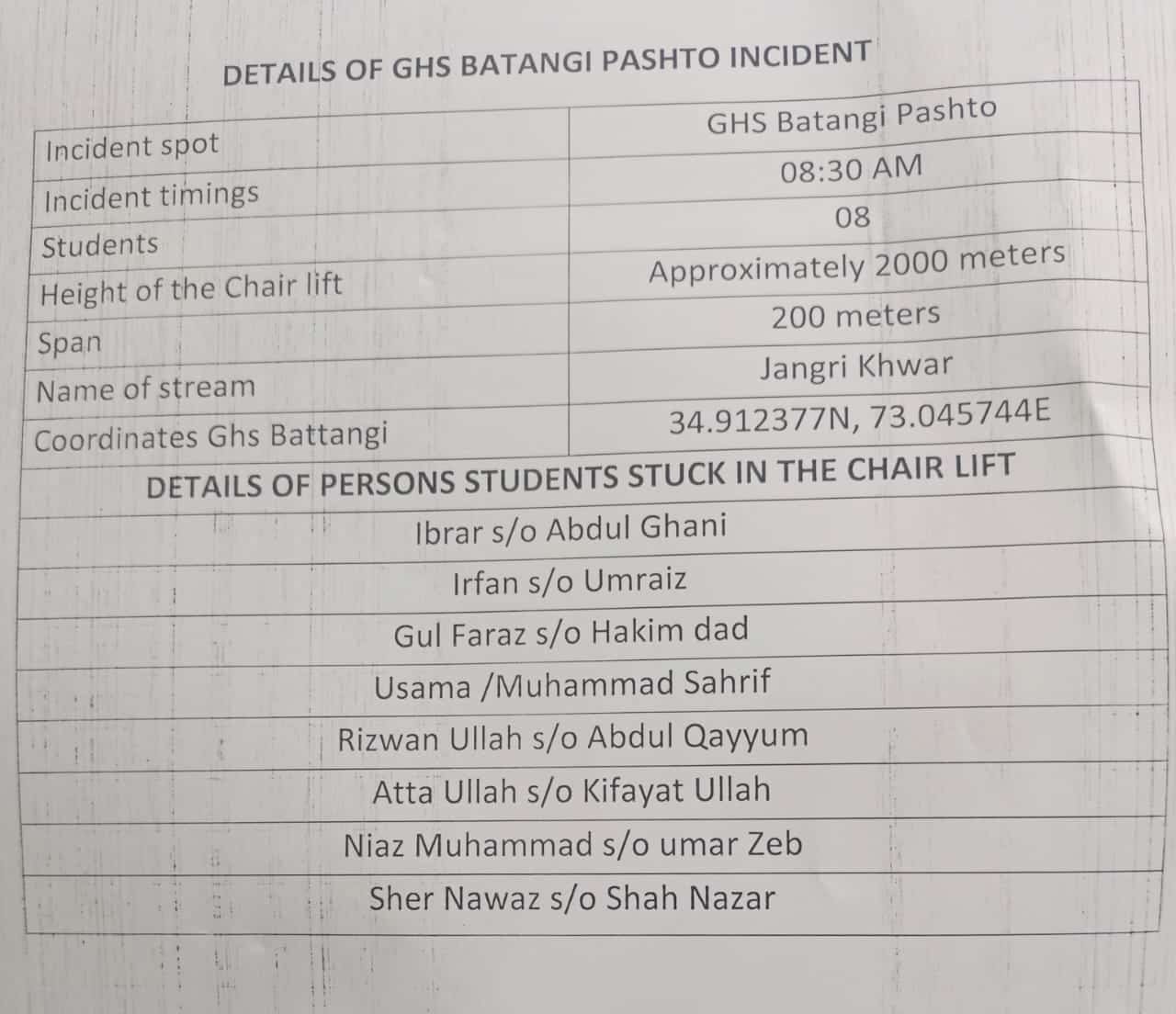
    The incident occurred at GHS Batangi Pashto spot where the cable car was suspended at the height of approximately 600 feet and its sling spanned over 200 meters. The cable car was crossing over Jangri Khwar stream carrying eight students. Around 8:30 a.m., while the passengers were making their way to school, two of the main cables that regulated the movement of the cable car snapped due to a technical malfunction.

    Makeshift cable cars are commonly used in eastern Mansehra, Azad Jammu and Kashmir (AJK), and Gilgit Baltistan, sometimes being the only alternative to traditional mediums of transportation in a topography that includes mountains and rivers. While there are no roads or schools in some of these areas, cable cars are the only means of travel for many.

    Who were the people stuck in the cable car?

    There were a total of eight passengers: seven students and one local. 20-year-old Gulfaraz spoke with Geo News over the phone while stuck in the cable car. According to him, the children were aged between 10 and 15. One boy had fainted because of fear and heat.

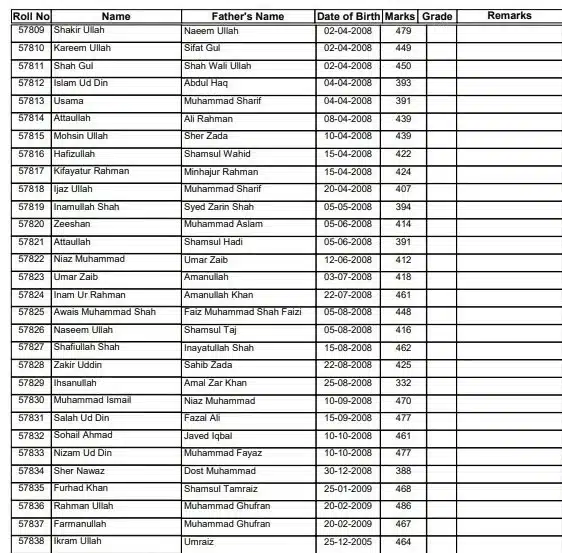
    The students present in the cable car were Ibrar (son of Abdul Ghani), Irfan (son of Umraiz), Usama (Muhammad Sharif), Rizwan Ullah (son of Abdul Qayyum), Atta Ullah (son of Kifayat Ullah), Niaz Muhammad (Umar Zeb), and Sher Nawaz (son of Shah Nazar).

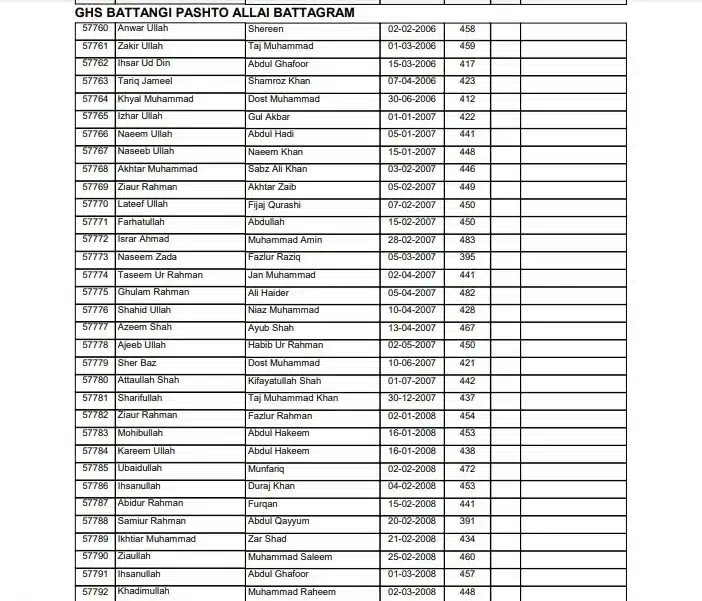
    While these students were stuck and awaiting rescue, Geo News reported that the Board of Intermediate and Secondary Education Abbottabad had announced results. Three of the students to receive results were among the trapped passengers, including Attaullah, who obtained 442 marks; Niaz Mohammad, who secured 412 marks; and Usama, who took 391 numbers. All the three boys had been promoted to class 10.

    The rescue operation

    Even though the operation began near noon, the first boy was not rescued till late evening. The situation got tricky with wind picking up speed and the looming darkness. By nighttime, the military helicopter rescue operation was called off with only two children rescued till then. However, ground-based rescue operation began, with flood lights and a platform quickly built along the cable. In the hours that followed, all the passengers were successfully saved.

  • ‘If you don’t get a joke then the joke is on you’; Indian actor Prakash Raj arrested after posting meme on X

    ‘If you don’t get a joke then the joke is on you’; Indian actor Prakash Raj arrested after posting meme on X

    Actor Prakash Raj has been booked by police in Karnataka’s Bagalkot district in India after jeering at the country’s third lunar mission, Chandrayaan-3.

    According to the police, a complaint was filed by the leaders of Hindu organizations who demanded that action be taken against the actor.

    What happened?

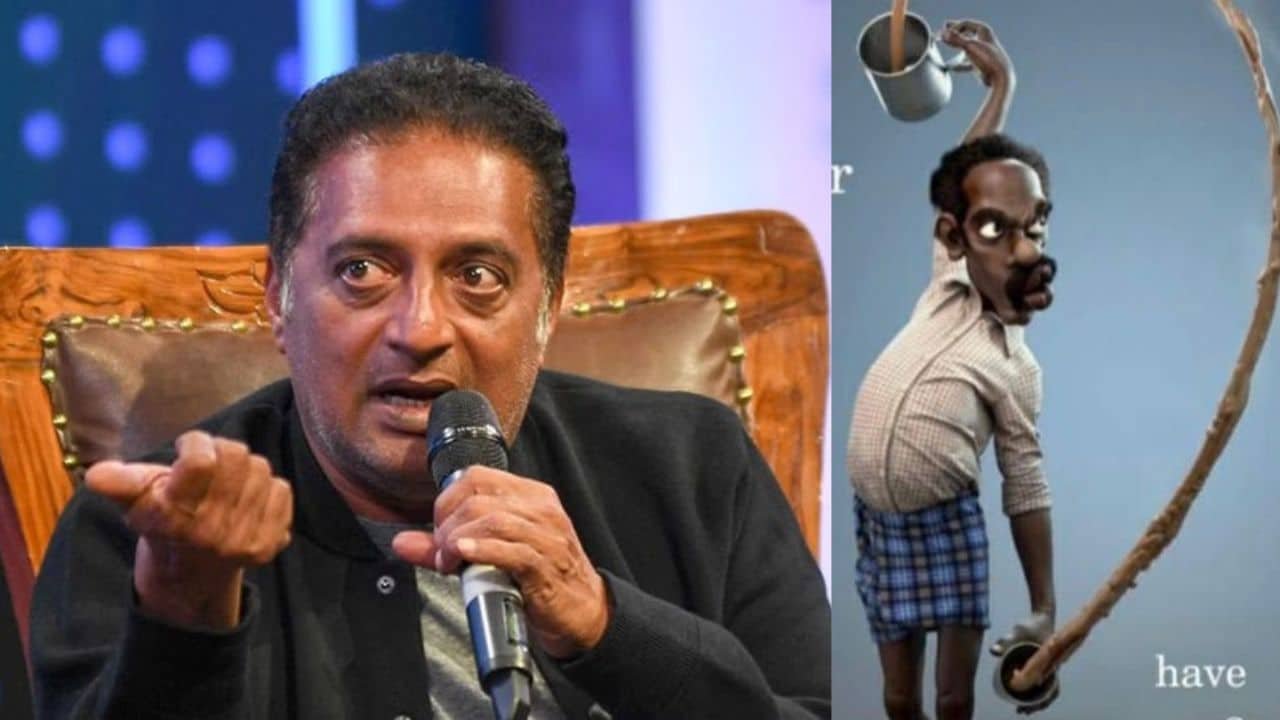
    On Sunday, Raj posted a cartoon picture on X in which a man wearing a shirt and a lungi is pouring tea. According to The Wire, the screenshot was from an old short meme about Neil Armstrong coming across a shopkeeper, a Malayalee entrepreneur offering him a glass of legendary Kerala tea on the moon.This picture was captioned : BREAKING NEWS:- First picture coming from the Moon by #VikramLander Wowww #justasking

    This was taken as an offence by many Indians since Chandrayaan-3 mission is considered as a matter of national pride. Raj resultantly faced heavy backlash on social media by angry Indians.

    Some people, however, came to Raj’s rescue

    One corrected a famous news platform, India Today

    Prakash Raj eventually responded to the trolling and criticism in another tweet saying,
    “Hate sees only Hate.. i was referring to a joke of #Armstrong times .. celebrating our kerala Chaiwala .. which Chaiwala did the TROLLS see ?? .. if you dont get a joke then the joke is on you .. GROW UP #justasking”

  • ‘Elections not possible before May 2024,’ says former ECP secretary

    ‘Elections not possible before May 2024,’ says former ECP secretary

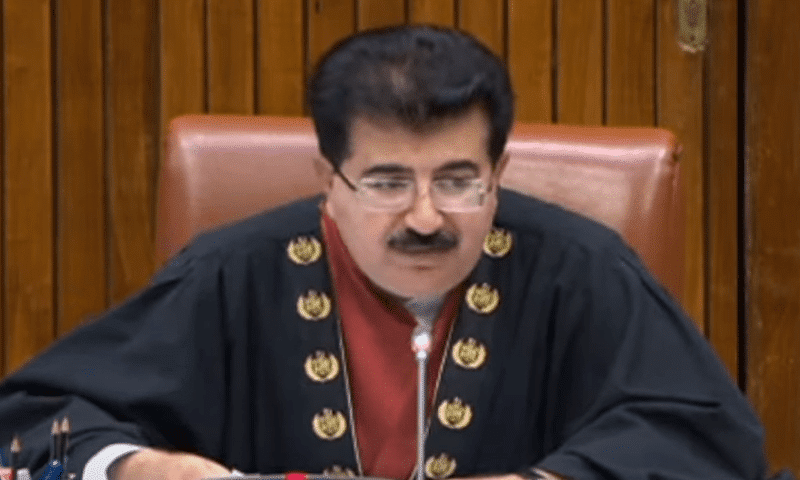
    According to a former Secretary of Election Commission of Pakistan (ECP) , Kanwar Dilshad, general elections are not possible before May 2024, stressing that polling will only be possible after nine months.

    He explained his point further while talking to The News that the process of delimitation of constituencies will take almost four months.

    The former ECP secretary said that four months for delimitation, three months for finalising the voter list, and two months for the election schedule will make the upcoming election possible. So, according to the former ECP, more than nine months are required to make the general election possible.

    He also said that the ECP should not ignore the factor of revision of electoral rolls, as it is very necessary according to the Election Act 2017.

    On the other hand, according to the sources of Geo News, ECP has decided to consult all the major political parties about the final date of the upcoming general election. Pakistan Tehreek-e-Insaf (PTI) will also be consulted regarding this matter.

    The ECP’s meeting with the political parties, the sources added, is expected to begin in the next few days.

    Pakistan Peoples Party (PPP), Pakistan Muslim League-Nawaz (PML-N), Muttahida Qaumi Movement (MQM), Jamaat-e-Islami (JI), Awami National Party (ANP), and Jamiat Ulema-e-Islam-Fazl (JUI-F) are the major political parties in the country.

  • Gold price reaches Rs234,000 per tola, nearing new record high

    Gold price reaches Rs234,000 per tola, nearing new record high

    Gold prices in Pakistan continued to rise on Tuesday, influenced by the Pakistani rupee’s decline against the US dollar and an uptick in global prices. 

    According to the All Pakistan Gems and Jewellers Sarafa Association, the cost of 24-carat gold settled at Rs234,500 per tola, marking a substantial increase of Rs4,600. Similarly, the price of 10 grammes of gold rose by Rs3,944 to reach Rs201,046.

    It is expected that the price of gold might reach unprecedented levels due to the relentless and rapid decline of local currency against the greenback.

    The movement of gold prices in Pakistan closely follows the path of the US dollar due to the country’s reliance on gold imports. 

    The Pakistani rupee saw a notable decrease, falling to a new all-time low against the US dollar. It ended at Rs299.01 rupees per dollar, reflecting a decline of Rs1.88, as reported by the State Bank of Pakistan.

    Currency experts attribute the surge in gold prices to the recent depreciation of the rupee. 

    With growing concerns about the country’s economic situation, investors are turning to gold as a safe-haven asset. This shift has resulted in a significant increase of Rs12,700 per tola in just one week.

    Read more: PKR to USD rate

    Notably, the hike in gold prices coincided with political turmoil and a decrease in the local currency’s value, leading to an all-time high valuation of Rs240,000 per tola on May 10, 2023. On the international front, the price of gold saw a $10 increase, reaching $1,901 per ounce on Tuesday.

  • Elon Musk’s X plans to remove headlines from links to news articles

    Elon Musk’s X plans to remove headlines from links to news articles

    (Reuters): Elon Musk is pushing for a change in news links on his social media platform X, formerly called Twitter, in a move that could potentially undermine the ability of news publishers to draw an audience.

    X is planning to remove the headline and text while retaining just the lead image from links to news articles shared on the platform, Musk said in a post late on Monday.

    The move is likely an attempt by Musk to get users to spend more time on X and push them to opt for the subscription service for more details.

    It is not immediately clear how the move will impact advertisers on the platform that Musk claimed in July had 540 million monthly users.

    Currently news links come up on the timeline of users as “cards” along with an image, source address and an abridged headline. Such a packaging helps draw clicks and helps publishers gain readers.

    But with the shortened links, users might end up writing some text along with their posts and eventually they could consider X’s premium service that allows a single post of up to 25,000 characters.

    With the changes, Musk is pitching X as a more relevant platform for content creators. Premium subscribers can now post longer videos, their posts are shown higher up and they also receive a cut of ad sales.

  • Pakistan beat Afghanistan by 142 runs in first ODI

    Pakistan beat Afghanistan by 142 runs in first ODI

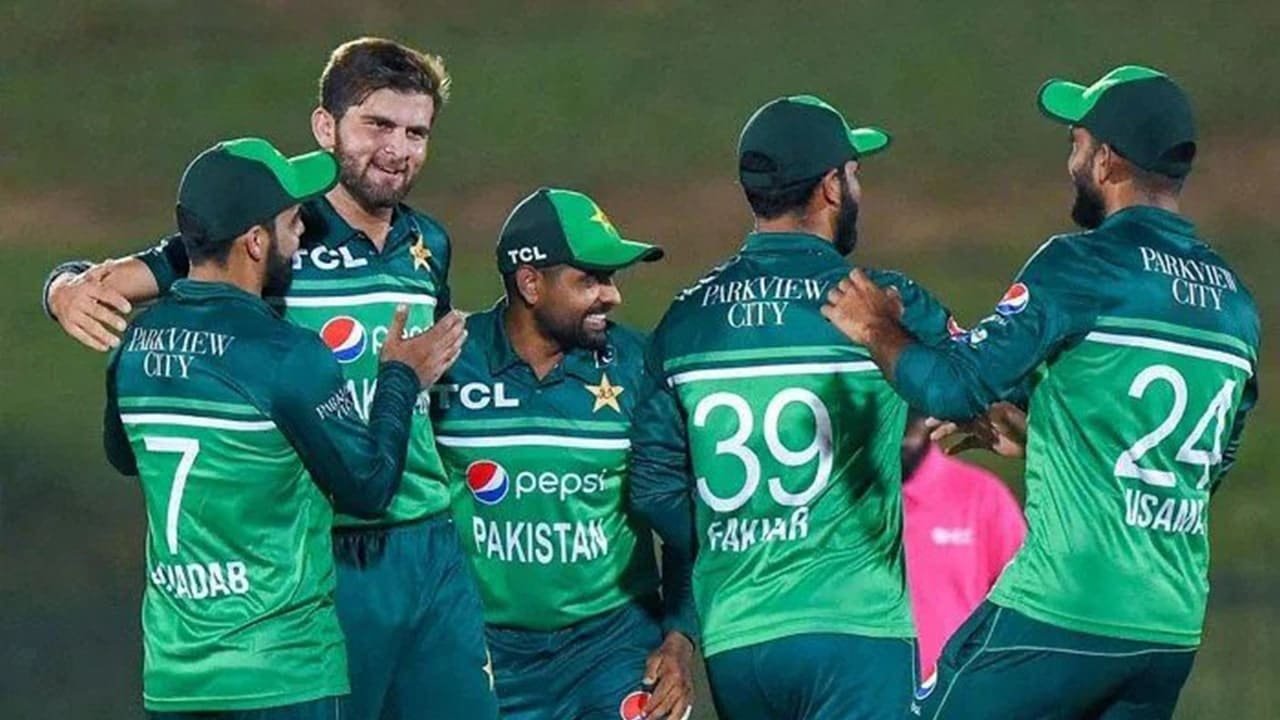
    Pakistan have beaten Afghanistan by 142 runs in the first ODI of a bilateral series between the two neighibouring countries. Pakistan won the toss and elected to bat first, losing the early wicket of Fakhar Zaman on the second ball of the first over. Captain Babar Azam fell on the last ball of the 2nd over, adding to Pakistan’s troubles. In the first power play (first 10 overs) Pakistani team scored only 41 runs with three early wickets lost.

    After drinks, Pakistan was at 59/3, completing 100 runs in 25.1 overs. Imam-ul-Haq scored 61 runs while Muhammad Rizwan put up 21 runs. Iftikhar Ahmed and Shadab scored 30 and 39 runs, bringing Pakistan to a total of 170 runs. At the tail end, Nasim Shah contributed 18 runs, finishing the inning with a total of 201 runs in 47.1 overs.

    Mujeeb ur Rehman took three wickets while Rashid Khan and Muhammad Nabi took two wickets each. Fazal Haq Farooqi and Rehmat Shah also took a single wickets each.

    The second innings was dominated completely by Pakistani bowlers, as the team made it difficult to play for Afghan batters. The Afghan side lost four early wickets with the score at 21 in the first power play. Afghan batters struggled in the whole match and finished at a total of 59 runs in 19.2 overs.

    Haris Rauf took a five-wicket haul with an economy rate of 2.84. Shaheen Afridi picked up two wickets while Nasim Shah and Shadab Khan succeeded in taking a single wicket each.