‘Pathaan’ is a frustrating film because it does not want to make things too difficult but it also does not want to take the easy way out. It does not mind being silly but it certainly will not become stupid. Perhaps to resolve these contradictory impulses, it chooses to be a fan-service film, something that requires a certain amount of blind faith on part of the audience but also a deep and nuanced knowledge of the world the star who helms it inhabits.
‘Pathaan’ is first and foremost a ritual. According to sociologist Émile Durkheim, when a community or society comes together and simultaneously communicates the same thought and participates in the same action, it represents a collective effervescence. That is, the group members experience a loss of individuality and a unity with gods, where the god and the society are the same and the clan itself transfigures into a symbol, the totem pole around which they gather with strong emotion.
So what can the film offer to non-fan viewers like this author, who have the background knowledge but not the blind faith?
If you are not part of this collective effervescence, you might be tempted to perceive the scene, the totem, the group as separate entities but it is simply impossible to extricate one from the others. The only way to understand ‘Pathaan’ is to view the film, the star, the fandom and the world it emerges from as one composite whole even if you are outside of that experience.
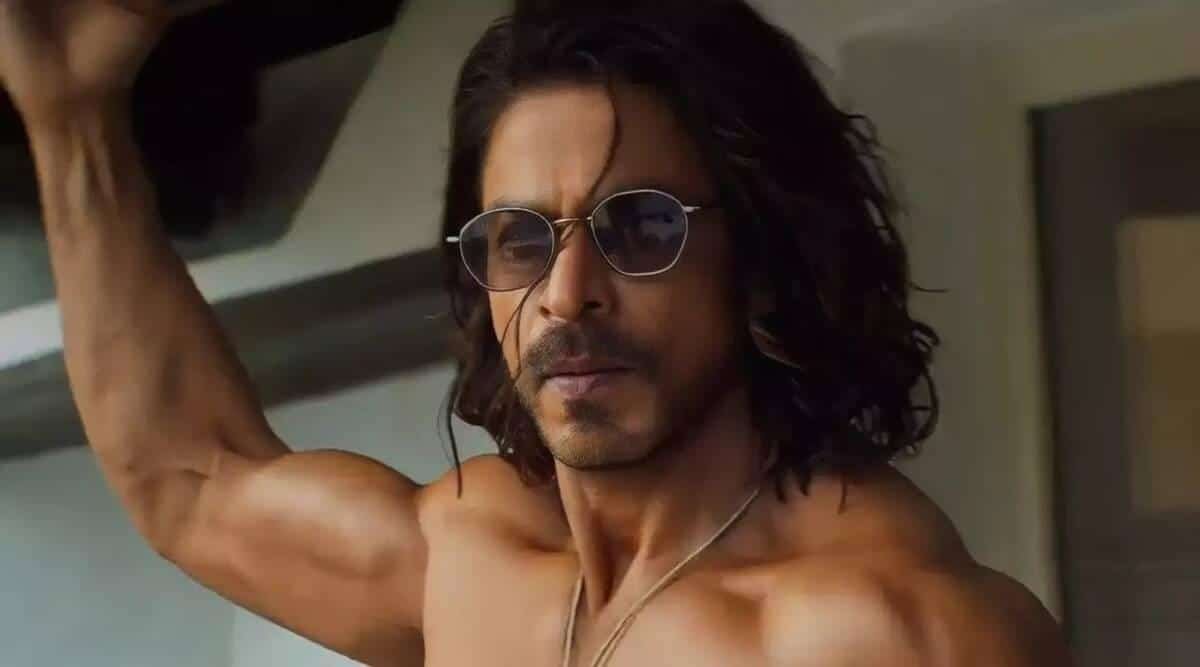
Khan is a pathaan (son of a Khudai Khidmatgar no less) and, through this film, he insists that he must be seen as no more than an orphan of Indian cinema. Left as he was as a baby in a movie theatre, pathaan has no history and no identity beyond the service of Indian society. That he found a family outside Indian borders – in the film, this is represented by an Afghan village – holds for him deep emotional resonance, but ‘Pathaan’ and Shah Rukh Khan are, first and foremost, lost at and found by Indian cinema. And the Indian in him has a lot to get off his chest – or, do I mean his abs? – and will, unfortunately, exclude his non-Indian fans at least for the purposes of this film.
This is not the first time a Shah Rukh film and the man became indistinguishable from one another. In ‘My Name is Khan’ (MNIK), Shah Rukh urged an increasingly Islamophobic world to not see all Muslims as terrorists. Moving on from what now seems like innocent times when the deeply problematic discourse of “good Muslims and bad Muslims” retained some currency, India now finds itself at a stage where proving one’s patriotism through a trial by fire (for example, in ‘Chakde India’) will bear no results. The Khan of ‘Pathaan’ is the older, weary and (literally and figuratively) broken version of the man in MNIK and Chakde. He has given up trying to prove his patriotism – if you are not yet convinced, you are unlikely to ever be. If you happen to be one of those blessed with blind faith, this film will not only help you reiterate your beliefs, it will also give you renewed energy to go out into the world filled with hate, despair and anger.
John Abraham, who plays the antagonist Jim in the film, mentioned in a post-release press conference that Shah Rukh Khan is not a man but an emotion. This film, which is also the star, the nation and its audience all at once, is similarly an emotion. This is why it does not make the treatment of very complex issues difficult or easy. The issues are presented as Indians experience them.
For me, it was still jarring to sit through the throwaway lines on Pakistan when criticism of the Indian state remains muted and one can well imagine the frustration that led Fatima Bhutto to write that Bollywood, as a whole, appears to be ‘obsessed with Pakistan’. Indian films have been steadily churning out plots where Pakistanis are represented as not only “nasty” but also gullible and even moronic. But, for Indians, who have been subjected to phallic slogans like “ghar mein guss ke maareinge” (we will invade your homes to kill you) in the recent past, the film comes as almost a relief. ‘Pathaan’ is at least not a chest-thumping agent of chaos – whether it is in India or Afghanistan, on-screen he is only trying to protect people. Whether he should have participated in the American invasion of Afghanistan at all is not a question the movie is interested in – just as it shies away from actually taking a political position on the abrogation of Article 370 that forms the impetus of the conflict presented in the film.
It is in this almost desperate attempt to avoid taking overt stands on polarising debates that the film becomes reluctantly nuanced. While some lazy lines suffice to illustrate that only a handful of Pakistan’s military establishment have, to quote the ISI agent Rubai (played by Deepika Padukone), gone berserk, the blame for the imminent threat lies with the soulless and even callous Indian bureaucracy and a particular version of nationalism that pervades public discourse today. Jim is a narcissist for whom love for the nation used to be an extension of love for self and, now that his love has soured, he cannot but mock the selfless love that ‘Pathaan’ holds on to despite being betrayed and hurt. Most of their conversations centre on this differing attitudes towards nationalism, offering Khan ample opportunity to respond to the real-life attacks the Indian state and its narcissistic nationalists have subjected him to in recent years. The camera lingers on his dark brooding face as he expresses, in turn, his quiet disappointment with state’s priorities (while listening to Jim’s backstory), the shock of betrayal (as Rubai leaves him behind) and abject resignation (when he finally decides to go rogue). The emotions spill over the frame and become a testament to the life of India’s most famous and openly religious Muslim man under the tyranny of Hindu nationalism.
While Bhutto’s criticism is well-taken, movies like ‘Pathaan’ – and ‘Raazi’, which she also mentions – emerge from a specific political struggle within India and must be seen as a challenge to the rampant hate rather than carriers of the same hateful messaging. Pakistan in ‘Pathaan’ serves as an empty signifier that it has been in films like ‘Uri’ where the larger plots are aimed at othering the Indian Muslims through an invocation of an external threat. But, in a crucial difference, ‘Pathaan’ brings attention back from the neighbouring country to the internal struggle in India that was provoking such excessive obsession in the first place. It is as if the filmmakers are telling us that it is impossible to speak on Indian nationalisms without underlining the disproportionate space Pakistan occupies in public imagination.
While Jim is explicit about his motivations, Rubai’s backstory leaves a lot unsaid. Rubai’s father was a journalist somewhere in West Asia who “asked too many questions” and, as a child, she was forced to witness his waterboarding by agents of an undemocratic regime. As memories of the father’s torture merge with her own waterboarding at the hands of Indian agents she had actually helped, the signifier of Pakistan is emptied out and her story becomes one of Indian journalists who, in recent times, had “asked too many questions” with national interest at their heart and paid the price for the same.
It may still be too unrealistic to ask Pakistanis not to be offended by ‘Pathaan’ since it is probably no consolation that the film does not address them at all. The totem of Shah Rukh holds great emotional resonance across South Asia and the world and, while the film tells us that he cherishes ‘his family’ outside India, ‘Pathaan’ is targeted at the Indian society – as a collective – that loves him and, yet, as the film sees it, has betrayed him.