Category: Business

The most important business news, explained in a young, easy to understand way. News that affects young career professionals.

  • Did you know Diamond Supreme Foam has an ‘Islamic mattress’?

    Did you know Diamond Supreme Foam has an ‘Islamic mattress’?

    One of Pakistan’s leading mattress manufacturers, Diamond Supreme Foam, has an ‘Islamic mattress’, which the bedding industry giant boasts is the first in Pakistan.

    According to details available on the company’s website, the mattress called ‘Saha’ has “scientifically been developed and balanced for every body type based on Islamic principles”.

    “The Saha is Pakistan’s first Islamic mattress engineered for people who sleep on their back or their right side which is the Islamic way for sleeping,” says the description of the mattress that costs around Rs17,000.

    Medical science tells us that that the best healthy sleeping position is to sleep on your back or on your right side which is also the Islamic way of sleeping, practiced and taught 1400 years ago, it adds.

    “Sleeping on the right side does not let the weight of stomach and intestine to suppress the heart, hence blood circulation is not affected.  By sleeping on the right side, the heart remains in the topside, and aids the process of rising early before sunrise to perform Fajr: the prayer that starts off the day with the remembrance of God.”

    What do you think of the mattress and the manufacturer’s pitch? Let The Current know in the comments below.

  • Islamabad’s New Blue Area auction receives Rs.12 Billion Investment in Just two Days

    New Blue Area project in Islamabad has received an investment of more than Rs. 12 billion in just 2 days of the auction.

    Capital Development Authority (CDA) has organised a three-day auction from July 15 to 17 for the commercial plots of the New Blue Area situated on Jinnah Avenue in front of the F-9 Park.

    So far, eight commercial plots of different sizes were auctioned that were sold for more than Rs. 12.79 billion.

    The spokesperson of CDA said “the New Blue Area project is evidence of Prime Minister (PM) Imran Khan efforts to promote the construction industry in Pakistan. The interest of the investors in the auction process shows their confidence in the business-friendly policies of the Federal Government.”

    The authorities are expecting to receive a total investment of Rs. 15 billion by the end of the three-day auction process, which is ending today.

    The investment that will be collected through the auction will be used in different projects for the betterment of Islamabad residents.

    On 1 March, PM Imran Khan had visited the proposed site of the New Blue Area project before formally launching the project.

    PM Imran Khan had formally approved the plan of the New Blue Area project in February after CDA allocated 170 Kanals for the project on Jinnah Avenue.

  • New heights of friendship: Turkish Airlines to manage Pakistan’s fruit, vegetable exports after PIA ban

    New heights of friendship: Turkish Airlines to manage Pakistan’s fruit, vegetable exports after PIA ban

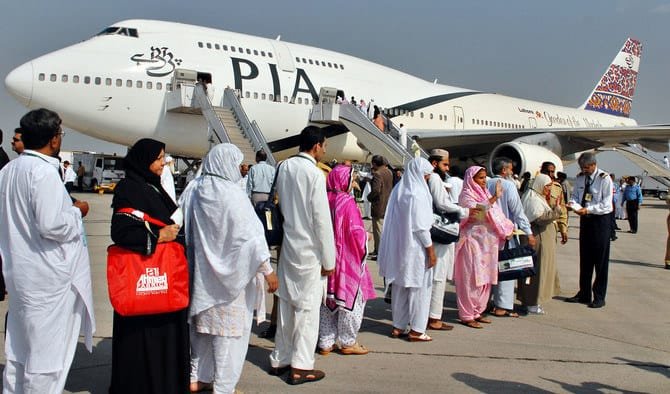
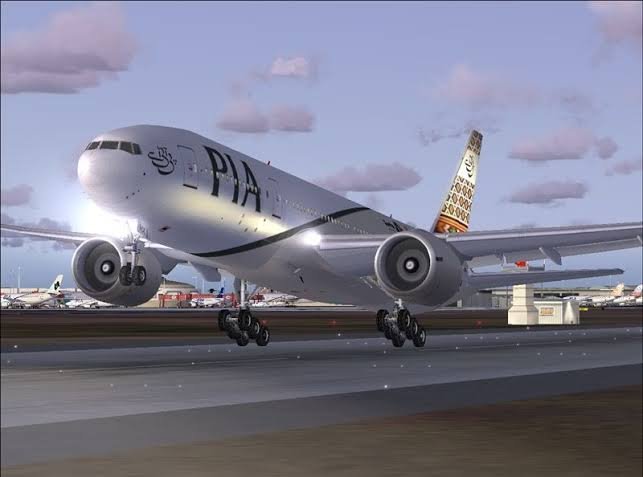
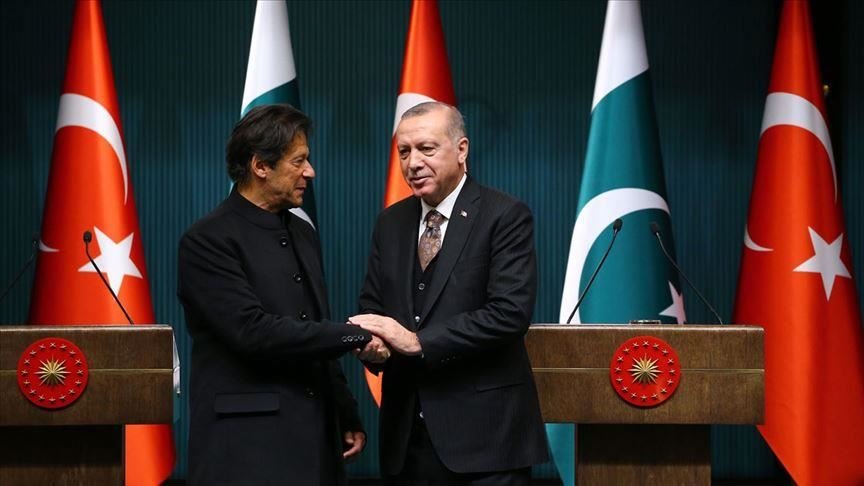
    As Pakistan International Airlines (PIA) flight operations in Europe remain suspended, Turkish Airlines has offered its services to transport fruit and vegetable exports to other countries, Profit reported.

    According to fruit and vegetable exporters, Turkish Airlines will charge lower freight charges for transport of Pakistani fruits and vegetables to England, Germany and other western countries and has assured that it will facilitate the promotion of the same. 

    Earlier the European Union Air Safety Agency (EASA) imposed a six-month ban on PIA’s flight operations to Europe after reports emerged that several PIA pilots held dubious flying licences

    Among other issues, the ban created problems for the export of Pakistani fruits and vegetables. In this regard,  the Pakistani Embassy in Istanbul Commercial Counselor Bilal Khan Pasha met with Turkish Airlines Chairman Ilker Ayci who assured that Turkish Airlines will resume its flight operation in Pakistan and will help in the export of fruits and vegetables to the European Union (EU).

    Moreover, a delegation of exporters led by Waheed Ahmed, the head of All Pakistan Fruit and Vegetable Exporters, Importers and Merchants Association (PFVA) met with Turkish Airlines General Manager (GM) Gurhan Sozen.

    READ: Embarrassment for aviation minister as Civil Aviation Authority says all licences issued are real

    According to Waheed Ahmed, PIA had recently reduced freight charges in order to assist exporters to reduce cost of export shipments, however, after the six month ban on PIA, exporters will have to use the services of foreign airlines who might charge higher freight charges.

    According to exporters, during the meeting with Turkish Airlines GM the need for reduction in freight charges and provision of special handling facilities for perishable cargo to facilitate the export of Pakistani fruits and vegetables to Europe, the UK and Canada was stressed.

  • US bans PIA

    US bans PIA

    Following footsteps of the European Union (EU), the United States on Thursday banned all flights of Pakistan International Airlines (PIA) with immediate effect.

    The US Transport Department said in a statement that special permission given to PIA had been suspended due to safety concerns.

    The move follows the grounding of 262 airline pilots in Pakistan over fake licences in a decision made by the Civil Aviation Authority of Pakistan.

    PIA said on Thursday it would ground pilots with “dubious” licences.

    As per sources, Kuwait Air has grounded at least seven Pakistani pilots and 56 engineers, while Qatar Airways, Oman Air and Vietnam Airlines have compiled lists of Pakistani pilots, engineers and ground staff.

    The UAE’s Emirates airline has also put a halt on all Pakistani airline flights, barring them from using the airports for destination and transit flights.

    This has been done after the Imran Khan-led government announced and notified various countries about the actions it took against the alleged 141 pilots, who have been grounded and were under investigation.

    As per officials of Kuwait Air, Omar Air and Vietnam Airlines, “employees whose name are on the lists will remain grounded till a report is received from the Pakistani authorities”.

    Moreover, the European Union (EU) has also put a ban on Pakistani airlines while many other Pakistani pilots working on other airlines have also been barred from flying till the investigation into the fake licenses is concluded and results are revealed by the Pakistan government.

    This action was taken after Pakistan International Airlines (PIA) wrote to foreign missions and global regulatory and safety bodies, notifying them that it grounded all 141 pilots suspected of obtaining licenses through unfair means.

    “It is also ensured that pilots flying PIA flights are having genuine licenses endorsed by the government of Pakistan and are in physical possession of the same during all domestic and international flights,” said a copy of the letter sent to the US Embassy in Islamabad.

    Pakistan grounded at least 262 pilots, 109 commercial and 153 airline transport pilots as an investigation to verify their license was initiated.

    The 262 pilots include 141 from PIA, nine from Air Blue, 10 from Serene Airlines and 17 from Shaheen Airlines, which has closed down.

    The step has brought global embarrassment for Pakistan as serious questions are bring raised over the safety of passengers, who use Pakistani airlines services for domestic and international travelling.

    On the other hand, the pilots whose names have been listed and have been grounded, have rejected the claim stating that the government’s issues list is based on wrong and false facts.

    “The list of grounded pilots has stated that many pilots were found guilty of falsely clearing nine papers, while there are eight papers in total required to get a pilot license from Civil Aviation Authority (CAA),” said one of the pilots whose name is in the list.

    “There are many others, who have not even given eight papers till now and are co-pilots, they have put their names in there too,” he added.

    As per Standard Operating Procedures (SOPs) followed by the CAA, a pilot is required to pass all eight papers to become fully qualified, after completing at least 1,500 hours commercial flying time.

    Pilots association has called on the government to form a judicial commission and inquire into the matter, adding that they do not trust the transparency of the government-led investigation.

    The incumbent Pakistan government is also suffering to major criticism by the opposition political parties, who are now accusing the aviation minister and the government for bringing global embarrassment to the country.

  • Six-star PIA downgraded to one   star on fake licences issue

    Six-star PIA downgraded to one star on fake licences issue

    Six-star Pakistan International Airlines (PIA) has been downgraded to one star by AirlineRatings.com after the recent revelation of 150 fake pilot licences.

    The European Union (EU) has banned the airline from member states — costing one star –, while AirlineRatings.com has stripped the airline of three stars for the IATA Operational Safety Audit (IOSA) besides one star for the ICAO country audit.

    The rating downgrade to the lowest safety standards could further dent PIA’s business because customers will avoid travelling through it while other countries may close their airports for Pakistan’s national carrier.

    AirlineRatings.com Editor-in-Chief Geoffrey Thomas said, “Clearly there needs to be an investigation into possible bribery and falsifying related to the pilot licences. This is deeply disturbing as the IOSA audit and ICAO country audit should pick this up.”

    In a statement, IATA said, “We are following reports from Pakistan regarding fake pilot licences, which are concerning and represent a serious lapse in the licensing and safety oversight by the aviation regulator. We are trying to obtain more information on the matter.”

    Earlier, PIA sacked 150 pilots over cheating on their exams in the wake of the Karachi crash of an A320 that killed 98 people in May.

    The sacking had come in the wake of the statement by Aviation Minister Ghulam Sarwar Khan that 262 out of 860 Pakistani pilots had “fake” licences through bribing other qualified pilots to take the exams.

  • Army to finally launch Askari Airline?

    Army to finally launch Askari Airline?

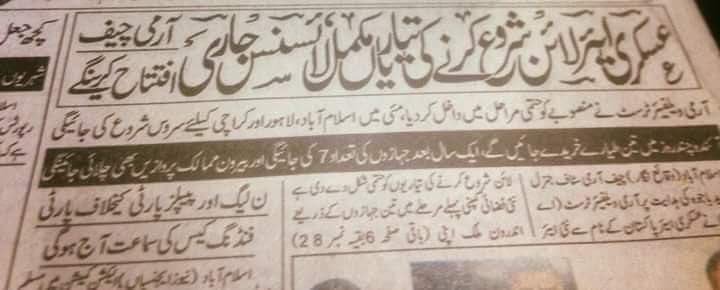
    Amid controversies surrounding the licences of several Pakistani pilots, which have also led to the suspension of Pakistan International Airlines’ (PIA) authorisation to operate in European Union (EU) member states and the United Kingdom (UK), a newspaper clipping pertaining to the launch of army’s Askari Airline has left Twitterati in doubts.

    “Preparations for the launch of Askari Airline completed; licence issued,” read the undated Urdu newspaper clipping making the rounds on the internet.

    The undated Urdu newspaper clipping making the rounds on the internet

    It added that “the chief of army staff (COAS) would inaugurate the project that was in its final stages owing to the efforts of the Army Welfare Trust (AWT)” — Pakistani conglomerate also known as Askari Group of Companies — and mentioned details of the airline’s fleet.

    The clipping drew the ire of a majority of netizens who attempted to draw a link between the downfall of the national carrier and the alleged impending launch of Askari Airline, compelling The Current to look into the claims.

    According to prominent aviation journalist Tahir Imran, Askari Airline was given approval a few years ago, which suggests that the clipping is not a recent one.

    When contacted, Imran said that Askari Airline was among six new airlines that had applied to the Civil Aviation Authority (CAA) for regular public transport (RPT) licences in 2018.

    “These airlines are Liberty Air owned by Chaudhry Munir and Mian Amir, Go Green Airways owned by Elahi Group, Askari Air owned by AWT, United Airways Pakistan Limited owned by Adnan Tabani, AirSial owned by the Sialkot Chamber of Commerce and Afeef Zara Airways owned by Rashid Siddiqui,” he said, adding that even though they had been granted licences, no other airline except AirSial was for now in a position to launch flight operations.

    “But even AirSial faces an uncertain future as its launch scheduled for May 2020 has indefinitely been postponed due to the coronavirus pandemic among other reasons. It might see the light of day by 2020’s end… but everything depends on how the current situation pans out.”

    To a question regarding the fate of Askari Airline, Imran said that no appointments in this regard had so far been reported, let alone any progress towards its launch. “Askari, as well as other upcoming airlines except AirSial, lack the required infrastructure for now and their launch within the ongoing year doesn’t seem possible.”

    ASKARI AVIATION SERVICES:

    Speaking of Askari Aviation Services (AAS), he said it was run by AWT and its activities included domestic and international travel as well as transportation by Askari Charter Services (ACS), ground handling services at Islamabad airport by Askari Airport Services (AAPS), domestic and international air travel ticketing by Askari Travel & Tour (AT&T), ground, cabin and flying training of fixed-wing and rotary-wing aircraft by Askari Flying Academy (AFA) beside aircraft and helicopter maintenance and operation services through Askari Aviation (Pvt) Ltd (AAL).

    “In addition to its integral fleet of helicopter and aircraft, AAS also enjoys the backing of Pakistan Army Aviation and is providing international charter services to the army for its United Nations (UN) peacekeeping troops deployed around the world,” he said.

  • ‘Shameful’: Yet another old tweet comes back to haunt Imran after fuel prices hike

    ‘Shameful’: Yet another old tweet comes back to haunt Imran after fuel prices hike

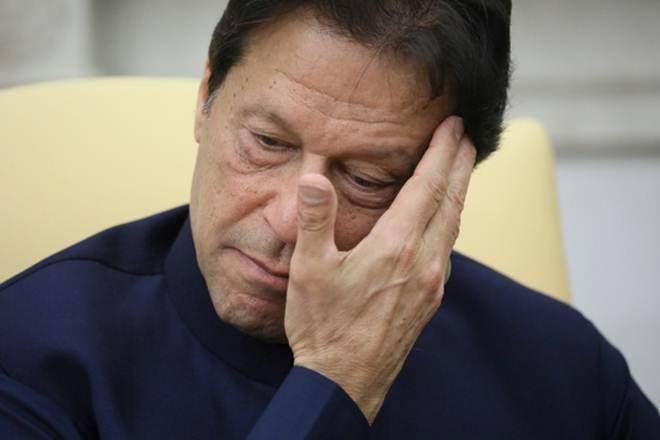
    With Prime Minister (PM) Imran Khan approving a Rs25 hike in petrol price, yet another tweet from the past has come back to haunt the ruling Pakistan Tehreek-e-Insaf (PTI).

    The premier on Friday approved a summary of recommendations to increase the prices of petroleum products “in view of the rising oil prices trend in the global market”, with a notification issued to announce the new rates.

    The notification stated that the new petrol prices would come into effect immediately.

    Petrol prices, according to the recommendation, were to be bumped up Rs25.58 per litre. Similarly, the per-litre prices of high-speed diesel (HSD), kerosene oil, and light diesel were recommended to be increased Rs21.31, Rs23.50, and Rs17.84, respectively.

    The new per-litre prices of petrol, HSD, kerosene oil, and light diesel, therefore, would respectively be Rs100.10, Rs101.46, Rs59.06, and Rs55.98.

    With the hike drawing a strong reaction from the general public as people expressed frustration over the development that could result in yet another inflation bomb amid the coronavirus outbreak, some took to Twitter to retweet a statement by the premier from back when he sat in the parliament on opposition benches.

    “Absolutely shameful how the govt has dropped a petrol bomb on the poor nation at the start of 2018. Instead of undertaking tax reforms and cracking down on money laundering, the govt continues to burden the masses — this time with a big increase in petroleum products’ prices,” the tweet read.

    “Petrol should be sold at Rs58 per litre, demands @ImranKhanPTI [sic],” another tweet from 2015 by PTI’s official handle read.

    This isn’t the first time an old tweet has come back to bite the PTI government.

    While the same tweets were used to criticise the government after a fuel prices hike in July 2019, a separate tweet from August 2014 read, “All over the world, just on an incident of railway accidents, minister resigns. This is real democracy, says Imran Khan [sic].”

    It had started making rounds last month after the tragic train accident in Sadiqabad, which claimed over 20 lives.

    Prior to this, as PM Imran reached China amid Tehreek-e-Labbaik Pakistan’s (TLP) nationwide protests last year, a 2012 tweet of his, went viral. In the tweet, he had criticised the then premier for traveling abroad as the country “burned”.

    It was aimed at criticising former prime minister Yousaf Raza Gillani, who had traveled to China for the Boao Forum while violence linked to sectarian, ethnic and political tensions continued in different parts of the country.

  • READ: PTI govt’s ‘corona budget’ for FY2020-21

    The Pakistan Tehreek-e-Insaf (PTI) government has presented its second federal budget in the National Assembly.

    According to Industries Minister Hammad Azhar, who delivered the budget speech on the floor of the house, the Federal Board of Revenue (FBR) revenue target for next year has been kept at Rs4.95 trillion, while defence allocations amount to around Rs1.3 trillion.

    The federal development programme has been budgeted at Rs650 billion to support growth prospects.

    The budget for fiscal year (FY) 2020-21 comes at a time when the country is battling the COVID-19 pandemic that has served a severe blow to the economy. According to reports, it has been formulated considering the impact of the virus and to give relief to the citizens, as part of which no new taxes have been imposed.

    Here’s the complete Rs7.13 trillion budget:

  • Register your VPN with PTA by June 30 or face legal action besides disconnection of services

    Register your VPN with PTA by June 30 or face legal action besides disconnection of services

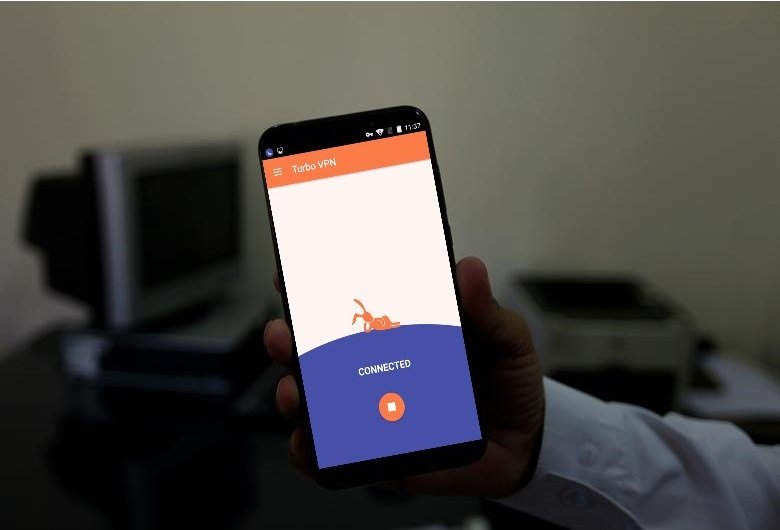
    In a bid to promote legal information and communications technology (ICT) services in Pakistan and for the safety of telecom users, the Pakistan Telecommunication Authority (PTA) is continuing with the long-pending process of registration of Virtual Private Networks (VPNs), the use of which has significantly increased across the country over the past few years.

    A VPN extends a private network across a public network and enables users to send and receive data across shared or public networks as if their computing devices were directly connected to the private network. It is programming that creates a safe, encrypted connection over a less secure network, using tunneling protocols to encrypt data at the sending end and decrypt it at the receiving end.

    Through a public notice, the PTA has declared the use of any mode of communication such as VPN, by means of which communication becomes hidden or encrypted, a violation of its regulations.

    “Users, which are required to use VPN for their legitimate purposes, must register their VPN with [the] PTA through their respective internet service providers [ISPs] till 30-06-2020,” read the notice.

    On top of interruption of services, legal action may also be initiated against those found in illegal use of unregistered VPNs, it added.

    “The step is being taken to eliminate all grey traffic [the use of illegal telephone exchanges for making international calls bypassing the legal routes and exchanges] from Pakistan. It is the case with many companies running call centre services in the country using VPN or unregistered Voice over Internet Protocol (VoIP) services to make international calls appearing as if they’re located somewhere, in most cases, the United States (US),” sources told The Current.

    The authority wants to eliminate grey traffic after registration of VPNs and has already started to blacklist internet protocol (IP) addresses of corporate clients of several ISPs, they said.

    ‘NOT THE FIRST TIME’:

    “It isn’t the first time that the PTA has directed registering VPNs as the process was long-pending,” an official told The Current on the condition of anonymity.

    “Through a similar public notice in 2014, the authority had announced that all unregistered VPNs will be blocked in its continuous efforts against grey traffic. All such users were required to apply to PTA for registration of their VPN connections through their respective service providers latest by May,” they said, adding that not much had, however, followed the announcement back then.

    Speaking to The Current, Digital Rights Foundation (DRF) founder Nighat Dad also said it wasn’t the first time such an announcement had been made by the PTA, but it was very important for the authority to clarify the notice.

    “They need to make it clear if the notice is only for financial institutions and software companies using VPNs or if it applies to individuals as well,” she said while seeking a better interpretation of the announcement.

    Dad also said the authority should be asked as to which provision was invoked for the process to continue. “There is one regulation on grey traffic from 2010 which included a provision on VPN registration, but the PTA should clarify the law and its provision under which the said notification was issued.”

    ‘VPNS ARE NOT PERMITTED’:

    When contacted, PTA Public Relations Director Khurram Mehran said that under applicable rules and regulations, appropriate registration from the authority was required for any mode of communication in which it becomes hidden or encrypted.

    “The process for registration of VPNs is not new and has been in vogue since 2010. Authorised users can register their VPNs with the authority through a swift process initiated through their service provider,” he said, adding that action would be taken only against unauthorised VPNs for terminating illegal traffic, which causes loss to the national exchequer.

    PTA remains committed to serve as per its vision in ensuring that high quality ICT services are available to telecom users in Pakistan, Mehran said.

    “VPNs are not permitted and so are blocked whenever reported or detected. Whoever wants to use one can do so after registration under regulation,” he said when asked if the announcement also applied to individuals.

  • Amid shortage, govt likely to allow petrol stations to set their own prices

    Amid shortage, govt likely to allow petrol stations to set their own prices

    As consumers across the country face difficulties due to petrol shortage, the government is currently contemplating completely deregulating pricing and marketing of petrol. 

    According to a report published in Dawn,  the government is considering doing away with uniform pricing of petrol and deregulating it in line with other petroleum products like hi-octane blending component (HOBC) which are already deregulated. 

    Recently oil marketing companies (OMCs) have come under severe criticism for their alleged collusive behavior that has seen the price of HOBC, to increase to Rs148-160 per litre. 

    While the government slashed petrol prices to Rs74 per litre in line with the decrease in international oil prices, no such reduction was seen in the price of HOBC. 

    According to the report, the government has also decided to deregulate the Inland Freight Equalisation Margin (IFEM) that currently ensures uniform prices throughout the country. As a result, consumers that are close to ports and refineries will be able to buy petroleum products at a cheaper price that may differ anywhere from Rs1 to Rs5 depending on the transportation cost.

    Earlier, on June 4, the Competition Commission of Pakistan (CCP) had taken notice of public concerns and complaints about the shortage of petroleum products in the country and had initiated an inquiry to see whether such a shortage is the result of any anti-competitive activity.

    The CCP’s inquiry will determine the possibility of the existence of any anti-competitive practices causing the shortage of fuel in the country and the undertakings involved in it.

    The inquiry will further examine why the impact of the reduction in the prices of oil have not resulted in the corresponding reduction in the prices of the lubricants and other oil-based products, including the prices of hi-octane, which are primarily deregulated products.

    Similarly, the Oil and Gas Regulatory Authority (OGRA) had also expressed its reservations last week regarding high prices of HOBC and had asked OMC’s to set prices at reasonable levels keeping in view the interests of the consumers.