Category: Business

The most important business news, explained in a young, easy to understand way. News that affects young career professionals.

  • Over 100,000 students register for interest-free motorcycle initiative

    Over 100,000 students register for interest-free motorcycle initiative

    The Punjab government has announced a significant initiative to offer interest-free motorcycles to students, with over 100,000 registrations received through the Punjab Information Technology Board (PITB) e-bike portal.

    This scheme aims to provide 20,000 motorcycles to students in Punjab, allowing them easier and more affordable transportation options.

    According to the PITB on Tuesday, the e-Bikes Portal has facilitated students across Punjab to register for the initiative, with more than 16,000 online applications already submitted.

    Out of these, over 13,500 students have applied for petrol bikes, while more than 3,800 have opted for e-bikes.

    The portal remains open for further applications, encouraging students to take advantage of this unique opportunity.

    The initiative offers a flexible down payment and monthly instalment plan, with the government covering the markup on both.

    This arrangement allows students to manage the cost of their motorcycles over time without the burden of interest, making it a more accessible option for those who rely on personal transportation for their education.

    Eligible applicants must be regular students of government or private graduate colleges or universities, aged 18 or older, and possess a valid driving license or learner permit.

    In the initial phase, the distribution of e-bikes will focus on the cities of Lahore, Multan, Faisalabad, Bahawalpur, and Rawalpindi. Petrol bikes will be distributed across other districts of Punjab.

    The deadline for applications is April 29, and interested students can register through the e-Bikes Portal [bikes.punjab.gov.pk].

    PITB Chairman Faisal Yousaf highlighted the transparency of the system, emphasizing that the initiative aligns with the broader goal of facilitating education across Punjab.

    He stated that the program’s aim is to make it easier for students to access motorcycles, enhancing their mobility and supporting their educational journey.

  • Profit plunge: Pakistan Refinery Limited records Rs1.24 billion loss

    Profit plunge: Pakistan Refinery Limited records Rs1.24 billion loss

    Pakistan Refinery Limited (PRL), a subsidiary of Pakistan State Oil Company Limited (PSO), faced a significant loss of Rs1.24 billion in the third quarter ending March 31, 2024, primarily due to reduced revenue and escalating costs.

    This marks a stark contrast to the same quarter in the previous fiscal year, when PRL posted a profit of Rs1.77 billion.

    The financial setback was announced through a notice to the Pakistan Stock Exchange (PSX) on Wednesday following a meeting of PRL’s board of directors on April 23. In light of the loss, the board recommended no dividend distribution.

    According to the report, the loss per share (LPS) for the quarter was Rs1.97, a notable decline from earnings per share (EPS) of Rs2.81 in the same period last year (SPLY).

    This financial downturn was driven by a 17 per cent drop in revenue from contracts, which fell to Rs49.45 billion in 3QFY24 from Rs59.55 billion in SPLY. As a result, PRL recorded a gross loss of Rs559.1 million, a significant shift from a gross profit of Rs4.46 billion in SPLY.

    The company’s ‘other income’ rose dramatically, up over 95 per cent to Rs1.12 billion in 3QFY24 compared to Rs574.32 million in SPLY.

    Despite this increase in other income, the company’s operating expenses soared by more than 240 per cent, reaching Rs1.69 billion in the third quarter, compared to Rs495.52 million in SPLY.

    Consequently, PRL reported an operating loss of Rs1.13 billion, a sharp reversal from an operating profit of Rs4.54 billion in the same period last year.

    The loss before tax (PBT) from refinery operations in 3QFY24 was Rs2.11 billion, a considerable drop from a profit of Rs2.65 billion in SPLY.

    However, despite the quarterly loss, PRL’s performance over the first nine months of the fiscal year remains positive, with a profit of Rs5.27 billion—more than double the Rs2.53 billion earned in the same period last year.

    Pakistan Refinery Limited was established in 1960 and has a current capacity of approximately 50,000 barrels of crude oil per day.

    It produces various petroleum products, including furnace oil, high-speed diesel, kerosene oil, jet fuel, and motor gasoline.

    Despite the recent downturn, the company’s operational capacity and product range remain robust.

  • Critical IMF meeting scheduled for April 29 to approve $1.1 billion for Pakistan

    Critical IMF meeting scheduled for April 29 to approve $1.1 billion for Pakistan

    The Executive Board of the International Monetary Fund (IMF) is scheduled to meet on April 29 to deliberate on the approval of a $1.1 billion funding tranche for Pakistan.

    This amount represents the final installment of a $3 billion stand-by arrangement (SBA) with the IMF that is due to expire this month.

    The anticipated funding comes at a critical time for Pakistan’s economy, which has been struggling with a chronic balance of payments crisis.

    The country has nearly $24 billion in debt and interest repayments due over the next fiscal year, which is approximately three times more than its central bank’s foreign currency reserves.

    Meanwhile, Pakistan’s Finance Minister, Muhammad Aurangzeb, has indicated that the government is seeking a new long-term, larger loan from the IMF. Discussions are underway, with a staff-level agreement expected by early July.

    Islamabad is reportedly aiming for a multi-year agreement to promote macroeconomic stability and implement long-overdue structural reforms. However, the finance minister has not disclosed the exact loan size Pakistan is seeking.

    If approved, this would mark the 24th IMF bailout for Pakistan. The ongoing negotiations reflect the country’s continued reliance on international financial assistance to navigate its economic challenges.

    Pakistan’s economy is projected to grow by 2.6 per cent in the current fiscal year ending in June, according to the finance ministry.

    Despite this modest growth, the country continues to face high inflation, which is expected to average around 24 per cent this fiscal year, down from a record high of 38 per cent in May 2023.

    As Pakistan navigates these economic hurdles, securing the final tranche of the IMF’s stand-by arrangement and potentially a new loan agreement could provide much-needed relief and lay the groundwork for longer-term stability.

  • FBR seizes counterfeit cigarettes worth Rs96 million in nationwide crackdown

    FBR seizes counterfeit cigarettes worth Rs96 million in nationwide crackdown

    In a sweeping enforcement effort spanning the nation, the Federal Board of Revenue (FBR) has confiscated 1,235 packs of counterfeit cigarettes, valued at approximately Rs96 million.

    Under the guidance of FBR Chairman, Malik Amjed Zubair Tiwana, and the direct supervision of Mir Badshah Khan Wazir, Member Inland Revenue (Operations), IR Field Formations of FBR executed a comprehensive crackdown on counterfeit and non-stamped cigarettes.

    During the operation, which targeted evasion practices, a total of 4,652 retail outlets were inspected nationwide. Out of these, 33 establishments were found engaged in illicit tobacco trade and subsequently sealed.

    The enforcement drive involved a significant deployment of resources, with a total of 204 teams comprising 1,047 personnel dedicated to the mission of curbing the circulation of illicit cigarettes.

    Chairman FBR, Malik Amjed Zubair Tiwana, and Member Inland Revenue (Operations) Mir Badshah Khan Wazir commended the diligent efforts of the IR field formations involved in the operation.

    Despite facing constraints in human resources and logistics, the Inland Revenue Enforcement Network persistently strives to eliminate the menace of illicit tobacco trade.

    The successful outcome of this operation underscores the FBR’s commitment to combating illegal activities and safeguarding public health and revenue integrity.

  • Pakistan’s forex reserves expected to reach $9-10 billion by year-end

    Pakistan’s forex reserves expected to reach $9-10 billion by year-end

    The Federal Minister for Finance and Revenue, Muhammad Aurangzeb, said on Tuesday that Pakistan’s foreign exchange reserves held by the State Bank of Pakistan (SBP) are expected to close the fiscal year at around $9-10 billion mark.

    This news comes amid growing optimism about the country’s financial stability and the potential for a new agreement with the International Monetary Fund (IMF).

    Speaking at the 7th Leaders In Islamabad Business Summit, themed “Collaborating for Growth,” Minister Aurangzeb outlined several positive developments in Pakistan’s economic landscape.

    The country’s central bank currently holds just over $8 billion in reserves, despite a recent $1-billion bond payment.

    Aurangzeb highlighted the dramatic increase from last year’s reserves of $3.4 billion, which covered just 15 days of imports, to over $8 billion.

    The finance minister indicated that once the IMF disburses its final tranche by the end of this week, the foreign exchange reserves would exceed $9 billion.

    He projected that by the end of June, the reserves could reach between $9-10 billion, offering about two months’ worth of import coverage.

    In his address, Minister Aurangzeb also addressed concerns about the IMF’s involvement in Pakistan’s economic recovery.

    He said that the current IMF programme is not solely driven by the international body, but is also a reflection of Pakistan’s own strategies for overcoming economic challenges.

    “This is our requirement as a country if we want to get out of the trap we are in,” he said, adding that the government had productive discussions with the IMF in Washington, D.C., to establish a broader and longer-term programme.

    The IMF mission is set to visit Pakistan in mid-May, with staff-level agreements expected by June or early July, contingent on progress with the country’s privatisation plans.

    Aurangzeb stressed that the IMF should be seen as a means to an end, rather than the end itself, emphasising that Pakistan’s long-term economic stability requires a commitment to market-driven reforms and sustainable growth opportunities.

    The summit’s inaugural session provided a platform for the finance minister to discuss the government’s efforts to stabilise the economy, promote growth, and attract international investment.

    The anticipated agreement with the IMF and a more robust foreign exchange reserve position signal a hopeful outlook for Pakistan’s economic recovery.

  • Gold prices plunge, falling by Rs7,800 per tola in a single day

    Gold prices plunge, falling by Rs7,800 per tola in a single day

    Gold prices in Pakistan witnessed a significant downturn on Tuesday, following the global trend of declining gold rates.

    In the local market, the price of gold per tola dropped to Rs240,900 after a sharp single-day reduction of Rs7,800, according to rates shared by the All Pakistan Gems and Jewellers Sarafa Association (APGJSA).

    Simultaneously, the price for 10 grammes of gold experienced a similar decrease, settling at Rs206,533, a drop of Rs6,687 from the previous day’s trading. This marks a substantial reduction after Monday’s decline, when gold per tola fell by Rs3,500.

    The international market also saw a downward trend in gold prices, which further impacted local rates.

    According to APGJSA, the international rate for gold was set at $2,309 per ounce, with a premium of $20, following a significant decline of $72 during the day. This indicates a continuing bearish outlook for the precious metal.

    In addition to the falling gold prices, silver rates also experienced a reduction. The price per tola for silver decreased by Rs100, settling at Rs2,780.

    This reflects a broader downward trend in precious metals, driven by fluctuating global market dynamics and investor sentiment.

    The cumulative effect of these decreases over just two trading sessions has led to a total decline of Rs11,300 per tola in the local market, mirroring an over $100 per ounce drop in the international rate.

    This sharp decline in gold prices comes just days after the metal hit an all-time high of Rs252,200 per tola in Pakistan on Saturday.

    The record surge in gold prices had been attributed to geopolitical tensions in the Middle East, coupled with central banks increasing their gold reserves, factors that typically drive demand for safe-haven assets like gold.

    However, the recent downward trend indicates a shift in market sentiment, with possible impacts on local and international investment strategies.

    Traders and investors will be closely monitoring the fluctuations in the gold market, looking for signs of stabilisation or further volatility as international and local factors continue to evolve.

  • Shayad abh gas aajaye gi? Sindh to draft policy to produce gas from Thar coal

    The Energy Department of the Sindh government is planning to draft a policy for the production of liquid gas from coal, stated the Deputy Director Sindh Coal Authority (SCA) Asif Mangi in an interview with WealkthPK.

    SCA consultant Dr Farid A Malik has also said that Thar coal was declared a subject for gasification in the international laboratory of South Africa and could save up to 500 million dollars in foreign exchange annually.

    As of now, Pakistan is highly dependent on imported energy resources. In terms of gas import, an energy system from Thar’s 175 billion tons of coal reserves could reduce the energy import bill by 50 percent.

    Coal gasification is a process that converts solid coal into a combustible gas, composed primarily of carbon monoxide and hydrogen, by adding an oxidizing agent (air, oxygen, water vapor).

    The SCA conducted a study to evaluate the probability of Thar coal for conversion to liquid and gas by sending samples of the indigenous coal to the South African Laboratory.

    The study revealed that Thar coal has high tar yields of 20 percent (air dried basis) and high CO2 reactivity, which were typical of lignite coal and suitable for gasification.

  • Overseas workers’ remittances surge to $3 billion in March

    Overseas workers’ remittances surge to $3 billion in March

    In March 2024, Pakistan witnessed a significant surge in the influx of overseas workers’ remittances, reaching a notable milestone of $3 billion.

    This remarkable figure reflects a remarkable 31.3 per cent increase on a month-on-month basis compared to February 2024, when the remittances stood at $2.25 billion.

    The latest data released by the State Bank of Pakistan (SBP) unveiled this positive trend, highlighting the pivotal role remittances play in Pakistan’s economic landscape.

    Year-on-year comparisons also underscored the upward trajectory, with a 16.4 per cent increase noted in March 2024 compared to the same month in the previous year, when remittances amounted to $2.54 billion.

    Such consistent growth in remittances holds significance beyond mere monetary figures, as these funds contribute substantially to bolstering the country’s external account and fueling economic activity.

    Moreover, they serve as a crucial supplement to the disposable incomes of remittance-dependent households, enhancing their financial resilience.

    In a broader fiscal context, the first nine months of Fiscal Year 2024 witnessed a steady rise in workers’ remittances, totaling $21.0 billion.

    This marks a modest 0.9 per cent increase compared to the corresponding period in the previous fiscal year, where remittances amounted to $20.8 billion.

    Such stability and growth in remittances underscore the resilience of Pakistan’s overseas workforce and their commitment to supporting their families and homeland.

    Breaking down the sources of these remittances, Overseas Pakistanis in Saudi Arabia emerged as leading contributors, with remittances totaling $703.1 million in March 2024.

    This represents a substantial 30 per cent increase compared to the previous month and a noteworthy 24 per cent increase year-on-year.

    Similarly, remittances from the United Arab Emirates (UAE) witnessed a remarkable surge, jumping by 43 per cent on a monthly basis to reach $548 million in March, reflecting a 34 per cent increase compared to the same period last year.

    The United Kingdom also played a significant role in this surge, with remittances soaring to $462 million in March 2024, marking a notable 33 per cent increase compared to February 2024.

    Meanwhile, remittances from the European Union exhibited a robust 19 per cent monthly growth and a 6 per cent year-on-year improvement, amounting to $315 million in March 2024.

    Overseas Pakistanis in the United States also contributed significantly, send`ing $373 million in March 2024, reflecting an 18 per cent increase compared to the previous year and a substantial 30 per cent increase month-on-month.

  • Tesla cancels affordable electric car, shifts focus to Robotaxis

    Tesla cancels affordable electric car, shifts focus to Robotaxis

    Tesla has made a significant shift in its strategy, announcing the cancellation of its long-awaited affordable electric car, a move that has left investors and consumers stunned.

    The decision, revealed by three reliable sources familiar with the matter and corroborated by company messages obtained by Reuters, marks a departure from Tesla’s earlier mission of bringing affordable electric vehicles to the masses.

    The automaker, instead, will pivot its resources towards the development of self-driving robotaxis, utilizing the same small-vehicle platform, according to insiders. This strategic redirection signifies a significant deviation from Tesla CEO Elon Musk’s previous commitments and vision outlined in the company’s initial “master plan” in 2006.

    Musk, who has often emphasized the goal of making electric cars accessible to a broader audience, had initially promised investors and consumers an affordable vehicle following the success of luxury models. However, despite repeated assurances from Musk, including as recent as January, wherein he outlined plans for production at Tesla’s Texas factory by the second half of 2025, those aspirations have been dashed.

    Tesla’s cheapest model currently available, the Model 3 sedan, comes with a price tag of approximately $39,000 in the United States. The now-scrapped entry-level vehicle, often referred to as the Model 2, was anticipated to be priced around $25,000.

    In response to inquiries, Tesla remained silent, offering no official comment on the matter. However, Musk took to social media platform X to dispute the Reuters report, without specifying any inaccuracies, leading to a momentary fluctuation in Tesla’s stock prices.

    Following Musk’s online intervention, where he hinted at an upcoming Tesla Robotaxi unveiling, the company’s shares experienced a rebound in after-hours trading. This abrupt change in direction comes amidst mounting competition in the global electric vehicle market, particularly from Chinese manufacturers offering vehicles at significantly lower price points.

    The decision to prioritize the development of self-driving robotaxis, though potentially lucrative, poses considerable engineering challenges and regulatory hurdles, as highlighted by industry experts.

    Leaks reveal that the decision to scrap the Model 2 was communicated to employees in a meeting held in late February, further underscoring Tesla’s strategic pivot in the face of evolving market dynamics.

  • Crackdown intensifies against illegal constructions in Karachi

    Crackdown intensifies against illegal constructions in Karachi

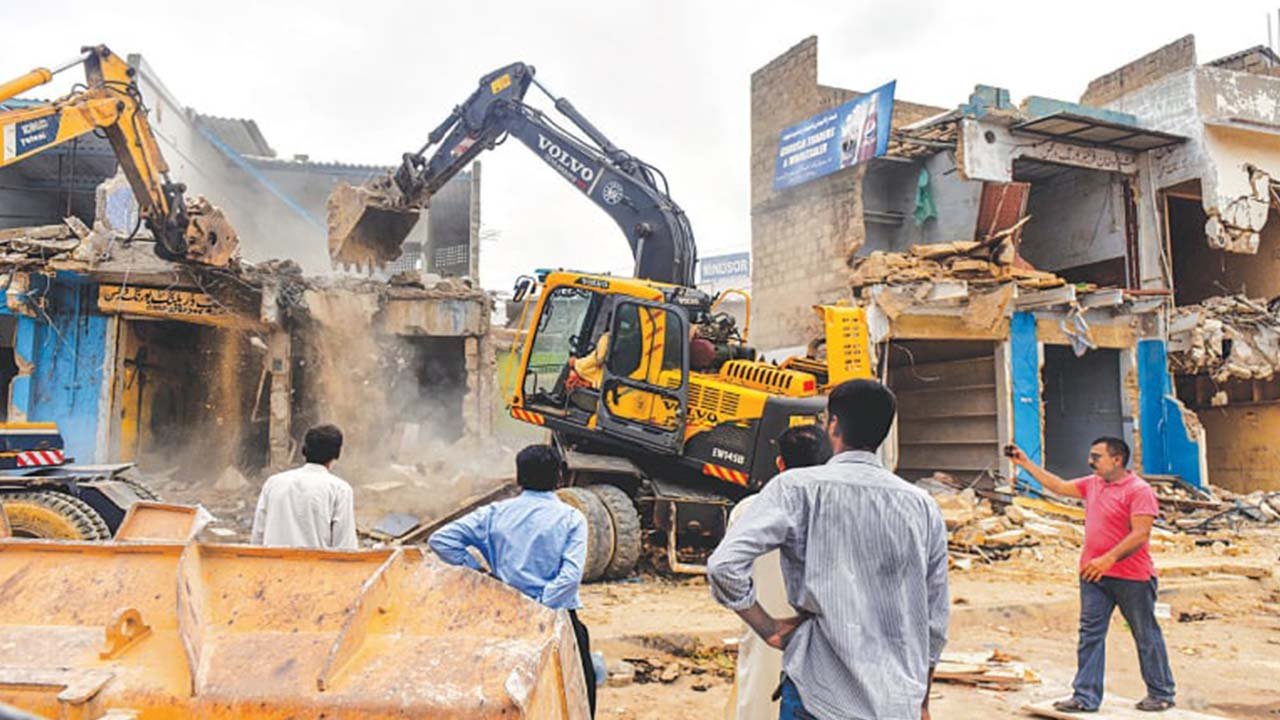
    The Sindh Building Control Authority (SBCA) has intensified efforts to combat unauthorised constructions across Karachi, leading to the demolition of several structures, including wedding halls.

    In a recent operation targeting illegal construction in District Central Karachi, SBCA personnel faced gunfire from unidentified individuals. Despite the danger, SBCA officials pressed on, successfully demolishing the fourth floor of a targeted building.

    The Director General of SBCA, Abdul Rasheed Solangi, swiftly directed the Senior Superintendent of Police (SSP) Central to apprehend the culprits and initiate legal action against those responsible for the shooting.

    Solangi stressed the crucial need for resolute enforcement against illegal construction, commending the dedication and integrity of the SBCA staff. He assured them of unwavering support to ensure their safety and effectiveness in carrying out their duties amidst challenges.

    The crackdown on illegal construction continues across various parts of the city. Abdul Rasheed Solangi, along with the Demolition Squad, oversaw the demolition of multiple buildings in areas such as Essa Nagri, Paposh Nagar, and Gulberg.

    Additionally, over 13 illegal structures have been dismantled in localities including Saddar Town, Jamshed Town, Gulberg, and Gulshan-e-Iqbal.

    Director General Abdul Rasheed Solangi personally supervises the ongoing crackdown on illegal construction, underscoring the authority’s commitment to uphold building regulations and ensure public safety.

    Meanwhile, Minister for Local Government Saeed Ghani has issued directives to eradicate all forms of unauthorised construction in the city. He emphasised the importance of taking stringent action against any SBCA officials found complicit in facilitating illegal construction.