Category: Lifestyle

The lifestyle of millennials is underreported in our mainstream media. The Current’s lifestyle news covers social events and issues that are unique.

  • How humanitarian aid reaches war-torn Gaza

    How humanitarian aid reaches war-torn Gaza

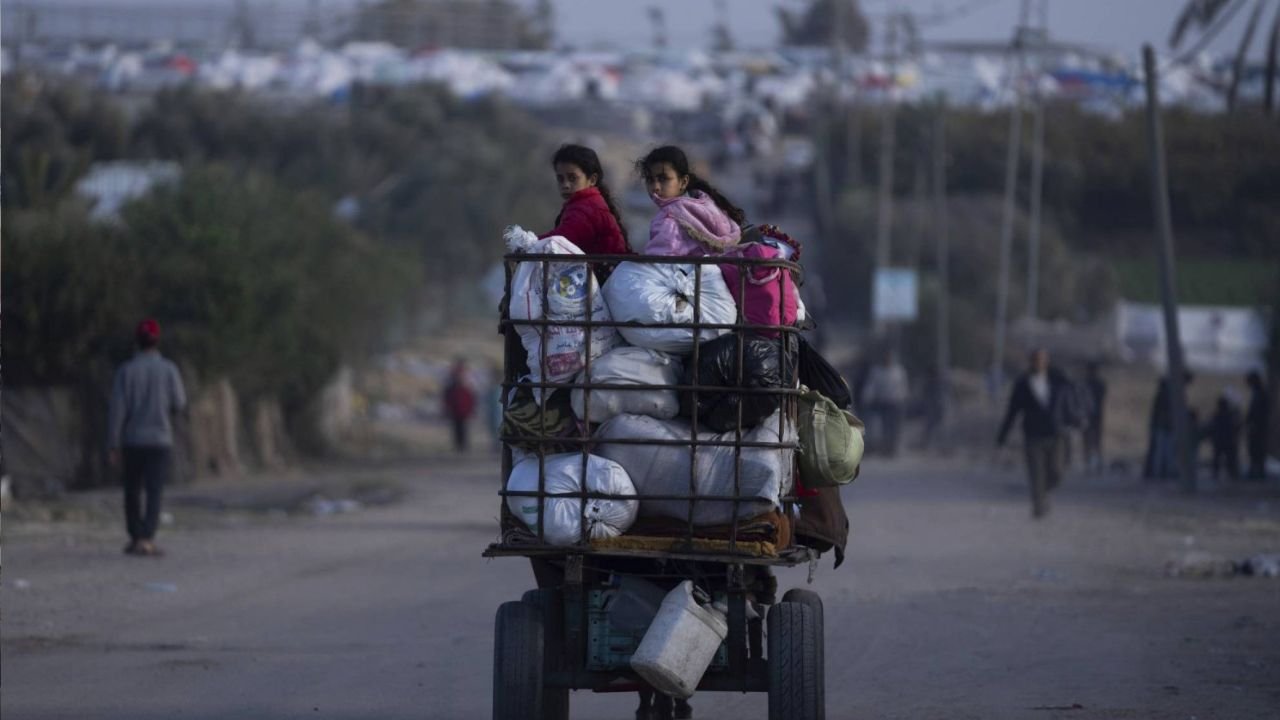
    Most aid bound for war-ravaged Gaza arrives overland from neighbouring Egypt but Israel and UN agencies clash on how much actually makes it inside the Palestinian territory.

    The volume of aid entering Gaza by road each day through the Rafah crossing from Egypt is insufficient, aid workers say, blaming rigorous Israeli inspections at least in part.

    With no truce in sight to pause the Israel-Hamas war, here is a look at how aid currently reaches Gaza and what alternatives are being weighed to alleviate the crisis in the besieged Palestinian territory.

    First stop: Egypt

    Most Gaza-bound goods arrive by sea in the Egyptian ports of Port Said or El-Arish.

    El-Arish is closer to Gaza but also smaller, and was quickly overwhelmed by the volume of shipments arriving, aid groups say.

    Israeli authorities, who have blockaded Gaza since Hamas took sole control of the Palestinian territory in 2007, require that all aid entering Gaza be inspected by them.

    The main inspection area for goods is Kerem Shalom in southern Israel, not far from the Rafah crossing.

    Another inspection area exists in Nitzana, on the Israeli-Egyptian border about 40 kilometres (25 miles) to the southeast.

    Long wait for trucks

    Before reaching the inspection areas, many aid trucks wait for days at the Egyptian side of the Rafah checkpoint.

    Once inspected, goods that are cleared to enter by Israel are unloaded from the mostly Egyptian trucks in the zone between Egypt and Gaza.

    The supplies are then loaded onto separate vehicles, driven by Gazans working for aid groups, for distribution inside the Palestinian territory.

    Cumbersome screenings are a major reason shortages are so glaring, aid workers say.

    Israel blames a lack of sufficient capacity on the Palestinian side to distribute the aid once it gets in.

    In recent days, Israel took issue with UN figures on the number of trucks entering Gaza, accusing UN Palestinian refugee agency UNRWA of counting only trucks it had processed, not those processed by Israel.

    Heading north

    For months, aid groups and foreign governments including top ally the United States have urged Israel to reopen border crossings into the north of Gaza, where the humanitarian crisis is most severe.

    Israel announced that six World Food Programme (WFP) aid trucks entered the north directly from its territory in early March, in what it described as a “pilot project”.

    The trial was not extended, however, and aid convoys bound for northern Gaza must travel the length of the territory negotiating battlegrounds, Israeli bombardments and mobs of desperate civilians.

    In March, the WFP said one of its convoys had been blocked by Israeli forces inside Gaza before it could reach the north.

    After turning back, the agency said the convoy was looted by a “crowd of desperate people”.

    According to Israeli authorities, 28 trucks reached northern Gaza on Wednesday.

    They were among 298 trucks that Israel said entered Gaza on Wednesday, still far below the number aid groups say is needed to sustain the territory’s 2.4 million people.

    Under pressure from the international community, Israel announced on April 5 that it would open a new crossing directly into northern Gaza, without specifying its exact location or when it would open.

    By air and by sea

    In a bid to get round the logjam, several Arab and European governments, later joined by Washington, began carrying out aid airdrops over Gaza, particularly the north.

    But the airdrops have proved controversial, with multiple deaths among civilians on the ground who were crushed by aid crates when parachutes failed to open, or drowned trying to reach others accidentally dropped in the sea.

    There has also been an attempt to establish a maritime aid corridor from the Mediterranean island of Cyprus but it has largely fizzled out after seven aid workers were killed by Israeli fire on April 1 as they unloaded food from the second flotilla to make the crossing.

    Even though the Cypriot government insists it has not given up on the aid corridor, no further crossings are currently planned after the US and Spanish charities behind the first two suspended their operations in the region.

    UN agencies have in any case said repeatedly that road convoys are the only practical way of meeting Gaza’s needs.


  • Heatwaves put millions of children in Asia at risk: UN

    Heatwaves put millions of children in Asia at risk: UN

    Massive heatwaves across East Asia and the Pacific could place millions of children at risk, the UN warned Thursday, calling for action to protect vulnerable people from the soaring temperatures.

    Global monitors have warned that 2024 is shaping up to be the hottest year on record, marked by climate extremes and rising greenhouse gas emissions.

    The UNICEF data showed over 243 million children across the Pacific and East Asia were estimated to be affected by heatwaves, putting them at risk of heat-related illnesses and death.

    Several countries in the region are currently smouldering in the summer heat, with temperatures nearing record levels as they regularly hit over 40 degrees Celsius (104 degrees Fahrenheit).

    Local forecasters are predicting steeper rises in the coming weeks.

    Some Philippine schools suspended in-person classes in April, with the state weather forecaster saying temperatures could reach a “danger” level of 42 or 43 degrees Celsius in parts of the country.

    In Thailand, a temperature of 43.5 degrees Celsius was recorded in the northern province of Mae Hong Son earlier this week — just a few degrees shy of the record 44.6 degrees Celsius.

    Around 40 people die from heat-related illnesses annually, according to the Thai Ministry of Health.

    And in February, neighbouring Vietnam endured a monster heatwave in its southern “rice bowl” when temperatures reached up to 38 degrees Celsius — an “abnormal” high for the period.

    According to the UNICEF report, children are more at risk than adults as they are less able to regulate their body temperature.

    “Children are more vulnerable than adults to the effects of climate change, and excess heat is a potentially lethal threat to them,” said Debora Comini, Director of UNICEF Regional Office for East Asia and the Pacific.

    The report said heatwaves and high humidity levels — commonly experienced in the region — can have a deadly effect as the heat will “hinder the body’s natural cooling mechanisms.”

    “We must be on high alert this summer to protect children and vulnerable communities from worsening heatwaves and other climate shocks,” Comini said.

    The UN projected that over two billion children are expected to be exposed to heatwaves by 2050.

  • 150 Jewish celebrities show support for director’s pro-Palestine Oscars speech

    150 Jewish celebrities show support for director’s pro-Palestine Oscars speech

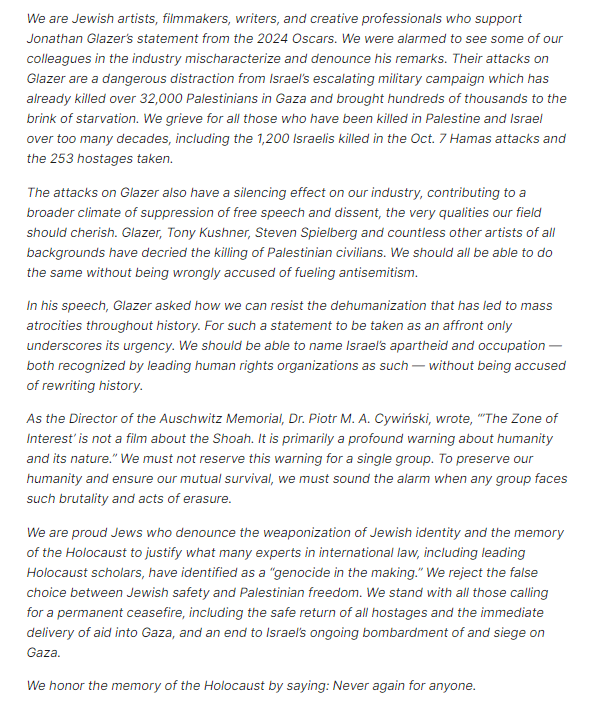
    More than 150 Jewish creatives have signed an open letter supporting Oscar Winner Jonathan Glazer’s pro-Palestine Oscars speech.

    The British filmmaker, Jonathan Glazer, who won the Best International Feature Oscar for his film ‘The Zone of Interest’, has been at the centre of an ongoing debate in Hollywood. He was under fire for his pro-Palestine speech at the Oscars. Glazer, who is Jewish himself, has now received support from heavyweight names.

    Jonathan Glazer’s speech is continuing to become one of the Oscars’ most debated and polarizing moments after many media outlets called it “anti-semitic”
    While accepting Best International Feature for his Holocaust film The Zone of Interest, Glazer drew a parallel between his film and the current conflict in Gaza: “Right now, we stand here as men who refute their Jewishness and the Holocaust being hijacked by an occupation, which has led to conflict for so many innocent people – whether the victims of October the 7th in Israel or the ongoing attack on Gaza – all the victims of this dehumanisation…”

    Now, the director has received fresh and welcome support through a new letter, whose signatories include major Jewish creatives like Nan Goldin, Joaquin Phoenix, Tom Stoppard, Elliott Gould, Debra Winger, Joel Coen, Emma Seligman, Nicole Holofcener, and Boots Riley.

    They are among more than 150 Jewish creatives who have signed the open letter supporting Glazer’s Oscars speech, writing that they were “alarmed to see some of our colleagues in the industry mischaracterize and denounce his remarks”.

    “In his speech, Glazer asked how we can resist the dehumanization that has led to mass atrocities throughout history,” read the letter. “For such a statement to be taken as an affront only underscores its urgency.”

    The letter also criticized the earlier condemnations of Glazer, saying they “have a silencing effect on our industry, contributing to a broader climate of suppression of free speech and dissent, the very qualities our field should cherish.”

    “We should be able to name Israel’s apartheid and occupation – both recognized by leading human rights organizations as such – without being accused of rewriting history.”

    The letter concluded: “We stand with all those calling for a permanent cease-fire, including the safe return of all hostages and the immediate delivery of aid into Gaza, and an end to Israel’s ongoing bombardment of and siege on Gaza.”

  • Hepatitis viruses kill 3,500 people a day: WHO

    Hepatitis viruses kill 3,500 people a day: WHO

    More than 3,500 people die from hepatitis viruses every day and the global toll is rising, the World Health Organization warned on Tuesday, calling for swift action to fight the second-largest infectious killer.

    New data from 187 countries showed that the number of deaths from viral hepatitis rose to 1.3 million in 2022 from 1.1 million in 2019, according to a WHO report released to coincide with the World Hepatitis Summit in Portugal this week.

    These are “alarming trends,” Meg Doherty, head of the WHO’s global HIV, hepatitis and sexually-transmitted infection programmes, told a press conference.

    The report said that there are 3,500 deaths per day worldwide from hepatitis infections — 83 percent from hepatitis B, 17 percent from hepatitis C.

    There are effective and cheap generic drugs which can treat these viruses.

    Yet only three percent of those with chronic hep B received antiviral treatment by the end of 2022, the report said.

    For hep C, just 20 percent-or 12.5 million people-had been treated.

    “These results fall well below the global targets to treat 80 percent of all people living with chronic hep B and C by 2030,” Doherty said.

    The overall rate of hepatitis infections did fall slightly.

    But WHO chief Tedros Adhanom Ghebreyesus emphasised that the report “paints a troubling picture”.

    “Despite progress globally in preventing hepatitis infections, deaths are rising because far too few people with hepatitis are being diagnosed and treated,” he said in a statement.

    Africa accounts for 63 percent of new hep B infections, yet less than one in five babies on the continent are vaccinated at birth, the report said.

    The UN agency also lamented that the affected countries did not have enough access to generic hepatitis drugs — and often paid more than they should.

    Two thirds of all hepatitis cases are in Bangladesh, China, Ethiopia, India, Indonesia, Nigeria, Pakistan, the Philippines, Russia, and Vietnam, according to the report.

    “Universal access to prevention, diagnosis, and treatment in these 10 countries by 2025, alongside intensified efforts in the African region, is essential to get the global response back on track,” the WHO said in a statement.

    Viral hepatitis is the second-biggest infectious killer, narrowly trailing tuberculosis.

  • Know all about Eid predictions here

    Know all about Eid predictions here

    There is a strong possibility that the Shawwal moon will be visible in Pakistan today.

    The age of the moon will be complete enough to be visible to the human eye this evening, according to experts of Meteorological Department. However, the final announcement of the moon of Shawwal will be made by the central Ruet-i-Hilal Committee.

    The moon of Shawwal has not been seen in Saudi Arabia, in view of which, Eid-ul-Fitr will be held tomorrow, Wednesday, in Saudi Arabia.

    In addition to Saudi Arabia, Qatar, the United Arab Emirates, Bahrain, and Kuwait will celebrate Eid tomorrow, according to media reports in the Gulf-based newspapers. Simi­larly, Australia has also announced that Eid will be observed on Wednesday.

    The central moon-sighting body will meet at the roof of the Federal Secreta­riat’s Kohsar Block in Islamabad, while meetings of zonal and district Ruet-i-Hilal committees will be held at their respective headquarters concurrently.

    In a statement on Mon­day, the committee requ­es­ted citizens to share any information regarding sightings of the moon with the committees in their respective areas.

    If the committee manages to spot the new moon today, then Pakistan will also celebrate Eid with the rest of the world.

  • Sikh Yatrees to come to Pakistan for mela

    Sikh Yatrees to come to Pakistan for mela

    Sikh pilgrims will come to Pakistan on April 13 to participate in the celebrations of Khalsa Janma Day and Vasakhi Mela. Officials of the Evacuee Trust Property Board (ETPB), Pradhan and other Sikh leaders will be welcoming the guests.

    The main ceremony will be held at Gurudwara Panja Sahib, Hasan Abdal, on April 14. The pilgrims will reach Nankana Sahib from Hassan Abdal on April 15 and on April 18, they will go to Gurudwara Darbar Sahib Kartarpur, Narowal, reports The Express Tribune.

    On April 20, the yatrees will visit Aimanabad and reach Lahore where they will stay for one day.

    The Sikh pilgrims will return to India after completing their 10-day pilgrimage on April 22.

  • Two journalists booked for interviewing suspects in Toba Tek Singh Maria murder case

    Two journalists booked for interviewing suspects in Toba Tek Singh Maria murder case

    Update: Local police on Saturday booked a reporter and a cameraman of a private TV channel for “illegally” recording and broadcasting on social media the interviews of the three in-custody suspects in the Maria murder case, reports Dawn.

    In the First Information Report (FIR) complainant Station House Officer (SHO) Muhammad Hasan stated that the private TV channel’s reporter Rana Khalid Mahmood and cameraman Ali Ahmad violated the law by recording video statements of the suspects in custody, without permission of the concerned authorities.

    However, no arrest has so far been made in the case.

    Meanwhile, journalists’ organizations have expressed concern over the registration of the case under the Prevention of Electronic Crimes Act (PECA) declaring it beyond the Punjab police’s domain to book any media person. They also urged Chief Minister Maryam Nawaz to take notice of the alleged violation of law by the Punjab police and warned the government that journalists would be forced to stage protests if the “illegal” FIR against the two media persons was not dismissed.

    The TV reporter, Rana Khalid, claims his lawyers had filed his pre-arrest bail plea before the court who refused to hear it with the remarks that the cases under PECA should be heard by a Federal Investigation Agency (FIA) court.

    However, in the case, BOL News is claiming that the brother who filmed the murder, Shehbaz, and his wife Sumera have been convicted by the court for hiding the murder of 22-year-old Maria under section 201 of the penal code of Pakistan. They have been sent to jail on judicial remand.

    Previously, in the Toba Tek Singh’s Maria murder case, the brother, Faisal, who was seen murdering the sister in the video, and the complicit father, Abdul Sattar, lying on a bed beside him have alleged that the brother who filmed it raped her. The two were talking to the media when they said that.

    The matter of the brutal murder and it being filmed was discussed by Zarar Khuro, Wusatullah Khan, and Shahzaib Jillani in their show Zara Hat Kay. The reporter Sultan Sidhu explained that a four day remand has been taken again and shocking revelations have been made in the case as the alleged complicit duo of father and son have told the police that Shehbaz the brother who filmed it was raping Maria and not them.

    https://youtu.be/6jh5M4ybXd4?si=OEGBT7zHEYu_F4CK

    Previously, lawyer Kamran Zafar, Maria’s elder brother Shehbaz’s lawyer announced the withdrawal of his advocacy in the case.

    The lawyer announced the withdrawal of his letter of attorney in Toba Tek Singh, citing he cannot advocate for “beasts”

    Maria,22, murder case was heard in a local court of Toba Tek Singh. The main accused Faisal and his father were presented before the court. During the hearing, the police requested 14 days remand of the accused in the case, however, the magistrate approved a four-day remand.

    Lawyer said Shahbaz and his wife were misleading, and he could not represent such “beasts” before the court, reports ARY News.

    Meanwhile, the family of Maria alleged that lawyer after taking Rs 400,000 decided to help the police.

    Moreover, the elder sister of deceased Maria Bibi revealed shocking details and demanded justice from the authorities in an interview with ARY News.

    The statement of the deceased Maria Bibi’s elder sister, Kosar, has come to light in which she stated that her brother informed her at 1 am that Maria’s condition had deteriorated but when she arrived home she was already dead. “She was subjected to severe torture and brutally murdered as she saw blood flowing from Maria’s nose, said Kosar.

    Background

    The horrific video of the murder of a 22-year-old girl in Toba Tek Singh has gone viral in which one of her brothers strangled her while being encouraged by their father while the other brother was filming. The father and the brother who killed the girl have been accused of allegedly raping the victim.

    The video of the gruesome murder of Maria in 477 JB, a suburb of Toba Tek Singh, has invoked horrified reactions on the internet. The video, filmed inside what looks like a room in a rural home, shows Faisal strangling Maria while her father Abdul Sattar is lying down, seemingly not bothered by his daughter’s death. The other brother’s wife Sumaira can also be seen standing in the room in the video. Meanwhile the brother who was secretly filming the incident, Shehbaz, filmed the clip on the pretext of talking to a friend on the phone.

    A two-day physical remand of the victim’s brother Faisal and father Abdul Sattar, arrested on the charge of murder, has been obtained, while the other brother of the victim, Shehbaz, who made the video, and the sister-in-law Sumaira, who is seen in the video, have also been made part of the investigation, as per the police.

    The neck bone of the girl is broken, reveals the preliminary investigation.

    Relatives of the victim and the neighbours say that the three of them- father and sons- killed the girl and tried to hide the crime by burying her and declaring her death to be natural.

    The father and son strangled Maria together between the nights of March 17 and 18, according to the police report. The brother who made the video, Shehbaz, has accused his brother and father of killing the victim after she complained of rape.

    https://youtu.be/a3M40PEV_XQ?si=yFCPQ2rgsv3KU2Mj

    In the video, Maria’s brother Shehbaz could be heard suggesting to his father and younger brother Faisal to free the sister.

    Reporter Geo News Sajid Majeed explained that Shehbaz instantly informed the police but no action was taken. Consequently, his lawyer shared the video in various groups and made it viral on social media. This prompted the police to arrest the two murderers.

    Shahbaz said that when he tried to rescue Maria, his brother and father threatened to kill his daughters too.

    “I cannot resist for the sake of my daughters but I recorded the murder from my mobile pretending to be speaking on a phone call,” he added while talking to Samaa News.

    https://youtu.be/USGwB0im1uA?si=xNYEUw3b0VjNN5Qj

    Shahbaz asked the police to register the case on his complaint, not on behalf of the state, reports 24 News.

    Maria’s sister-in-law has said that when they entered the room, Maria’s hands and feet were tied.

    DPO Ibadat Nisar Toba Tek Singh has said that DNA tests of the three fathers and sons are being conducted while the samples have been sent for forensics after the exhumation and post-mortem of the victim.

  • Why unprotected eclipse gazing will leave you seeing stars

    Why unprotected eclipse gazing will leave you seeing stars

    Just a single, unguarded glance at a solar eclipse can result in a lifetime of vision loss, eye health experts warn.

    On Monday, tens of millions of spectators across Mexico, the United States and Canada will witness the Moon completely obscure the Sun’s light, a rare celestial spectacle that won’t be visible for most of North America again until 2044.

    Medical literature is teeming with examples of people who suffered damage to their retinas — the layer of light-sensitive tissue at the back of the eye — and health professionals are offering advice on how to avoid becoming the next cautionary tale.

    Aaron Zimmerman, a clinical professor of optometry at the Ohio State University, told AFP that the dangers of sungazing during eclipses were discussed by the ancient Greek philosopher Socrates, but it wasn’t until recently that science really caught up with how eye injury happened.

    When it comes to eclipses, he explained, the main damage comes from “photochemical toxicity,” where short, high-energy wavelengths of light — blues, violets and non-visible ultraviolets — trigger chemical reactions that damage the rods and cones of the retina.

    Cue visits to the emergency department by people with complaints of blurry vision, changes in color perception, and blind spots, with the outlook for recovery far from certain.

    Human beings inherently look away from the Sun because of the discomfort it causes, but during eclipses “you can psychologically override” that instinct, explained Zimmerman.

    A famous journal report about the 2017 US solar eclipse involved a woman in her twenties who presented to the New York Eye and Ear Infirmary after looking at the solar rim “several times for approximately 6 seconds without protective glasses” and then later with eclipse glasses.

    Hours later, objects started to look fuzzy and out of shape, colors became distorted, and she developed a central black spot in her left eye.

    An advanced imaging technique was able to show the damage at the cellular level which persisted on her follow up six weeks later.

    Young adults might be more susceptible, the authors of the paper said, because of larger pupils, clearer eye structure, or “poorer recognition of the dangers” of viewing eclipses with improper eyewear.

    “In some cases, it’s just partially damaged and it may resolve so that you don’t notice it anymore,” Neil Bressler, a professor of ophthalmology at Johns Hopkins University and editor-in-chief of JAMA Ophthalmology told AFP. If recovery happens, it’s normally within the first six months.

    “But in other cases, it can leave a permanent blank spot… and we don’t have a treatment to reverse that. It’s like brain tissue, once you lose it, it won’t grow back,” added Bressler.

    The best way to view the eclipse is with eclipse sunglasses, which block out 99.999 percent of light. Always go for genuine products. To test if your glasses are up to standard, “find the brightest light bulb in your home — and then look at that from up close and you should barely be able to see the light,” said Zimmerman.

    If it’s too late to procure specialist eyewear, then there are indirect methods, such as punching a pinhole into a cardboard and letting the light shine onto another surface, or even using the humble kitchen colander to the same effect. NASA’s webcast is another option.

    Those fortunate enough to be in the “path of totality,” under which the Moon will fully block out the Sun, can look up without glasses and admire the Sun’s outer atmosphere, or corona, glowing from behind the silhouette of the Moon.

    But, said Bressler, the danger is not having protection before and after those precious moments, which can last anywhere from seconds to a few minutes, depending on your location.

    “You must know when it begins and use protection before that, and you may be enamored by looking at all this, but you must have some alarm to tell you it’s about to end,” he warned.

  • Swiss farmers dump dead sheep in protest against rising number of wolves

    Swiss farmers dump dead sheep in protest against rising number of wolves

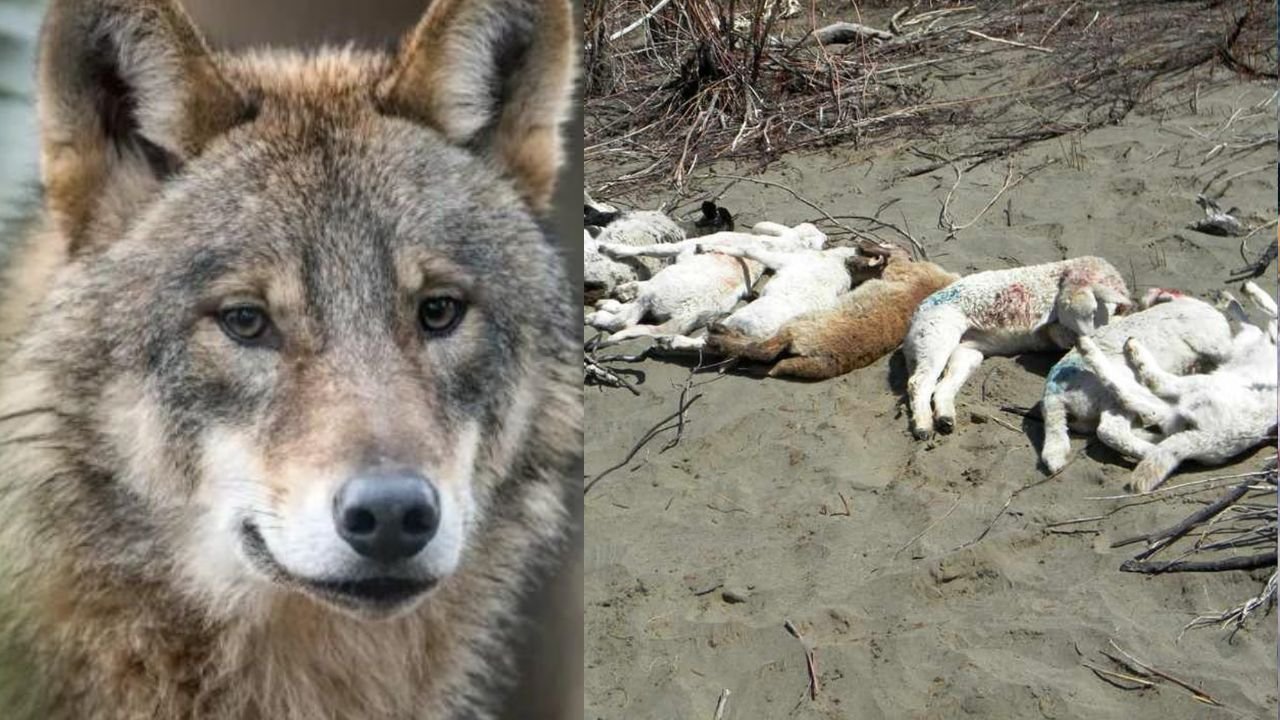
    Swiss sheep farmers on Saturday dumped the bodies of animals killed by wolves in front of a regional government building, demanding more action against the predators, Swiss media reported.

    Around a dozen breeders came from the Saint-Barthelemy area in the western Swiss canton of Vaud to lay out the carcasses of 12 sheep in front of the regional government headquarters in Lausanne, the Chateau Saint-Maire.

    “These sheep were killed last night,” Eric Herb, a member of a Swiss association demanding the regulation of big predators, was quoted as saying by the Keystone-ATS news agency.

    “It is really time to act.”

    “We are sick of this. We want the wolf killed,” agreed Patrick Perroud, a farmer and butcher from the nearby municipality of Oulens.

    “Cohabitation is not possible. Our territory is too small,” he told Keystone-ATS.

    The protesters told the news agency that wolves had killed 17 sheep in the same area late last month, two earlier this week and 13 overnight to Saturday.

    “The breeders have played nice until now, but this time it was too much,” Herb said.

    The protesters were planning to increase the pressure on the Vaud government environment minister, Vassilis Venizelos of the Green Party, he said.

    One of the protesters’ banners read: “Vassilis step down”, Keystone-ATS reported.

    The breeders had briefly negotiated with regional police before being allowed to lay down the animal carcasses on tarpaulin in front of the Chateau.

    Participants in the protest, which was supported by the regional chapter of the far-right Swiss People’s Party — Switzerland’s largest party — lamented that they were losing sleep.

    “We have to check on our animals every night,” one was quoted as saying.

    After being wiped out more than a century ago, wolves have in recent decades begun returning to Switzerland and to several other European countries.

    Since the first pack was spotted in the wealthy Alpine nation in 2012, the number of packs swelled to 32 last year, with around 300 individual wolves counted.

    Nature conservation groups have hailed the return as a sign of a healthier and more diverse ecosystem.

    But breeders and herders complain of attacks on livestock and have been ramping up demands to cull more wolves.

    Swiss authorities last year relaxed the rules for hunting the protected species, and decided to allow large preventative culls in the most affected cantons but swift legal actions put those plans partially on ice.

    The debate in several parts of Europe about wolves rose up the political agenda in September.

    In an open letter to the European Commission, eight leading conservation groups said there were ways to make coexistence easier between humans and large wild animals like wolves.

    “Damage to livestock is often linked to the lack of adequate supervision and/or physical protection,” they said. They pointed to strategies such as “the training of dogs to protect herds, education of herders, tools and technical solutions to deter wolves”.

  • Maryam Nawaz announces transgender schools in each division while they exist since PTI times

    Maryam Nawaz announces transgender schools in each division while they exist since PTI times

    Chief Minister Punjab Maryam Nawaz has announced the establishment of transgender schools at the division level. Additionally, she directed the relevant officials to provide educational facilities to special children in at least one government school in each district.

    Dawn reports that these decisions were ta­­ken at a meeting held to re­­­view proposed school education reforms in the province.

    While chairing the revi­­ew meeting, CM Nawaz said: “Schools for trans­ge­nder [community] will be established at divisional level.”

    PTI-initiated Transgender schools

    Nine of the 11 divisions in Punjab already have schools for the transgender community. The initiative was taken by the previous PTI government under the supervision of the then Punjab Minister for School Education Murad Raas.

    Trans Educational School Sys­t­­em, Multan, Principal Ali­sha Sherazi told Dawn that no one from the government had contacted them for the establishment of transgender schools, as such schools already exis­ted in different cities of Punjab like D.G. Khan, Gujran­wala, Rawalpindi, Sargo­dha, Faisalabad, Gujrat, Multan and Bahawalpur. Only the one established in Lahore was later closed, she added.

    Transgender schools

    Alisha Sherazi, a trans­gender and a former cons­u­ltant of UNDP who did her MPhil in Education, Planning and Manage­m­ent from Burhanuddin Za­­kariya University, expl­ai­ned that three of the scho­ols including D.G. Khan, Multan and Bahawalpur were giving vocational tr­­a­ining to members of the transgender community. Four labs for IT, stitching, cooking and make-up classes were established in those schools, while other schools were focusing on academics, according to the principal.

    The government did not have the exact figures of transgender community’s population in the Punjab, Alisha added.

    At the meeting, CM Maryam Nawaz directed relevant authorities to implement a new comprehensive procedure.