Category: Lifestyle

The lifestyle of millennials is underreported in our mainstream media. The Current’s lifestyle news covers social events and issues that are unique.

  • Israel alleges UN organisation involved in Oct 7 attack, funding suspended for agency

    Israel alleges UN organisation involved in Oct 7 attack, funding suspended for agency

    Australia and Canada have suspended their funding to the UN agency for Palestinian refugees, after Israel accused several employees of involvement in October 7 attacks by Hamas.

    Australian Foreign Minister Penny Wong said on Saturday she was “deeply concerned” by the allegations against the agency, UNRWA.

    “We are speaking with partners and will temporarily pause disbursement of recent funding,” she wrote on social media platform X.

    “We welcome UNRWA’s immediate response, including terminating contracts and launching an investigation, as well as its recent announcement of a full investigation into allegations against the organization,” she added.

    Canada’s International Development Minister Ahmed Hussen on Friday announced that Ottawa had “temporarily paused any additional funding to UNRWA while it undertakes a thorough investigation into these allegations”.

    “Canada is taking these reports extremely seriously and is engaging closely with UNRWA and other donors on this issue,” he wrote on X.

    “Should the allegations prove to be accurate, Canada expects UNRWA to immediately act against those determined to have been involved in Hamas’s terrorist attacks.”

    The moves come after the United States halted its funding to UNRWA on Friday, saying the allegations were against 12 employees who “may have been involved” in the Hamas attack that triggered the war in Gaza.

    The United Nations agency for Palestinian refugees says it has opened an investigation into some employees Israel alleges were involved in the October 7 attacks, and that it has severed ties with those staff members.

    “The Israeli authorities have provided UNRWA with information about the alleged involvement of several UNRWA employees in the horrific attacks on Israel on October 7,” Philippe Lazzarini, commissioner-general of the UN Relief and Works Agency for Palestine Refugees in the Near East (UNRWA), said on Friday.

    UN chief Antonio Guterres has pledged to conduct an “urgent and comprehensive independent review of UNRWA”.

    Established in 1949 following the first Arab-Israeli war, the agency provides services including schooling, primary healthcare and humanitarian aid to Palestinians in Gaza, the West Bank, Jordan, Syria and Lebanon.

    It is important to note that since the onset of the war on Gaza, Israeli authorities, including Prime Minister Benjamin Netanyahu, have accused it of fuelling anti-Israeli incitement – allegations it denies.

    UNRWA says it has provided aid to desperate people in Gaza and used its facilities to shelter those fleeing Israeli attacks.

    The agency’s shelters have also been repeatedly targeted by Israeli missiles during the war, despite pleas for safe passages to deliver humanitarian aid and assistance.

  • ‘Game changer’: Gene therapy offers hope for children born deaf

    ‘Game changer’: Gene therapy offers hope for children born deaf

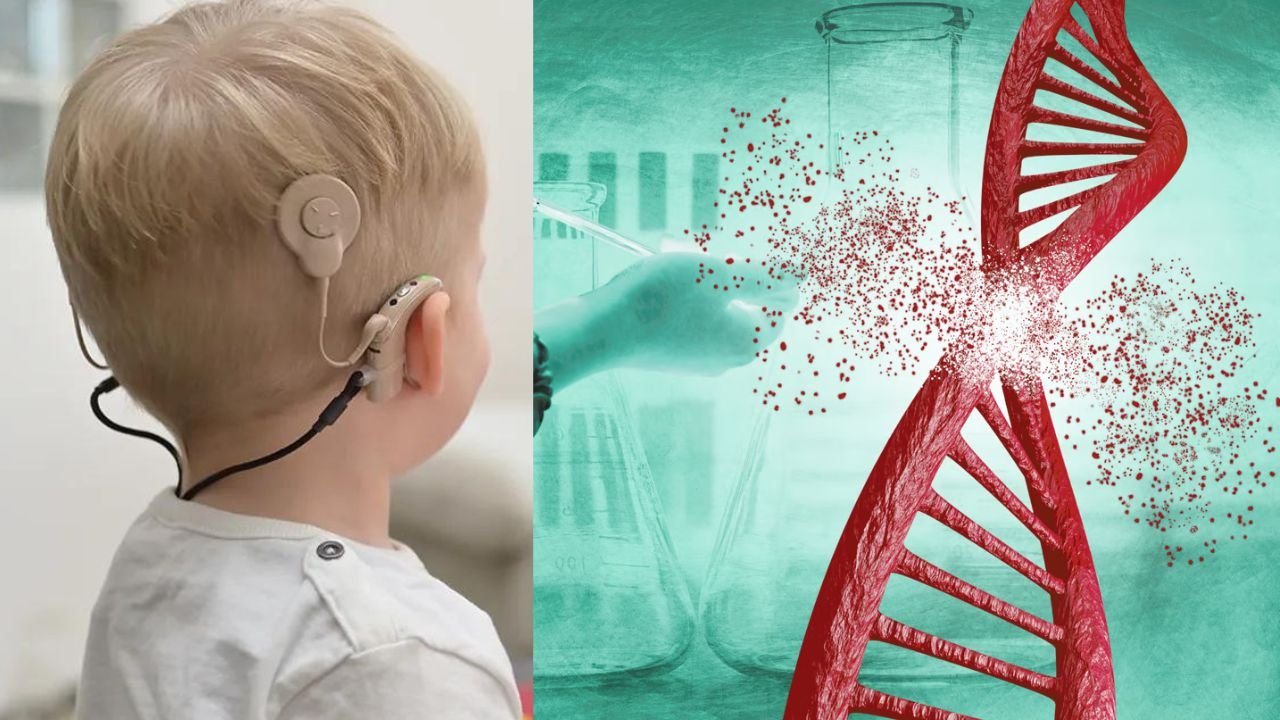
    A gene therapy that has allowed several children born deaf to hear for the first time is being hailed as a “game changer” that raises hopes of the first new treatment for hereditary deafness in decades.

    Several medical teams around the world are trialling the procedure, which focuses on a rare genetic mutation that affects only a small number of the 26 million people with congenital deafness globally.

    But several success stories announced this week are already being seen as a turning point.

    On Tuesday, the Children’s Hospital of Philadelphia revealed that 11-year-old Aissam Dam, who was born deaf, was now “literally hearing sound for the first time in his life”.

    Aissam still has mild-to-moderate hearing loss, and may never learn to talk because the brain’s window for acquiring speech closes around the age of five.

    But a trial in China, the results of which were announced in The Lancet journal on Thursday, tested a similar treatment on six younger children.

    Five gained the ability to hear, according to the findings of the trial that started in 2022, making it the first to have tested the gene therapy on humans.

    Some of the children were already able to speak thanks to a cochlear implant — which they now no longer need, study co-author Zheng-Yi Chen of the Massachusetts Eye and Ear hospital told AFP.

    But one, a baby only a year old, had never been able to communicate verbally, Chen said.

    Chen said that after the treatment, when the mother asked the baby “who am I?”, the baby responded: “Mama.”

    When asked what a chicken sounds like, the baby responded: “Coo-coo.”

    “Everyone just cried with joy, it’s really amazing,” said Chen, adding that the baby was expected to grow up speaking normally.

    Not since cochlear implants were invented 60 years has there been such an advance, Chen said, adding that the therapy “symbolises a new era in the fight against all types of hearing loss”.

    – How does it work? –

    For now, the trials in China, the United States and another announced in France this week all use a similar technique to focus on people born with a mutation of the OTOF gene.

    This defect means they can no longer produce the protein otoferlin, which is needed for hair cells in the inner ear to convert sound vibrations into electrical signals that can be sent to the brain.

    The treatment involves injecting a harmless virus into the inner ear that smuggles in a working version of the OTOF gene, restoring hearing.

    The French trial will focus on babies aged 12-31 months, in the hopes it can “enable the acquisition of language”, said Nawal Ouzren, CEO of the firm Sensorion developing the treatment.

    Natalie Loundon, a French doctor and hearing loss expert, called the technique “a game-changer, a technological advance that will revolutionise therapeutic care”.

    “The idea is to be able to offer this treatment to children rather than an implant, which is not always received well,” she told AFP.

    For the China-based trial, the researchers will continue to study the participants to find out if their improved hearing lasts.

    Chen estimated that the treatment tested in that trial could be ready to apply for regulatory approval within three to five years.

    – Targeting the other genes –

    But this particular treatment will only help a fraction of those born deaf.

    Around one in every 1,000 children are born deaf due to gene defects, but a lack of otoferlin is the cause of only around three percent of those cases.

    More than 150 other genes have been discovered that trigger genetic hearing loss.

    But Chen had some good news.

    So far, the otoferlin treatment seems to work just as well in humans as it did in during trials on mice — which is not always the case for such research.

    Trials on mice targeting other gene defects that cause hearing loss have also been successful, Chen said.

    Researchers therefore hope this first treatment opens the door to others.

    France’s Pasteur Institute, which pioneered the research on otoferlin, and Sensorion are already working on another therapy that focuses on a gene whose mutations are responsible for the most common forms of hereditary deafness.

  • Pakistani-British doctor miraculously saves woman’s life on flight through apple watch

    Pakistani-British doctor miraculously saves woman’s life on flight through apple watch

    A British doctor of Pakistani origin saved the life of an elderly woman on a flight with the help of an Apple Watch.

    According to the British broadcaster BBC, Dr. Rashid Riaz of the National Health Service (NHS) from Hereford, England, was going to Verona from Birmingham for a vacation. He was on a flight when a 70-year-old woman’s condition suddenly deteriorated, leading ti difficulty in breathing.

    Seeing the condition of the woman, the flight attendant asked if there was a doctor on board, upon which Dr. Rashid Riaz came forward to help.

    After the initial check-up, he wanted to check the patient’s oxygen saturation level but was unable to do so using the equipment on the flight. He then asked the crew if there was an Apple Watch available to monitor the woman’s health. “The Apple Watch helped me find out the patient had low oxygen saturation,” the doctor told the BBC.

    He used local health monitoring software to estimate levels.

    Dr. Rashid Riaz said that the woman was suffering from heart disease and with the help of Apple Watch, it was easy for him to detect the decreasing oxygen level of the elderly woman, thus saving her life by providing oxygen.

  • JI calls for sit-in outside Board of Intermediate Education Karachi after 80 per cent students fail

    JI calls for sit-in outside Board of Intermediate Education Karachi after 80 per cent students fail

    The Jamaat-e-Islami (JI) has announced a sit-in outside the Board of Intermediate Education office in Karachi (BoIEK) following the announcement of inter results which revealed that about 80 per cent Arts students had failed.

    In a press conference in Karachi, JI’s city chief Hafiz Naeemur Rehman blamed BoIEK for putting children’s future at stake by undermining their education due with their ineptness.

    He has also claimed that the students were subjected to board’s incompetence during examinations such as cheating, paper leaks, and external interference, so much so that Metropolitan University, Karachi University, and NED University can not be deemed as credible anymore.

    Hafiz Naeemur Rehman also called for a protest outside the Intermediate Board office on Friday, asking students to join along with their mark sheets.

    Background

    The results for first-year (Part-I) examination announced by the Board of Intermediate Education Karachi (BIEK) raised concerns as more than 50 per cent of the students have failed.

    According to the inter board spokesperson, 72 per cent of the candidates failed in arts first year (private) and 80 per cent in arts (regular).

    He added that 11,046 candidates participated in the Arts (regular) exams in which only 2,298 candidates were successful while 2,795 candidates participated in the Arts private exams in which 792 candidates passed all the papers.

    Additionally, 63 per cent of the candidates failed in Commerce (private) as 1,986 candidates participated in the exams, out of which 744 candidates passed all the papers.

  • Lahore High Court stops planting of palm trees on highways and motorways

    Lahore High Court stops planting of palm trees on highways and motorways

    Lahore High Court has stopped the planting of palm trees on highways and motorways, reports Geo.

    Justice Shahid Karim of Lahore High Court heard the petitions of citizen Haroon Farooq and others for the remedy of smog, during which DG Environment told the court that pollution does not stay on palm leaves as they grow better in hot areas. It has not been successful on motorways and highways in Islamabad.

    During the hearing, Justice Shahid Karim stated that there should be an investigation into the renovation and decoration of the underpasses in Lahore. “Who has earned the money for the renovation of the underpasses,” the court inquired. The judge then observed that the underpasses have become stranger than before, looking like a joke. He said that the strange lights which were installed in there went off on the first day.

    Justice Shahid Karim added that water should not be wasted as reports are indicating that the previous resource will run out by 2026- 2027. What steps did WASA take to install water meters, the court asked members of the water commission. He was informed in response that one year is required to install water meters.

    Later, the court ordered the DG Environment to stop the planting of palm trees on highways and motorways.

  • Last functional hospital in Gaza under attack as medical personnel toll hits 192

    Last functional hospital in Gaza under attack as medical personnel toll hits 192

    The United Nations has said that heavy fighting has “encircled” two hospitals in Khan Younis – Nasser and Al-Amal – leaving thousands of “terrified staff, patients and displaced people trapped inside”.

    The World Health Organization (WHO) has said that seven out of 24 hospitals are “partially functioning” in northern Gaza and suffering a shortage of personnel and supplies.

    Journalist Bisan shared a recent post detailing an attack on the Khan Yones camp by the Israeli occupation forces. Consequently, the last functioning hospital in Gaza- Al Nasser Medical Hospital- was under attack as well. Videos of gunfire surfaced on various social media platforms as well.

    The health scenario in Gaza is nearing collapse. Al Jazeera shared a report titled, ‘Against every instinct: How doctors in Gaza persevere amid Israel attacks’, in which it was revealed that almost 192 doctors were killed in Gaza between October 7 and November 8, 2023.

    According to the WHO, only 15 of Gaza’s 36 hospitals are partially functional – nine in the south and six in the north. The hospitals in the south are operating at three times their capacity while facing critical shortages of basic supplies and fuel.

    The facilities are “without enough specialized medical staff to manage the volume and range of injuries, nor sufficient medicines and medical supplies, fuel, clean water, or food for patients or staff”, the WHO said in a statement.

    The Ministry of Health in Gaza says occupancy rates are reaching 206 percent in inpatient departments and 250 percent in intensive care units.

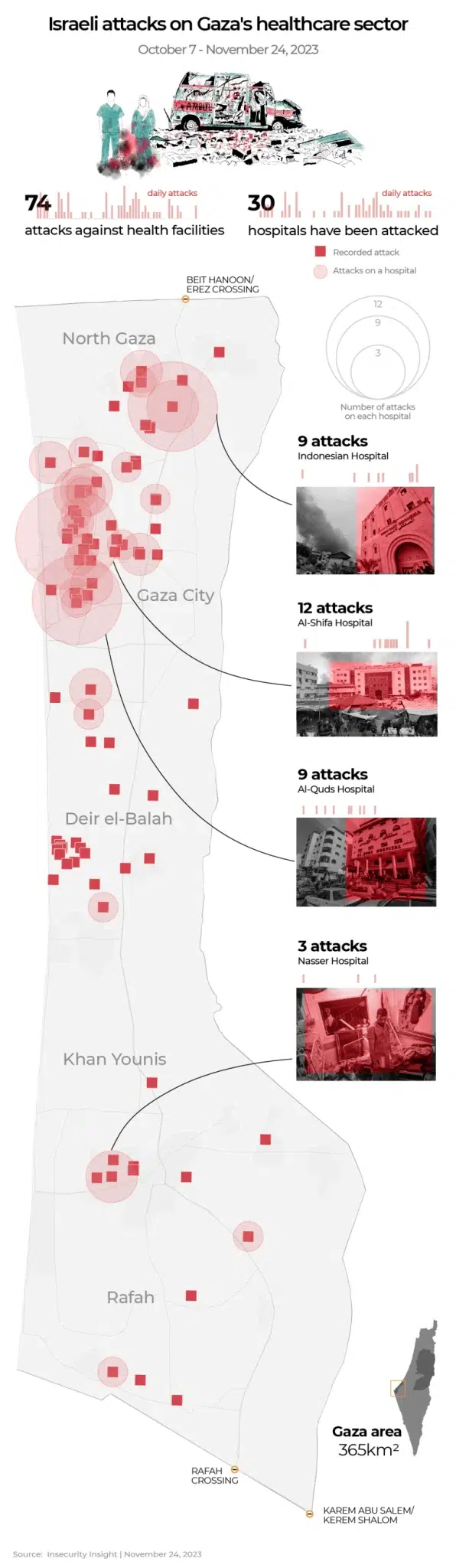
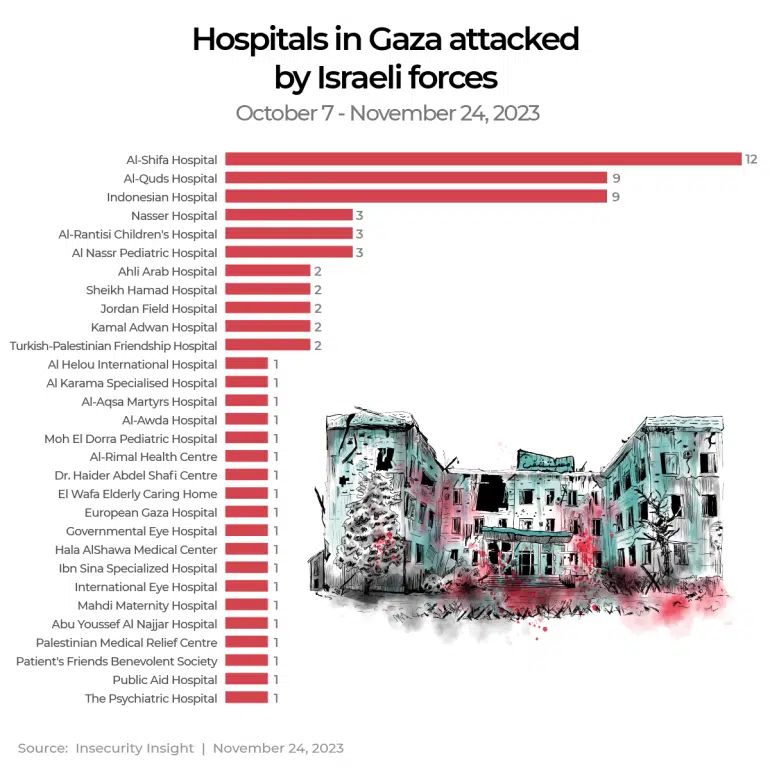
    From October 7 to November 24, there were 74 Israeli assaults on health facilities with 30 hospitals attacked in Gaza, according to Insecurity Insight, a humanitarian association that collates data on threats facing people in dangerous environments. It delivered 19,000 litres (5,000 gallons) of fuel to al-Shifa Hospital on Tuesday after facing delays at a checkpoint and on damaged roads.

    There have been 212 attacks on medical personnel.

    Attack on Hospitals

    The hospitals that have been attacked most often include:

    1. al-Shifa Hospital – attacked 12 times
    2. al-Quds Hospital – attacked nine times
    3. Indonesian Hospital – attacked nine times
    4. Nasser Hospital – attacked three times

    Insecurity Insight documented at least 26 other hospitals from across the Gaza Strip that were attacked by Israeli forces over the same period.

    How Gaza’s healthcare system has been destroyed?

    Mohamed S Ziara, a Palestinian doctor, talked to Al Jazeera and explained in a tone that is soft and unaffected by the rumbling explosions and pop of gunfire that can be heard in the background.

    He is a plastic surgeon working 12- to 14-hour shifts, six days a week at the European Gaza Hospital (EGH) in Khan Younis, where he treats up to 15 cases a day. Ziara describes the healthcare situation as “catastrophic”.

    “It doesn’t match anything I’ve seen before, even with previous escalations and war,” says Ziara, who has worked during Israel’s assaults on Gaza since 2014.

    He has been posting about Israeli attacks near the EGH and the conditions inside on his Instagram account.

    “No doctor wakes up in the morning and says: ‘I’m going to amputate a child’s leg without anesthesia.’”

    “You don’t want to watch children suffer,” Dr Amber Alayyan with Doctors Without Borders, known by its French initials MSF, told Al Jazeera.

    Chronically ill patients

    In addition to immediate injuries from Israeli air strikes and artillery, patients with prior and long-term illnesses and vulnerable health conditions are faced with not being treated. According to WHO, they include:

    • 1,100 patients in need of kidney dialysis
    • 71,000 patients living with diabetes
    • 225,000 patients with high blood pressure requiring medication
    • 485,000 people with mental health disorders
    • cancer patients, 2,000 of whom are diagnosed each year, including 122 children
    • 45,000 patients with cardiovascular disease.

    A grim prospect for the future

    On January 7, exactly three months into the war on Gaza, WHO Director-General Tedros Adhanom Ghebreyesus said: “It is inconceivable that this most essential need – the protection of healthcare – is not assured.”

  • Pakistani passport once again least powerful

    Pakistani passport once again least powerful

    Henley & Partners‘ Passport Index has published a list portraying the world’s travel access hierarchy.

    Top on the list of countries that encourage travelling are France, Germany, Italy, Japan, Singapore, and Spain, whose citizens can visit an astounding 194 destinations without requiring arduous visa procedures. This group of countries offer passport-to-plane experience, setting the bar high for unmatched worldwide mobility.

    With access to 193 locations, Finland, South Korea, and Sweden share second place. Many visa-free or visa-on-arrival options are available to their well-travelled inhabitants, providing access to a variety of cultures and environments.

    Austria, Denmark, Ireland, and the Netherlands take third place with access to 192 destinations. These nations serve as entry points to a wide range of travel opportunities.

    The long list goes on, honouring countries that place a high priority on global connection. Among the notable entries are the United States, Canada, Greece, Switzerland, and New Zealand, all of which provide their inhabitants with an abundance of travel options.

    On the other hand, the Passport Index identifies states with more limited travel options. Afghanistan, Syria, Iraq, and Pakistan are among the least accessible, offering their passport holders entry to just 34 countries that require no visa or one upon arrival.

    The London-based company, which offers residency and citizenship consultancy services, teamed together with the International Air Transport Association to create a unique ranking that takes into account passport holders’ access to countries without a visa or with one upon arrival.

  • Pneumonia continues consuming lives in Punjab, 251 children affected in last 24 hours

    Pneumonia continues consuming lives in Punjab, 251 children affected in last 24 hours

    Punjab Health Department has shared that 1,777 new cases of pneumonia were reported in the province within 24 hours, while 12 children also died due to the disease.

    According to the Health Department, 11, 597 children were affected by pneumonia in the first 24 days of the year 2024 in Punjab whereas 251 children were affected by pneumonia in 24 hours in Lahore only. 220 deaths from pneumonia have also been reported in Punjab in the last 24 days, reports Geo.

    Director of Immunization Dr. Mukhtar said that pneumonia is spreading in Punjab, adding that the pneumonia vaccine is not effective in viral outbreaks even though there is plenty of vaccine available. However, there is only one pneumonia vaccine for children and adults. He emphasized that pneumonia vaccine is not available in the general market; no pharmacy can order pneumonia vaccine from abroad without the permission of the government, which only orders vaccines for children under immunization.

  • Japan To Allow Male Prisoners To Use Same Skin-care Items As Women

    Japan To Allow Male Prisoners To Use Same Skin-care Items As Women

    Japan’s justice ministry next month will allow male prisoners to have face lotion and hair conditioner, which women inmates may already use, in light of changing gender norms, an official said Wednesday.

    Under previous rules, the in-prison purchase and gift acceptance of the toiletry items were allowed only for female inmates, based on the notion that those items tend to be used by women.

    But the ministry notified prisons nationwide this month that men will be able to obtain those products too under revised rules, a justice ministry official told AFP.

    “It is our view that steps are increasingly being taken in Japanese society towards eliminating unreasonable gender gaps”, the official said, speaking on condition of anonymity.

    “We felt it is necessary to treat prison inmates in a way that would better reflect the changing landscapes of outside society”, the official added.

    The new rules will take effect beginning next month, he said.

    Still, some items will remain off-limits to men, including hair bands and women’s sanitary products, the ministry said, adding shampoo and handkerchiefs have long been accessible regardless of gender.

  • Here’s how to get Bilawal’s, Maryam’s and Nawaz’s looks on a budget

    On Wednesday, many political bigwigs appeared in public gatherings, flaunting their own particular fashion statements. Their winter attire had people wondering how to get hold of similar looks on a budget. We understand and so here we are to help out.

    Bilawal Bhutto-Zardari, usually clad in a shalwar kameez, is quite a simple dresser but yesterday’s denim jacket was a refreshing change. We figured out that the denim fur jacket is available with Markhor trends on sale in Rs. 2,800.

    The Denim Company has a similar-looking piece in Rs 4, 350 while the Fitted has it in Rs. 3, 999.

    Maryam Nawaz, famous for her style statements, is yet again giving fashion inspo with her long coats.

    A look-alike of the beige coat she wore in a previous jalsa is available on Laam. pk on a discounted price of Rs. 14,025.

    That’s not exactly cheap, so another option is to try and get a pre-loved piece from a thrift shop.

    The latest coat which she wore in Nankana Sahib Jalsa is available with Clothing Call in Pakistan at a discounted price of Rs. 17, 800.

    Nawaz Sharif is not lagging in his style game with an olive coat and an orange and white scarf. The good news is that a similar piece is available at Clicky in Rs 4, 421.