Category: Politics

News stories of Politics, for the topics that matter the most to young professionals and college students, political news reported with a different angle.

  • 28 killed, 40 injured in two separate blasts in Balochistan

    28 killed, 40 injured in two separate blasts in Balochistan

    At least 28 people have been killed and 40 injured in two separate blasts in Balochistan on Wednesday afternoon, just a few short hours before polling starts on election day.

    The first attack claimed at least 15 people’s lives while over 30 were injured after an explosion took place outside an independent candidate’s office in Balochistan’s Pishin. The second blast took place outside a Jamiat Ulema-e-Islam Fazl (JUI-F) office in the Killa Saifullah district.
    The Pishin blast happened outside the political office of independent candidate Asfand Yar Khan Kakar in the Khanozai area.

    Injured people have been shifted to the Tehsil Hospital Khanozai, while the bodies have also been transferred, the hospital’s MS Dr Habib told Geo News.

  • The ever-looming threat of disinformation in Pakistan

    The ever-looming threat of disinformation in Pakistan

    2024 is surely the most significant global election year in history so far as about 60 countries around the world will hold elections.

    Eyes are on major economies like Russia, India, USA, United Kingdom, and European Union that will also determine the alteration of the geopolitics of the next decade.

    But looming over the polls like a dark cloud is one danger that democracies are, or should be, wary of.

    The World Economic Forum (WEF) recently warned that misinformation and disinformation is a grave threat to the democratic process. This challenge cannot only mislead and influence the opinions of potential voters in already polarised societies, but also “disrupt” economies and even “trigger civil unrest and confrontation”.

    Additionally, with access to Artificial Intelligence (AI), deep fake videos, photoshopped images, voice cloning and illegitimate internet websites are a major hindrance in ensuring free elections and security.

    While AI is meant to serve in public’s advantage, it has been exploited in the worst possible ways.

    To give the most recent example, the Financial Times revealed in a report that a number of AI-generated videos were used during the days leading to the election day in Bangladesh to spread disinformation against the opposition Bangladesh Nationalist Party (BNP) and the U.S. This put in question the integrity of the Bangladeshi government in ensuring free and fair elections.

    Disinformation and Pakistan

    Since the ouster of former prime minister Imran Khan in April 2022 through a vote of no confidence, he has been in and out of court due to cases related to the diplomatic cipher, toshakhana gifts, his marriage to Bushra Bibi and more. Now jailed for 14 years, Khan and his party Pakistan Tehreek-e-Insaf are out of the election however, his party members are independently bearing the flag and have been campaigning for votes.

    Always being ahead of the campaigning game, PTI has conducted virtual jalsas after getting banned from holding in-person assemblies. The party went a step further by putting up an AI generated speech in the voice of Imran Khan.

    So while PTI has been “innovative” in their use of social media since the party has not been allowed to fully carry out their political activities, editor at Geo Fact Check, Benazir Shah, believes that with the lack of regulation in the use of AI, it poses a serious threat in a weak democracy like Pakistan.

    According to DataReportal, with a population of 238.1 million (as of January 2023), and 87.35 million internet users at the start of 2023, Pakistan has been home to 71.70 million social media users i.e. 30.1 percent of the total population.

    Considering the large number of users residing in the country, Hyra Basit, Cyber Harassment Lead at Digital Rights Foundation, asserts that widespread disinformation is primarily linked with lack of digital literacy among the general public. She explains that while media usage is seeped into people’s daily lives, there is no concept of double checking.

    In the recent past, posts on social media circulated with videos from Aurat March 2021 falsely transcripted to blasphemous slogans, deeming the movement as sacrilegious. FIRs were filed against the officials while some women went into hiding due to threats.

    By the time the misleading videos were countered and fact-checked, disinformation had already spread to a wide audience since disinformation tends to spread more quickly than facts.

    Responsibility and Solution

    Journalist Umar Cheema believes that when it comes to countering disinformation, the responsibility largely falls on media as fact-checking is considered one of its domains. Over and above, whenever the state has brought about laws in countering disinformation, it has directly affected journalists in the shape of censorship.

    “We need a paradigm shift in thinking”, he states. “[As journalists] We have learned to question and speak, but we do not know how to find a solution — because it is not considered a part of our duty. However, we must also learn to bring about solutions since disinformation as well as censorship affects us directly.”

    He also points at media platforms and independent journalists who report information without verifying and counter questioning interviewees, and how the use of click-baits also fall in the ambit of disinformation.

    “Our journalism should move beyond this [cursory journalism] or else there is no difference between a layperson and a journalist”, he says.

    However, along with media platforms and fact-checkers, Benzair Shah considers the civil society responsible for ensuring truth in information sharing.

    “When I say “collective effort”, it doesn’t only include journalists, state, and the civil society but especially young people who actively use social media and need to use it more responsibly.

    “The question arises with fact-checking is that how do we pre-bunk disinformation — to ensure [it beforehand] that there is authentic information out there,” she points out.

    She highlights easily available and accessible tools like Google reverse image search that can be used to verify videos and images circulating social media apps.

    Similarly, Hyra Basit asserts that if disinformation in Pakistan is to be countered, “you have to educate and equip people receiving information so they can accept to reject mis/disinformation, question and verify the information they receive.

    Over and above, users need to understand what disinformation is and how they can protect themselves from it.”

    Executive director for Media Matters for Democracy, Asad Baig, underlines that while there are organisations actively countering disinformation in Pakistan, they are not enough and will take a while to establish their footprint on the internet.

    “We need to take a holistic approach towards solving problems around disinformation. Initiatives taken for, for example, elections are temporary and act like a bandaid for a short while.

    “It is important to realise that the challenges for the media in countering disinformation will remain the same before and after the elections as they are right now”.
  • What are Google trends saying about your search history of popular party leaders?

    What are Google trends saying about your search history of popular party leaders?

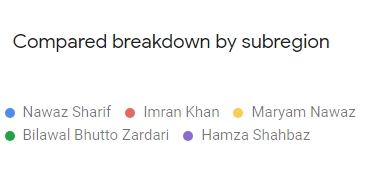
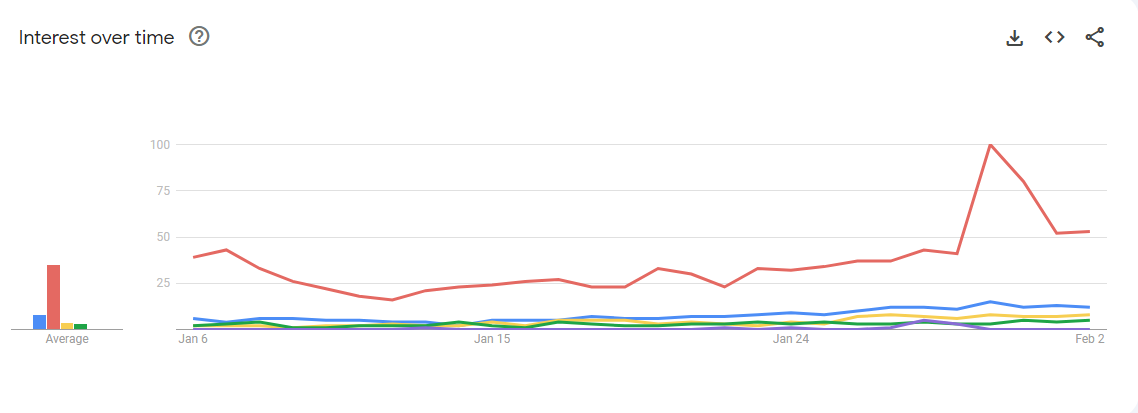
    Google Trends offer an insight into the popularity and curiosity political leaders enjoy among the masses. As the elections are drawing near, we took a peak into the data Google Trends have recorded over the last 30 days.

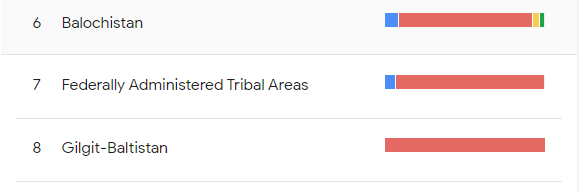
    The highest and ever-increasing line graph is Imran Khan’s. The highest peak was shown on January 30 with Khan hitting the record 100 score whereas his contemporaries, Nawaz stood on 15, Maryam Nawaz at eight, Bilawal-Bhutto Zardari at three, and Hamza Shehbaz being the lowest: less than one.

    However, it is important to note that Imran’s progressively increasing arc starts dropping successively in the days after Jan 30.

    On the other hand, except for Hamza Shehbaz, the other three is slowly on an upward trend.

    Breakdown of regions

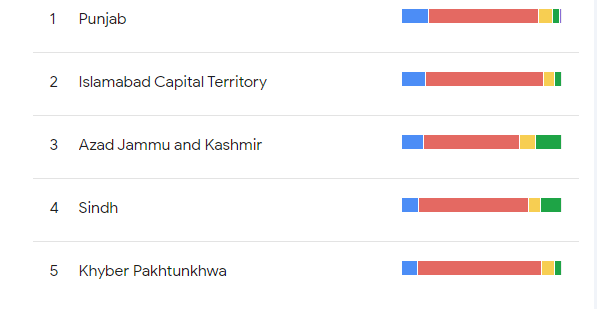
    PTI founder and jailed leader Imran Khan is most popular all over Pakistan according to Google Trends.

    Punjab

    In Punjab, the most popular choices for Chief Ministership, Hamza Shehbaz, and Maryam Nawaz contrary to popular perception, are not being searched so much. After Khan winning with more than 69 percent of searches, Nawaz Sharif is at 17 percent while Maryam is at nine percent. It appears that people in Punjab are comparatively more interested in Bilawal than Hamza who has 1 percent searches from all over the province.

    However, it is important to note that out of all the provinces, Punjab has shown more interest in PML-N leader Nawaz Sharif. Sindh has shown the most interest after Punjab, which is 11 percent, 10 percent in Khyber Pakhtunkhwa, nine percent in Balochistan, and seven percent in former FATA.

    Sindh

    After Imran Khan (69 percent) former Foreign Minister and Chairman of Pakistan People’s Party, Bilawal Bhutto Zardari is unsurprisingly most popular in Sindh with 13 percent of Google searches. Second in line is Punjab and third is Balochistan. After him is Nawaz (11 percent) followed by Maryam (7 percent).

    Balochistan

    Imran Khan leading the slot here with 84 percent followed by Nawaz (9 percent), Maryam (4 percent), and Biawal Bhutto (3 percent). Hamza does not invoke public curiosity even the slightest.

    Gilgit Baltistan

    Imran Khan has a 100 percent popularity rate in Gilgit Baltistan, where it seems no other party leader stands a chance, implying that there were minor searches of them in GB.

    Former FATA

    Interestingly, in the former federally administered tribal areas, only Imran Khan and Nawaz Sharif were searched for, Khan at 93 per cent of searches and Nawaz at seven percent.

    Though Google search and Google trends are not the ultimate parameter of a party leader’s popularity, they certainly are proof of what netizens are most interested in and the social media footing of a politician.

  • Maryam Nawaz tells PTI supporters to end politics of hate

    Maryam Nawaz tells PTI supporters to end politics of hate

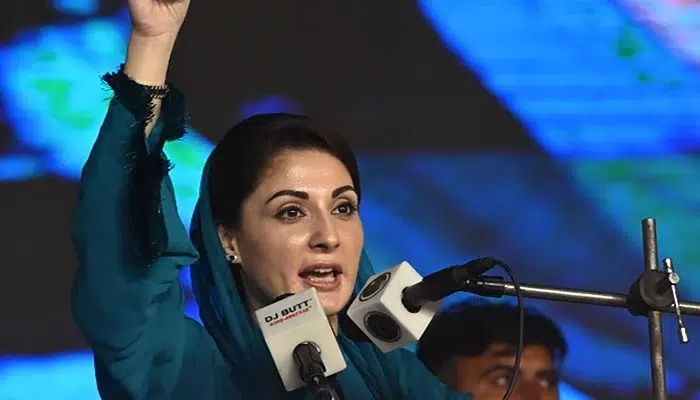
    Pakistan Muslim League-Nawaz (PML-N) chief organizer Maryam Nawaz has urged Pakistan Tehreek-e-Insaf (PTI) supporters to stop indulging in what she described as politics of hate.
    “Today I want to say that I am ready to forget all the oppression against us,” Maryam said. “I promise today and invite everyone to put an end to all this once and for all,” she said at a rally in Kasur.
    “I want a Pakistan where the government concentrates on serving people instead of avenging the past,” she said.

  • Electioneering in Sindh – VI

    Electioneering in Sindh – VI

    In the last part of this series on election politics in Sindh, we will look into three districts – Thatta, Jamshoro, and Dadu districts of the Hyderabad division, where four National Assembly (NA) and nine provincial assembly (PA) seats are at stake. On NA 223 Thatta, 12 candidates are contesting the polls. Sadiq Ali Memon of PPP, Imtiaz Ahmed of JI, Junaid Siddiqi of MQM-P, Rasool Bux Jakhro of – and Syed Jameel Ahmed Shah Bukhari of PTI are the main contenders. Looking at the 2018 results, it looks like the PPP candidate has a clear lead over his opponents. Riaz Hussain Shah Shirazi of PPP, Muhammad Farooque of PTI, Abdullah Adam Gandro of JI, Muhammad Arshad Memon of JUI-F, Mahar Ali Shah of QMM are noticeable among the 12 candidates on PS 75 Thatta-I. Going through past results, it seems the PPP candidate is poised to win this seat. Eights candidates are contesting on PS 76 Thatta-II. Altaf Hussain Kachi of TLP, Saeed-Ur-Rehman of JUI-F, Ali Hassan Zardari of PPP, Muhammad Ali Khan of JI, and Muhammad Umer Nahyo of Khadmeen-e-Sindh are the main competitors in this constituency. The PPP candidate can easily win this seat.

    On the single NA seat – NA 226 – of district Jamshoro, the PPP has awarded ticket to Malik Asad Sikander while Munir Hyder Shah, Ubedullha Jamro, Abdul Hakeem Chandio are running on GDA, TLP and PTI tickets respectively. The GDA candidate will try to put up a fight. However, past results show that the PPP candidate will likely stand victorious. Former chief minister of Sindh, Syed Murad Ali Shah, is contesting to retain his seat on PS 77 Jamshoro-I.

    A total of 15 candidates are in the field against the PPP candidate. GDA’s Roshan Buriro, TLP’s Manzoor Ahmed Halepoto and PTI’s Muhammad Farooq are prominent among them. In 2018, Murad Shah beat Jalal Mehmood Shah of SUP, and this time again, he is the frontrunner. Dr. Sikandar Shoro gave a tough fight to PPP’s Malk Asad Sikandar on then PS 82 Jamshoro as an independent candidate; however, later he joined the PPP and is contesting election on PS 78 Jamshoro-II against Badaruddin of TLP, Syed Munir Hyder Shah of GDA, Sadaf Raza Warraich of PML-N and nine other candidates. The main contestants on this seat are PPP’s Sikandar Shoro and GDA’s Munir Shah. Razia of JUI-F, Malik Sikander Khan of PPP, Meer Ahmed of GDA, Muhammad Tayyab Khan of Pakistan Rah-e-Haq Party, Peer Murtaza Ali Shah Jillani of PTI and independent candidate Malik Changez Khan are vying for PS 79 Jamshoro-III. A close contest is expected between PPP candidate Malik Sikander and independent candidate Malik Changez.

    There are two NA seats in Dadu district. On NA 227 Dadu-I, former CM Sindh Liaquat Jatoi is contesting on a GDA ticket after parting ways with PTI. His rivals, among others, are PPP’s Irfan Ali Leghari, JUI-F’s Hajan Khan Leghari, MQM-P’s Zulfiqar Ali and PTI’s Shahana Nawab. PPP’s Irfan Leghari defeated Liaquat Jatoi by getting 95,891 votes while Jatoi got 82,658 in 2018. Incumbency and anger among voters due to the 2022 floods may jeopardise the PPP candidate’s chances of a victory. Rafique Ahmed Jamali of PPP and Karim Ali Jatoi of GDA are again in the field on NA 228 Dadu-II along with 13 other candidates, which include Abdul Majeed Chahwan of MQM-P, Zafar Ali of JI, Rashid Ali of TLP and Abu Bakar of JUI-F. PPP’s Jamali beat Jatoi in 2018 by securing 81,215 votes against Jatoi’s 63,032 while independent candidate Jan Muhammad Panhwar got 19,906 votes. In this constituency, the incumbency factor may go against the PPP candidate.

    On PS 80 Dadu-I, GDA’s Karim Ali Jatoi, PPP’s Abdul Aziz Junejo, MQM-P’s Shahid Hussain Shah, JUI-F’s Taj Muhammad, TLP’s Bashir Sodhar, PTI’s Asghar Ali Sodhar and JI’s Mir Murtaza are prominent among 12 candidates.

    PPP’s absence from the ground during the 2022 floods may favour GDA candidate. Fayaz Butt of PPP, Liaquat Ali Jatoi of GDA, Abdullah of JI, Parveen of TLP, Talib Hussain Panhwar of MQM-P, Muhammad Masood Panhwar of JUI-F and Majeed Khoso of PTI are noticeable among 19 candidates on PS 81 Dadu-II. Although PPP won this seat in 2018, this time the previous ruling party may feel the heat due to its bad handling of the 2022 floods in the area.

    Pir Mujeeb-ul-Haq of PPP is vying on PS 82 Dadu-III against Ashique Ali Zounr of GDA, Shahid Solangi of MQM-P, Zameer Ahmed of JI, Karim Bux Siddiqui of IPP, Zulfiqar Mallah of PTI and 16 other candidates. The GDA candidate will put up a resistance but the PPP candidate has a bit of an upper hand. On PS 83 Dadu-IV, 20 candidates are running for victory, which include Pir Syed Salih Shah Jilani of PPP, Imdad Ali Leghari of GDA, Bandah Ali Leghari (independent) and Anwar Ali Panhwar of PTI. Syed Ghulam Shah Jillani of PPP won this seat in 2018 and after his death, his son Salih Shah Jillani won in the by-elections. Local internal rivalries in the PPP and incumbency factor due to the 2022 floods can cause damage to the PPP candidate here.

  • Yeh election Pakistan ki izzat ka mamla hai: Caretaker Federal Minister Gohar Ijaz

    Yeh election Pakistan ki izzat ka mamla hai: Caretaker Federal Minister Gohar Ijaz

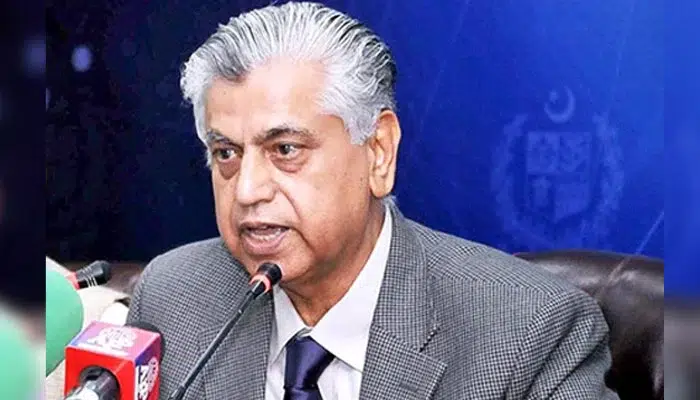
    Caretaker federal minister, Gohar Ijaz, said on Tuesday in a press conference that the election is a matter of Pakistan’s honour, adding that the caretaker government is fulfilling its responsibility of holding elections ‘with honesty’.

    He also said that the law and order situation is now better in Sindh. He further mentioned that the police and civil armed forces have the ability to overcome any adverse law and order situation.

    Ijaz also mentioned that there are no issues between election candidates in Balochistan, and all political parties in the province are in communication with each other.

    He also said that Pakistan is threatened by forces that want to destabilise the country. However, the country’s security system can protect Pakistan from those forces.

  • Bilawal promises to change Karachi if elected

    Bilawal promises to change Karachi if elected

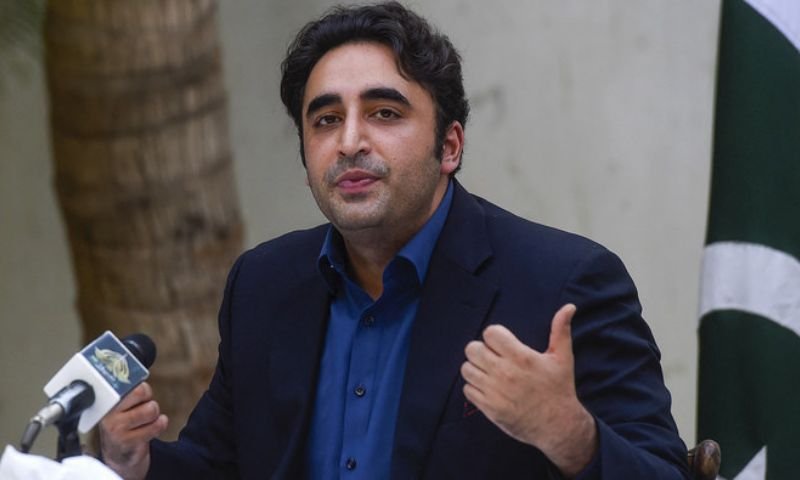
    Former foreign minister Bilawal Bhutto Zardari has promised to change the map of Karachi if he comes into power after winning the upcoming general elections set to take place on February 8.

    The Pakistan People’s Party (PPP) chairman promised to ensure Karachi receives its fair share of rights by securing representation in both the provincial and national assemblies.

    “Other parties are contesting polls for their benefits, but the PPP will work for Karachi and protect its mandate,” he said.

    Bilawal Bhutto also stated that everyone other than PPP is engaged in the politics of hatred and revenge.

  • More than 120 million people will vote on February 8, says Murtaza Solangi

    More than 120 million people will vote on February 8, says Murtaza Solangi

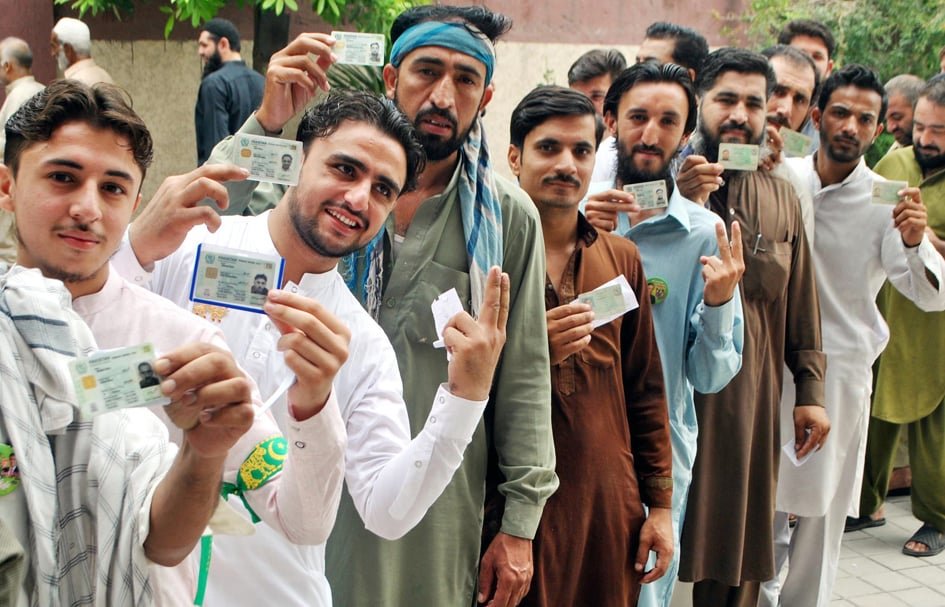
    The Caretaker Information Minister, Murtaza Solangi, said on Monday that over 120 million people will vote on February 8, as the general elections are scheduled on the same date.

    According to PTV, he passed the remarks while addressing a ceremony.

    Murtaza Solangi also said that the caretaker government helped the Election Commission of Pakistan (ECP) to make the election process smooth.

    “Elections are just two days away,” he added. “People will choose their representatives by exercising their right to vote.”

    The information minister also said that according to the constitution, elected representatives will run the country.

  • Pakistanis observe Kashmir Solidarity Day

    Pakistanis observe Kashmir Solidarity Day

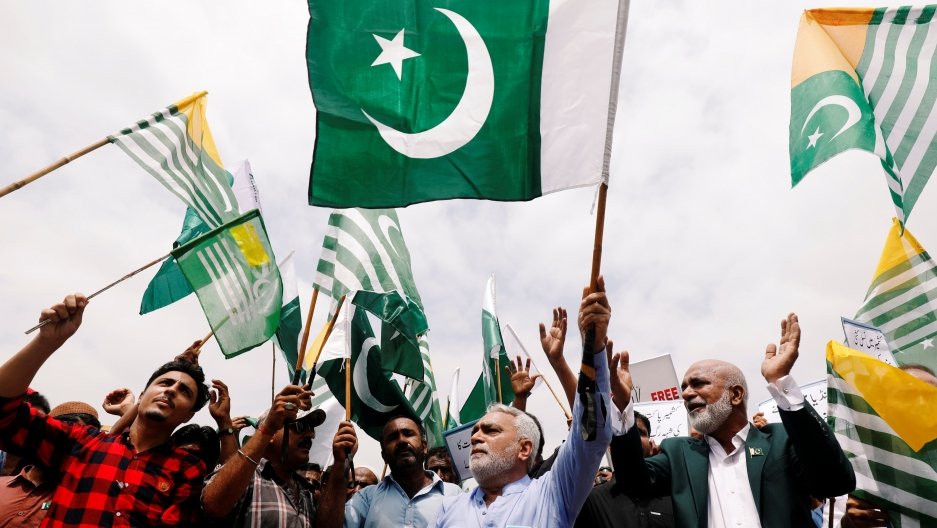
    People across Pakistan are showing support for their Kashmiri brothers and sisters’ fight against human rights abuses in the Indian Illegally Occupied Jammu and Kashmir (IIOJK) by observing Kashmir Solidarity Day on Monday.

    The Ministry of Kashmir Affairs issued a press release, stating that they have made all necessary arrangements to observe Kashmir Solidarity Day.

    The ministry is organising solidarity walks all over the country, including Azad Jammu and Kashmir. In Islamabad, a rally on Constitution Avenue showed support for the Kashmiri people.

    A minute of silence was also observed at 9:30am to pay homage to the martyrs of Kashmir.

    “Posters and billboards have been displayed around important Avenves, airports, and railway stations to highlight the plight of Kashmiri people,” said the statement.

    Additionally, educational institutions across the country have arranged debate and declamation contests along with essay writing competitions for the occasion.

    President Dr Arif Alvi has said that the right to self-determination is a cardinal principle of international law, but regrettably, the Kashmiri people have not been able to exercise this inalienable right.

  • Bilawal urges people to vote for “arrow” if they want to stop lion

    Bilawal urges people to vote for “arrow” if they want to stop lion

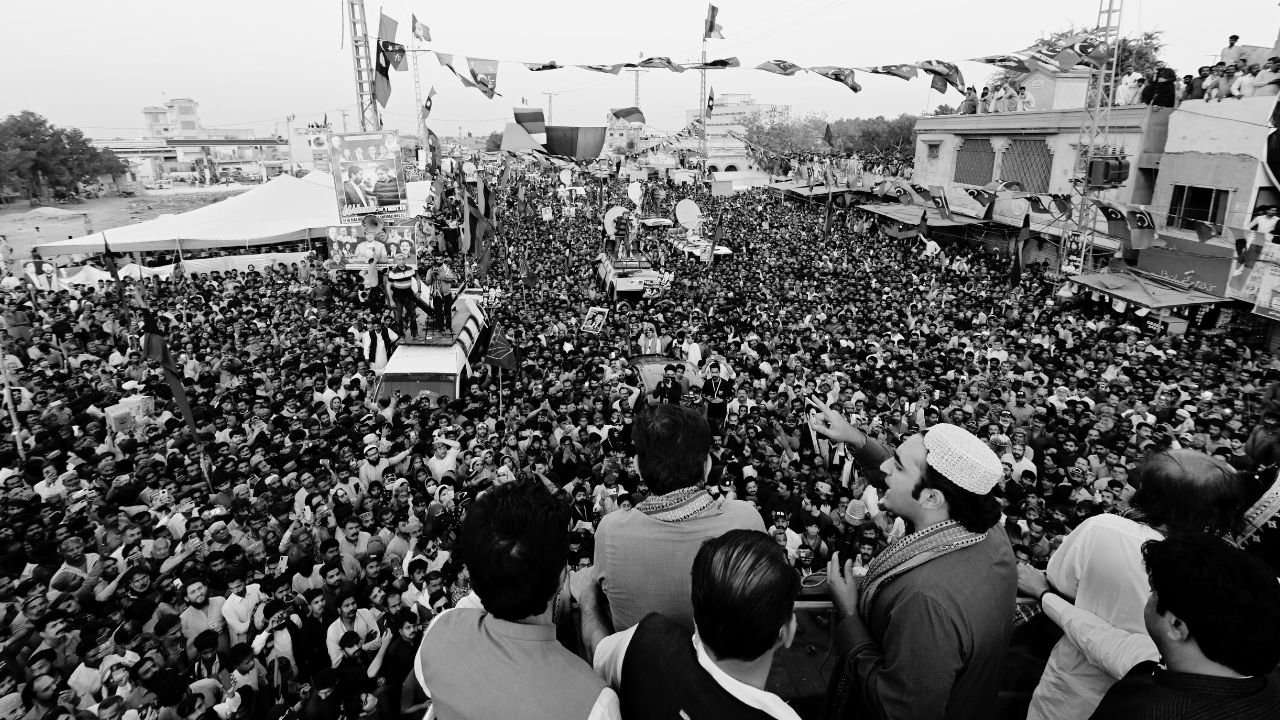
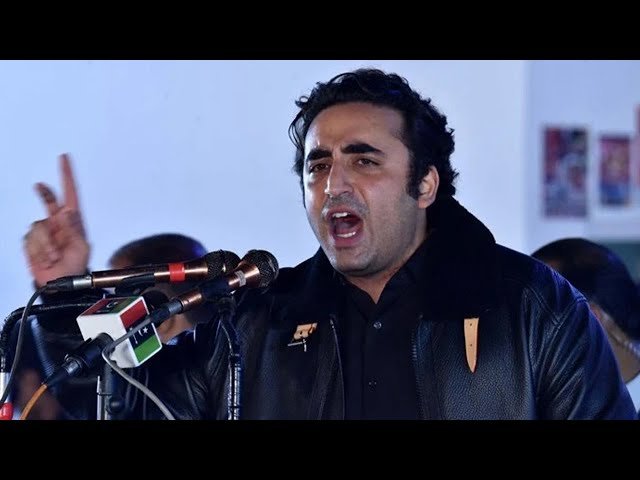
    Just days before the February 8 general elections, Pakistan People’s Party (PPP) Chairman Bilawal Bhutto-Zardari launched criticism at all opposing political parties as election campaigning reached its peak.

    While addressing an election rally in Hyderabad, Bilawal asked his audience to vote for arrow, the symbol of the PPP, if they want to block the lion, the symbol of Pakistan Muslim League-Nawaz (PML-N).

    Stressing the need for hard work, the ex-foreign minister asked the participants, “You just get PPP to win [elections]. I will handle this lion.”

    The PPP chairman also criticised the Muttahida Qaumi Movement-Pakistan (MQM-P). “If people ask you to vote for ‘kite’, then tell them, ‘We will not vote for those who raise anti-Pakistan slogans.’”

    Reply that the kite will be ripped apart, he added. The PPP leader urged the people not to waste their vote on any independent candidate — an apparent reference to Pakistan Tehreek-e-Insaf (PTI)-backed candidates.

    PTI candidates are taking part in the upcoming general elections as independent candidates after the Election Commission of Pakistan (ECP) didn’t allot them their election symbol (bat).