Category: Politics

News stories of Politics, for the topics that matter the most to young professionals and college students, political news reported with a different angle.

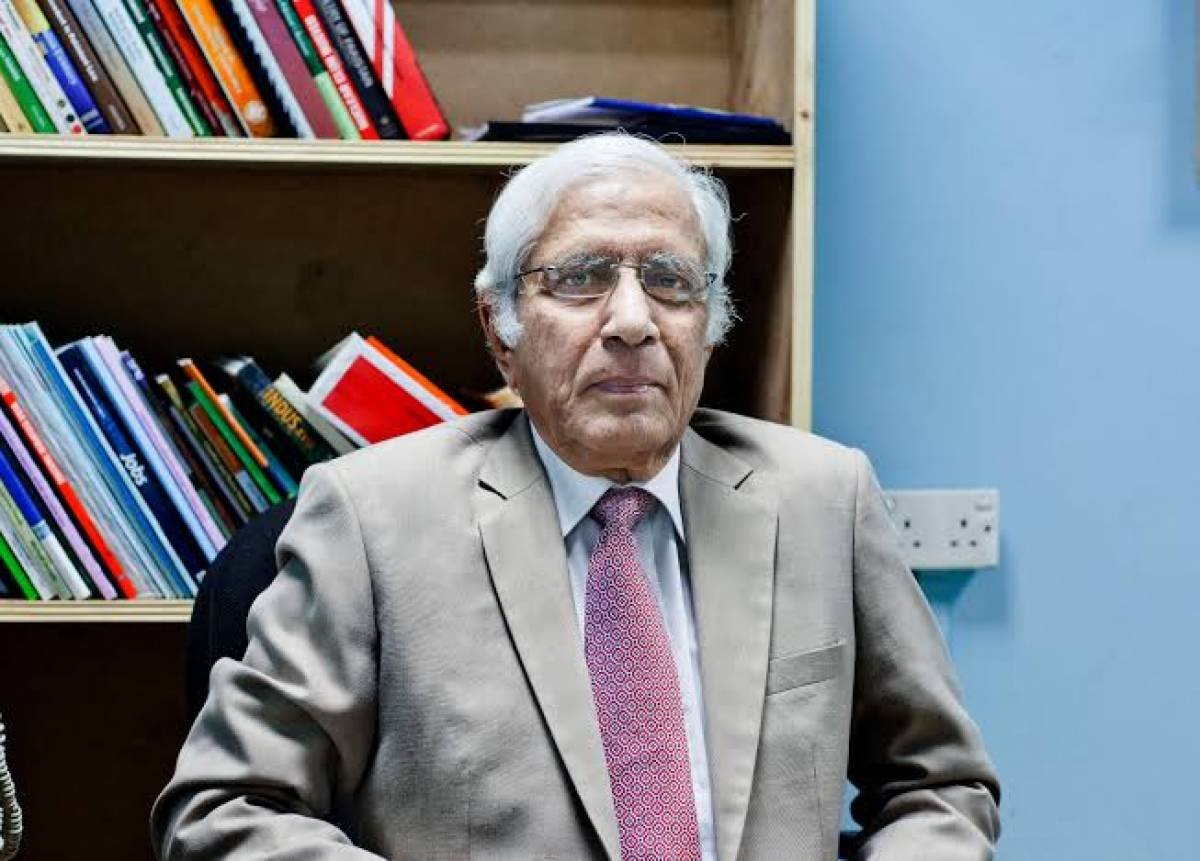
  • Veteran journalist Muhammad Ziauddin passes away at 83 after prolonged illness

    Veteran journalist Muhammad Ziauddin passes away at 83 after prolonged illness

    Veteran journalist Muhammad Ziauddin passed away on Monday in Islamabad after a period of prolonged illness. He was 83.

    Ziauddin had a career span of 60 years in journalism. He earned a Master’s degree in Journalism from Karachi University in 1964. Later that same year, he made his entry in the profession.

    One of the most respected names in journalism, Ziauddin worked at almost all the major newspapers of the country—The Muslim, The NewsDawnThe Express Tribune.

    Many people paid tribute to Ziauddin after the news of his death was confirmed. 

    Information Minister Fawad Chaudhry tweeted, “One of the most capable fiercely independent journalist I came across with has left for his final abode #Ziauddin was no commoner a wise man—integrity and boldness added to his personality.”

    Afrasiab Khattak tweeted: “The death of iconic journalist Ziauddin sahib is a huge loss to journalism in Pakistan. He maintained professional standards and integrity under under circumstances when it wasn’t easy to do so.”

    Abbas Nasir tweeted: “An iconic journalist; a personal friend of 35 years; a senior who was generous with his counsel and love; and a giant who stood up to autocrats for over 50 years.”

    Mubahsir Zaidi tweeted, “Icon of Pakistani journalism Mohammed Ziauddin dies.”

    Journalist Nasim Zehra tweeted, “One of Pakistan’s leading illustrious old guard experienced and widely respected journalist, former Editor of Dawn & the News; currently a columnist with Express Tribune #MZiauddin sahib passes away.”

    Journalist Hamid shared a picture of Ziauddin and tweeted, “I always told #Ziauddin sahib ‘your experience in journalism is equal to my age’.”

    Journalist Khurram Husain tweeted, “Deeply grieved to learn of the passing of Zia saab. He was grace, dignity, and professionalism personified.”

    Journalist Murtaza Solangi tweeted, “#Ziauddin lived his life on his terms, his values and his principles. He did not waver and vacillate on his progressive and democratic ethos for a single day. His over half a century work is a compass in our dark days and nights. Goodbye my comrade!”

    Journalist Shahbaz Rana tweeted how Ziauddin had taught him “to keep emotions separate from the noble cause” of journalism.

    Journalist Amber Shamsi tweeted, “Gutted to learn Ziauddin sb is no more. A fine gentleman and a finer journalist, who was so accessible and willing to teach.”

  • Federal ministers hold Sindh responsible for food inflation

    Federal ministers hold Sindh responsible for food inflation

    The federal government on Friday criticised the Sindh government for ‘poor governance’ with ministers holding it responsible for food inflation in the country, reports Dawn.

    The criticism came from the government after Prime Minister Imran Khan had claimed the Centre would uplift 14 districts under the Rs444 billion Sindh Development Plan.

    Meanwhile, Information Minister Fawad Chaudhry blamed the Sindh government for rising food inflation in the country, alleging that the “Sindh government has left the people of the province at the mercy of mafias”.

    He said when sugar price went up to Rs150 per kilo, the Sindh government stopped supplying sugar cane to mills and later blocked stocks of sugar from reaching the markets. He said prices of food and grocery items were still higher in Sindh as compared to other provinces.

    However, Pakistan People’s Party (PPP), which rules Sindh, slammed the federal government for criticising the provincial government.

    PPP spokesman Faisal Karim Kundi asked: “Why does Imran Khan worry so much about Sindh?”

    He claimed that Sindh was the only province where free treatment was being given for cancer, heart ailments, liver and kidney ailments.

    “If nothing is being done in Sindh, then why do people from across the country travel to Sindh to avail free medical treatment,” he questioned.

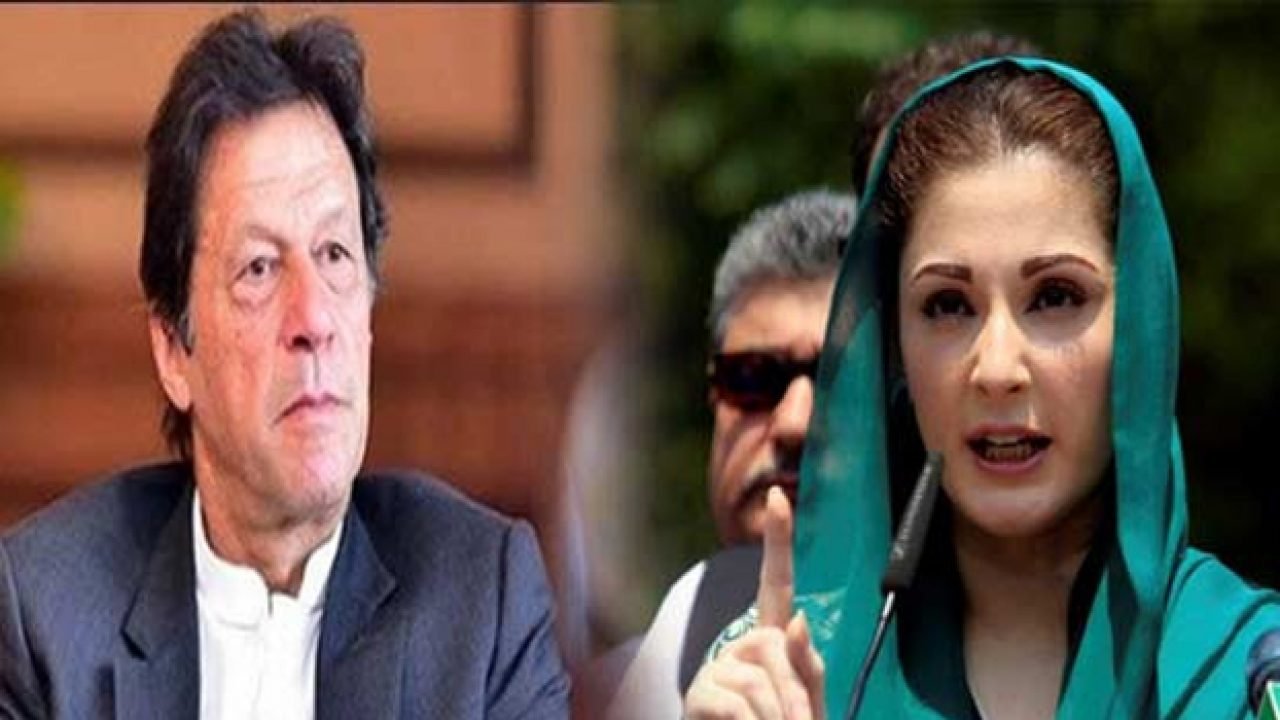
  • ‘PML-N calls us fascist, but they are more than that’: PM Khan reacts to Maryam Nawaz’s audio clip

    ‘PML-N calls us fascist, but they are more than that’: PM Khan reacts to Maryam Nawaz’s audio clip

    Prime Minister (PM) Imran Khan said Pakistan Muslim League-Nawaz (PML-N) calls the government “fascist”, but the party itself is “more than that”, reports Geo News.

    “They [PML-N] say that we impose restrictions on media and call us fascist, however, they are more fascist than us,” remarked the premier.

    He also questioned in what capacity did the PML-N leader issue such directives.

    PM Khan’s comments come in relevance to PML-N leader Maryam Nawaz’s audio where the latter can be heard refusing to give ads to media organisations.

    Earlier this week, in an audio clip doing the rounds on social media, Maryam Nawaz could be heard saying, “We have given many chances to Samaa News. The kind of news Samaa [airs] and the way its anchor Nadeem Malik is, our pact can no longer work with the channel. So we are not giving any ads to Samaa.”

    ”Samaa News, Channel 92, ARY News, and Channel 24 will not get any ads from us [PML-N],” said Maryam

  • Rs40 billion irregularities detected in PM’s Covid package, reveals audit report

    Rs40 billion irregularities detected in PM’s Covid package, reveals audit report

    Pakistan gave in to the International Monetary Fund’s (IMF) pressure by releasing the audit report of expenditures incurred on Covid-19, disclosing over Rs40 billion irregularities in operations, reports Shahbaz Rana for The Express Tribune.

    “The release of the report by the Ministry of Finance is one of the five prior actions that the IMF has asked Pakistan to implement if it wants to get the $1 billion loan tranche by January next year.”

    “The finance ministry issued Rs314 billion less supplementary grants from the prime minister’s (PM) stimulus package due to which citizens of Pakistan could not avail the complete benefit of the announced package resulting in suffering, economic hardship, and many private factories laying off their workers during Covid-19 process,” revealed the report.

    “Against Rs200 billion promised to daily wagers, only Rs16 billion were distributed among them. The vulnerable families were promised Rs150 billion but given Rs145 billion.”

    Benazir Income Support Programme (BISP)

    “The maximum irregularities of over Rs25 billion were found against Rs133 billion spent under the banner of the Benazir Income Support Programme (BISP), which was equal to 19 per cent of its spending.”

    The BISP utilised Rs133.3 billion during the fiscal year 2019-20 and 13.1 million beneficiaries were paid.

    The audit observed Rs6.6 billion payments to relatively better-off 484,402 beneficiaries due to the absence of any clear policy which needs to be addressed before making any related future payments.

    “Over Rs16 million payments of Covid-19 cash transfers were made to those beneficiaries who had filers’ status and were well-off. There was also a case of withdrawal of Covid-19 cash grants from both BISP and Zakat by the same beneficiaries worth Rs318.7 million.”

    National Disaster Management Authority (NDMA)

    “The National Disaster Management Authority’s spending was Rs22.8 billion and the auditors raised a red flag on Rs4.8 billion or around 21 per cent of the spending.”

    “The auditors found mis-procurement on account of the installation of Resource Management System (RMS) by the NDMA with Rs42.5 million cost. A million-dollar loss was caused to the public exchequer on account of the purchase of ventilators at higher rates and China donated $4 million for the construction of 250 beds Isolation Hospital and Infections Treatment Centre (IHITC), but the money was never used. There were cases of overpayment to Chinese firms on account of the procurement of ventilators.”

    “The NDMA did not impose liquidated damages on supplier firms causing a loss of Rs2.7 billion and $8.3 million.”

    Utility Store

    “The AGP pointed out Rs1.4 billion loss due to irregular and ill-planned procurement of sugar. Another loss of Rs1.6 billion was caused due to irregular procurement of ghee/cooking oil and non-availability of fitness certificates of ghee/oils worth over Rs1.4 billion.”

    “The Rs323 million loss was caused due to non-observance of prescribed flour specifications and another expense of Rs1.7 billion incurred without laboratory test reports. The USC also made excess claim subsidies by increasing the profit ratio on account of the purchase of sugar.”

    Defence

    “The Rs200 million Covid-19 funds were diverted towards the clearance of liabilities and procurement of normal cardiac medicines. During an audit of Combined Military Hospital Rawalpindi, it was observed from the record that PPE items of the same specifications were purchased at higher rates by ignoring the lowest rates available in the comparative statement of tenders.”

    “The Rs235 million irregular payment was made to Pakistan International Airlines without fulfilling the required formalities against shipment of exactly the same commodity required to be transported through the armed forces’ service aircraft.”

    Other departments

    “The audit observed that the procurements of nine items had been made at higher rates causing a loss of Rs7 million. There were also cases of non-delivery of Personal Protective Equipment (PPE) by UNICEF having the value of Rs1.3 billion. The Rs10 million discrepancy was found in cases of transportation and food items for passengers returning from abroad, handled by deputy commissioner Islamabad.”

  • Malik Riaz and son’s 10 years UK visit visa revoked due to possible corruption

    Malik Riaz and son’s 10 years UK visit visa revoked due to possible corruption

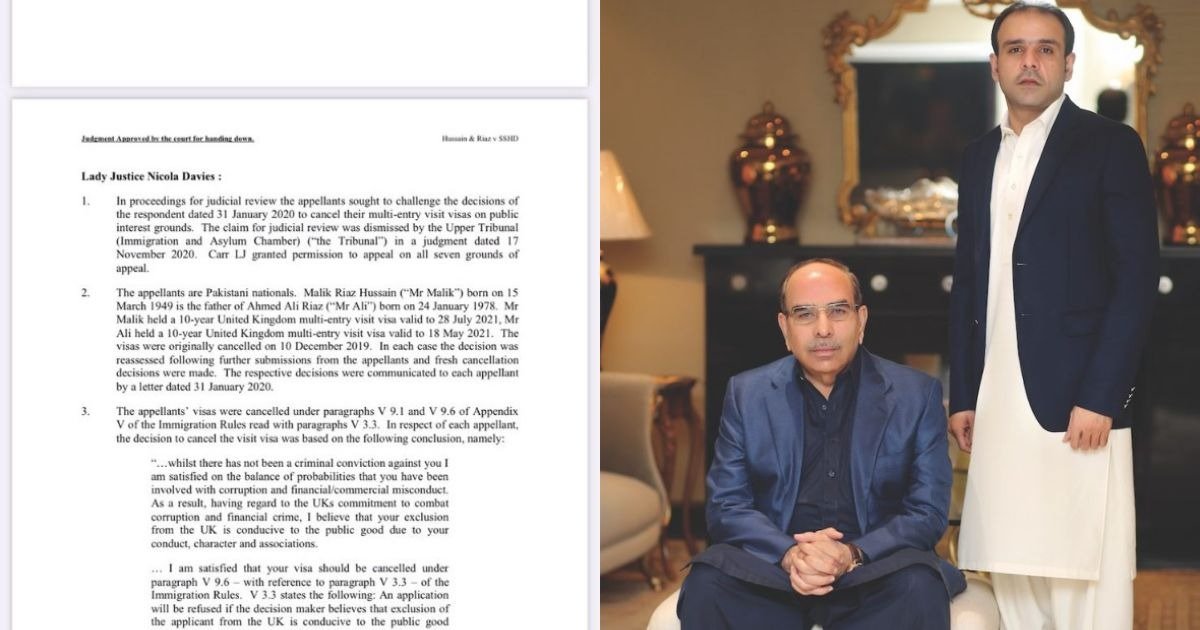
    United Kingdom (UK) courts have decided to revoke a 10-year multi-entry visit visa to real estate tycoon Malik Riaz, and his son Ahmed Ali Riaz.

    Lady Justice Nicolas Davies, in her judgment against the appeal of Riaz and his son, wrote, “Whilst there has not been a criminal conviction against you I am satisfied on probabilities that you have been involved with corruption and financial/commercial misconduct.”

    “As a result, having regard to the UK’s commitment to combat corruption and financial crime, I believe that your exclusion from the UK is conducive to the public good due to your conduct, character, and associations,” wrote Justice Nicolas.

    The UK High court on Malik Riaz case cited, “The appellants [Malik Riaz and Ahmed Ali] have been involved with corruption and financial/commercial misconduct was founded on their involvement in the affairs of a company, Bahria Town. The company is wholly owned and run by the appellant’s family and is described as the largest property developer in Asia. At all relevant times, Mr Malik was the Chairman of Bahria Town, Mr Ali was the CEO.”

  • Nadra denies FIA’s claim that national database has been hacked

    Nadra denies FIA’s claim that national database has been hacked

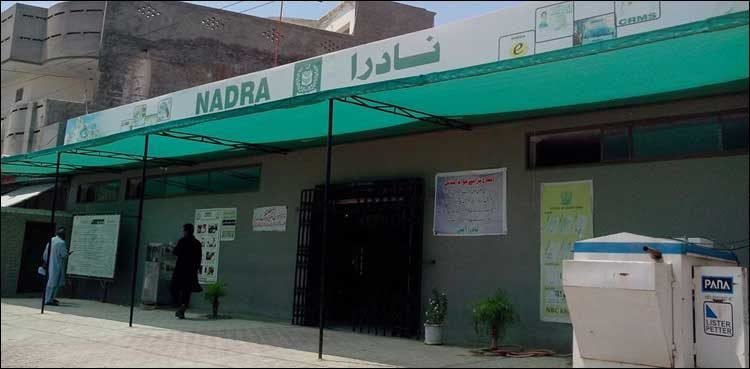
    A meeting of the National Assembly’s Standing Committee on Information Technology on Thursday witnessed a curious discussion on the security of important data as an official of the Federal Investigation Agency (FIA) claimed that the system of the National Database and Registration Authority (Nadra) had been hacked. He later changed his statement when pressed to elaborate upon his remarks.

    “We have discovered that Nadra’s data has been compromised, it has been hacked,” Tariq Pervez, additional director of FIA’s Cybercrime Wing, told the meeting chaired by Ali Khan Jadoon. The FIA had seized around 13,000 illegal SIMs during a crackdown in Faisalabad, he said.

    Pervez said that 89,000 complaints have been received by his wing, but they did not have enough staff to address the complaints reported on a daily basis.

    “The FIA’s cybercrime wing has only 162 investigation officers,” he added.

    Pervez’s statement caught the attention of the committee members who put various questions to him regarding the theft of Nadra data. After this accusation, the FIA’s additional director altered his statement and said that Nadra’s data had not been hacked, but its biometric system had been compromised and used during the SIM verification process.

    He further informed the committee that whenever they traced a suspect involved in financial frauds, the suspect mostly turned out to be an elderly man or a woman, whose data was being used by someone else.

    Nadra, refuting the claim of the FIA official in a statement, said, “The FIA statement regarding hacking of biometric data is based on misunderstanding,” adding that Nadra would seek clarification from the FIA over the “unnecessary statement and misrepresentation of the issue”.

    Responding to concerns of the committee members, Pakistan Telecommuni­ca­tion Authority (PTA) chairman retired Maj Gen Amir Azeem Bajwa said that complaints could be lodged against those involved in sending messages related to financial fraud at the PTA website.

    Jadoon of the Pakistan Tehreek-e-Insaf (PTI), the chairman of the committee, stressed that it was essential to keep national interest and national perspective into consideration while formulating laws.

  • ‘Didn’t want to sell Pakistan out’: Karachi street criminal who turned FBI spy

    ‘Didn’t want to sell Pakistan out’: Karachi street criminal who turned FBI spy

    Kamran Faridi, United States (UN) Federal Bureau of Investigation’s (FBI) valued secret agent, has been sentenced to seven years in jail, reports Murtaza Ali Shah for The News.

    Judge Cathy Seibel of New York’s Southern District Court condemning Faridi said, “perhaps the most difficult sentencing I have ever done.”

    Faridi eventually grew close to PSF’s Najeeb Ahmed, then a well-known student leader

    “Faridi, who is currently serving time in a New York jail, was born and grew up in Block 3 of Karachi’s Gulshan-e-Iqbal area. He joined the Peoples Students Federation (PSF) — the student wing of the Pakistan Peoples Party (PPP)— when he was a Grade-9 student at the Ali Ali School and started hanging out at the National College, Karachi University, and NED University. Faridi eventually grew close to PSF’s Najeeb Ahmed, then a well-known student leader.”

    “As he lived in an area dominated by the rival Muttahida Qaumi Movement (MQM), it soon became difficult for him to operate from home ground. Najeeb helped Faridi shift where he joined other PSF activists living in the apartment complex.”

    “Local police and the Crime Investigation Department (CID, now known as the CTD) soon had arrest warrants out against Faridi. At the same time, MQM activists were hunting him down. Aware of the danger, Faridi’s family paid off a human smuggler and arranged for him to travel to Sweden. In Sweden, however, Faridi was unable to keep a low profile and soon got into fights with the local Albanian and Bangladeshi gangs. He was arrested a few times by local police, and in 1992, Swedish authorities blacklisted him and refused to give him a visa due to his bad conduct,” says the reporter who met with Faridi.

    “Now an illegal immigrant, Faridi went into hiding at an island, where he was allegedly helped by Greenpeace activists. A local human rights activist, according to Faridi, arranged a fake passport for him to travel to Iceland, from where he went to America and started a life in New York City. He later moved to Atlanta, Georgia, in 1994 and bought a gas station in a violent neighbourhood called Bankhead Highway.”

    “According to Faridi, Atlanta police used to hustle him regularly for bribes. Fed up of their harassment, he reported them to the FBI. This is how Faridi first came into contact with the federal agency.”

    FBI saw value in Faridi’s fluent command of Urdu, Punjabi, and Hindi, and in 1996 he became a full-time informant and agent

    “The FBI agents he was in contact with, Faridi claimed, told him that they would help him, but only if he would help them first. They wanted him to infiltrate a local Urdu-speaking Pakistani gang that had been causing difficulties for local law enforcement. The FBI saw value in Faridi’s fluent command of Urdu, Punjabi, and Hindi, and in 1996 he became a full-time informant and agent.”

    “Faridi did so well in helping the FBI’s investigations that he was offered assignments with the Central Intelligence Agency (CIA), the Drugs Enforcement Agency (DEA), UK’s MI6, French intelligence, Austrian federal police, Thailand’s Federal Police, and the Malaysian National Police. Faridi’s feats included several high-profile terrorism-related operations. He also reportedly played a key role in obtaining information from some of the world’s deadliest groups and persons.”

    It was through Faridi’s efforts that the US learned about Abu Jafar and other al-Qaida members planning to attack the US and foreign maritime vessels with explosives

    “In May 2011, Faridi began supporting an FBI investigation into the notorious South Asian criminal network, D-Company. In 2015, Faridi maintained a joint safe house with Walid Al-Agha, a Daesh supporter, and leader based in Turkey, and facilitated the travel of other ISIS supporters between Syria and Turkey. In November 2015, Al-Agha was ultimately convicted in Turkey and the US government credited Kamran Faridi for playing a lead role in the conviction. “

    “In March 2018, he travelled to South America, where he identified a support network that was facilitating the travel of terrorist operatives. It was through Faridi’s efforts that the US learned about Abu Jafar and other al-Qaida members planning to attack the US and foreign maritime vessels with explosives off the coasts of Djibouti and Europe. When Abu Jafar received scuba-diving training in Malaysia and Thailand, Faridi accompanied him, and based on Faridi’s reporting and assistance, the FBI placed Abu Jafar on its Most-Wanted list.”

    “The FBI also deployed Faridi to Southeast Asia several times in 2016, and again in 2019, to interact with senior terrorist figures. In February 2019, Faridi’s assistance led to the arrest of two al-Qaida operatives in Malaysia, according to the US government.”

    “It was due to Faridi that Karachi businessman Jabir Motiwala was arrested in London in August 2018 on suspicion that he was a top lieutenant of underworld kingpin Dawood Ibrahim and was involved in running drugs, extortion, and money laundering on behalf of D-Company, the criminal network run by Ibrahim. While Motiwala was in Wandsworth prison in London — contesting but waiting for his almost certain extradition to the US — the FBI revoked Faridi’s contract in February 2020.”

    “I did not want to sell Pakistan out on a false basis. I say it on oath that I was asked to lie in my statements by my bosses and I refused to lie,” Faridi

    “Faridi said he was asked by the FBI to falsely testify against D-Company, Dawood Ibrahim, Chhota Shakeel, Anees Bhai, and Anees Tingu in Jabir Motiwala’s case to link them to the charges against Jabir Motiwala. He was also allegedly told to sign false testimony linking these individuals to the procurement of nuclear technology on behalf of a leading Pakistani spy agency.”

    Faridi claimed he, “did not want to lie” because he “had no evidence” and he “did not want to submit a false testimony for money”.

    “I did not want to sell Pakistan out on a false basis. I say it on oath that I was asked to lie in my statements by my bosses and I refused to lie. They said if I lie the evidence will become stronger, but I refused,” he said.

    Faridi “felt betrayed” by the FBI because his wife, Kelly

    After his contract was suddenly revoked, Faridi emailed and texted multiple death threats on February 17 and 18, 2020, to his former FBI handlers.

    “Faridi had felt betrayed by the FBI because his wife, Kelly, had just been diagnosed with cancer, and news of his termination worsened the blow. The US government also informed the court that Faridi had helped “enemies of the US” when he asked his wife to alert at least four or five suspects that they were under surveillance.”

    The judge said that while she did agree that Faridi had obstructed the work of law enforcement, but “the value of this defendant’s incredible work for the United States is immense” and that “the work that Mr Faridi did for the United States is at the very top to me of valuable source work”.

    The judge added: “[…] even if the [US] government gave it the back of the hand, I don’t give it the back of the hand. Incredible work of immense value over many years, in the riskiest of circumstances, and, you know, I think it would be hard to understate (sic) the value of it.”

    “The benefit that the defendant gave this country is tremendous and the damage he did […] didn’t wipe it out completely, but it did a tremendous amount of harm.” She sent him to jail for a seven-year term.

    “I served the US wholeheartedly, but I have been rewarded a jail sentence and removed from long service because I refused to lie about Pakistan”- Faridi

    “Faridi now hopes that the judge will take a considerate look at his case and contributions and reduce the sentence. That is the only hope he has right now. He told this reporter that he will leave for Pakistan as soon as his sentence is over. “

    “I served the US wholeheartedly, but I have been rewarded a jail sentence and removed from long service because I refused to lie about Pakistan.”
  • National Geographic’s green-eyed ‘Afghan Girl’ evacuated to Italy

    National Geographic magazine’s famed green-eyed girl, Sharbat Gula, has been evacuated to Italy, the country’s Prime Minister (PM) Mario Draghi’s office announced on Tuesday, reports Reuters.

    The office said it had responded to pleas from non-profit organisations working in the war-torn country to help her leave and “travel to Italy as part of the wider evacuation programme in place for Afghan citizens and the government’s plan for their reception and integration”.

    Gula’s famous picture was taken by a United States (US) photographer Steve McCurry in a Pakistan camp in 1984, which was the front cover of the National Geographic magazine. She said she first arrived in Pakistan as an orphan, some four or five years after the Soviet invasion in 1979.

    Pakistan arrested Gula for forging a national identity card and she was deported back to Afghanistan in 2016. At that time, former Afghan President Ashraf Ghani welcomed her.

    In September, Rome said it had evacuated almost 5,000 Afghans after the Taliban seized power in August.

  • Islamabad Court Chief Justice says remarks about retired judges, ex-CJP not contempt of court

    Islamabad Court Chief Justice says remarks about retired judges, ex-CJP not contempt of court

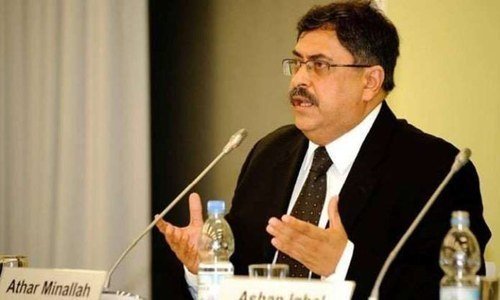
    Islamabad High Court (IHC) Chief Justice Athar Minallah observed on Friday, that remarks about retired officials did not warrant contempt of court charges, even if they were made against a former chief justice of Pakistan (CJP).

    Justice Minallah made the observation during a hearing to decide the maintainability of a petition, filed by Advocate Kulsoom Khaliq, seeking contempt proceedings against Pakistan Muslim League-Nawaz (PML-N) leaders Maryam Nawaz and Shahid Khaqan Abbasi for trying to scandalise the judiciary through their statements against the former CJP Saqib Nisar.

    On November 15, Abbasi demanded that a suo motu notice be taken against Nisar after the former chief judge of Gilgit-Baltistan Rana Shamim accused Nisar of being involved in denying bail to PML-N supremo Nawaz Sharif and Maryam ahead of the 2018 general elections.

    Abbasi, questioning the lawmakers, said, “If Mian Nawaz Sharif can go to jail, why can’t Mian Saqib Nisar?”

    IHC Chief Justice Athar Minallah said in his written order that a judge who ceases to hold a judicial office “attains the status of a private citizen”.

    “Such a person is no more a member of the ‘Court’ in the context of Article 204 of the Constitution nor under the Ordinance of 2003,” Justice Minallah wrote.

    “It remains open to a retired judicial officer to seek remedies available in a court of law. However, the offence of contempt is not attracted in the case of a retired judge because after retirement the latter attains the status of a private citizen,” wrote Justice Minallah.

    He insisted that judges were open-minded about criticism, saying, “Judges hold a very high position and they should welcome criticism.”

  • Zartaj Gul fights with PTI’s Amin Aslam, leaves UN Glasgow conference

    Zartaj Gul fights with PTI’s Amin Aslam, leaves UN Glasgow conference

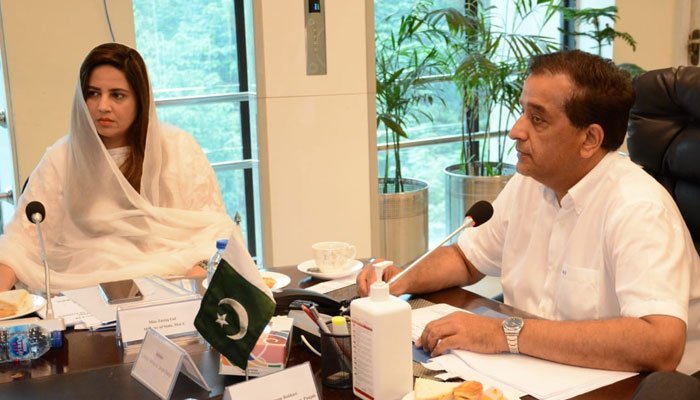
    Special Assistant to the Prime Minister (PM) on Climate Change Malik Amin Aslam and Minister of State for Climate Change Zartaj Gul Wazir allegedly got into an argument during the United Nations (UB) Climate Change Conference in Glasgow, revealed Pakistan Tehreek-e-Insaf’s (PTI) Member National Assembly (MNA) Riaz Fatyana.

    During a session of the Public Accounts Committee (PAC), Fatyana alleged that the argument between Zartaj and Aslam made the former leave the conference and return to Pakistan.

    He also alleged that the 18-member delegation of the Ministry of Climate Change sat idle at the conference, undertook no activity, and “wasted money”.

    Malik Amin Aslam rubbished Fatyana’s allegations, saying that Zartaj Gul had left the conference midway to head for the joint session of the parliament.

    “Riaz Fatyana has lied before the Public Accounts Committee,” he said. “Not even a single rupee of the government was spent at the conference. It was organised completely by foreign donors,” he added.

    “PTI lawmaker had arrived at the conference via an NGO’s sponsorship and had demanded official protocol,” said Aslam.

    “The party should investigate Fatyana,” he added.