Category: Uncategorized

  • India accepts it will kill people inside Pakistan

    India accepts it will kill people inside Pakistan

    India’s Defence Minister Rajnath Singh recently passed controversial remarks about the Guardian article on Indian extra-judicial killings inside Pakistan in defiance of International rules and norms, stating that if a person commits crimes in India and then runs to Pakistan for safety then, “we will enter their home and kill them there.”

    Interestingly enough, India’s ministry of external affairs denied all allegations put forth in the Guardian article and condemned the “false and malicious anti-India propaganda.” Yet the defence minister’s statements are in stark contrast with the official statement.

    Internet users reacted by condemning the minister’s statements and many users on X, formerly Twitter, pointed out that the Indian General Elections 2024 is taking place so such empty bravado was expected of a BJP minister.

    An Indian account replied, “The mere statement will take Modi beyond 400 seats.” Similarly, someone else wrote “Why are you hell-bent on helping Modi and BJP?” while another user said “Not the India Nehru dreamt of.”

    It must be underscored that the defence minister’s statement is highly irresponsible and begets a rogue state that does not believe in international norms.

    The Foreign Office (FO) of Pakistan strongly condemned Singh’s statement: “India’s ruling dispensation habitually resorts to hateful rhetoric to fuel hyper-nationalistic sentiments, unapologetically exploiting such discourse for electoral gains.”

    The BJP government is often accused of heating up the pot with Pakistan before the elections, for instance the 2019 Balakot event happened before the elections.

  • Israeli fire ‘most likely’ killed woman hostage on Oct 7: Army

    Israeli fire ‘most likely’ killed woman hostage on Oct 7: Army

    An Israeli investigation found Friday that an Israeli woman who had been seized during the October 7 attack was “most likely” killed when a combat helicopter fired on her kidnappers’ vehicle.

    Efrat Katz and most of the militants in the vehicle were killed when the Israeli aircraft fired on them on October 7, the army investigation said.

    The helicopter “fired at a vehicle that had terrorists in it, and which, in retrospect, based on the testimonies, also had hostages in it,” the army said in a statement.

    “As a result of the fire, most of the terrorists manning the vehicle were killed, and most likely, Efrat Katz … was killed as well.”

    The “tragic and unfortunate” event occurred at a time of “fighting and conditions of uncertainty,” Israeli Air Force chief Tomer Bar said in the statement.

    “The commander of the air force did not find fault in the operation by the helicopter crew, who operated in compliance with the orders in a complex reality of war.”

    The army statement said the mistake occurred because surveillance systems could not distinguish hostages from kidnappers once in a vehicle, and that “the shooting was defined as shooting at a vehicle with terrorists”.

    Katz, 68 at the time of Hamas’s attack on southern Israel, was kidnapped from the Nir Oz kibbutz close to the Gaza border.

    Her daughter Doron Katz-Asher and her two children were taken hostage during the attack, but were later released on November 24.

    Katz’s partner Gadi Moses and his ex-wife Margalit Moses were also taken hostage during the attack. She was later released but Gadi is believed to remain in captivity in Gaza and still alive.

    The Hamas attack resulted in the death of 1,170 Israelis and foreigners, most of them civilians, according to an AFP tally of Israeli official figures.

    Palestinian militants took more than 250 hostages, of whom 130 remain in Gaza, including 34 the Israeli army says are dead.

    Israeli genocide in Gaza has killed at least 33,091 people since October 7, mostly women and children, according to the health ministry in the Hamas-run territory.

  • Zainab Qayoom shares: ‘I’ve left my marriage plans in Allah’s hands’

    Zainab Qayoom shares: ‘I’ve left my marriage plans in Allah’s hands’

    Former supermodel Zainab Qayoom, also known as ZQ, has talked openly about marriage and happiness in a recent Ramadan show. The ex-model and host from Pakistan shared her honest thoughts on relationships, highlighting the importance of faith and being content with whatever life brings.

    During a chat with Nadia Khan and actor Aijaz Aslam, Zainab shared her views on finding love later in life. When asked about marriage, she spoke with a mix of self-reflection and faith in God’s plan. ‘I’ve left it to Allah,’ she said.

    Zainab talked more about her thoughts on marriage, saying that as you grow older, you become more used to your ways. “The older you get, you’re more set in your habits,” she explained. “It’s quite difficult. It’ll probably be a miracle.” She also mentioned that even though she might want it, she doesn’t want to feel bad about something that might not be meant for her. “I talk to God, I act, which I love, and I meet diverse, interesting people on sets. I’m happy,” she added.

    Talking about proposals, Zainab asked Aijaz if she seems unapproachable. She said, “I think my prayer has come true. I told Allah that I am not a good judge of character, keeping in mind my past record. I said, ‘Whatever You send should reach me, otherwise, let it go.’ It’s been thirteen years since my first divorce.” She stopped talking, accepting that this is how things have turned out for her so far. “I can’t go back in time,” Zainab concluded.

  • Israel increases Gaza aid; admits ‘mistakes’ in aid worker deaths

    TEL AVIV: The Israeli army on Friday admitted a series of errors and violations of its rules in the killing of seven aid workers in Gaza, saying it had mistakenly believed it was “targeting armed Hamas operatives”.

    The two brigade officers who ordered the drone strikes, a colonel and a major, are being fired, the army said, and its Southern Command chief reprimanded.

    It was a rare confession of wrongdoing by Israel in its nearly six-month war against Hamas in the Gaza Strip, where the health ministry of the Hamas-ruled territory says more than 33,000 people, mostly civilians, have been killed.

    The victims — an Australian, three Britons, a North American, a Palestinian and a Pole — were killed Monday night in three strikes over four minutes by an Israeli drone as they ran for their lives between their three vehicles, the military said.

    The US-based charity for which they worked, World Central Kitchen, demanded an independent inquiry, and Poland called for a “criminal” probe after the military’s announcement.

    The drone team who killed the aid workers made an “operational misjudgement of the situation” after spotting a suspected Hamas gunman shooting from the top of one of the food trucks the aid workers were escorting, an internal Israeli military inquiry found.

    Senior Israeli officers showed reporters clips from drone footage of what they said was a “Hamas operative” joining the US-based World Central Kitchen (WCK) convoy.

    Although the roofs of the three aid workers’ vehicles were emblazoned with WCK logos, retired Israeli general Yoav Har-Even, who is leading the investigation, said the drone’s camera could not see them in the dark.

    “This was a key factor in the chain of events,” he said.

    The aid group has said its team was travelling in a “de-conflicted” area at the time of the strike. “Despite coordinating movements with the (Israeli army), the convoy was hit as it was leaving the Deir al-Balah warehouse,” WCK said.

    The army said aid was moved at night to avoid deadly stampedes by hungry Gazans.

    The aid workers’ deaths “outraged” US President Joe Biden who demanded Israeli Prime Minister Benjamin Netanyahu order steps toward an “immediate ceasefire”.

    Israel later said it would allow “temporary” aid deliveries into northern Gaza, where the United Nations has warned of imminent famine.

    Har-Even admitted that “the three air strikes were in violation of standard operating procedures”.

    But he argued that “the state of mind” of the Israeli drone commanders “was that they were striking cars that had been seized by Hamas” after they thought one passenger was carrying a gun rather than a bag.

    “One of the commanders mistakenly assumed the gunmen were inside the vehicles and were Hamas terrorists,” the army said in a statement.

    US Secretary of State Antony Blinken said it was “very important that Israel is taking full responsibility for this incident.”

    The aid workers were killed after they had overseen the unloading of a ship carrying 300 tonnes of food aid from Cyprus to a warehouse inland.

    But as they drove south at 11:09 pm on April 1 the drone “struck one car, and identified people running out of the car and entering the second car,” Har-Even said.

    “They decided to hit it, which was against standard operating procedures. Then they struck the third car.”

    Asked by AFP, the general was not able to explain what happened to the “Hamas gunman” on the truck but he conceded they had been mistaken to think armed Hamas suspects had joined the WCK aid workers in the three pickups.

    “It is a tragedy. It is a serious mistake that we are responsible for,” Israeli military spokesman Daniel Hagari told reporters. “That shouldn’t have happened.”

    Har-Even said it was a breakdown in communication in the chain of military command which may have led to the strikes.

    He said that WCK had provided all the information necessary, but it was not passed down.

    “The biggest mistake was that (the drone team) didn’t have the coordination plan,” he said. “Their belief was the vehicles were Hamas, based on operational misjudgement and misclassification.”

  • UN chief ‘deeply troubled’ by reports Israel using AI to identify Gaza targets

    UN chief ‘deeply troubled’ by reports Israel using AI to identify Gaza targets

    UN Secretary-General Antonio Guterres on Friday expressed serious concern over reports that Israel was using artificial intelligence to identify targets in Gaza, resulting in many civilian deaths.

    According to a report in independent Israeli-Palestinian magazine +972, Israel has used AI to identify targets in Gaza — in some cases with as little as 20 seconds of human oversight.

    Guterres said that he was “deeply troubled by reports that the Israeli military’s bombing campaign includes Artificial Intelligence as a tool in the identification of targets, particularly in densely populated residential areas, resulting in a high level of civilian casualties.”

    “No part of life and death decisions which impact entire families should be delegated to the cold calculation of algorithms,” he said.

    The +972 report claims that “the Israeli army has marked tens of thousands of Gazans as suspects for assassination, using an AI targeting system with little human oversight and a permissive policy for casualties.”

    The report said that, according to “six Israeli intelligence officers”, a system dubbed Lavender had “played a central role in the unprecedented bombing of Palestinians, especially during the early stages of the war.”

    “According to the sources, its influence on the military’s operations was such that they essentially treated the outputs of the AI machine ‘as if it were a human decision’,” +972 reported.

    Two sources said “the army also decided during the first weeks of the war that, for every junior Hamas operative that Lavender marked, it was permissible to kill up to 15 or 20 civilians”.

    If “the target was a senior Hamas official… the army on several occasions authorized the killing of more than 100 civilians,” it added.

    The Israeli army, known as the IDF, on Friday rejected the claims.

    “The IDF does not use an artificial intelligence system that identifies terrorist operatives or tries to predict whether a person is a terrorist,” it said.

    Instead it has a “database whose purpose is to cross-reference intelligence sources… on the military operatives of terrorist organizations” to be used as a tool for analysts, it added.

    “The IDF does not carry out strikes when the expected collateral damage from the strike is excessive,” it said, using a term that includes civilian casualties.

    Israeli genocide in the Gaza Strip has killed at least 33,091 people since October 7, mostly women and children, according to the health ministry.

    The United Nations has warned of imminent famine in the besieged territory.

    Israel began hyping AI-powered targeting after an 11-day conflict in Gaza during May 2021, which commanders branded the world’s “first AI war”.

    The military chief during the 2021 war, Aviv Kochavi, told Israeli news website Ynet last year the force had used AI systems to identify “100 new targets every day”, instead of 50 a year previously.

    Weeks into the latest Gaza war, a blog entry on the Israeli military’s website said its AI-enhanced “targeting directorate” had identified more than 12,000 targets in just 27 days.

    An unnamed Israeli official was quoted as saying the AI system, called Gospel, produced targets “for precise attacks on infrastructure associated with Hamas, inflicting great damage on the enemy and minimal harm to those not involved”.

    But an anonymous former Israeli intelligence officer, quoted in November by +972, described Gospel’s work as creating a “mass assassination factory”.

    In a rare confession of wrongdoing, Israel on Friday admitted a series of errors and violations of its rules in the killing of seven aid workers in Gaza, saying it had mistakenly believed it was “targeting armed Hamas operatives”.

    Alessandro Accorsi, a senior analyst at Crisis Group, said the +972 report was “very concerning”.

    “It feels very apocalyptic. It’s clear… the degree of human control is very low,” he told AFP.

    “There are a thousand questions around this obviously — how moral it is to use it — but it is hardly surprising it is used,” he said.

    Johann Soufi, a human rights lawyer and former director of the UN Palestinian refugee agency UNRWA’s legal office in Gaza, said the +972 article described methods that were “undeniably war crimes”.

    They were “likely crimes against humanity” in view of the high civilian casualties, he added on X, formerly Twitter.

  • Gold price reaches all-time high of Rs241,100 per tola

    Gold price reaches all-time high of Rs241,100 per tola

    Gold prices in Pakistan have hit a fresh record high, with the 24-karat gold reaching Rs241,100 per tola in today’s trading session. 

    This marks an increase of Rs2,200 per tola compared to the previous session’s close.

    It’s important to highlight that the previous peak for 24-K gold stood at Rs240,000, noted on May 10, 2023. 

    However, the all-time intraday high for gold has not been surpassed yet. According to the Karachi Sarafa Association, the highest intraday price recorded stands at Rs242,700.

    The current surge in domestic gold prices has been ongoing since March, with the precious metal seeing a significant increase of Rs19,100 in line with the rise in international gold prices.

    The association also reported that the price of 24-karat gold reached Rs206,704 per 10 grammes, marking an increase of Rs1,886 compared to the previous session. 

    Similarly, the price of 22-karat gold saw an uptick, reaching Rs189,480 per 10 gramme.

  • ‘Shocking increase’ of children denied aid in conflicts: UN

    ‘Shocking increase’ of children denied aid in conflicts: UN

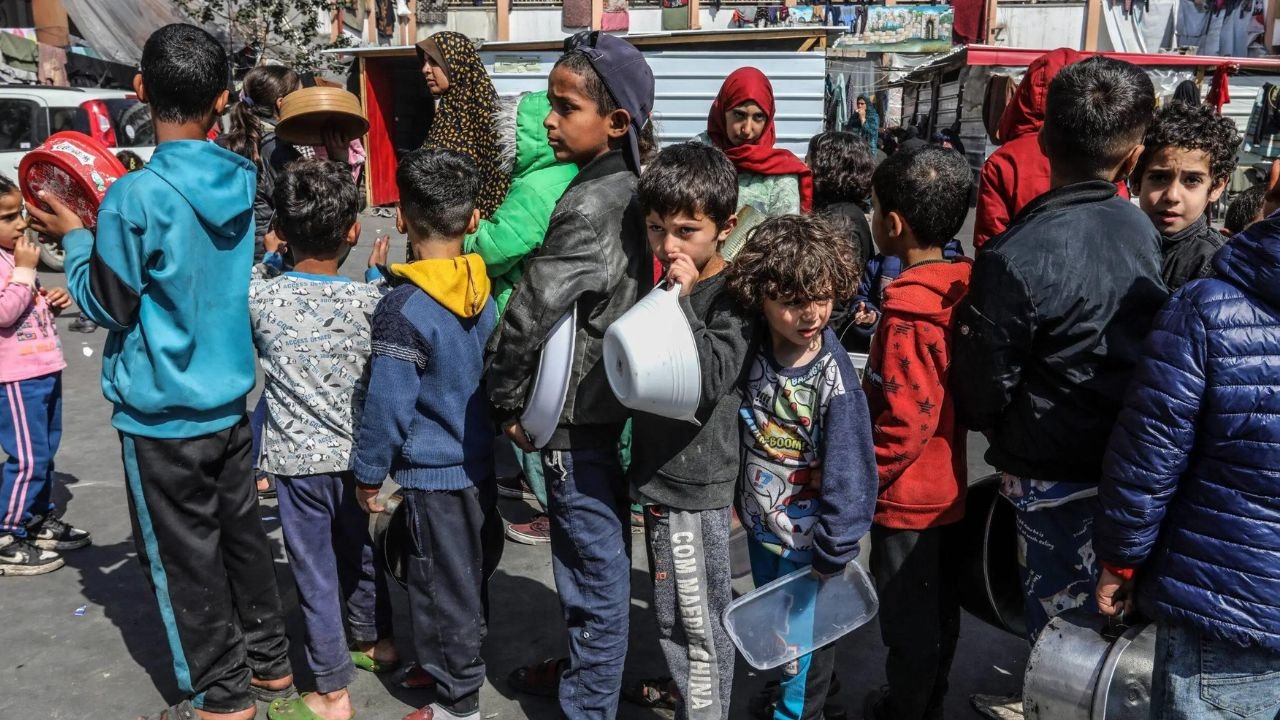
    A growing number of children caught up in armed conflicts around the globe are being denied access to critical humanitarian aid, a United Nations official warned Wednesday, as relief operations come under attack or are blocked by governments.

    The last report by the UN secretary-general on the rights of children in conflicts, published in June 2023, recorded nearly 4,000 confirmed cases of aid being denied to children, from Gaza to Yemen, Afghanistan and Mali.

    “Data gathered for our forthcoming 2024 report shows we are on target to witness a shocking increase of the incidents of the denial of humanitarian access globally,” Virginia Gamba, the secretary-general’s special representative for children and armed conflict, told the Security Council Wednesday.

    She said last year’s figure already represented an “exponential” increase since 2019.

    “Cases of denial of humanitarian access are linked to the restriction of humanitarian activities and movements; interference with humanitarian operations and discrimination of aid recipients; direct and indiscriminate attacks on civilian infrastructure; disinformation and detention, violence against, and killing of, humanitarian personnel; and looting,” Gamba said.

    She did not specify which countries would be singled out in the 2024 report, set to be released this summer.

    Nearly half of the cases in last year’s report — 1,861 — were of Israeli forces denying aid to children in Gaza.

    That report came before the October 7 attack by Hamas militants on southern Israel and the ensuing all-out war in Gaza.

    The UN has since repeatedly denounced restrictions Israel has put on aid entering the war-torn territory.

    “As a result of these constraints, children cannot access age-appropriate nutritious food or medical services and have less than two to three liters of water per day,” UNICEF deputy executive director Ted Chaiban told the Council.

    “The consequences have been clear,” Chaiban said, noting that one in three children in northern Gaza  under two years old suffer from acute malnutrition, “a figure that has more than doubled in the last two months.”

    Apart from Gaza, he also highlighted the threats to children’s access to humanitarian aid in Sudan and Burma.

    In addition to access to humanitarian aid, the UN’s report on children and armed conflict also lists the number of children killed and wounded, as well as attacks on hospitals and schools.

    From all the data points, the report draws up a “list of shame” of government forces and other armed groups responsible for the violations.

    Last year’s report listed Russia’s military over its attacks on Ukraine, but excluded Israel, angering several NGOs which have called for its inclusion for years.

  • Don’t take Imran Abbas’ money and go for Umrah

    Don’t take Imran Abbas’ money and go for Umrah

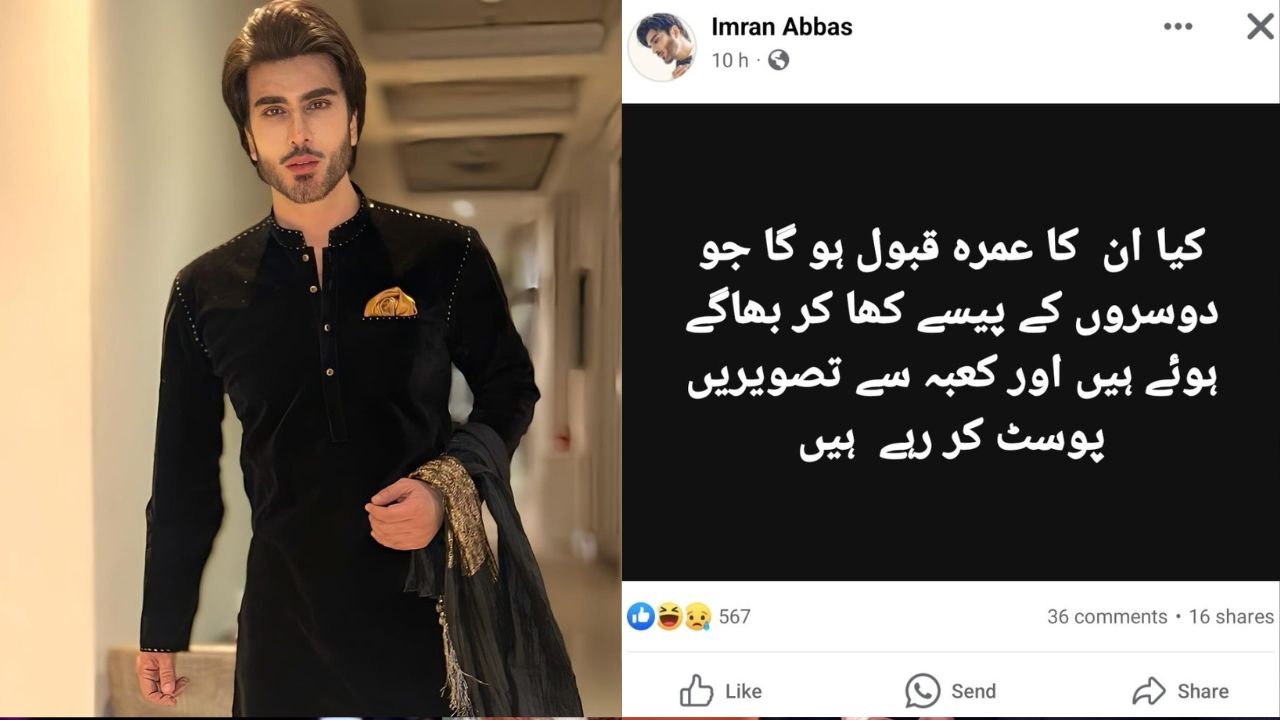
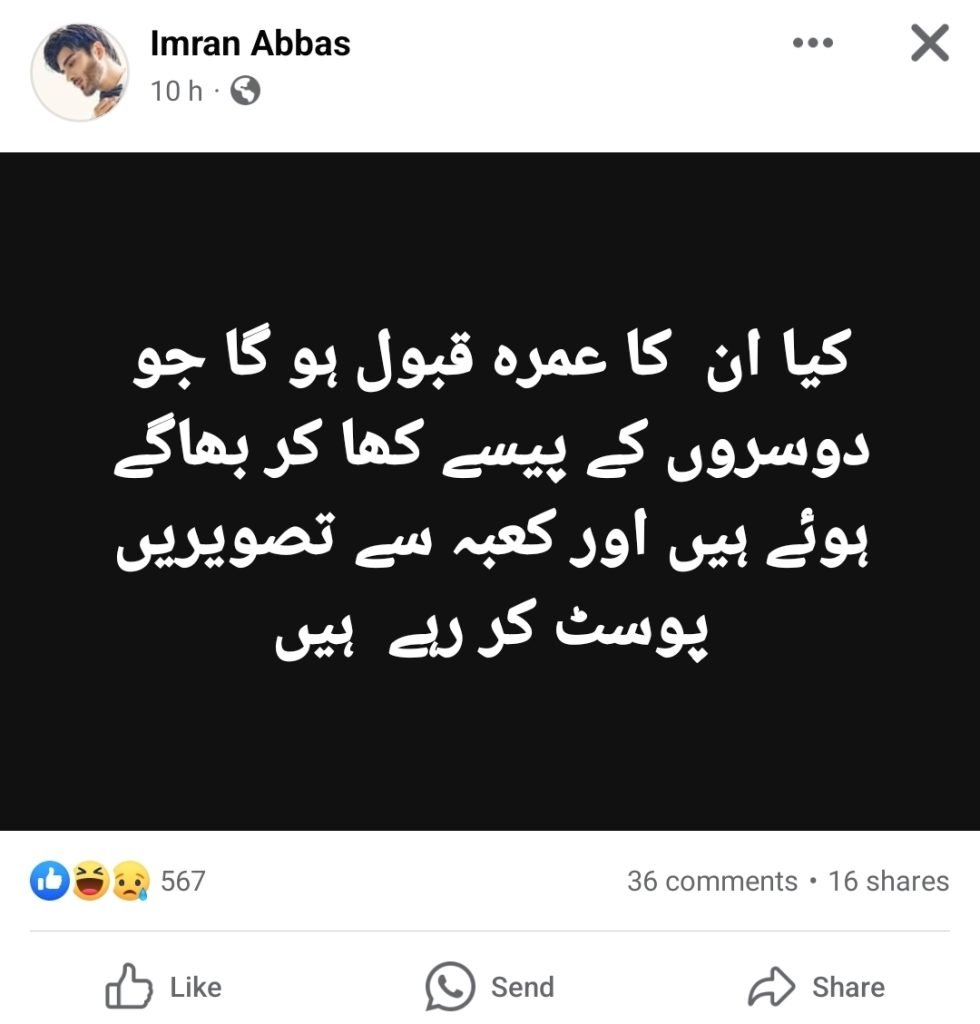
    Imran Abbas, the beloved Pakistani actor known for his stellar acting, has left fans wondering with a cryptic post on his private Facebook account. Addressing a common issue in the entertainment industry—non-payment by production houses—Imran expressed his frustration indirectly. “Will the Umrah of those be accepted who haven’t cleared payments of others and are posting pictures from Saudi Arabia,” he wrote.

    Read the post:

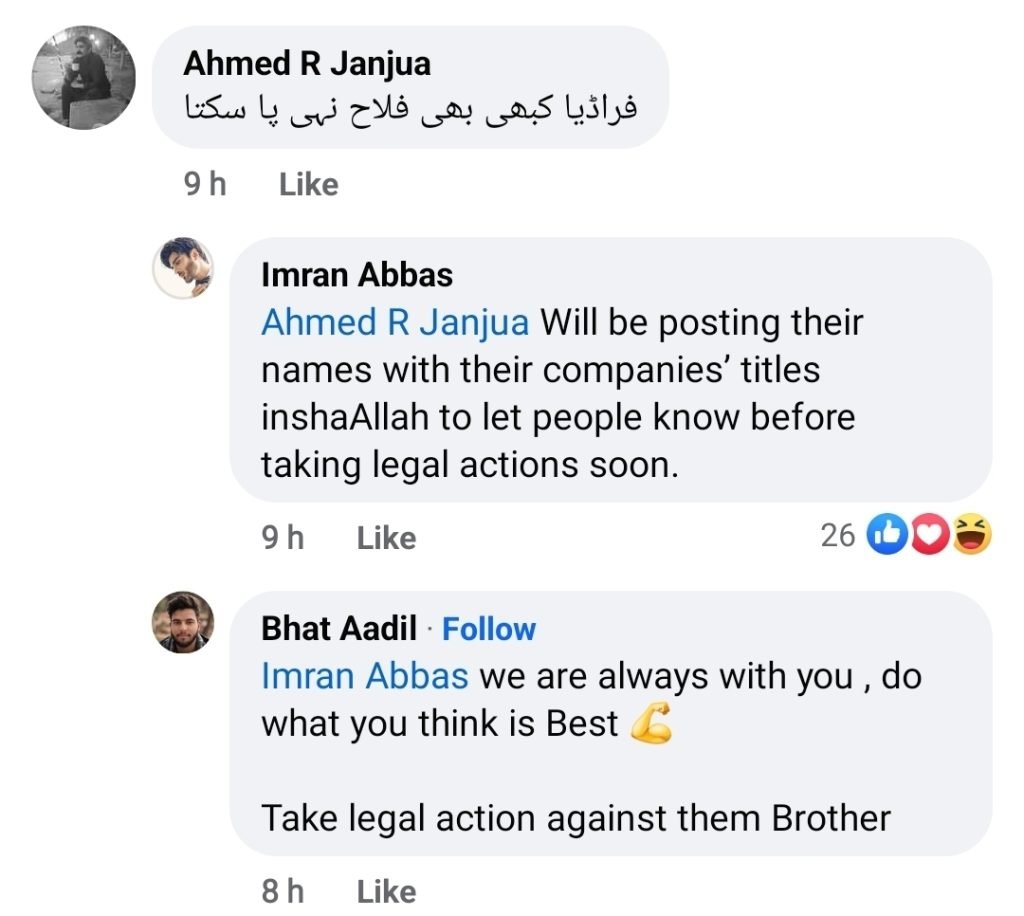
    In the comments section, he stated his intent to take prompt legal action and reveal the names of the production house and individuals involved. While some fans speculated on the identity of the person hinted at, Imran didn’t name anyone. However, many believed it was directed at a well-known producer currently on an Umrah trip, as indicated by their recent social media posts from Saudi Arabia.

    Read the comments:

    Abdullah Kadwani is currently on an Umrah trip with his family. He posted pictures alongside Haroon Kadwani and his youngest son, along with sharing a heartfelt story from Madina.

    Meanwhile, Imran Abbas’s mysterious post on Facebook has left the public speculating. It’s worth noting that Imran Abbas recently starred in the hit drama serial ‘Ehraam E Junoon’ on Geo TV, which gained millions of views.

  • Man who raped boy in aitekaf arrested

    Man who raped boy in aitekaf arrested

    The National Commission on the Rights of Children (NCRC) has issued an update that the man who had reportedly raped a 13-year-old boy during aitekaf in Muzaffargarh has been arrested.

    NCRC shared the report on social media.

    “Taking cognisance of the case, NCRC followed up with the district police office Muzaffargarh and it has been informed that the culprit has been arrested.” the post stated.

    The commission added that it would “ensure that justice prevails and the perpetrator is held accountable”.

    Background

    A man reportedly raped a 13-year-old boy during aitekaf in a mosque located at Sanawan Bukhi Chowk, Muzaffargarh.

    According to media reports, the boy, who was observing aitekaf, was allegedly sexually assaulted by a man who was sitting in aitekaf.

    The suspect is said to have escaped after he threatened the Imam of the masjid of “dire consequences”.

    The young boy was rotely learning the Holy Quran at the mosque.

    Following the incident, the boy was taken to hospital for medical examination.

    Station House Officer Shahid Rizwan Mahota claims that the suspect will be arrested.

  • Pakistan facing 30 percent water shortage for sowing season

    Pakistan facing 30 percent water shortage for sowing season

    Pakistan is facing a 30 percent water shortage at the start of the sowing season for cash crops such as rice and cotton, the country’s water regulator said.

    The Indus River System Authority (IRSA) said the gap is based on lower-than-normal winter snowfall in Pakistan’s northern glacier region, affecting catchment areas of the Indus and Jhelum Rivers that are used for irrigation.

    Kharif crops, or monsoon crops, including rice, maize, sugarcane and cotton are sown in April and require a wet and warm climate with high levels of rainfall.

    “There was less snow than normal as a result of climate change affecting the country’s glaciers,” Muhammad Azam Khan, assistant researcher with IRSA, which regulates the distribution of water resources along the Indus river, told AFP on Wednesday.

    “This will have a direct impact on the availability of water for kharif crops in the summer.”

    The water shortage gap is expected to narrow as the monsoon rains arrive later in the season.

    However, the country’s meteorological department has also forecast higher than normal temperatures during monsoon season, increasing uncertainty.

    Agriculture is the largest sector of Pakistan’s economy, contributing about 24 percent of its GDP.

    But it has been criticized for being water inefficient.

    “What this current water shortfall means for the crops is that authorities will have to better plan on how to utilize the water that is allotted to them,” said IRSA’s Khan.

    Pakistan, the world’s fifth-largest country with a population of more than 250 million, has recently been grappling with the profound impacts of climate change which includes shifting and unpredictable weather patterns.

    Devastating floods in 2022 — which scientists linked to climate change — that affected more than 30 million people also severely impacted Pakistan’s cotton crop that year.