Category: Uncategorized

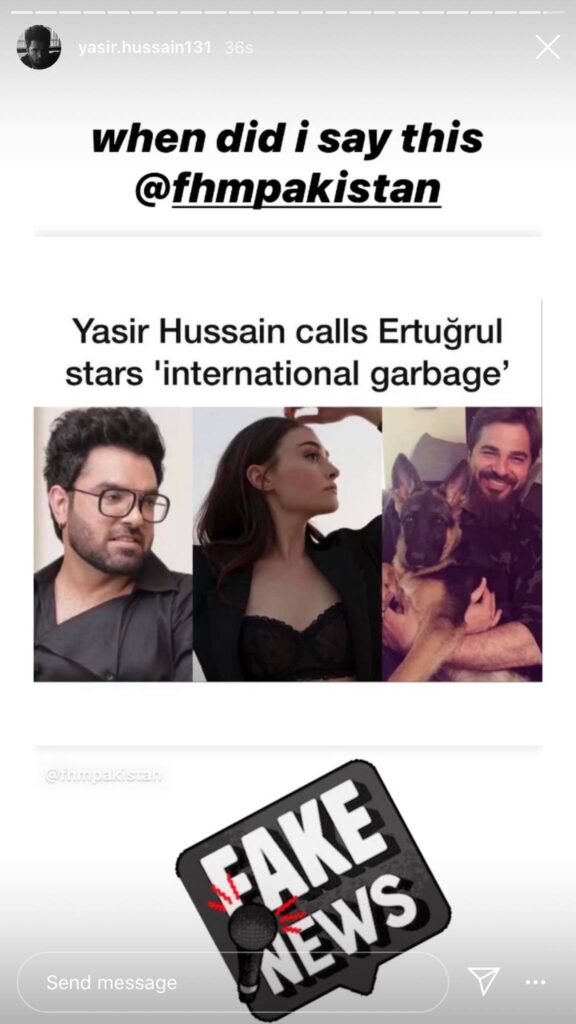
  • Yasir Hussain denies calling Turkish actors ‘kachra’, is upset with Anoushey Ashraf for calling him out on social media

    Yasir Hussain denies calling Turkish actors ‘kachra’, is upset with Anoushey Ashraf for calling him out on social media

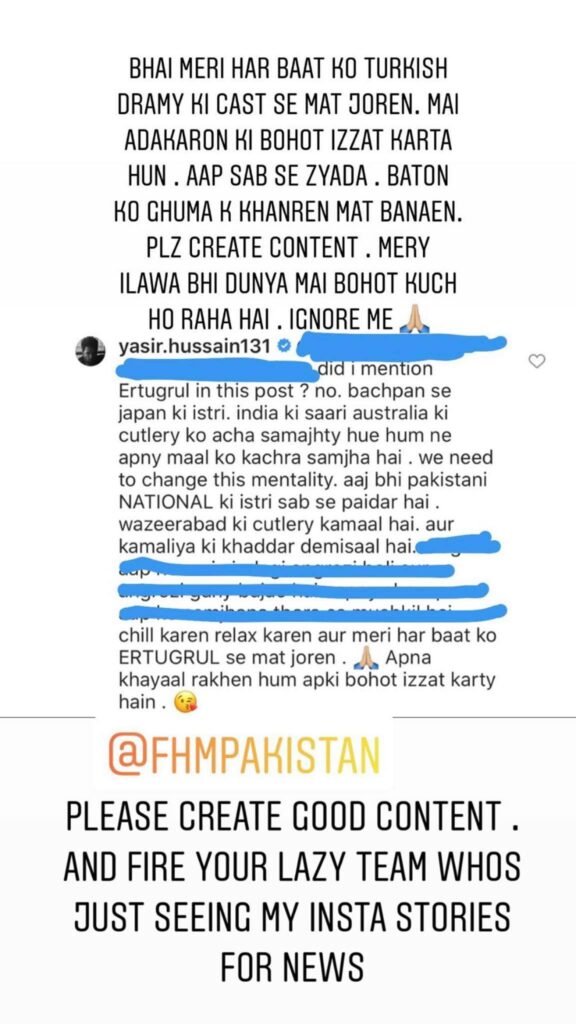
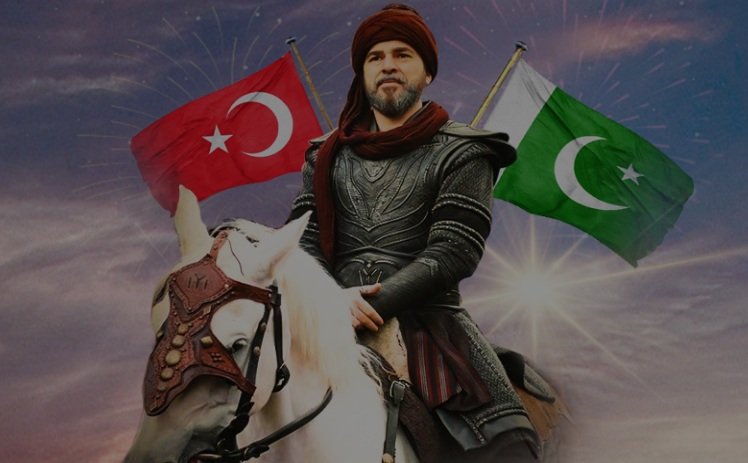
    Yasir Hussain and his comments on Turkish actors have found themselves in hot waters once again. The actor was reported to have likened Turkish actors to ‘kachra‘ (garbage). According to details, Yasir while sharing a picture of ‘Pakistani Turgut and Pakistani Ertuğrul’ had commented: “Inko koi nahi poochega (no one will give them any attention). Kyunke ghar ki murgi daal barabar or bahar ka kachra bhi maal barabar,” insinuating that Pakistanis do not appreciate local talent enough.

    Minutes after Hussain posted this story, people began to call out the actor and strongly criticised him for his remarks.

    However, Hussain denied making these comments, saying that the publications twisted his words.

    He said that every comment of his is not connected to the cast of Diriliş: Ertuğrul and that he respects them all before concluding “Ignore me”.

    The actor also joked that he will pass controversial comments every week to irk those who get offended by his comments and abuse him.

    Yasir Hussain vs Anoushey Ashraf

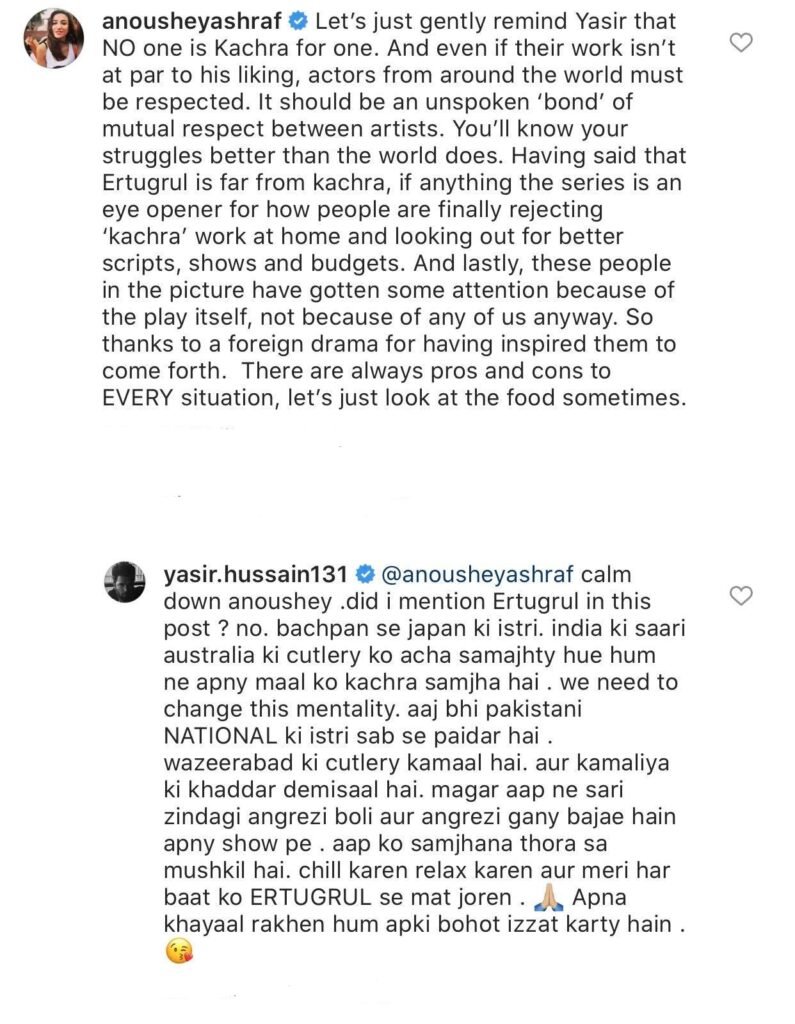
    Among those who called out Yasir for his comments was Anoushey Ashraf who “reminded Yasir that no one is kachra for one.” However, Yasir hit back at Ashraf saying that Pakistanis have always preferred international brands over local ones.

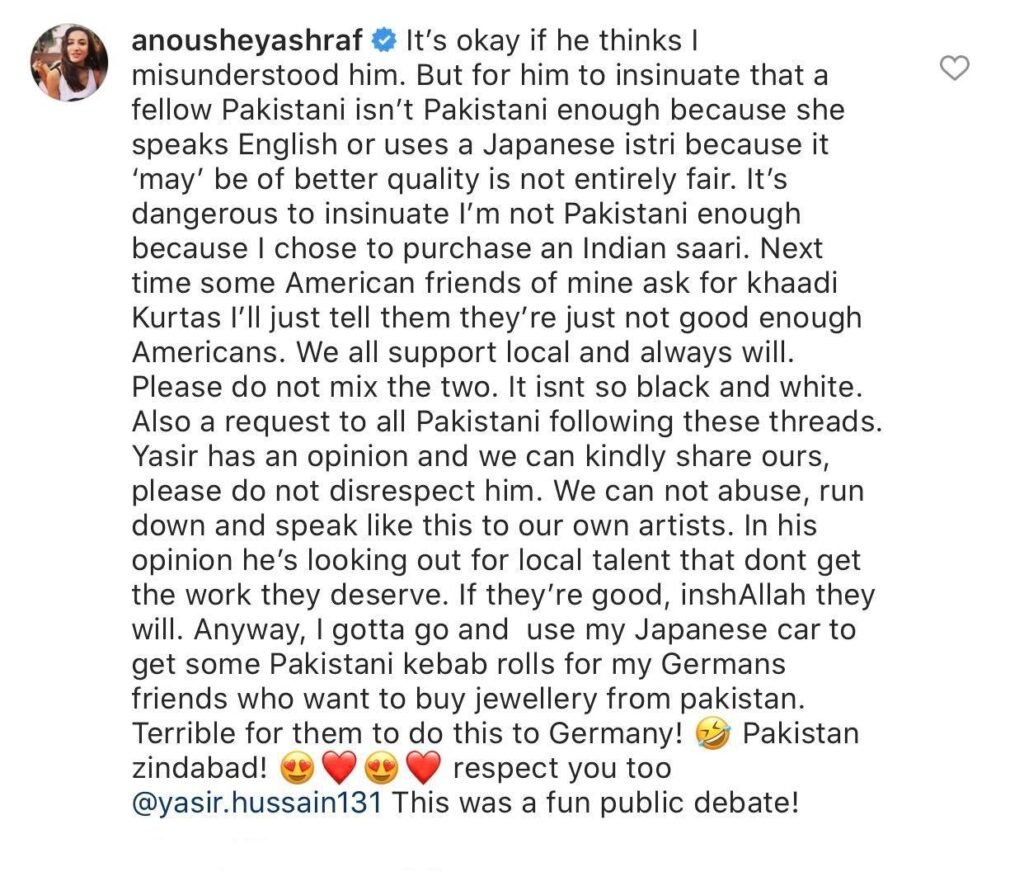
    Anoushey responded by saying that “It’s dangerous to insinuate I’m not Pakistani enough because I chose to purchase an Indian saari.”

    “We all support local and always will,” said Anoushey.

    Anoushey’s comments were widely circulated on social media, which upset Yasir, who then expressed his disappointment with Anoushey for calling him out on social media instead of sending him a message on Whatsapp.

    “Don’t need this kind of fame buddy,” said Anoushey in response to Yasir’s comment. “Just stood up for what I thought was right.”

    It is pertinent to mention here that earlier Anoushey had defended Yasir when he had likened Turkish dramas to landay ke kapray. After Yasir had been strongly criticised and been at the receiving end of personal attacks, Anoushey had urged her followers to respect Yasir’s decision and not abuse him because that’s what Ertuğrul would have done.

    “Yasir shared an opinion,” wrote Anoushey. “Your Ertuğrul wouldn’t have lectured, hated and abused him. He would have seen it as exploring’two sides to a story’.”

  • Educational institutions to re-open on Sept 15?

    Educational institutions to re-open on Sept 15?

    Federal Education Minister Shafqat Mahmood on Monday chaired a meeting of provincial education ministers to make a final decision on whether to reopen educational institutes across the country from September 15, The News reported.

    According to reports, the Higher Education Commission’s (HEC) chairperson and executive director, Special Assistant to the Prime Minister (SAPM) on Health Dr Faisal Sultan, and officials of the health department were also present at the Inter-Provincial Education Ministers Conference (IPEMC), which aimed to compile the final recommendations regarding the opening of educational institutes.

    The recommendations to resume educational activities would be sent to the National Command Operation Centre (NCOC) for further deliberations among all the stakeholders.

    The meeting was set to also focus on finalising the standard operating procedures (SOPs) in this regard. Educational institutes across Pakistan had been shut down back on March 13 in a bid to curb the spread of the deadly coronavirus.

    The Single National Curriculum (SNC), a short curriculum for the current academic year, examinations in 2021, and establishment of anti-harassment bodies in the provinces were also on the meeting’s agenda.

    A discussion on the transition plans related to the Basic Education Community Schools (BECS) and National Commission for Human Development (NCHD) was also planned for the IPEMC.

    In this regard, Sindh Education Minister Saeed Ghani said all educational institutes were to open between September 15 and 30.

    All classes starting Grade 9 and up, as well as all universities, would reopen from Sept 15, while Grade 6-8 classes would resume by Sept 22, Ghani said, adding, however, that pre-primary and primary classes would reopen on Sept 30.

    The provincial minister warned that the schools in any area that may witness a rise in the number of coronavirus cases would be closed.

    Wearing face masks would be mandatory in the schools and strict action was to be taken in case of violation of the coronavirus-related SOPs, he added.

    Moreover, Punjab Education Minister Dr Murad Raas said there would be “no double shift”.

    “Alternative day schedule to be followed by all public & private schools,” Raas said on Twitter.

    Separately, in Khyber Pakhtunkhwa (KP), the provincial education department has decided to conduct coronary tests on school staff and students.

    “Health Department’s teams will be visiting public and private educational institutions to conduct random tests of teachers / staff / students / canteen vendors and all those persons who are working within the premises of educational institutions in an effort to detect COVID-19 positive cases and prevent the spread of disease,” a notification shared on the Twitter account of the ruling PTI’s KP chapter stated.

  • Ertuğrul is coming to Pakistan

    Ertuğrul is coming to Pakistan

    Ertuğrul fans, brace yourself! Because latest reports have suggested that star of the super hit Turkish TV series Diriliş: Ertuğrul Engin Altan Düzyatan is coming to Pakistan in October.

    According to a press release by London-based events management outfit Frontiers World, “Engin Altan Düzyatan has finally confirmed his much-awaited visit to Pakistan. He looks forward to meeting many of his fans in three ticketed-only events in Karachi, Lahore, and Islamabad. The Turkish star will hold an exclusive on-stage question and answer sessions during the events.”

    The three-day tour has been titled ‘Jashn-e-Ertuğrul’ and will take place from October 9-11.

    Frontiers World is organising the trip in collaboration with TRT, the official Turkish broadcaster.

    Set in 13th century Anatolia and based on the struggle of Ertuğrul Gazi, father of Osman I – the founder of the Ottoman dynasty, Diriliş: Ertuğrul has won the hearts of Pakistani audiences ever since its first episode aired on PTV Home in April 2020. In an exclusive interview with The Current, Pakistan Tehreek-e-Insaf (PTI) Senator Faisal Javed Khan revealed that Turkish President Recep Tayyip Erdoğan had gifted the drama series to Pakistan as a goodwill gesture.

  • Defence Day: President warns India, PM praises armed forces, army chief stresses peace

    The 55th Defence Day was observed on Sunday to commemorate the sacrifices of fallen heroes during the 1965 war with India and to renew the pledge to safeguard the country’s geographical and ideological boundaries in every situation and at all costs.

    The day commenced with special prayers in mosques for the peace, prosperity and solidarity of the country and to pay tribute to those who sacrificed their lives for the protection of their motherland.

    The main ceremony was held in the morning at the General Headquarters (GHQ) in Rawalpindi, according to Radio Pakistan, where Chief of the Army Staff (COAS) General Qamar Javed Bajwa laid a floral wreath at the Martyrs Monument.

    A change of guards was also held at the Quaid’s mausoleum with Air Vice Marshal Shakeel Ghazanfar as the chief guest of the ceremony. A contingent of 46 cadets of the Pakistan Air Force Asghar Khan Academy took over guard duties.

    A ceremony was also held at the Naval Headquarters in Islamabad, Radio Pakistan reported.

    In his message to the countrymen on Defence Day, President Arif Alvi said that Pakistan would never compromise on its sovereignty and security, making it clear that any kind of misadventure by the enemy would be dealt with severely.

    “It makes me happy to state that we have achieved self-reliance in the defence field […] We have thwarted external aggression; we have successfully defeated terrorism and extremism, and now we are on the path towards economic prosperity.”

    He said the day was a reminder of the spirit and valour of Pakistan’s armed forces and the nation through which they thwarted the evil designs of the enemy on this day, 55 years ago.

    The president said the nation saluted the martyrs as well as their families for their fortitude as they set a great example of patriotism by sacrificing their loved ones for defence of the country.

    “The spirit of September 1965 still lives in our hearts and I can proudly say that because of this, we have been successful in many testing times. Our armed forces’ professional excellence, combat readiness, and above all their unwavering faith in Allah has made Pakistan invincible,” he added.

    Meanwhile, Prime Minister (PM) Imran Khan said that Pakistan’s desire for peace must not be misconstrued as its weakness, adding that the country’s armed forces were “fully capable” of defending the country.

    “The resilient nation and the battle-hardened armed forces of Pakistan have time and again proved that they are fully capable of defending the country and are fully prepared to meet any kind of eventuality,” the premier said in a series of tweets.

    In his message, the premier honoured the fallen heroes of the war, saying that 55 years ago, the nation and the men in uniform “proved that it is not the size that matters, but it is the courage and devotion that matters the most”.

    “September 6 is a day in Pakistan’s glorious history that is commemorated as a symbol of courage, strong will and unmatched spirit of sacrifice by our gallant armed forces.”

    Later, during an investiture ceremony held at the army’s General Headquarters in Rawalpindi on the occasion of the 55th Defence Day, the army chief conferred military awards to army personnel for acts of gallantry during various operations.

    “Families of shuhada/ghazis, senior serving military officers/soldiers also attended the ceremony,” according to a press release by the Inter-Services Public Relations (ISPR).

    The military’s media wing said 40 officers were awarded Sitara-e-Imtiaz (Military), 24 officers and soldiers were awarded Tamgha-e-Bisalat and a soldier was awarded the United Nations Medal.

    The medals of the martyred were received by their family members.

    Addressing the gathering, the army chief said that Pakistan faced great trials over the last 20 years with war on the eastern and western fronts. He said that the country also faced natural disasters, such as floods and earthquakes, and the war on terror.

    General Bajwa said that thousands of people got displaced and many sacrificed their lives. He also noted that the country successfully fought against coronavirus and the locust attack.

  • Karachi’s rain mess: A case of governance failure, corruption and political turf wars

    Karachi’s rain mess: A case of governance failure, corruption and political turf wars

    “The curious case of this city is that it is administered by a mix of federal and provincial controlled landholding associations, cooperative housing societies, military-run cantonments, the navy, the railways and the industrial area authorities to name a few.”

    A commercial port city with more than 20 million residents, Karachi has continued to suffer decades of civic mismanagement, gaps in urban planning and development given the lack of adequate governance, corrupt civic agencies and political parties vying for power. None of the myriad agencies that control resources and management in this city have honestly bettered the city and the lives of its people.

    Take the tussle between the PPP and the MQM that has not only brutally destroyed the socioeconomic fabric of districts such as Lyari, a sprawling slum settlement turned into a hotbed of violence, guns and drugs when rival gangs were patronised by the city’s two political parties, but also resulted in turf wars affecting the running of civic institutions. The political bifurcation of jurisdictions within this city has, therefore, resulted in a complete breakdown of basic service provision over years – lack of clean drinking water, electricity, housing, security are just a few municipal services that should be under the local government system but this is not the case. Even an elected mayor has no jurisdiction over certain areas of this city. When a city’s history is rooted in ethnic and identity-based politics building urban infrastructure, providing municipal services, or even intervening in areas that are essentially administered by a particular political party is near to impossible.

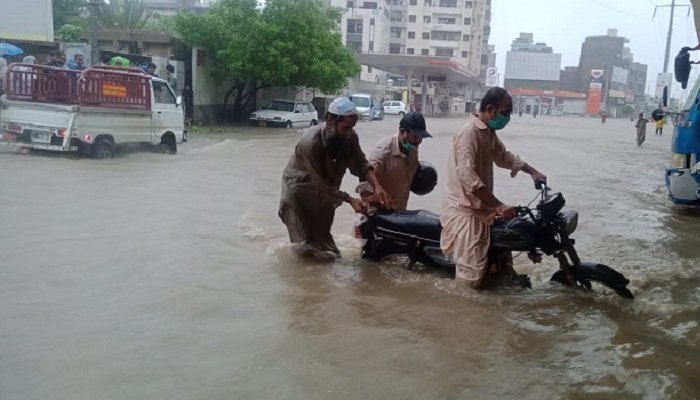
    Last week, Karachi was submerged in 230mm of rainfall in less than 12 hours, the most ever recorded, according to the Pakistan Metrological Department, exposing again glaring gaps in urban development, especially in low-income and vulnerable communities. Wealthy residential areas were not spared where drainage channels were choked. One such densely populated urban settlement with poor access to water and sanitation, Lyari is located about 15 minutes from the city’s business hub at I.I. Chundhrigar Road where you’d find most of the banking sector is headquartered. Streets were inundated with rain and sewerage water for days and later cleared up by residents because no government assistance reached these communities. Similarly, homes, businesses and streets in the city’s old quarter of Kharadar – a symbol of pre-colonial history which becomes the centre for Muharram processions (near Mithadar where the Edhi main office is located and adjacent to Jodia Bazaar) – literally drowned in a mix of rain, putrid sewerage water and floating garbage, increasing the risk of diseases, such as dengue and malaria. Some commercial/residential areas remain flooded with no electricity almost a week after the downpour in this city; sewerage water has collected in empty plots according to residents in different areas of Karachi where gutters are broken.

    First let’s be clear here: vulnerable neighbourhoods with already inadequate urban and social infrastructure have long been neglected by the ruling political powers and whomsoever authority is in charge of a given district. Then, the urban poor in Karachi are like none other. I recently read on Twitter: ‘The Lebanese people are like kids who’ve had to raise themselves because the parents were never around to take care of them.’ Now apply that to Karachi and it makes sense. Migration from rural to urban, and from the north has meant living in overcrowded, unsafe environments with little access to education, health, or sanitation, and with the COVID-19 crisis having reduced livelihood opportunities even further because of mobility restriction and decreased economic activity, natural disasters have the potential to decimate lives and homes. So why no focused body that can fix Karachi? The curious case of this city is that it is administered by a mix of federal and provincial controlled landholding associations, cooperative housing societies, military-run cantonments, the navy, the railways and the industrial area authorities to name a few. Many question the absence of the relevant authorities responsible for civic provisions, such as drain clearing before the annual monsoons, sewerage repairs and garbage collection. In fact, it was army personnel, volunteer rescuers, and even volunteers from the Islamist group Tehreek-e-Labbaik who rescued and evacuated people from many inundated residential neighbourhoods — some using boats for rescuing residents living in the newly constructed Naya Nazimabad area while some families waded through waist-high water. 

    Floating cars and destroyed homes: an apocalyptic sight

    Moreover, substandard construction in the city and informal settlements, built close to water draining channels or nullas, were perilously flooded or sunk during these rains given their poor physical infrastructure. This kind of urban flooding is to be expected as climate patterns change experts warn. And we have witnessed urban flooding in the past in Karachi. Warnings from the late Perveen Rahman, Orangi Pilot Project’s director, of the possibility of urban flooding if the mangrove plantation was removed on either side of Mai Kolachi because it served as a catchment area that could prevent flooding, were never heeded.

    The human toll of the recent rain tragedy has left Karachi’s residents reeling with more anger than ever and rightly so. I use the term tragedy here because rain in Karachi is hardly romantic or calls for a relaxing cup of tea and pakoras – rather it’s become synonymous with loss of lives, homes and livelihoods that could have been avoided had the concerned authorities prioritised rain preparations by declogging stormwater drains beforehand or constructing drainage facilities where none exist. Hundreds of people were forced to take shelter in the homes of relatives while scores of cars and other vehicles caught in the torrential downpours either remained submerged in water, many seen floating away as the water began flowing akin to a river developing rough currents. Scenes captured and shared as photographs and videos on social media were as if this city had been hit by a passing meteor and destroyed with a vengeance. Main thoroughfares and all seven newly constructed underpasses were submerged under several feet of water; children and motorcyclists drowned in waterlogged underpasses; young men slipped into storm drains (nullahs); 21 bodies were pulled out of just one water channel near Korangi; cars were seen stranded or floating everywhere in the city; underpasses resembled swimming pools turned nasty, and electricity was cut in areas for over five days to save people from getting electrocuted because this city has a surplus supply of unnecessary wires dangling on electric poles or lying unattended on roads and pavements. All this while empty shipping containers placed to block streets during the ninth and tenth of Muharram were seen dangerously floating down Zaibunissa street in Saddar jostling calmly for space with cars and buses. In the case of a police van caught in moving water currents on the main Sharah-e-Faisal thoroughfare that leads to Jinnah International airport – images of which went viral on social media – around five policemen were rescued by passersby who threw a rope ladder at them. Where were the authorities, the rescue services other than volunteers such as Edhi and Chippa to help in this disastrous monsoon deluge is a question we need to ask the provincial/federal government.

    And it was not just Karachi that witnessed the monsoon rains this year but images from the interior of Sindh are heartbreaking – entire villages have drowned, mud homes entirely washed away with families having lost their meagre belongings, hungry children huddled together under the open skies – and these are communities that persistently suffer from drought, malnutrition, lack of healthcare, unemployment. Again, why has this government neglected its most vulnerable people needing protection, shelter and food? According to the NDMA, troops using boats evacuated 300 people from the rain-hit district of Dadu in Sindh, while 1,245 people were evacuated from Karachi’s rain-hit areas last week, where residents lost their life’s savings when businesses were destroyed and homes flooded with sewerage water, especially where the city’s outdated drainage and waste systems were overwhelmed by an unprecedented spell of heavy rain. That is not to say urban flooding was unexpected. Although flood warnings were issued, it appears authorities in charge of overseeing the city’s basic services and infrastructure were at their usual lethargic best without formulating any kind of preemptive response.

    When DHA drowned in sewerage water

    This year’s monsoon rains did not distinguish between slum settlements and the wealthy Clifton and Defence Housing Authority (DHA) neighbourhood. Given DHA is a housing authority for the rich and famous, in the aftermath of these rains that didn’t appear so – the sprawling area that comprises DHA was inundated with water as aerial views shared on social media revealed not a dry patch. Originally founded in 1953 as Pakistan Defence Officers Housing Authority, Zia-ul-Haq passed a Presidential Order in 1980 to create DHA, a civic authority run by the powerful military controlling five per cent of urban land in this city. It is a private enterprise given a governing body run by chiefs of defence institutions, essentially administered by serving brigadiers under the direct command of corps commanders. It was decided then that DHA would have its own rules and essentially not adhere to the local government system that oversees the municipal provisions of the city. This Presidential Order divided the Karachi Cantonment – the southern side named Clifton Cantonment that was given DHA Phase 1. In other words, DHA and Cantonment Board Clifton (CBC) do not come under the mayor of the city who cannot control the drainage, water supplies and planning for this area.

    Residents from DHA, one of the largest landholding bodies in this city, were hard hit this year when scores of houses were flooded in the city’s posh district home to politicians, ministers, entrepreneurs and industrialists. No one from this authority emerged to apologise for the putrid mess that was open gutters and collected rainwater measuring over five feet in certain areas and no one attempted to provide assistance for those vulnerable residents trapped in their homes without electricity, food, water and medicine; some even at the risk of drowning. Many took to twitter cussing the electricity supplier, the Sindh government and the DHA authorities, as they witnessed green streets drowning mercilessly with such rainwater intensity that gated homes were left in utter disarray; heavy metal gates flung wide open with currents of the free-flowing water, expensive cars floating aimlessly or submerged and basements of homes flooded with expensive paintings and books destroyed in some homes. The urban middle-class deprived of basic amenities, clean water and electricity for years intermittently, say they watched this side of the Clifton bridge as they term the elite, drowning and waited for a reaction. The point being if you pay your taxes, water taxes included, and get nothing in return, because you’re compelled to buy your water, electricity and security, something has to give – and these rains meant no one was going to sit back and take the callousness suffered over years.

    Residents mobilised over Facebook and protested outside the office of the CBC, DHA’s sister organisation, to register their anger at having paid taxes for years but not having received any services, such as solid waster management disposal – the city actually has no plan for waste disposal – or running water without having to purchase water tankers and pay a whopping Rs 7,000 for one tanker. Furthermore, the stormwater drains clogged with garbage in DHA and elsewhere in the city, have not been removed as a preemptive move before the summer rainfalls. Hundreds of residents protested outside the offices of the CBC demanding the authorities clear the water hours, and present their audit for the past five years. Despite a legitimate right to protest, the organisers are now faced with police charges for rioting — and for shaking the CBC head out of his lethargic stupor. Fed-up with the city administration, other protests happened, in the days to follow, including all Karachi residents irked by years of neglect. A friend who said she’d stopped the water from seeping into her dining room and flooding her house, calling the city a disaster zone, a death trap. I can’t worry unless something hits me in the face, she said. Or else I’d die of anxiety. And I forgot to mention if you have a generator, which most Karachiites at home and for their businesses would do, finding a petrol station at 4 am was a nightmare when you ran out of petrol or diesel. 

    In certain residential and commercial areas of this city, even as I write this, electricity is yet to return; roads are filled with water, and sewerage, despite the Sindh government’s representatives, including the chief minister rolling up their sleeves and supervising water drainage. Draining the water from main roads has largely been left to volunteers and the Sindh government (read Sen Murtaza Wahab’s twitter updates) when the concerned authorities were unable to move in swiftly and do their job. Businesses have been gutted; supplies worth hundreds of thousands lost all over this destitute city, but who is listening to these troubles? Who will work or represent the interests of this city and its people? All of Karachi deserves greater attention because it has suffered years of neglect and economic hardship despite generating maximum revenue. No city can function with multiple agencies and multiple service provision jurisdictions. According to a paper on landownership in Karachi authored by Arif Hasan, Noman Ahmed and others, this city is governed by 13 different land management authorities which resultantly means no consensus is achieved and there is no coordinating mechanism, because of clashing interests. Over the years this has translated into a lack of low-income housing, amenities and utilities.

    Making Karachi liveable

    So while it is critical for megacities like Karachi where urban sprawl has not been able to keep up with the growing population needs to focus resources on immediate management and response to natural disasters or an urban crisis, attention must be paid to how long-term measures can be implemented to build a more sustainable and liveable city. This approach is imperative after an intensely destructive monsoon season countrywide that has revealed how unprepared and clueless we are when it comes to managing disasters of this unprecedented scale – natural disasters intensifying over the years as unusual weather patterns emerge clearly warning of the impact of climate change (Karachi’s extreme heatwave in 2015 is yet another example) If climate change is not addressed adequately by this government, without a disaster management infrastructure and expertise to match, severe weather will cause loss of lives and livelihood. Mitigating the effects of climate change  (on agriculture, for example) is imperative, especially in vulnerable areas, rural districts in Sindh, even KP and Balochistan, where the capacity to sustain climate change shocks is non-existent, and where disaster prevention is unaddressed.

    Karachi’s woes require a serious reorganisation of administrative duties so whomsoever civic agency is responsible gets the job done without political and commercial interference (especially in the use of land to their own advantage) while keeping at the fore the impact of climate change (droughts, floods, rain intensity will adversely affect water and food security in the near future) Governance must no longer be compromised because of conflict between stakeholders at the expense of the people. Strengthening local bodies is critical. As a party, the PPP has never allowed for that because it becomes a political issue whereas the PML-N gets voted on its governance track record in Punjab, so it must keep to a standard when it comes to civic services.

  • Kaghan to be developed into an all-time tourist destination

    The industries department has announced that Kaghan Valley will be developed into an all-weather tourist destination under the Economic Revitalisation of Khyber Pakhtunkhwa (KP) Project.

    As per reports, the chief minister’s special adviser on industry Kareem Khan handed over snow-blowing and other heavy machinery to Kaghan Development Authority (KDA) deputy director Sajjad Jan for the purpose.

    Kareem told reporters that the KDA would find places in Kaghan Valley, where landslides are a common occurrence and make them accessible for tourists. He said the government wanted to boost tourism in these areas so it provided modern machinery to the Kaghan and Galiyat Development Authorities for garbage dumping to preserve the environment.

    The chief minister’s aide said his department had allocated the financial support of Rs64 million to small and medium entities to promote tourism in the province.

    “The government in collaboration with the World Bank has launched the Economic Revitalisation of Khyber Pakhtunkhwa Project in 2012 to support small and medium enterprises through the matching grant along with the promotion of integrated tourism through the clean and green initiative,” he said.

    KDA deputy director Sajjad Jan said the industries department had given the authority heavy machinery, so it can clear landslides from the Mansehra-Naran-Jalkhad Road to control and restore traffic efficiently.

  • PEMRA directs ARY to review ‘Jalan’s’ content after multiple complaints

    PEMRA directs ARY to review ‘Jalan’s’ content after multiple complaints

    The Pakistan Electronic Media Regulatory Authority (PEMRA) has directed ARY Digital and the makers of Jalan to review its content and script and modify it in accordance with Pakistani values.

    In a press release, the media regulatory body said that it has been getting multiple complaints regarding the drama, its content and script through the Pakistan Citizens Portal, PEMRA social media accounts, and PEMRA call centres. It added that the content of the drama, especially the main storyline, is being strongly criticised by audiences on social media.

    “Audiences have strongly criticised the drama saying that it has made a mockery of sacred relationships,” said the press release.

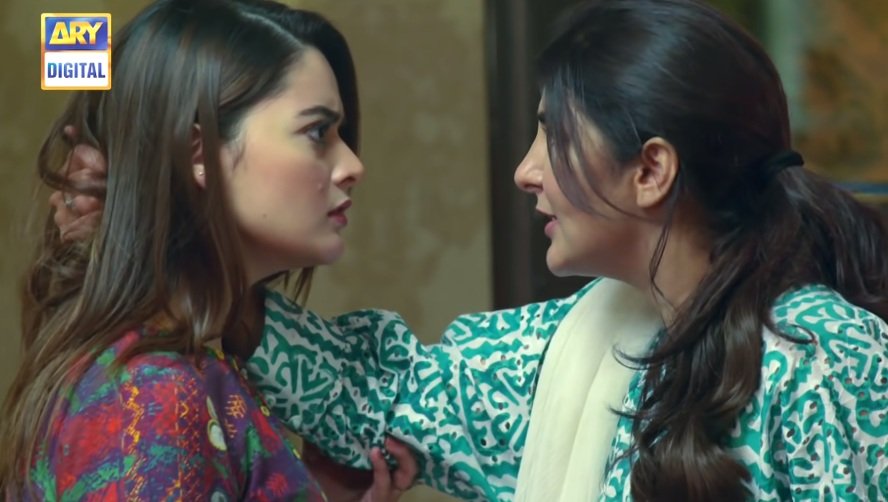
    Jalan is about two sisters Nisha (Minal Khan) and Misha (Areeba Habib). While Misha is the sweet and obedient sister, Nisha is a spoiled brat and wants to be better than her sister, so she sets her sights on her brother-in-law Asfandyar (Emmad Irfani) because he’s rich and good-looking. Ignoring the fact that her sister is married to Asfandyar, Nisha openly flirts with him and urges him to divorce his pregnant wife. Despite, it’s convoluted and twisted storyline, the drama trends on TV and social media every week.

    Similarly, PEMRA also banned the repeat telecast of Ishqiya and Hum TV’s Pyar Ke Sadqay saying that the content of the dramas is against the “morals” of society. Though both dramas have completed their prime time run, they are being re-aired at different times. The notification added that the dramas cannot have a repeat telecast on the ARY Zindagi or HUM Sitaray sub-channels either.

    Read more – Pyar Ke Sadkay’: All’s well that ends well

    Furthermore, the regulatory body warned drama makers that if they do not oblige with their recommendations, PEMRA will take strict action under Section 27 of the PEMRA Ordinance and stop the drama from being aired without any prior notice.

    Section 27 of the PEMRA Ordinance prohibits the broadcasting or re-broadcasting or distributing of any programme that PEMRA deems is against society values. The section states: “The Authority shall by order in writing, giving reasons, therefore, prohibit any broadcast media or distribution service operator from broadcasting or re-broadcasting or distributing any programme or advertisement if it is of the opinion that such particular programme or advertisement is against the ideology of Pakistan or is likely to create hatred among the people or is prejudicial to the maintenance of law and order or is likely to disturb public peace and tranquility or endangers national security or is pornographic, obscene or vulgar or is offensive to the commonly accepted standards of decency.”

    PEMRA said that the channels have been repeatedly informed about viewers’ concerns regarding the content and have been directed to produce content according to Pakistan’s social, religious, social and moral values. It is pertinent to mention here that in June Prime Minister Imran Khan, in a video meeting with renowned writers across the country, urged them to promote family values and national identity through their writings and dramas.

    “As there was no improvement in the script of the dramas by the channels, a final instruction was given to the channels on August 18 to produce the content of the dramas in accordance with the values ​​of Pakistan,” read the press release.

    Read more – ‘Ishqiya’ ends on a bittersweet note

    PEMRA has also requested all stakeholders, including TV channels and production houses, to immediately review the content of their future dramas.

    “Regardless of the cost and time invested in the drama, if the content of a play is against national values and expectations of the audience, the play will be banned without any warning,” stated the press release.

    Watch The Current’s review on Jalan here:

  • ‘Band karo isay’: Twitterati suspect more than a technical fault on Shahzeb Khanzada’s Thursday show

    ‘Band karo isay’: Twitterati suspect more than a technical fault on Shahzeb Khanzada’s Thursday show

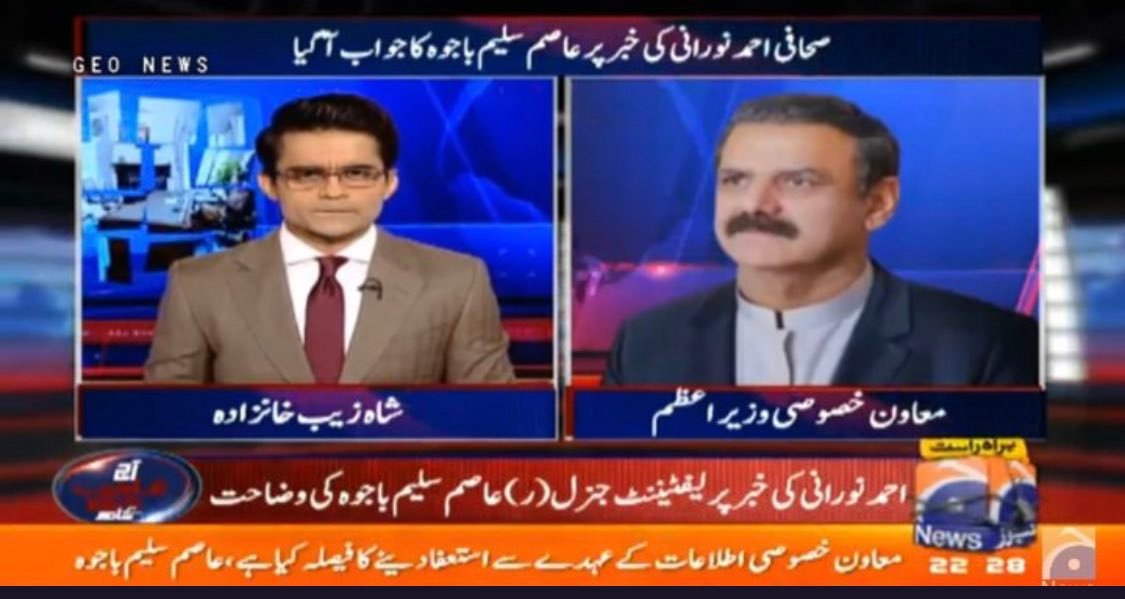
    With Lieutenant General (r) Asim Bajwa’s call dropping during his appearance on Geo News show ‘Aaj Shahzaeb Khanzada Kay Sath’ as he rebutted the news report linking his family’s businesses to his military career, Twitterati, owing to some background chatter, are suspecting more than just a technical fault.

    As per the details, Bajwa on Thursday issued a detailed press release rubbishing claims made regarding the assets of his family members by journalist Ahmad Noorani.

    The press release was followed by Bajwa appearing on multiple current affairs shows later in the day to further clarify the situation.

    In an on-air telephonic conversation with Shahzeb Khanzada, Bajwa reiterated his statements aimed at rubbishing the claims made in the story that he has called “malicious propaganda”.

    As the interview continued, the phone call dropped amid questions posed by Khanzada.

    WATCH INTERVIEW:

    But Twitterati suspected there was more to the dropped call than an alleged technical fault as they pointed out some background chatter.

    The former military officer, however, returned after a commercial break and responded to the question.

    What do you think of the interview? Let The Current know in the comments below

  • Usman Mukhtar’s ‘Bench’ selected at the first Cannes International Independent Film Festival

    Usman Mukhtar’s ‘Bench’ selected at the first Cannes International Independent Film Festival

    Congratulations are in order for Usman Mukhtar, whose short film Bench has been selected at the first Cannes International Independent Film Festival. The film earlier also won the ‘Best Short Film Award’ at the South Shore Film Festival, New York.

    Sharing the exciting news on social media, Usman said, “With great humility, joy and pride do we announce that Bench has been selected at the first Cannes International Independent Film Festival – CIIFF.”

    https://www.instagram.com/p/CEraLQaJh32/

    Rubya Chaudhry, who is Mukhtar’s co-star in the film also expressed her excitement on social media.

    https://www.instagram.com/p/CErdGZcl_QL/?utm_source=ig_embed

    The film which has been directed by Mukhtar and written by Ali Mudar the film sees two people at difficult crossroads of their lives, cross paths.

    Speaking to a local media publication, Mukhtar shared that the “film is about two people who meet on a bench. It’s a dialogue based film which takes a very interesting twist and turns.”

    He had also shared that the film has been submitted to a lot of film festivals including the Toronto, Cannes and Busan Film Festivals but due to the current situation, they’re screening the film online but he is yet to hear back from them.

    Watch the trailer of the film below:

  • CPEC Authority chief Lt Gen (r) Asim Bajwa rubbishes report on family’s assets, resigns as Imran’s aide

    CPEC Authority chief Lt Gen (r) Asim Bajwa rubbishes report on family’s assets, resigns as Imran’s aide

    Lieutenant General (r) Asim Saleem Bajwa has categorically rebutted all corruption allegations levelled against him and resigned from the post of special assistant to prime minister on information and broadcasting, however, he will continue to remain the chairman of China-Pakistan Economic Corridor (CPEC) Authority.

    Defending the businesses and enterprises owned by his brothers in countries abroad, he said that shameless allegations were levelled against him to tarnish his image.

    Lt Gen Bajwa, in rejoinder to a story published on an “unknown website”, lamented that the allegations were “false and incorrect”. He insisted that on the date of filing of his declaration, i.e. June 22, 2020, his spouse was no longer an investor or shareholder in any business of his brothers.

    “My wife had disinvested all her interests as at 01.06.2020 in any entity abroad and such fact has been duly documented in the official records in the USA. It may be pointed out that the company registered in the SECP [Securities and Exchange Commission of Pakistan] in Pakistan was Liaison Office of the companies in the USA,” he maintained.

    About the investments abroad, Lt Gen Bajwa said that since 2002 till June 1, 2020 his wife had only invested $19,492 in his brothers’ companies. He said that all investments came from his savings over the last 18 years, and no regulations of the State Bank of Pakistan (SBP) have been broken.

    Concerning the alleged investment of businesses in the pizza chain Papa John’s in the US and DQ, UAE, Lt Gen Bajwa said that facts and figures were fully documented.

    He insisted that Bajco Global Management, LLC did not have any ownership interest in any Papa John’s in the USA, DQ, UAE or any real estate.

    READ: ‘Who is this Mr Bajwa you are talking about?’ NAB DG on alleged assets of Lt Gen (r) Asim Bajwa’s family

    “The author further makes a false claim that Bajco owns 99 companies. The author has listed many companies multiple times on his list. There is a total of 27 active companies in the US and two in the UAE,” he said.

    “For eighteen years, the actual out of pocket cash investment into the said businesses by my brothers and wife has been about US$73,950/-. It is further pointed out that out of US $73,950/-, my wife’s contribution, as stated aforesaid, is US$19,492/-. Thus, the total out of pocket cash contribution of my five brothers, for eighteen years, has been US$54,458/-,” Lt Gen Bajwa added.

    He added that the cash contributions of $54,458 by his five brothers were fully accounted for and traceable to their sources. He further said that apart from his five brothers and his wife, the businesses have at least 50 other investors. He maintained that any further investments were a result of profits generated from the business, while also mentioning the various qualifications of his five brothers as a source of income.

    “One question that may be underscored is whether three persons who have worked in the US up to the positions of a Vice President in a US Bank, a Controller in a restaurant operating company, and as an operating partner of a restaurant; and two persons having worked as doctors, would not be able to save US$54,458/-,” argued Lt Gen Bajwa.

    Responding to the allegations made about businesses of his children, he said that the company Scion Builders and Estates (Pvt.) Ltd owned by his sons and registered in the SECP had never done any business and same is dormant since inception. He said the same about other businesses owned by his sons, namely Advance Marketing (Pvt.) Ltd, Scion Natura LLC, and Mochi Cordwainers.

    READ: ‘Lt Gen (r) Asim Bajwa to issue clarification on report linking military career to family’s businesses’

    Regarding an allegation about a house owned by his son’s Scion Management Group LLC, he asserted that the house was only 31,000 and had been bought by his sons through their independent resources in “cheap foreclosure proceedings”.

    “Baseless allegations have been levelled that a business entity of my two brothers by the name of Silkline Enterprises (Pvt.) Ltd has been formed to acquire CPEC contracts. It may be stated that this company has never acquired any CPEC contract. This company is in Rahim Yar Khan and has only provided labour/human resources to industries in Rahim Yar Khan region,” he added.

    He said that one of his sons owns a house in the USA but it has been acquired through a mortgage in the manner that 80 per cent of loan/mortgage remains unpaid.

    “This again is a small time-house. All my sons are above 18 years and none are my dependents. Masha’Allah their ages are 33, 32 and 27 years respectively. It shall be noted that my sons completed their business degrees from reputable universities in the United States and have had well-paying jobs,” concluded the retired general.

    On August 27, a website known as Fact Focus published a story, claiming that Lt Gen Bajwa’s family had set up 99 companies in four countries, including a pizza franchise with 133 restaurants.

    The website further claimed that Lt Gen (r) Bajwa’s wife was a “shareholder” in at least 86 companies. Of them, 71 were set up in the US, seven in the UAE and four in Canada.

    The rebuttal followed the statement of Federal Minister for Information and Broadcasting Shibli Faraz, who had earlier this week said that Bajwa will soon be issuing a clarification on the news report.

    Bajwa had earlier called the report a “malicious propaganda story”.

    The story had been called an attack on CPEC by the ruling Pakistan Tehreek-e-Insaf (PTI).