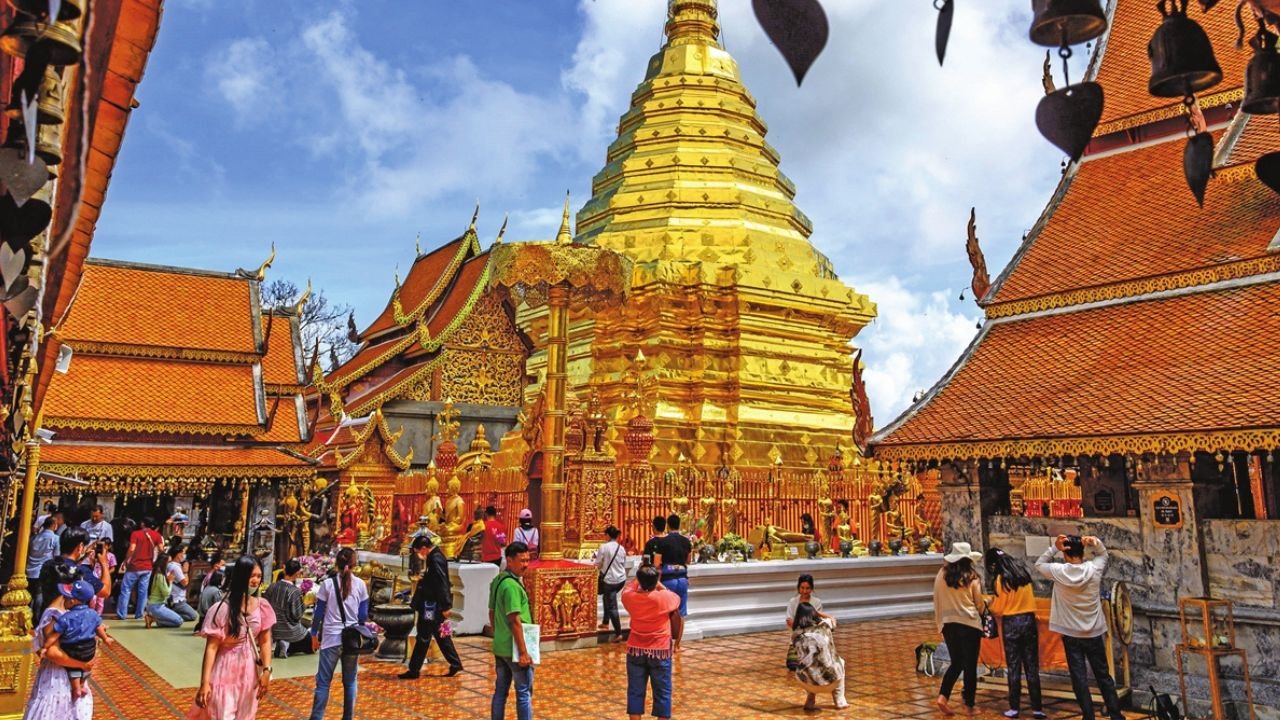
Thailand has launched a scheme to offer visitors up to $14,000 in medical coverage in the event of an accident, the tourism minister said Thursday, as the kingdom seeks to lure travelers back after the pandemic.
The government will cover expenses up to 500,000 baht ($14,000) and pay compensation of up to one million baht in case of death under the new scheme.
Travel restrictions during the Covid-19 pandemic hammered the kingdom’s vital tourism sector and arrivals have not bounced back as quickly as officials hoped.
Tourism minister Sudawan Wangsuphakijkosol told AFP the new Thailand Traveller Safety scheme began on January 1 and will run until August 31.
“The campaign aims to assure foreign tourists that Thailand is safe and everyone will be under good care,” she said.
The kingdom has long been popular with young backpackers from around the world seeking sun, sand and adrenalin.
But accidents are not uncommon and there have been numerous reports in recent months of young Europeans finding themselves facing big medical bills with inadequate insurance.
The Thai government stresses that the scheme will not cover accidents caused by “negligence, intent, illegal acts” or risky behaviour.
Tourists can register for the scheme through the Thailand Traveller Safety website at tts.go.th.
Some 28 million people visited Thailand in 2023, up from 11 million the year before, but still well down from the 40 million who came in 2019, the last year before the pandemic.
Officials are hoping to hit 35 million visitors in 2024, with a target of $55 billion in revenue.
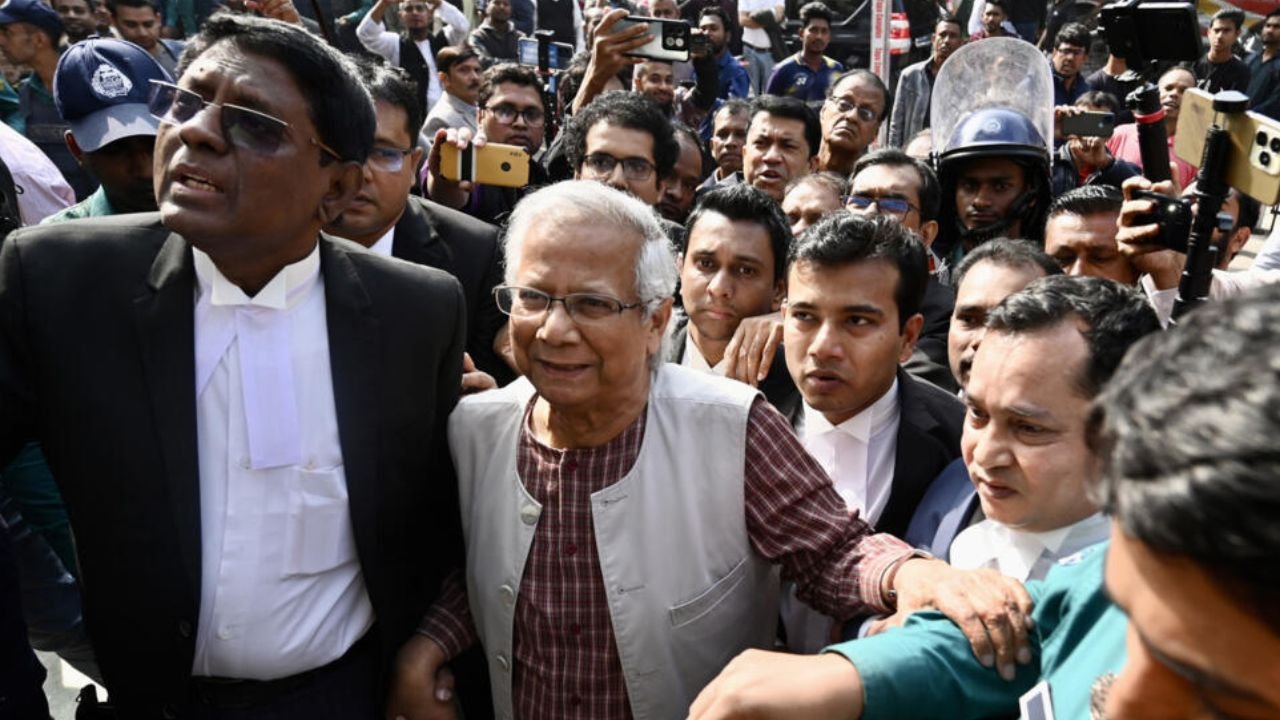
Dhaka (AFP) – Nobel peace laureate Muhammad Yunus was convicted on Monday of violating Bangladesh’s labour laws in a case decried by his supporters as politically motivated.
Yunus, 83, is credited with lifting millions out of poverty with his pioneering microfinance bank but has earned the enmity of longtime Prime Minister Sheikh Hasina, who has accused him of “sucking blood” from the poor.
Hasina has made several scathing verbal attacks against the internationally respected 2006 Nobel Peace Prize winner, who was once seen as a political rival.
Yunus and three colleagues from Grameen Telecom, one of the firms he founded, were accused of violating labour laws when they failed to create a workers’ welfare fund in the company.
A labour court in the capital Dhaka convicted and sentenced them to “six months’ simple imprisonment”, lead prosecutor Khurshid Alam Khan told AFP, adding that all four were immediately granted bail pending appeals.
All four deny the charges. Dozens of people staged a small demonstration of support outside the court for Yunus, who left without speaking to media.
“This verdict is unprecedented,” Abdullah Al Mamun, a lawyer for Yunus, told AFP. “We did not get justice.”
Yunus is facing more than 100 other charges over labour law violations and alleged graft.
He told reporters after one of the hearings last month that he had not profited from any of the more than 50 social business firms he had set up in Bangladesh.
“They were not for my personal benefit,” Yunus said.
Another of his lawyers, Khaja Tanvir, told AFP that the case was “meritless, false and ill-motivated”.
“The sole aim of the case is to harass and humiliate him in front of the world,” he said.
‘Travesty of justice’
Irene Khan, a former Amnesty chief now working as a UN special rapporteur who was present at Monday’s verdict, told AFP the conviction was “a travesty of justice”.
“A social activist and Nobel laureate who brought honour and pride to the country is being persecuted on frivolous grounds,” she said.
In August, 160 global figures, including former US president Barack Obama and ex-UN secretary-general Ban Ki-moon, published a joint letter denouncing “continuous judicial harassment” of Yunus.
The signatories, including more than 100 of his fellow Nobel laureates, said they feared for “his safety and freedom”.
Critics accuse Bangladeshi courts of rubber-stamping decisions made by Hasina’s government, which is all but certain to win another term in power next week at elections boycotted by the opposition.
Her administration has been increasingly firm in its crackdown on political dissent, and Yunus’s popularity among the Bangladeshi public has for years earmarked him as a potential rival.
Amnesty International accused the government of “weaponizing labour laws” when Yunus went to trial in September and called for an immediate end to his “harassment”.
Criminal proceedings against Yunus were “a form of political retaliation for his work and dissent”, it said.
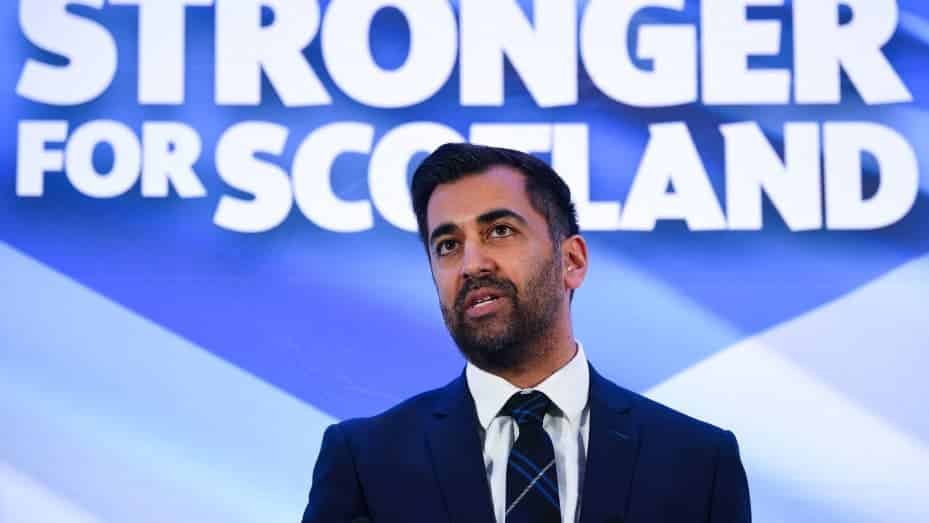
Scotland’s First Minister Humza Yousaf posted a video message on X (formerly Twitter), saying that the U.K. is willing to take Gaza refugees in, following Israel’s bombardment of Palestine.
“So, many of them don’t want to leave and neither they should have to leave but for the million that have been displaced just in this current conflict, for those that want to leave, there should be a worldwide refugee scheme,
“Because of the numbers, the world should be involved.”
Yousaf also urged other countries to open their borders to refugees from Gaza.
The people of Gaza are a proud people.
Many don’t want to leave, and shouldn’t have to.
But for those displaced, who want to leave, there should be a worldwide refugee scheme.
Scotland is willing to be a place of sanctuary and be the first country to take those refugees. pic.twitter.com/5RbZpJsGHX
“Let’s say that Scotland will be a place of sanctuary for them as we have shown that kindness and compassion for others. Let us show it once again and this time for the people of Gaza,” Yousaf said, adding that Scotland is willing to lead the way for the rest of the U.K.
“And Scotland is willing to be the first country in the U.K. to take those refugees,” he said.
In another video, the First Minister stated that Scotland’s hospitals will care for the Gazans injured in the escalation and requested the U.K. government to “begin work on the creation of a refugee resettlement scheme for those in Gaza who want to, and of course are able to, leave.”
In the past, people in Scotland and across the UK have opened our hearts and our homes.
Scotland is ready to play her part.
To be the first country in the UK to offer safety and sanctuary to the people of Gaza.
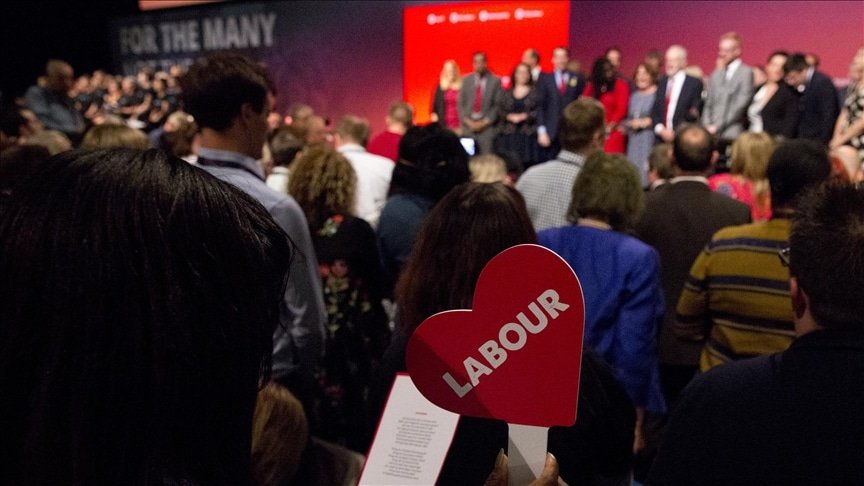
Several members of the Labour Party have resigned since the Israel bombing of escalation on October 7.
The Labour Party is currently in the opposition in the UK whose leader, Keir Starmer, recently stated that Israel has the “right” to cut power and water supplies to Gaza. Similar comments were issued by prominent members including shadow attorney general Emily Thornberry and shadow defence minister John Healey.
This was followed by a resignation from Oxford City councillor Shaista Aziz. As a former international aid worker, she has worked in the occupied West Bank, Israel, and refugee camps in Gaza.
13.10.23
Statement of resignation from the Labour Party from Cllr Shaista Aziz, Cllr Amar Latif, Oxford City Council.
We stand in solidarity with the people of Israel and Palestine and call for and end to violence and the humanitarian crisis. pic.twitter.com/2L7a5ovDIJ
Middle East Eye spoke to her and she said, “The Labour Party leader’s stance on not being able to condemn collective punishment of Palestinians in Gaza was the final red line for me,”.
In an interview, Strarmer was asked about the seige, blockade, and the killing by Israel to which he replied that while all action must be taken within the international law, “I don’t want to step away from the core principles that Israel has the right to defend herself.”
Among other Labour councillors who have resigned are Amar Latif, Mairéad Healy and Jessie Hoskin.
“As a working GP, I am deeply distressed by the loss of all innocent lives in both Palestine and Israel. However, it cannot be right that there is collective punishment in direct contravention of international law, and it is incumbent on all leaders at a local, national and international level to speak out against this,” said Latif.
Similarly, Hopkins stated, “I was elected because I believe in human dignity for everyone without exception. The Labour Party no longert reflects those views,”
While Healy said the Labour leadership was “encouraging collective punishment towards the Palestinian people by condoning the indiscriminate withholding of water and energy supplies in Gaza,” which she believes is illegal under international law.
Previously, Israel had told 1.1 million Palestinians in northern Gaza to move to south Gaza within the span of 24 hours in the light of a potential ground operation.
This led to a backlash from the UN, Palestinians, and many other humanitarian organisations who deemed it to be “impossible” and catastrophic.
Yet again, Israel’s former deputy foreign minister, Danny Ayalon, while speaking to Al Jazeera, suggested that Palestinians in Gaza should flee to Egypt’s Sinai Desert, where tent cities would be built for them.
“The idea is for them to leave over to the open areas where we and the international community will prepare infrastructure … tent cities, with food and with water, just like for the refugees of Syria.”
Evacuation impossible, says WHO
The World Health Organization (WHO) has declared that is impossible to evacuate hundreds of critically injured patients from hospitals in northern Gaza “without endangering their lives”.
“Of the thousands of patients with injuries and other conditions receiving care in hospitals, there are hundreds that are severely wounded and over 100 who require critical care.
“These are the sickest of the sick. Many thousands more, also with wounds or other health needs, cannot access any kind of care,” the WHO added
The statement also pointed out that “The compressed timeframe, complex transport logistics, damaged roads, and, above all, lack of supportive care during transport all add to the difficulty of moving.”
WHO has also called on Israel to lift its blockade of Gaza and to establish a “humanitarian corridor” on urgent basis.
Hospital staff refuse to leave
Despite no medical supplies and blockade of food, water and power, the medical teams at a hospital in the northern Gaza Strip have refused to evacuate, rejecting the Israeli army’s order.
70 dead while fleeing northern Gaza on Israel’s callOfficials have revealed that a significant number of Palestinians have been killed in Israeli air raids while fleeing the northern Gaza Strip.
Among the 70 killed were mostly children and women and were in their transport, on their to South.
324 Palestinians killed in less than 24 hours
The death toll of Palestinians in Gaza has reached 324 according to health ministry whereas 1,000 have been wounded as the result of Israeli air raids in the last 24 hours.
Reportedly, 66 percent of the affectees are women and children.
Previously, hospitals in Gaza report that since October 7, Israeli air raids have killed at least 256 people, including 20 children, and wounded 1,788 others in less than 24 hours, according to hospitals in Gaza.
According to WAFA’s correspondent, Israeli forces have targeted Tal al-Hawa neighbourhood in Gaza city and the Red Crescent’s al-Quds Hospital that was currently sheltering hundreds of families.
Simultaneously, dozens of homes and residential buildings have also been destroyed. Israeli fire has killed at least 52 Palestinians in the occupied West Bank since Hamas’s attack on October 7, according to Palestinian health officials.
Palestinian bodies stored in ice cream refrigerators due to lack of space in hospitals
Due to lack of space in hospital morgues in Gaza, the bodies of Palestinians killed by Israeli air raids are now being stored in ice cream refrigerators instead.
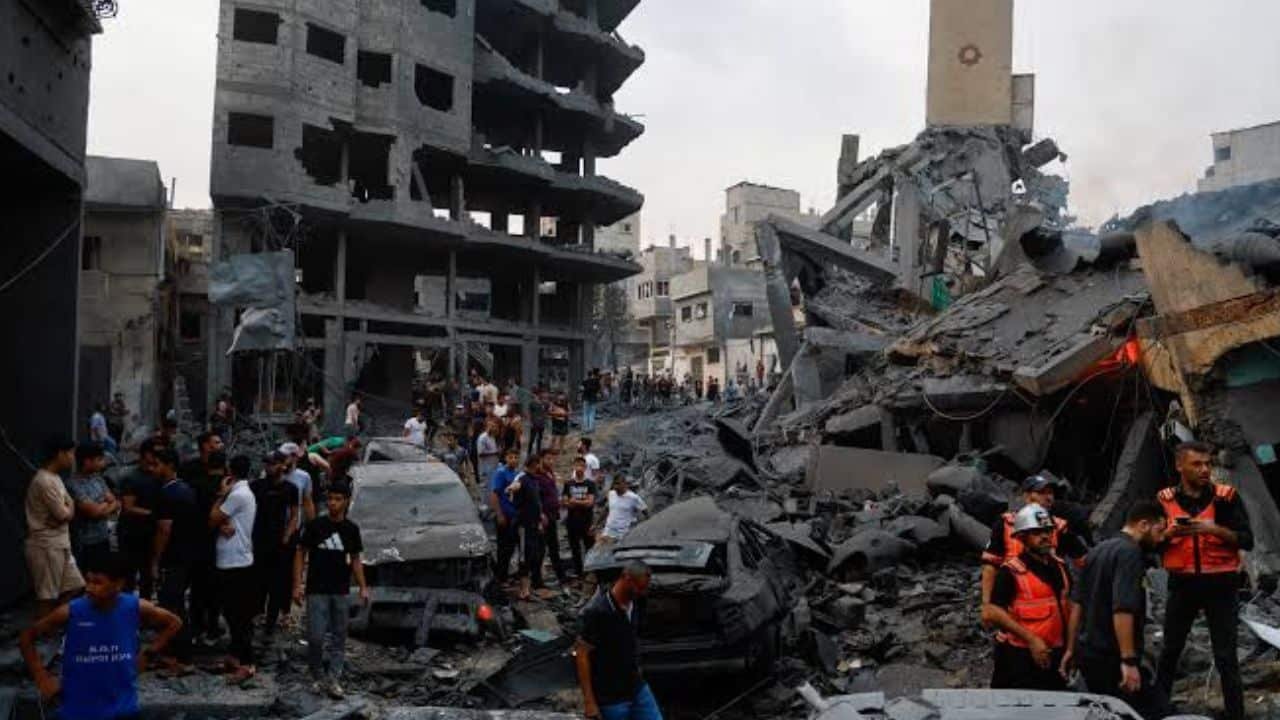
1,300+ buildings destroyed in Gaza: UN
The United Nations reports that more than 1,300 buildings in the Gaza Strip have been destroyed in the Israeli attacks.
OCHA calculates the destruction of “5,540 housing units” in the destroyed buildings and nearly 3,750 homes have become uninhabitable.
Top Hammas military commander dead
According to the Israeli military, a senior military commander of Hamas heading the group’s aerial operations has been killed in Israeli air raids.Hamas is yet to respond to the news.
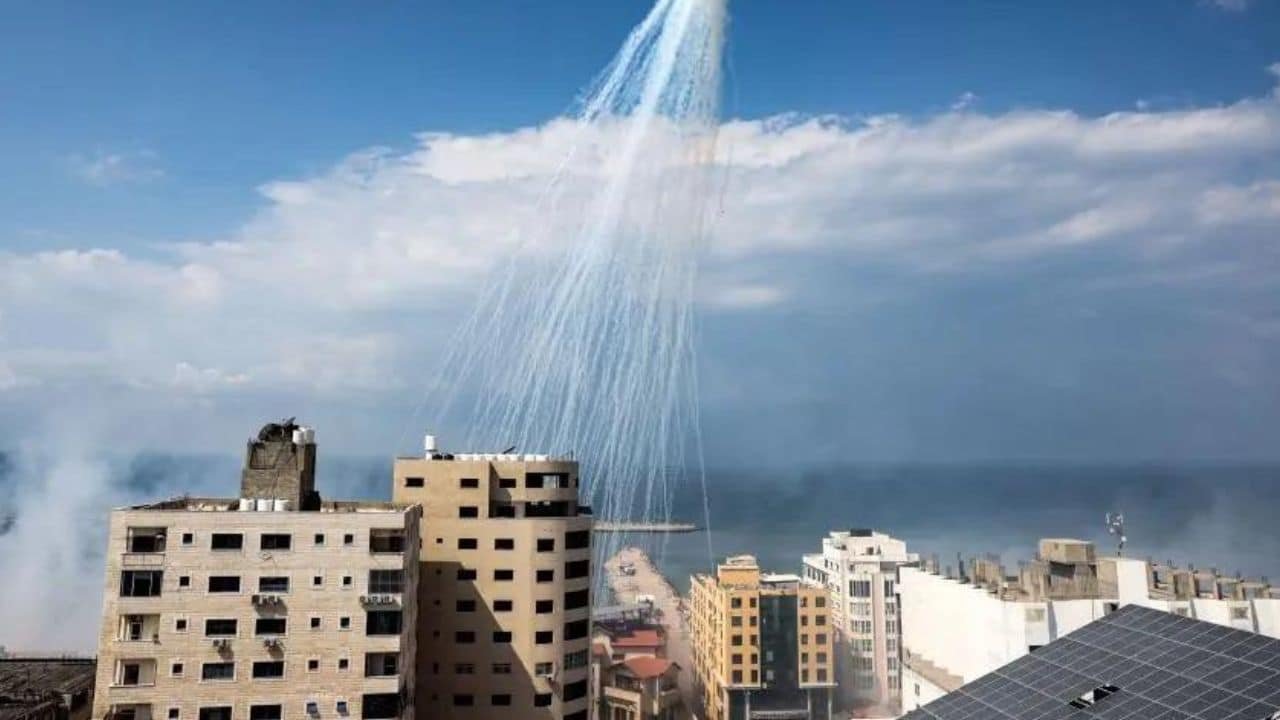
As Israel’s onslaught on Gaza enters the seventh day, multiple sources claimed that Israeli forces were using white phosphorus to attack Gaza and Lebanon.
Israeli warplanes and artillery use internationally #prohibited_white_phosphorus, destroying #Al_Karama neighborhood in the northwest of Gaza City with a continuous series of airstrikes. There are casualties and wounded, while ambulances and civil defense vehicles are unable to… pic.twitter.com/ym7zfKqIBH
“Human Rights Watch verified videos taken in Lebanon and Gaza on October 10 and 11, 2023, respectively, showing multiple airbursts of artillery-fired white phosphorus over the Gaza City port and two rural locations along the Israel-Lebanon border, and interviewed two people who described an attack in Gaza,” they have stated.
Additionally, Lama Fakih, Middle East and North Africa director at Human Rights Watch explains that “Any time that white phosphorus is used in crowded civilian areas, it poses a high risk of excruciating burns and lifelong suffering,
“White phosphorous is unlawfully indiscriminate when airburst in populated urban areas, where it can burn down houses and cause egregious harm to civilians.”
The United Nations has banned the use of incendiary weapons in 1972.
“Incendiary weapons are weapons or munitions designed to set fire to objects or cause burn or respiratory injury to people through the action of flame, heat, or combination thereof, resulting from a chemical reaction of a flammable substance such as napalm or white phosphorus,” the UN says.
Nonetheless, it is not the first time that Israel has used white phosphorus against Palestinians. One of the first recorded incidents of its use is from 2009.
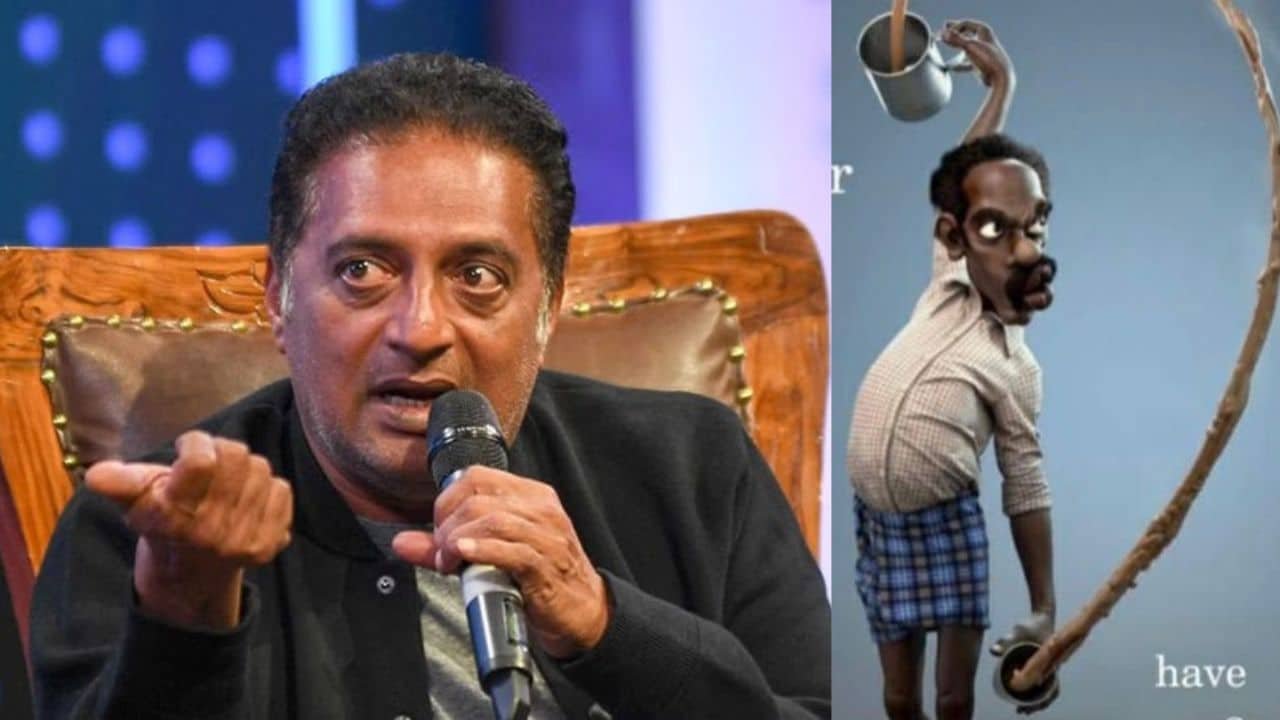
Actor Prakash Raj has been booked by police in Karnataka’s Bagalkot district in India after jeering at the country’s third lunar mission, Chandrayaan-3.
According to the police, a complaint was filed by the leaders of Hindu organizations who demanded that action be taken against the actor.
What happened?
On Sunday, Raj posted a cartoon picture on X in which a man wearing a shirt and a lungi is pouring tea. According to The Wire, the screenshot was from an old short meme about Neil Armstrong coming across a shopkeeper, a Malayalee entrepreneur offering him a glass of legendary Kerala tea on the moon.This picture was captioned : BREAKING NEWS:- First picture coming from the Moon by #VikramLander Wowww #justasking
This was taken as an offence by many Indians since Chandrayaan-3 mission is considered as a matter of national pride. Raj resultantly faced heavy backlash on social media by angry Indians.
Chandrayaan 3 is something whole of India must be proud of, irrespective of political ideology.
Know the boundary between political vs national trolling, else stick to wetting your pants in movies.
— Cabinet Minister, Ministry of Memes, (@memenist_) August 20, 2023
This is tragically sad. The work of @isro and #Chandrayaan_3 are one of those rare things which ignites sparks of unity, passion and optimism in a billion hearts. If you can’t celebrate that, then your hate for an individual is more intense than your love for the nation. https://t.co/uMDLwLePLT
Morons trolling @prakashraaj have never heard the joke about Neil Armstrong being offered a cup of chai by a Malayalee on moon! https://t.co/EhwADDQ1LE
Prakash Raj eventually responded to the trolling and criticism in another tweet saying, “Hate sees only Hate.. i was referring to a joke of #Armstrong times .. celebrating our kerala Chaiwala .. which Chaiwala did the TROLLS see ?? .. if you dont get a joke then the joke is on you .. GROW UP #justasking”
Hate sees only Hate.. i was referring to a joke of #Armstrong times .. celebrating our kerala Chaiwala .. which Chaiwala did the TROLLS see ?? .. if you dont get a joke then the joke is on you .. GROW UP #justaskinghttps://t.co/NFHkqJy532
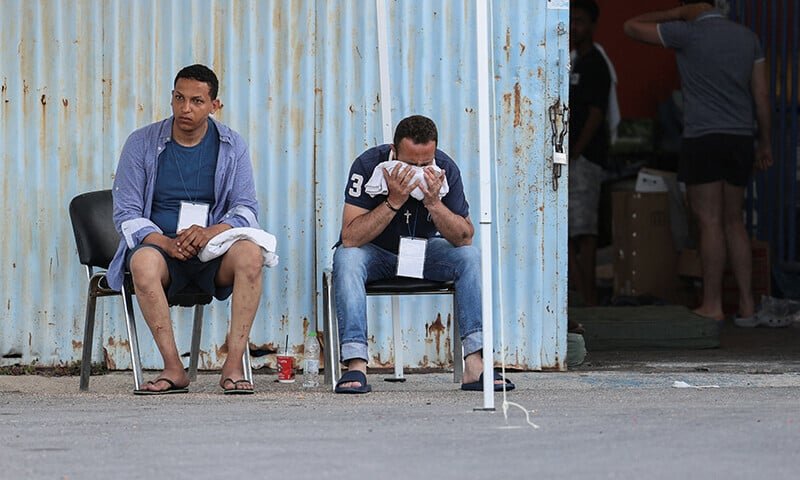
The overcrowded fishing vessel capsized off the Southern Peloponnese while on course to Italy from the Libyan town Tobruk, according to state broadcaster ERT. Nearly all the victims were men from Pakistan and Afghanistan.
Alarm Phone, a trans-European network supporting sea rescue operations, published a transcription of the vessel’s contact with them. The passengers were only able to send their location coordinates two hours after the first distress call was received Tuesday afternoon.
The Greek coastguard and EU border agency Frontex were alerted immediately, yet state those on board refused assistance offered by Greek authorities late on Tuesday. They claimed that the passengers accepted food rations but wanted to continue their voyage. A few hours later the boat capsized and sank.
The survivors were taken to the southern port city of Kalamata, where the deputy mayor indicated that there were more than 500 people onboard, according to the information he had received. The UN’s migration agency provided an estimate of 400.
ABR, a body set up to monitor and report issues related to migrant movement in the Aegean Sea, tweeted that the vessel could have had about 750 people onboard. ABR noted that the testimonies from survivors give indicators of around 400-750 passengers, rendering the exact figure unknown.
The Mediterranean Sea and the countries bordering it have long been perilous routes for refugees fleeing from conflict and poverty in Asia, the Middle East, and Africa. UN data suggests that about 72,000 refugees and migrants have arrived to countries like Greece, Italy, Spain and Cyprus just this year.
Camilla, Duchess of Cornwall, becomes King Charles’s Queen Consort, in a remarkable journey to public acceptance after she became a hate figure for her perceived role in the break-up of his marriage to princess Diana.
For years, Camilla was vilified as the marriage-wrecker who shattered Britain’s fairy-tale royal love story.
Diana famously complained in a bombshell BBC television interview in 1995 that “there were three of us in this marriage” — her, Charles and Camilla, his long-time lover.
She even reportedly called her love rival a “rottweiler”.
After Diana died in a Paris car crash in 1997, Charles and Camilla gradually began to appear together in public and in time became accepted as a couple.
They married in 2005 and she, over time, won plaudits as the future king’s loyal wife.
The couple were seen side-by-side as they looked at flowers left by mourners for Charles’ father Prince Philip.
The popular Netflix series “The Crown”, charting the lives of Britain’s most famous family, albeit with a heavy dose of artistic licence, rekindled interest in their affair.
Charles was portrayed as very much in the driver’s seat, pursuing the older Camilla, played by Oscar-winning writer, director and actress Emerald Fennell.
In real life Camilla has carved out her own role, participating in the Booker literary prize ceremony and even the final of television ballroom dancing talent contest “Strictly Come Dancing”.
She campaigns to raise awareness of osteoporosis a condition from which her mother, Rosalind, suffered — and has an Instagram book club.
Marking 70 years on the throne earlier this year, the queen announced she hoped Camilla would be known as Queen Consort when Charles becomes king, resolving a long debate over her future title.
A YouGov poll in May 2022 found only 20 percent would like to see her become “queen”, while 39 percent favoured the title of “Princess Consort”.
YouGov ranked Camilla as the eighth most popular royal in the second three months of 2022, with 40 percent viewing her positively.
Born Camilla Rosemary Shand in London on July 17, 1947, Camilla had a traditional upbringing among Britain’s monied upper classes.
The granddaughter of the 3rd Baron Ashcombe, Roland Cubitt, she was educated in London, went to finishing schools in Switzerland and France, and spent her home life on a country estate in Sussex, in southern England.#photo1
Self-confident and attractive, she first met Prince Charles as a young woman at a polo match in the early 1970s, and they later became close.
However, believing Charles would never propose, she married British Army officer Andrew Parker Bowles in 1973. Royal guests included the queen’s sister, princess Margaret, and the monarch’s daughter, princess Anne.
The couple had two children: Tom Parker Bowles, whose godfather is Charles, is now a food writer, while Laura Lopes is an art curator.
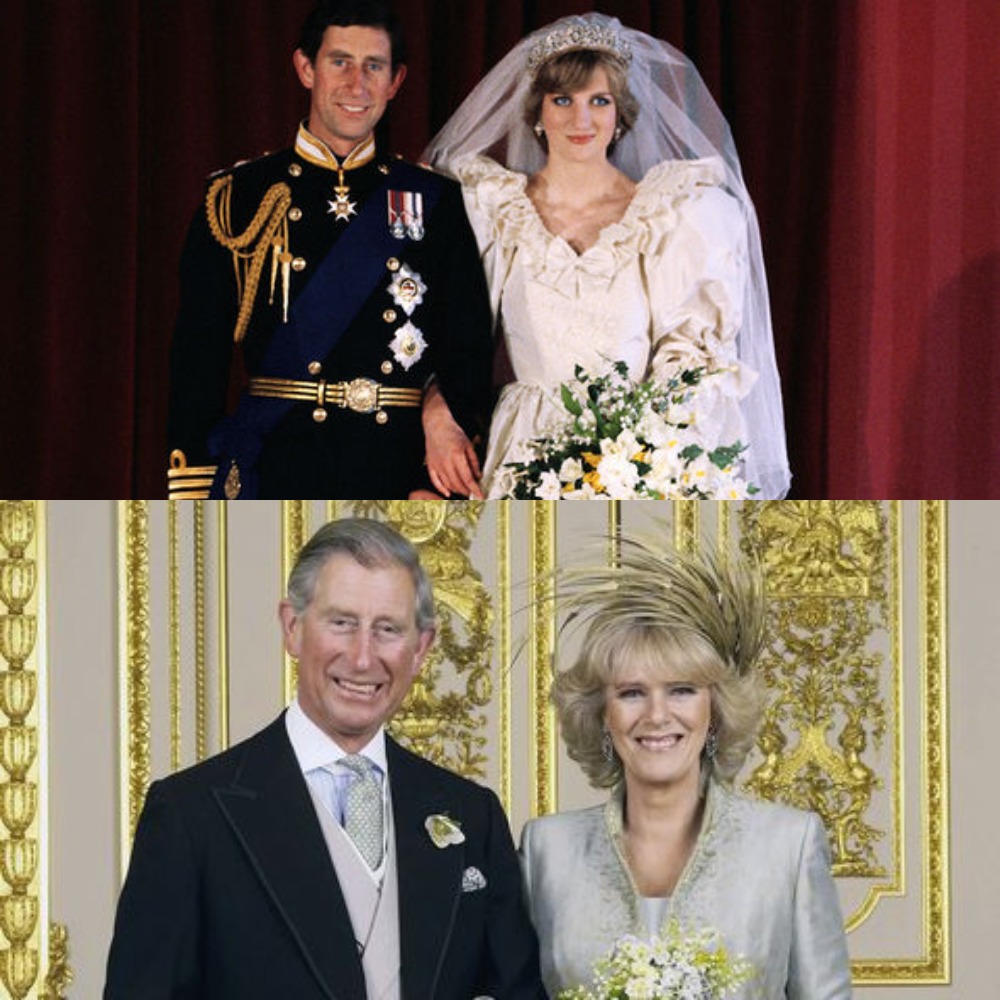
Mutual feelings with the prince remained, nonetheless, with Charles allegedly continuing to see Camilla even after his high-profile marriage to Diana at St. Paul’s Cathedral in 1981.
The romance was fully rekindled later that decade as the royal marriage crumbled, which was luridly chronicled in leaked recorded phone conversations to the tabloid press.
Camilla and Andrew Parker Bowles divorced in 1995, a year before Charles and Diana.
After Diana’s death, Charles and Camilla kept their relationship discreet, but it gradually became apparent they were effectively living together as husband and wife.
Following months of careful planning, the couple made their first public appearance together in 1999 and after that became increasingly open about their relationship.
They were married in the royal town of Windsor on April 9, 2005, in a civil ceremony followed by a religious blessing at St. George’s Chapel, with Queen Elizabeth II present.
Both divorced, there was controversy over whether they could have a church wedding, especially given Charles’ future role as supreme governor of the Church of England.#photo2
But the wedding — delayed by a day to allow the prince to attend pope John Paul II’s funeral — drew a cheering crowd of 20,000 into the streets leading to Windsor Castle.
As a married couple, they settled into a life of royal duties, overseas tours and holidays at Balmoral, the royal estate in northeast Scotland.
Camilla — known as the Duchess of Rothesay in Scotland — remained the archetype of the tweed-wearing, horse-loving British country aristocrat.
She has two Jack Russell terriers, rescue dogs Beth and Bluebell, and is a keen flower arranger.
Over time, Camilla has also been widely accepted by the royal family, including Charles and Diana’s two sons, princes William and Harry.
In 2005, Harry rejected the image of her as a “wicked stepmother”, describing her as a “wonderful woman and she’s made our father very, very happy, which is the most important thing.
“William and I love her to bits.”
Prince Charles’s behaviour with the two
Prince Charles’ relationship with Princess Diana when out in public was noted to be different in comparison to his behaviour with Camilla.
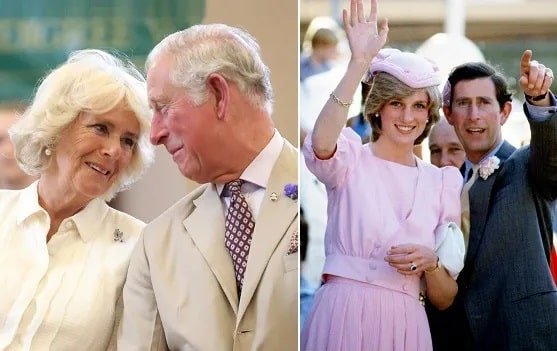
When the Prince of Wales is joined by the Duchess of Cornwall, he is snapped smiling and laughing with her, something which body language expert Inbaal Honigman shared was different when he was with Princess Diana.
Speaking to Express about Charles’ interaction with Camilla verses with Diana she said: “Prince Charles is regularly seen embracing his wife Camilla.
“The pair are often observed with their arms interlocking, looking each other in the eye, smiling full into each other’s faces, and generally seeking each other’s closeness, that the collective consciousness sees him as this guy.
“The warm, tactile, even romantic husband who is devoted to the lady beside him.
“Often photographed facing the same way as each other, or indeed facing one another, the married couple are clearly in love, and feel comfortable in each other’s presence, as they share royal duties, and the odd private moment.”
“A glance back at his photos with his first wife, the late Princess Diana, reveal a very different Prince.
“Official images and some personal press shots from the early years of the young couple’s married life, show a blushing Diana and an often discontent Charles in absolute disarray towards one another.
“There’s always a good few feet of social distancing between them, and they rarely face the same way.
“In the starkest of photographs, they’re facing squarely away from one another, both standing stiff with their arms by their sides.
“But even on the occasions when they’re not searching for something to look at on opposite ends of the room, they are not in harmony – if they both look ahead, it’s never in the same direction.
“Their facial expressions don’t match. They both look like they wished they were elsewhere, with somebody else.
“Partly, this disparity between 80s Prince Charles and his military stance, and modern era granddad Charles, all warm and loving, may be down to social protocols around the royals changing.
“It could be that back in his first marriage, the Prince was under clear instructions to not hold hands, to not look too happy – and during those days, there was no room for flexibility even with his young wife.
“These days now, the royals are accepted as people in their own right, and the Prince shows his spontaneity and natural wit without any negative repercussions.”
Inbaal continued: “Another consideration is maturity – many people only develop their romantic sides as they age.
“There is every chance that the apparent antipathy between Prince Charles and Princess Diana in the early days, expressed in their body language of opposites, was a result of social reasons, not emotional incompatibility,” she added.
Queen Elizabeth II, the longest-reigning monarch in British history, breathed her last on Thursday in Balmoral Castle, United Kingdom (UK) at the age of 96. “The Queen died peacefully at Balmoral this afternoon,” a display message on the official website of the Royal family reads.
“The official website of the Royal Family is temporarily unavailable while appropriate changes are made.”
Who is the new King?
Charles, as the queen’s eldest son, inherited the sovereign title and job as head of the Commonwealth, along with other assets such as land and property.
Charles, 73, is the longest-serving heir in British history after waiting decades to get to the throne. The queen and her late husband, Prince Philip, had four children together, with him being the oldest. He became Britain’s heir apparent at age 3 when his mother succeeded to the throne at the age of 25. Prince of Wales, Duke of Cornwall, Duke of Rothesay, and Earl of Carrick are some of Charles’ titles.
The Prince and Princess of Wales were born after Charles wed Diana Spencer in 1981. William and Harry, two princes, were born to them. Charles and Diana separated in 1992. Charles wed Camilla Parker Bowles, who is now known as the Duchess of Cornwall, in 2005 after Diana passed away in 1997.
Will Camilla become the new Queen?
The title of queen is typically bestowed upon the king’s wife, but in Camilla’s case, this hasn’t always been the case. At the time of Charles and Camilla’s wedding in 2005, it was agreed that she would be referred to as princess consort rather than queen. However, now that he is king, Charles has the option of changing this designation.
What is expected to happen in the next ten days?
Day 1:
Charles will be officially proclaimed King. This happens at St James’s Palace in London, in front of a ceremonial body known as the Accession Council. The same day, in the afternoon, the new king will have audiences with the prime minister and cabinet, the leader of the opposition, the archbishop of Canterbury and the dean of Westminster.
Day 2: The Queen’s coffin will return to Buckingham Palace. Proclamations will be read in the devolved administrations. Tributes are likely to continue in parliament.
Day 3: In the morning, King Charles will receive the motion of condolence at Westminster Hall. In the afternoon, he will embark on a tour of the United Kingdom, starting with a visit to the Scottish parliament and a service at St. Giles Cathedral in Edinburgh.
Day 4: King Charles will land in Northern Ireland, where he will attend a ceremony at St. Anne’s Cathedral in Belfast and receive a further motion of sympathy at Hillsborough Castle. Rehearsals for the funeral will be taking place.
Day 5: On the fifth day, a procession will begin, starting at Buckingham Palace and ending at the Houses of Parliament, then a service will be held at Westminster Hall. The Queen will then be placed on display for three days so that the public can view her coffin.
Day 6: On the fifth day, a procession will begin, starting at Buckingham Palace and ending at the Houses of Parliament, then a service will be held at Westminster Hall.
Day 7: King Charles will travel to Wales to receive another motion of condolence at the Welsh parliament and attend a service at Liandaff Cathedral in Cardiff.
Day 08: Prime ministers and governors general from the countries are anticipated to attend King Charles’ coronation.
Day 09: Charles will extend an invitation to visiting royal families from other countries the night before the funeral. VIP foreign visitors are anticipated at the lying in state.
Day 10: The state funeral itself will be held at Westminster Abbey. There will be a two-minutes’ silence across the nation at midday. Processions will take place in London and Windsor. There will be a committal service in St. George’s Chapel at Windsor Castle, and the queen will be buried in the castle’s King George VI Memorial Chapel.