Blog

  • Banks rush to lend ahead of private loan deadline

    Banks rush to lend ahead of private loan deadline

    The government has decided to finally increase lending levels amid the threat of an additional tax of 15 per cent looming over banks due to low private lending. Banks were able to sidestep these additional taxes last year by negotiating with the government; however, Islamabad refused to budge this year.

    This led to banks taking the matter up with Islamabad High Court (IHC), which granted them a temporary moratorium on the additional tax payments. The reason why banks are facing an ‘additional’ tax being levied on their earnings is due to their low Advance-to-Deposit Ratio (ADR) figures.

    For reference, ADR refers to the percentage of a bank’s deposits that are being lent out to satisfy non-government sector needs – such as those of businesses, individuals, and other private entities.

    Since the ruling of the IHC in their favour, banks have increased their ADR to avoid any further run-ins with the law. However, they have still not surpassed the legal threshold level of 50 per cent, shying away from the legal ratio by six per cent. The economy is likely to see increased lending to non-government sectors now, as banks will have to face the additional tax if the ADR requirement is not met by the end of 2024.

    At first glance, this spells great news for businesses as they will now be able to expand the scope of their operations using loans from banks. However, this might not end up being the case as Pakistani banks have traditionally favoured risk-free investments in government securities.

    If banks continue to exhibit this behaviour of lending to businesses that are considered safer investments, credit might get extended to companies that work with the government. As such, the aforementioned benefits to businesses could be reaped by those linked to the government via contracts.

    Since working with the government might signal to banks that businesses possess a safe stream of income, banks may feel more comfortable lending to them. As such, these businesses will be able to grow operations and secure more government contracts.

    The companies most frequently contracted by the government are primarily construction companies. As such, banks could see a disproportionate flow of credit towards construction companies. However, even though loans might be preferential, it does not mean that growth may not be seen.

    This is because if the construction sector witnesses growth, it will also propel more than 42 other ancillary sectors, such as steel, cables and cement, to name a few.

    It will be interesting to note how the lending patterns of banks have changed with the legal system breathing down their necks. Will satisfying ADR requirements boost business growth? Only time will tell.


  • 38 individuals dead in Kurram gun attack

    38 individuals dead in Kurram gun attack

    38 people, including three women, were killed in an attack when assaulters opened fire on a passenger bus in the Ochat area of the Kurram district on Thursday.

    The attacker targeted the convoy, which was travelling from Parachinar to Khyber Pakhtunkhwa’s capital, Peshawar, as per the police officials.

    Ahmady Shama Station House Officer (SHO) Kaleem Shah confirmed to Dawn that 38 people were killed, including three women, and 11 were injured.

    1732199735-2Z4Y3SIOBZ.jpg

    Interior Minister, while speaking to media outside Islamabad High Court (IHC), stated, “This past week has been difficult and upsetting; now 38 people have been martyred in Kurram.”

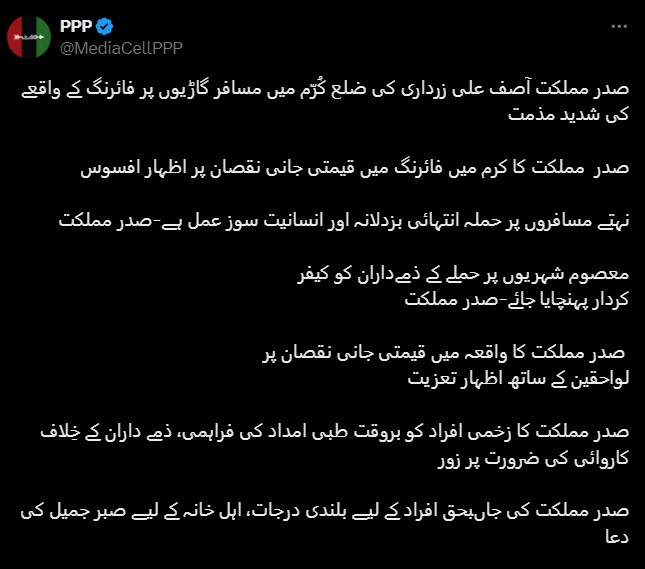
    President Asif Ali Zardari condemned the attack and expressed condolences to the families of the dead.

    “Attacking innocent passengers is a cowardly and inhumane act,” Pakistan Peoples Party media cell quoted President Zardari, adding that those responsible for the incident must be punished, and he directed that timely medical aid be provided to the injured.

    1732199764-3I4AKNTR6S.jpg

    The Kurram attack has been seen as the most lethal attack of the decade in Pakistan’s history, according to reports.

    Khyber Pakhtunkhwa (KP) Chief Minister Ali Amin Gandapur also condemned the attack and directed the Chief Secretary, provincial law minister and the area’s Member National Assembly and Member Provincial Assembly MPA to visit the Kurram district immediately.

    “The provincial government, police and all relevant institutions are making serious efforts to improve the law and order situation in the area,” he said.

    Kurram Deputy Commissioner (DC) Javedullah Mehsud told AFP that “Two separate convoys of members of the Shia community … were targeted by the terrorists in the Kurram district.”

    “Both convoys consisted of around 40 vehicles travelling under police escort,” DC Mehsud added.

    Prime Minister Shahbaz Sharif condemned the attack, saying, “The enemies of the peace of the country attacked the convoy of innocent citizens which is tantamount to brutality. All attempts of anti-national elements to destroy the peace of the beloved country will be thwarted.”

    Earlier, around 24 people were killed and 46 injured on November 9 in a bomb blast at Quetta Railway Station.

    The banned and militant outfit Balochistan Liberation Army (BLA) had claimed responsibility for the explosion.

    In another attack on November 1, nine people, including five school-going children, were killed, and 29 were injured in a blast near girl’s schools in Mastung, a Balochistan district.

  • Internet, mobile services to be ‘partially suspended’ ahead of PTI protest

    Internet, mobile services to be ‘partially suspended’ ahead of PTI protest

    The federal government has announced the partial suspension of internet and mobile services in Islamabad and other areas of Khyber Pakhtunkhwa and Punjab in light of the Pakistan Tehreek-e-Insaf (PTI) protest scheduled for November 24.

    Maryam Nawaz from Geo News reports that the Pakistan Telecommunication Authority (PTA) will activate a firewall for mobile internet service from November 22, and the internet services will be suspended from November 23.

    The report also quotes sources that have claimed that internet and mobile services might be suspended at certain locations at any time.

    The shutdown will result in users being unable to download audio and videos from social media apps.

    The interior ministry has asked the Khyber Pakhtunkhwa government, which is administered by the PTI, to ensure that the province does not utilise state machinery to facilitate the protest.

    “[…] in the wake of protest by PTI, it is requested that it may kindly be ensured that Government of KPK does not utili[s]e state machinery, equipment, officials or finances for political protest by the political party,” read the ministry’s letter.

    The Punjab government has also made known that the PTI protesters will be dealt with iron-handedly, while Information Minister Azma Bokhari asserted that the demonstrators will be handled the “same as terrorists.”

    The Islamabad administration announced on Monday the imposition of Section 144 in the federal capital for the coming two months to avoid any lapse in law and order.

    A ban, moreover, has been placed on all processions, rallies, demonstrations and gatherings having five or more than five people, as per the notification issued by Additional District Magistrate Usman Ashraf.

    Additional security has also been requisitioned by Punjab and Islamabad police. For this, over 10,700 police personnel from across Punjab have been put on standby equipped with tear gas, rubber bullets, and anti-riot gear.

    Islamabad administration alone has requisitioned 8,000 additional personnel from Punjab, Sindh, and Kashmir.

    Rangers and the Frontier Corps (FC) are already deployed in the capital, which is likely sealed off with shipping containers by Friday (November 22).

  • Pakistani AI robot in hijab upsets Faryal Mehmood

    Pakistani AI robot in hijab upsets Faryal Mehmood


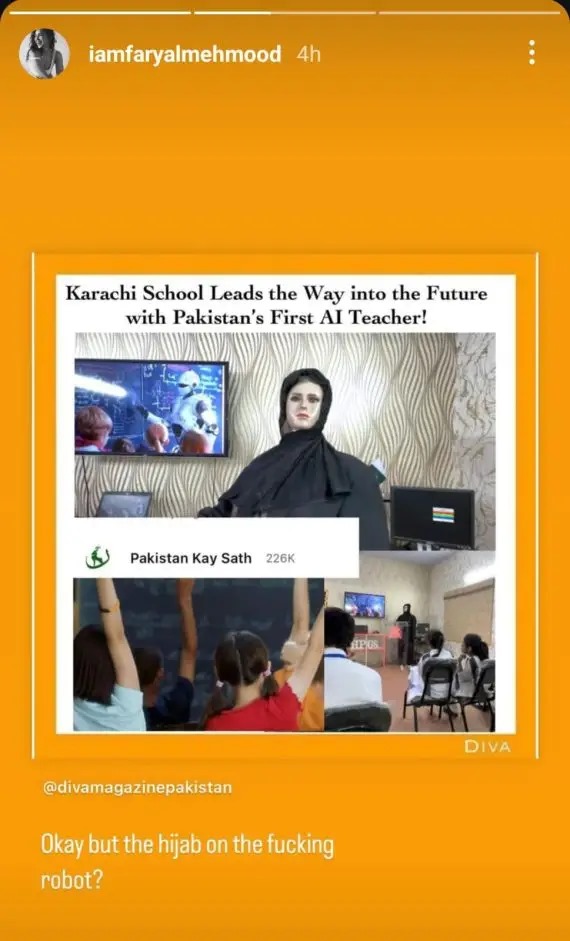
     Actress Faryal Mehmood, who is known for speaking her mind, seems to be upset over Pakistan’s new AI robot that wears a hijab.

    Taking to Instagram to share her thoughts, Wakhri actress posted a news piece featuring the robot and wrote, “Okay but the hijab on the [expletive] robot?”


    Here is the story shared of Faryal Mehmood on her Instagram.


    The robot has been created by Abul Hassan Isphani, head of the AI Department at Happy Palace School.

    “The purpose of creating this [robot] was that I have been in the education field for the past 13 years. One common problem that all teachers face is that sometimes the answer doesn’t come to mind when put on the spot,” said Isphani, who has been an academician for over 13 years, while sharing the rationale behind creating the robot.


    Other than the need for it to wear a hijab, the robot has also been receiving mixed reactions over its functionality.

    Here are the comments:


    Artificial intelligence has become a global trendy hot topic, thanks to platforms like ChatGPT, an innovative AI tool that has been able to make talking to machines feel natural and interactive, therefore rewriting the way people see and use AI.


    ChatGPT, developed by OpenAI, is highly valued for its ability to provide responses in a human-like manner. Whether it’s answering questions, producing an essay, creating a story, or helping complete technical tasks, ChatGPT has demonstrated the enormous scope of AI in various areas. The ease with which access to it can be gained through laptops and mobile devices has encouraged individuals, students, and businesses to pursue AI for learning, productivity, and creative projects.

    One key reason for the AI popularity boom is the simplification of complex task tasks that use tools like ChatGPT to save precious time and effort in such mundane activities as composing emails, brainstorming ideas, or even researching.
    Its role in supporting professionals, writers, and developer further establishes AI as a reliable workplace companion.
    AI platforms have also triggered interest and excitement about the future, as ChatGPT introduced millions to the concept of generative AI: machines that create content based on user inputs.


    This approach to AI opens doors for innovations, education, entertainment, and technology, although there are greater challenges in the rise of AI, such as the potential ethical implications and impacts on jobs, tools like ChatGPT could still showcase the prospect for revolutionizing industries and making technology more approachable.


  • Australia to impose $30m fine on social media platforms for ignoring under-16 ban

    Australia to impose $30m fine on social media platforms for ignoring under-16 ban

    Social media companies could be fined more than US$30 million if they fail to keep children off their platforms under new laws tabled before Australia’s parliament Thursday.

    The legislation would force social media firms to take steps to prevent those under 16 years of age from accessing platforms such as X, TikTok, Facebook and Instagram.

    Failing to do so would mean fines of up to Aus$50 million (US$32.5 million).


    Australia is among the vanguard of nations trying to clean up social media, and the proposed age limit would be among the world’s strictest measures aimed at children.

    Details about how social media companies are expected to enforce the ban remain unclear.

    The proposed laws would also include robust privacy provisions that require tech platforms to delete any age-verification information collected.

    Minister for Communications Michelle Rowland said Thursday that social media companies had a responsibility for the “safety and mental health” of Australians.

    “The legislation places the onus on social media platforms, not parents or children, to ensure protections are in place,” she said.

    Some companies will be granted exemptions from the ban, such as YouTube, which teenagers may need to use for school work or other reasons.

    Rowland said that messaging services — such as WhatsApp — and online gaming would also be exempt.

    Once celebrated as a means of staying connected and informed, social media platforms have been tarnished by cyberbullying, the spread of illegal content, and election-meddling claims.

    If the proposed law passes, tech platforms would be given a one-year grace period to figure out how to implement and enforce the ban.

    Social media companies have said they will adhere to new legislation but have cautioned the government against acting too quickly and without adequate consultation.

    Analysts have also expressed doubt it would be technically feasible to enforce a strict age ban.

    Katie Maskiell from UNICEF Australia said Thursday the proposed legislation would not be a “solve-all” for protecting children and much more needed to be done.

    She added the laws risked pushing young people onto “covert and unregulated online spaces”.

    Several other countries have been tightening children’s access to social media platforms.

    Spain passed a law in June banning social media access to under-16s.

    And in the US state of Florida, children under 14 will be banned from opening social media accounts under a new law due to come into force in January.

    In both cases, the age verification method has yet to be determined.

  • Day after AR Rahman’s divorce, bassist Mohini Dey announces her own separation

    Day after AR Rahman’s divorce, bassist Mohini Dey announces her own separation

    Mohini Dey, the bassist for renowned Indian musician AR Rahman, has announced her separation with composer Mark Hartsuch, hours after Rahman went public with the news of his divorce.


    Rahman had on Tuesday announced separation with his wife, Saira Banu, after 28 years of marriage.


    Saira’s lawyer, Vandana Shah, released a statement citing emotional strain and unbridgeable differences as reasons for the separation. The statement emphasised that despite their deep love for each other, the couple could not overcome the challenges in their relationship. Rahman and Saira, who got married in 1995, have three children – Khatija, Raheema, and Ameen.


    Hours after the news was confirmed, Mohini and Hartsuch announced their separation, adding that it was a mutual decision and the two would continue to work together professionally.


    “Mark and I have separated with mutual understanding. We remain great friends and will continue to work together. We kindly ask for your respect and understanding during this time,” Mohini said in a social media post.


    Despite separation, both Mohini and Hartsuch assured fans that their professional work remained unaffected.


    Mohini, who gained prominence through her performances with Rahman’s troupe, released her debut album in August 2023. The former couple has collaborated on several projects, including their joint music venture, MaMoGi.

  • One Direction stars attend Liam Payne’s funeral in UK

    One Direction stars attend Liam Payne’s funeral in UK

    Family and friends of One Direction star Liam Payne, who died last month after falling from a Buenos Aires hotel room, gathered for his funeral in Britain on Wednesday.

    Payne’s former bandmates Harry Styles, Niall Horan, Zayn Malik and Louis Tomlinson were among the dozens of mourners at the private service at St Mary’s Church in Amersham, Buckinghamshire, just outside London.

    Payne’s tearful parents were joined by his two sisters, his girlfriend Kate Cassidy and former partner Cheryl Tweedy, with whom he has a son.

    Around a dozen fans watched from behind a nearby cordon as guests hugged each other before walking past floral tributes into the 12th-century church to pay their final respects.

    “Because his death was such a public death, to have the funeral in a private way… I think it was very nice,” said onlooker Sheila Morris, a 65-year-old from Amersham.

    “It’s a beautiful church… it’s a very beautiful place for a funeral,” she said.

    Payne’s coffin arrived in a white horse-drawn hearse topped with floral tributes spelling the words “Son” and “Daddy”, followed by his parents.

    Payne was found dead on October 16 after falling from the balcony of his third-floor room at the Casa Sur Hotel in the Argentinian capital.

    His death, at 31, prompted a global outpouring of grief from family, former bandmates and fans, with thousands gathering in cities around the world to offer condolences.

    – ‘Completely devastated’ –

    Payne shot to stardom as a teenager alongside Styles, Horan, Tomlinson and Malik after their appearance on the UK talent show “The X Factor” 14 years ago.

    He died from “multiple traumas” and “internal and external haemorrhaging” after the fall from the hotel room, a post-mortem examination found.

    The balcony attached to his room overlooked a rear patio that was about 14 meters (45 feet) high.

    Hotel staff had called emergency services twice to report a guest “overwhelmed by drugs and alcohol” who was “destroying” a hotel room.

    Investigators have said he was alone at the time and appeared to have been “going through an episode of substance abuse”.

    In a short statement following his death, Payne’s family said: “We are heartbroken. Liam will forever live in our hearts and we’ll remember him for his kind, funny and brave soul.”

    One Direction said they had been “completely devastated” by his death.

    After forming in 2010, the band went on to release an album of radio-ready songs each year in time for the holiday shopping season and became one of the highest-grossing live acts in the world. 

    In 2016, after Malik left, the group said it was on an indefinite hiatus but not splitting up.

    Payne’s first solo single “Strip That Down” peaked at number three on the UK charts and number 10 on the US Billboard top songs list.

    But in recent years he had spoken publicly about struggles with substance abuse and coping with fame from an early age.

    His last solo work, the single “Teardrops”, was released in March, with a second album announced at the time.

    Payne was born and raised in Wolverhampton, central England.

  • Islamic Ideology Council blames ‘clerical error’ for declaring VPN ‘un-Islamic’

    Islamic Ideology Council blames ‘clerical error’ for declaring VPN ‘un-Islamic’

    Dr Raghib Naeemi, Chairman of the Council of Islamic Ideology (CII), recently addressed the controversy surrounding his earlier remarks about VPNs, clarifying that deeming their use as “un-Islamic” and “against Shariah” was a clerical mistake.

    A 10-point agenda was adopted during the CII’s 240th meeting on Wednesday, which reaffirmed that Article 191 of the Constitution guarantees every citizen the right to freedom of expression and access to information, provided it aligns with religious principles, national unity, and the laws of the land.

    Dr Naeemi also clarified the confusion caused by his previous statement, explaining that it was the result of a “clerical error.” He asserted that one had declared VPNs un-Islamic or against Shariah and that a “typing mistake” in their earlier statement, “where the word ‘not’ was omitted, led to this misunderstanding.”

    The CII Chairman further explained that the typing error in the statement from his Friday sermon was a mistake that was overlooked by his staff. He categorically rejected any pressure behind the earlier remarks, asserting that they were made independently.

    Stance on blasphemous content 

    Dr. Raghib Naeemi, during a press conference, addressed the government’s stance on the use of VPNs to access blasphemous and vulgar content. He described it as a matter of shame for the nation that 20 million Pakistanis visit websites containing such material, including content that threatens national security.

    He also reiterated the government’s deadline of November 30 for VPN registration and emphasized that all users, including ministers and officials, must use registered software applications.

    Dr. Naeemi further stated that whether using a VPN is un-Islamic depends on its purpose and how it is used or misused.

    Previous statement

    Previously, state-run Pakistan Television (PTV) reported that the Council of Islamic Ideology (CII) has termed the use of virtual private networks (VPNs) “un-Islamic”. 

    CII Chairman Dr Raghib Hussain Naeemi, in that statement, said the federal government had the prerogative to curb evil and prevent access to it, declaring that adopting measures to prevent or restrict access to immoral and offensive content was in accordance with the Shariah.

    Ironically, this was also announced on the blocked microblogging site X, which is widely used in Pakistan via VPN.

  • Federal orders bureaucracy against use of KP govt resources for Nov 24 protest

    Federal orders bureaucracy against use of KP govt resources for Nov 24 protest

    Fearing that Khyber Pakhtunkhwa’s (KP) ruling Pakistan Tehreek-e-Insaf (PTI) might use state machinery for its upcoming protest, the Interior Ministry has ordered Chief Secretary Nadeem Aslam Chaudhry to ensure that state resources were not used.


    In a letter to the KP chief secretary, the ministry said the provincial government must not utilise “state machinery, equipment, officials or finances” for political protests.

    1732185799-SO8MU6HZ9H.jpg


    The development comes a day after the ministry also approved deployment of both the Frontier Constabulary (FC) and Rangers in Islamabad to deal with any law and order situation due to the PTI’s Nov 24 march on the federal capital.


    The federal government has already imposed section 144 in the capital city for two months.


    Last week, PTI founder and former prime minister (PM) Imran Khan had issued the “final and decisive call” for countrywide demonstrations on November 24.

    The PTI demands revocation of the recently-passed 26th Constitutional Amendment, “restoration of democracy”, the return of “public’s mandate” in light of irregularities in the 2024 General Election, and the release of all political prisoners, including party founder Imran Khan.


    Meanwhile, police have reportedly launched a crackdown on PTI leadership and workers, arresting at least 30 activists so far.


    The development came despite Imran Khan’s permission for the party leadership to negotiate with the government and establishment.


    Imran’s lawyer and PTI leader Faisal Chaudhry, while speaking to journalists outside Adiala Jail, said that if the talks between the government and opposition leadership remain successful, then there “won’t be a protest but celebration”.


    “If negotiations make progress by tomorrow (Thursday), then it is fine… if the talks do not progress, then we will definitely protest,” Faisal quoted incarcerated Khan as saying.

    Previously, former PM Khan was arrested on August 5 last year from his residence in Zaman Park, Lahore, shortly after his conviction in the Toshakhana case and has been in jail since then on multiple charges.

    Currently, he is held in Rawalpindi’s Adiala Jail under high security and with B-class facilities due to his status as a former premier.

    It may be noted here that incarcerated PM Imran Khan is facing several cases, including the £190 million reference (Al Qadir Trust case).

    However, the Founder of Pakistan Tehreek-e-Insaf (PTI), Imran Khan, has been granted bail in the ToshaKhana case 2.

    Islamabad High Court (IHC) judge Justice Miangul Hassan Aurangzeb on Wednesday granted bail to party founder Imran Khan in ToshaKhana case two.


    However, the party founder was reportedly not released as he has been in judicial remand in multiple cases in Lahore.

  • 10 power distribution companies likely to be transferred to president

    10 power distribution companies likely to be transferred to president

    The World Bank has proposed transferring the ownership of 10 power distribution companies (DISCOs) to the president of Pakistan before their privatisation.


    According to reports, Power Division officials, during a meeting of the Senate Standing Committee on Privatisation, revealed that the World Bank had outlined at least nine conditions for DISCO privatisation, of which only two had been met so far.


    The recommendations include notifying tariff rules, clarifying subsidies and revising eligibility criteria for licenses.


    The global lender has also emphasised cleaning up DISCOs’ balance sheets, recognising liabilities and implementing a clear electricity policy to define roles and responsibilities aimed at reducing technical and commercial losses.


    Officials expressed optimism that the remaining seven conditions would be met by January 2025.  
    The privatisation process is backed by the World Bank under its Non-Lending Technical Assistance programme. 

    However, Federal Minister for Privatisation Abdul Aleem Khan stressed that unresolved legacy issues and off-balance sheet liabilities must be addressed before moving forward.  


    The additional secretary of the Power Division disclosed that the government’s uniform tariff policy would remain intact even after privatisation.


    This means consumers in efficient regions, like Punjab, will continue subsidising those in areas with higher line losses, such as Sindh and Balochistan. Furthermore, the government will maintain subsidies for privatised companies, keeping the budget under strain.  


    In August, the cabinet had approved a phased privatisation plan for DISCOs. In the first phase, profitable entities such as Islamabad Electric Supply Company (IESCO), Faisalabad Electric Supply Company (FESCO) and Gujranwala Electric Power Company (GEPCO) will be sold outright. 


    The second phase will include loss-making entities like Lahore Electric Supply Company (LESCO), Multan Electric Power Company (MEPCO) and Hazara Electric Supply Company, while the highest loss-making firms such as Hyderabad and Peshawar DISCOs, will be offered under long-term concession agreements.