Chairman of the Pakistan Telecommunication Authority (PTA), Major General Retired Hafeez ur Rehman, has said that Virtual Private Networks (VPNs) can be blocked nationwide, but doing so may harm businesses.
While giving a briefing on telecommunication issues to the a Senate Standing Committee, he said, “The government is allowing VPNs, after which unauthorized VPN in Pakistan will not work.”
Talking about controversial content on social media, the PTA chairman said, ” If any post is against the laws of Pakistan, we close the social media platform on the request of the government. Blocking a specific post is impossible.”
Earlier, he said that PTA will unblock X (formerly Twitter) the day the government allows it.
The government of Pakistan banned X in February during elections. Users can access it only by using VPNs.
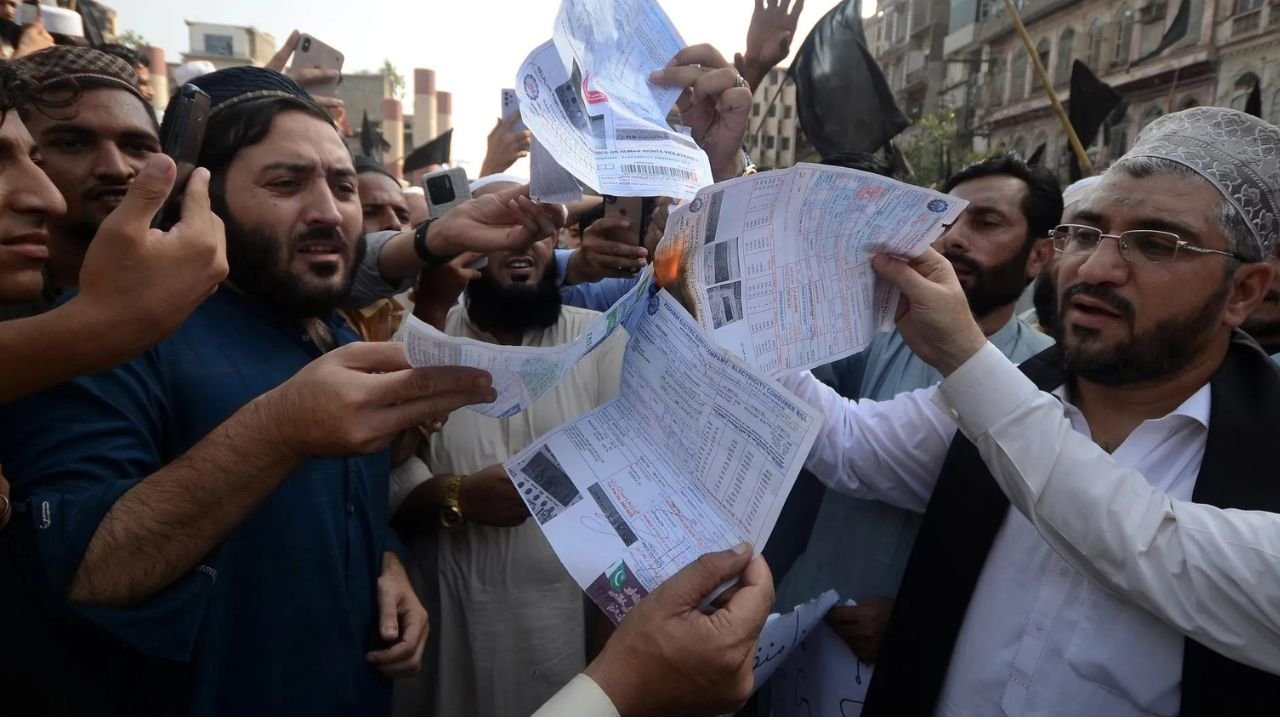
Experts have little hope for a reduction in Pakistan’s high electricity prices. The government has turned electricity and petroleum products into revenue sources, and Independent Power Producers (IPPs) face no performance checks or contract revisions, they said, adding that it gives the generators unchecked freedom.
Experts discussed the issues with DAWN at a seminar titled Pakistan Energy Crisis and IPPs: How Overbilling Impacts Quality of Life and Pathways to Solution, held at the Applied Economics Research Centre (AERC), University of Karachi on Thursday.
Experts highlighted that over-billing and high electricity costs have become a crisis, adversely impacting poor and middle-income households. This crisis affects their spending on health, education, food, and transport.
AERC Assistant Professor Dr. Aamir Siddiqui stated that electricity charges are unlikely to decrease soon because the government uses petrol and electricity as revenue sources. With around 100 IPPs and numerous suppliers in the country, electricity prices should at least be stable, but they continue to rise.
He also noted that Pakistan generates more power than needed, yet load shedding persists. Despite this, the government is not addressing the quality and services of IPPs or revising their contracts, even though payments are made in dollars or equivalent exchange rates.
Dr. Muhammad Saber, Principal Economist at the Social Policy and Development Center in Karachi, stated that electricity rates will not decrease until the government prioritises public welfare over its own interests. He pointed out that many contracts with IPPs were signed without considering public benefit, and even IPPs not supplying electricity receive timely and full payments.
AERC Assistant Professor Dr. Fauzia Sohail mentioned that the residential sector is the largest consumer of electricity, followed by the industrial sector. Low and middle-income households are particularly affected by over-billing. Rising electricity charges force people to cut spending on essentials like health, education, food, transport, and housing. This not only adversely impacts these amenities but also drives some low-income individuals below the poverty line, especially in Karachi.
Social media has been buzzing since Wednesday after a sex tape of controversial screenwriter Khalil-ur-Rehman Qamar with the woman who orchestrated his honey trap went viral.
While the misogynistic writer was called out on different platforms for hypocrisy, actress Sabeena Farooq took time out to urge people not to target Qamar’s family, especially his daughter.
The ‘Kabli Pulao’ actress took to Instagram to write, “We ask this to ourselves and everyone almost every day. Is there no humanity left? What does KRQ’s daughter have to do with his actions? Why bully her? It can have an impact on her for life. Why do we take so much pleasure in watching other people’s misery?”
Sabeena ended her message by asking people to stop blaming children for their parents’ actions and vice versa.
A Britney Spears biopic is in development after Universal Pictures bought movie rights to the pop star’s best-selling memoir, the Hollywood studio announced Thursday.
“Crazy Rich Asians” director Jon Chu is attached to develop and direct the film, based on Spears’s recent autobiographical book “The Woman In Me,” the company said in a statement to AFP.
Universal won a “highly competitive auction” for the film adaptation rights, with “La La Land” producer Marc Platt due to oversee the project, it said.
“Excited to share with my fans that I’ve been working on a secret project with #MarcPlatt. He’s always made my favorite movies,” Spears herself posted on social media Thursday.
“Stay tuned,” she told fans.
“The Woman In Me” laid bare the troubled singer’s journey from child star to global pop phenomenon, as well as her subsequent high-profile public breakdown and legal battles with her father.
Full of criticism of her controlling family and an industry that mercilessly devours its talent, the book sold over 2.5 million copies in the United States alone following its publication last October.
Spears’s phenomenal early music success with late 1990s hits like “…Baby One More Time” coincided with an aggressive paparazzi culture that delighted in capturing her partying alongside hell-raisers like Paris Hilton and Lindsay Lohan.
In the book, Spears revealed that Justin Timberlake urged her to have an abortion after she became pregnant during their relationship.
And she shared details of her brief but intense affair with Irish actor and Oscar nominee Colin Farrell, which she called “a two-week brawl.”
Following Spears’s public breakdown, she was placed under the conservatorship of her father Jamie Spears, who controlled her money and her personal life, even as she continued to perform high-profile concerts.
The conservatorship was dissolved by a Los Angeles court in 2021, after a groundswell of public support to “Free Britney.”
Her father has always insisted that he had the best interests of his daughter at heart and was seeking to protect her from exploitation.
No release date has been set for the Britney film.
Universal has previously released musical biopics about hip-hop group N.W.A (“Straight Outta Compton”) and rapper Eminem (“8 Mile.”)
Chu is also directing Universal’s big-budget, two-part movie adaptation of the musical “Wicked,” with the first film out in November.
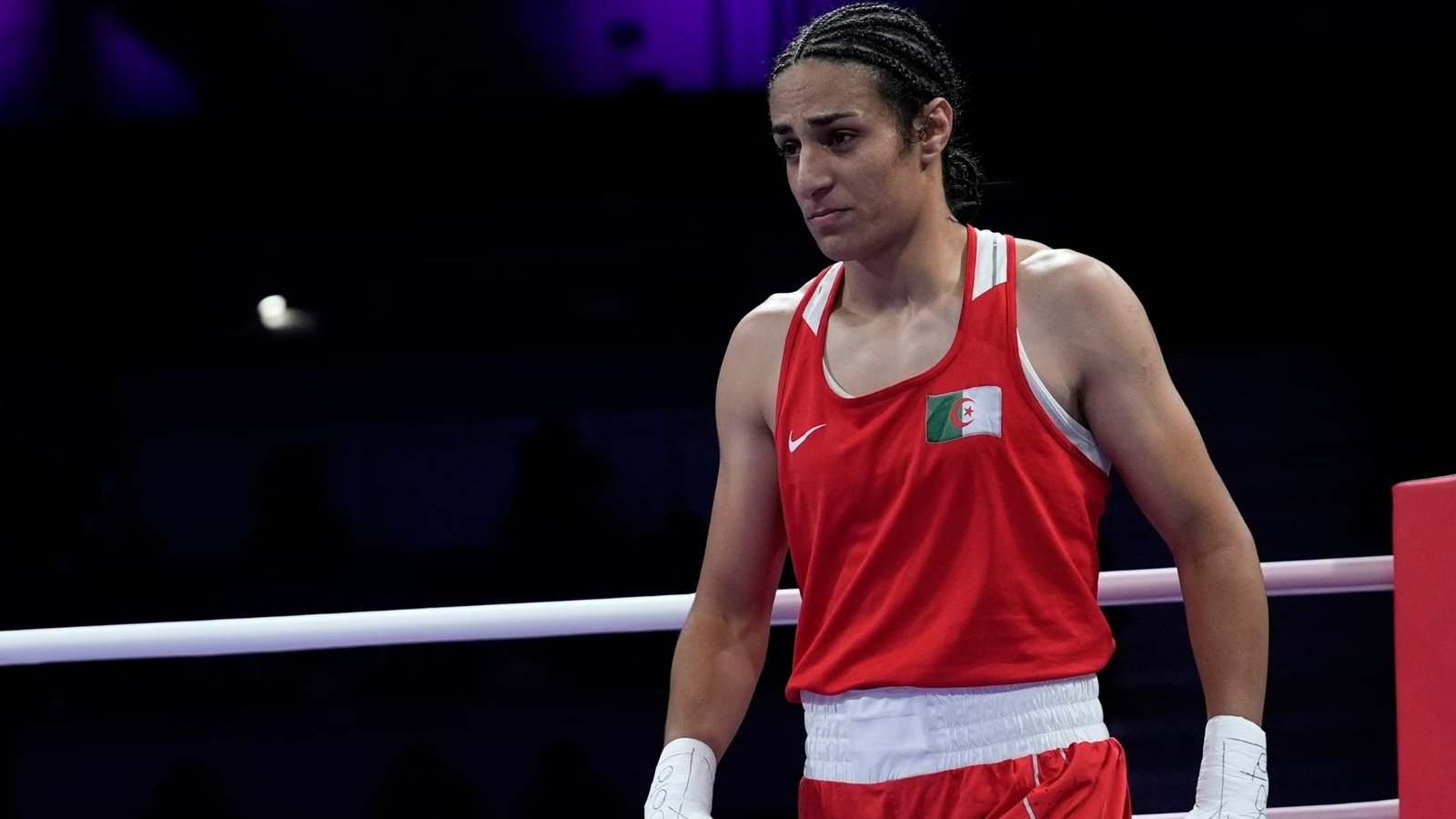
Algerian boxer Imane Khelif has become the center of a racist attack after her opponent Angela Carini of Italy quit their match while crying, just 46 seconds into the first round.
The two women exchanged just a few punches before Carini’s helmet was dislodged. She refused to shake Imane’s hands and cried on her knees in the ring. Later, she said that she quit after experiencing intense pain in her nose. Notably, she said that she had not refused to fight Imane.
The match led to an uproar among right-wing Western conservatives, including Harry Potter author JK Rowling and Elon Musk, who instantly resorted to calling Imane a man because she had failed an unspecified test in the World Boxing Championships last year. The governing body said she had “elevated levels of testosterone.”
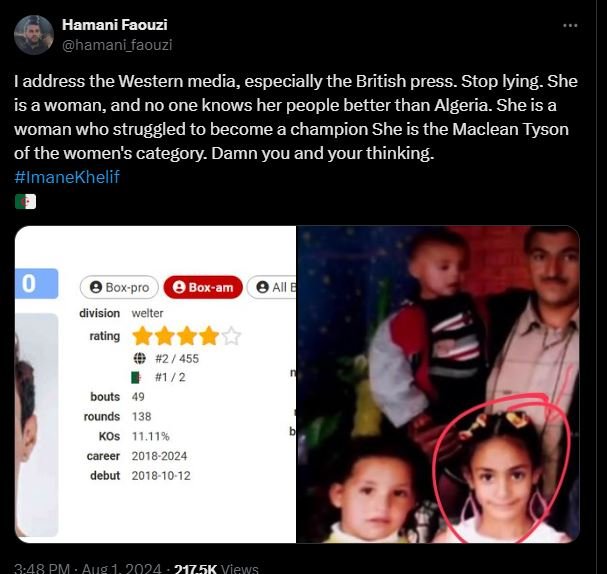
Social media was quick to rally to Khelif’s defence, pointing out that she had been competing as an amateur since years and had been defeated by women before this match.
Users shared childhood pictures of the Algerian sportswoman, showing her in girl’s clothing and pigtails. Others pointed out that Algeria is a conservative Muslim country where women cannot have gender reassignment surgeries and transgenderism is legally barred.
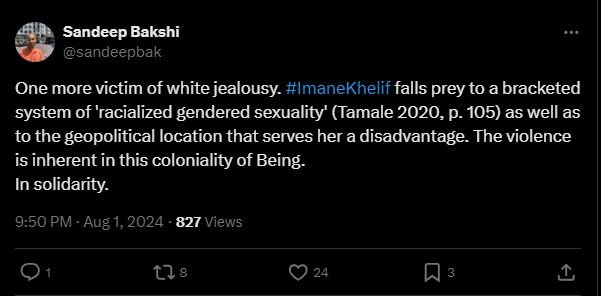
Nida Kirmani wrote that the episode proved that black and brown athletes face immense racism.
Algerian Football Media account called her a “superwoman”.
Another account called out Rowling and pointed out that Khelif just has elevated testosterone, something she was born with.
Others called out Carini for crying about being hit in a boxing match.
Netflix has announced that the popular Korean series ‘Squid Game’ will have a third season, while also confirming that Season 2 will start on December 26 this year.
In a statement released on Thursday, Netflix said that the show will end with season 3 in 2025.
The show’s creator, Hwang Dong-hyuk, said, “It’s been almost three years since Season 1 was a big hit around the world. I’m very excited to tell you that Season 2 will start soon and that we will also have a third and final season.”
Hwang also shared some details about the new seasons. “Seong Gi-hun, who wanted revenge at the end of Season 1, comes back to the game. Will he get his revenge? The Front Man will be a tough opponent again. Their intense fight will continue in Season 3, which you will see next year.”
He added, “I’m happy to see how the story of ‘Squid Game’ has grown. We will do our best to make the final seasons exciting. I hope you’re looking forward to what’s coming.”
Netflix had already announced a second season for the smash hit in June 2022. The new seasons will bring back characters Gi-Hun and The Front Man.
As the countdown to Season 2 begins, excitement is higher than ever. Fans can look forward to an emotional rollercoaster full of suspense, mystery, and surprising twists. The deadly games will return with even higher stakes, promising a thrilling experience.
Beyond the action, ‘Squid Game’ has always offered deep social messages, and Season 2 is expected to continue exploring these themes. The final chapter promises to be as exciting and thought-provoking as the earlier seasons.
COPENHAGEN: Extreme heat kills over 175,000 people a year in Europe, where temperatures are rising quicker than the rest of the globe, the World Health Organisation’s (WHO) European branch said on Thursday.
Of the some 489,000 heat-related deaths recorded each year by the WHO between 2000 and 2019, the European region accounts for 36 per cent or, on average, 176,040 deaths, the WHO said.
The health body noted that temperatures in the region are “rising at around twice the global average rate.” The WHO’s European region comprises 53 countries, including several in Central Asia.
“People are paying the ultimate price,” Hans Kluge, the WHO’s regional director for Europe, said in a statement. According to the WHO, there has been a 30pc increase in heat-related mortality in the region over the past two decades.
“Temperature extremes exacerbate chronic conditions, including cardiovascular, respiratory, and cerebrovascular diseases, mental health, and diabetes-related conditions,” Kluge said. The regional director added that extreme heat can particularly be a problem for elderly people and an “additional burden” for pregnant women.
The WHO noted that “heat stress” — when the human body can no longer maintain its temperature — “is the leading cause of climate-related death” in the region. According to the WHO, the number of heat-related deaths is set to “soar” in the coming years as a result of global warming.
“The three warmest years on record” for the region “have all occurred since 2020, and the ten warmest years have been since 2007,” Kluge said. On July 25, UN Secretary-General Antonio Guterres warned that humanity was suffering from an “extreme heat epidemic,” and called for action to limit the impacts of heat waves intensified by climate change.
Scorching China
Chinese weather authorities said on Thursday, July was the country’s hottest month since records began six decades ago, as extreme temperatures persist across the globe. China is the world’s biggest emitter of the greenhouse gases that scientists say are driving climate change and making extreme weather more frequent and intense.
Heatwaves this summer have scorched parts of northern China, while torrential rains have triggered floods and landslides in central and southern areas. Last month was “the hottest July since complete observations began in 1961, and the hottest single month in the history of observation”, the national weather office said on Thursday.
The weather office said the average air temperature in China in July was 23.21°C, exceeding the previous record of 23.17°C in 2017. The mean temperature in every province was also “higher than the average for previous years,” with the southwestern provinces of Guizhou and Yunnan logging their highest averages.
It forecast that the mercury would continue to climb in eastern regions this week, including Shanghai, where a red alert for extreme heat was in place.
“Next week will be more of the same. It’s like being on an iron plate,” wrote one user of the Weibo social media platform in response to the megacity’s heat warning.
Singer Aima Baig recently surprised her fan base with a series of stories on her Instagram account, hinting at her leaving Pakistan. Fans were left worried and confused, thinking she was leaving the country for good.
Aima has now clarified that the speculation was not true.
“I’m not actually leaving Pakistan, it’s just an extended trip. As an artist, I have to live out of a suitcase, but my roots are still here,” she said. Aima Baig has calmed her fans’ concerns and informed them that she won’t be leaving Pakistan’s music industry in the near future with her clarification.
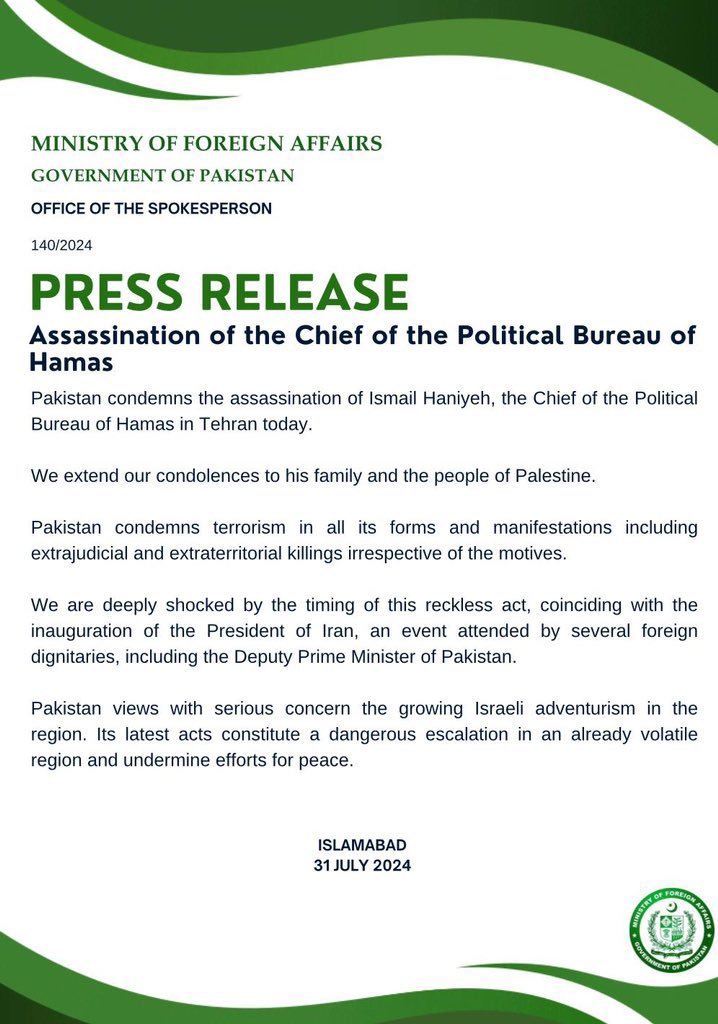
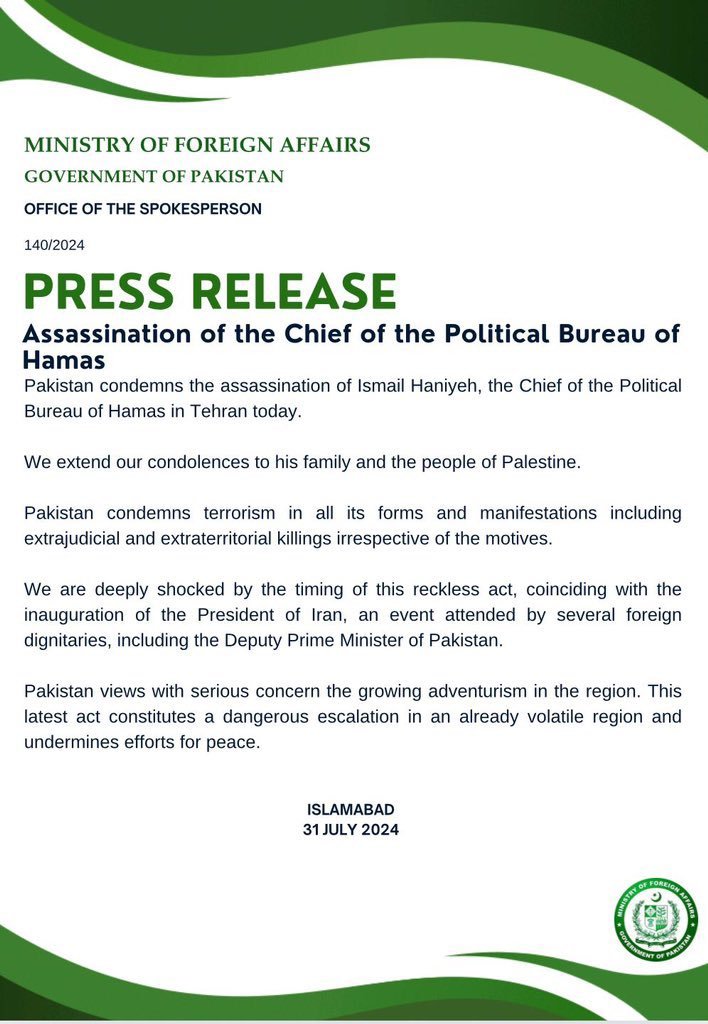
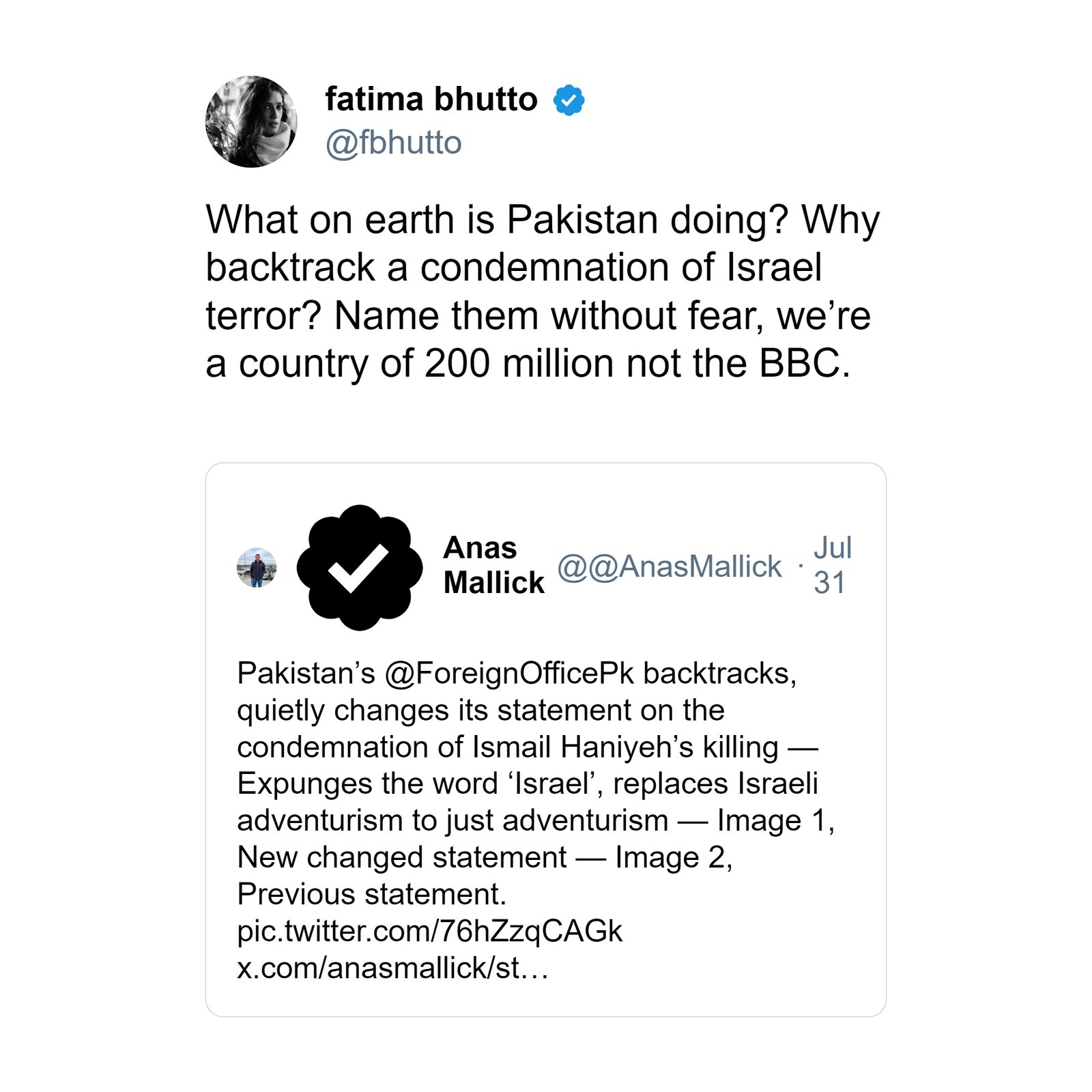
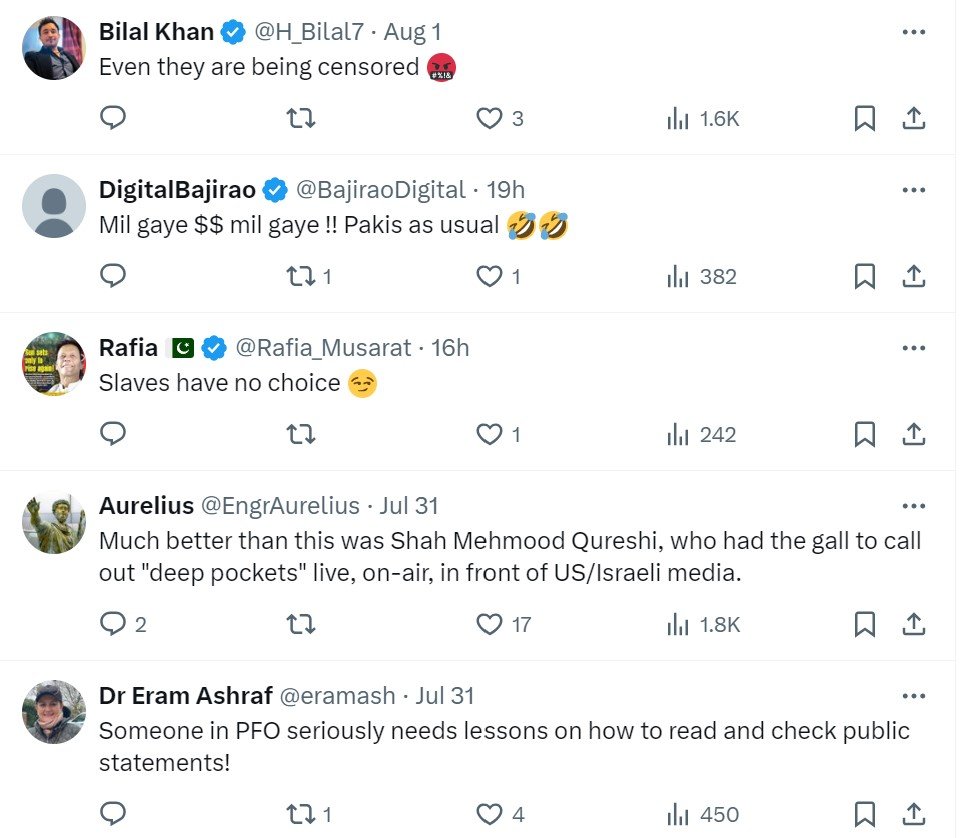
In an unusual development, the Foreign Office (FO) Pakistan on July 31st re-issued its press release condemning the assassination of Hamas’s Ismael Haniyeh, expunging the word “Israel”.
Both press releases were issued on the same day; however, in the last paragraph of the initial press release, it was written, “Pakistan views with serious concerns the growing Israeli adventurism in the region.”
First statement:
Later, it was changed to “Pakistan views with serious concerns the growing adventurism in the region,” redacting the word “Israel” from its statement.
Updated statement:
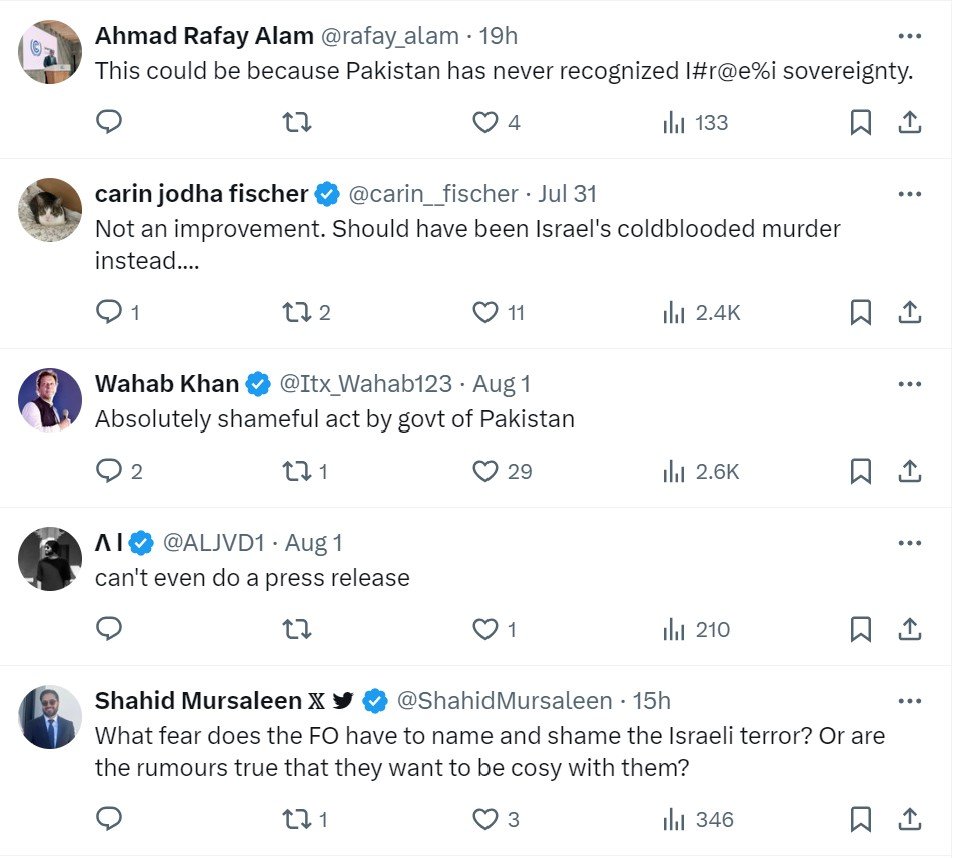
Social media noticed the correction instantly and reacted with suspicion, with most questioning the intent behind FO Pakistan’s move.
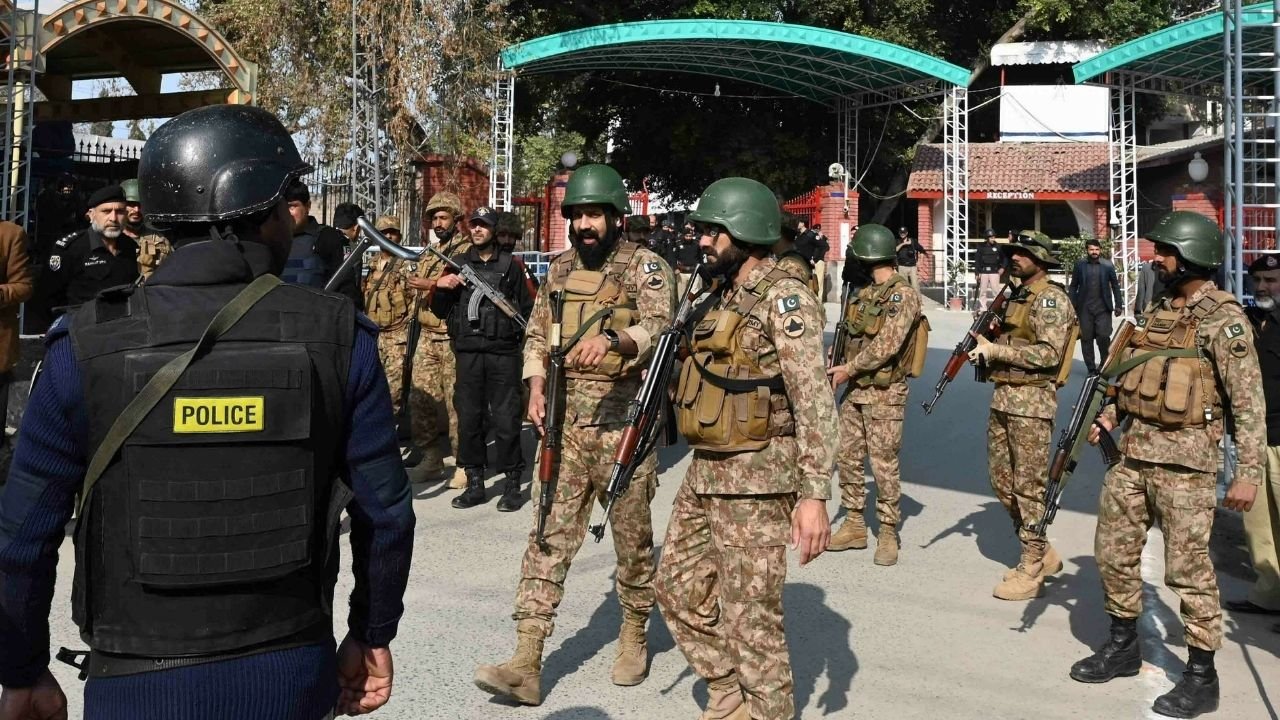
An Islamabad-based think tank has revealed that terrorist violence surged across the country in July following a slight decline in June.
The Pakistan Institute for Conflict and Security Studies (PICSS) reported that 79 militant attacks took place in July, resulting in 108 deaths and 71 injuries.
Attacks rose by 14 per cent, while deaths surged by a staggering 80 per cent, and injuries increased by nine per cent from June.
In response to the rising violence, security forces intensified their operations and killed at least 50 terrorists in July, a 56 per cent increase from June.
Most of the terrorist attacks occurred in Khyber Pakhtunkhwa and its merged tribal districts (formerly FATA), with 36 attacks reported in Khyber Pakhtunkhwa, resulting in the deaths of 60 people and 27 others injured. In the tribal districts of the province, 30 people died in 26 attacks.
In Balochistan, 12 terror attacks resulted in 12 deaths and 24 injuries. Sindh experienced five attacks, leading to 6 deaths and two injuries.
A significant development in July was the arrest of Al-Qaeda leader Aminul Haque by Punjab’s counter-terrorism unit on July 18.
Security forces also killed 6 key commanders of the outlawed TTP in various operations based on secret information. This included Najeeb alias Abdul Rahman and Ashfaq alias Muawiya in the Tirah Valley of Khyber tribal district, Irfanullah alias Adnan in Bajaur, Shah Faisal in the Diamar district of Gilgit-Baltistan, and Noor Rehman in North Waziristan and Peshawar, where the shadow governor of the banned TTP was also targeted.