Blog

  • Emmad Irfani is a rebel with a cause in his debut film ‘Gawah Rehna’

    Emmad Irfani is a rebel with a cause in his debut film ‘Gawah Rehna’

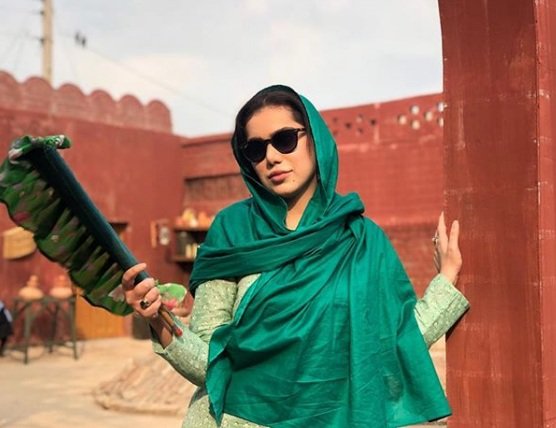
    The first look of Emmad Irfani and Ghana Ali’s Gawah Rehna based on the Khilafat Movement is out.

    Emmad, who stole the audiences with his performance in Cheekh, shared the poster on Instagram.

    https://www.instagram.com/p/B9ZrVJZn664/

    According to the film’s official social media account, Gawah Rehna “is a story celebrating our history and our unsung heroes.” It is set in the 1900s when the Muslims of the subcontinent stood up against the British Raj and started the Khilafat Movement.

    “It is a story of courage, hope and resilience against incredible odds and that’s why it will make its viewers proud of their history and their heroes who stood up against tyranny and injustice.”

    The film is written and directed by Tahir Mahmood who has served as an official of the Foreign Service in Turkey. It will be released in Pakistan and Turkey both. Earlier, it was being reported that the film is a joint production with Turkey but Emmad later clarified that the film is entirely a local production and that it will be released in Turkey. Veteran actor Qavi Khan is also an integral part of the film. An official release date has not been announced.

    Meanwhile, speaking exclusively to The Current, Emmad shared that the vision for the film came about when the director was living in Turkey. Mahmood was intrigued by the respect the Turks have for the Pakistanis and that is what motivated him to study the history of the two countries. He found that the brotherly ties of both the countries date back to the early twentieth century and the findings fascinated so much that he decided to make a film on it to further the ties between the two countries as well as highlight them.

    Talking about his own character, Emmad said that his character belongs to interior Punjab and through the course of the film realises his life goal and purpose.

    When asked what motivated him to do this project, given that it is his debut film, Emmad said that he wanted to highlight Pakistan’s history and that films are a very powerful medium to do that.

    “Much of the subcontinent’s history has been presented to the world through Bollywood. Pakistan’s point of view is not known as such,” the actor remarked, adding that our history it is imperative for the world to see our history.

    Irfani also said that the strong script and the director’s blind faith and passion is what motivated him even further.

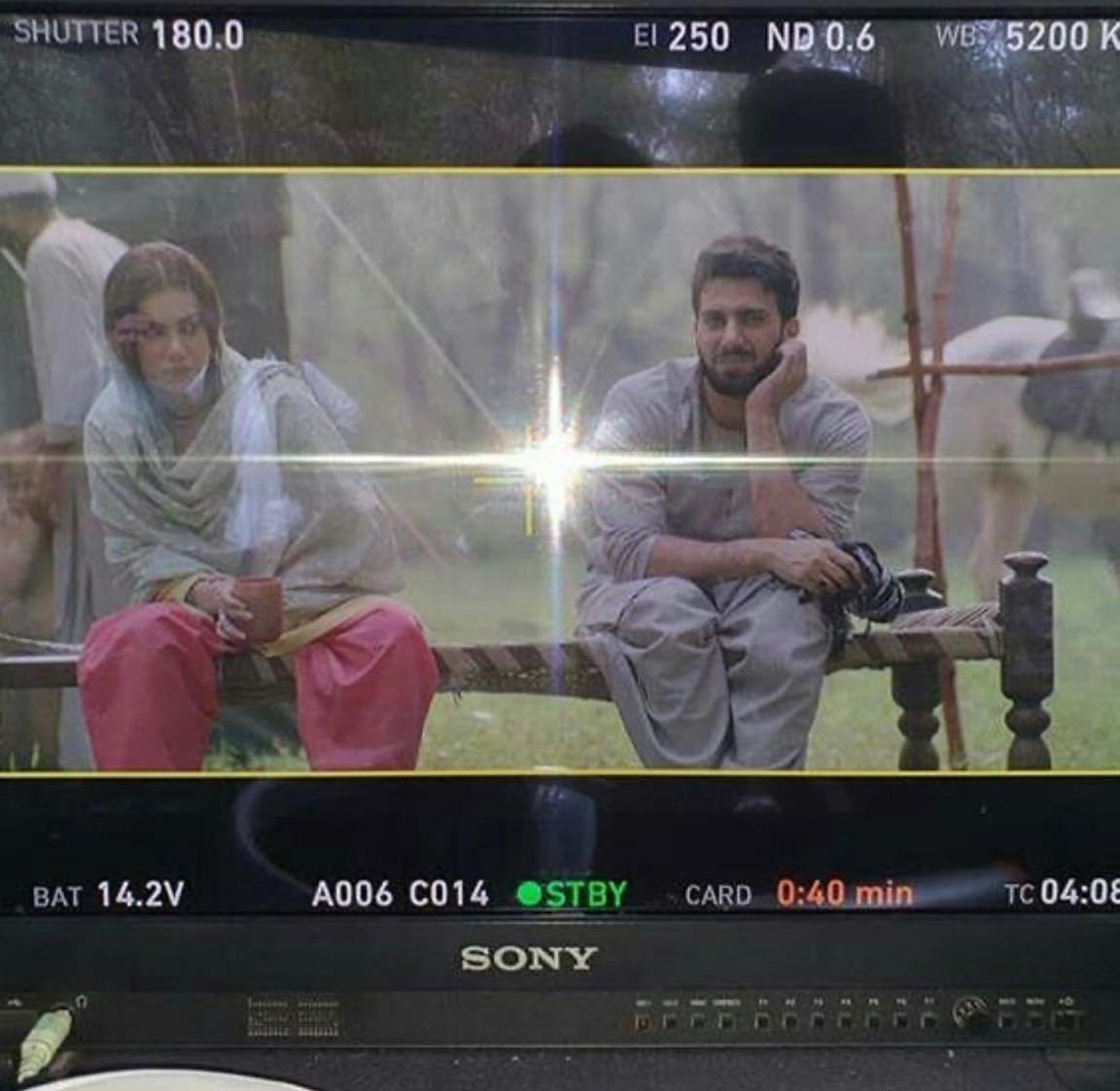
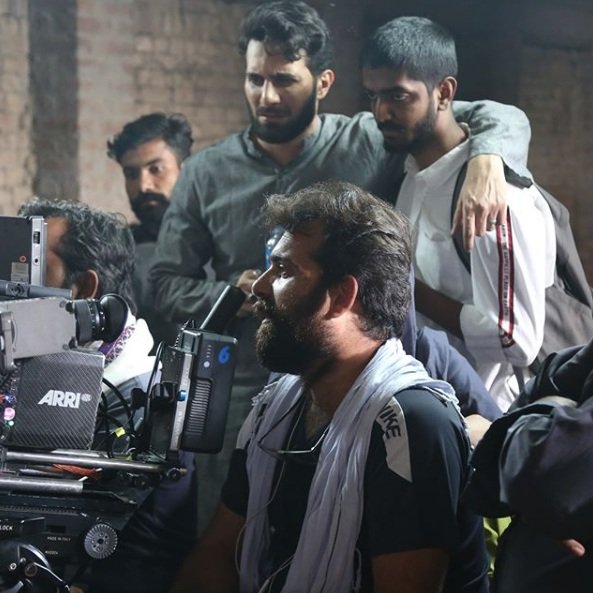
    Here are some BTS shots from the sets of the film.

  • PTA warns people to beware of thumb impression forging mafia

    PTA warns people to beware of thumb impression forging mafia

    The Pakistan Telecommunications Authority (PTA) has warned people to be careful of a gang that has been forging thumb impressions to issue SIM cards used in grey trafficking.

    A report submitted during a meeting of the Senate’s Standing Committee on Information Technology and Communication showed that more than 15,000 SIM cards were used for grey trafficking in 2020.

    Grey trafficking is a route that is legal for one country but illegal for the alternative end.

    The PTA spokesperson said, the mafia steals people’s identities, even their thumb impressions, to commit crimes.

    He added that it is suspected that data is being stolen from NADRA and an investigation is being initiated to look into the matter.

    All the complaints received by the authority this year have been sent to the Federal Investigation Authority (FIA) for further investigation.

  • Tributes pour in for Amanullah from across the border

    Tributes pour in for Amanullah from across the border

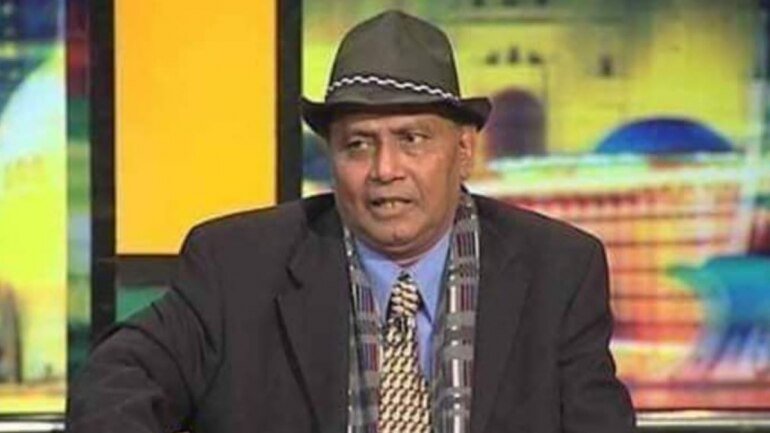
    Rich tributes poured in from Pakistan and across the border for veteran comedian and stage actor Amanullah, who passed away on Friday at the age of 70 after prolonged illness.

    Comedians Kapil Sharma and Johnny Lever were among those who expressed their grief over the comedian’s death. While Sharma tweeted his condolences, Lever while speaking to a Pakistani TV channel expressed his grief and praised Amanullah for being “a great stand-up comedian”. He shared that the two would often correspond over the phone.

    Amanullah was part of an Indian television show, Great Indian Laughter Challenge, and has apparently trained many art students who credit their acting to him.

    Meanwhile, politicians, actors, sportsmen and audiences from Pakistan expressed their grief over Amanullah’s death.

  • Vanity projects and double standards

    Women in public life are judged on what they wear rather than what they do.”

    The runup to International Women’s Day in Pakistan has been marked by a heated national debate: not about the sorry state of women’s status in the country, but about the witty and audacious slogans raised in connection with Sunday’s Aurat March.

    The absurdity of the debate about Aurat March is characterised by the terrible misogyny it reveals in terms of women’s choices, particularly in relation to their bodies and their appearance. And here it is pertinent to take a step back and recognise just how deeply ingrained preconceptions about women’s appearance and sartorial choices are in Pakistan — and how, to some extent, all of us are guilty of this.

    For me, the most telling thing is the different way in which male and female politicians are regarded and judged and the very different standards to which they are held.

    Most young people will not remember this, but not so long ago, the Sharif brothers sported gleaming pates. Then over a decade ago, they had whatever work is required done and then they sprouted hair on the top of their heads. Nobody really commented on this even though it was essentially a vanity undertaking.

    I wrote about this on my blog on BBC Urdu, pointing out the complete double standards at play: Benazir Bhutto’s appearance had been routinely criticised and her clothes, shoes, gait, hairdo and makeup were something that nearly everybody in Pakistan — men or women — would hold forth upon. My blog which was titled Naye Baal, Nayee Zindagi pointed this out but much of the feedback it generated had an outraged tone telling me how dare I “criticise” these wonderful men — even though all I was doing was pointing out the double standards.

    “Nearly every woman politician in Pakistan is careful to cover her head in public and to look modest, yet the Vawdas and Khans in the political arena will wear tight jeans and designer garb or any other less-than-occasion-appropriate attire yet arouse no comment and suffer no public backlash at all.”

    Bhutto was the first woman elected Muslim prime minister in the world and she achieved this at the very young age of 35. Yet, most of the public discourse around her was less about her policies or her politics and more about her clothes or her looks. People discussed, ad infinitum, the possibility that she might have had plastic surgery as if it was a matter of grave national importance. There was endless holding forth upon this by armchair experts who insisted, authoritatively, that her face looked different than in her early photos. Implicit in all of this commentary was the idea that Bhutto was somehow a terrible, vain and wealthy person if she had had any “work” done.

    Yet, when the Sharifs got new hair, nobody even batted an eyelid.

    Now fast forward to the present day where botox and hair regrowth procedures are becoming more and more common in Pakistan. Notice how little comment there is when a male politician or TV personality appears with a suddenly creaseless forehead or with jet black hair. No surprise, no comment, no embarrassment.

    The prime minister, Imran Khan, had a small bald patch about 14 years ago, but now he periodically appears with slightly thicker hair and nobody seems to comment on it or on any small changes to his face. I’m not saying that we need to comment on people’s appearance or their choices about that appearance, I’m just pointing out that the prevalent view is that men can do what they want but women’s appearance or clothes are considered something that everybody simply MUST criticise.

    These attitudes are, of course, linked up with a primitive social view that “honour” reposes in the body of the woman and she is a possession that might be “stolen” or “lost”. As a possession, she must be controlled by a man because there is a perception that if she is “free”, society will collapse and “immorality” or “fahashi” will prevail.

    Nearly every woman politician in Pakistan is careful to cover her head in public and to look modest, yet the Vawdas and Khans in the political arena will wear tight jeans and designer garb or any other less-than-occasion-appropriate attire yet arouse no comment and suffer no public backlash at all. Educational institutions will have a very strict dress code and rules for females, but be lenient with the males. It is always the women who have to be conscious of what they wear, how they walk or who they speak to.

    Times are changing, but there still is a long way to go because the people who are guilty of this sort of double standards are not just the chauvinists or the religious right — it is nearly everyone. These attitudes are now normalised and are so ingrained in our society that even educated, reasonable people — both men and women – are guilty of such behaviour. But the more aware of these double standards we can become, the more we will be able to overcome them.
  • Judge summons buffalo to court

    A senior civil judge has summoned a buffalo into the court after two persons claimed ownership of the dairy animal in Chiniot.

    A case was being heard by a senior civil judge in the suburban area of Punjab’s Chiniot city after the theft of the buffalo that was stolen from Sambha and was found from a house in Kakkay Tibbay village.

    A local of Moza Samundar village, Nazir, had filed the complaint to the Chiniot local court where he claimed that he owns the buffalo recovered from Kakkay Tibbay village.

    Following his claims, the judge directed authorities to summon the dairy animal in the court. The person accused of stealing the buffalo kept insisting that the animal belongs to him. 

    The civil judge ordered police not to hand over the buffalo to any party until ownership of the animal is proved with evidence and witnesses.

  • Coronavirus can cause $5 billion loss to Pakistani economy

    Coronavirus can cause $5 billion loss to Pakistani economy

    The Asian Development Bank (ADB) has given a “hypothetical worst-case scenario” that shows Pakistan’s economy sustaining a whopping $5 billion loss due to the outbreak of the new coronavirus, in which case Pakistan’s GDP will go down by 1.57% and 946,000 people will be unemployed, The Express Tribune reported.

    According to the report published Friday, the global GDP will also be affected from $77 billion in the best-case scenario to $347 billion in the worst-case scenario, with China affected the most.

    ADB projected that Pakistan’s economy may face $16 to $61 million losses due to the spread of COVID-19, while in a one-page paper issued by Tola Associate — tax and corporate advisors — it was also claimed that the economy of the country will sustain a $5 billion loss due to coronavirus.

    The firm based its claim on an ADB publication.

    According to the estimates published by the ADB the impact of the coronavirus, in terms of the global GDP ranges from $77 billion in best case scenario to $347 billion in worst-case scenario, or 0.1% to 0.4% of the global GDP.

    The report said the total losses likely to be sustained by Pakistan will be only $16.23 million in best case scenario. It projected that in best case scenario, Pakistan’s agriculture and mining sector could sustain a loss of $5.5 million; business trade, personal and public service $5.54 million; hotels and restaurants $0.67 million;  light and heavy manufacturing $3.6 million and transport services $0.92 million.

    In moderate case scenario, the projected losses to be faced by Pakistan are $34.2 million. In worst case scenario, the projected losses to be faced by Pakistan are $60.8 million.

    In the worst case scenario, Pakistan’s agriculture and mining sector will face $21.7 million losses; business and trade $18.8 million losses; hotel and restaurants $2.4 million losses; light and heavy engineering $14.6 million losses; and transport services $3.4 million.

    While discussing the hypothetical worst case scenario, the ADB projected that Pakistan’s economy will lose $5 billion. There will be $1.5 billion loss to agriculture and mining; $1.94 billion to business and trade; $253.7 million in hotel and restaurants; $671 million to light and heavy engineering and $565.6 million loss to transport services.

    In addition to the global slowdown, the fear caused by the COVID-19 is going to cause an estimated loss of $1.5 trillion across the globe in hypothetical worst case scenario. The lockdown has slowed down the pace of the Chinese economy, if compared to the last 30 years.

    Coronavirus losses will depend on the magnitude of the problem and the scale of the underlying uncertainties in countries which have strong trade and production linkages with China, according to the Tola Associate.

    According to the ADB estimates, around 946,000 people will be unemployed in Pakistan in hypothetical worst case scenario.  The net effect of the drop in oil prices due to coronavirus is neutral, yet alarmingly negative for the economy of Pakistan.

    If this crisis prolongs, it will eventually lead to a significant increase in expenditures; a further slowdown in tax collection; a rise in inflation; and an increase in the fiscal deficit.

  • Osman Khalid Butt throws shade on Ahmed Ali Butt over his claims on ‘Mera Jism Meri Marzi’

    Ahmed Ali Butt’s take on the Aurat March and the slogan ‘Mera Jism Meri Marzi‘ has elicited strong reactions from all around. While there are some who agree with his comments that the Aurat March is a “foreign-funded movement”, others are calling him out for his ignorance and misuse of privilege.

    Read more – Ahmed Ali Butt makes outrageous claims about ‘Mera Jism, Meri Marzi’

    Among those criticising Butt is Osman Khalid Butt who has been vocally advocating for the Aurat March on social media. Osman threw shade at his fellow actor without taking his name.

    Other Twitter users also schooled Butt for his comments.

    https://twitter.com/AliDayan/status/1235857384624414720?s=20

    https://twitter.com/haleemak_/status/1235825870171852800?s=20

    Meanwhile, Ahmed Ali Butt continued to defend his stance and even got involved in a spat with a leading publication over the matter.

    https://www.instagram.com/p/B9YyqDUD66W/
    https://www.instagram.com/p/B9bDu54D0Dw/
  • Sham Idrees, Froggy’s newborn already has thousands of followers on Instagram

    Sham Idrees, Froggy’s newborn already has thousands of followers on Instagram

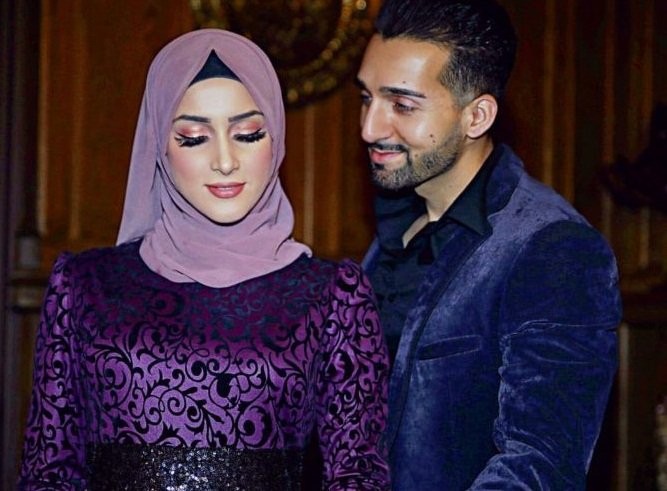
    YouTube stars Sham Idrees and his wife, Seher (Queen Froggy) have welcomed a baby girl who they have named Sierra. The couple shared the big news with their fans on social media.

    https://www.instagram.com/p/B9UQNG9lt1X/?utm_source=ig_web_copy_link

    The baby girl has her own account on Instagram and though it has only one post, Sierra already has close to 60,000 followers. Her parents shared the same picture with the caption, “Hi world.”

    https://www.instagram.com/p/B9UQNG9lt1X/

    Idrees also responded to those asking for his baby girl’s pictures.

    “Wait a little while, let her grow up. She’s too precious and tiny,” he wrote on Twitter.

  • CJP distributes motorbikes among female lawyers

    CJP distributes motorbikes among female lawyers

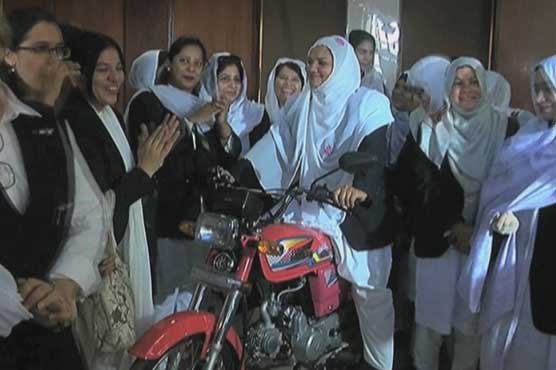
    Chief Justice of Pakistan Justice Gulzar Ahmed distributed motorbikes among women lawyers on Friday. While giving out the motorcycle-driving training to women lawyers, the CJP encouraged women to ride the bikes adding that this was a good start and that he hoped this practice will continue. He also advised women lawyers to avoid talking during motorcycle-riding.

    Addressing a motorbike distribution ceremony at the Sindh High Court Bar Association, the CJP appreciated the bar association’s efforts for providing a motorbike-driving training opportunity to women advocates.

    He said that although motorbike-riding was dangerous, it was the responsibility of the trainers as well as of women motorbike riders to drive safely and ensure that they did not meet with an accident.

    He said women lawyers kept on talking during the programme and advised them to curb their habit of talking during motorcycle-riding.

     Sindh High Court Chief Justice Ahmed Ali M Sheikh also appreciated the SHCBA and senior lawyers for making arrangements to award motorbikes and training to the women lawyers.

    Salman Sufi, head of Salman Sufi foundation, said that his organisation had given motorbike-riding training to as many as 15,000 women since 2016, and have set a target that his organisation would provide training to 500,000 women by 2025.

  • Coronavirus: Airlines may lose up to $113 billion

    Airlines could lose up to $113 billion in revenues this year due to the coronavirus, equivalent to the damage experienced by the industry during the financial crisis, AFP quoted a trade body as warning.

    The dire prediction came as Flybe — a British airline — collapsed into bankruptcy with the virus, which has killed over 3,200 people worldwide, dealing a fatal blow to the ailing regional carrier.

    With the disease now rapidly spreading outside China, demand for air travel is nose-diving globally, spelling serious trouble for many already struggling carriers. In a new assessment of the impact, the International Air Transport Association (IATA) estimated revenue losses to airlines’ passenger business of between $63 billion and $113 billion in 2020.

    The higher figure is for a scenario where the virus spreads more widely, and would be equivalent to the hit to the industry during the 2007-2008 global financial crisis, the group warned.

    The “industry’s prospects in much of the world have taken a dramatic turn for the worse”, said IATA head Alexandre de Juniac, and appealed to governments for support. “Airlines are doing their best to stay afloat,” he said. “As governments look to stimulus measures, the airline industry will need consideration for relief on taxes, charges and slot allocation. These are extraordinary times.”

    Flybe had narrowly avoided going bust in January when the United Kingdom (UK) government agreed to review air passenger duty paid by its customers — and shareholders pledged extra investment.

    But it finally collapsed after the government reportedly refused a rescue loan for £100 million ($128 million).

    In further bad news Thursday, Norwegian Air scrapped its 2020 earnings guidance after earlier predicting a return to profit following several years of losses.

    Other recent high-profile aviation industry casualties in Europe include French carriers Aigle Azur and XL Airways, as well as Slovenia’s Adria Airways.

    Meanwhile, travel analytics company ForwardKeys said the number of new flight bookings to Europe fell by 79 percent in the final week of February due to the outbreak.

    IATA’s assessment was far bleaker than just two weeks ago, when it forecast revenue losses would come in at $29.3 billion. But since then the virus has spread rapidly outside China, and has now reached some 80 countries and territories, infecting more than 95,000 people. The vast majority of global deaths and infections are in China, which quarantined entire cities, temporarily shut factories and closed schools indefinitely after the virus emerged.

    IATA predicted that worldwide passenger revenues would fall between 11 and 19 percent this year. The impact on Asia-Pacific carriers will be bigger than during the Severe Acute Respiratory Syndrome (SARS) outbreak in 2002-2003, as the Chinese travel market is far bigger now, said IATA chief economist Brian Pearce.

    Like the new virus, SARS emerged in China before spreading to numerous countries, killing hundreds. A plunge in oil prices caused by the virus could cut airlines’ fuel costs by up to $28 billion this year, which would provide some relief but would not have a significant impact, the body added.