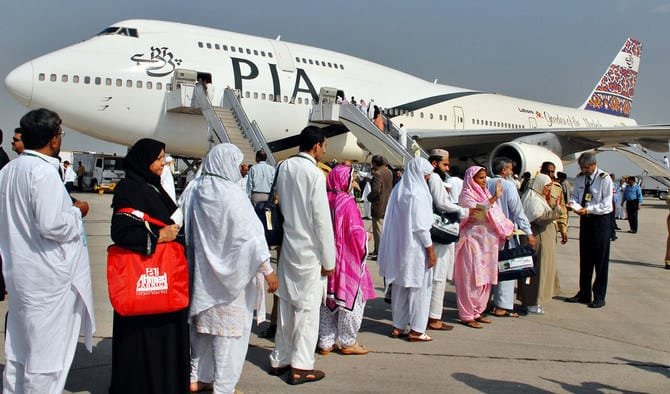
Pakistan International Airlines (PIA) has earned a revenue of Rs7-8 billion from Hajj operations against the anticipated figure of Rs25 billion, The Express Tribune reported.
According to reports, around 250,000 people went to perform Hajj from Pakistan this year. Out of the total number of pilgrims, PIA flew more than 82,000 pilgrims, which is 20% more than previous year’s 68,000.
PIA and Saudi Airlines, being major services, covered around 100,000 Pakistani pilgrims, while the remaining pilgrims were carried by Airblue, Etihad, Emirates and others.
Further details reveal that the Hajj package offered by the government this year cost around Rs400,000 while privately undertaken pilgrimage has no upper limit and can go up to Rs3 million.
Meanwhile, the ticket prices from Lahore, Islamabad ranged from Rs110,000 to Rs150,000 and tickets from Karachi airport cost between Rs100,000-Rs105,000.
DISCLAIMER: This review is not sponsored. The Current has done its own independent research for this review.
Looking to buy a fridge? Which one is the most popular in Pakistan? We compare two – Dawlance and Kenwood – that are the most popular in your city. According to our research, Orient, PEL and Haier are also very popular but salespeople at local stores claim that these two are the ones which are most commonly bought.
The table below gives a brief outline of the two fridges.
Dawlance
Kenwood
Rs 33,000 – 55,000
Rs 45,000 – 65,000
Service Centres: 4 in Karachi, 2 in Lahore
Service Centres: 4 in Karachi, 3 in Lahore
3-way cooling
Unbreakable models
Works on low voltage
Best in load shedding
Warranty – 12 years
Warranty – 3 years
Because of its services, price and warranty time period, Dawlance emerges as a winner.
The Sri Lankan cricket team, despite its bitter experience of the past, has agreed to play a Test series in Pakistan, a private media outlet reported Saturday.
According to reports, the decision was taken after a security delegation from Sri Lankan Cricket (SLC) visited Pakistan from August 7 to 9 to evaluate the security conditions in the country.
The security team visited three major cities, including Lahore, Karachi and Islamabad.
PCB’s director for international cricket, Zakir Khan, and the head of security, Colonel Asif Mehmood, briefed the security team about the arrangements being made at the stadium for the series.
The team was assured of foolproof security for the guest team during its visit to Pakistan.
SLC Secretary de Silva thanked Pakistan for inviting them for security assessment and said: “We had a very fruitful discussion and briefing about the arrangements being made for the test match here.”
Earlier, PCB had invited the Sri Lankan cricket team to come to Pakistan this October and play two Test matches in the country.
The series will be the first of its kind to be played in the country ever since the attack on the Sri Lankan cricket team 10 years ago.
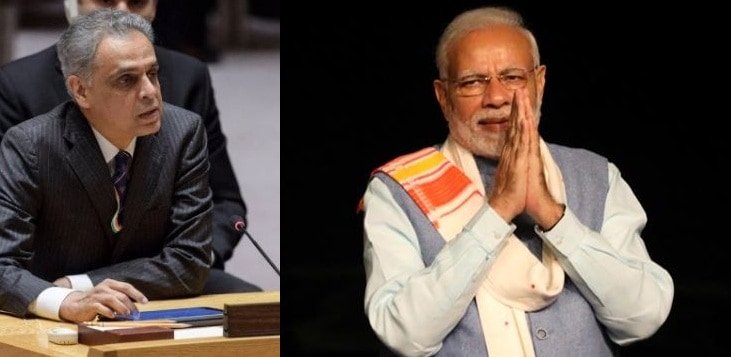
Soon after the United Nations Security Council (UNSC) held its first-ever meeting over the Kashmir issue in almost 50 years, India has backtracked on its statement and admitted that Indian-occupied Kashmir (IoK) is disputed territory.
According to The Express Tribune, facing a barrage of questions in a press briefing following the historic meeting at the UN headquarters on Friday, India’s envoy to the United Nations Syed Akbaruddin said that India was committed to the Shimla Agreement inked with Pakistan in 1972, which explicitly declares Kashmir as disputed between the two countries.
Earlier, New Delhi had regularly blocked discussion on held Kashmir at the UN, saying it considers the matter an “internal affair”.
“So let me begin by coming across to you and shaking your hand… as we’ve already extended our hand of friendship by saying we are committed to Shimla Agreement. Let us wait on that from the Pakistani side,” said the Indian ambassador while awkwardly reaching out to Pakistani journalists and shaking their hands.
WATCH VIDEO:
Responding to a question, he said: “In closed consultations at the UNSC, anyone, especially parties to the dispute, can try and throw in anything at the members of the Security Council. That’s the nature of the beast.”
“We are ready to address these issues in a matter in which states who have normal approaches to international ties address them… and in our case, we are committed to Shimla Agreement,” he added.
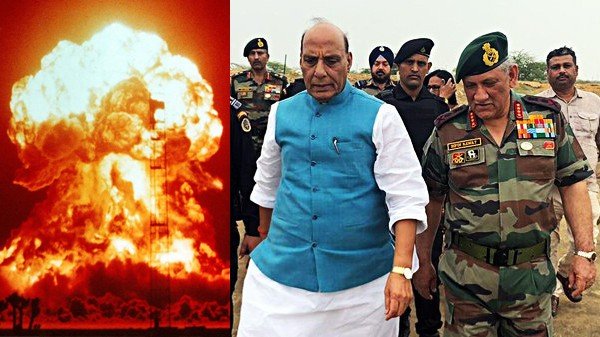
Pakistan has taken exception to Indian defence minister’s statement on the use of nuclear weapons, saying the “substance and timing of the statement was highly unfortunate and reflective of India’s irresponsible and belligerent behaviour”.
Rajnath Singh had on Friday said that New Delhi may see a major shift in its nuclear weapons doctrine by doing away with the ‘no first use’ policy in the future. ‘No first use’ is a pledge to not use nuclear weapons as a means of warfare unless first attacked by an opposition using its nuclear arms.
“Till today, our nuclear policy is ‘no first use’. What happens in future depends on the circumstances,” the Indian defence minister had said while addressing a gathering in Pokhran, the site of India’s nuclear tests in 1998.
In a subsequent tweet, Singh had added:
Pokhran is the area which witnessed Atal Ji’s firm resolve to make India a nuclear power and yet remain firmly committed to the doctrine of ‘No First Use’. India has strictly adhered to this doctrine. What happens in future depends on the circumstances.
— Rajnath Singh (मोदी का परिवार) (@rajnathsingh) August 16, 2019
“It further exposes the pretense of their no first use policy, to which we have never accorded any credence,” Pakistan Foreign Office said while reacting to the Indian defence minister’s statement.
“No first use pledge is non-verifiable and cannot be taken at face value, especially when the development of offensive capabilities and force postures belie such claims,” the statement read and added that Pakistan always proposed measures relating to nuclear restraint in South Asia.
“Pakistan will continue to maintain a credible minimum deterrence posture.”
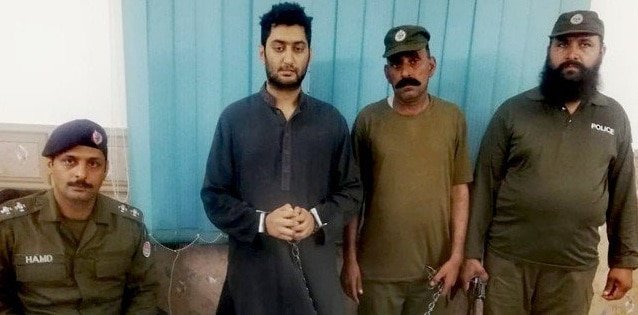
Police have arrested a couple allegedly involved in kidnapping, sexually abusing, blackmailing and also recording inappropriate videos of 45 girls in Rawalpindi. The accused identified as Qasim Jahangir and Kiran Mehmood confessed to the crime.
As per reports, the action was taken after a complaint was filed by a victim, a student of Allama Iqbal Open University. The student said that she was kidnapped from outside Gordon College by a woman who pretended to be a fellow student. She said that her brother was coming to pick her up. After a few minutes, when her “brother” arrived in a grey car, the woman pushed the victim inside the car and threatened her with a knife. The student was then taken to a house in Gulistan Colony where Qasim, the husband, allegedly raped her while the wife recorded a video of the crime. They blackmailed the girl by showing her video. Later at night, she was released on Tipu Road.
Police officials said that the couple had sold the videos and photos to an international porn website. The wife has been sent to Adiala jail on judicial remand while the husband is in police custody on physical remand.
The police have also involved the FIA as they do not have modern technology to examine laptops and other devices used by the accused.
After India revoked Article 370 which granted special status to Indian occupied Kashmir, tensions between the two neighbouring countries reached an all-time high. Following that the Government of Pakistan announced that they will cut all ties with India effective immediately. Bollywood films have been banned in Pakistani cinemas for a while now.
Bollywood actor Sonam Kapoor who has a wide fanbase in Pakistan and has shared the screen with Pakistan heartthrob Fawad Khan spoke at length about the unrest in the IoK and said that she is very disturbed with all that’s happening.
Talking to the BBC Asian Network, Kapoor said, “It’s heartbreaking to see where the situation has landed right now but I’m very patriotic. So I think for me now it’s better to keep quiet and let this pass because even this too should pass. Our countries were one country like 70 years ago and the fact that there is so much divisive politics at play is really heartbreaking.”
Sonam continued that she is very upset about the ban on Bollywood in Pakistan because “as an artist, you want to be represented everywhere and you want your work to be shown everywhere,” adding that she was heartbroken when her film Neerja wasn’t allowed to be screened in Pakistan.
“I have a huge Pakistani following and my two best friends are Muslims and half Pakistanis,” Sonam said.
On her thoughts on the Kashmir conflict, Sonam remarked, “I think it’s very complicated and I don’t understand it as much because there is so much contrasting news everywhere so I don’t really know what the truth is.”
“I
believe in having a peaceful discourse and understanding what’s going on. So
when I have the complete information is when I think I can give an opinion.”
The Kapoors have been very open about their roots on this side of the border.
“I am half Sindhi and half Peshawari. It’s heartbreaking to see that part of my culture is something that I can’t explore as well because of that,” Sonam said.
The Kashmir situation on the Indian-administered side continues to divide people, including in Bollywood.
Actress Sonam Kapoor has been speaking to us about it and says it’s upsetting because of her family’s links to the region. pic.twitter.com/Uz5Leujiaz
Sonam shared that her parents named her when they visited the valley and that she hopes peace would return to the picturesque valley soon so she can also go and visit it one day.
“I hope there is a peaceful way of working things out. I don’t know how that’s possible but I think there should be because it’s a beautiful place but I think it’s been under so much duress and I don’t think anybody knows who’s right now,” Sonam finished.
Adnan, born in Britain and earlier a Canadian citizen, is of Pakistani descent. His father, Arshad Sami Khan, was a Pashtun and a Pakistan Air Force (PAF) fighter pilot who later served three Pakistani presidents as their aide-de-camp.
An aide-de-camp is a military officer acting as a confidential assistant to a senior officer.
The singer relocated to India some 18 years ago, and has time and again received flak for his decision and the pro-Indian statements he usually makes.
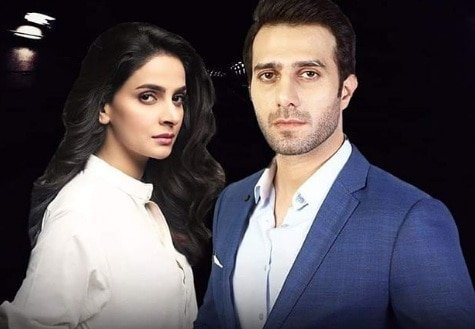
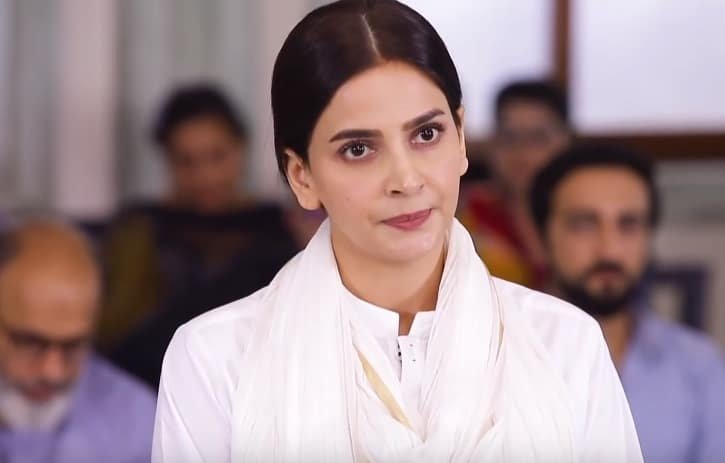
Saba Qamar and Bilal Abbas Khan’s much-hyped drama Cheekh has finally drawn to a close and we couldn’t be more relieved.
Despite all the phenomenal performances by the lead actors, the drama and storyline was stretched way beyond its snapping point and was getting ridiculous and unrealistic with every passing episode. What began as an ambitious and game-changing project, Cheekh soon went downhill as the makers behind it tried to keep the audiences engaged by introducing one twist after another.
The first 10-12 episodes were brilliant and had you on the edge as Mannat (Saba Qamar) battled all odds to get her murdered friend, Nayab, justice. The plot was realistic and understandable. But after the case of Nayab’s murder went to court, everything started going downhill including the script.
There were lots of unnecessary turns and twists which turned a perfectly good drama into a Star Plus soap opera. I mean what was the point of sending Mannat to the pagal khaana and drugging her into becoming sleeping beauty? Or scaring Mannat’s mother into testifying against her own daughter? Agreed that our justice system is extremely flawed but itna ziada? And in the quest for justice, Mannat lost her mother, husband and unborn child. The message the drama seemed to give out was that if you fight for the truth, you’ll end up getting ruined in the process – Not sure if the makers were trying to encourage women to speak up or discourage them from ever raising their voice.
The middle of the drama was dragged for no reason and you just ended up skipping most of the scenes. Because of a lack of a proper build-up, the final episode of the drama ended up being rushed.
The last episode began so abruptly with Mannat reopening Nayab’s case and representing herself in the court that you had to pause and go back to the previous episode to see if you missed anything. As expected, the makers had to give the drama a happy ending, so the series ended with Mannat getting justice and Wajih on death row. The final scene was absolutely absurd, with Wajih having read the whole Quran and justifying his actions because previously he wasn’t religiously enlightened. He then proceeded to shift the blame to his elder brother Yawar for not stopping him from doing bad things and always shielding him from the consequences of his actions. More so, in the entire scene, Haya cried as if Wajih was the victim.
Meanwhile, Mannat becomes unnecessary. She just sits in her corner and looks up to the sky and thanks God for making an example of her.
“Khuda misaal banana ke liye na, hum sab mein se kisi eik ko chunta hai…aur woh eik, mein thi,” she says. I mean…
Even Nayab’s father was nowhere to be seen.
The plot aside, the cast of the drama probably delivered their finest performances to date. Saba as the headstrong and unabated Mannat was amazing. Bilal as the conniving and manipulative Wajih was remarkable. The two leads shared amazing chemistry on screen and their scenes together were so strong that you’d end up holding your breath without realising. His performance in the last scene was so strong that it gave you goosebumps. He actually ended up making you feel sorry for Wajih the killer. If he doesn’t win an award for Best Performance in a Negative Role on at least one award function, award functions should be officially be cancelled. Emmad Irfani as the doting, loving husband conflicted between his wife and family won hearts and frankly redefined the typical Pakistani drama husband. That’s definitely a win. The rest of the cast also gave superb performances. A special round of applause to director Badar Mehmood for bringing out the best in his actors.
On the whole, Cheekh lost itself somewhere in the middle. Where it could have been a rule-changing Pakistani drama, the makers decided to play safe and follow the traditional route.
It’s a trend now. To talk about the non-conformists, the ones who don’t fit in and the ones who don’t want to.
In her 10th novel, Japanese fiction author Sayaka Murata doesn’t make up a story. She calmly and incredibly coolly takes us into the world of the straight face life of a “convenience store woman” in her internationally best-selling book of the same name.
Stores of Convenience
It’s a weird book and it’s so much fun. We enter the world of a convenience store worker, Keiko, who is 36 years old and single, has never dated anyone and has worked part-time at the same store for the past 18 years.
No one seems to understand why she has worked in the Smile Mart for so long, why she yearns to be there and how it literally becomes her day and her night. But then she isn’t one to do things normally.
The first blow that Keiko gives us is a memory of her childhood, when, to break up a fight, she hits one of the boys on the head with a spade and doesn’t understand when everyone is shocked by what she does. They did say they wanted the fight to stop.
Deadpan and almost robotic, Keiko is the person we would tend to avoid — lacks emotion, copies emotion, and doesn’t get angry. You can’t trust Keiko but you can’t help but like her. Murata has so beautifully carved out Keiko’s character that you somehow don’t feel bad for her at all. Perhaps because you know that she already has everything; a job she lives for, a convenience store she loves and that’s enough for her.
Murata, through Keiko, takes us through the experience of milestones that are part of every single society in the world. Work, life-partner, marriage, children and how we tend to isolate and judge people who don’t fit in society’s norms.
Keiko’s counter, the young, lanky, and smelly Shiraha, is full of disdain. He joins the store and soon gets fired from the Smile Mart for not doing his duties. Figures that his only reason for taking the job was to find a woman, stalk her and marry her.
The utter stench his words produce when we meet him is more effective than repellent. He is a loathsome character and as we move through the book, and discover that he might be important, we try to like him when there is nothing at all to like.
But to be fair, Murata rushes through the existence of Shiraha. Maybe because she doesn’t want to marry the crazy beauty she has created with Keiko and perhaps she realises that the reader might relate more to Shiraha; whether they like him or not.
It’s a short read, ends in 162 pages, bound to finish in a few hours because of how perfectly normal it is. It’s not at all a judgey book but it takes us into such a quirky and strange journey through Keiko that we can’t help but reflect on how judgemental we can be. How she, without question, anger, regret, tries to adapt to her society, where she doesn’t fit in. She cleverly and poignantly highlights what we all do: mirror others, judge others for not fitting in molds and feel happy for them when they do.
At one point of the book, Keiko is told off by Shiraha who says, “You’re not human” to which Keiko thinks, “That’s what I’ve been trying to tell you!” a thought which will leave you with a smile and simple reflection on life’s ambitious rat race and the simplicity of the convenience store worker. For a moment you’ll want her contentment, her creepy thoughts (inertly thinking that you might have had one or two of those yourself) until you conveniently forget and go back to ignoring the simple, convenient things.