A survey conducted by IPSOS has revealed that there is an increase in the number of Pakistanis who are hopeful that the economic situation of the country will improve in the next six years.
The results also show that the fear of losing jobs or work has decreased.
The survey, based on 1,000 participants across Pakistan, was conducted between October 31 and November 3, 2023.
There has been an increase from 11 per cent to 25 per cent in people’s optimism of improving their financial conditions in the next six months while pessimism and disappointment has gone down from 60 per cent to 49 per cent.
No difference has been noted among the people with moderate stance as 26 per cent are neither hopeful nor despondent about their financial situation in the future.
According to IPSOS, 95 per cent of Pakistanis feared losing employment in the previous survey, but now the number has come down to 88 per cent, indicating an increase in optimism by seven per cent.
Additionally, the rate of Pakistanis who expressed an inability to save and invest to meet future needs decreased by four per cent, while 92 per cent said they were not able to save.
Only one in 10 Pakistanis believe that the country is headed in the right direction among whom men are four times more likely to be more optimistic than women.
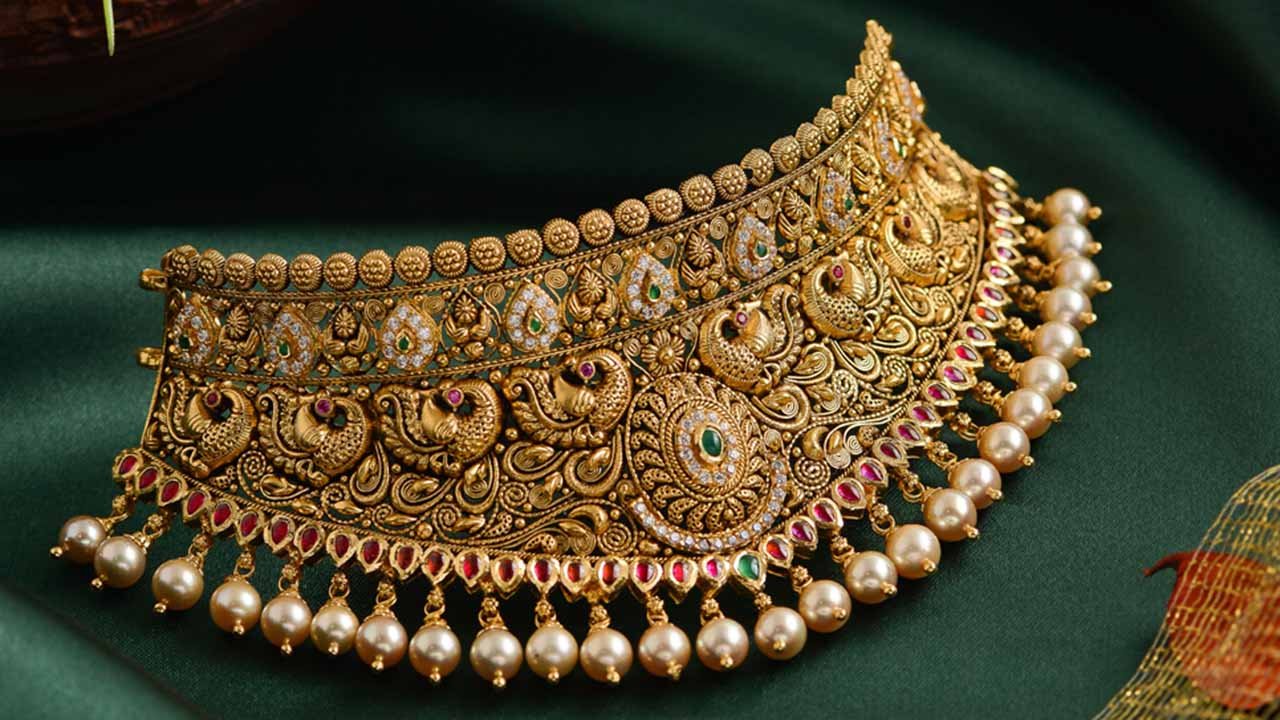
The domestic bullion market commenced the week with robust performance, witnessing a noteworthy surge in the price of 24-karat gold, which rose by Rs1,100 per tola to reach Rs217,600.
The Karachi Sarafa Association reported that in three last session, the price of 10-gramme 24-karat gold closed at Rs186,557, reflecting a gain of Rs943, while 10-gramme 22-karat gold stood at Rs171,010, experiencing an increase of Rs864.
It’s worth noting that the local gold prices had risen by Rs1,400 per tola last week, primarily influenced by the upward trend in international prices.
The silver market also saw positive momentum, with 24-karat silver and 10-gramme 24-karat silver closing at Rs2,550 and Rs2,186.21, respectively, marking gains of Rs70 and Rs60.
Domestic gold prices are intricately linked to changes in global prices and fluctuations in the interbank exchange rate of the local currency.
On the international front, the spot price of gold has risen by 0.50 per cent, currently trading at $2,012.39. Market sentiment leans towards the belief that the Federal Reserve has concluded its tightening cycle, exerting downward pressure on the US dollar and bond yields.
The US dollar index recorded its third consecutive weekly decline, making gold more affordable for holders of other currencies and positively influencing gold prices.
Additionally, falling yields enhance the appeal of gold as a safe-haven asset by reducing the opportunity cost of holding the precious metal.
Pakistan and the United Arab Emirates (UAE) signed several multi-billion dollar Memorandum of understanding (MoUs) in a range of areas on Monday.
According to the press release issued by the Prime Minister’s office, Caretaker Prime Minister Anwaar-ul-Haq Kakar and the President of the UAE Sheikh Mohammed bin Zayed Al Nahyan witnessed the signing of MoUs between Pakistan and UAE.
Chief of Army Staff (COAS) General Syed Asim Munir was also present at the meeting.
In a video message, Kakar said that the goal of MoUs is to enhance economic, regional, and strategic cooperation between both nations.
The interim prime minister extended congratulations to the people of Pakistan and the UAE, highlighting that the foundation of friendship with Pakistan was established by Sheikh Zayed bin Sultan Al Nahyan in the 1970s. He further said that this legacy has been advanced by his son, ushering in a new era of bilateral cooperation.
In a separate statement, the Prime Minister’s Office (PMO) reported that interim PM Kakar engaged in a bilateral meeting with His Highness Sheikh Mohamed bin Zayed Al Nahyan, the President of the United Arab Emirates, in Abu Dhabi. The meeting was also attended by the Army chief.
The benchmark index of the Pakistan Stock Exchange (PSX) marked a record-breaking bullish run on Monday, closing just shy of the 60,000 mark without surpassing it.
There is an anticipation that, given the current pace, the stock market might breach the 60,000 level soon.
According to the PSX website, the KSE-100 index showed marginal gains until noon. However, at 1:11 pm, it experienced a sudden surge that persisted until closing time, reaching 59,811.34, up by 724.99 points (1.23%) from the previous day’s 59,086.35.
In the preceding Friday session, the KSE-100 index had set a new record at 59,100 points, attributed to strong corporate profits, reduced economic volatility, the successful conclusion of an IMF staff-level deal, expectations of a stable post-poll government, and optimism about an early reversal of monetary tightening. This led to a rapid increase in share prices over the last three months.
Regarding the current rally, Raza Jafri, head of equity at Intermarket Securities, noted, “The banking sector is driving the rally, aligning with the improving economic outlook.” He emphasised that banks, offering a combination of high dividend yields and attractive valuations, have consistently been favoured by foreign investors.
Shahbaz Ashraf, chief investment officer at FRIM Ventures, a Karachi-based investment company, attributed the rally to “cheap valuations and an influx of liquidity.”
State-of-the-art climate models drastically underestimate how much extreme rainfall increases under global warming, according to a study published Monday that signals a future of more frequent catastrophic floods unless humanity curbs greenhouse emissions.
It comes as countries prepare to meet at the COP28 summit in Dubai beginning later this week, amid fears it could soon be impossible to limit long-term warming to the 1.5 degrees Celsius scientists say is necessary to curb the worst effects of human-caused climate change.
Researchers from the Potsdam Institute of Climate Impact Research (PIK) looked at the intensity and frequency of daily precipitation extremes over land in 21 “next generation” climate models used by a UN body in its global assessments.
They then compared the changes projected by the models with those observed historically, finding that nearly all climate models significantly underestimated the rates at which increases in precipitation extremes scaled with global temperature rise.
“Our study confirms that the intensity and frequency of heavy rainfall extremes are increasing exponentially with every increment of global warming,” said Max Kotz, lead author of the paper published in the Journal of Climate.
The changes track with the Clausius-Clapeyron relation in physics, which established that warmer air holds more water vapor. This finding underpinned the fact that temperature and not wind dominate the global change in extreme rainfall events, according to the authors.
Stronger increases in rainfall intensity and frequency were found across the tropics and high-latitudes, like in Southeast Asia or Northern Canada, according to the study.
The average air quality index (AQI) of Lahore was recorded at 356 (hazardous) on Sunday while the maximum was 444 at 3 am.
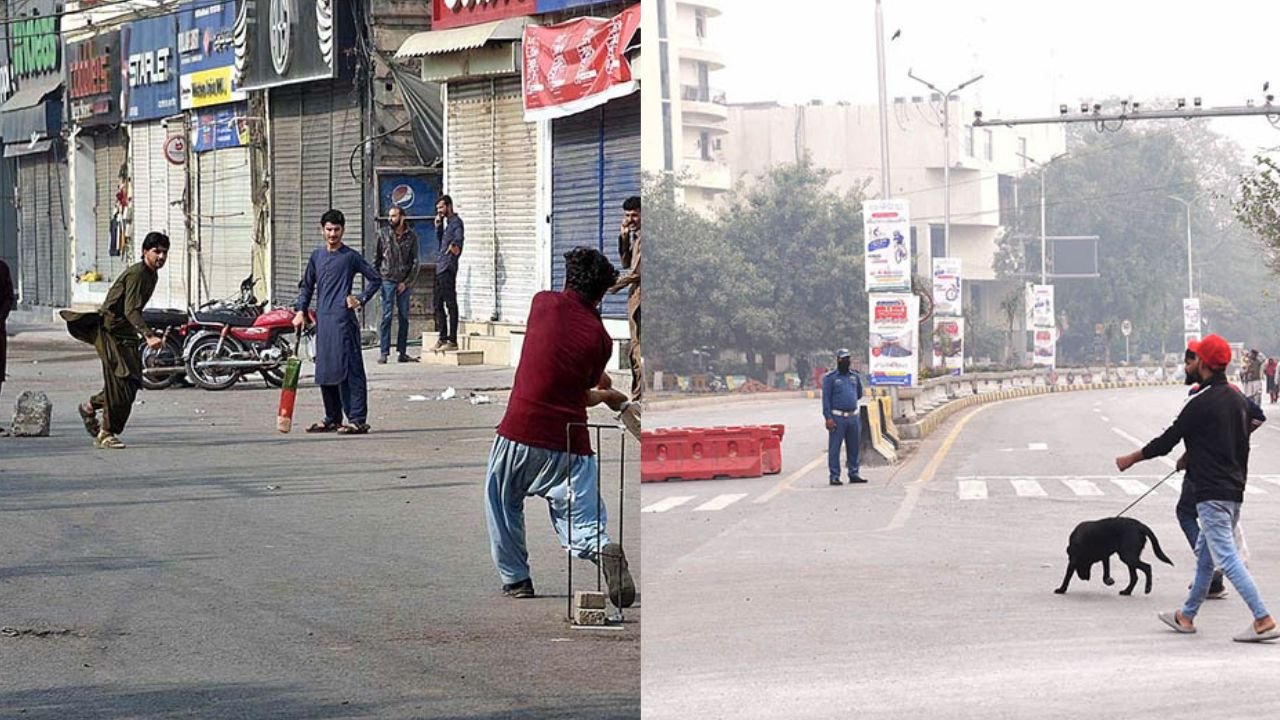
The government completely closed vehicular traffic on Mall Road for a day but the effort seemed futile as the AQI around the road was 458 in the morning while AQI in the DHA Phase 8 was 437, in Gulberg it was 412 and in Johar Town, it stood at 402, reports Dawn.
As of today, the air quality index of Lahore was recorded at 415 (extremely hazardous) around 10 a.m. and by the evening, when this report is being filed, it is standing at 305 (hazardous).
While Mall Road was totally barricaded, some markets and shops were found open despite restrictions till 4 pm on Sunday and people were thronging food points in Liberty Market, Ichhra and Anarkali Bazaar.
Netizens criticised the Punjab government for a lack of effective steps to counter smog.
A user posted about it being attributed to the endless construction in the city while others complained about it being lethal for citizens.
This is 10 minutes before sunset in Lahore. It’s not cloudy. This is smog. Growing up here I remember blue skies. Now we see it rarely, only after heavy rain. pic.twitter.com/8YpX39WErq
Smog proving to be deadly for children in Lahore. What causes smog? Surely, it can’t be crop burning; been happening for 100s of years. Biggest cause is uncontrolled, needless expansion of real estate housing projects, owned & operated by state affiliated institutions & tycoons.
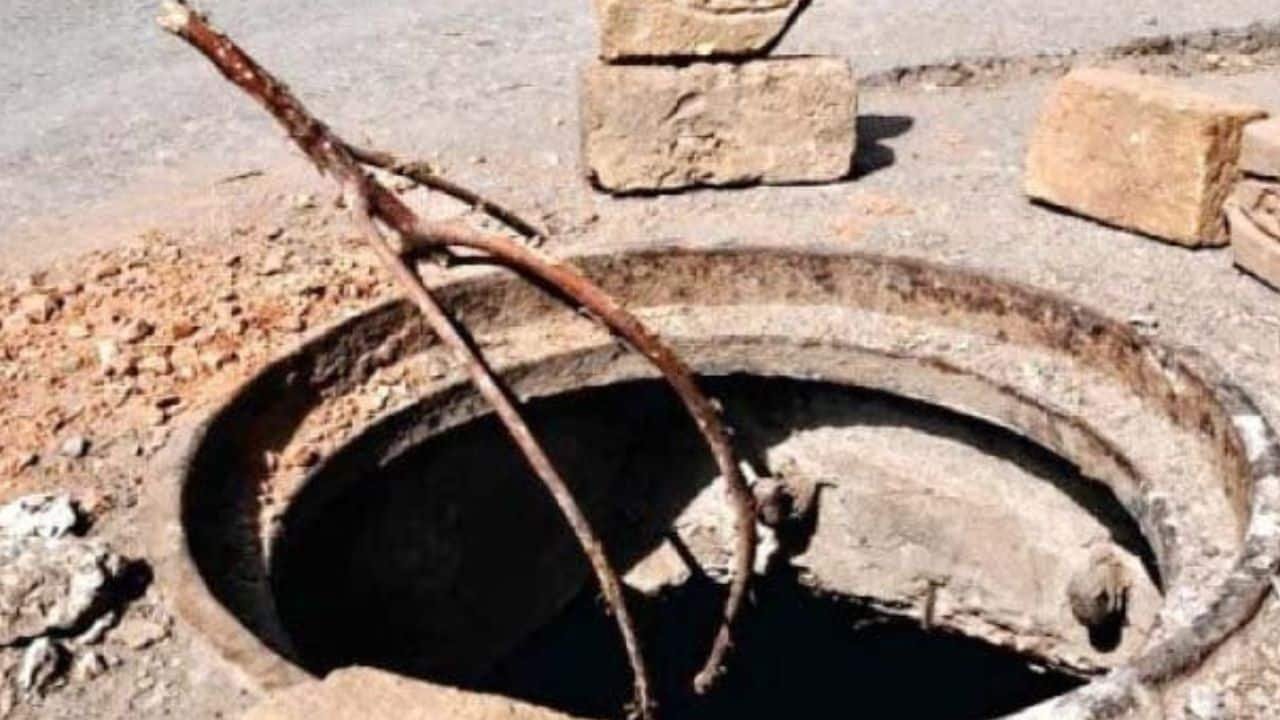
Muhammad Naveed, a blind man from Ali Husssainabad in Maraka, Multan Road fell in an open manhole. He reportedly went missing three days ago after saying he was going to the nearby stop. On his return, he fell in the open manhole, a 10 feet deep sewer, and remained there for three days.
Yesterday, passersby heard his cries and informed the shopkeepers on the street. They took immediate action, trying to pull Naveed out of the hole with the help of ropes. Meanwhile, the rescue team also arrived and helped speed up the process.
The sewage drain was right in front of the office of the National Highway and Motorway Police, reports Jang. Naveed was injured and was given first aid upon recovery.
Pakistan Tehreek e Insaf (PTI) Chairman Imran Khan’s lawyer Abuzar Salman Niazi revealed that Imran Khan is worried about his biceps while in jail.
He took to X (formerly Twitter) and said, “A lot of people are asking me whether this is true or not. Let me narrate what actually happened. As I and @BarristrUKNiazi were waiting for khan sb to come and see us on Thursday. As soon as he came, when we asked him if he is facing any problem in Jail. He said I am not affected by anything, even i can sleep on floor. But I can’t comprise on my muscles.”
A lot of people are asking me whether this is true or not. Let me narrate what actually happened. As I and @BarristrUKNiazi were waiting for khan sb to come and see us on Thursday. As soon as he came, when we asked him if he is facing any problem in Jail. He said I am not… pic.twitter.com/zYlKRCQstd
He further stated that Khan said his biceps are getting a little out of shape due to the non-availability of dumbbells.
He explained that he had requested many times for the provision of the same but was denied for no apparent reason.
Due to security issues, Khan can’t go to Gym like other poisoners.
He further stated, “All I have asked for is pair of heavy dumbles from my own expense which has been denied. In nutshell, jail has made Khan sab more determined and strong. All machinations of Govt to Pester him are counter productive and making him stronger.”
The Cases
The former prime minister is currently being held in Adiala Jail after his arrest from his Zaman Park residence in Lahore on August 5.
He was moved to the prison on September 26 from Attock Jail where he was initially kept after his arrest.
Khan was first convicted by a lower court in the Toshakhana case in August and sentenced to three years of imprisonment. The IHC suspended his sentence the same month.
The Islamabad accountability court issued arrest warrants for PTI Chairman Imran Khan in the Toshakhana and 190 million Al-Qadir Trust cases.
Khan was arrested in the Al-Qadir Trust case on May 9 for the first time.
The 190 million (approximately Rs60 billion) settlement case pertains to the money of property tycoon, Malik Riaz, being laundered and caught by the UK authorities during Imran’s government in 2019.
The UK government had informed the Pakistani authorities regarding the money being caught.
The former premier is already in prison as he was subsequently booked in the ‘cipher’ case.
In the cipher case, Khan, along with his close aide and former foreign minister Shah Mahmood Qureshi, has been accused of leaking state secrets.
Pakistani female Mixed Martial Arts (MMA) fighter Anita Karim has won two gold medals at the Siam Cup in Bangkok, Thailand.
Anita Karim won medals in the 55 kg/lightweight category as well as in the ‘Absolute’ category. In the lightweight category, she won against Japan’s Mayo Suzuki, Thailand’s Chutima Sala, and Sefa Phatidi.
She won the first two bouts by submission and the last by one point. In the absolute category, Anita Karim defeated Thailand’s Chautima Sala Sasethun Yahi and Tanyapuran Mangkalkeri. The first and third fights were won by submission while the second was won on points. Anita Karim is Pakistan’s first female MMA fighter to compete internationally.
Her brother Uloomi Kareem himself is an MMA fighter who recently fought on November 25, 2023, against Mohammad Mahdi of Iran on the same day as his sister.
Anita Karim’s six wins also resulted in her promotion to purple belt. She fought these fights as a blue belt but was promoted to purple after winning. 27-year-old Anita Karim has come a long way for a country like Pakistan where women’s participation in sports is minimal.
Eying each other across a stream of traffic, rival biryani joints vie for customers, serving a fiery medley of meat, rice and spice that unites and divides South Asian appetites.
Both sell a niche version of the dish, steeped in the same vats, with matching prices and trophies commending their quality.
But in Karachi, where a biryani craze boomed after the creation of Pakistan, it is the subtle differences that inspire devotion.
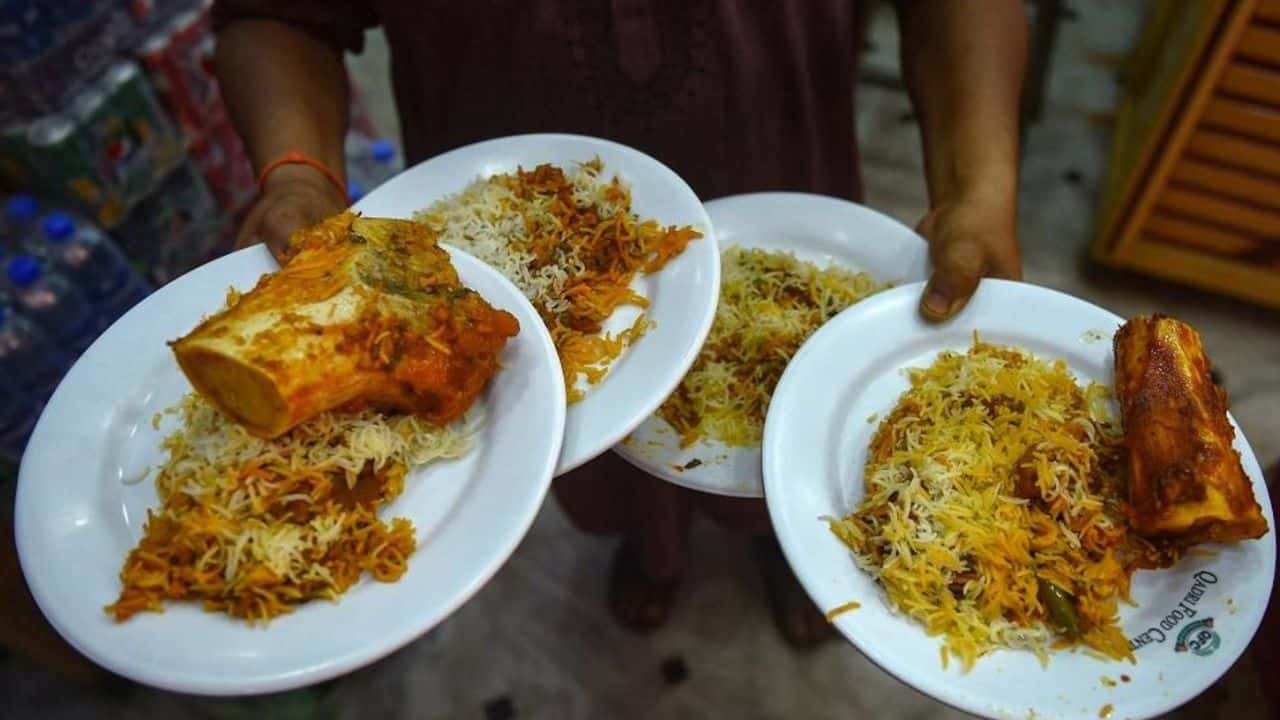
“Our biryani is not only different from theirs but unique in the world,” says restaurateur Muhammad Saqib, who layers his “bone marrow biryani” with herbs.
“When a person bites into it he drowns in a world of flavours,” the 36-year-old says.
Across the road, Muhammad Zain sees it differently.
“We were the ones who started the biryani business here first,” the 27-year-old claims, as staff scoop out sharing platters with a gut-punch of masala.
“It’s our own personal and secret recipe.”
Cooked in bulk, biryani is also a staple of charity donations. PHOTO: AFP
Both agree on one thing.
“You can’t find biryani like Pakistan’s anywhere in the world,” says Saqib.
“Whether it’s a celebration or any other occasion, biryani always comes first,” according to Zain.
British colonial rule in South Asia ended in 1947 with a violent rupture of the region along religious lines.
Hindus and Sikhs in newly created Pakistan fled to India while Muslim “Muhajirs” — refugees — went the other way.
Pakistan and India have been arch-rivals since, fighting wars and locked in endless diplomatic strife. Trade and travel have been largely choked off.
Many Muhajirs settled in Karachi, home to just 400,000 people in 1947 but one of the world’s largest cities today with a population of 20 million.
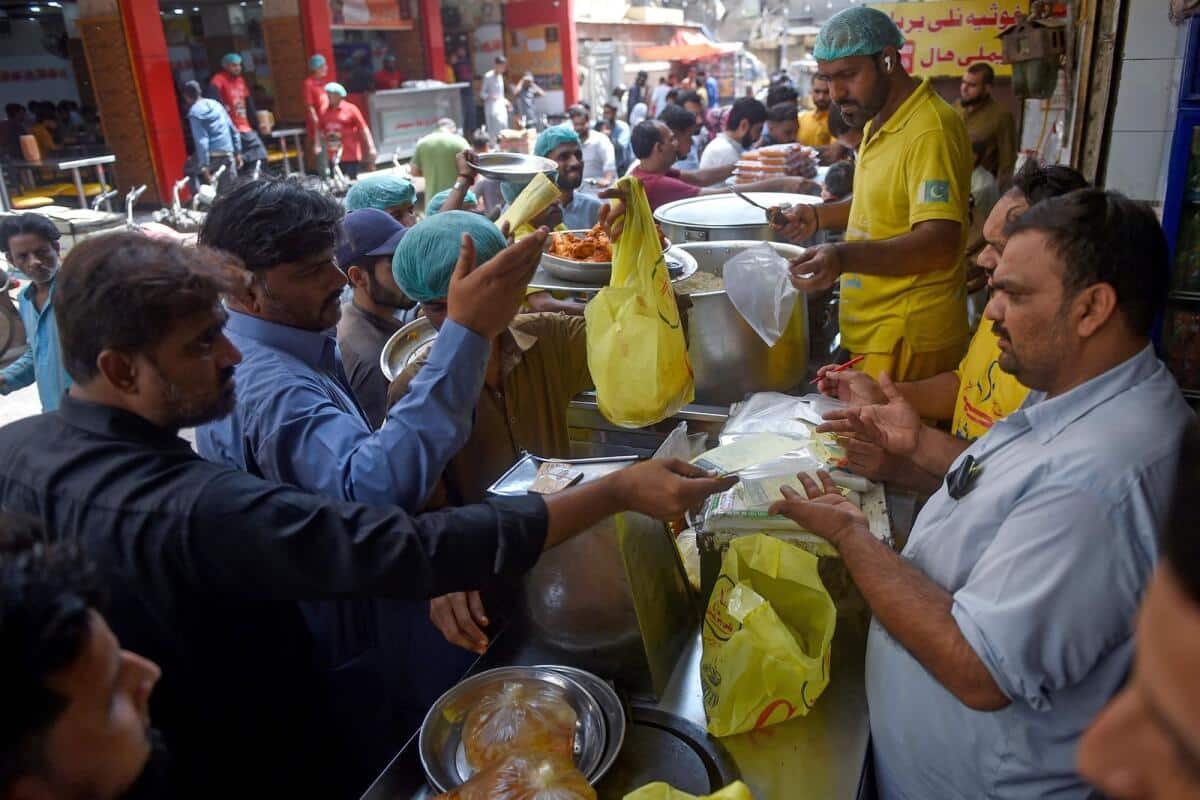
Every Karachi neighbourhood has its own canteens fronted by vendors clanking a spatula against the inside of biryani pots. PHOTO: AFP
For Indian food historian Pushpesh Pant, biryani served in South Asia’s melting-pot cities such as Karachi is a reminder of shared heritage.
“Hindus ate differently, Nanakpanthis (Sikhs) ate differently, and Muslims ate differently, but it was not as if their food did not influence each other,” he told AFP from the city of Gurugram outside Delhi.
“In certain parts of Pakistan and certain parts of India, the differences in flavours and foods are not as great as man-made borders would make us think.”
Every Karachi neighbourhood has its own canteens fronted by vendors clanking a spatula against the inside of biryani pots.
The recipe has endless variations.
The one with beef is a favourite in majority Muslim Pakistan, while vegetarian variants are more popular in largely Hindu India.
Chicken is universal. Along coastlines, seafood is in the mix.
And purists debate if adding potatoes is heresy.
“Other than that, there is Pulao Biryani which is purely from Delhi,” says 27-year-old pharmacist Muhammad Al Aaqib, describing a broth-stewed variation.
“My roots lead back to Delhi too so it’s like the mother of biryanis for us.”
“Perhaps every person has a different way of cooking it, and their way is better,” says 36-year-old landlord Mehran Khoso.
The origins of biryani are hotly contested.
However, it is generally accepted the word has Persian roots and it is argued the dish was popularised in the elite kitchens of the Mughal Empire, which spanned South Asia between the 16th and 19th centuries.
In spite of that pedigree, its defining quality is permutation.
Quratulain Asad, 40, spends Sunday morning cooking for her husband and son, Muhajir descendants of a family that arrived in Karachi from the Indian town of Tonk in 1948.
The origins of biryani are hotly contested. PHOTO: AFP
But at the dinner table, they feast not on an heirloom recipe but a TV chef’s version with a cooling yoghurt sauce and a simple shredded salad.
Asad insists on Karachi’s biryani supremacy.
“You will not like biryani from anywhere else once you’ve tasted Karachi’s biryani,” she says.
“There is no secret ingredient. I just cook with a lot of passion and joy,” she adds. “Perhaps that’s why the taste comes out good.”
Cooked in bulk, biryani is also a staple of charity donations.
At Ghazi Foods, 28-year-old Ali Nawaz paddles out dozens of portions of biryani into plastic pouches, which are delivered to poor neighbourhoods on motorbikes.
A minute after one of those bikes stops, the biryani is gone, seized by kids and young adults.
“People pray for us when they eat it,” says Nawaz. “It feels good that our biryani reaches the people.”