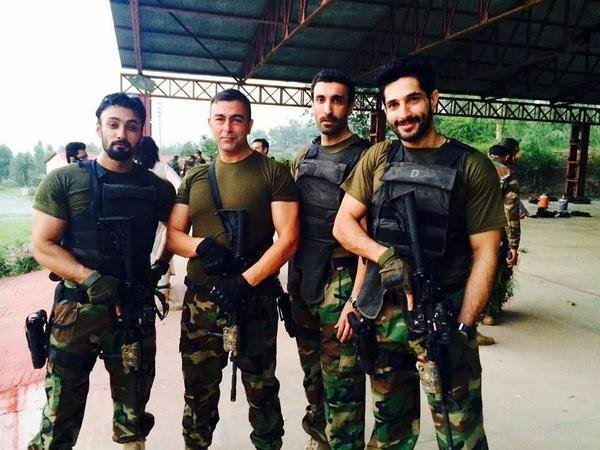
Pakistani actor Shaan Shahid reacted to a viral picture from his movie ‘Yalghaar’ after an ex-Indian army officer tweeted a photo of Pakistani actors, falsely claiming that they were Pakistani soldiers who had been martyred in Panjshir Valley in Afghanistan. Apart from Shaan, others actors in the picture include Umair Jaswal and Bilal Ashraf.
Shaan responded to the tweet by sharing his movie poster and said, “Hello from the other side. Pakistan Zindabaad!”
The confusion started after a former Indian army officer, Maj Gen GD Bakshi, claimed on Twitter that the Pakistan Army had suffered heavy casualties in Panjshir Valley.
A Twitter user mocked Bakshi by sharing a picture from the set of Pakistani movie ‘Yalghaar’ and wrote: “My class fellow from school days Maj Aijaj 2nd from left and Capt Jufar 1st from left embraced martyrdom in Panjshir. They were buried yesterday in Peshawar. ISPR is trying to hide these casualties. They fought bravely and should be honoured as such. This is injustice by Pak Army.”
My class fellow from school days Maj Aijaj 2nd from left and Capt Jufar 1st from left embraced martyrdom in Panjshir. They were buried yesterday in Peshawar. ISPR is trying to hide these casualties. They fought bravely and should be honoured as such. This is injustice by Pak Army pic.twitter.com/sOx16xpAol
Earlier, an Afghan journalist mistook Pakistan Tehreek-e-Insaf (PTI) MNA Aamir Liaquat as a martyred soldier in Afghanistan.
Indian news channels, Republic TV, and Zee Hindustan ran visuals from a video game — Arma-3 — stating that it was the Pakistan Air Force (PAF) attacking the anti-Taliban fighters.
Then a Twitter user shared a picture of a fighter jet, claiming that a PAF plane was shot down in Afghanistan’s Panjshir Valley. Later, a fact-check byDawn showed that the picture is actually from 2018 in the United States.
Bakshi, who has had a long career in the Indian army, is known for spreading fake news. An article by Indian publication The Print last year referred to him as the “shrillest warmonger in the media”, as per Dawn.
The report says, “The brutal rulers [US leaders] figured out that the best way to get away with mass abuse was to label it a fight against terrorism.”
Furthermore it states, “The war paradigm was also used to justify killing suspects wherever they were found, often on the flimsiest of evidence. However, international human rights law requires law enforcement officials to arrest suspects whenever possible and to use lethal force only as a last resort to stop an imminent threat to life.”
“They [US] not only mistreated the people of Afghanistan but its citizens also had to face discrimination. Globally, Muslims are the primary victims of terrorism. The US has always treated ‘presumed terrorists’ as combatants,” the report reads.
HRW also has discussed the ill-treatment of one million Uyghurs in Xinjiang, China and the bombings on Gaza by Israel.
“It is a time to condemn the evil of terrorism. It is also the time to close Guantanamo, by releasing all of the 39 aging detainees still there, who have not been charged and giving the rest a fair trial in a proper court,” the report concluded.
People from all over the world remembered the horrifying episode today on social media, while some of them share their stories.
On this 20th anniversary of 9/11, we remember every parent, brother, sister, friend, and colleague that was stolen from us in the Twin Towers, the Pentagon, and in a field in Shanksville, PA. We must always honor their sacrifice and never forget them. #September11#911Anniversarypic.twitter.com/6TqW0xaEuI
Never Forget #September11 Even in the horror of that day, beyond the tragedy and evil, faith endured and God showed Himself. I was struck by the spontaneous outpouring of devotion and belief in the aftermath of 9/11. There has been no national expression to match it in 2 decades. pic.twitter.com/wZs5YSlFaX
One of my most vivid 9/11 memories is being evacuated from my office building (blocks from the White House) & seeing crowds of people on Connecticut Ave looking up nervously at the sky, fearing (as rumored) that another hijacked plan may be approaching to strike the White House.
Since 2001, the notorious military prison at Guantanamo has become a symbol of US human rights abuses. Many detainees — mostly Muslim men — were tortured or held for years and even decades without charges, trials, or basic legal rights.
The 9/11 attacks are the deadliest terrorist attacks on American soil in US history. It was a series of airline hijackings and suicide attacks committed by 19 militants associated with al-Qaeda.
The death of Rahimullah Yusufzai is a terrible blow to journalism – not just in this region, but at a global level. He was one of the best-known and most well-respected journalists on the subject of the Afghan conflict and considered an authority on the Taliban and Al-Qaeda. With his passing we have lost not just an important source of context and information, we have lost a master practitioner of this craft, somebody who was dedicated to truth and accuracy, and who was always ready to go into the field, talk to people, find the story, understand the context.
Despite his considerable fame, Rahimullah sahab, as we always called him, remained modest about his achievements and very down to earth about everything. What I most remember about him was his enthusiasm for his work and the professionalism with which he did it. In the three decades, I knew him, he never turned down a request for an interview or a story – even if this was a very short notice.
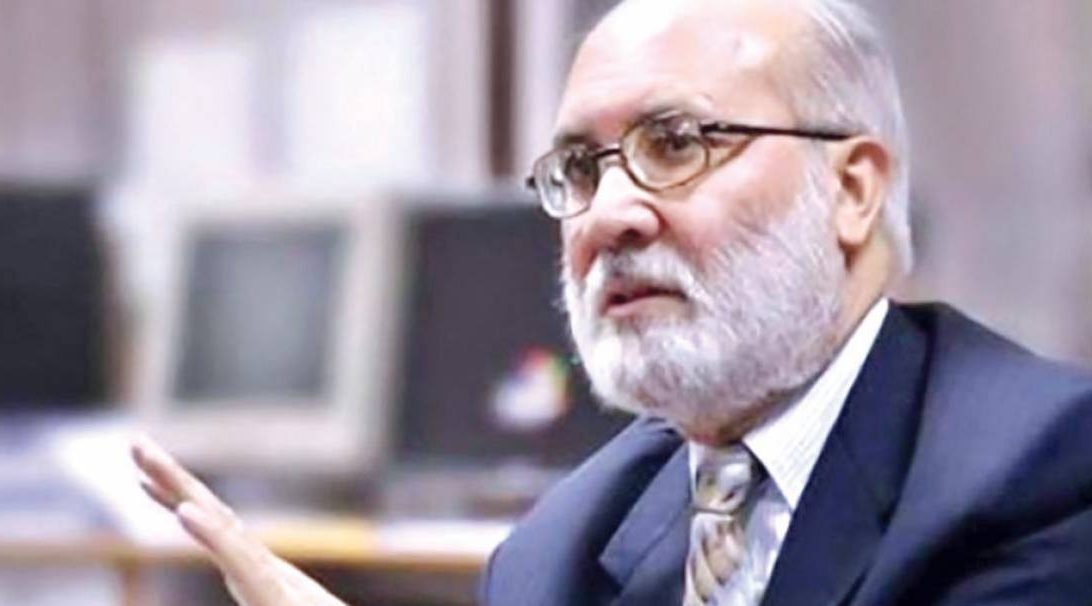
In this picture, late Rahimullah sahab, Resident Editor of The News is seen working in his office
Rahimullah sahab was recommended to Newsline in 1989 by another journalist (I think it was Aziz Siddiqui, then editor of the Frontier Post). At that time, he worked for the Frontier Post in Peshawar and Rahimullah sahab would file the monthly political roundup from the province for us. His copy was impeccable and his political insights sound but what was also very interesting was his readiness to write on other subjects. We would ask about possible writers or reporters for sports and culture stories and he would offer to do everything himself. I remember a few responses like: “Sports – that’s my first love! I can do that for you,” and “Culture, I can cover that for you.” And he really could. He was extremely versatile; a story he did on Pashto cinema was one of Newsline’s greatest hits.
Newsline, founded by Razia Bhatti, was an independent, journalist-owned venture and we often struggled with finances but Rahimullah sahab was a great supporter in those early years and he remained so throughout his life. In March this year – just six months ago – he was a guest speaker at the IBA Centre for Excellence in Journalism’s Razia Bhatti Memorial lecture. It was indeed a privilege to have him deliver the lecture in which he spoke specifically about his 1998 interview with Osama bin Laden (OBL) and more generally about reporting on the Taliban and Al-Qaeda.
Earlier press briefing with OBL 1998
The event was titled ‘Tea with Osama bin Laden’, and despite being a virtual event, it was extremely well attended. After Kamal Siddiqui of CEJ, Akbar Zaidi of IBA and I had said a few introductory words, Rahimullah sahab began his talk by saying how “humbled and honoured” he was by what had been said. We had only stated facts and talked about his achievements and reputation. I had also spoken about his great sense of professional solidarity, but the fact that he was so touched by what we said showed how modest he remained about his achievements.
The talk itself was extremely interesting and full of detail. His account of a 1998 presser with OBL was fascinating. He recalled that he asked OBL a number of awkward questions, one of which was how wealthy was he. In response, OBL had put his hand on his heart and said he was rich (‘ghani’) in there and thus deflected the enquiry. There was a lot of interesting detail in his account of the OBL interview, which took place a few months after the press briefing — how it was arranged, what constraints there were, how he was asked to destroy a photo he took of OBL entering the tent because Osama bin Laden was walking with the aid of a stick and the organisation “didn’t want him to look weak”.
In the Q&A session after the talk, Rahimullah sahab also spoke about a number of other experiences and issues. When asked about any advice he wanted to remind journalism students of, he said the most important issues were just “hard work and honesty”. He emphasised the need for proper preparation and research (tayari). He also said laughingly that he was perhaps the person who had taken the most photographs of OBL but that in the early years, he had sold them to various outlets, not for very much money. That sounds right, Rahimullahsahab was very much a person who wanted to get on with his work rather than promote his own persona or negotiate lucrative deals for his work.
We also talked about the Sharbat Gula matter. Sharbat Gula was the green-eyed Afghan girl whose photograph had appeared on the cover of National Geographic in 1984, and who was featured again by the publication more than a decade later (and who Pakistan, rather pointlessly, deported in 2016 despite her having lived in the country for decades). Rahimullah sahab was the person who traced her for National Geographic after all those years and he spoke about that and how he was able to negotiate with the publication on her behalf. He needn’t have done that — many journalists would have looked only to their own interests but Rahimullah sahab made sure to help Sharbat Gula’s family to get something from the magazine (medical aid, Hajj expenses, and a small monthly stipend). He said he had never mentioned all of this publicly before but now he was putting it into his book. When asked when we might see this book completed, he lamented he wasn’t able to give enough time to this because the misfortune of a working journalist like himself was he was always so involved with various deadlines on a daily basis. He also mentioned the financial pressures journalists in Pakistan were facing and how his employers had not paid their staff for months.
He recalled that a CNN producer who had once interviewed OBL had managed to produce two books based just on that one meeting and how so many others who had met Osama had managed to get so much mileage out of the experience. He said somehow the fascination with the man and the movement continued, yet he himself had not really taken advantage of this, but that he would record such experiences in his book.
But now Rahimullah sahab is gone. We don’t know if any part of his book is complete or whether it was in notes and planning form. But he does leave behind a vast body of work in journalism. He is now invariably described as a ‘veteran’ journalist, which is apt: he covered the Afghan conflict for years and interviewed nearly every Afghan leader of consequence, including Dr Najeebullah and several leading mujahideen. He had a rare insight and understanding of the politics of his own country and province. He leaves behind a tremendous void – not just was he an experienced reporter and an informed analyst, he was an invaluable source of information and one of the people still practising the craft of journalism with integrity and commitment.
Apart from his enthusiasm for his work, his meticulous attention to detail and fact-checking, and his ability to present a balanced and factual picture, what I shall remember also about Rahimullah sahab is the tremendous grace and dignity with which he always conducted himself – whether on reporting assignments, in international conferences or in small villages. He was never one to curry favour or be impressed by pomp or power. He always remained essentially a journalist: looking for stories, talking to people, ascertaining the facts, and abiding by the basic principles of journalism.
Rahimullah sahab towered above most of his colleagues physically in his life but professionally too, he was a giant of the profession. We shall all miss him very much.
Federal Minister for Finance and Revenue Pakistan, Shaukat Tarin has said that Pakistan may have to send experts to Afghanistan because of the country’s major experts have left the country which has complicated the Taliban’s administration, reports The News.
While giving an extensive briefing to the Senate Standing Committee on Finance on Thursday, Mr Tarin said that the government was building up strategic reserves of essential food commodities to meet domestic as well as Afghanistan’s requirements.
According to him, “they [Afghanistan} require assistance and we may have to dispatch experts because of the brain drain in Afghanistan. The situation is fluid and we are analysing it. The West has stopped foreign reserves of Afghanistan to the tune of $10 billion, as the IMF has stopped $400 million and many others so Kabul will be facing a scarcity of foreign exchange. Our bilateral trade will surge but we may have to undertake bilateral trade in the Pak rupee.”
Talking about Pakistan’s economic situation he stated, “Pakistan’s trade deficit stands at $4 billion and remittances are hovering around $2.5 billion.”
“On tax revenue, FBR revenues are ahead of target by 23 percent. The track and trace system will be placed for five major sectors. The Point of Sale (POS) will integrate receipts and standardised and frivolous notices will be withdrawn,” he assured.
More than 120,000 people evacuated from Afghanistan are qualified professionals from civil servants to lawyers.
Michael Barry, a specialist on Afghanistan who taught at the American University in Kabul, said that many members of the Taliban are from rural areas and lack the knowledge to run the state bureaucracy, as perAgence France-Presse (AFP).
Adding to a list of Taliban atrocities, two Afghan Journalists were left with immense bruises in Kabul. Their crime: covering protests in the Afghan capital.
According to Taqi Daryabi and his colleague Nematullah Naqdi, of the daily newspaper Etilaat Roz (Information Daily), the Taliban separated them into two rooms, insulted, and flogged them with cables after accusing them of organising the protest as per Agence France-Presse (AFP).
The two were reporting on a protest by women demanding the right to work and education in front of a police station.
Naqdi said he was stopped by a Taliban fighter as soon as he started taking pictures.
“They told me that you cannot film’,” he told AFP. Moreover he said that Taliban fighters insulted him and kicked him in the head and that a Taliban fighter placed his foot on his head and crushed his face against the concrete. When he was asked why he was being beaten, he was told, “you are lucky you weren’t beheaded.”
Zaki Daryabi, the daily newspaper publisher told Committee to Protect Journalist (CPJ) via phone that the Taliban subjected the reporters to severe physical abuse that he described as “torture” for four hours that each lost consciousness at least four times in custody. However, CPJ could not independently confirm allegations of torture.
According to the BBC, their journalists were also prevented from filming. Not only this, Al-Jazeera reported that three of their reporters said that Taliban fighters pushed, slapped them and took their belongings.
Over the last days, the Taliban detained and later released at least 14 journalists covering protests against the group, At least nine of these journalists were subject to violence during their detention.
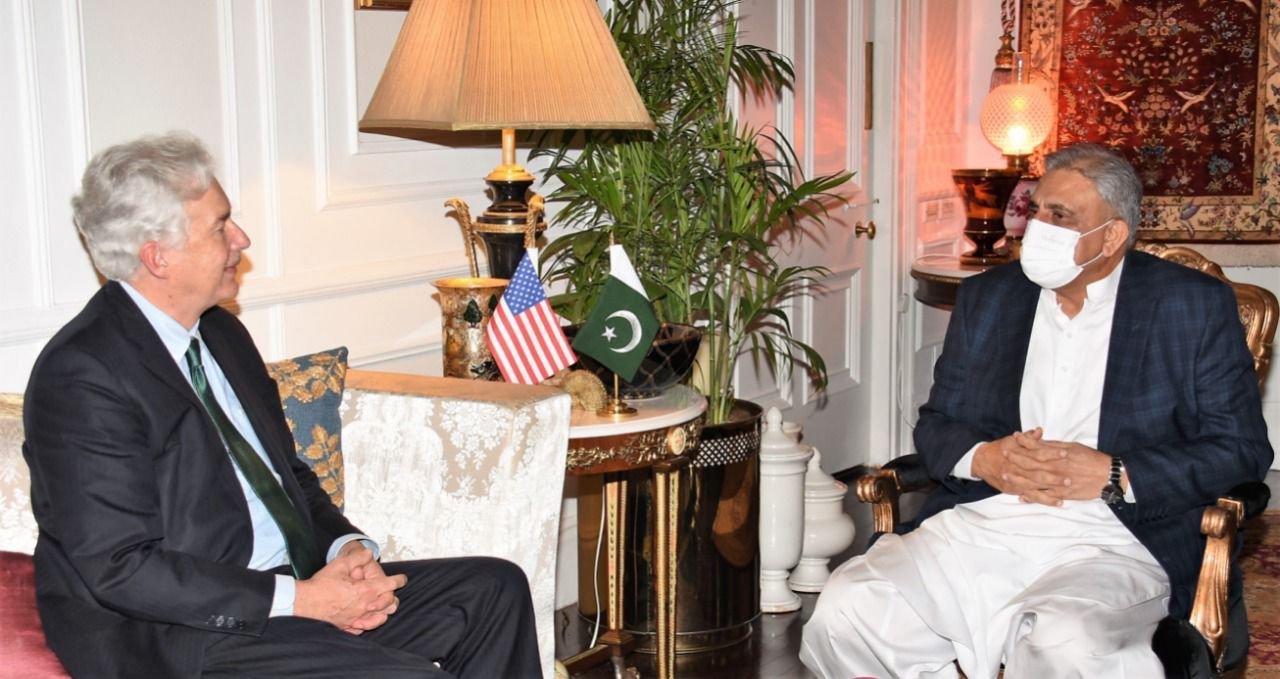
Chief of Army Staff (COAS) General Qamar Javed Bajwa along with Inter-Services Intelligence (ISI) Director General Lt-Gen Faiz Hameed held a meeting with Central Intelligence Agency (CIA) Director William Joseph Burns.
During the meeting, matters of mutual interest, regional security, and the current situation in Afghanistan were discussed, the Inter-Services Public Relations (ISPR) said in a statement.
“It was reiterated that Pakistan remains committed to cooperating with its international partners for peace in the region and ensuring a stable and prosperous future for [the] Afghan people,” the ISPR said.
The CIA chief appreciated Pakistan’s role in Afghanistan, including the successful evacuation operation, efforts for regional stability, and pledged to play a role for further improvement in diplomatic cooperation with Pakistan at all levels.
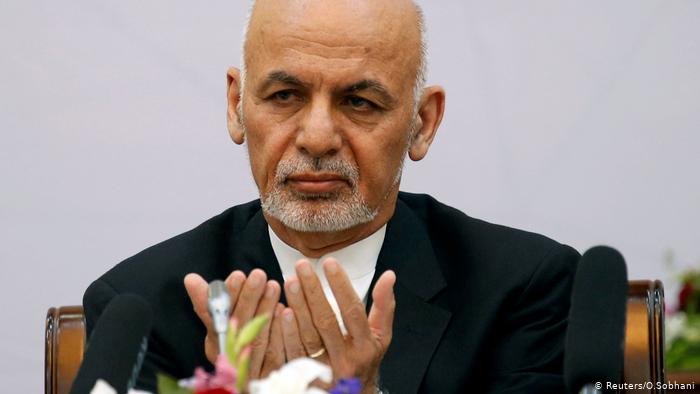
Former Afghan President Ashraf Ghani, in a statement posted on Twitter, said: “It is with deep and profound regret that my own chapter ended in similar tragedy to my predecessors — without ensuring stability and prosperity. I apologise to the Afghan people that I could not make it end differently.”
“Leaving Kabul was the most difficult decision of my life, but I believed it was the only way to keep the guns silent and save Kabul and her six million citizens,” said Ghani.
“If I stayed, there was a risk of the same horrific street-to-street fighting the city had suffered during the Civil War of the 1990s.”
“Corruption is a plague that has crippled our country for decades, and fighting corruption has been a central focus of my efforts as president,” he said, adding that he and his Lebanese-born wife were “scrupulous in our personal finances”.
“I have publically declared all my assets. My wife’s family inheritance has also been disclosed and remains listed in her home country of Lebanon,” said Ghani.
“I welcome an official audit or financial investigation under United Nations (UN) auspices or any other appropriate independent body to prove the veracity of my statement,” added Ghani.
He appreciated the sacrifices the Afghans had made over the past 40 years of war in their country.
President Dr Arif Alvi has said that if anyone wants to leave the ideology of the banned Tehreek-e-Taliban Pakistan (TTP) and work as per the Constitution of Pakistan, the government may consider a general amnesty.
Speaking onDawn News programme, ‘Khabar se Khabar’, President Alvi said, “The TTP is a threat to us. We have been told that they will stay with them [Afghan Taliban] but do nothing against Pakistan.”
“It’s one step, Pakistan will consider general amnesty, if anyone surrenders,” further added Alvi.
Earlier, Afghan Taliban spokesperson Zabiullah Mujahid had said in an interview that TTP is not a problem of Afghanistan but of Pakistan, so it is Pakistan’s job to formulate a strategy in this regard.
“If TTP believes in our followers and our Amir-ul-Mominin, then they [TTP] will have to follow them as well,” added Mujahid.
The detailed interview of the president is yet to be aired on Dawn News. A short teaser of the show was aired by the channel on Wednesday.
Cricket Australia (CA) warned to cancel the Test match against Afghanistan in November if women are not allowed to play the sport under the Taliban regime.
The updated stance from CA follows the developments on Wednesday where the Taliban indicated that women would not be able to participate in sport, including cricket.
The planned historic maiden men’s Test between Australia and Afghanistan appears almost certain to be cancelled #AUSvAFG
In a statement released on Thursday, Cricket Australia confirmed it would be unable to proceed with the planned Test at Hobart’s Blundstone Arena from November 27 if news reports of Taliban views on the women’s game were true.
“Driving the growth of women’s cricket globally is incredibly important to Cricket Australia,” the statement said.
“Our vision for cricket is that it is a sport for all and we support the game unequivocally for women at every level.”
“If recent media reports that women’s cricket will not be supported in Afghanistan are substantiated, Cricket Australia would have no alternative but to not host Afghanistan for the proposed Test Match due to be played in Hobart,” it added.
The ICC has said that Afghanistan’s status in the international game will be discussed at their next board meeting but that is not scheduled until November, which raises further questions about their participation in the T20 World Cup.
Afghanistan is the only Full Member to have received that status without having an operational women’s team in place. Last year, the Afghanistan Cricket Board had announced their first contracts for women as they looked to build a team.
The Taliban spokesperson has said that the Afghan women, including the country’s women’s cricket team, will be prohibited from participating in sports under the new Taliban regime, The Gurdian has reported.
Ahmadullah Wasiq, the deputy chairman of the Taliban’s culture commission, claimed in an interview with Australian network SBS that women’s sport was neither appropriate nor required.
“I don’t think women will be allowed to play cricket because it is not necessary that women should play cricket,” Wasiq said. “In cricket, they might face a situation where their face and body will not be covered. Islam does not allow women to be seen like this”.
“It is the media era, and there will be photos and videos, and then people watch it. Islam and the Islamic Emirate [Afghanistan] do not allow women to play cricket or play the kind of sports where they get exposed.”
On September 7, Taliban spokesperson Zabihullah Mujahid announced members of the new interim government in Afghanistan. Afghanistan will be led by Mohammad Hasan Akhund while the group’s co-founder Abdul Ghani Baradar will be the deputy Afghan leader.