Tag: Ahmad Faraz

  • ‘People should rise in love’: social media users defend viral Sajal Aly quote about relationships

    ‘People should rise in love’: social media users defend viral Sajal Aly quote about relationships

    Actress Sajal Aly is once again going viral on the internet but for a very absurd reason. A user on X (formerly Twitter) shared a clip of the actress speaking at a red carpet interview.

    When asked about her opinion on relationships, the ‘Ye Dil Mera’ actress said:

    “People will start rising in love instead of falling in love,” responded Sajal. “You know what I mean? You know we say ‘fall in love’, why do you fall in love man? Just rise in love!”

    The user who shared the tweet mocked the actress but other tweeps defended the actress by pointing out ‘rising in love’ is a healthier alternative approach to relationships, where one is encouraged to gain a fresh insight to life after meeting someone new, even by sharing how previously writers and films defending this concept.

    A user shared a quote from Toni Morrison’s book ‘Jazz’ which talked about the same concept of rising in love.

    “Nobody gave you to me. Nobody said that’s the one for you. I picked you out. Wrong time, yep, and doing wrong by my wife. But the picking out, the choosing. Don’t ever think I fell for you, or fell over you. I didn’t fall in love, I rose in it. I saw you and made up my mind. My mind. And I made up my mind to follow you too.”

    Another user shared a quote from the 1999 Bollywood movie ‘Taal’ where a dialogue was: “Pyar Mein Giro Mat Bachche … utho, Rise in Love.”

    Another shared the proclaimed Urdu poet Ahmad Faraz had defended the same concept in an article and spoke about the need to rise in love rather than fall in it.

    Another user shared a clip by screenwriter and producer Jemima Khan, who had also worked with Sajal for ‘What’s Love Got To Do With It’ and had spoken in an interview about encouraging more women to walk into love rather than fall in it.

    Other users defended the actress’s healthy approach to love by pointing out that it should make people better, not encourage them to submit themselves entirely to another person.

    Exactly our point. Please go touch grass or read a book before coming after female celebrities this way.

    Some also slammed the user for indirectly mocking the actress’s English skills, and criticised trolls today for relentlessly targetting female actresses for small reasons.
  • After Imran Khan, Maryam Nawaz too recommends ‘The Forty Rules of Love’

    Pakistan Muslim League-Nawaz (PML-N) Senior Vice President Maryam Nawaz has revealed her favourite books, writers, poets and thinkers in a recent interview.

    In an interview with a web channel, Maryam Nawaz said that her favourite reading genre is Fiction and History. She went on to name her favourite writers who’s books she enjoyed reading while she was incarcerated.

    “A few fiction writers are close to reality; I read them a lot, like Paulo Coelho. I really like his Alchemist and Warrior of Light. Elif Shafak is another writer whom I enjoy reading. One of my most favourite books is The Forty Rules of Love. There is a book called, The Seat of the Soul and Twilight in Delhi; I have really enjoyed reading them,” said Maryam.

    She stated that she preferred books with a historical background.

    Moving on to poetry, Maryam said she loves reading the work of Irish poet Seamus Heaney, especially his work on freedom. Recalling her time in jail, Maryam said that was the first time she could read Urdu novels and poetry.

    “One has a lot of time in jail, so I miss how I used to read there. I read the work of Ahmad Faraz, Sahir Ludhianvi, Parveen Shakir and Amjad Islam Amjad. Apart from this, I have enjoyed reading the work of thinkers and even implemented their philosophies in my life. I have really enjoyed the work of Francis Bacon and Friedrich Nietzsche.”

  • Another Faraz, Another Era

    Another Faraz, Another Era

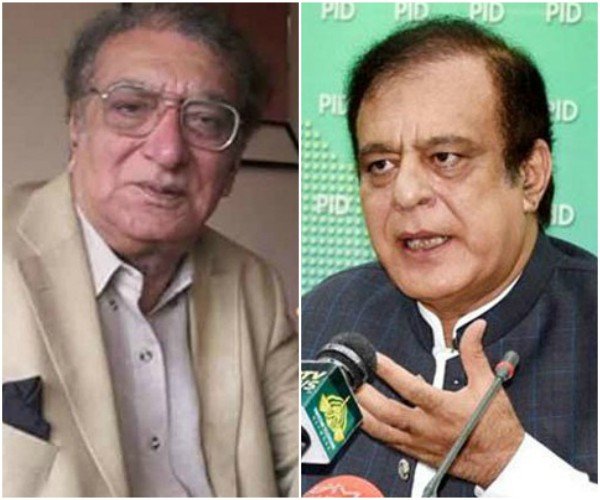
    Today Faraz’s son speak for a regime that is often described as ‘hybrid’

    Pakistan’s information minister is seen more and more on the TV screen nowadays. There he is on nearly every channel, —giving briefings, answering questions and being interviewed, cool and collected, smirking his way through the questions as he talks of PTI’s political opponents and assures journalists that his government is doing amazing things for the country.

    It is, of course, commendable that the minister is so accessible to journalists and so happy to dominate screen time, but every time I see him on the box I cannot help but wonder if his father would’ve supported such a regime.

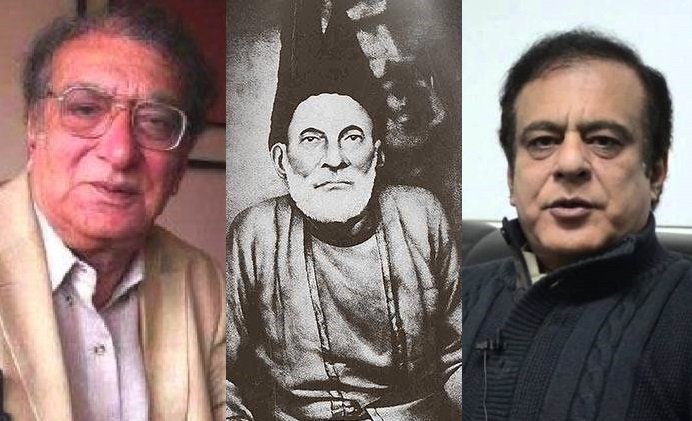
    Ahmed Faraz was one of the greatest Urdu poets of the twentieth century. And along with poets like Faiz Ahmed Faiz and Habib Jalib his poetry has also documented the political and social struggles of the the time. One particular poem of Faraz did become very controversial and reportedly there was a period in which he denied that it was his work. The reason is because that particular work (“…Tum Sipahi Nahin”) is extremely critical of martial tyranny and bloodshed and harks back to the attitude of the army during the bloody civil war which resulted in the secession of East Pakistan and the creation of Bangladesh.

    That poem is chilling. Read it (or listen to a recital) today and your blood will run cold. Through verse the poet tells of a terrible disillusionment and declares that his pen will not write lies or propaganda as it is not a weapon to be used by tyrants but rather is the instrument of the people, the awam. “Mera Qalam tow amanat hai meray logon ki.” He talks of a military that uses force  against its own people, of tyrants who talk of justice but practise cruelty and encourage hatred. The poem harks back not just to the civil war but to numerous political upheavals and regime changes and conflicts — and the words are spine chilling.

    Listen to the verses and it is not difficult to see why Faraz was forced to deny the poem and why at one time it was circulated secretly by people. I’m not sure if he ever spoke, on the record, about what the repercussions were for him of writing that poem, but I imagine the consequences could not have been pleasant. And perhaps it was these consequences that convinced his family members that such lofty principles are simply not paying such a high price for.

    Today Faraz’s son speak for a regime that is often described as ‘hybrid’ and represents a government that works very closely with the institution whose very attitudes and actions are criticised in this poem. It seems the fact is indeed stranger than fiction. Or perhaps we should just call this ‘progress’.

    But listen to this particular poem in the context of present day Pakistan and one thing becomes clear: it doesn’t matter what compromises people like Faraz might make in later life if they are able to leave behind them such creations, creation that lives on long after they are gone and reverberate so strongly still. This is art but it is also social history and a lasting testament to political struggle and the fight for justice, it is the reminder of a dark night and of the people who fight for the dawn of justice and for an end to oppression and division. The poem is also an acknowledgement of the duty of the writer, a reiteration of the poet’s responsibiltity to document and resist tyranny “aaj shayir par yeh qarz matti ka hai” — he says the situation is serious and his words are written not with ink but in blood “aaj is qalam may lahu hai siyahi nahin”.

    Today Faraz’s son speak for a regime that is often described as ‘hybrid’ and represents a government that works very closely with the institution whose very attitudes and actions are criticised in this poem. It seems the fact is indeed stranger than fiction. Or perhaps we should just call this ‘progress’.

  • Info minister Shibli Faraz shares ‘father’s poetry’, is told it is not Ahmad Faraz but Ghalib’s ghazal

    Info minister Shibli Faraz shares ‘father’s poetry’, is told it is not Ahmad Faraz but Ghalib’s ghazal

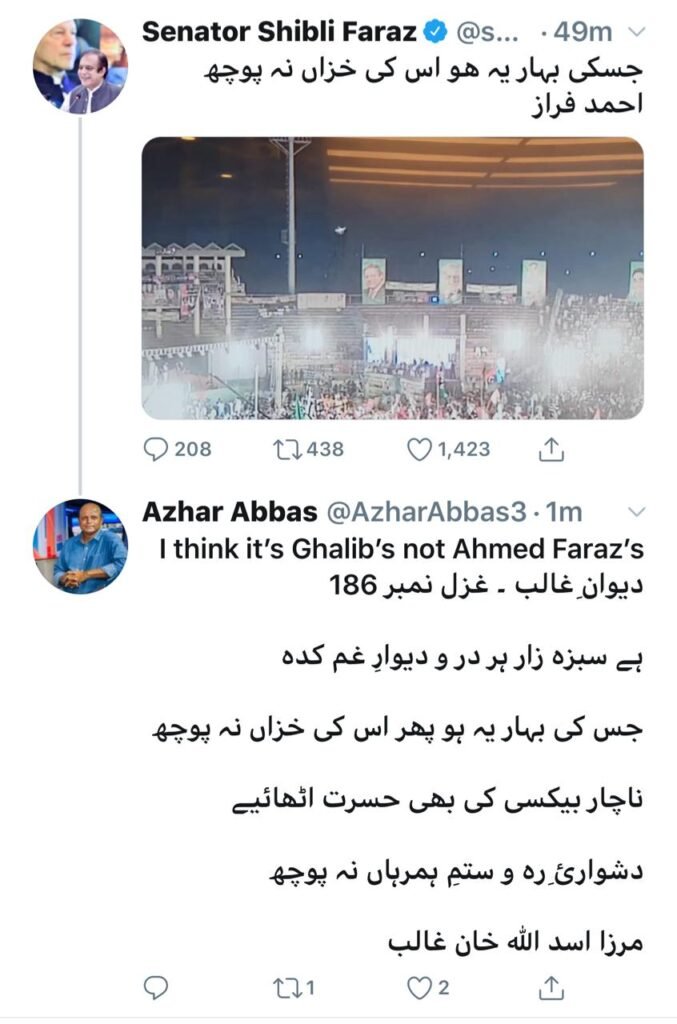
    In a rather embarrassing development, Federal Minister for Information Shibli Faraz on Friday had to delete a tweet criticising the opposition after he was told that the poetry he had shared as that of his father, Ahmad Faraz, was actually a ghazal by Mirza Ghalib.

    Jiski bahaar yeh ho uski khizaa naa pooch [don’t ask about the autumn of whose spring is this],” the minister said in the deleted tweet aimed at mocking the joint opposition for what the government called was “an empty stadium” in Gujranwala during the maiden public gathering of the opposition parties’ anti-government campaign.

    The tweet was deleted after journalist and Geo News Managing Director Azhar Abbas told him that the phrase the minister had attributed to his father and late poet Ahmad Faraz was actually from a ghazal by classical Urdu poet from the 19th Century, Mirza Ghalib.

    “I think it’s Ghalib’s not Ahmad Faraz’s,” Abbas tweeted.

    Shibli Faraz, who is serving as the federal minister for information and broadcasting since April 28, 2020, is a member of the Senate from Khyber Pakhtunkhwa (KP) since 2015. He is the son of the late renowned poet Ahmad Faraz, who was displaced by dictators for also being a vocal critic of military rule.