The Lahore High Court (LHC) on Thursday heard petitions regarding environmental issues, including smog. During the hearing, an official of the Punjab Disaster Management Authority (PDMA) told the court that increase in the consumption of grilled fish and BBQ in the winter season was one of the factors contributing to pollution and smog.
The official also asked the court to order early closure of these (BBQ) shops. However, the suggestion was not approved by the court.
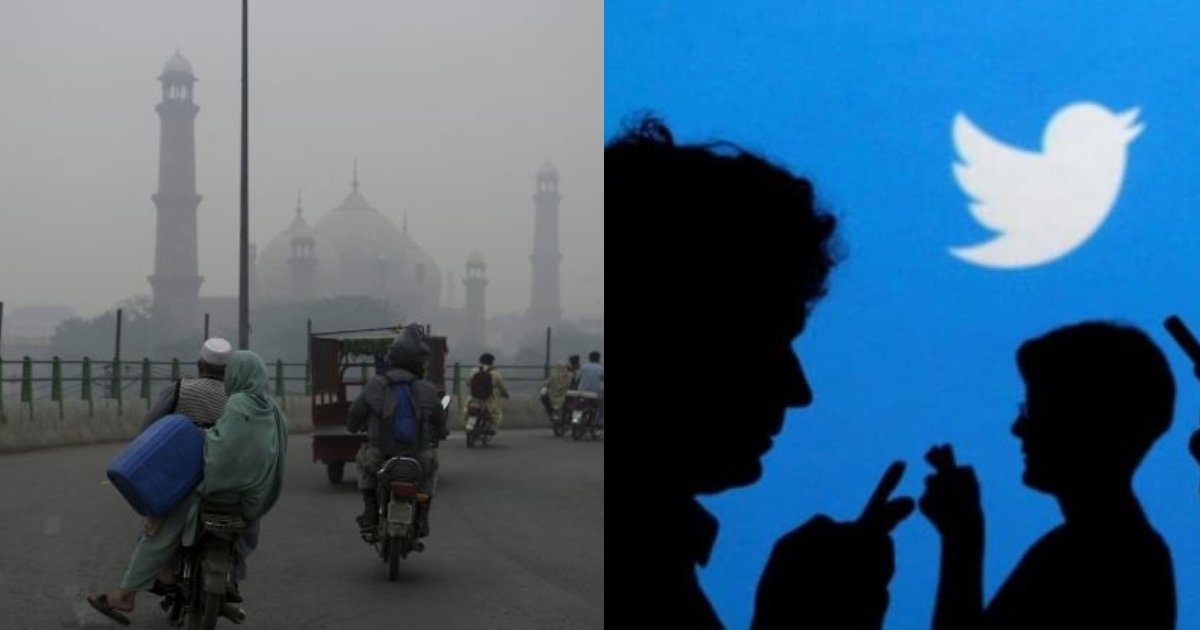
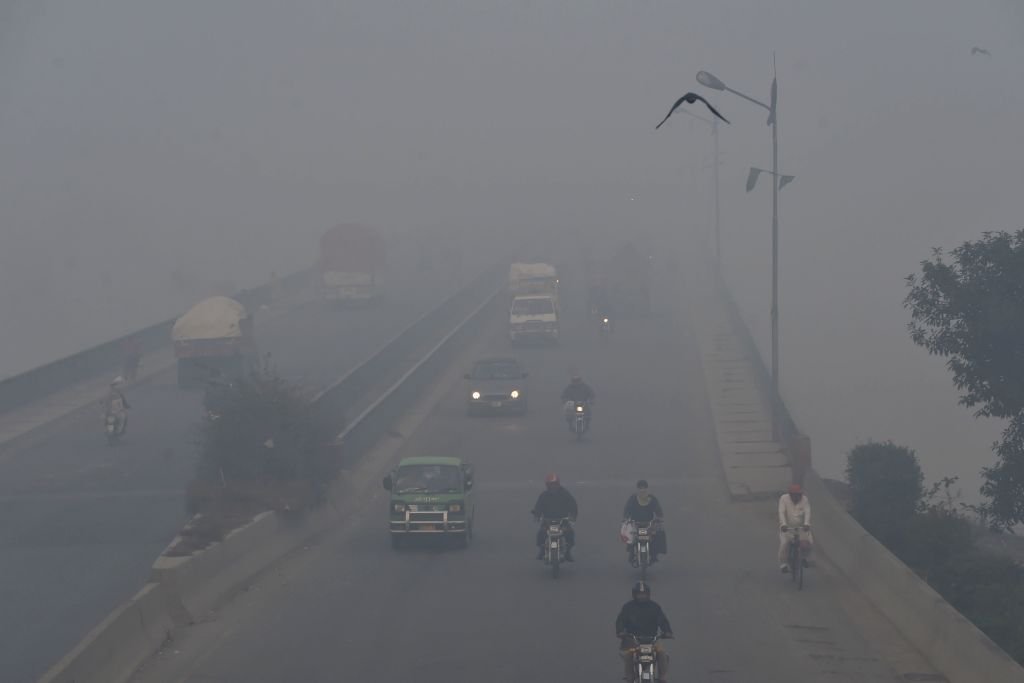
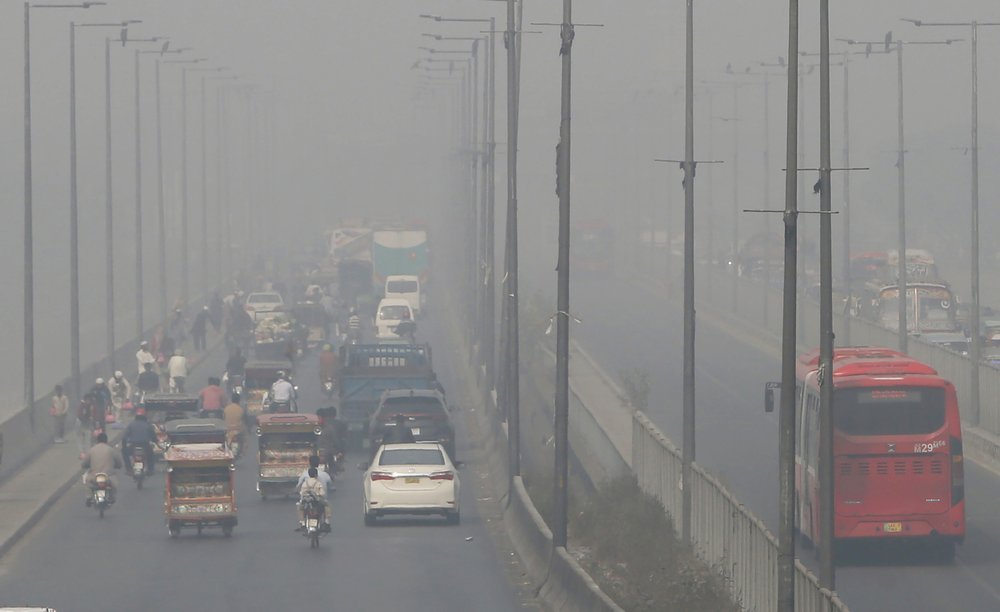
Lahore recorded the worst air quality in four years on Wednesday (December 15).
An Air Quality Index (AQI) of 981 was recorded near the Mall Road, Samaa has reported. As per United States Environmental protection agency, the hazardous category indicates an AQI of 301–500. The ‘good’ category is 0–50, which is followed by ‘moderate’ at 51–100 while anything in the 101–301 AQI range is considered unhealthy.
Meanwhile, in November, Provincial Minister of Punjab for Environment Protection Muhammad Rizwan claimed that there has been no smog in Punjab, including Lahore, for the last two years.
Provincial Minister of Punjab for Environment Protection Muhammad Rizwan in a show aired on City 42 News claimed that there has been no smog in Punjab, including Lahore, for the last two years.
He said that the Air Quality Index (AQI) of Lahore which is being observed nowadays is different.
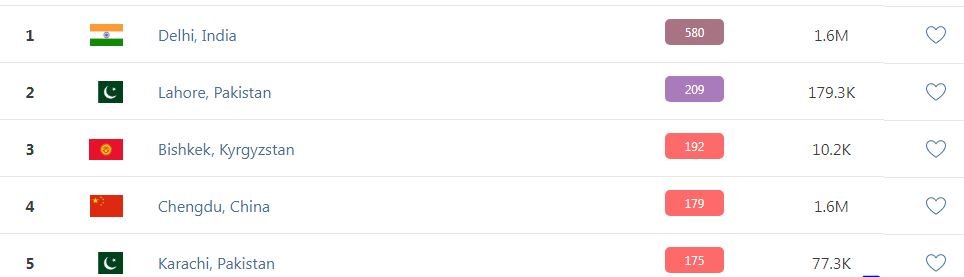
While Lahore is engulfed in dense smog and listed at the top among cities with highest Air quality indices, Minister of EPD Punjab Rizwan said there is no smog for even a second in last two years. Smog outside may be smiling but many will die due to hazardous air and negligence https://t.co/Q5rLg0gSb2
According to the minister, the Air Quality Index (AQI) of Lahore which is being observed nowadays is different and the actual rating as per Pakistan Meteorological Department is 134.
Muhammad Rizwan, while speaking to City 42 News, said that people don’t know how to install air quality monitors. He announced that the administration is starting a plan in which people will be given education and training related to this.
Furthermore, while maintaining his stance, he stated: “Today our department has recorded AQI 134 mark while Town Hall has 192 and Model Town has 186.”
After this, the host of the programme said that today (Friday) the city’s quality index was at 337 and previously Lahore was on the list of the most polluted cities.
To which he replied, ”I can say with full confidence that there has been no smog in the last two years in Punjab, including Lahore.”
He said that even if there is no fog, the presence of smog was not possible.
Air pollution contaminates the air in Punjab and it shoots up in winter as farmers burn rice stalks left behind after harvesting to clear their fields to plant wheat.
During these cooler months, Lahore, which is surrounded by rice-growing districts, is covered with thick smog, putting people, especially the elderly and sick, at an increased risk.
“It is a health emergency – the air quality monitors in Lahore routinely show hazardous levels in November,” said Farah Rashid, a climate and energy program coordinator for green group WWF-Pakistan.
Now the Punjab government hopes to tackle the problem by providing 500 rice farmers around Lahore with a set of machines named ‘Happy Seeder’ that together eliminate the need to burn crop stubble.
The machines include a shredder that breaks down rice stubble and mulches it into the ground and a seed drill that follows to sow wheat through the mulch.
Malik Amin Aslam, climate change adviser to Prime Minister Imran Khan, called air pollution a “silent killer” and said Lahore’s smog had increased in intensity and frequency over the last five years.
He explained that rice farmers traditionally use combine harvesters to cut their rice in October, leaving behind about four inches of stubble.
With less than two weeks before they have to ready their fields to sow wheat, burning is the fastest way to clear the land, he told the Thomson Reuters Foundation.
In Pakistan, rice is grown on an area of about 2 million hectares (5 million acres), mainly in the Punjab and Sindh provinces. Many of the fields are cleared by burning every year.
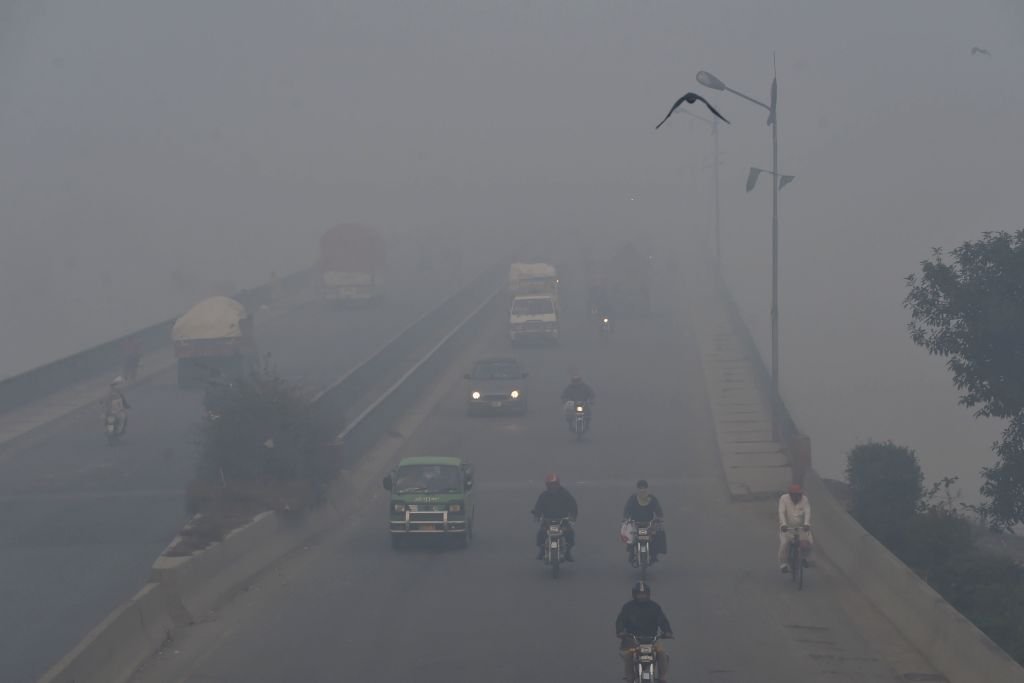
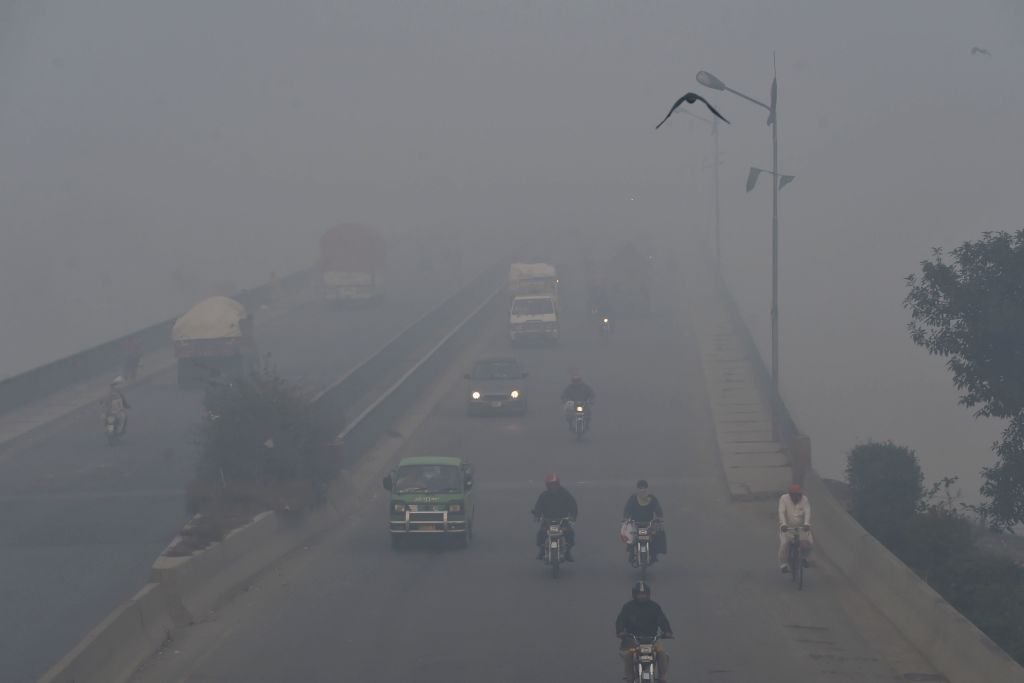
Commuters drive their vehicles amid heavy smog conditions in Lahore
In October and November, Lahore’s Air Quality Index level can jump to over 300, a number that the US Environmental Protection Agency says corresponds to a “health warning of emergency conditions.”
CUTTING EMISSIONS
Farmers say the new farm equipment can help combat smog but note that crop burning produces only a small share of the province’s pollution.
“The stubble is burned only for a few weeks in the winter. It is a fact that the problem becomes worse during this short period,” Bhandara said.
“But farmers are not the only reason for this pollution,” he added.
A 2018 report by the UN Food and Agriculture Organisation (FAO) on the underlying causes of smog in Punjab noted that agriculture — mainly rice residue burning — accounts for 20 percent of total air pollutant emissions.
That puts it behind the industry, which produces a quarter of the air pollution in the province, and transport, which contributes more than 40 percent.
Tackling air pollution — and leaving stubble on the soil as mulch, rather than burning it — also has the benefit of reducing carbon emissions that contribute to climate change.
In India, where farmers have been using the rice stubble shredder and Happy Seeder for the past few years, a group of scientists published a report last year stating the technology could cut greenhouse gas emissions by as much as 78 percent.
CHOSEN BY LOTTERY
In Mandi Bahauddin district, where famed Basmati rice is grown, Muhammad Afzal, an agriculture officer at Punjab’s Government Agriculture Seed Farm, has been experimenting with the Happy Seeder for the past two years.
“Stubble management is a serious issue for farmers,” said Afzal, who helps farmers adopt new farming techniques.
Pakistan has penalties for rice stubble burning, including fines of up to Rs20,000 per acre — but most farmers have little other choice and simply continue the practice and pay the penalty when they are charged.
But a growing number are looking for alternative solutions, Afzal said.
The total cost for the stubble shredder and Happy Seeder is about Rs637,500 rupees, and the government this year is paying about 80 percent of the price for 500 farmers, he noted.
“For those who can’t afford it, bigger farmers are willing to rent out the machines. In the future, more service providers will come up to rent them out,” Afzal said.
One drawback to the machines, he noted, is the need to mount them on the back of a tractor — and not just any tractor will do.
“It requires a large, 85-horsepower tractor,” he noted, something most rice farmers in Pakistan do not have.
Bhandara, the farmer in Pakpattan, said the subsidised machines also are only available in certain districts around Lahore, in the so-called smog “red zone.”
“The subsidised machines should be made available to rice farmers in South Punjab and Sindh as well, otherwise they are too expensive for most farmers,” he said.
Despite the limitations, the Happy Seeder has proven so popular that the government has had 10 applicants for each of its 500 machines, according to Aslam, the climate change adviser.
He said authorities are using a lottery system to decide who gets the subsidised equipment.
The government has plans to expand the Happy Seeder program next year and cover the whole of the Punjab rice belt by 2023, Aslam noted.
In the meantime, he added, it is already working on a technology upgrade.
“The agriculture extension department has developed a prototype to combine the two shredder [and] seeder machines into one ‘Pak Seeder’, which will be even more effective and efficient” — plus 30 percent cheaper, he said.
A thick blanket of smog has enveloped Lahore, prompting officials to warn that tens of thousands of the city’s residents risk respiratory disease and eye-related problems while doctors urged people to stay at home.
The air quality in Lahore deteriorated to hazardous levels, putting an additional burden on the fragile healthcare system amid a surge in coronavirus deaths and new infections. The Air Quality Index at one point rose to 750 in the city’s poorer areas — about 12 times the recommended level.
Earlier in the day, Switzerland-based air quality information platform IQair declared Lahore the second most polluted city, after New Delhi, India’s capital. Pollution indexes peak dramatically in Pakistan in winter, when farmers burn off stubble in the fields. Winds worsen the pollution by further spreading smog across the region.
“The air quality level was hazardous today,” said Sajid Bashir, a spokesman for Environmental Protection Department.
By mid-day the situation had improved, he said, as authorities took steps to keep smoke emitting vehicles off the roads and shut brick kilns across Punjab.
Lahore, once dubbed as the city of gardens, remained pollution-free for months after March, when the government imposed a lockdown to contain the spread of coronavirus. But the restriction was lifted in May, allowing a return to industrial activities and normal businesses. With cars back on the roads, the air quality gradually deteriorated, falling again to unhealthy levels.
Pollution is no stranger to Pakistan, a country of 220 million — or Lahore, with some 12 million people. Cars are the top pollutants in Lahore but the city also has other sources of pollution, including the stubble burning, steel manufacturing furnaces and the city’s famous brick kilns.
“Coughing, throat infection and irritation in the eyes are common,” said Anza Farid, an environmental expert, warning that the situation could worsen in the coming weeks as more people burn garbage in the cities and farmers burn off the stubble in their fields.
Dr Talha Ayub urged people to wear face masks for protection, both from pollution and the coronavirus. “People should try to stay at home if they can,” he appealed.
Pakistan on Thursday said it registered 34 new COVID-19 deaths and 1,808 new infections over the past 24 hours — despite a government-imposed partial lockdowns in 4,136 residential areas across the country. The government is turning to sealing off hotspots in a bid to contain rising fatalities and infections from coronavirus.
Authorities also banned large gathering, shut shrines, cinemas and theatres to contain the spread of the virus, which has infected more than 348,000 people in Pakistan and killed 7,021 since February.
Prime Minister Imran Khan has warned that the second wave of coronavirus infections was imminent, especially in cities that face higher air pollution levels.
In an award ceremony pertaining to clean green index programme, the prime minister said that he feared there might be a resurgence of COVID-19 infections in cities where the rate of pollution increases in October and November.
“I fear that in October and November […] cities like Faisalabad, Lahore, Karachi, Peshawar and Gujranwala where there is more pollution […] there might be a second spike in coronavirus cases. The cases are rising gradually and we hope that they don’t increase quickly; we are monitoring it,” he added. According to the PM, the infections could increase during winter as ‘pollution becomes stagnant in the atmosphere’.
This is not the first time that the premier has warned of a resurgence of the deadly virus. At the start of this month, he had urged people to follow precautionary measures to curb the spread of coronavirus.
Even though there have been multiple warnings by the government officials about the imminent spike in coronavirus infections, the federal and provincial governments have yet to take any serious measures to thwart a potential catastrophe. In March when the virus had started making inroads in Pakistan, the federal government through its reckless attitude enabled the outbreak.
The prime minister had said the coronavirus infection was just like normal ‘flu’ which could be cured with ‘hot water’. This attitude didn’t help the government or public living under the shadow of a pandemic.
If you catch #coronavirsu, you will recover soon because it is like a flu, said PM of Pakistan Imran Khan. — And world doesn’t have vaccine coz it is just like flu. So, Imran Khan, return money to @WorldBank & AB; u collected in the name of Coronavirus
This time again, the government is dilly-dallying on measures to prevent COVID-19 outbreak. Despite a gradual spike in cases since September, the government has allowed schools and businesses to operate, exposing millions to the virus.
SMOG AND CORONAVIRUS:
Experts say the pollutants could also aid the spread of coronavirus, said a BBC report. “In addition to air pollution decreasing immune defences, it is thought that particulate and nitrogen dioxide found in air pollution can act as vectors for the spread and survival of airborne particles such as Covid [virus],” Mary Prunicki, director of air pollution and health research at Stanford University, said.
Studies have shown that exposure to high levels of pollution worsens the condition of patients who have diabetes, hypertension, coronary disease and asthma. And it also weakens the immune system of healthy people.
“The lung is the gateway to the body and any damage to the organ can cause severe problems. And that makes people more susceptible to Covid-19,” Dr DJ Christopher, head of pulmonary medicine at the prestigious Christian Medical College in Tamil Nadu, said. Christopher said. “It’s akin to fighting a war with weakened front-line soldiers.”
In Lahore, the air quality index has crossed 200 –very unhealthy– since the past week. According to the IQAir website, “Air quality in Lahore usually worsens during the winter season from October to February.” It says that winter air pollution is ‘worse due to temperature inversion, which results in a layer of warm air that is prevented from rising trapping air pollutants’.
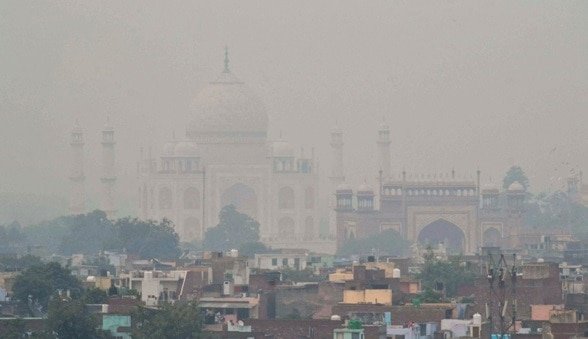
New Delhi and the areas surrounding the city have been engulfed by a cloud of smog which is choking the city and its residents. The air quality index has reached hazardous levels as the Indian capital has been hit by the worst pollution in three years. A public health emergency has been declared and people have been advised to stay indoors.
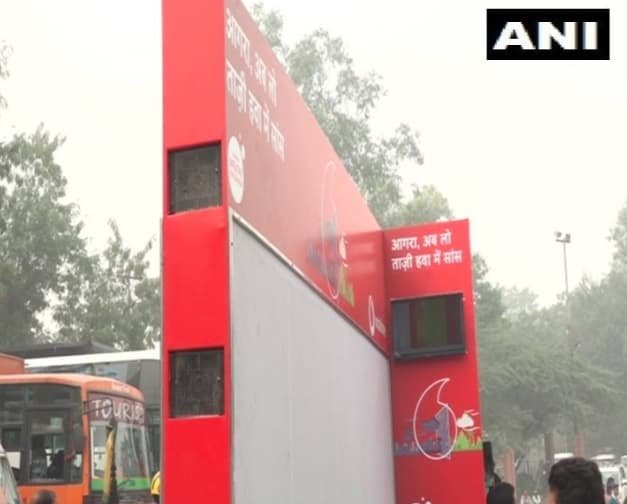
According to a report in Khaleej Times, as smog levels exceeded, authorities parked a van with an air purifier near the Taj Mahal – the iconic 17th-century marble mausoleum 250 kilometres (150 miles) south of Delhi – in a bid to clean the air in its surrounds.
The air purifier van deployed by the Uttar Pradesh Pollution Control Board (UPPCB) has the capacity to purify 15 lakh cubic metre air in eight hours within a 300-metre radius.
Regional Officer of UPPCB Bhuvan Yadav shared that a mobile air purifier van has been deployed at the west gate of the Taj Mahal keeping in mind the developing situation and consistent deterioration in air quality.
Agra: In a bid to combat pollution district admn has deployed air purifying machines in Taj Mahal. RK Rathi, Executive Engineer,Agra Municipal Corp says,”an agency has been directed to do mechanised cleaning as well as deploy two air purifying machines at the gates of Taj Mahal.” pic.twitter.com/geFbNbdwD7
Pollution around the white marble mausoleum has been a cause of concern for a long time as it has been damaging the monument, one of the seven wonders of the world. Pollution causes the white marble of the monument to turn yellow.
Meanwhile, the Delhi government has declared a public health emergency in the city following the deterioration in air quality. The local government also directed the closure of all schools till November 5 in the interest of the health and safety of children. Free pollution masks were also handed to the children to limit their exposure.
Construction work in the city has been put on hold and private cars have been banned on the roads to limit pollution.
According to a recent study, almost one million Indians died prematurely every year as a result of inhaling this pollution-ridden smog. Experts have warned that both state and national governments needed to go beyond short-term remedies and find a solution to combat this problem which hits every year.
Across the border, Lahore is also suffering from the effects of smog. The air quality index in the city has also reached hazardous levels making breathing tiresome for the residents.
Minister of State for Climate Change Zartaj Gul has said that the pollution in Lahore is increasing due to the extra number of vehicles entering Lahore for Azadi March.
In a video posted on Twitter from Gul’s official account, the minister has termed all reports fake which are claiming that Lahore has entered into the list of most polluted cities of the world.
She said that the company which has released this data wants the government to install their equipment for monitoring air pollution and is spreading misleading reports for the past two years.
“They take their equipment out for recording data when the traffic is dense and use these reports to spread panic”, the minister added.
دانستہ طور پر لاہور میں ہوا کی آلودگی کے بارے میں پھیلائی جانے والی افواہ کی سختی سے تردید کرتی ہوں۔ اور ان عناصر کی مذمت کرتی ہوں۔
Deliberately misinformation is being spread about Lahore AIr Quality. It is nowhere as bad as being asserted by vested elements.
Yesterday, the air quality monitoring station installed in US Consulate Lahore indicated that the Air Quality Index (AQI) of the city is near 469, while the threshold for hazardous levels of air quality is 300.
Moreover, the London-based non-governmental organisation, Amnesty International in a statementreleased to the media on Wednesday stated that the levels of air quality in the province has been rated “near unhealthy” to “very unhealthy” for most of the year.
The report also said that the Air Quality Index (AQI) in Lahore has reached 484 in the early morning. Meanwhile, EPA is still unable to show the actual picture of the scenario and is showing the unrealistic data in this regard.
The South Asia Campaigner at Amnesty International, Rimmel Mohydin has also urged the government to do more to adequately address such a severe public health crisis — one that endangers people’s health and even their lives”.
As smog levels rise across Pakistan and Lahore reaches hazardous levels, air purifiers are selling out across the country. The biggest debate: do they actually work?
According to research, air purifiers do work and have benefits. The demand for air purifiers is increasing worldwide and in 2022, there will be a 10.2 billion dollar global market for air purifiers.
Air purifiers filter out harmful particles, kill germs and removes volatile organic compounds that can harm the lungs, liver or kidneys.
In Pakistan, most air purifiers are now out of stock as Karachi and Lahore are facing the brunt of the air pollution. The Current brings you a daily smog level check at 7AM on Instagram and Facebook for your city and what’s really worrying is that Lahore has hit hazardous levels and Karachi is at very unhealthy – and about to get worse.
Wearing smog masks can help protect you against air pollution and air purifiers are also a great investment. They aren’t cheap but worth it in the long run.
Here are three air purifiers that are currently in stock on Pakistani websites and have been tried and tested by customers
1. Smart Air Cannon Air Purifier
Available here this small but powerful air purifier is effective for a room sized 323 square feet. It was effective in removing pollution particles and comes with a one year warranty. It is cheapest air purifier that is currently available, at 18,000 rupees.
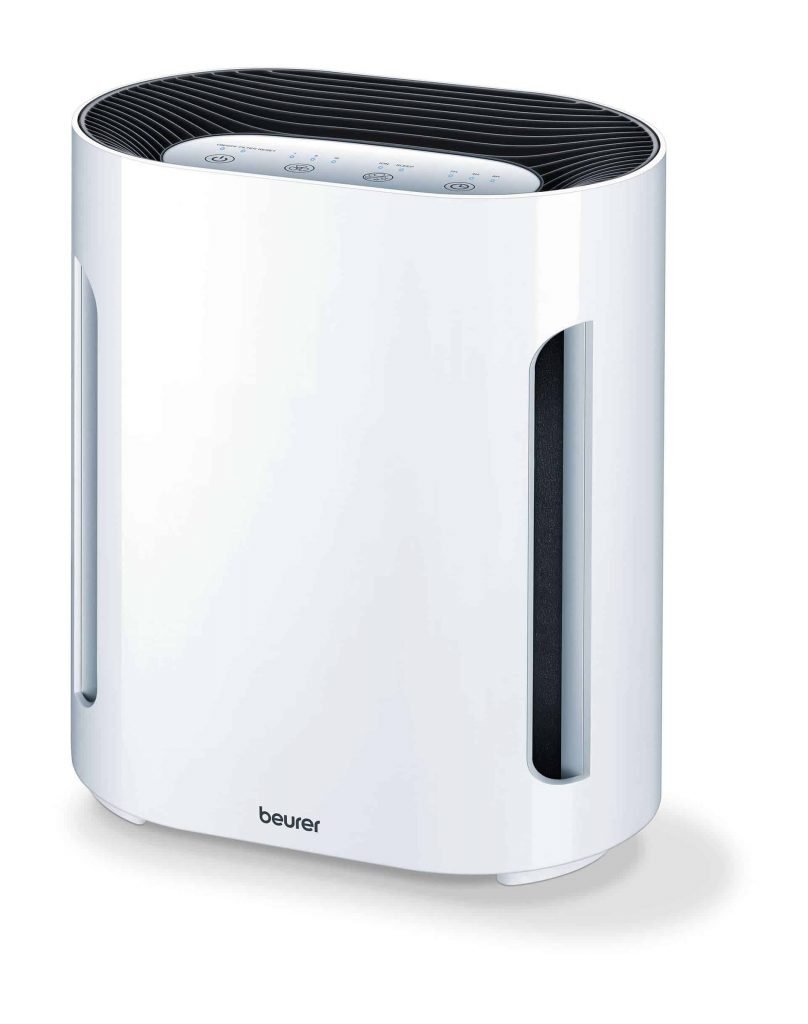
2. Beurer LR 200 Air Purifier
Available here Beurer is a tried and tested company, with a popular humidifier range. The air purifier is sleek but according to reviews, it’s difficult to clean the filter. It is for 27,500 rupees and also has a one year warranty.
3. Hextio Air Purifier
At 60,000 Rupees the Hextio is available here. It has automatic settings where it detects air pollution and increases the level of the fan. It also has a two year warranty.