Tag: airlines

  • Relieved travellers land in Singapore after deadly turbulence

    Relieved travellers land in Singapore after deadly turbulence

    Rattled travellers and crew landed in Singapore Wednesday after a terrifying high-altitude plunge on a flight from London during which an elderly passenger died and more than 80 were injured.

    Singapore Airlines flight SQ321 hit “sudden extreme turbulence” over Myanmar 10 hours into its journey on Tuesday, abruptly rising and plunging several times.

    One passenger said people were thrown around the cabin so violently they put dents in the ceiling during the drama at 11,300 metres (37,000 feet), leaving dozens with head injuries.

    Photos from inside the plane show the cabin in chaos, strewn with food, drinks bottles and luggage, and with oxygen masks dangling from the ceiling.

    The plane, carrying 211 passengers and 18 crew, made an emergency landing at Bangkok’s Suvarnabhumi Airport, where medical staff used gurneys to ferry the injured to ambulances waiting on the tarmac.

    A 73-year-old British man died, while Bangkok’s Samitivej Srinakarin Hospital said late Tuesday 71 people had been sent for treatment — six of them seriously injured.

    The airport in the Thai capital said 83 passengers and crew were hurt.

    A relief flight carrying 131 passengers and 12 crew landed at Singapore’s Changi Airport on Wednesday morning.

    Relieved relatives greeted the arrivals with hugs but all were too shaken to talk to waiting reporters.

    Andrew Davies, a British passenger aboard the Boeing 777-300ER, told BBC radio that the plane “suddenly dropped” and there was “very little warning”.

    “During the few seconds of the plane dropping, there was an awful screaming and what sounded like a thud,” he said, adding that he helped a woman who was “screaming in agony” with a “gash on her head”.

    Separately, he told a BBC podcast he feared the plane was going to crash.

    “Remembering the plane now — the huge dents in the roof that people had obviously hit with their head. There was a water bottle stuck in a gap in the ceiling,” he said.

    Singapore Prime Minister Lawrence Wong sent his “deepest condolences” to the family and loved ones of the dead man — identified as Geoff Kitchen, a musical theatre director from near Bristol.

    The city-state is sending investigators to Bangkok to probe the incident and Wong posted on Facebook that they were “working closely with Thai authorities.”

    Of the passengers, 56 were Australians, 47 British and 41 Singaporeans, according to the airline.

    “In terms of exactly what happened, it’s too early to tell. But I think passengers are too casual on board commercial aircraft,” US-based aerospace safety expert Anthony Brickhouse told AFP.

    “The moment the captain turns off the seatbelt sign, people literally unbuckle.”

    Davies, the passenger, said “the plane suddenly dropped” at the very moment a seatbelt sign came on.

    Allison Barker told the BBC her son Josh, who was aboard the plane, texted her that he was on “a crazy flight” that was making an emergency landing.

    “It was terrifying,” she said. “I didn’t know what was going on. We didn’t know whether he’d survived, it was so nerve-racking. It was the longest two hours of my life.”

    Scientists have long warned that climate change is likely to increase so-called clear air turbulence, which is invisible to radar.

    A 2023 study found the annual duration of clear air turbulence increased 17 percent from 1979 to 2020, with the most severe cases increasing more than 50 percent.
  • PIA to be privatised: assets, debt and staff to be transferred

    PIA to be privatised: assets, debt and staff to be transferred

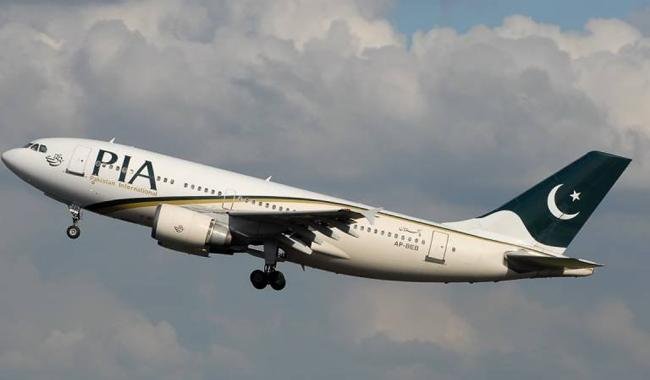
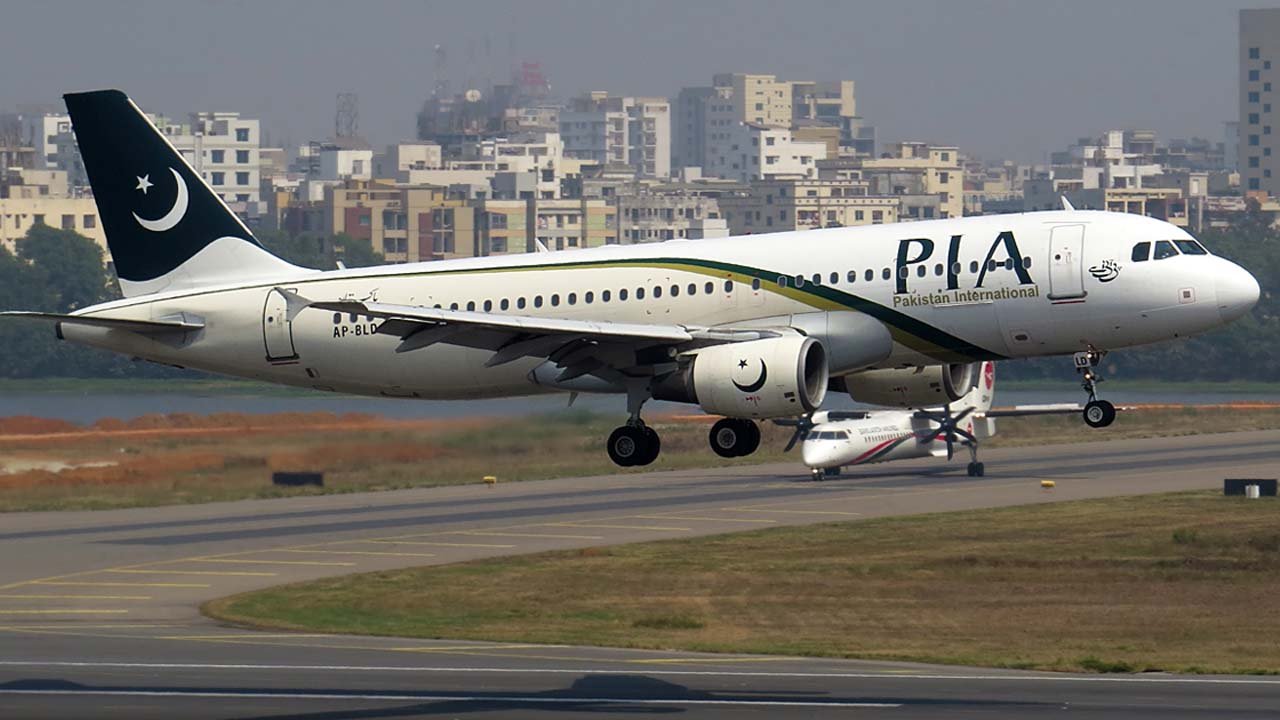
    Pakistan International Airlines (PIA), which has been running at a loss, has unveiled its privatisation plan. Sources indicate that this plan encompasses not only the privatisation of PIA but also the power distribution companies and the revival of Pakistan Steel Mills.

    Furthermore, it has been reported that the process of appointing a financial advisor for PIA’s privatisation is underway. While PIA’s affiliated institution will remain unaffected by privatisation, plans have been solidified to address issues related to PIA’s debt and government guarantees.

    According to ARY News, the Privatisation Commission sources have disclosed that, under the current circumstances, Pakistan Steel Mills cannot be privatised. However, efforts will be made to enhance the mill’s production and capabilities to attract potential investors.

    It’s worth noting that the restructuring plan for the privatisation of Pakistan International Airlines (PIA) is progressing rapidly. The PIA administration has invited applications from legal and corporate firms for assistance in this restructuring plan. The Department of Contract Management has been instructed to forward these applications by October 6.

    The assets of PIA, including properties, debts, aircraft, and employees, will be transferred to the new company, presenting PIA as a debt-free organisation to potential investors.

  • Heatwave woes: Rising temperatures pose new threats to air travel

    Heatwave woes: Rising temperatures pose new threats to air travel

    In a twist of fate, climate change is exacerbating the challenges of air travel, creating a new layer of misery for passengers and airlines alike. As temperatures soar due to global warming, the very air that planes need to lift off becomes less cooperative.

    When the mercury climbs, hot air’s reduced density causes planes to struggle for lift, complicating takeoffs and in-flight stability. Airlines often resort to delaying flights or unloading cargo and passengers to mitigate the issue, leading to a cascade of disruptions across the aviation system. Stranded on runways, passengers endure stifling conditions within grounded aircraft.

    Experts warn that this problem is set to intensify as the planet heats up further and the frequent occurrence of extreme heat becomes the norm. A Columbia University study projected that by mid-century, up to 30 per cent of all US flights could be subject to weight restrictions during periods of high heat.

    Regrettably, there’s no silver bullet to overcome this challenge. Ethan Coffel, an assistant professor at Syracuse University, explains that it’s a physical limitation tied to air density, leaving limited room for technological solutions.

    Heat-related delays are emerging as a more substantial issue than snow or ice. Last summer, Chicago’s O’Hare International Airport faced twice the number of weather-related delays compared to the previous winter. The impact is especially pronounced at airports with shorter runways, like New York’s LaGuardia Airport, which struggles to handle the volume of traffic it receives.

    Airports in high-altitude regions and warm climates are hit particularly hard by this heat-induced predicament. Denver and the Sun Belt cities face additional hurdles, with workers on scorching runways at risk due to the “heat island” effect. Despite efforts to make aircraft lighter and more efficient, progress is incremental, leaving airports to rely on conventional solutions like rescheduling flights and strengthening runways.

    The compounding effects of climate change on air travel are undeniable. Turbulence grows riskier, flights lengthen due to shifting wind patterns, and extreme weather spawns more delays. To truly address this issue, a holistic approach is required, including a concerted effort to reduce fossil fuel emissions, a primary driver of climate change. Amidst these challenges, the future of air travel remains uncertain, prompting travellers to brace for increasingly tumultuous skies.

  • Passenger banned for 30 days from airline after urinating on woman during flight

    Passenger banned for 30 days from airline after urinating on woman during flight

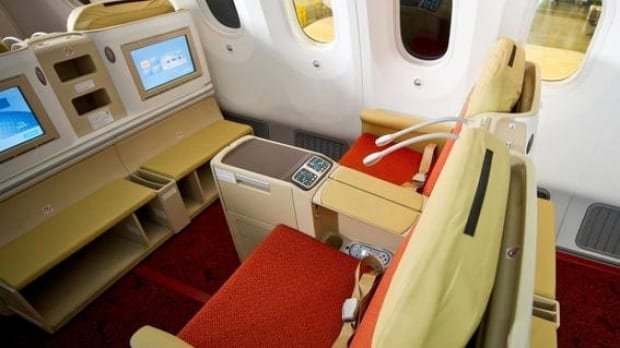
    A drunk male passenger in business class on an Air India flight from New York to Delhi allegedly unzipped his pants and urinated on a female co-passenger, earning a ban from the airline for 30 days.

    The incident took place in late November, however, the airline took notice on Wednesday after the woman wrote to the group chairman of Air India, N Chandrasekaran. She described the episode as the “most traumatic flight I have ever experienced”.

    According to the female passenger who is in her 70s, after urinating, the man allegedly kept exposing himself and didn’t move until another passenger asked him to return to his seat.

    The woman complained to the crew and told them her clothes, shoes, and bag were soaked in urine. The crew allegedly gave her a set of pajamas and slippers and told her to return to her seat which was covered in sheets but still reeked of urine

    The airline has also filed a police complaint against the man and constituted an internal committee to investigate the matter.

  • Malaysia bound PIA flight delayed over hijacking scare

    Malaysia bound PIA flight delayed over hijacking scare

    A Malaysia-bound Pakistan International Airline (PIA) flight PK-894 from Islamabad was delayed on Thursday night because of a plane hijacking scare, reports Saama.

    The flight was supposed to take off at 12:30 am but it was cleared by 2 am as the plane was thoroughly searched.

    The national airline’s spokesperson said that as they had doubts about a terror attack, therefore they started a search and checked passengers. This took time and delayed take-off.

    He said that false information was circulated that a hijacking alert has been issued but this wasn’t true.

  • ‘Rapid COVID-19 testing’ –  CAA announces new SOPs for flights

    ‘Rapid COVID-19 testing’ – CAA announces new SOPs for flights

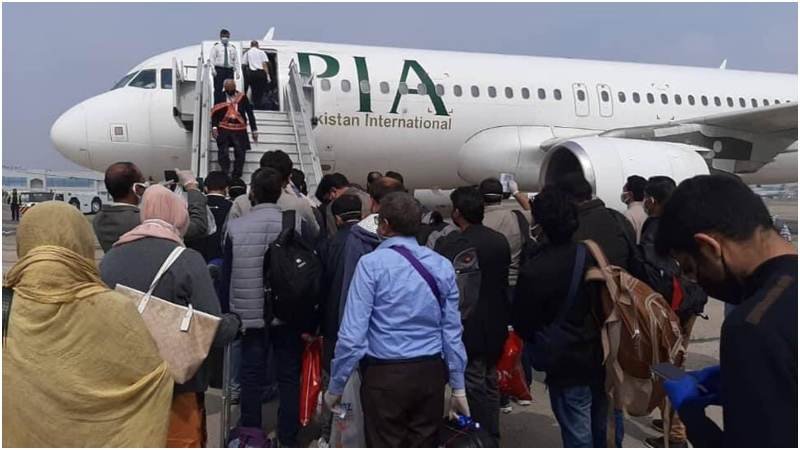
    The Civil Aviation Authority (CAA) has issued new provisions for airlines after a sharp increase in coronavirus cases. The decision came after many violations in SOP’s not being followed were reported.

    Airlines have been instructed to keep 20 per cent of their seats vacant and ensure social distancing between passengers. As per new directives, airlines violating the orders will be fined. Airport managers have been tasked to ensure that the SOPs are being followed.

    Earlier this week, the authority began rapid Covid-19 testing of international passengers at airports across Pakistan. According to the Health Ministry, through these tests, coronavirus reports will be obtained within 20 minutes.

    If reports are positive, passengers will have to isolate at a quarantine center at their own expense. Those who test negative will be allowed to go home but will have to stay indoors for a week.

    On May 1, the government decided to reduce inbound international flights to 20 per cent of the current measure.

  • ‘A glimpse of death’: Hasnain Lehri shares harrowing experience of turbulent flight

    ‘A glimpse of death’: Hasnain Lehri shares harrowing experience of turbulent flight

    Following the tragic PIA plane crash in Karachi and the controversy around the alleged fake licences of hundreds of Pakistani pilots, Pakistanis have become fearful when it comes to air travel. While COVID-19 lockdowns across the world have limited movements, some people are forced to travel due to various reasons.

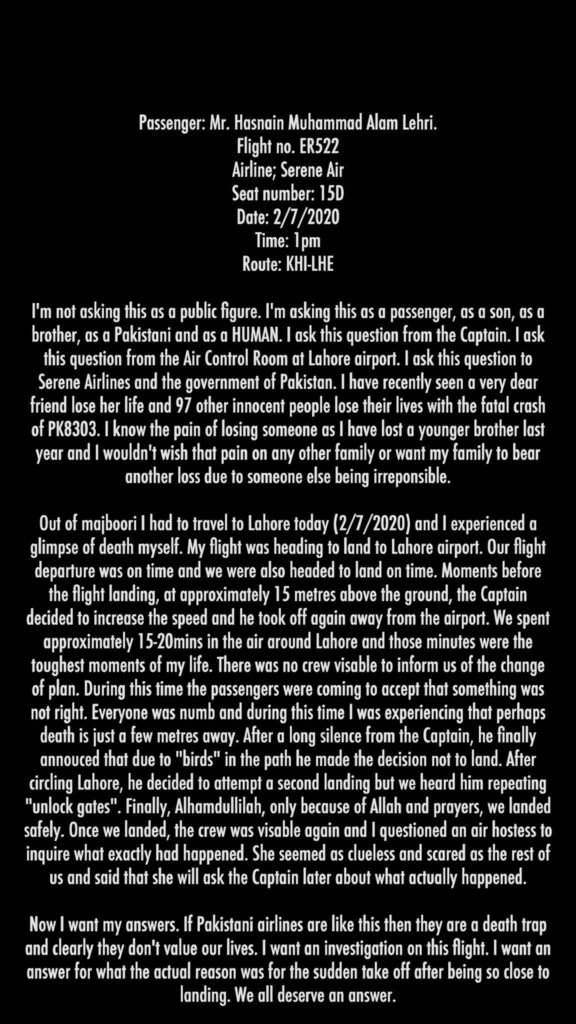
    Renowned model Hasnain Lehri, in a Twitter post, shared a harrowing flight experience with Serene Airlines and demanded that he wants answers as to why the pilot decided to increase speed and take off again moments before landing. Detailing his ordeal, Lehri said that he experienced “a glimpse of death”.

    Hasnain recounted that just as the plane was about to land at Lahore Airport, the pilot increased the speed of the plane and took off again following which the plane circled around Lahore for a few minutes before he finally attempted to land again. Lehri shared that those 15-20 minutes were the longest of his life and he was not sure if he would come out of this alive.

    The model added that the pilot said that he did not land due to “birds in the path”. However, neither he nor the fellow passengers were convinced with this excuse and demanded a more detailed answer on the matter.

    Meanwhile, in response to Lehri’s tweet, Serene Airlines said that the complaint has been forwarded to the relevant department.

    Lehri’s colleague Zara Abid was on the ill-fated Pakistan International Airlines (PIA) flight which crashed in Karachi on May 22.

  • Coronavirus: Airlines may lose up to $113 billion

    Airlines could lose up to $113 billion in revenues this year due to the coronavirus, equivalent to the damage experienced by the industry during the financial crisis, AFP quoted a trade body as warning.

    The dire prediction came as Flybe — a British airline — collapsed into bankruptcy with the virus, which has killed over 3,200 people worldwide, dealing a fatal blow to the ailing regional carrier.

    With the disease now rapidly spreading outside China, demand for air travel is nose-diving globally, spelling serious trouble for many already struggling carriers. In a new assessment of the impact, the International Air Transport Association (IATA) estimated revenue losses to airlines’ passenger business of between $63 billion and $113 billion in 2020.

    The higher figure is for a scenario where the virus spreads more widely, and would be equivalent to the hit to the industry during the 2007-2008 global financial crisis, the group warned.

    The “industry’s prospects in much of the world have taken a dramatic turn for the worse”, said IATA head Alexandre de Juniac, and appealed to governments for support. “Airlines are doing their best to stay afloat,” he said. “As governments look to stimulus measures, the airline industry will need consideration for relief on taxes, charges and slot allocation. These are extraordinary times.”

    Flybe had narrowly avoided going bust in January when the United Kingdom (UK) government agreed to review air passenger duty paid by its customers — and shareholders pledged extra investment.

    But it finally collapsed after the government reportedly refused a rescue loan for £100 million ($128 million).

    In further bad news Thursday, Norwegian Air scrapped its 2020 earnings guidance after earlier predicting a return to profit following several years of losses.

    Other recent high-profile aviation industry casualties in Europe include French carriers Aigle Azur and XL Airways, as well as Slovenia’s Adria Airways.

    Meanwhile, travel analytics company ForwardKeys said the number of new flight bookings to Europe fell by 79 percent in the final week of February due to the outbreak.

    IATA’s assessment was far bleaker than just two weeks ago, when it forecast revenue losses would come in at $29.3 billion. But since then the virus has spread rapidly outside China, and has now reached some 80 countries and territories, infecting more than 95,000 people. The vast majority of global deaths and infections are in China, which quarantined entire cities, temporarily shut factories and closed schools indefinitely after the virus emerged.

    IATA predicted that worldwide passenger revenues would fall between 11 and 19 percent this year. The impact on Asia-Pacific carriers will be bigger than during the Severe Acute Respiratory Syndrome (SARS) outbreak in 2002-2003, as the Chinese travel market is far bigger now, said IATA chief economist Brian Pearce.

    Like the new virus, SARS emerged in China before spreading to numerous countries, killing hundreds. A plunge in oil prices caused by the virus could cut airlines’ fuel costs by up to $28 billion this year, which would provide some relief but would not have a significant impact, the body added.