Tag: Amnesty International

  • Justice still pending as Jaranwala incident marks one year

    Justice still pending as Jaranwala incident marks one year

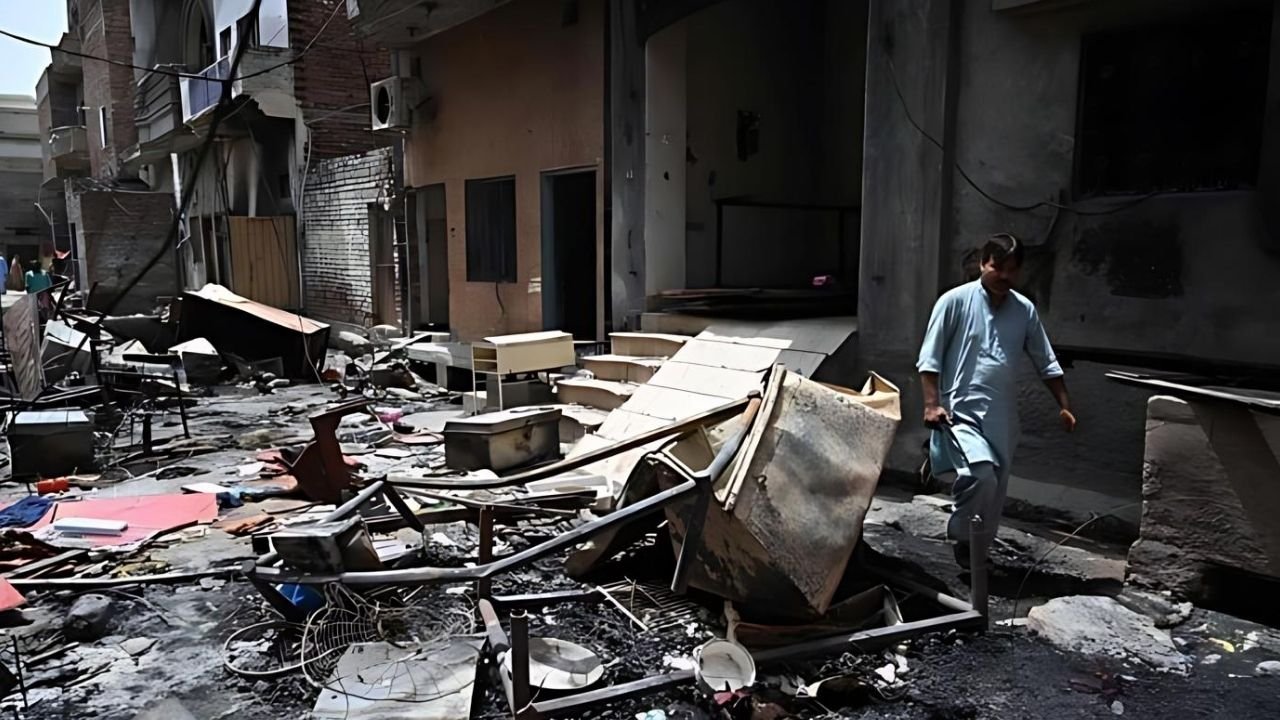
    The Christian community in Jaranwala is still awaiting justice one year after the mob attack on their community. The government of Pakistan had promised to provide justice to the victims of the vandalized Christian community and to punish those involved in the violence, but their efforts appear to have been ineffective.

    On August 16, 2023, two Christian residents were allegedly accused of blasphemy, a charge that was later disproved. Despite this, a large mob went on to vandalize 20 churches and around 80 Christian homes.

    Amnesty International has reported that more than 40 percent of the affected Christian families are still awaiting government compensation.

    Out of the 5,213 suspects, 380 were arrested, but 305 individuals were released on court orders.

    Only 85 out of 146 families have received compensation so far, while 61 are still waiting for their due.

    ‘’We saw our houses in complete shambles as the building would soon collapse. To date, we have received no support. My husband is unemployed for a year because no one hires him (due to stigma). Many people received the promised compensation of 2 million rupees (US$7,200), but we did not receive it’’ said Jaranwala resident Christian Khalida Bano.

    The apex court disapproved the police report on the Jaranwala incident in February 2024, stating that it lacked the required information.

    One year later, trials against the culprits have yet to commence.

  • Civilians’ military trials are ‘no-no’ under international law, says Amnesty International

    Civilians’ military trials are ‘no-no’ under international law, says Amnesty International

    Amnesty International’s Secretary General Dr Agnès Callamard said on Tuesday that according to the Universal Declaration of Human Rights and the International Covenant on Civil and Political Rights, military courts can not conduct trials of civilians.

    In an exclusive interview with Dawn, Dr Agnès Callamard, who is on an official visit to South Asia, said that conducting civilian’s trials in military courts is a “no-no” under international law; “sadly it has happened throughout Pakistan’s political history… [and] is not a novelty”.

    Dr. Callamard said that Pakistan must maintain its international obligations and follow the country’s constitution for fair trials. She stressed the importance of transparency, due process, and urged Pakistan to protect civilians’ rights. 

    “The use of military courts is threatening the constitutionality of what’s happening right now,” she said.

    Talking about the ban on X (formerly Twitter) in Pakistan, she said yhat Amnesty is quite concerned by constricting space for freedom of speech in Pakistan.

  • ‘Deliberate’ Israeli strike on journalists in Lebanon warrants ‘war crime’ investigation: watchdogs

    ‘Deliberate’ Israeli strike on journalists in Lebanon warrants ‘war crime’ investigation: watchdogs

    The Israeli strike that killed one journalist and wounded six others in Lebanon merits a “war crime” investigation, rights groups Amnesty International and Human Rights Watch (HRW) told AFP on Thursday.

    Reuters journalist Issam Abdallah, 37, was killed instantly in the strike on October 13 in the south of the country near the Israeli border.

    The others present — two more Reuters journalists, two from Al Jazeera, and two from AFP — were all injured.

    AFP photographer Christina Assi, 28, was seriously wounded, later had a leg amputated and is still in hospital.

    Independent investigations by both rights groups concluded, like an AFP investigation published earlier on Thursday, that the first strike that killed Abdallah and severely wounded Assi was most likely a tank round fired from Israel.

    Amnesty said the strikes “were likely a direct attack on civilians that must be investigated as a war crime”.

    “Those responsible for Issam Abdallah’s unlawful killing and the injuring of six other journalists must be held accountable,” said Aya Majzoub, Amnesty’s deputy regional director for the Middle East and North Africa.

    “No journalist should ever be targeted or killed simply for carrying out their work. Israel must not be allowed to kill and attack journalists with impunity.”

    HRW said the two Israeli strikes “were apparently deliberate attacks on civilians, which is a war crime”.

    Under international humanitarian law, “it is forbidden in any circumstances to carry out direct attacks against civilians”, it said.

    The group’s investigation indicated that the journalists were “well removed from ongoing hostilities, clearly identifiable as members of the media, and had been stationary for at least 75 minutes before they were hit”.

    Amnesty said images it verified showed “the seven journalists were wearing body armour labelled ‘press’, and that the blue Reuters crew car was marked ‘TV’ with yellow tape on its hood”.

    “The evidence strongly suggests that Israeli forces knew or should have known that the group that they were attacking were journalists,” HRW’s Lebanon researcher Ramzi Kaiss said.

    “This is an unlawful and apparently deliberate attack on a very visible group of journalists,” he said.

    ‘Justice and accountability’

    Speaking at a press conference in Beirut, Dylan Collins, the other AFP journalist wounded in the attack, said: “I know they (the investigations) won’t bring Issam back to life. I know they won’t help Christina walk again.

    “But what I do hope is that they at least will mark the start of some sort of process of justice and accountability,” he said.

    He shared a message from Assi that said: “We chose journalism with a mission to deliver the truth, and despite the inevitable costs, our commitment remains unwavering. Nothing can silence us.”

    Lebanese Prime Minister Najib Mikati said in a statement his government would “take all measures to include” the conclusions of the investigation “in the complaint filed before the UN Security Council”.

    Since Israel’s bombardment of Gaza started after Palestinian fighter group Hamas struck Israel in a surprise attack on October 7, 63 journalists and media workers have been killed — 56 Palestinians, four Israelis and three Lebanese, the Committee to Protect Journalists says.

    The New York-based rights group on Thursday called for “an immediate, independent, and transparent investigation that holds the perpetrators to account” for the strike on journalists in Lebanon.

  • ‘Institutional reform, not the death penalty’ needed to end violence against women: Amnesty International South Asia

    ‘Institutional reform, not the death penalty’ needed to end violence against women: Amnesty International South Asia

    “The murder of Noor Mukadam was a horrific crime and those responsible must receive punishment consistent with the gravity of the crime, but without resorting to the death penalty,” said Amnesty International’s South Asia campaigner, Rimmel Mohydin.

    The statement further added that “institutional reform — and not the death penalty — is needed to tackle the endemic problem of violence against women in Pakistan.”

    Amnesty’s South Asia campaigner said, “Convictions have been dismally low for victims of gender-based violence in Pakistan, making today’s guilty verdict all the more significant. This conviction underscores the importance of ensuring that the criminal justice system responds effectively at all levels.”

    “However, far-reaching procedural and institutional reform — and not the death penalty — is needed to tackle the endemic problem of violence against women in Pakistan,” she said in the statement.

    “If the authorities want to take meaningful steps to ensure justice for women and girls, they must avoid using the death penalty as a ‘quick fix’ and commit to ensuring the criminal justice system prevents and responds to such crimes effectively at every stage.” 

    A sessions court in Islamabad yesterday sentenced Zahir Jaffer to death for the murder of Noor Mukadam. The co-accused staff members at Zahir’s house who aided in keeping Noor in Zahir’s house, Iftikhar and Jameel, were sentenced to 10 years in jail. All other accused were acquitted, including Zahir’s parents and Therapy Works staff.

  • Amnesty International halts operations in India after government freezes bank accounts

    Amnesty International halts operations in India after government freezes bank accounts

    The government of India has completely frozen the Amnesty International Bank accounts by alleging them for money laundering which has brought all operations of the company at a complete halt.

    Moreover, the organisation was forced to let go of staff in India and pause all its ongoing research project and campaigns on human rights.

    The official statement posted on the website of the organisation claims government actions to be the “latest in the incessant witch-hunt of human rights organisations by the Government of India over unfounded and motivated allegations.”

    Furthermore “The continuing crackdown on Amnesty International India over the last two years and the complete freezing of bank accounts is not accidental.

    The constant harassment by government agencies including the Enforcement Directorate is a result of our unequivocal calls for transparency in the government, more recently for accountability of the Delhi police and the Government of India regarding the grave human rights violations in Delhi riots and Jammu & Kashmir. For a movement that has done nothing but raise its voices against injustice, this latest attack is akin to freezing dissent,” said Avinash Kumar, Executive Director of Amnesty International India.

    More than four million Indians have supported Amnesty International India’s work in the last eight years and around 100,000 Indians have made financial contributions.

    These contributions evidently cannot have any relation with the Foreign Contribution (Regulation) Act, 2010. The fact that the Government is now portraying this lawful fundraising model as money-laundering is evidence that the overbroad legal framework is maliciously activated when human rights activists and groups challenge the government’s grave inactions and excesses.

    The attacks on Amnesty International India and other outspoken human rights organizations, activists and human rights defenders is only an extension of the various repressive policies and sustained assault by the government on those who speak truth to power.

    “Treating human rights organisations like criminal enterprises and dissenting individuals as criminals without any credible evidence is a deliberate attempt by the Enforcement Directorate and Government of India to stoke a climate of fear and dismantle the critical voices in India.