Tag: animal rights

  • Turks Up In Arms Over Killing Of Stray Cat

    Turks Up In Arms Over Killing Of Stray Cat

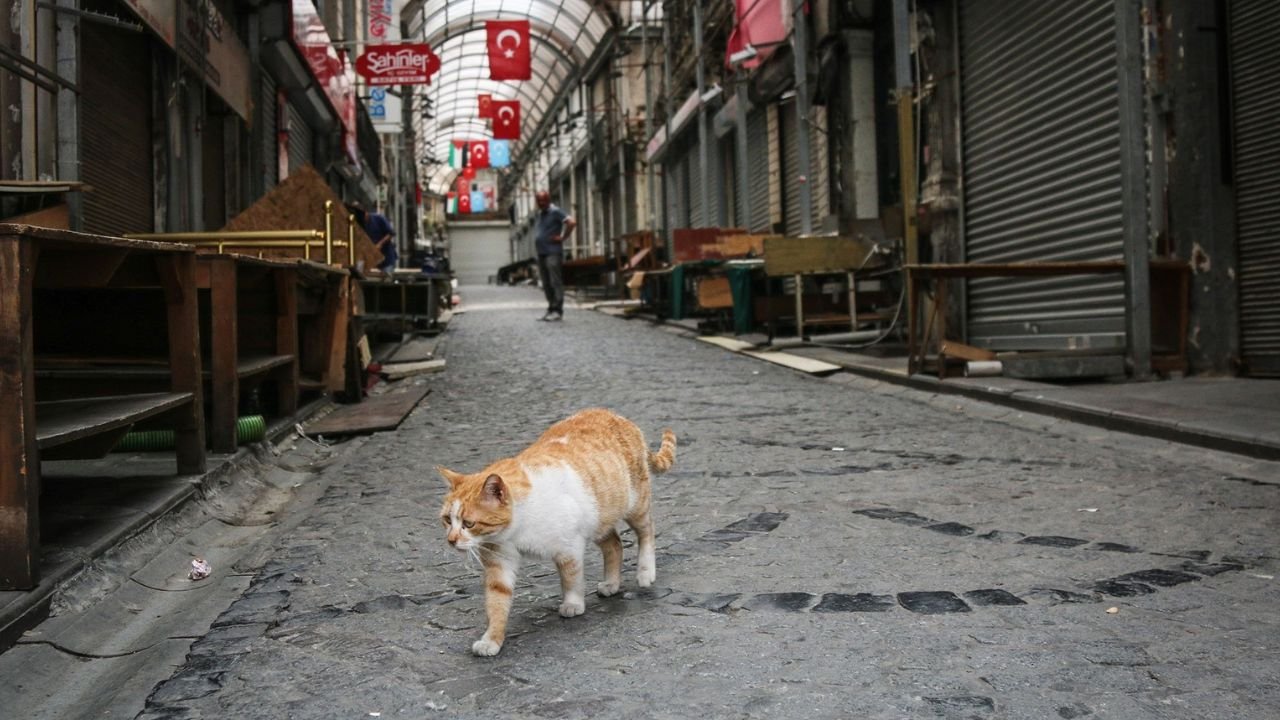
    The killing of a stray cat in Istanbul has triggered petitions, protests and death threats, pushing the president to intervene and the courts to retry the culprit.

    On January 1, Ibrahim K. was caught on a security camera in the lobby of the building where he lived kicking to death a stray cat named Eros that his neighbours regularly fed.

    He was sentenced in early February to 18 months in jail but was then released for good behaviour, sparking indignation among animal welfare groups and a section of the public in Turkey, whose large stray cat population is often fed and sheltered.

    Some 320,000 people signed an online petition demanding a stiffer sentence and in late February the justice ministry said Ibrahim K. would be retried after it received a night-time call from President Recep Tayyip Erdogan saying he was taking a “personal” interest in the case.

    Ibrahim K. was retried on Wednesday in a court building where hundreds of people thronged the corridors and the atmosphere was tense.

    The judges increased his sentence by one year but did not order him to be detained, ignoring the demands of animal welfare groups and internet trolls who have sent him death threats.

    One animal rights group is to appeal, saying Ibrahim K. should be jailed for the maximum four years allowed by law.

    On Thursday, the hashtag #JusticeforEros (#ErosicinAdalet) was trending on X, formerly Twitter, in Turkey and several major newspapers, including Hurriyet, splashed pictures of the dead cat on their front pages.

    Hurriyet carried several articles about Eros and “Ibrahim the killer”.

    Several celebrities have joined the Justice for Eros appeal, including Argentinian footballer Mauro Icardi, the star striker at Istanbul giants and reigning Turkish champions Galatasaray.

  • Nearly 500 rhinos killed as poaching increases in South Africa

    Nearly 500 rhinos killed as poaching increases in South Africa

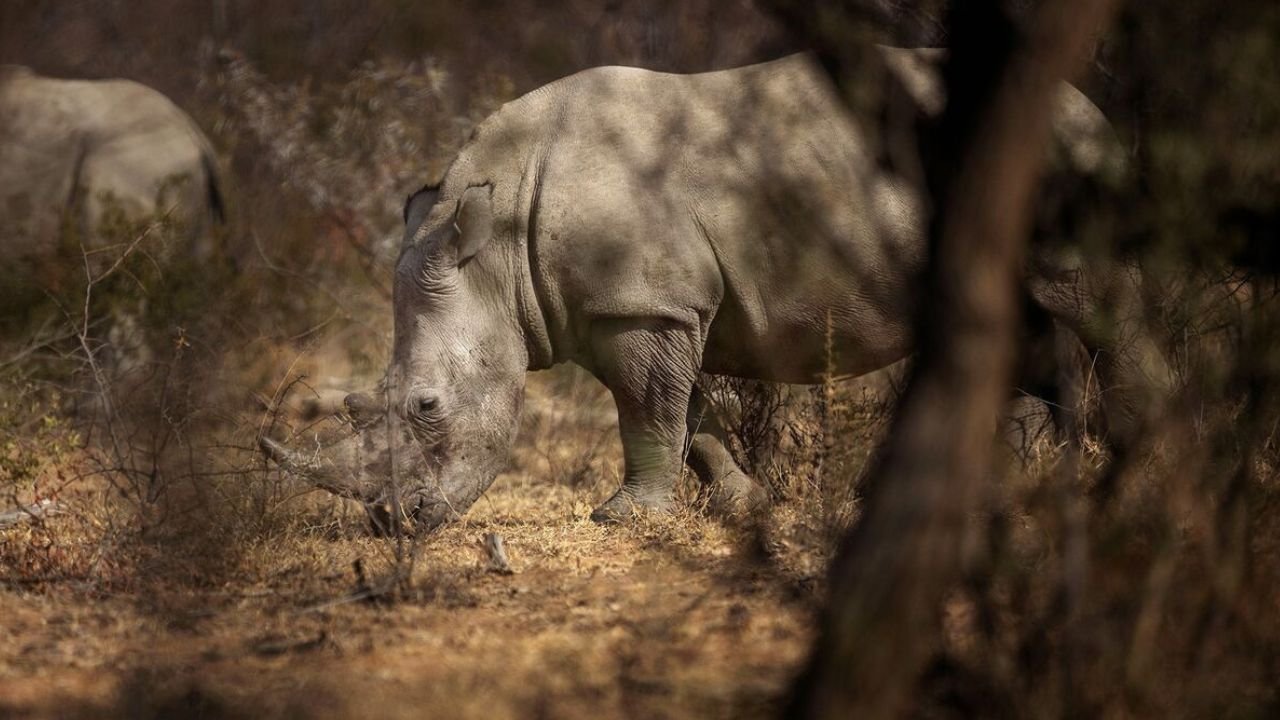
    Johannesburg (AFP) – Almost 500 rhinos were killed by poachers in South Africa last year, up 11 percent on 2022, despite government efforts to tackle the illicit trade in horns, ministers said Tuesday.

    The country is home to a large majority of the world’s rhinos and a hotspot for poaching, which is driven by demand from Asia, where horns are used in traditional medicine for their supposed therapeutic effect.

    The environment ministry said 499 of the thick-skinned herbivores were killed in 2023, mostly in state-run parks.

    The lion’s share were poached in eastern KwaZulu-Natal province, with the Hluhluwe–Imfolozi park — Africa’s oldest reserve — alone losing 307 animals.

    “This is the highest poaching loss within this province,” said Environment Minister Barbara Creecy.

    “Multi-disciplinary teams continue to work tirelessly in an attempt to slow this relentless pressure”.

    In recent years, authorities have tightened security particularly around the Kruger National Park, a tourist magnet bordering Mozambique that has seen its rhino population fall drastically over the past 15 years.

    This has resulted in lower losses there — 78 rhinos were killed in 2023, 37 percent fewer than in 2022.

    But it has also pushed poachers towards regional and private reserves like Hluhluwe–Imfolozi.

    Law enforcement agencies arrested 49 suspected poachers in KwaZulu-Natal last year, Creecy said.

    Across the country, 45 poachers and horn traffickers were convicted in court, she added.

    Among them was a former field ranger sentenced to 10 years behind bars for killing a rhino he later claimed had charged him.

    As of 2023, the national parks authority requires new employees to take a lie detector test amid concerns that some workers might be in cahoots with poachers.

    Rhino horns are highly sought in black markets where the price per weight rivals that of gold and cocaine.

    Nevertheless, in September last year the International Union for Conservation of Nature (IUCN) reported that thanks to conservation efforts rhino numbers had grown across Africa.

    Nearly 23,300 specimens roamed the continent at the end of 2022, up 5.2 percent on 2021, IUCN said, adding the increase was the first bit of “good news” for the animals in over a decade.

    About 15,000 live in South Africa, according to a separate estimate by the International Rhino Foundation.

    “While these updated IUCN populations figures provide hope, these gains remain tenuous as long as the poaching crisis continues,” Jeff Cooke of the World Wildlife Fund said Tuesday.

    And he described the spike in killings in South Africa’s KwaZulu-Natal, in particular, as “of grave concern”.

  • Spain police investigate suspected poisoning of 47 cats

    Spain police investigate suspected poisoning of 47 cats

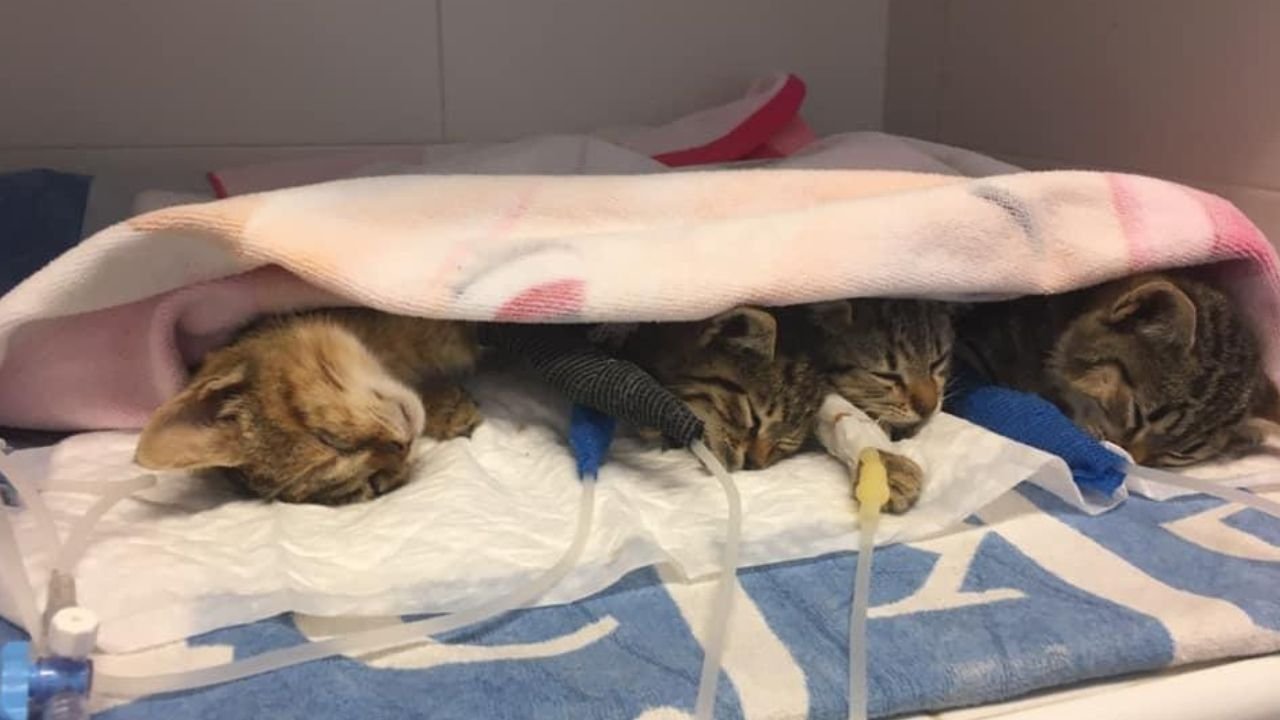
    Spanish police said Thursday they had opened an investigation into the suspected poisoning of nearly 50 street cats that could see the perpetrators serving several years’ jail time under a new animal welfare law.

    The incident occurred in La Carlota village just outside the southern city of Cordoba, with local residents discovering the bodies of at least 10 cats on December 31 at the local dump where the colony was based.

    They alerted the animal rights party PACMA which on Tuesday filed a complaint with the Guardia Civil police over “the mass poisoning of a 47-strong feline colony”.

    “Some of the animals were found inside nearby containers while others were lying in the street with only one survivor, a young male cat which is in very poor state,” said the complaint, a copy of which was seen by AFP.

    The rest of the cats had disappeared, with a PACMA spokeswoman saying they were believed to have died in the nearby woods after the poison took hold.

    In response, officers from the Guardia Civil’s nature protection service Seprona were dispatched to the scene on Wednesday to investigate, a spokesman for the force said.

    “They are looking into whether the deaths were due to poisoning or from other causes. And if there was a crime, to identify the culprits,” he added.

    Under terms of a new law that came into force in September, anyone found guilty of cruelty leading to an animal’s death could face up to three years behind bars, up from a previous penalty of 18 months.

    In a separate operation, police said Thursday they had smashed a ring which allegedly imported puppies from Hungary and Slovakia and then sold them in Spain with forged documents.

    Officers arrested eight people and rescued over 100 animals during four searches they carried out as part of the operation, a police statement said.

  • Baby monkey gives hard time to wildlife team after it escapes KHI court

    Baby monkey gives hard time to wildlife team after it escapes KHI court

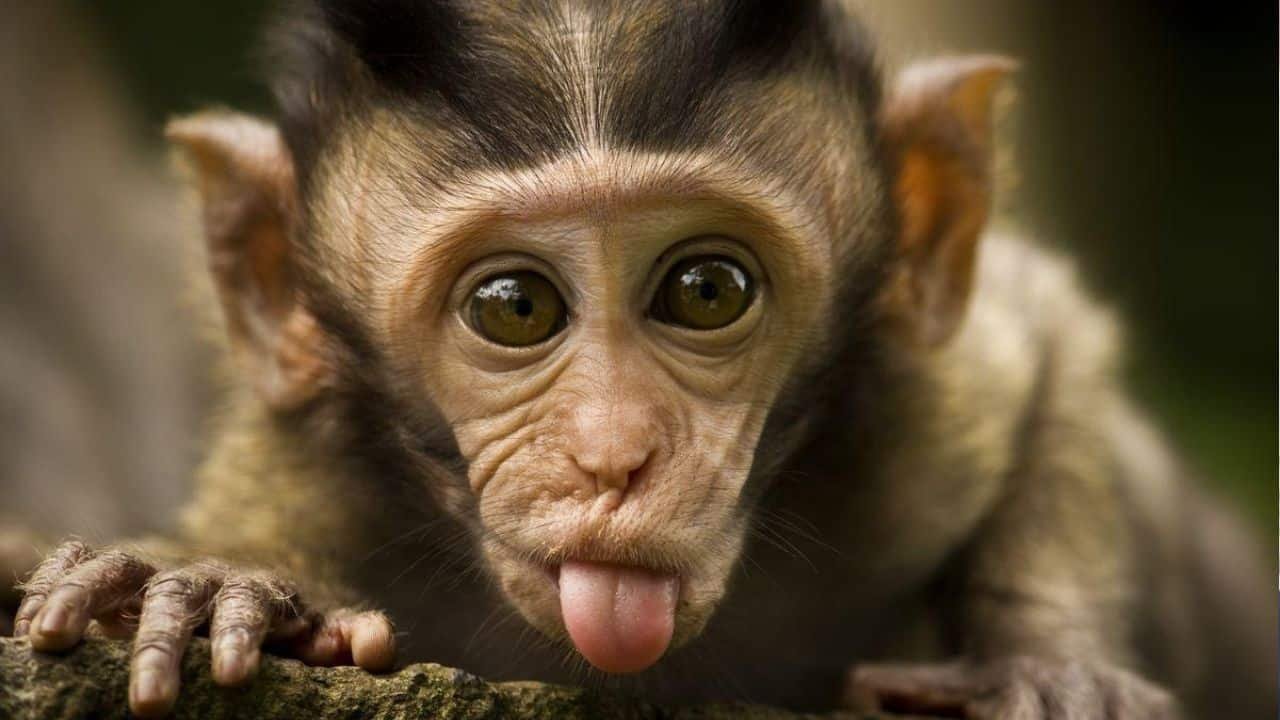
    A dramatic incident unfolded at the city court in Karachi when a baby monkey managed to escape while being brought alongside 13 other monkeys by the Sindh Wildlife Department, reported Geo News.

    Two individuals responsible for transporting the monkeys were arrested by the authorities for violating provincial wildlife laws. The suspects were brought before the district and sessions court on Thursday, which fined them Rs100,000 and ordered to hand over the baby monkeys to the zoo.

    The monkeys were being kept in wooden mango crates, and one clever little monkey managed to escape the confines of its container. The baby monkey sought refuge on a tree, proving to be quite elusive due to its small size and agility, making it challenging for the rescue team to catch. The Sindh Wildlife Department stated that they would continue their rescue operation the next day (Friday), which is today, in an effort to capture the baby monkey still at large in the city court area.

    The department had recovered them during a search of a passenger bus arriving in Karachi from Charsadda. The monkeys were suspected to have been illegally captured from the forests in Charsadda.

    Authorities are working diligently to ensure the safety and welfare of these rescued monkeys, aiming to return them to their natural habitats or appropriate care facilities.

  • Chile animal shelter offers hope to wildlife affected by natural disasters

    Chile animal shelter offers hope to wildlife affected by natural disasters

    In response to the aftermath of natural disasters in Chile, an animal shelter called Refugio Animal Cascada, located near Santiago, is providing refuge and rehabilitation for wildlife impacted by the events.

    With a history spanning two decades, the shelter has recently seen an influx of new residents due to a series of wildfires, droughts, and heavy rains.

    Reuters has reported that Chile’s central regions experienced severe weather conditions, including heavy rainfall and floods, leading to evacuations and further distress for the wildlife. Earlier this year, devastating wildfires ravaged Chilean forests, displacing numerous woodland animals and leaving destruction in their wake.

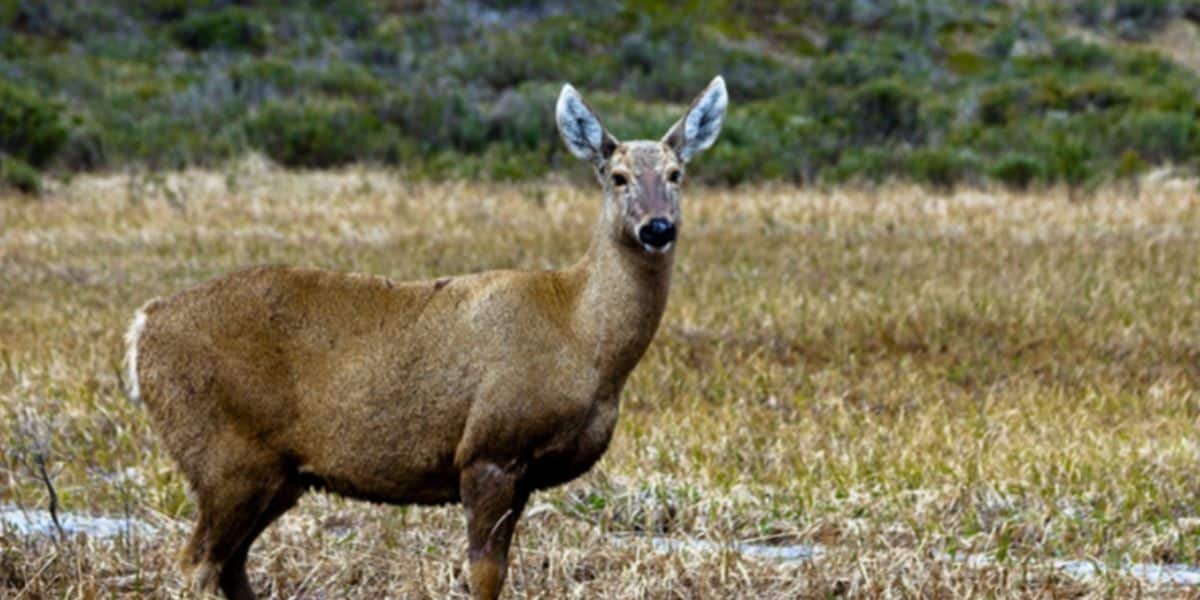
    Activists responded by treating injuries, including burns, sustained by animals like the small nocturnal marsupials known as monitos del monte and pudus, the world’s smallest deer.

    The escalating global environmental crisis, characterized by the loss of biodiversity and native wildlife, prompted Chilean Environment Minister Maisa Rojas to express concern during her visit to inaugurate a new unit at the shelter.

    She emphasized the vulnerability of the country’s wildlife, stating that it is at risk.

    The shelter’s primary objective is to rehabilitate these animals and ultimately release them back into their natural habitats.

  • ACF’s Ayesha Chundrigar teams up with Marina Khan, Sania Saeed to make short film about animal rights

    ACF’s Ayesha Chundrigar teams up with Marina Khan, Sania Saeed to make short film about animal rights

    Animal Rescue Foundation ACF announced on Wednesday that they are making a short film ‘Aisa He Hota Hai’ which will explore the issue of animal rights in Pakistan. The five minute film will be directed by powerhouse Marina Khan, while the script was written by the founder Ayesha Chundrigar and veteran actress Sania Saeed will star in the film.

    The Current spoke to Chundrigar about how this project came about. The animal rights activist revealed that the short film reflected how animal abuse isn’t an isolated issue, but connects with every other issue in society. She also told us that the project was made without a budget, except for necessities like cameras and petrol, describing it as “a film about animals, but at the same time, it’s not about animals, its so much more.”

    “I am a psycho therapist by profession and what is very interesting for me, especially in my line of work with animals, is that I have to deal with human behavior of all sorts. I meet some of the best people, the kindest people, but then I also meet the worst kind of people that abuse those who are more vulnerable than them, who exploit them and treat them very badly. I have had the privilege of doing my work, while also looking at it through the lens of a psycho-therapist. And everything I do on social media, if you look at ACF’s, I tell stories of animals, of how we help…I try to get to the root of the problem.”

    Chundrigar said that the film was born out of her fascination by the connection between animal abuse and all other kinds of things that can happen in society:

    “We normally see animals and animal abuse as totally separate from issues in society. But what I find fascinating is how animal abuse is linked so deeply to every other issue in society, we just have a blind spot to it. But it’s so necessary to look at it because it’s so pivotal to everything else. So I thought it’s finally time to address it through the most powerful medium, which is a film, because it can reach all sorts of patents on social media and can have a really wide range. The difficult part is to put it in a story form, but it was honestly one night. I was just sitting and thinking…and this idea just came into my head. I wrote it within five minutes.”

    Chundrigar partnered with long time animal activist Sania Saeed, who is often spotted at the shelter and during rescue operations as well. Chundrigar gushed about Saeed’s enthusiasm for the project, and said she was the first person who Ayesha had reached out for the script:

    “I shared this idea with Sania because she’s the most amazing human who comes to the shelter all the time to help us with our rescues, with re-habilitating, and grooming animals there. She’s come with us to places like Empress Market to spread awareness. She is truly one of my top five most favorite people in the world. She’s so deep, incredible and empathetic. When I told her about the idea, she immediately came on board and also wrote all the dialogue because I wrote it in English, she translated it into Urdu.”

    It was through Saeed that Ayesha connected to the producer Imaan, veteran actress and director Marina Khan’s niece, who both came on board to help push the project forward:

    “Marina herself is amazing”, Chundrigar praised the ‘Dhoop Kinare’ actress. “She has visited us several times, and has even adopted a paralysed puppy from us who has grown to become this naughty little cartoon who lives with her. And Marina is the biggest animal lover, and an inspiring woman. I was lucky to be in her and Sania’s presence and working and learning with them. It happened organically, like I didn’t have to do anything. We talked with each other, and then had a couple of meetings, and then everything came together easily. Iman got the best team together for our sound, photography and so on.”

    We also spoke to Marina Khan on what drove her to participate in the project. She said that it was to help encourage empathy towards animals, and to show respect to all of God’s creatures:

    “The project was about addressing empathy towards animals and show respect to all of God’s creatures. We may use animals for labour and we may use them as food but we can still show them some respect. Also to show that the mistreatment of animals leads to the mistreatment of humans.”

    Pakistan is currently witnessed a rise in animal cruelty cases, most notoriously the elephant Noor Jehan, who passed away in Karachi Zoo in April due to poor health and neglect. Furthermore, there have been consistent cases of dog culling, as was the case in a May incident, when a man was arrested after a video showed him killing a dog by hanging and another case in KPK where another man was arrested for butchering dogs.

    To ensure that there is a shift in society in how animals are seen and treated, Chundrigar said that her organisation has been working through their social media pages to raise awareness about showing empathy and compassion to animals, so that the work for ensuring better rights for animals keeps progressing:

    “The state of animal rights in Pakistan has always been bad, the difference is that animals were never highlighted as a cause being worthy of even talking about. But now you and I are talking about it. Animal rights has become news now, and that is what my organization has been building towards. Because it’s very easy to say something like ‘we need laws’ or ‘we need our rights’. Of course we need them, that’s common sense! But to implement a policy, we need to ensure that the cause is seen as important. This is what my organization has been working towards for the last ten years, we have been building this case to become worthy of news. This is how we know about Noor Jehan, or the rising reports of dog culling, and the reason why people are trying to stop it and those in charge and now taking notice. This is a movement of animal rights, and like any movement its not just going to happen. You cant force it, but let it take shape slow and steady, but you have to be consistent and set an example through your actions. This is what we share on our social media about why animals are important, and what it takes to make a compassionate society. This is what I’m keep doing, because I look at it through a psychological perspective. The moment people start noticing animals, automatically you’ll seem ore things done to benefit them, which is why I’m working on psychological roots of change as oppose to just working on surface level stuff, because that is the way to bring about change not just through laws or policy, but through the mindset.”
  • Sri Lanka is not sending elephants to Pakistan

    Sri Lanka’s High Commission in Pakistan has denied reports that the island nation plans to give two elephants to the country.

    Media reports had stated last week that Sri Lanka was gifting two elephants to Pakistan, after the demise of the Karachi Zoo’s Tanzanian elephant Noor Jehan. The pachyderm died after a very public battle with illness exacerbated by neglect from Zoo officials.

    The news was met with backlash from Pakistani social media users, including celebrities like Nadia Jamil, who took to Twitter to condemn the possibility, pointing out that Pakistan had no proper policy about the well-being and care of Zoo animals, which had led to Noor Jehan’s death.

    However, a tweet posted by the Sri Lankan High Commission has put the rumors to rest.

    “Sri Lanka has not taken action or discussed in providing Elephants to the Zoo’s in Karachi or Lahore, neither Government of Pakistan has made any such request. This post indicate the correct position in view of certain articles in media and discussions on going on social media.”

    The post did clarify that there was some truth to the claims, because the Sri Lankan Honorary Counsel in Lahore Yasin Joyia, had discussed the possibility of providing elephants to Pakistan, but he did not hold any authority to execute such decisions.

  • ‘Don’t give Pakistan any animals’: Nadia Jamil slams Sri Lanka’s offer to send elephants

    ‘Don’t give Pakistan any animals’: Nadia Jamil slams Sri Lanka’s offer to send elephants

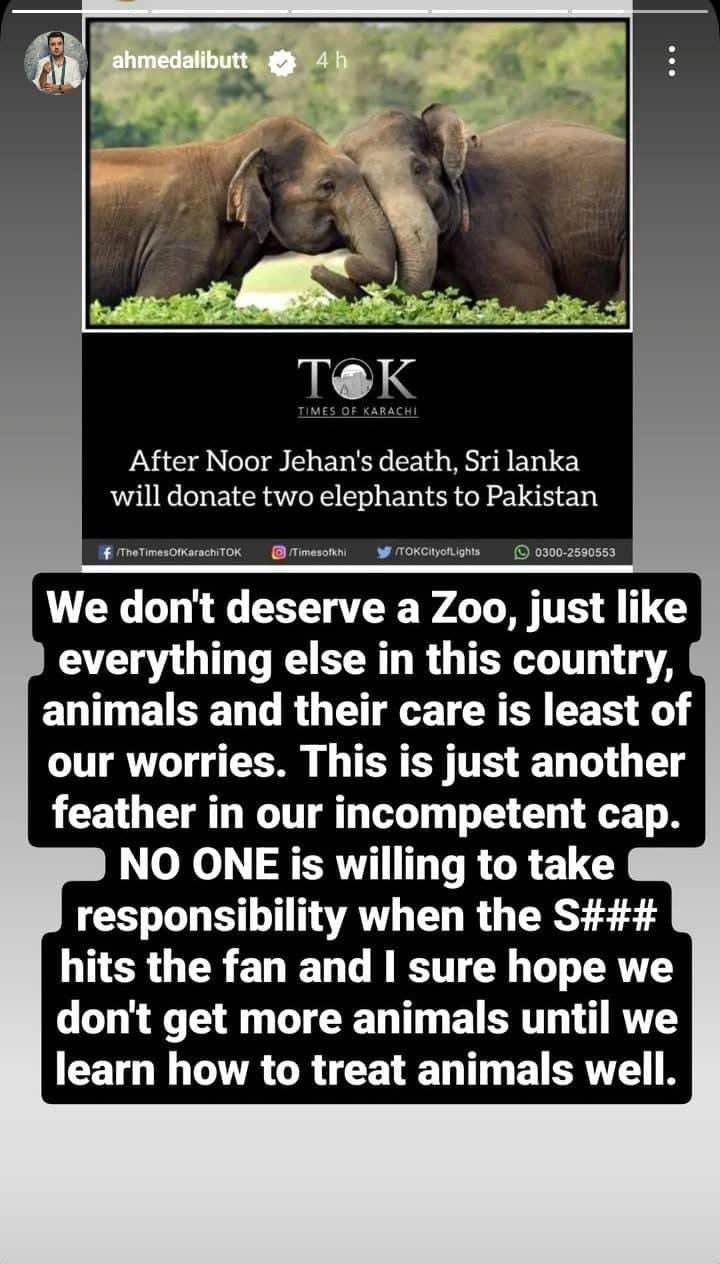
    After the tragic death of Karachi Zoo’s ailing elephant Noor Jehan after years of neglect and abuse, Sri Lankan authorities announced that they were donating two elephants to Pakistan. According to Geo News, Sri Lankan Honorary Counsel Yasin Joya announced that one will be given to Karachi Zoo and the other one to Lahore Zoo.

    Celebrities like veteran actress Nadia Jamil spoke out against this decision, slamming the Pakistani government for providing poor facilities for the animals that had led to Noor Jehan’s death.

    “I beg Sri Lanka, DO NOT GIVE PAKISTAN ANY ELEPHANTS. NOT until Pakistan develops a policy to protect animals in its zoos and learns to take care of animals as they should be taken care of. Please. No more tragic deaths. Please spare more animals from suffering like Noorjehan.”

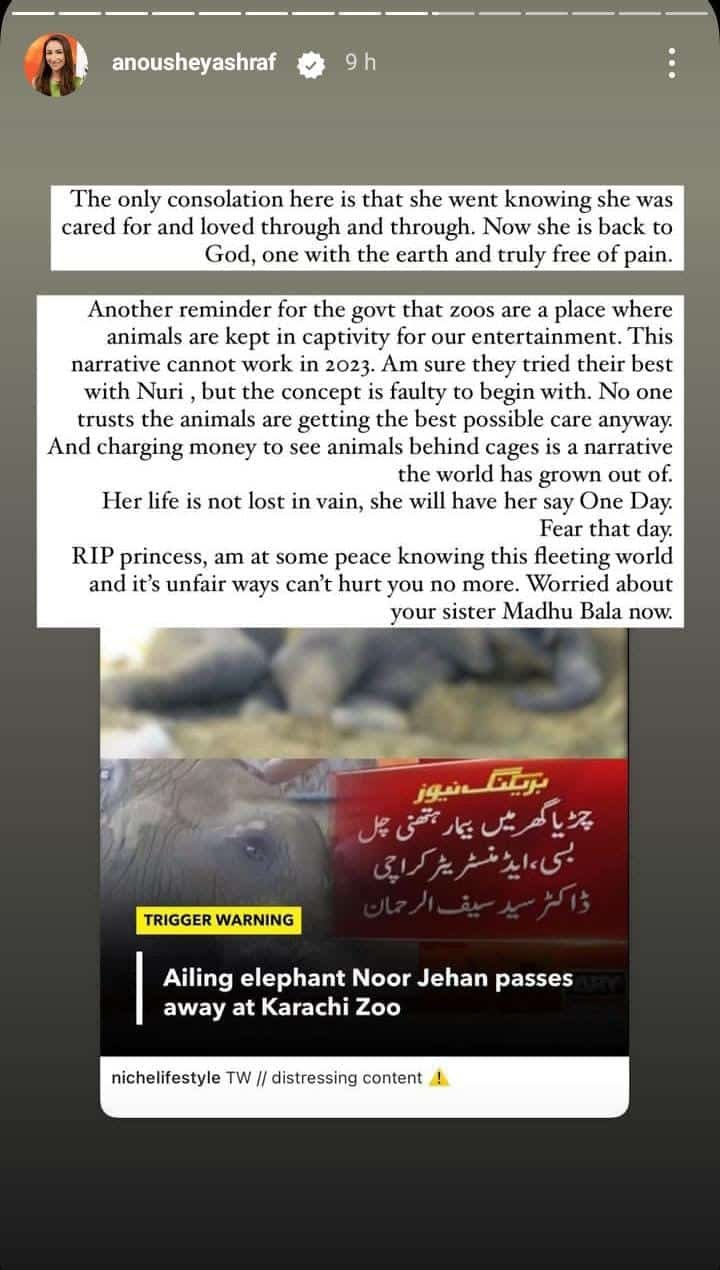
    Other celebrities like Anushay Ashraf and Ahmed Ali Butt mourned the loss of Noor Jehan, and slammed the Karachi authorities for their limited resources which had led to the neglected conditions of animals at Karachi Zoo. In a now-expired post on her Instagram stories, Ashraf pointed out how zoos are not safe places for animals, and should not be entertainment facilities for humans:

    “Another reminder for the govt that zoos are a place where animals are kept in captivity for our entertainment. This narrative cannot work in 2023. Am sure they tried their best with Nuri, but the concept is faulty to begin with. No one trusts the animals are getting the best possible care anyway. And chargingn money to see animals behind cages is a narrative the world has grown out of.”

    Singer and actor Ahmed Ali Butt slammed the decision to import elephants from Sri Lanka, because as he wrote:

    “We don’t deserve a zoo, just like everything else in this country, animals and their care is the least of our worries. This is just a feather in our incompetetnt cap.”

  • ‘Janwaron say bad dua lenay say behtar hai’: Hamza Ali Abbasi joins rallying cry to shut down zoos across Pakistan

    ‘Janwaron say bad dua lenay say behtar hai’: Hamza Ali Abbasi joins rallying cry to shut down zoos across Pakistan

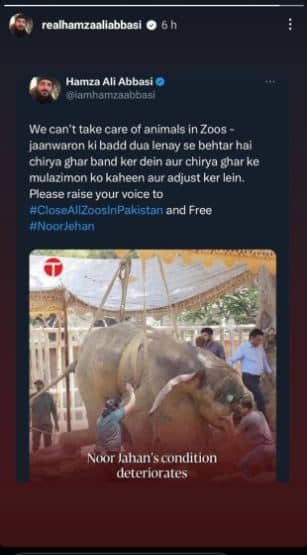
    Actor Hamza Ali Abbas has joined the chorus of voices calling for zoos across Pakistan to be shut down. As the country watches veterinarians try to save the life of one of Karachi Zoo’s elephants, Noor Jehan, celebrities have lent support to the demand that the animals be shifted to sanctuaries.

    Taking to Instagram, the ‘Maula Jatt’ actor shared a clip of a post by Express Tribune, slamming authorities for not caring about the welfare of the animals:

    “We can’t take care of animals in zoo’s- it is better than to receive curses from animals that we should ban zoos and send the animals to a safer place.”

    Abbasi’s criticism comes after countless celebrities, including Grammy award winner Arooj Aftab, raised their voices to support animals and shut down zoos. Aftab re-shared a clip from her interview with The Current where she had talked about the abysmal conditions of animals in Lahore’s zoo, calling for better facilities to be set up for animals.

    Just as Noor Jehan improved, she fell into a concrete pond built inside her shelter, leading to worsening of her condition. Authorities had remained in contact with the animal welfare organization Four Paws to coordinate for her treatment.

    Yesterday, The Nation reported that Minister of Climate Change and member of Pakistan People’s Party (PPP) Sherry Rehman, had advised Sindh government to shut down Karachi Zoo, and for the animals to be moved to enclosures where they are provided with proper facilities.

  • It’s time to close the zoos in Pakistan

    It’s time to close the zoos in Pakistan

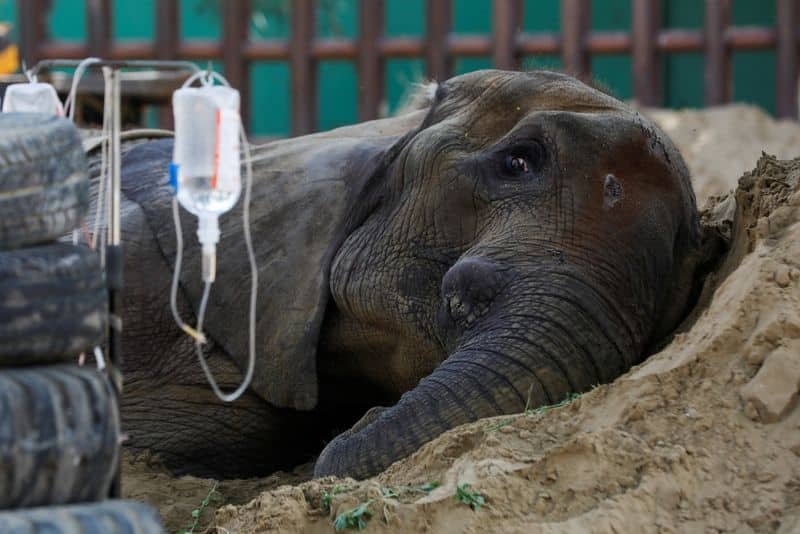
    Noor Jehan, an elephant in Karachi Zoo, is critically ill after the 17-year-old fell in a pond in a small enclosure. She has since been lying visibly weak with limited motion on a mound of sand, propped up against the only tree inside the enclosure. Noor Jehan’s condition is a reminder that we have imprisoned animals in cages for the entertainment of the people. We humans are the reason that the animals suffer and bear so much torture and pain.

    Wild animals are unlikely to survive or live happily in an artificial environment like the ones we provide them at the zoos. Moving them from their natural habitat and from their community puts them under great stress. It is no secret that animals in Pakistani zoos are kept in poor conditions.

    The wildlife parks and zoos of Pakistan are characterised by a weak governance system. The animals lying in the zoos and wildlife parks of Pakistan are ignored with regard to their physical and mental well-being. They are not properly provided with adequate nutritional food and are seldom treated effectively for their physical ailments. There are about 10 public zoos, 25 private zoos and 28 wildlife parks in Pakistan. Neither of these are authorised by any recognised association of zoos and aquariums. The animals kept in these zoos are often neglected. Not only is their food and nutrition ignored but several other environmental issues thwart their well-being. Several zoos lack veterinary professionals, owing to which the animals do not get ample medical help whenever required. Some animals die due to lack of adequate required treatment adding to the plight of the zoos of Pakistan.

    This brutality towards animals has been there because of continuous negligence being directed towards them. This isn’t the first time we are witnessing the suffering of animals at zoos and this definitely doesn’t seem to be the last time either. In 2020, American singer Cher arrived in Pakistan to send off Kaavan, an elephant in Islamabad Zoo she had spent years trying to free, before his move to a Cambodian sanctuary. Animal rights advocates had campaigned for the 36-year-old Asian elephant to be rescued from grim conditions.

    Minister for Climate Change, Sherry Rehman, has said that there is a no-zoo Islamabad model of rescue and rehab centre and transition sanctuary, in the federal capital. The Islamabad zoo where the bears and the elephant were kept have now been closed. Pakistan should stand firmly against any kind of animal cruelty and take timely action to stop it.

    We all need to stand up for the animals and treat them right. It took one Noor Jehan to make us realise that zoo animals suffer from continued neglect and will continue to die and go through pain if our policies don’t change. So if, we cannot take care of our animals, we should close the zoos and free the animals. We Pakistanis don’t deserve them.