Tag: Antonio Guterres

  • UN chief, at Gaza crossing, urges end to ‘nightmare’ of war

    UN chief, at Gaza crossing, urges end to ‘nightmare’ of war

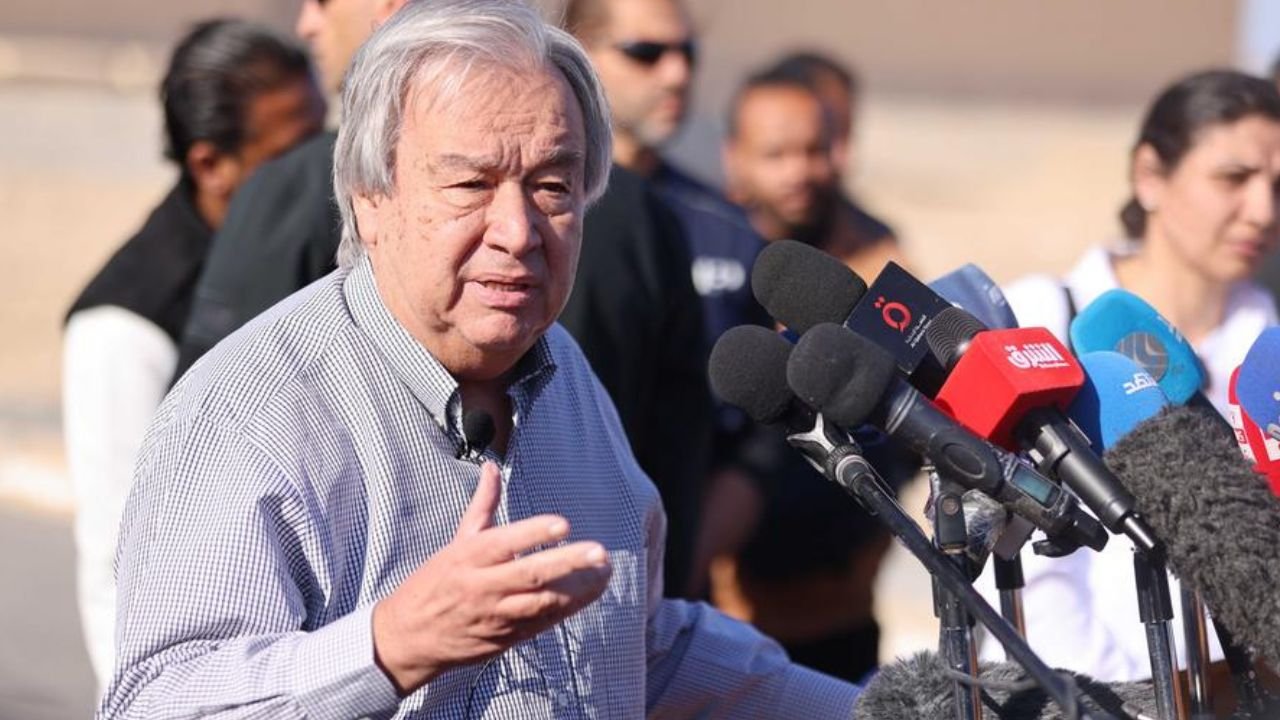
    UN chief Antonio Guterres, on a visit to the doorstep of Gaza, on Saturday said the world has seen enough of the war’s horrors and appealed for a ceasefire to allow in more aid.

    ‘Palestinians in Gaza—children, women, men—remain stuck in a non-stop nightmare,’ he said on the Egyptian side of the Rafah crossing where truckloads of aid trickle into Gaza but the population is stalked by ‘hunger and starvation’.
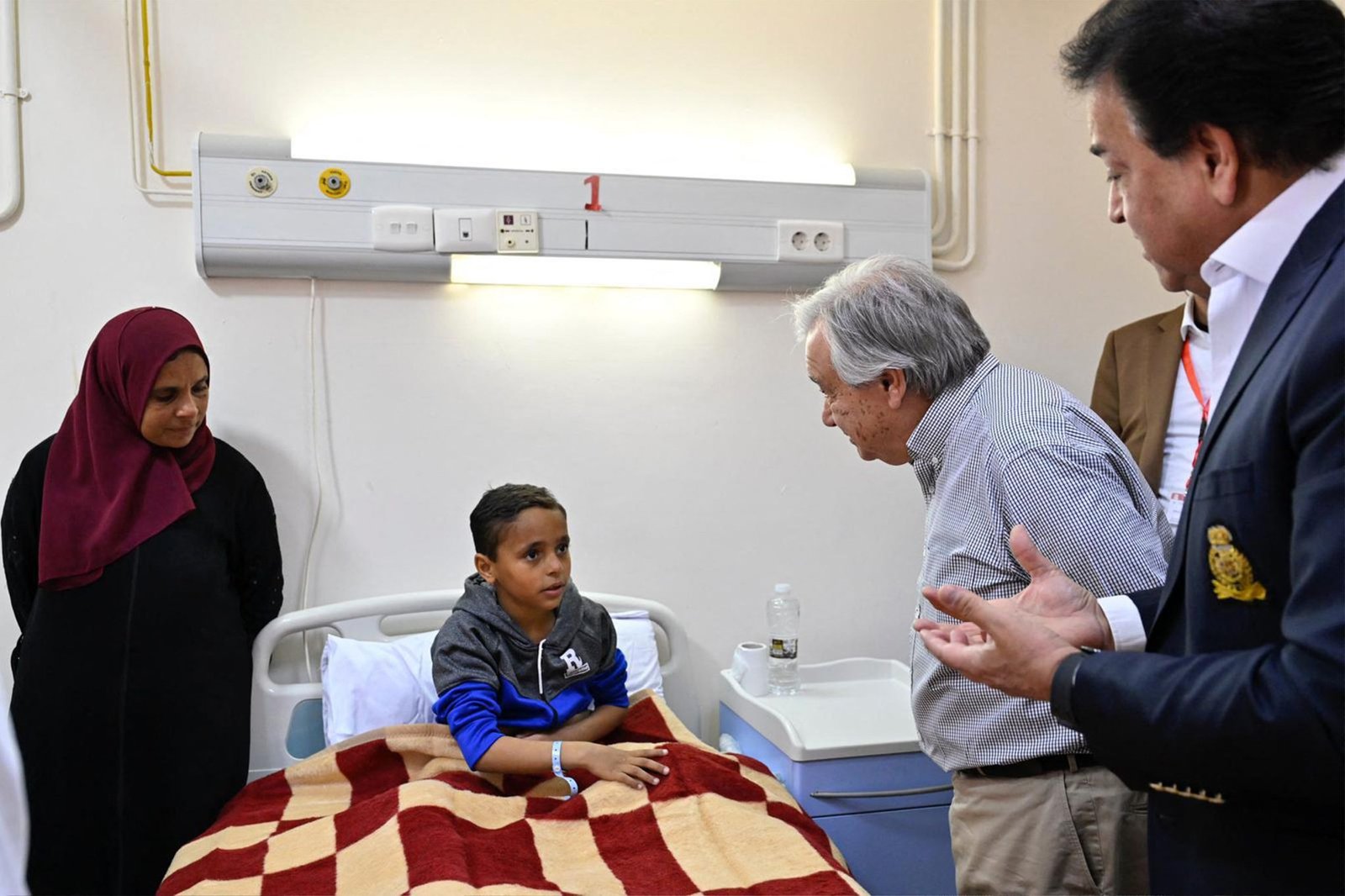
    This handout pictured released by the United Nations press office shows UN Secretary-General Antonio Guterres meeting with a Palestinian child evacuated from the Gaza Strip receiving treatment at the general hospital in El-Arish in Egypt’s northeastern North Sinai province on March 23, 2024, amid the ongoing conflict in the Palestinian territory between Israel and the militant group Hamas. (Photo by Mark GARTEN / UNITED NATIONS / AFP) / RESTRICTED TO EDITORIAL USE – MANDATORY CREDIT “AFP PHOTO / UNITED NATIONS – MARK GARTEN” – NO MARKETING NO ADVERTISING CAMPAIGNS – DISTRIBUTED AS A SERVICE TO CLIENTS – RESTRICTED TO EDITORIAL USE – MANDATORY CREDIT “AFP PHOTO / UNITED NATIONS – Mark Garten” – NO MARKETING NO ADVERTISING CAMPAIGNS – DISTRIBUTED AS A SERVICE TO CLIENTS /

    ‘I carry the voices of the vast majority of the world who have seen enough,’ Guterres said, deploring ‘communities obliterated, homes demolished, entire families and generations wiped out’.

    He reiterated that ‘nothing justifies the horrific attacks by Hamas’ against Israel, triggering the war on October 7.

    ‘And nothing justifies the collective punishment of the Palestinian people,’ the United Nations secretary-general said.

    Guterres, speaking at a lectern in front of the imposing gates to the Gaza side of  Rafah, through which aid trucks pass, said the ‘heartbreak and heartlessness of it all’ were clear.

    ‘A long line of blocked relief trucks on one side of the gates. The long shadow of starvation on the other,’ which he called ‘a moral outrage.’

    Guterres emphasised ‘it is more than time for an immediate humanitarian ceasefire’ and appealed to Israel for ‘total, unfettered access for humanitarian goods throughout Gaza.’

    The UN chief, who makes an annual ‘solidarity mission’ to distressed Muslim communities during their holy fasting month, said that ‘in the Ramadan spirit of compassion, it is also time for the immediate release of all hostages’ captured in the October attacks and still held by militants in Gaza.

    Response from Israel

    Israel’s foreign minister said Saturday the United Nations had become an ‘anti-Israeli body’ under Antonio Guterres, after the UN chief called for a ceasefire on a visit to Gaza’s border.

    International outrage over the heavy civilian toll and humanitarian crisis in Gaza has further worsened the long strained ties between Israel and the world body.

    ‘Under his (Guterres’s) leadership, the UN has become an anti-Semitic and anti-Israeli body that shelters and emboldens terror,’ Foreign Minister Israel Katz said on social media platform X.

    The top Israeli diplomat criticised Guterres, who Katz said ‘stood today on the Egyptian side of the Rafah crossing and blamed Israel for the humanitarian situation in Gaza’, claiming instead that Hamas militants ‘plunder’ aid.

    Katz, whose government has accused staff at the UN agency for Palestinian refugees of involvement in Hamas’s October 7 attack that triggered the war, also said Guterres spoke ‘without calling for the immediate, unconditional release of all Israeli hostages’.

    Vote at Security Council

    Meanwhile, a vote at the UN Security Council on a new text calling for an ‘immediate’ ceasefire in the Israel-Hamas war was postponed to Monday, diplomatic sources told AFP, after a separate, US-lead draft resolution was vetoed.

    The United States, Israel’s main ally and military backer, had put forward a resolution mentioning ‘the imperative of an immediate and sustained ceasefire’ and condemning the October 7 attack by Hamas.

    Russia and China on Friday vetoed that resolution, which was also opposed by Arab states for stopping short of explicitly demanding Israel immediately end its campaign in Gaza.

    The new ceasefire text was meant to go to a vote on Saturday, but was pushed back to allow further discussions, the diplomatic sources said.

    The new, tougher draft resolution, seen by AFP, ‘demands an immediate ceasefire’ for the ongoing Muslim holy month of Ramadan that leads ‘to a permanent sustainable ceasefire’ respected by all sides.

    Eight of the council’s 10 non-permanent members have been working on the draft, which also calls for the ‘immediate and unconditional’ release of hostages seized by Hamas and the lifting of ‘all barriers’ to humanitarian aid flowing into the besieged Gaza Strip.

    ‘We as (the) Arab Group unanimously endorse and support the draft resolution,’ said Palestinian ambassador to the UN Riyad Mansour, who had denounced the US-led text as biased.

    But US Ambassador Linda Thomas-Greenfield indicated opposition, saying the resolution would jeopardize ongoing diplomatic efforts to secure the release of hostages—the same reason the United States gave before vetoing previous ceasefire resolutions.

    ‘In its current form, that text fails to support sensitive diplomacy in the region. Worse, it could actually give Hamas an excuse to walk away from the deal on the table,’ she said.

    Friday’s text did not explicitly use the word ‘call,’ but simply stated that a ceasefire was imperative, and linked to ongoing talks, led by Qatar with support from the United States and Egypt, to halt fighting in return for Hamas releasing hostages.

    ‘If the US is serious about a ceasefire, then please vote in favor of the other draft resolution, clearly calling for a ceasefire,’ China’s representative, Zhang Jun, said.
  • Taliban refuse to let women work and go to school

    Afghan Taliban have once again rejected international calls to lift the ban they imposed on women’s work and education, after the United Nations sanctions committee concluded in Doha without formally recognising the administration in Afghanistan.

    Suhail Shaheen, head of the Taliban political office in Doha pointed out that the meeting’s decisions cannot be accepted or implemented when the government in Afghanistan is not part of the process.

    In a meeting where over 20 countries’ representatives were present, the Taliban administration was not invited.

    When asked by a journalist if there will ever be a situation when he will meet the Taliban directly, UN Chief António Guterres said: “If the time is right, I will not deny the possibility.”

    Afghan Foreign Minister (FM) Amir Khan Muttaqi will reportedly visit Pakistan in a couple of days.

  • ‘Race against time’: PM Shehbaz calls on the world to help flood ravaged Pakistan

    ‘Race against time’: PM Shehbaz calls on the world to help flood ravaged Pakistan

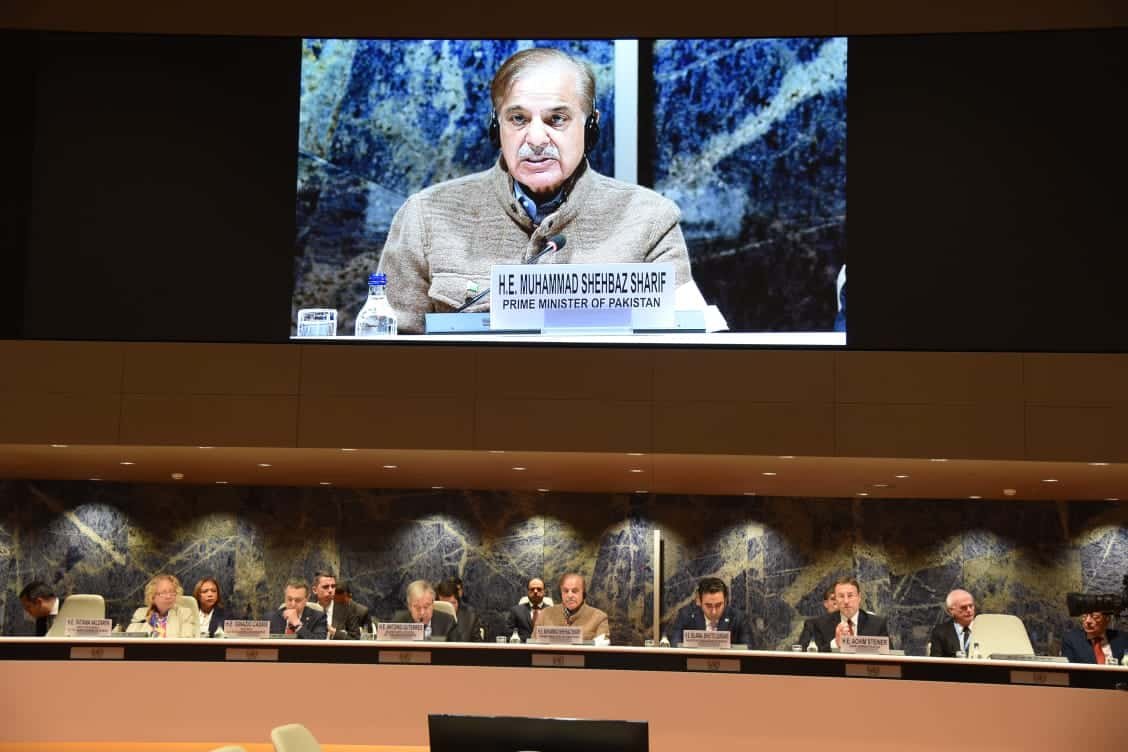
    The International Conference on Climate Resilient Pakistan — co-hosted by Pakistan and the United Nations — began in Geneva on Monday.

    The international conference began with the words of Foreign Minister Bilawal Bhutto Zardari, who said, “We will need considerable support” from the international community,” as he sought solidarity to help Pakistan achieve a “resilient” future.

    The FM said that rehabilitation “continues to this day” as Pakistan battles with wide-scale destruction brought on by the environmental catastrophe.

    United Nations Secretary-General Antonio Guterres Monday appealed to the world to help Pakistan deal with the disaster caused by floods, saying “massive investments” are needed for the country’s rehabilitation which is expected to cost more than $16 billion.

    “Even through the darkest moments, the giving spirit of the Pakistani people has shone brightly,” said Guterres, “I have seen neighbours helping neighbours with food, water and shelter”.

    The UN head stated that his heart broke when he saw first-hand the active devastation of last summer’s floods. “No country deserves to endure what happened to Pakistan, but it was especially bitter to watch that country’s generous spirit being repaid with a climate disaster of monumental scale,” he said.

    Prime Minister (PM) Shehbaz Sharif again called on the world to help flood-ravaged Pakistan in his address at the International Conference on Resilient Pakistan.

    PM Shehbaz said that the world was standing at a “turning point of history” today.

    “One can go on and on but to truly say, we are racing against time. We are thankful for the support extended to us by the Asian Development Bank, UN, International Monetary Fund and several other international organisations.”

    At the moot, Prime Minister Shehbaz Sharif also launched the ‘Resilient Recovery, Rehabilitation, and Recons­truction Framework’ (4RF).

    The framework outlines a vision for rehabilitation and reconstruction of the flood-affected areas as well as will emphasise the need for global support and long-term partnership to implement it.

    “The first part of the 4rf plan reflects the priorities for recovery and reconstruction, bearing in mind the minimum funding requirement of $16.3 billion, half of which we met from domestic resources and the remaining half with the help of development partners and friends,” PM Shehbaz said.

    He said that the second part of the framework plan incorporates flood-resilient designs and infrastructure projects such as protecting key highways, railway line networks and early warning systems and capacity building for rescue and relief for future disasters.

    The PM while sharing details of the scale of destruction the country has suffered said that “various parts of Sindh and Balochistan still remain under water”.

    The floods, blamed on climate change, dealt a severe blow to Pakistan’s strained economy while displacing some 8 million people and killing at least 1,700.

    PM Shehbaz stressed that he was asking for support for those who have lost their life savings, homes, and livelihoods and are facing the harsh winter under open skies.

    “The one thing we have learned is that nothing can go back to business as usual,” the PM stressed.

    “I am asking for a sustained international support plan to meet this daunting challenge, for a new lifeline for these people. Together we have to rebuild their lives and their dreams,” he concluded.

    French President Emmanuel Macron, Turkish President Recep Tayyip Erdoğan, Norwegian Prime Minister Jonas Gahr Store and President European Commission Ursula von der Leyen shared messages of solidarity at the event via video link.

  • Baita waapis aaya: Junaid is moving back permanently to help mother in politics

    Baita waapis aaya: Junaid is moving back permanently to help mother in politics

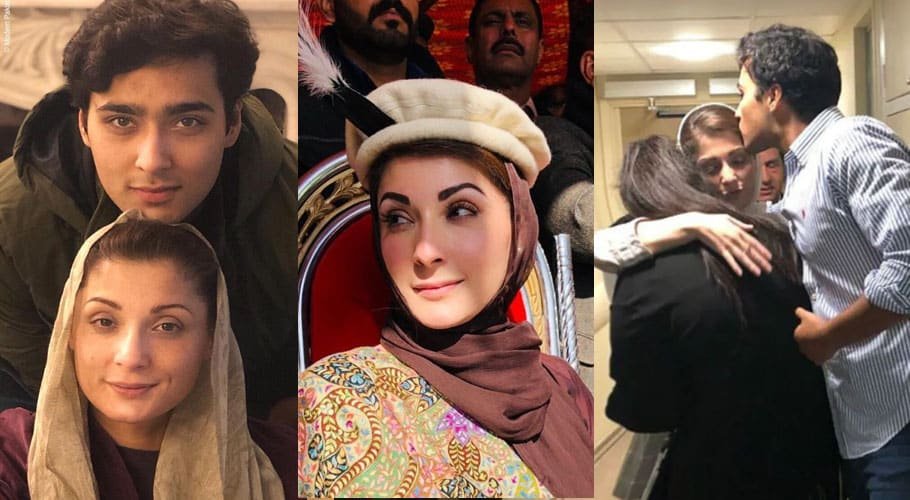
    Junaid Safdar, the son of Senior Vice President of Pakistan Muslim League- Nawaz (PML-N), Maryam Nawaz, is set to travel to Pakistan to settle in the country permanently, reports Murtaza Shah for The News.

    News reports state that Junaid and his wife, Ayesha Saif, will reach Pakistan on Friday from Doha.

    The couple would be shifting to Pakistan permanently to assist Maryam Nawaz in the party’s political activities.

    On January 2, Maryam Nawaz was appointed the Senior Vice President of PML-N. She will also take on the responsibility of organising the party.

    According to news reports, PML-N supremo Nawaz Sharif and Maryam Nawaz on Wednesday left London for a week-long trip to Switzerland’s Geneva.

    Meanwhile, Prime Minister (PM) Shehbaz Sharif will also be visiting Geneva to co-host the International Conference on Climate Resilient Pakistan — along with United Nations Secretary-General Antonio Guterres — on January 9.

    The reports further suggest that the PML-N supremo and his daughter will have meetings scheduled during the trip. Nawaz will also meet with PM Shehbaz, who is expected to reach the Swiss city on Sunday, January 8.

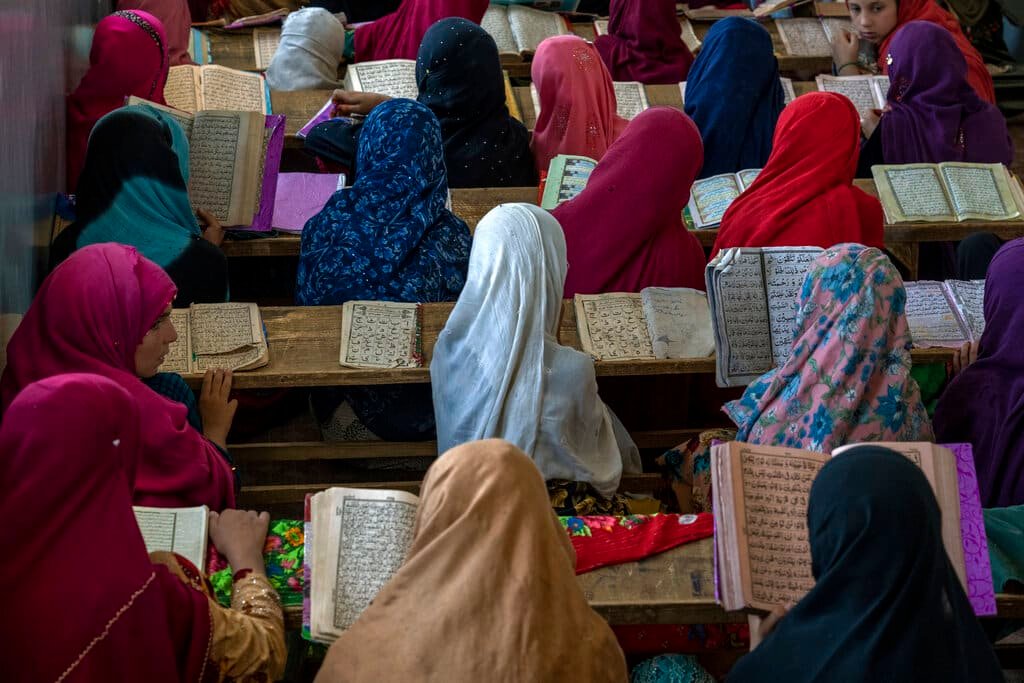
  • Today marks one year since Afghan girls were banned from attending school

    Today marks one year since Afghan girls were banned from attending school

    United Nations (UN) Secretary-General Antonio Guterres took to Twitter to urge Taliban authorities in Afghanistan to revoke the ban on girls’ education that was implemented a year ago.

    He said, “Sunday marks one year since girls were banned from attending high school in Afghanistan. A year of lost knowledge and opportunity that they will never get back. Girls belong in school. The Taliban must let them back in.”

    “It is profoundly damaging to a generation of girls and to the future of Afghanistan itself”, said Markus Potzel, the acting head of the United Nations Assistance Mission in Afghanistan (UNAMA). The UN has called the ban ‘tragic and shameful.

    According to UNAMA, more than a million teenage girls have been deprived of education across the county.

    Earlier this month, dozens of girls protested in an eastern Afghan city due to the closure of schools for girls.

    When the Taliban seized power in August last year, they did reopen high schools for boys on September 18 but banned secondary school girls from attending classes.

    Education Minister Noorullah Munir termed this act a “cultural issue”. He said that many rural people do not want their teenage daughters to attend school.

    Earlier this year, the Taliban said that schools for girls would be opened after March 21 with the caveat that girls and boys must be completely segregated in schools

    However, schools were opened for a small period of time and again were shut down

    At the time, the Ministry of Education said that the schools would be closed until a plan was drawn up in accordance with Islamic law and Afghan culture.

    Despite the fact that the international community has on multiple occasions made the education of girls a key demand for any future recognition of the Taliban administration, the group has barred Afghan girls and women with certain restrictions including covering themselves from head to toe and not to travelling alone.

  • ‘Six months’: Murad Ali Shah gives estimate on when flood waters will drain

    Sindh Chief Minister (CM) Murad Ali Shah said that the government is working on rehabilitating people and the province’s drainage, irrigation network. According to him, it will take “three to six months” to drain the water from flood-affected areas of the province as in “some areas, there is at least eight to 10 feet of water”.

    While speaking to the media in Karachi, the chief minister talked about the damages and loss of assets. He said that “12.5 million people are affected by the disaster and around 350 billion rupees’ losses to the farmers are being reported in the province.”

    He revealed that even in places where the floodwater is receding, “the situation is not such that people can return”, highlighting that Pakistan had received unprecedented rainfall this year.

    It is pertinent to mention that Sindh is the worst-hit province so far after biblical floods wreaked havoc across the country. Sindh had the most deaths and injuries. Out of the 1,396 fatalities countrywide, 578 people have died in Sindh province alone.

    Moreover, CM Shah said that the province is facing a shortage of tents and medicines and he had raised the issue with the United Nations (UN) chief Antonio Guterres during his recent visit to Sindh.

    “The whole world has to come together to combat climate change,” he said, adding that Guterres had also called on the world to “pitch in” to help Pakistan navigate the crisis.

    Earlier, the UN chief on his visit to Pakistan’s flood-affected areas said that he has “never seen climate carnage on this scale”.

    At a press conference in Karachi on Saturday after witnessing the worst of the damage in southern Pakistan, he said, “I have seen many humanitarian disasters in the world, but I have never seen climate carnage on this scale.”

    Guterres also strongly urged international creditors to introduce a new mechanism ‘Debt Swap’ for flood-devastated Pakistan.

  • Exclusive: Apple user or Samsung loyalist? What phone does PM Shehbaz use?

    Exclusive: Apple user or Samsung loyalist? What phone does PM Shehbaz use?

    Android or iOS—which one is better? We have heard this never-ending debate many times. Now, the debate has turned towards the power corridors of Islamabad. The question being asked on social media is, what phone does our Prime Minister (PM) Shehbaz Sharif use?

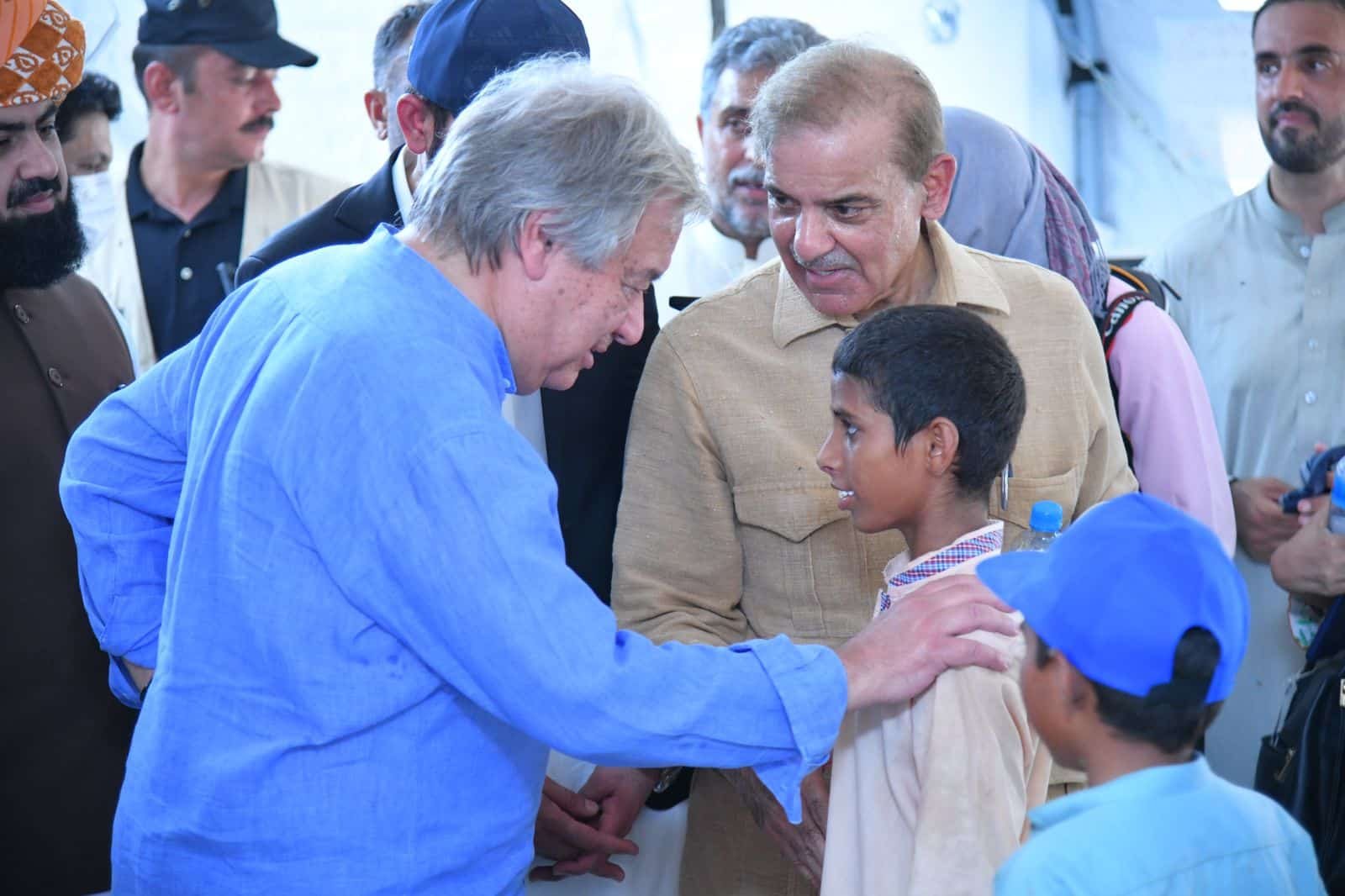
    Earlier in the day, PM’s Focal Person on Digital Media, Muhammad Abubakar Umer, shared a video of the Premier who was sitting with United Nations (UN) Chief Antonio Guterres. They both visited the flood-affected areas of Sindh.

    In the video, PM Shehbaz pulled out his phone which appears to be an iPhone 7.

    Abubakar has also mentioned the model of the phone in the caption. He said, “PM Shehbaz doesn’t normally carry/use his mobile phone in public. This is probably the first time he pulled out his phone during a meeting—to show a flood-related video to UN Secretary-General— and guess what? It’s not iPhone 14, not even X or 9. It looks more like iPhone 7.”

    Upon asking the reason behind PM not upgrading his phone, Abubakar told The Current, “He [PM Shehbaz] uses the phone only for necessary functions and not for entertainment or luxury. He would use the phone as long it serves the basic purpose of call or text and sometimes video message or call.”

    The focal person also revealed that when he met PM Shehbaz back in 2011 he [PM] was carrying a phone that “looked like Nokia 3310”. He said that it was a very “basic” phone.

    “PM has all the resources to afford a new phone but he is doing great even without keeping up with the latest phone models”, he added.

  • ‘Matter of justice’: UN chief appeals to the world to support Pakistan

    ‘Matter of justice’: UN chief appeals to the world to support Pakistan

    United Nations Secretary-General Antonio Guterres on Saturday, September 10, urged the international community to support disaster-hit Pakistan as the country needed massive financial help to overcome post-flood crises.

    “It is not a matter of generosity, but a matter of justice,” he said reiterating the United Nation’s commitment, strong support, and solidarity with the flood-affected populace of Pakistan.

    Guterres said that huge damages and losses were caused to human lives and properties. The Secretary General further said that the UN absolutely supported Pakistan and requested richer nations to generously help the country so that it could face the future challenges of climatic changes and save its people.

    He stressed that the international community must realize the serious impacts of greenhouse emissions as nature was striking back in the form of natural calamities.

    He continued that greenhouse gases had accelerated climatic changes and that nations with larger greenhouse emission footprints must understand these issues. Citing scientific estimates, the UN secretary-general emphasized that now was the right time to reduce greenhouse emissions.

    He said it was also a fact that they were living in a climatic changing era and have to make efforts to rebuild communities and to enable countries to resist and face future disasters that could be wrought by the natural calamities.

    Prime Minister (PM) Shehbaz Sharif, Foreign Minister Bilawal Bhutto-Zardari, Minister for Planning Ahsan Iqbal, Minister for Information and Broadcasting Marriyum Aurangzeb, provincial ministers, and the relevant authorities were present on the occasion.

    Sindh Chief Minister Murad Ali Shah gave a detailed briefing on the damages and loss of lives in the province.

    He said during the current monsoon season, different districts of the province had received unusual rainfall never witnessed in the past.

    He said that 30 districts of the province were affected, displacing about 12 million, adding that a total of 578 people lost their lives. A total of 3 million houses were destroyed and crops grown on an area of about 3.3 million acres were damaged while 500,000 livestock had been swept away.

    Earlier, the prime minister along with the UN secretary general and the federal ministers took an aerial review of the flood-affected areas of the Sindh province.

  • Across borders: Rahul Gandhi extends heartfelt sympathies to Pakistan’s flood victims

    The leader of India’s Congress party, Rahul Gandhi, has extended his heartfelt condolences and sympathies to the bereaved flood-affected families of Pakistan.

    In a tweet on Friday, Gandhi said, “The floods in Pakistan are a terrible tragedy. My heartfelt sympathies to all the people affected and deepest condolences to those who have lost their loved ones.”

    Earlier, Indian Prime Minister (PM) Narendra Modi also offered condolences to Pakistan.

    In a tweet posted on August 29, Modi said he was, “Saddened to see the devastation,” of the floods, adding that he hoped to see an early return to normalcy.

    PM Shehbaz Sharif had replied to his Indian counterpart’s tweet, thanking him for his words of condolence.

    Devastating floods in Pakistan have wreaked havoc across the country, leaving a path of destruction and loss in their wake. More than 1,400 people have lost their lives, one-third of whom are children.

    Record monsoon rains and melting glaciers triggered the disaster. The United Nations (UN) and Pakistan have linked the extreme weather to climate change; some 600,000 people have fled their homes.

    As many as 33 million people of the 220 million South Asian nation have been affected in some way by the floods that swept away houses, roads, railways and bridges and submerged around 4 million acres of farmland.

    UN Secretary-General Antonio Guterres is currently in Pakistan and all set to visit flood-affected areas of the country today (Saturday).

    On Friday, Guterres said that Pakistan is one of the countries most affected by climate change despite its minimal contribution to the phenomenon.

    During a briefing at the National Flood Response Coordination Centre (NFRCC), the UN chief said, “Pakistan has had little contribution to climate change but it is one of the most dramatically impacted by the consequences of climate change.”

    Earlier this week, PM Shehbaz said that the financial impact of the biblical floods might be in the “trillions”.

  • UN Chief António says climate change has attacked wrong targets

    UN Chief António says climate change has attacked wrong targets

    United Nations (UN) Secretary-General António Guterres has said that Pakistan was one of the countries most severely affected by climate change despite its minimal contribution to the phenomenon.

    “Pakistan has had little contribution to climate change but [it] is one of the most dramatically impacted by the consequences of climate change,” Guterres said.

    Guterres during a briefing at the National Flood Response Coordination Centre (NFRCC) alongside Prime Minister Shehbaz Sharif, the Secretary General said that there was “no memory of anything similar to what has happened with the impact of climate change in Pakistan”.

    Pakistan needs massive financial support

    “The numbers are appalling. But beyond the numbers, I see the families that have lost their loved ones, houses, crops, jobs and are living in desperate conditions,” he expressed.

    “Pakistan needs massive financial support to respond to this crisis as according to initial estimates the losses are around $30 billion,” observed Guterres.

    “Effective solidarity and justice is shown by mobilising massive support,” the UN chief said.

    Nature has attacked the wrong targets

    “It is like nature has attacked the wrong targets. Those that are more responsible for climate change should have to face these kind of challenges,” he stated.

    Guterres stressed that it is the international community’s obligation to drastically reduce emissions and support countries that need to invest in resilience and recovery.

    “My voice is entirely at the service of Pakistan and its people. We know our contribution is limited […] but we are totally committed.”

    Challenge is absolutely beyond human capacities, yet humans have to handle it and we are

    Speaking at the briefing, PM Shehbaz Sharif said that the UN chief’s empathy and support was great encouragement for Pakistan, as he expressed gratitude towards the visiting dignitary.

    “The government of Pakistan, along with the provincial governments and all stakeholders […] are working together to provide relief and rescue to millions,” the premier said.

    PM Shehbaz said that efforts were underway and flood affectees were being moved to safer areas while also being provided food and shelter. “The challenge is absolutely beyond human capacity, yet humans have to handle it and so we are.”

    UN chief in Pakistan on solidarity visit after catastrophic flooding

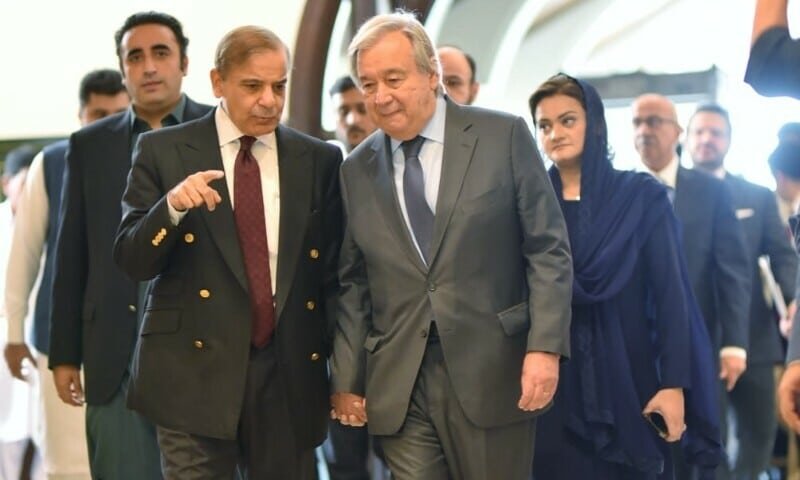
    The prime minister had welcomed the UN secretary general as he arrived at the PM House along with his delegation.

    Guterres arrived in the capital during the early hours of Friday. The secretary general had announced his plan for a solidarity trip to Pakistan soon after the launch of the $160 million UN Flash Appeal for helping the people most affected by the floods caused by what he had called “monsoon on steroids”.

    He will be back in New York on September 11 where the 77th session of the UN General Assembly is starting on September 13.