Tag: approval

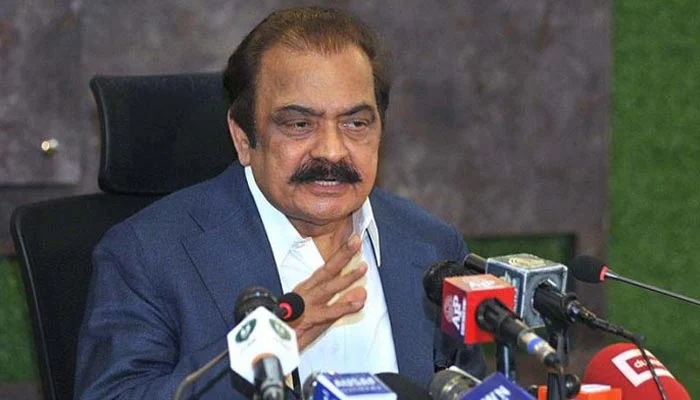
  • Rana Sanaullah likely to become interior adviser

    Rana Sanaullah likely to become interior adviser

    Pakistan Muslim League-Nawaz (PML-N) made another important decision after making Ishaq Dar the deputy prime minister of the country.

    Sources have told Samaa that PML-N leader and former federal minister Rana Sanaullah is likely to be given an important role. The government may appoint him as interior advisor, the sources claimed.

    The senior leadership of PML-N wants to see Rana Sanaullah in the interior ministry, and this responsibility will be given to Rana Sanaullah after the approval of former prime minister and PML-N head Nawaz Sharif. 

    The inclusion of Rana Sanaullah in the federal cabinet may also lead to a shuffle in the ministries. 

    Earlier, two days ago, the prime minister of the country, Shehbaz Sharif, appointed Ishaq Dar as the deputy prime minister of Pakistan.

    Ishaq Dar currently has two designations, as he is also the foreign minister of the country.

  • Pakistan anticipates final IMF tranche approval in late April

    Pakistan anticipates final IMF tranche approval in late April

    The International Monetary Fund (IMF) announced that its Executive Board meeting, anticipated for late April, is crucial for approving Pakistan’s final tranche of approximately $1.1 billion (SDR 828 million). 

    This sum represents the last portion of the $3-billion Stand-By Arrangement (SBA) initiated in June of the previous year.

    Julie Kozack, IMF Communication Director, revealed this information during a media briefing, highlighting the significance of the staff-level agreement reached on March 19 between IMF staff and Pakistani authorities. 

    This agreement, subject to approval by the IMF’s Executive Board, acknowledges Pakistan’s strong program implementation by the State Bank of Pakistan (SBP) and the interim government, as well as the new government’s commitment to ongoing policy and reform endeavors aimed at transitioning Pakistan from stabilisation to robust, sustainable recovery.

    Kozack emphasised the improvement in Pakistan’s economic and financial position since the completion of the first review, with growth and confidence steadily rebounding. 

    Looking ahead, she mentioned the possibility of a successor IMF-supported program to address Pakistan’s fiscal and external stability challenges and foster inclusive growth, indicating the IMF’s readiness to engage in discussions with Pakistani authorities.

    Meanwhile, Pakistan’s foreign exchange reserves witnessed a modest increase, reaching $8.04 billion as of March 29, although still considered low for an import-dependent economy, raising concerns about potential future pressure. 

    Finance Minister Muhammad Aurganzeb has acknowledged the need for another IMF bailout, with discussions slated for the upcoming Spring meetings of the Board of Governors of the World Bank Group and IMF scheduled for April 15-20, 2024, in Washington DC, where Aurangzeb is expected to lead Pakistan’s delegation.

  • Swift approval of 24 universities without proper discussion sparks debate

    Swift approval of 24 universities without proper discussion sparks debate

    In an unusual move that contradicts customary legislative protocol, the National Assembly of Pakistan has sanctioned the establishment of twenty-four new universities across various cities within a single session. These approvals, though hailed as a massive boost to the nation’s educational infrastructure, have ignited debates over the abruptness of the process.

    The approval of the bills occurred in an unusually sparse session, without the traditional discourse within respective Standing Committees, raising questions about the abrupt nature of the process.

    Critics are questioning the urgency that bypassed the usual deliberations associated with such significant decisions.

    The newly approved institutions include Metropolitan International Institute of Science and Technology, Askari Institute of Higher Education, Federal Ziauddin University, The Indus University of Science and Technology, The Institute of Management and Technology, and Pak China Gwadar University.

    Other notable approvals were for Lahore, University of Shaheed Benazir Bhutto, Institute of Health and Professional Studies, Sheikhupura Institute of Advanced Studies, Cosmic Institute of Science and Technologies, Balhe Shah International University, The Ravi Institute, and The International Islamic Institute for Peace.

    Also given the green light were Shah Bano Institute Jardanwala, International Memon University, Umm Abiha Institute of Health Sciences, Mufti Azam Islamic University, Islamabad International University, Islamabad Institute of Modern Sciences, Al Biruni International University, National University of Health Emerging Sciences and Technologies, National Institute of Technology, Pakistan Institute of Management Sciences and Technology, and The Horizon University.

    As the debate continues, it remains to be seen how these newly approved universities will contribute to the country’s higher education landscape.
  • Pakistan successfully secures final IMF approval for $3 billion bailout

    Pakistan successfully secures final IMF approval for $3 billion bailout

    The International Monetary Fund (IMF) has officially granted approval to Pakistan for a 9-month Stand-By Arrangement (SBA) amounting to approximately $3 billion. This decision comes shortly after reaching a staff-level agreement with the country.

    In a statement, the IMF announced, “Today, the Executive Board of the International Monetary Fund (IMF) approved a 9-month Stand-By Arrangement (SBA) for Pakistan for an amount of SDR2,250 million (about $3 billion, or 111 percent of quota) to support the authorities’ economic stabilization program.”

    Earlier on the same day, Finance Minister Ishaq Dar confirmed that Pakistan had received $1 billion from the United Arab Emirates (UAE) as part of their financial commitment to assist Pakistan in securing the IMF bailout package. During a televised media address, the finance minister stated, “The UAE has deposited the amount into the State Bank account.”

    Additionally, Saudi Arabia had previously deposited $2 billion in the State Bank of Pakistan (SBP) account, fulfilling the IMF’s condition to bridge the external financing gap and bolster the country’s foreign reserves. This contribution aims to support the economic stability of Pakistan.

    Pakistan had signed a short-term IMF deal on June 30, under which the country was set to receive $3 billion over nine months, pending approval from the IMF’s board. With the Executive Board’s approval, an immediate disbursement of SDR894 million (approximately $1.2 billion) is authorised, as stated by the IMF.

    The remaining funds will be disbursed in phases throughout the duration of the programme, subject to two quarterly reviews, according to the IMF’s statement. The IMF acknowledges that Pakistan is currently facing a challenging economic situation due to external difficulties, devastating floods, and policy missteps, resulting in significant fiscal and external deficits, rising inflation, and depleted reserve buffers in the fiscal year 2023.

    The IMF sees the new SBA-supported programme as a means to address both domestic and external imbalances and provide a framework for financial support from multilateral and bilateral partners. Pakistan’s successful acquisition of the IMF bailout package was contingent upon implementing difficult economic measures, such as interest rate hikes and tax increases, to fulfill the IMF’s conditions.

  • Life-saving medicines in Pakistan to become 14% more expensive

    Life-saving medicines in Pakistan to become 14% more expensive

    The Drug Regulatory Authority of Pakistan (DRAP) has announced an increase of up to 14 per cent in the prices of life-saving medicines, following approval from the federal government.

    According to ARY News, DRAP stated that life-saving drugs will experience a 14 per cent hike, while all other medicines will see a 20 per cent increase.

    The regulatory authority clarified that these price adjustments are considered a one-time dispensation, in line with the 70 per cent rise in the consumer price index (CPI). This increase will be regarded as the annual raise for the fiscal year 2023-24, with no further increments in the upcoming financial year.

    The DRAP’s Policy Board will evaluate the situation after three months, specifically in July 2023, and submit recommendations to the federal government for potential price reductions, should the Rupee appreciate in value.

    The Economic Advisory Committee had already endorsed the price hike, taking into account the escalating fuel prices and the devaluation of the Rupee, which have contributed to record-high inflation in recent months, impacting various sectors of the economy.

    Earlier reports indicated a 0.16 per cent year-on-year decrease in weekly inflation, as measured by the Sensitive Price Indicator (SPI), for the week ending on May 18. However, short-term inflation surged to an unprecedented 48.35 per cent for the period ending on May 4.

    The Pakistan Bureau of Statistics (PBS) released data indicating a combined index of 255.12, compared to 255.53 on May 11, 2023. In contrast, the index stood at 175.08 a year ago, on May 19, 2022.

  • IMF demands approval for subsidies as Pakistan struggles to secure tranche

    IMF demands approval for subsidies as Pakistan struggles to secure tranche

    Pakistan has been negotiating an agreement with the International Monetary Fund (IMF) since January 2023. The IMF has specified that Pakistan must receive prior approval before providing any additional subsidies.

    Negotiations have hit a snag over a plan announced by Prime Minister Shehbaz Sharif in March to charge wealthy fuel consumers more to subsidise prices for the poor who have been severely impacted by inflation.

    Despite meeting almost all of the Fund’s conditions, the government is struggling to convince the lender to release the tranche. On a separate issue of securing confirmation on the external financing gap of $5 billion by June 2023, the Kingdom of Saudi Arabia and the United Arab Emirates have provided over $2 billion and $1 billion respectively.

    The formal agreements with these countries are expected to be signed soon. The Pakistani authorities are complaining that the IMF has placed prior actions before signing the staff-level agreement, which was not done in the past.

    According to The News, the IMF asks for confirmation from commercial banks before signing the agreement, while banks are asking for IMF’s board approval and the revival of the Fund program to refinance loans worth $2-3 billion.

    Finance Minister Ishaq Dar has assured US diplomat Andrew Schofer that the government is committed to completing the ongoing IMF program.

  • PTA temporarily unblocks non-compliant smartphones

    PTA temporarily unblocks non-compliant smartphones

    A number of Pakistani users have regained cellular connectivity on smartphones that are not PTA compliant. This led many customers and sellers to believe that the PTA had unblocked all non-PTA-approved phones.

    Unfortunately, all of the reports claiming that the PTA has unblocked non-tax compliant phones are false as the majority of imported phones with unpaid taxes, are still blocked by the Pakistan Telecommunication Authority (PTA) and cannot work with any cellular networks in the country.

    They can, however, continue to use Wi-Fi connections like before. Some people with unapproved phones had their phones unblocked at random in recent weeks, allowing them to reconnect to cellular networks.

    The telecommunications authority has made clear that it has unblocked an undefined number of non-approved phones solely to motivate people to pay taxes and have their phones properly unblocked.

    According to PTA spokesperson Khurram Ali Mehran, this was just a persuasive drill to get people to authenticate their phones and pay taxes, no matter how expensive they are.

    He stated that the PTA chose to unblock the phones at random and that they will all be blocked again within two months.