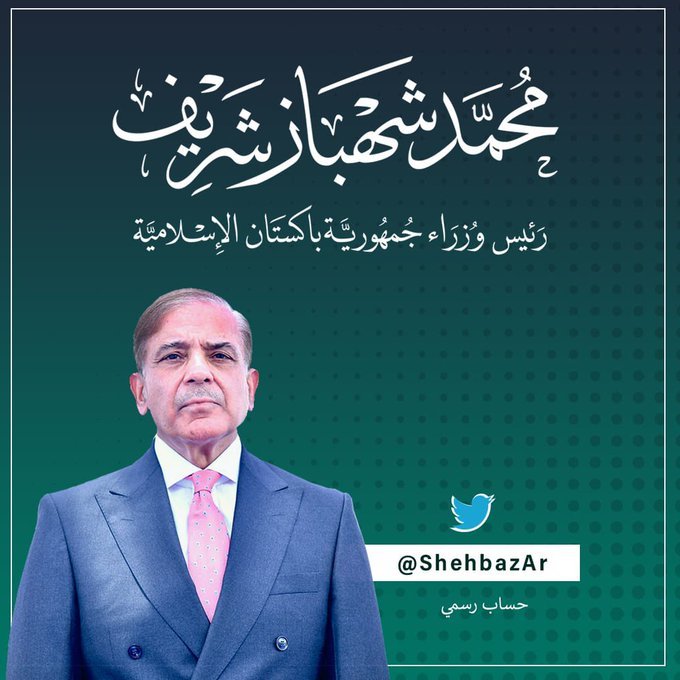
Prime Minister Shehbaz Sharif’s official Arabic language Twitter account, which was created yesterday (June 6), was suspended soon after its launch by the micro-blogging website.
The Current reached out to Prime Minister’s Focal Person on Digital Media Abubakar Umer to ask about the suspension of the account.
“The account is back online. It was temporarily suspended because Twitter wanted to verify the identity. The account has claimed that it is the official prime minister’s account. So Twitter just wanted to make sure that PM’s office is running the account. We have provided the photo id and they have restored it,” Abubakar Umer told The Current.
PM’s Arabic Twitter account was created on Monday to strengthen our bond and engagement with the brotherly people of Arab countries.
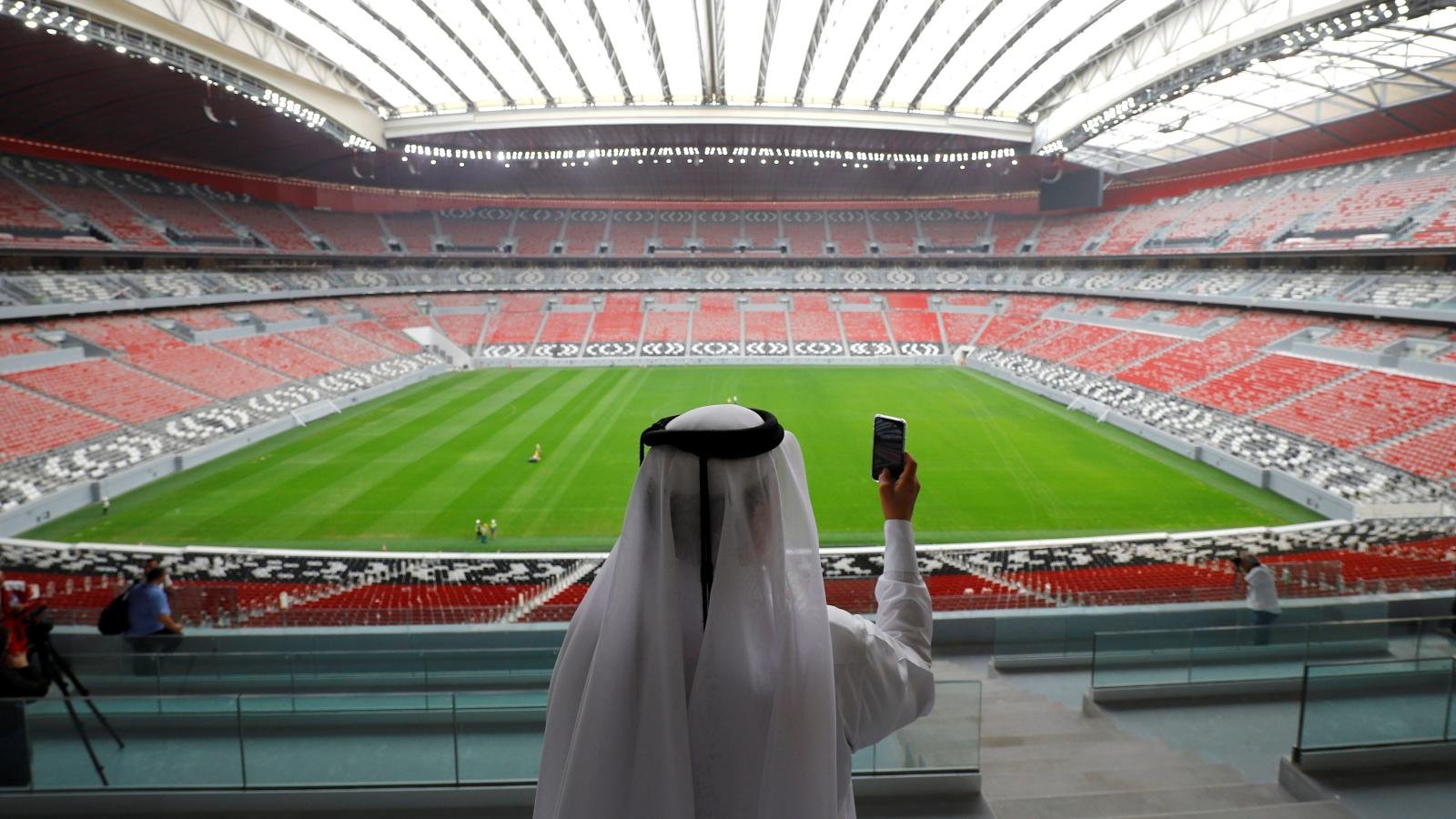
Tickets for the FIFA (Federation Internationale de Football Association) World Cup Qatar 2022 have been put on sale which is set to be played from November 21 until December 18 2022.
Qatari residents will benefit from subsidised tickets, with prices starting from just under $11 (Rs1,938). However, for international fans prices are starting from $69 (Rs12,158) that go up to $1,607 (Rs283,175). There will also be cheaper accessibility tickets available for those with disabilities.
Fans applying for tickets until February 8 will go into a draw with those who are successful to be notified by March 8.
It is reported that seven stadiums in Qatar have been purpose-built and one refurbished for the World Cup but as there will not be enough hotels some fans may have to stay on cruise ships for the event.
Qatar is the first Arab and Middle Eastern country to be hosting the biggest event of football. However, it has not yet been announced by either FIFA or the local organising committee how many fans will be allowed into stadiums.
Currently, the Arab country has imposed tight restrictions on visitors including quarantine for new arrivals.
The United Arab Emirates (UAE) announced that it will no longer censor cinematic releases, introducing a 21 and above age rating for films.
The country’s Media Regulatory Office said on Twitter that it had introduced a 21+ age category to its motion picture content rating system.
“According to this classification, the international version of movies will be shown in cinemas, with an emphasis on the strict following of age classification standards for audience entry,” it added.
The Media Regulatory Office announced the inscribed of the 21+ for the age classification categories for cinema films. pic.twitter.com/NO5WxZveZy
Recently, the country has seen a lot of developments, which include lifting a ban on unmarried couples living together and loosening restrictions on alcohol.
Earlier this month, the UAE also announced that it will move to a Western-style Saturday-Sunday weekend. This will make Emirates the only Gulf country not to observe weekends on a Friday, and Saturday.
Federal Minister for Information and Broadcasting Fawad Chaudhry recently revealed that Arab rulers who presented gifts to the Prime Minister (PM) of Pakistan “did not want their names to be made public”.
While speaking on Geo News programme ‘Jirga’with senior journalist Saleem Safi on Sunday, Fawad stated, “Previously, the heads of the government were allowed to take gifts after paying 15 per cent of the actual price.”
“Vehicles were considered personal gifts, but former president Asif Ali Zardari changed the law for personal interest,” he added while criticising the past governments.
Talking about the local elections in the country, the minister admitted that the Pakistan Tehreek-e-Insaf (PTI) government’s biggest failure was “not holding local body elections” in Pakistan. Moreover, he said that the local bodies, formed by former Chief Minister (CM) Shehbaz Sharif, were not effective and could not be restored on a technical basis.
He added that PM insisted on having elections but members within the party, including Chief Minister Punjab Usman Buzdar, didn’t agree to it.
He further said that a review petition against the restoration of the local bodies is being heard in the Supreme Court (SC).
Chaudhry said that the government has no personal rivalry with the Election Commission of Pakistan (ECP) but the election body directly attacked the PM during the Senate polls.
Furthermore, he revealed a total of 0.6 million Election Voting Machines (EVM) will be required for the upcoming general elections of 2023.
Previously, the federal government denied giving out information about the exchange of gifts between the premier and other heads of state. They mentioned in a notice that the matter is reflective of inter-state relations and the disclosure of such information potentially damages the interest of Pakistan in the context of international relations.
The UAE’s Nora al-Matrooshi is the first Arab woman to start training to be an astronaut, one of two Emiratis picked from thousands of applicants as the Gulf nation looks to the stars.
According to details, the 28-year-old mechanical engineer from Sharjah has dreamt about space since she was a little girl, learning about planets and stars at school.
She hoped since childhood to go into space one day. Her sailor ancestors explored the oceans that encouraged her to explore space one day.
“My mum’s side of the family are sailors. I’d say they explored the ocean. The term ‘astronaut’ means ‘star sailor’ in Greek,” said the softly-spoken Matrooshi.
Matrooshi and her 33-year-old fellow countryman, Mohammad al-Mulla will later this year go to the United States for the training at NASA’s Johnson Space Center.
They now join Sultan al-Neyadi and Hazza al-Mansoori in the Emirati fellowship of astronauts.
The two Emiratis are currently training in-house in the emirate of Dubai, from learning to speak Russian to flying lessons.
The UAE is a newcomer to the world of space exploration but is rapidly making its mark.
In September 2019, the oil-rich country sent the first Emirati into space as part of a three-member crew that blasted off on a Soyuz rocket from Kazakhstan for an eight-day mission.
Then in February, its “Hope” probe successfully entered Mars’ orbit on a journey to reveal the secrets of Martian weather, making history as the Arab world’s first interplanetary mission.
More recently in September 2020, Abu Dhabi said it planned to launch an unmanned rover to the moon by 2024 which would be the first trip to Earth’s satellite by an Arab country.
“If I can do it, then you can do it. If no one has done it before you, then just go ahead and be the first,” said Matrooshi.
“If you’re really passionate about what you’re doing, then you should just work hard for it and look for opportunities.”
Since learning to capture birds as a teen, Muhammad Rafiq has amassed a small fortune in Pakistan trapping and trafficking falcons — including some endangered species — for wealthy Gulf Arabs.
A single falcon can fetch up to tens of thousands of dollars on the black market, which allowed Rafiq to renovate his family home.
“Every season, dealers come from Karachi and leave their contacts with us, and we call them back if we catch something,” said the 32-year-old, from a nearby coastal village.
He recently trapped a peregrine falcon on a one-week hunting mission.
“I desperately needed money,” he told AFP. “And God has listened to me.”
For years, Pakistan has stood at the nexus of the falcon trade, both as a source of the birds of prey, and then as a destination to hunt with them.
Falcon poaching is officially banned, but demand for the birds is rising, according to the World Wildlife Fund in Pakistan.
It estimates that up to 700 falcons were illegally smuggled out of the country last year alone, often by organised criminal networks.
Their destination is normally Gulf countries, where falconry is a treasured tradition.
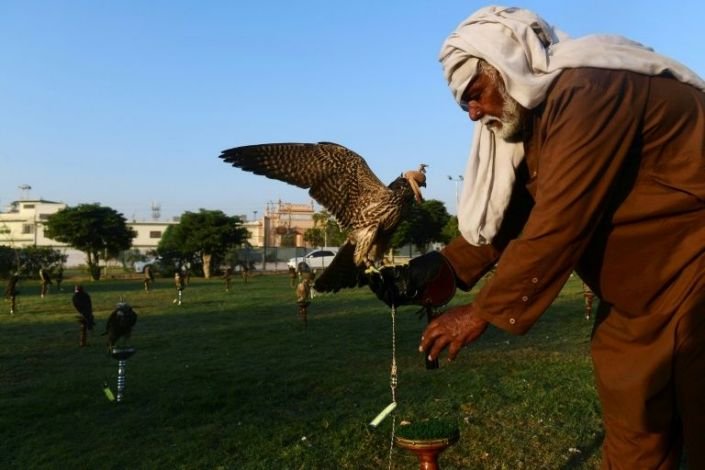
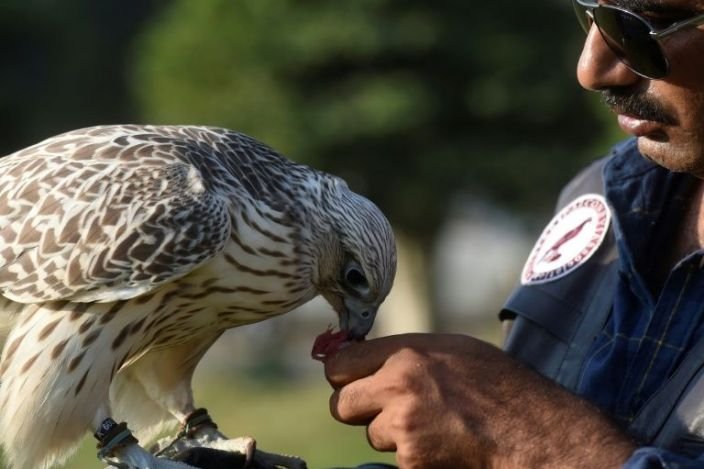
Owners treat the birds “like their own children”, said Margit Muller, the director of Abu Dhabi’s falcon hospital, which treats 11,000 falcons annually, a number that has more than doubled in the past 10 years.
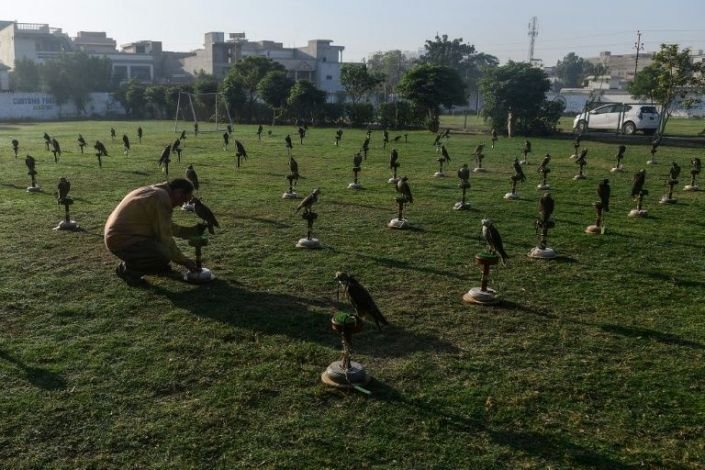
One conservationist told AFP an Arab falconer usually owns around five to six hundred birds, most of which will be captured in the wild in Pakistan or Mongolia.
Wild birds are prized over those bred in captivity because they are believed to be better hunters, though there is no evidence to support those claims.
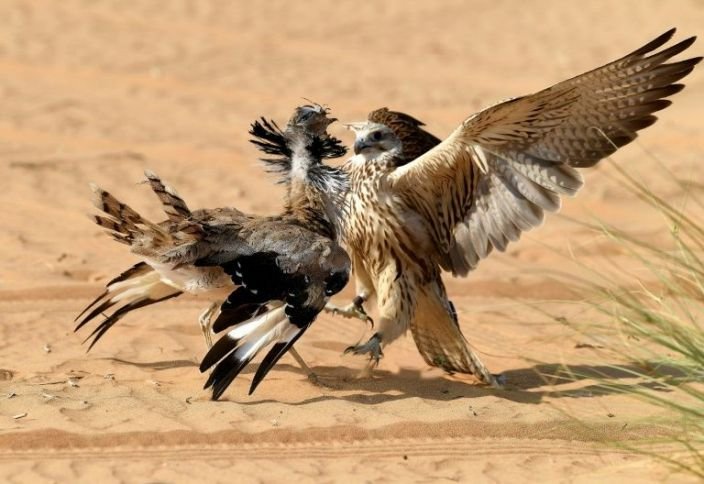
Every winter, lavish hunting parties from the Gulf flock to Pakistan’s sprawling deserts, where they are given permits to use their falcons to hunt the houbara bustards, a migratory bird wrongly prized as an aphrodisiac and classified as vulnerable by conservationists.
These excursions have cast a spotlight on the deep ties between Pakistan and its allies in the Gulf. For decades, the Gulf states have propped up Islamabad’s ramshackle finances with generous loans, with one of the expectations being that they can continue to use Pakistan as a hunting playground.
Saudi Crown Prince Mohammed bin Salman and two other royals were granted permission to catch bustards by Prime Minister Imran Khan’s government in December last year, a soft diplomacy tactic that Khan had openly disagreed with when he was in the opposition.
The government also presents falcons as gifts to world leaders.
“Our officials are working like pimps for the Arabs,” a government official requesting anonymity told AFP.
A brief ban on the bustard hunts was overturned in 2016 by the Supreme Court, but conservationists are now pushing for the export of falcons to be regulated in an ongoing case at the Islamabad High Court.
Every year, falcons escape the harsh Siberian winter and fly thousands of miles to warmer regions, including southern Pakistan.
During the migratory season, wildlife traffickers descend on villages along the Arabian Sea coastline, offering fishermen cash to briefly abandon their boats and try their hand at poaching.
“We pay them in advance, send food to their families and if they catch a bird that is precious, we happily give them motorbikes,” said one trafficker who spoke to AFP on the condition of anonymity.
A range of tactics can be employed — sticky liquids, net traps or, most commonly, using smaller birds as bait.
Poachers especially target the peregrine falcon, whose populations remain stable — but also the saker, which is endangered.
Bob Dalton, a veteran falcon conservationist, helped oversee the rehabilitation of dozens of falcons seized by Pakistani authorities in October, with officials estimating the cache to be worth well over $1 million.
“The illegal trade is growing, there is more money being spent, more pursuit from the Gulf,” he told AFP.
“With the exception of one or two species, most falcon populations are in decline or on the point of being unstable.”
With ongoing efforts to curtail rampant poaching failing, some officials in Pakistan have suggested regulating the falcon trapping market, inspired by a scheme involving another rare native species, the markhor — an elusive mountain goat with striking twisted horns found in Pakistan’s mountainous north.
Every year, foreigners shell out tens of thousands of dollars for a handful of trophy hunting permits, providing a financial incentive for communities to prevent poaching. Naeem Ashraf Raja, the director of the biodiversity at the ministry of climate change, said markhor numbers have rebounded as a result of this controversial conservation method.
With hunting parties set to descend on Pakistan again over the next few months, Kamran Khan Yousafzai, the president of Pakistan’s Falconry Association, said the country desperately needs to implement a sustainable wildlife programme.
“Arab falconers can’t resist coming to Pakistan. They have been coming to these hunting grounds for generations, and unless they face any real problems, they are not going to search for new destinations.”
France has urged Arab countries to stop calls for boycotts of French products, while President Emmanuel Macron vowed the country would never give in to “Islamic radicals”.
The French Foreign Affairs Ministry said in a statement released on Sunday that in recent days there had been calls to boycott French products, notably food products, in several Middle Eastern countries as well as calls for demonstrations against France over the publication of satirical cartoons of Prophet Muhammad (PBUH).
Les appels au boycott de produits français dénaturent les positions défendues par la France en faveur de la liberté de conscience, de la liberté d’expression, de la liberté de religion et du refus de tout appel à la haine.
“These calls for boycott are baseless and should stop immediately, as well as all attacks against our country, which are being pushed by a radical minority,” the statement said.
On Sunday, Macron tweeted, “We will not give in, ever to Islamic radicals.”
“We do not accept hate speech and defend reasonable debate,” the French leader added.
We will not give in, ever. We respect all differences in a spirit of peace. We do not accept hate speech and defend reasonable debate. We will always be on the side of human dignity and universal values.
Calls to boycott French goods are already growing in the Arab world and beyond after Macron criticised Islamists and vowed not to “give up cartoons” depicting the Holy Prophet (PBUH).
Macron’s initial comments, on Wednesday, had come in response to the beheading of a teacher, Samuel Paty, outside his school in a suburb outside Paris earlier this month, after he had shown the blasphemous cartoons during a class he was leading on free speech.
With the French president pledging to fight “Islamist separatism”, which he said was threatening to take control in some Muslim communities around France, hashtags such as the #BoycottFrenchProducts in English and the Arabic #ExceptGodsMessenger trended across countries, including Pakistan, Kuwait, Qatar, Palestine, Egypt, Algeria, Jordan, Saudi Arabia and Turkey.