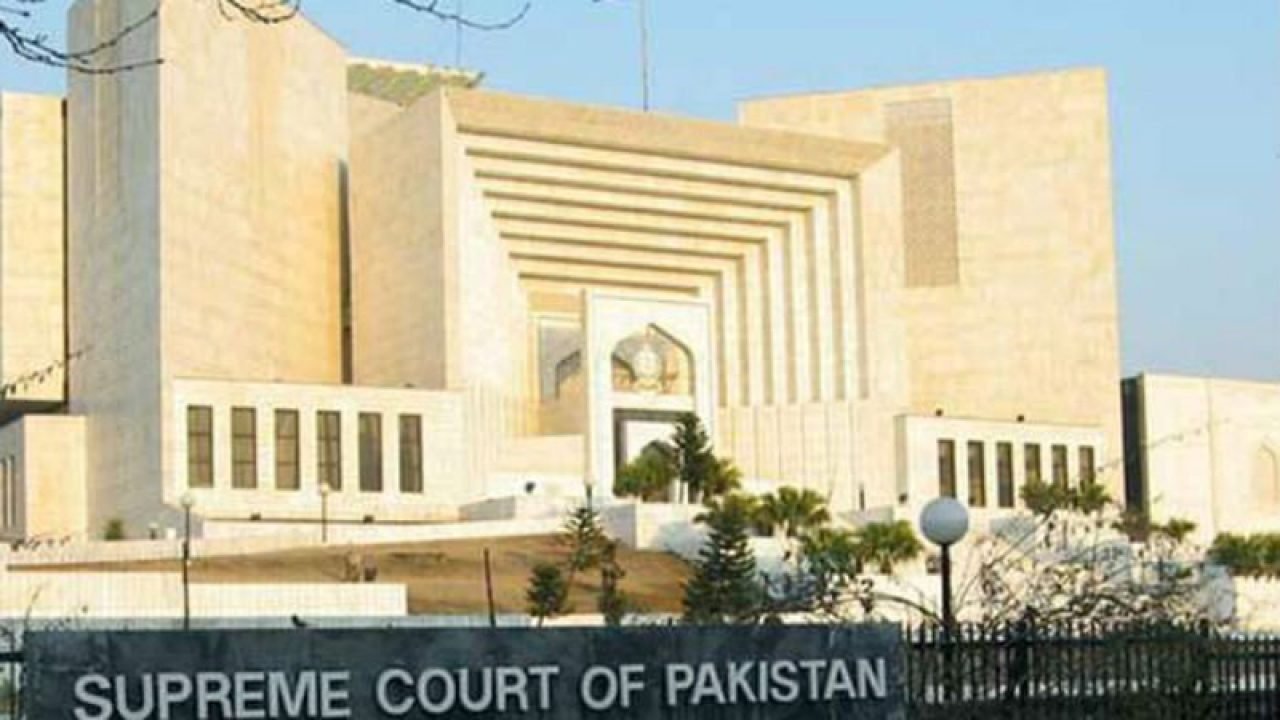
The Supreme Court (SC) on Tuesday in its decision on a presidential reference seeking interpretation of Article 63-A of the Constitution, which is related to the status of defecting lawmakers, said the votes of defecting lawmakers will not be counted.
Chief Justice of Pakistan (CJP) Umar Ata Bandial, Justice Ijazul Ahsan, and Justice Munib Akhtar gave the majority verdict while Justice Mazhar Alam Khan Miankhel and Justice Jamal Khan Mandokhail were the dissenting judges.
Question 1: Should Article 63-A have a limited or a broad, purpose-oriented interpretation?
The short-order said that the first question was related to the proper approach to be taken for the interpretation and application of Article 63-A.
“In our view, this provision cannot be read and applied in isolation and in a manner as though it is aloof from, or indifferent to, whatever else is provided in the Constitution,” the verdict stated.
It said that Article 63-A was an “expression in the Constitution itself of certain aspects of the fundamental rights that inhere in political parties under clause (2) of Article 17,” adding that the two provisions were “intertwined”.
“Defections rightly stand condemned as a cancer afflicting the body politic. They cannot be countenanced,” the order said, adding that 63-A must be interpreted in a “purposive and robust manner”.
“The pith and substance of Article 63-A are to enforce the fundamental right of political parties under Article 17 […] It must therefore be interpreted and applied in a broad manner, consistent with fundamental rights,” the verdict said.
Question 2: Will the defecting members’ vote be counted, given equal weightage?
Giving its stance on the second question, the verdict said that the vote of any member of a parliamentary party in a house “that is cast contrary to any direction issued by the latter in terms of para (b) of clause (1) of Article 63-A cannot be counted and must be disregarded, and this is so regardless of whether the party head, subsequent to such vote, proceeds to take, or refrains from taking, an action that would result in a declaration of defection.”
Question 3: Will the defectors be disqualified for life?
“While it is for parliament to enact such legislation, it must be said that it is high time that such a law is placed on the statute book. If such legislation is enacted it should not amount to a mere slap on the wrist but must be a robust and proportionate response to the evil that it is designed to thwart and eradicate,” the order stated.
Question 4: Measures that can be taken to prevent defection, floor crossing, and vote-buying
On the question of the measures that can be taken to curb vote-buying, the verdict refrained from giving an opinion on the fourth question, submitted by the president was returned by the court as it was “stated in terms” that were “vague, and too broad and general”.
What is Article 63-A?
Article 63(A) of the Constitution of Pakistan deals with the defection of parliamentarians.
According to the Article, a lawmaker can be disqualified on the grounds of defection if they vote or abstain from voting in the House contrary to any direction issued by the parliamentary party to which they belong.
However, this is restricted to three instances where they have to follow the party’s directions:
Election of the prime minister or chief minister;
Vote of confidence or a vote of no-confidence;
Money bill or a Constitution (amendment) bill.
Per the Article, the head of the party is required to present a written declaration that the MNA concerned has defected.
However, prior to presenting the declaration, the head of the party will have to give the MNA concerned a chance to explain the reasons for defection.
Following that, the party chief will then forward the written declaration to the speaker, who would, in turn, hand it over to the chief election commissioner (CEC).
The CEC will have 30 days at its disposal to confirm the declaration. Once confirmed, the MNA concerned will no longer be a member of the House and their “seat shall become vacant”.