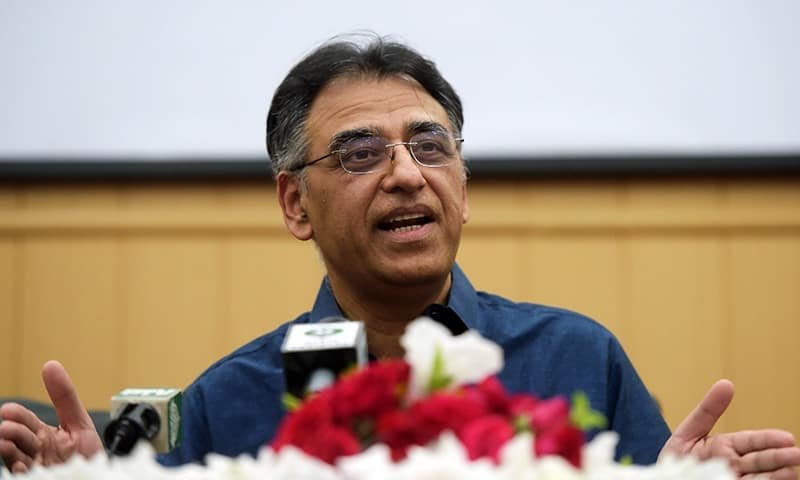
Tag: Asad Umar

  • VIDEO: Frontline workers receive their COVID-19 vaccines across Pakistan

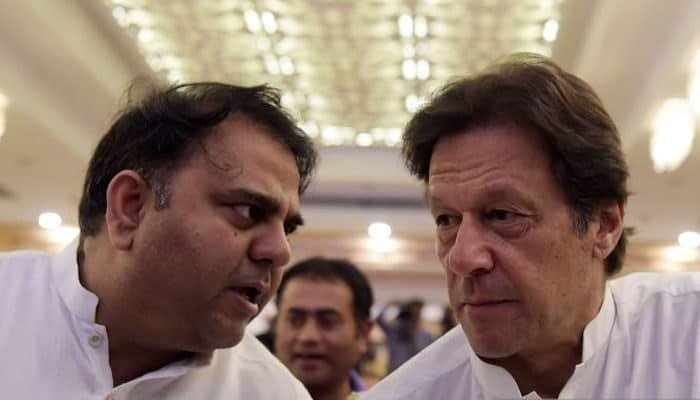
    The National Immunisation Drive against COVID-19 formally commenced on Tuesday with a ceremony at the National Command and Control Centre (NCOC) in Islamabad. Prime Minister Imran Khan, Asad Umar, Fawad Chaudhry, Dr Faisal Sultan and Dr Sania Nishtar were among those present at the event.

    According to Umar, Dr Rana Imran Sikander, who heads the COVID ward at PIMS Hospital in Islamabad, was the first person to receive the vaccination in the country.

    Speaking on the occasion, Minister for Planning and Development Asad Umar lauded the sacrifices and services of frontline healthcare workers for serving the nation during the pandemic.

    “Frontline healthcare workers are our real heroes,” said the minister. “No doubt they have put their lives at risk in their fight against COVID-19 and we pay tribute to all of them.”

    He also thanked the Government of China for supporting Pakistan during the pandemic and donating vaccine to the country. Umar also paid tribute to the NCOC team and provincial authorities working in close liaison in the fight against the virus.

    The next day on Wednesday, separate ceremonies were held in all the provinces and federating units at the same time, where healthcare workers received their first dose of the vaccine. Healthcare workers are being inoculated with the Sinopharm COVID-19 vaccine imported from China.

    Meanwhile, addressing a press conference on Wednesday, Special Assistant to Prime Minister (SAPM) on National Health Services Dr Faisal Sultan said an effective mechanism has been developed to ensure the administration of the COVID vaccine to the people.

    Dr Faisal said adult vaccine centres have been established across the country which currently have the capacity to administer the vaccine to forty thousand people on daily basis. He said this capacity will be further enhanced in the coming days.

    The SAPM added that the government aims to inoculate seventy percent population by the end of this year.

  • CPEC to come down crashing? Foreign media report claims ‘most serious disagreement’ between Pakistan, China

    Pakistan and China are embroiled in their most serious disagreement relating to the Belt and Road Initiative, causing the annual bilateral summit of the China-Pakistan Economic Corridor (CPEC) to be delayed, the world’s largest financial newspaper has claimed.

    The Joint Cooperation Committee (JCC) is CPEC’s principal decision-making body. It is jointly chaired by Pakistan’s minister for planning, development and special initiatives and the vice chairman of China’s National Development and Reform Commission.

    The first JCC meeting was held in August 2013 and the last in November 2019. The 10th JCC was scheduled for early 2020, but remains postponed.

    Initially, the COVID-19 pandemic was the reason, but later disagreements between the two countries over the Main Line 1 (ML-1) railway project and special economic zones became the main points of disagreement, Nikkei Asia has learned from informed sources.

    Asad Umar, Pakistan’s minister for planning, development and special initiatives, told local media in November that the 10th JCC would be held the following month. However, officials in the Planning Commission of Pakistan, who asked not to be named, recently told Nikkei that the meeting will not take place for at least three months — by far the longest JCC gap to date.

    ML-1 is the largest CPEC project and worth $6.8 billion. China is expected to lend $6 billion of this, which Pakistan wants to borrow at a concessional interest rate of less than 3%.

    China offers a mixture of concessionary and commercial loans for such projects. This could significantly increase the aggregate interest rate Islamabad will face, according to the planning commission officials.

    “China is reluctant to lend money for ML-1 because Pakistan has already sought debt relief to meet G-20 lending conditions and it is not in a position to give sovereign guarantees,” Nasir Jamal, a senior journalist in Lahore covering business and the economy, told Nikkei. He said Beijing’s appetite for lending money for large infrastructure projects has diminished because these projects are vulnerable to local politics that delay returns on investment for China. That has hindered agreement on the finance framework for ML-1.

    Andrew Small, a senior trans-Atlantic fellow with the Asia program at the German Marshall Fund, a U.S. think tank, said China tends to base its decisions about interest rates for loans to Pakistan on a couple of criteria. Firstly, do low-interest rates encourage projects that do not make sense financially? Secondly, what precedents are set for other countries looking for similar concessions?

    “China is much more comfortable deferring payments or providing new financing than it is offering concessional rates in the first place,” Small told Nikkei. He said this approach provides Beijing with greater leverage and control even if they are willing to be very flexible at the back-end.

    With host countries under pressure to repay at higher rates, China trades payment deferments in return for influence, which helps it get more favorable arrangements.

    The delayed JCC meeting and unsettled ML-1 financial framework is complicating matters for Pakistan. Early this month, Pakistan Railways asked the government for 11 billion rupees ($69 million) to provide ML-1 security. Without the Chinese financing framework being agreed by the JCC, it is hard for Islamabad to come up with such a large amount given the state of the economy and severe budgetary constraints.

    The other major disagreement between Beijing and Islamabad delaying the JCC meeting relates to SEZs. In the second phase of CPEC scheduled for 2020 to 2025, Chinese companies are due to start producing goods in Pakistan and exporting from there.

    Currently, the industrial cooperation framework for the SEZs is limited to a memorandum of understanding without detailed modalities. Matters such as tax exemptions and requirements for employing local labor have not been finalized. These need to be agreed by China for confirmation at the JCC. The Board of Investment of Pakistan submitted the draft agreement for the industrial cooperation framework to the Chinese government last month and is still awaiting a response.

    In December 2020, during a meeting of the Joint Working Group on Industrial Cooperation under CPEC, Asim Ayub, the project director for industrial cooperation at the Board of Investment, pressed for early signing of the industrial cooperation framework agreement.

    The seriousness of the delay is clear from China’s unprecedented reluctance to schedule a JCC meeting. In the past, JCCs were always held in time, and China agreed to Islamabad’s requests most of the time. Some experts believe the delay is evidence that CPEC is derailing.

    According to Small, there were plenty of announcements about CPEC last year, but actually setting deals in motion was another matter. “The optics do matter to China so I still expect them to figure out terms in the end, and certainly to keep some narrative of continued progress alive,” Small told Nikkei. “But that doesn’t mean they’re willing to agree on something that doesn’t make sense for other reasons just to speed things up a little.”

    Pakistan is currently renegotiating its $6 billion extended fund facility with the International Monetary Fund (IMF), which was suspended in April 2020. The IMF reportedly will only resume the program if Pakistan does not take out any new commercial loans, and that is one of the reasons it is looking for concessions on loans for the ML-1 project.

    An important long-term implication of this case for other BRI countries could be that China will be more wary of lending to countries that have entered loan agreements with global lenders such as the IMF.

    Hasaan Khawar, an Islamabad-based public policy analyst, views the situation from a different perspective. “The back-and-forth with China by Pakistan on the interest rate and additional guarantees for the ML-1 project is a good sign,” he told Nikkei. “The Pakistani side is appraising the terms carefully and trying to negotiate a better deal.”

    The report originally appeared on Nikkei Asia
  • Detection of COVID-19 in students adds to second wave fears

    Detection of COVID-19 in students adds to second wave fears

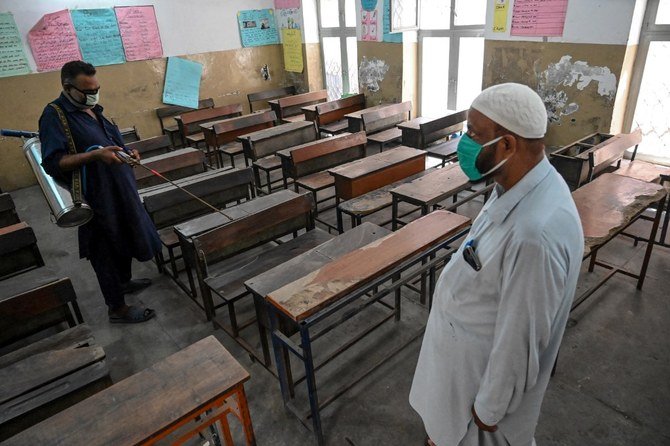
    Two more educational institutions in Islamabad have been sealed by the district health administration after the detection of COVID-19 cases among five students, fueling the outbreak’s second wave fears.

    In August, the government lifted most lockdown restrictions, which had come following a significant drop in new coronavirus cases. Federal Education for Minister Shafqat Mahmood had announced the re-opening of educational institutions on September 4, since when, at least 29 schools, colleges and universities have been sealed in the federal capital alone.

    The cases were reported despite the authorities concerned ensuring that necessary measures were taken ahead of the much-awaited re-opening of educational institutions.

    While it was earlier speculated that coronavirus has ended in Pakistan due to either an effective strategy of the government or multiple other reasons such as herd immunity being achieved, a sudden spike in the number of cases has left experts scratching their heads.

    Amid the rising positivity rate in the country which crossed 2% in September, the Pakistan Medical Association (PMA) has expressed concerns over the looming second wave of coronavirus, highlighting the carelessness in the implementation of standard operating procedures (SOPs) in schools and other public spaces.

    Taking to Twitter, Minister for Planning Development and Special Initiatives Asad Umar, who also chairs the National Command and Operations Centre (NCOC) to deal with COVID-19 in the country, has highlighted the rise in the number of infections as well.

    An analysis of previous data shows that since the easing of lockdown restrictions and reopening of education institutions in Pakistan, there has been a steady increase in the number of new COVID-19 cases.

    However, evidence from around the world has shown there is no correlation between students returning to institutions after coronavirus lockdowns and a rise or fall in new infections.

    According to Insights for Education, 52 countries, including France and Spain, actually saw infection rates rise during the holidays. Some, such as Croatia, have seen cases fall after reopening schools.

    Others, like Hungary and Great Britain, have seen a rise since reopening schools, according to the data — based on UNESCO and World Bank figures alongside rigorous daily media scans over the last six months — although the United Kingdom (UK) infection rate was already trending upwards before schools reopened.

    Overall, the picture is so varied that a link between schools and coronavirus transmission cannot be proved, the report suggested. Other factors, including the country’s health system capacity and economic openness and the robustness of its testing and tracing system, must be considered. 

    By the time this report was filed, Sindh had the highest number of infections and deaths in Pakistan — 140,997 and 2,566, respectively — followed by Punjab with 101,237 positive cases and 2,277 deaths.

    The total number of cases in the country stood at 321,218 with 305,395 recoveries.

  • Coronavirus in Pakistan: A July-August diary

    Since the beginning of July, there has been a decline in new coronavirus cases and the number of recovered patients has also increased. By the time this report was filed, there were 26,834 active COVID-19 cases in the country.

    While Prime Minister (PM) Imran Khan, as well as members of his team and other experts, repeatedly urged people to follow social distancing guidelines and standard operating procedures (SOPs) on Eidul Azha in order to avoid a June-like surge in coronavirus cases in the days to come, people were seen flaunting the same not only over the Eid weekend but also during rallies protesting illegal Indian annexation of held Kashmir on August 5.

    It was reported by Gulf News that the upper class of Karachi completely ignored Sindh government directives by sacrificing animals wherever they wished to despite 500 sites being designated by the provincial administration for the purpose. “Residents in the most expensive and posh neighbourhoods of the city were no exception… officials didn’t make any effort to ensure the people followed the law,” the report said.

    Meanwhile, the Punjab government on August 3 announced to lift the smart lockdown two days ahead of the scheduled date. The government announced to lift all restrictions on the third day of Eid because of a “significant” reduction in coronavirus cases.

    While Punjab Chief Minister (CM) Usman Buzdar expressed satisfaction over the observance of SOPs on Eidul Azha, Federal Minister for Planning, Development and Special Initiatives Asad Umar announced on Thursday that restrictions on the hospitality and recreational sectors, put in place nearly five months ago to curb the spread of the coronavirus, would be lifted by August 10.

    Dine-in restaurants, parks, cinemas, tourist spots and salons would be re-opened while marriage halls would remain closed at least until September 15 and the decision to re-open educational institutes would be looked into during the first week of September, he said.

    However, just a day after the announcement, Punjab witnessed a sudden increase in the number of new coronavirus cases. The everyday cases that had on an average dropped to below 100 during the past one month after reaching a new high in June, once again increased to around 300.

    Although some medical experts were not perturbed and declared it a routine surge, others believed that it might be a signal for the beginning of the second wave of the outbreak. Punjab reported 277 new confirmed cases of COVID-19 besides five deaths during the last 24 hours against 235 a day earlier, Dawn reported.

    Besides the lifting of lockdown restrictions for the economy’s sake in July, the surge is also being attributed to the fact that next to none social distancing guidelines were followed during the preparations and hosting of seminars and rallies to mark ‘Youme Istehsal [Exploitation Day]’ on the first anniversary of Narendra Modi-led India’s annexation of occupied Kashmir.

    Even though the coronavirus situation in Pakistan is getting better on paper, how the pandemic turns out over the next few days is subject to the behaviour of the masses and the policies of the government.

  • Eid ul Adha: Cattle markets to operate from 6 am to 7 pm

    Eid ul Adha: Cattle markets to operate from 6 am to 7 pm

    The National Command and Control Centre (NCOC) has decided to allow cattle markets to function between 6 am to 7 pm.

    According to reports, the decision was taken in a meeting held in Lahore by Federal Minister for Planning and NCOC chief Asad Umar.

    “The movement of cattle and people between villages and cities increases the risk of the virus spreading,” said the minister, adding that better management of livestock markets was essential to prevent its spread.

    He told that about 700 cattle markets had been set-up across the country. However, the size of the markets will be small and the number of people visiting it at time will be controlled.

    The meeting reviewed the management of cattle markets and standard operating procedures (SOPs), which have been given to all relevant departments.

     No cattle markets will be allowed inside cities. Wearing masks inside the market was made compulsory and all the visitors will be screened at the entrance. Children and the elderly won’t be allowed to come to the cattle markets.

  • Low testing rate bigger a reason for drop in coronavirus cases than govt efforts

    Low testing rate bigger a reason for drop in coronavirus cases than govt efforts

    Federal Minister for Planning, Development, Reforms and Special Initiatives Asad Umar has said that the coronavirus situation in the country is improving as the number of COVID-19 cases “decrease owing to effective measures taken by the government and a majority of people following social distancing guidelines”.

    But the statement the minister made while addressing a press conference at the National Command and Operation Centre (NCOC) last Friday, has been contradicted by the government itself as its data suggests that COVID-19 cases have declined over the past one week because of low testing rate.

    READ: Govt is grossly under-reporting coronavirus deaths and infections: PM’s task force head

    As many as 5,000 to 6,000 cases were being reported on a daily basis in Pakistan by mid-June, which had prompted the government to impose selective lockdowns in different parts of the country, especially Punjab and Sindh, and the number of daily infections has now dropped to 3,000 to 4,000.

    While data from June 15 to June 29 shows that the number of cases reported in the country after June 19 has comparatively been lower, contrary to Umar’s claims, a major reason behind the drop has been that the number of tests performed to diagnose COVID-19 across the country also dropped significantly during the said period.

    The rate of testing came down from 31,000 to 20,000 while the target set by the government to achieve in July was the enhancement of Pakistan’s testing capacity to 100,000.

    LIVE BLOG: COVID-19 pandemic

    If you look at the statistics, it is clear that Pakistan has conducted 1,327,638 (1.3 million) tests so far, while according to Worldometers, Pakistan ranks 32nd out of 49 Asian countries in terms of testing capacity. Countries including Iraq, Bhutan, Iran and Maldives have a higher testing capacity than that of Pakistan.

    According to Punjab health officials, the government is continuing to enhance testing capacity in the country but the testing rate has dropped because patients are less exposed to the virus amid lockdowns.

    “A test is conducted when a suspected patient comes forward after complaining of symptoms or as part of a random testing drive in hotspots,” they said, adding that both instances had seen a significant drop amid lockdown restrictions

  • Fawad vows not to resign as ministers urge Imran to take action against him

    Fawad vows not to resign as ministers urge Imran to take action against him

    Federal Minister for Science and Technology Fawad Chaudhry has said that politics is not for the “weak-hearted” and vowed not to resign for as long as he has the confidence of Prime Minister (PM) Imran Khan.

    “I will stay on as a minister till I have the trust of Prime Minister Imran Khan. There is no question of resigning on someone else’s wish,” Fawad tweeted Thursday, referring to Punjab Information Minister Fayazul Hasan Chohan, who had asked the federal minister to step down following the former’s claims pertaining to rifts among the ruling Pakistan Tehreek-e-Insaf (PTI).

    In an interview from earlier this week, Fawad had claimed that the PTI failed to bring “tabdeeli” [change] due to the in-fighting between Asad Umar, Jahangir Tareen and Shah Mahmood Qureshi after the formation of its government, which was followed by the ouster of the political class from PM Imran’s core team.

    “This political vacuum was then filled by new and non-elected people who did not have anything to do with politics,” the minister had said while also making other explosive revelations that did not sit well with many.

    READ: Tareen got Asad Umar fired; Asad settled score by getting rid of him: Fawad Chaudhry

    With Fawad drawing criticism from his colleagues for also disclosing that the premier had warned his ministers to perform within six months, many reportedly approached PM Imran, urging him to take action against the science and technology minister.

    It was followed by the PM telling his cabinet members to maintain unity within the party. Addressing a presser after a meeting of the federal cabinet chaired by PM Imran, Federal Minister for Information and Broadcasting Shibli Faraz said that Fawad’s interview with the Voice of America came under discussion during the cabinet meeting.

    “Fawad Chaudhry’s interview was discussed in the cabinet [meeting] and the prime minister said we should maintain unity within the party,” Faraz said.

    During the cabinet meeting, the information minister said that the prime minister has instructed the ministers and party leaders not to talk about things that “affect” the party or the government.

    READ: ‘Hold your tongues’: Imran tells cabinet members to not say things that affect PTI, govt

    According to reports, the premier has now also held separate meetings with federal ministers. Those who held meetings with Imran included Minister for Water Resources Faisal Vawda, Foreign Minister Shah Mahmood Qureshi and Minister for Planning, Development & Special Initiatives Asad Umar.

    During the meetings, the PM discussed the disorder and heat during the federal cabinet meeting.

    On the occasion, Umar and Qureshi apprised the premier on their respective positions and offered explanations.

    Umar reportedly raised before PM Imran the issue of Fawad’s statements, to which the premier directed his cabinet members to exercise caution and maintain unity.

    Vawda, on the other hand, openly criticised policies of Umar, Adviser to PM on Commerce and Investment Abdul Razak Dawood as well as Special Assistant to PM on Petroleum Division Nadeem Babar. He also reportedly accused some people of “conspiring from within the cabinet”.

    “There is a game being played here and we cannot sit silent,” he said, adding that people thought that they had become the prime minister.

  • ‘Hold your tongues’: Imran tells cabinet members to not say things that affect PTI, govt

    ‘Hold your tongues’: Imran tells cabinet members to not say things that affect PTI, govt

    Prime Minister (PM) Imran Khan has told his cabinet members to maintain unity within the party, a day after Federal Science and Technology Minister Fawad Chaudhry said in an interview that the Pakistan Tehreek-e-Insaf (PTI) was failing to bring promised change due to a lack of political leadership amid rifts among leaders such as Jahangir Khan Tareen, Planning Minister Asad Umar and Foreign Minister Shah Mahmood Qureshi.

    Addressing a presser after a meeting of the federal cabinet chaired by PM Imran, Federal Minister for Information and Broadcasting Shibli Faraz said that Fawad’s interview with the Voice of America came under discussion during the cabinet meeting.

    “Fawad Chaudhry’s interview was discussed in the cabinet [meeting] and the prime minister said we should maintain unity within the party,” Faraz said.

    In the interview, Fawad had said there were rifts among Tareen, Umar and Foreign Minister Shah Mahmood Qureshi, which hurt the party and forced the PTI’s “political class” to part ways.

    “As soon as the PTI government was formed, quarrels among Qureshi, Umar and Tareen began. Tareen used his influence to get Umar removed from the cabinet and later Umar got Tareen out,” Fawad had said.

    During the cabinet meeting, the information minister said that the premier has instructed the ministers and party leaders not to talk about things that “affect” the party or the government.

    Faraz also spoke about a recent interview of Climate Change Minister Zartaj Gul in which she said that Covid-19 means that the virus has 19 points that can be applied to any country based on its respective immunity levels.

    Her remarks were widely shared on social media and she was criticised for not knowing that Covid-19 is actually an acronym for the coronavirus.

    “It was a slip of the tongue and people make mistakes,” the information minister said, referring to Gul’s remarks. “It should not have happened and I completely agree with you.”

    The information minister said that Gul is an “outstanding” minister “who is doing great work”.

    “We should ignore the mistakes because people make mistakes,” Faraz added.

  • Tareen got Asad Umar fired; Asad settled score by getting rid of him: Fawad Chaudhry

    Federal Minister for Science and Technology Fawad Chaudhry has made some explosive revelations by claiming that the Pakistan Tehreek-e-Insaf (PTI) failed to bring “tabdeeli” [change] due to the in-fighting between Asad Umar, Jahangir Tareen and Shah Mahmood Qureshi after the formation of its government, which was followed by the ouster of the political class from Prime Minister (PM) Imran Khan’s core team.

    “This political vacuum was then filled by new and non-elected people who did not have anything to do with politics,” the minister said in an interview with VOA Urdu.

    Talking to senior journalist Suhail Warraich, Fawad revealed that Tareen was responsible for Asad Umar losing his Finance Ministry portfolio. When asked why was there so much in-fighting among PTI ranks, he said when Umar was the Finance Minister, Tareen got him fired.

    “Now when Umar got back in the government, he got rid of Tareen. Qureshi and Tareen also had meetings but things didn’t work out between the two.”

    He maintained that party groupings were a norm but PTI’s internal fighting between top leaders led to their replacement by bureaucrats, which compromised PM’s reform agenda.

    Fawad added that the PTI government was now just another government as its agenda of carrying out police and judicial among other reforms now faced an uncertain future.

    CIVILIAN SUPREMACY AND OPPOSITION:

    To another question, he said that people say there should be civilian supremacy and the military’s role in politics should be curtailed, but they should also take a look at the parliament and provincial lawmakers. “How can there be civilian supremacy under such leadership?” Ultimately, this is about human resources, he added.

    Criticising the opposition for having a limited vision due to dynastic politics, he also questioned why PM Imran had not developed any new and capable leadership.

    “We can understand why Nawaz Sharif and Benazir Bhutto put weak people in important positions because their vision was to transfer leadership to their own children. Imran doesn’t have this problem. He should have placed the best at powerful positions but somehow, he was advised by someone to place weak people in powerful positions so that they can be dictated. This only damaged Imran. He is far bigger than what he looks like right now.”

    ALL-POWERFUL TECHNOCRATS:

    When asked how bureaucrats and special advisors to the PM were all-powerful without any resistance from the political class, he said that most people worked with the status quo. “If you can’t balance politics and governance, then it is a problem. PM Imran knows this… he recently warned his cabinet that we have five and a half months to improve our performance, otherwise time will run out for us.” He added that they didn’t have a political or governance-reform team.

    PRESIDENTIAL FORM OF GOVT?

    Fawad said that in a parliamentary form of government, experts are brought in to consult in the decision-making process but decision-making has to be done by elected politicians. “This is the basic difference between parliamentary democracy and a presidential system.”

    When asked if the country was now moving towards a presidential form of government, he said that the appointment of so many advisors or special assistants, and elected people not being invited to participate in key decision-making, put a question mark on parliamentary form of government. “Imran Khan’s failure is not the failure of an individual; the entire nation’s hopes are pinned on his success. If the military and other state institutions are supporting the PM, it is because there are no other political options.”

    He also said that while parliamentary form of government was not the most competent, it was still the most powerful. “Ideas cannot be implemented without a good team and human resource.”

    It is not the first time Fawad Chaudhry has criticised the PTI government for favouring non-elected or weak people in key positions. Last year following a major cabinet reshuffle that led to Asad Umar losing his ministry while Fawad Chaudhry and several others were given new portfolios, Chaudhry lamented in an interview that at times, important decisions were taken “and we don’t even know”.

    WATCH VIDEO:

  • ‘Asad Umar will always stand with you’: Old video comes back to bite as PTI fires 9,350 Pakistan Steel Mills employees

    ‘Asad Umar will always stand with you’: Old video comes back to bite as PTI fires 9,350 Pakistan Steel Mills employees

    With the government approving retrenchment of all 9,350 remaining employees of the Pakistan Steel Mills (PSM) with a one-time severance cost of about Rs20 billion, an old video of now Federal Minister for Planning, Development, Reforms and Special Initiatives Asad Umar has come back to haunt the Pakistan Tehreek-e-Insaf (PTI) government.

    The Economic Coordination Committee (ECC) on Wednesday approved firing all employees of the PSM, reasoning that the mills haven’t been functioning for years and the employees haven’t been doing anything.

    There are 9,150 employees who will be fired within a month and another 250 will be let go within three months. The ECC meeting, chaired by Prime Minister’s (PM) Adviser of Finance and Revenue Abdul Hafeez Shaikh, also approved a Rs20 billion package for the employees, which amounts to Rs2.3 million per person.

    As the decision made headlines, mixed reactions were drawn. While some lauded the government’s ‘full and final’ human resource rationalisation plan for the PSM employees in accordance with the judgments and observations of the Supreme Court (SC), others criticised the same for leaving thousands unemployed.

    Amid war of words on social and mainstream media, an old video of then opposition member Asad Umar resurfaced, wherein he was seen garnering the support of PSM employees by vowing to stand by them if the PTI is elected to power. The undated video is said to be from the tenure of former ruling Pakistan Muslim League-Nawaz (PML-N), during which PSM was shut down after becoming a burden on the national exchequer under the Pakistan People’s Party (PPP).

    WATCH VIDEO:

    https://www.youtube.com/watch?v=1tZf62l5Vms

    “Record this so that you can embarrass me by showing me this video if I backtrack on my promise. If PTI comes to power and PSM employees are deprived of their rights, I won’t be standing with the PTI government, but will be supporting PSM employees instead,” Asad can be heard as saying in the video that is doing rounds over the internet as netizens troll him for “taking a U-turn”.

    Meanwhile, opposition parties are also criticising the government for its decision.

    Though the mills have been closed for years, they are running a Rs550 billion deficit and billions are being spent on debt servicing. However, the move will not be finalised until it is approved by the federal cabinet.

    Reports said that PSM stopped its commercial operations in June 2015 without formulating any human resource plan for its 14,753 employees, now reduced to 9,350. Presently, the per month net salary bill of PSM employees is approximately Rs350 million, adjusted as a loan in the financial accounts of PSM. Since 2013, an aggregate loan of Rs34 billion has been extended to PSM by the government on account of net salary payment.