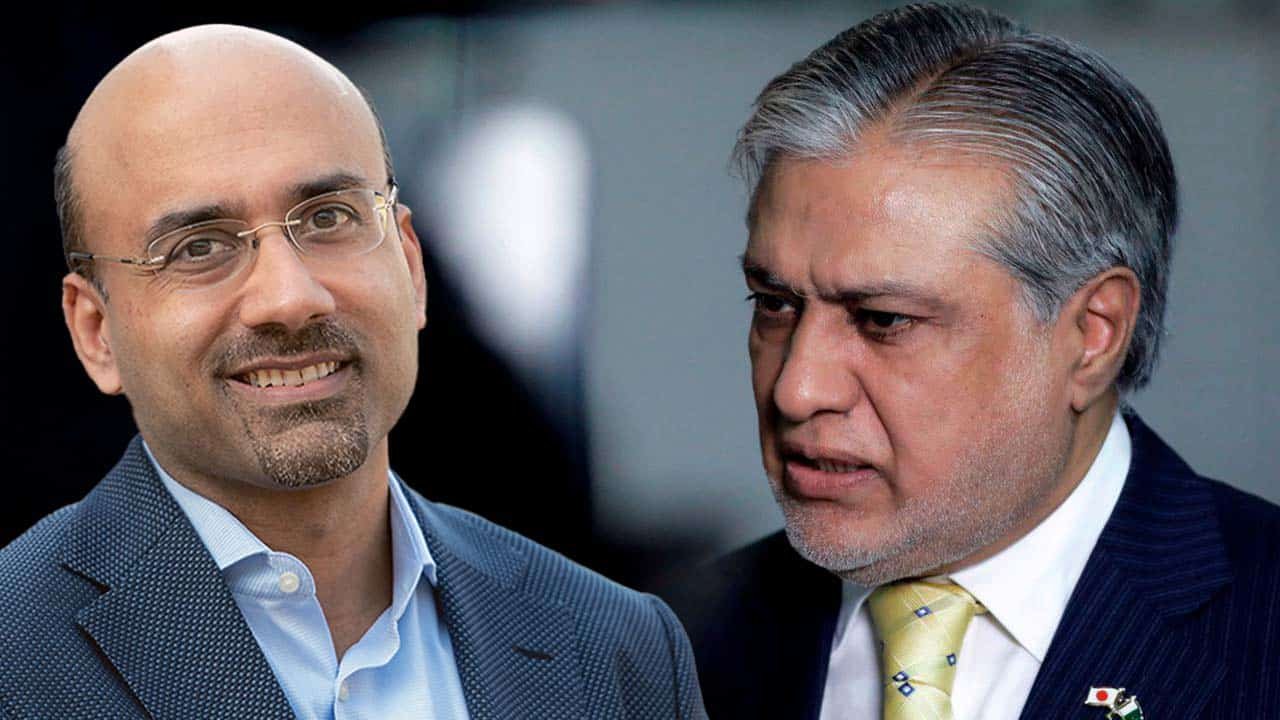
The Ministry of Finance strongly responded on Saturday to recent remarks made by Pakistani-American economist Atif Mian, criticising his lack of practical understanding of economics.
Mian had labelled the government’s economic policies as ‘nonsensical’ and suggested that Pakistan should take decisive actions to restructure its economy, citing Ghana and Sri Lanka as examples. In response, the Ministry of Finance dismissed Mian’s comments as a veiled suggestion of default and argued that his critique was purely theoretical, lacking practical insight into economics.
The ministry refuted Mian’s comparison of Ghana and Sri Lanka, pointing out that Pakistan’s economy and population are significantly larger, making the analogy misplaced.
Regarding Pakistan’s debt structure, the ministry clarified that less than 10 per cent of the debt consists of commercial bonds/sukuks, with the next maturity due in April 2024. The majority of the debt is owed to multilateral and bilateral creditors, who have not indicated any risk of default.
The ministry expressed disappointment that Mian overlooked the significant reforms undertaken by Pakistan in the past nine months. These reforms included market exchange rate adjustments, interest rate modifications, mid-year taxation to improve the fiscal position, levies on petroleum products, and non-monetisation of the fiscal deficit. These actions were implemented under an unprecedented IMF programme.
Despite the delay in reaching a staff level agreement with the IMF, the ministry assured that Pakistan’s economy would continue on the path of reform towards stability and sustainable growth.
The ministry dismissed Mian’s unwarranted comments on nominal exchange rates, stating that Pakistan’s real exchange rate is estimated to be 15 per cent undervalued, reflecting improving fundamentals.
In terms of petroleum prices, the ministry highlighted that historically, Pakistan has sold petroleum products at significantly lower prices compared to regional countries. Imposing additional taxes on consumers, especially given the recent price hikes and rising inflation, would be unwise.
The ministry attributed Pakistan’s current economic crisis to international shocks, including the COVID-19 pandemic, the Ukraine war, and devastating floods. It emphasised that the present government has successfully overcome the challenges inherited from an overheated economy and breached IMF conditionality. The current account deficit has been significantly reduced, indicating progress in balancing payments.
Lastly, the ministry pointed out that Mian failed to consider the unprecedented political challenges faced by Pakistan. It concluded by expressing optimism that with the likelihood of political stability emerging soon, a major economic turnaround is expected.
Overall, the Ministry of Finance strongly rebutted Mian’s criticism, emphasising the government’s commitment to reforms and the resilience of Pakistan’s economy.