Tag: aurat march

  • Khalil ur Rehman Qamar has a disgusting response to Adnan Malik’s criticism

    Khalil ur Rehman Qamar has a disgusting response to Adnan Malik’s criticism

    Khalil ur Rahman Qamar, who refers to himself as a feminist, has yet again passed disgusting comments on Adnan Malik after the latter criticised him for his words and actions. While other celebrities have also stepped forward to do the same, what makes Adnan stand out is the fact that he played Khalil in Hum TV’s super hit drama Sadqay Tumhare. The drama was based on the writer’s own love story.

    Read more – Adnan Malik reveals how he feels about playing Khalil ur Rehman Qamar in ‘Sadqay Tumhare’

    Following the Aurat March on March 8, the writer held a press conference in which he said that an “army of hijras (transgenders) has emerged and this has destroyed the entertainment industry.

    “You will sometimes see hijras in the role of the hero,” Qamar laughed, adding “I always check for hijras before casting anyone in my dramas.”

    He continued, “Laikin eik ghalti meray say bhi hogayi (I also made a mistake). Apnay hee role main, Khalil kay role main mainay eik hijray ko cast karliya (In my own role, in the role of Khalil, I cast a transgender).”

    Yeh mujhe kal pata chala iss liye mujhe pata chala keh mujh se ghalti hogayi (I found this out yesterday so I discovered my mistake yesterday).”

    Though Qamar did not name anyone, his words implied that he was referring to Malik, who played Khalil in Sadqay Tumhare.

    Qamar’s comments were met with a round of laughter and cheering.

    https://www.instagram.com/p/B9lqDUJJB7T/

    In the same press conference, Qamar also remarked that women nowadays have nothing better to do than to get botox done or get a new set of teeth.

    “These women just keep changing the wrapper,” remarked Qamar adding, “This changing of the wrapper highlights women’s insecurities.”
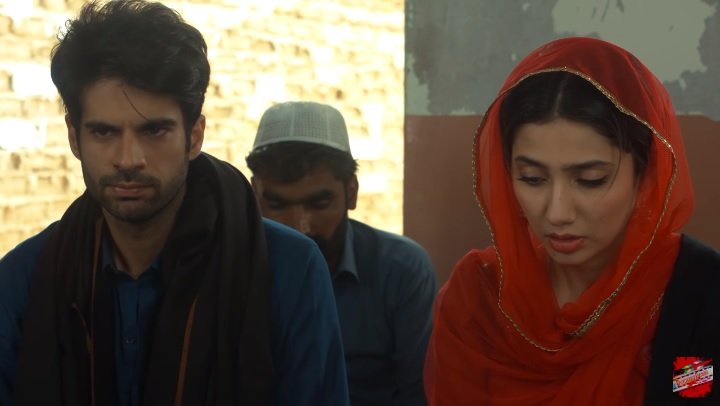
    Adnan Malik and Mahira Khan in ‘Sadkay Tumhare’

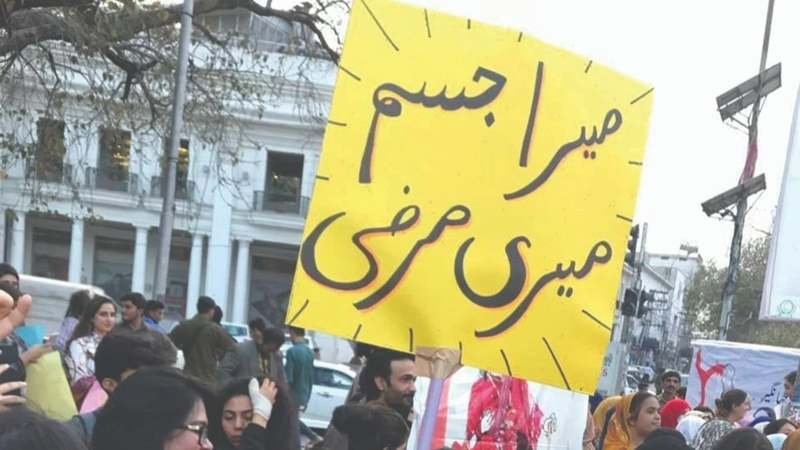
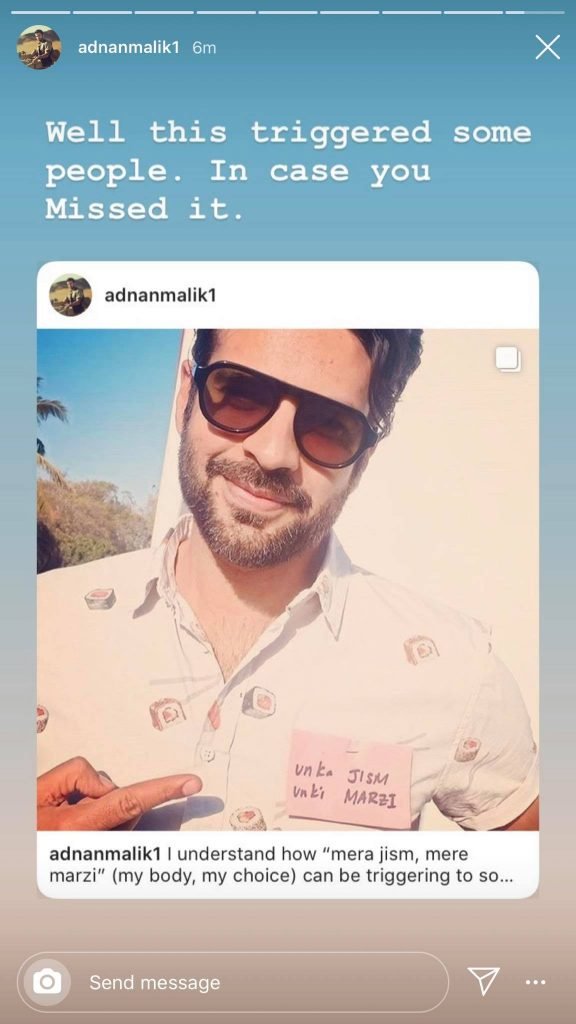
    Meanwhile, Adnan, who has always been a vocal advocate of women’s rights, explained his take on the controversial Aurat March slogan, Mera Jism Meri Marzi.

    In a long note posted to social media, Adnan wrote that he “understood how ‘Mera Jism, Meri Marzi‘ (my body, my choice) can be triggering to some people” before going on to explain his own interpretation of it.

    Adnan said that he “never saw it solely as a justification for ‘westernisation’ or wearing revealing clothes as so many men in this country do.”

    “But yes,” he continued, “The slogan is inclusive of that also. It’s setting a boundary for men who want to have control over women’s choices.”

    Adnan elaborated that the main issue isn’t the slogan but how someone chooses to interpret it.

    “Most men are triggered because they look at women’s bodies through the lens of ‘Madonna or whore’. Either the female body is sexualised or it’s so sacred that sexualising it is a sin. This is the dichotomy that most men are oscillating between- guilt and shame.”

    After Khalil’s remarks, Adnan shared his post again on social media.
  • Mansoor Ali Khan opens up about being trolled over attending the Aurat March

    Mansoor Ali Khan opens up about being trolled over attending the Aurat March

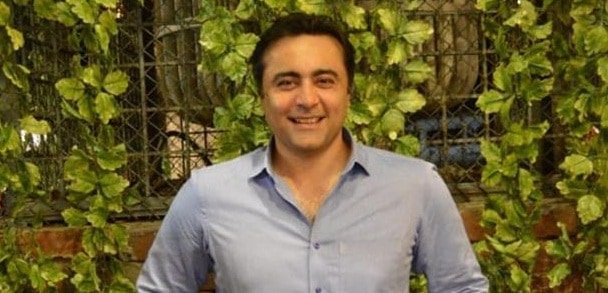
    Senior anchorperson Mansoor Ali Khan, known for his hard-hitting shows, is no stranger to online trolling.

    When Marvi Sirmed was abused on live television recently by writer Khalil-ur-Rehman Qamar, Mansoor hosted a program with Qamar along with Resham and Dr Aamir Liaquat. Mr Khan then went on to demolish Qamar’s misogyny through logic. This show and his support for Aurat March led to some more trolling.

    WATCH: Resham tells Khalil ur Rehman Qamar that he is not even worth one ‘taka’

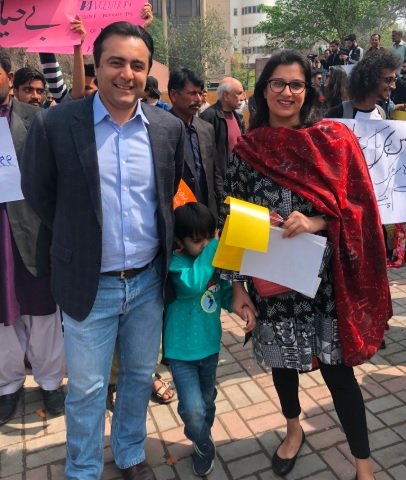
    On March 8, Khan went to the Aurat March in Lahore with his wife and his five-year-old son. Journalist Mehmal Sarfraz took their photograph and posted it online along with a few other photographs from the Aurat March.

    The Original Picture

    Trolls photoshopped the blank piece of paper that Khan’s wife was holding.

    Following this, Mansoor posted the original photo along with three photoshopped pictures:

    Talking to The Current, Mansoor said, “I am always ready to get trolled or get targeted on social media by different political trolls or trolls belonging to various groups but this was the first time that the attack was on my family — which had my wife and five-year-old child in the picture.”

    “Obviously I was disappointed and I was angry but my wife is the one who came up and stood next to me and said there is no reason to lose heart. She said: ‘When I decided to go to the Aurat March with you, I knew these things could happen and I was mentally prepared for that. I knew you were standing on the right path and I will wholeheartedly support you. Next year we are not just going to go with our 5-year-old but we will go with all our 3 sons to the Aurat March.’” he shared.

    “Hats off to my wife. If she doesn’t have a problem with all these things, then why should I? Obviously we in Pakistan need a better mechanism to control such things, which unfortunately is lacking. The authorities need to step up a bit to check such things,” he concluded.

    Meanwhile, AFP also ran a fact-check on the photos and confirmed that the words written on the placards were indeed doctored.

    https://twitter.com/AFPAfPak/status/1237293432055398401?s=20

    Earlier in an exclusive interview with The Current, when Mansoor was asked if he ever thought of leaving this profession because his family is targeted, Mansoor said, “Whatever I am today is because of my family. Whenever I am trolled, my family supports me a lot; they tell me to hold my ground no matter what happens and not deter. My family is my source of strength so I give them all the credit.”

    Watch the full interview here:

  • Why we march

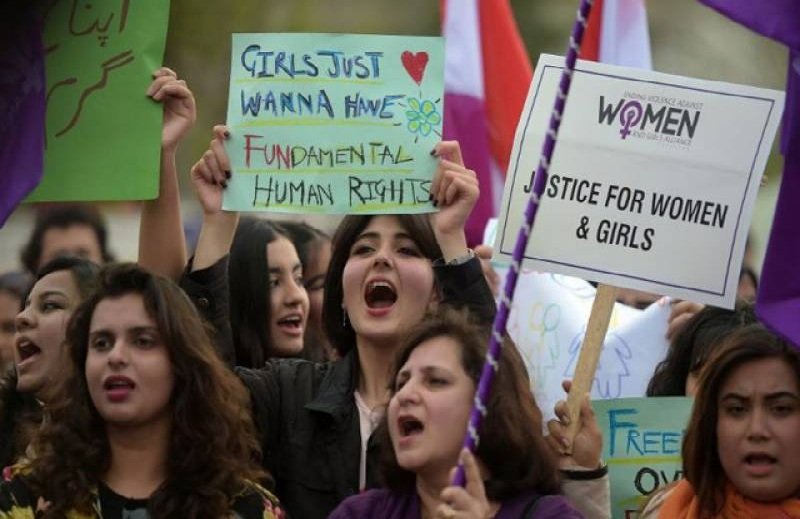
    International Women’s Day is celebrated across the globe on March 8. Pakistan, too, marks the day as women from all walks of life take out rallies and marches across the country to ask for equal rights.

    Aurat March, a rally organised by women, is being held across several cities of Pakistan today. 

    Despite threats from the Jamiat Ulema-e-Islam-Fazl (JUI-F), Lal Masjid affiliates and other right-wing elements, women have not backed down and will continue marching, bearing the flag of equality.

    As for why we march; we march for those 1,000 women killed in the name of “honour” every year. We march because domestic violence has been normalised in our society. We march because more than a thousand Christian and Hindu girls are forcefully converted and then married off to Muslim men against their will. We march because only 5-10 per cent of women have land in their own name. We march because 70,000 young girls die during childbirth as a result of underage marriages. We march because acid attack victims are shunned by society. We march because rape survivors are shamed into silence. We march so that victims of sexual harassment do not fear speaking out. We march because freedom should win over fear. We march because misogynists like Khalilur Rehman Qamar are glorified by our media while strong women like Marvi Sirmed are asked to tone down their behaviour. 

    Women were told to change or tone down the slogans of Aurat March. They are being threatened that if this is how they ask for their rights, they will not be given anything. Well, enough! We will ourselves decide how to speak, how to walk, how to sit, what to wear, where to go, what to do. When a woman says no, it means NO! 

    When we say ‘Mera Jism, Meri Marzi’, we speak for those nameless rape survivors, for those who are victims of domestic violence, for those who are victims of sexual violence, for those whose reproductive health rights have been snatched away, for those women who continue to suffer silently because society does not give them a chance or a way out. 

    We will march and continue to fight patriarchy every step of the way. Without equality, there is no going forward. It is not an easy task but our women have never let us down. From Fatima Jinnah to Benazir Bhutto, from Asma Jahangir to Malala Yousafzai, our women have continued to make us proud. We are proud of each and every one of our women. More power to you. Happy Women’s Day!

  • QUIZ: Which Aurat March Poster Are You?

    Take the quiz to find out which poster suits your personality the most:

  • Vanity projects and double standards

    Women in public life are judged on what they wear rather than what they do.”

    The runup to International Women’s Day in Pakistan has been marked by a heated national debate: not about the sorry state of women’s status in the country, but about the witty and audacious slogans raised in connection with Sunday’s Aurat March.

    The absurdity of the debate about Aurat March is characterised by the terrible misogyny it reveals in terms of women’s choices, particularly in relation to their bodies and their appearance. And here it is pertinent to take a step back and recognise just how deeply ingrained preconceptions about women’s appearance and sartorial choices are in Pakistan — and how, to some extent, all of us are guilty of this.

    For me, the most telling thing is the different way in which male and female politicians are regarded and judged and the very different standards to which they are held.

    Most young people will not remember this, but not so long ago, the Sharif brothers sported gleaming pates. Then over a decade ago, they had whatever work is required done and then they sprouted hair on the top of their heads. Nobody really commented on this even though it was essentially a vanity undertaking.

    I wrote about this on my blog on BBC Urdu, pointing out the complete double standards at play: Benazir Bhutto’s appearance had been routinely criticised and her clothes, shoes, gait, hairdo and makeup were something that nearly everybody in Pakistan — men or women — would hold forth upon. My blog which was titled Naye Baal, Nayee Zindagi pointed this out but much of the feedback it generated had an outraged tone telling me how dare I “criticise” these wonderful men — even though all I was doing was pointing out the double standards.

    “Nearly every woman politician in Pakistan is careful to cover her head in public and to look modest, yet the Vawdas and Khans in the political arena will wear tight jeans and designer garb or any other less-than-occasion-appropriate attire yet arouse no comment and suffer no public backlash at all.”

    Bhutto was the first woman elected Muslim prime minister in the world and she achieved this at the very young age of 35. Yet, most of the public discourse around her was less about her policies or her politics and more about her clothes or her looks. People discussed, ad infinitum, the possibility that she might have had plastic surgery as if it was a matter of grave national importance. There was endless holding forth upon this by armchair experts who insisted, authoritatively, that her face looked different than in her early photos. Implicit in all of this commentary was the idea that Bhutto was somehow a terrible, vain and wealthy person if she had had any “work” done.

    Yet, when the Sharifs got new hair, nobody even batted an eyelid.

    Now fast forward to the present day where botox and hair regrowth procedures are becoming more and more common in Pakistan. Notice how little comment there is when a male politician or TV personality appears with a suddenly creaseless forehead or with jet black hair. No surprise, no comment, no embarrassment.

    The prime minister, Imran Khan, had a small bald patch about 14 years ago, but now he periodically appears with slightly thicker hair and nobody seems to comment on it or on any small changes to his face. I’m not saying that we need to comment on people’s appearance or their choices about that appearance, I’m just pointing out that the prevalent view is that men can do what they want but women’s appearance or clothes are considered something that everybody simply MUST criticise.

    These attitudes are, of course, linked up with a primitive social view that “honour” reposes in the body of the woman and she is a possession that might be “stolen” or “lost”. As a possession, she must be controlled by a man because there is a perception that if she is “free”, society will collapse and “immorality” or “fahashi” will prevail.

    Nearly every woman politician in Pakistan is careful to cover her head in public and to look modest, yet the Vawdas and Khans in the political arena will wear tight jeans and designer garb or any other less-than-occasion-appropriate attire yet arouse no comment and suffer no public backlash at all. Educational institutions will have a very strict dress code and rules for females, but be lenient with the males. It is always the women who have to be conscious of what they wear, how they walk or who they speak to.

    Times are changing, but there still is a long way to go because the people who are guilty of this sort of double standards are not just the chauvinists or the religious right — it is nearly everyone. These attitudes are now normalised and are so ingrained in our society that even educated, reasonable people — both men and women – are guilty of such behaviour. But the more aware of these double standards we can become, the more we will be able to overcome them.

  • ‘Why I march’: 90 per cent people hold bias against women, study reveals

    ‘Why I march’: 90 per cent people hold bias against women, study reveals

    Almost 90% of the global population irrespective of gender holds some prejudice against women, indicated a United Nations (UN) study released ahead of International Women’s Day.

    The UN Development Programme studied 75 countries representing 80% of the world’s population and found that nine in 10 people — including women — hold such beliefs.

    The prejudiced views include: that men are better politicians and business leaders than women; that going to university is more important for men than women; and that men should get preferential treatment in competitive job markets.

    The percentage of those holding at least one sexist bias was largest in Pakistan — where 99.81% of people held similar prejudices — followed by Qatar and Nigeria, both at 99.73%.

    Countries with the lowest population of those with sexist beliefs were Andorra, at 27.01%, Sweden with 30.01%, and the Netherlands, 39.75%.

    France, Britain, and the United States each came in with similar scores, 56%, 54.6%, and 57.31% of people, respectively, holding at least one sexist belief.

    The numbers show “new clues to the invisible barriers women face in achieving equality” despite “decades of progress,” the UN Development Programme said in a statement accompanying the report.

    “The work that has been so effective in ensuring an end to gaps in health or education must now evolve to address something far more challenging: a deeply ingrained bias — among both men and women — against genuine equality,” UNDP Administrator Achim Steiner said.

    The agency called on governments and institutions to change discriminatory beliefs and practices through education.

    Beyond inequalities in education, health, and the economy, the statement also called out one of the report’s most chilling findings: 28% of people believe it is okay for a man to beat his wife.

  • ‘First individuals to embrace Islam were women,’ says IHC on petition calling Aurat March ‘anti-Islamic’

    ‘First individuals to embrace Islam were women,’ says IHC on petition calling Aurat March ‘anti-Islamic’

    Reserving its verdict on the maintainability of a petition seeking to restrict the Aurat March for being “unlawful, unconstitutional and un-Islamic”, the Islamabad High Court (IHC) has questioned the petitioners’ interpretation of slogans they had objected to.

    “The first individuals to embrace Islam were women,” IHC Chief Justice (CJ) Athar Minallah noted as the petitioners’ lawyers told the court that they sought restrictions on the Aurat March — scheduled to take place across the country on March 8 as the world marks Women’s Day — and shared three slogans that women would chant at such an event, Dawn reported.

    The eight petitioners had earlier appealed to the court to regulate activities like the Aurat March “subject to law, norms, decency and public morality in the best interest of justice and to order the respondents to perform their obligatory duties towards the Constitution and the law of land in this regard and restrain unlawful, unconstitutional and un-Islamic activities forthwith”.

    “In our society, various Islamic laws are being seriously violated. The court hopes that the petitioner also approaches it for the enforcement of all these Islamic laws,” remarked Justice Minallah during the hearing today.

    “The women’s slogans are that they be given the rights that Islam grants them. Can we interpret their slogans by ourselves?” the judge questioned.

    “It is important that you see the Aurat March in a positive light. On your own, how can you interpret these slogans?”

    The judge also questioned the petitioners’ counsel on how many women in the country were given the right to an inheritance, alluding to the difficulties they face despite clear Islamic laws in place.

    “Who ended the practice of burying girls alive?” the IHC chief justice inquired, in response to which the petitioners’ lawyer said Prophet Muhammad (PBUH) had done so.

    “In our society, the birth of a girl is still not considered good,” he added.

    The petitioners’ lawyers told the court that they completely supported women’s rights, adding that they were not opposed to the march or to the rights of women.

    They pleaded for the court to pass an order that the march is conducted within the ambit of the law, Constitution and Islam.

    Following the statements of the parties in the case today, the IHC reserved its verdict.

  • National Assembly committee thinks slogan ‘Mera Jism, Meri Marzi’ is ‘immoral’

    National Assembly committee thinks slogan ‘Mera Jism, Meri Marzi’ is ‘immoral’

    In a supposed attempt to curb ‘moral indecency’ allegedly linked to the Aurat March, the National Assembly’s Standing Committee on Information and Broadcasting urged the Pakistan Electronic Media Regulatory Authority (PEMRA) to direct all media channels to stop telecasting slogans like “Mera Jism, Meri Marzi”.

    The NA body held a meeting on Thursday under the chairmanship of Mian Javed Latif of the Pakistan Muslim League-Nawaz (PML-N).

    The committee asked the government to check the telecast of indecent and controversial content on television channels with a special reference to the slogans related to the Aurat March annually held on the International Women’s Day. The committee decided to take up the issue with PEMRA and owners of the electronic media houses.

    A lawmaker, Aftab Jahangir, expressed ‘concern’ over the language used by “certain people in news channel programmes” saying it was repugnant to the Islamic teachings, which no person could “watch in the presence of family members”.

    Special Assistant to the Prime Minister (SAPM) on Information and Broadcasting Dr Firdous Ashiq Awan said Islam was the champion of women’s rights, and anything against the religion and socio-cultural values would not be allowed.

    The constitution gives the right of freedom of speech but being the citizens of an Islamic and democratic country “we have some responsibilities and values”.

    “Nobody would be allowed to ridicule the ‘Islamic way’ of life in the name of freedom of speech,” the SAPM stressed.

    Dr Firdous said it was not an issue of the government but that of the entire society. The government, however, was committed to protecting the constitutional, legal, political, social and economic rights of women.

    ‘NO ONE CAN STOP AURAT MARCH’:

    Meanwhile, Pakistan People’s Party (PPP) chief Bilawal Bhutto-Zardari has said that “no maulana, politician or anchorperson can stop women from holding the march”.

    Speaking at a women convention by PPP Punjab in Lahore on Thursday, he said Benazir Bhutto had always fought against terrorism with courage.

    “The people who say that women would not march should hear loud and clear that they will march and no one can stop them. This path was shown by Benazir Bhutto. The PPP is standing shoulder to shoulder with women of this country and we demand the government provide protection to each and every march and the people threatening women be arrested and cases registered against them.”

    He said women were not begging, rather they were seeking their constitutional rights. “This is Pakistan of Mohtarma Fatima Jinnah, Shaheed Mohtarma Benazir Bhutto and Pakistan of every woman the country. This is not a Pakistan for the conservatives.”

    The PPP, Bilawal added, was a party of prosperity for the people of Pakistan. “Women know the best about the economy of the country because they manage homes. Women will take the PPP’s message of prosperity to every nook and corner of this country.”

    The PPP chief further said that his party had always raised voice for women empowerment.

  • Ahmed Ali Butt makes outrageous claims about ‘Mera Jism, Meri Marzi’

    Ahmed Ali Butt makes outrageous claims about ‘Mera Jism, Meri Marzi’

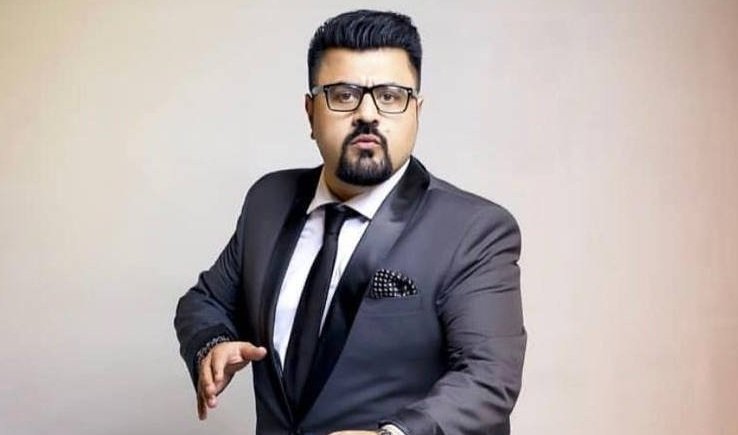
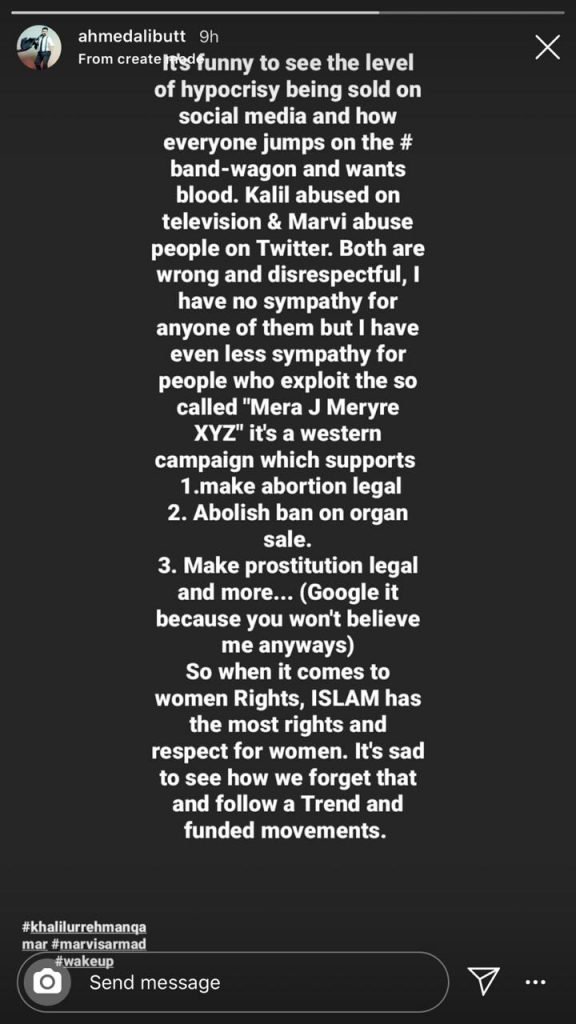
    Mera Jism Meri Marzi‘ has managed to ruffle more feathers than anything else and Ahmed Ali Butt has joined the bandwagon of those who are criticising the slogan without understanding it.

    In a lengthy message posted to social media, Butt said while he has no sympathies for Khalil ur Rehman Qamar or Marvi Sirmed, he has even little sympathy for the “people who exploit the so-called ‘Mera J Mery XYZ’, adding that it is a western campaign. The actor stated that “When it comes to women’s rights, Islam has the most rights and respect for women.”

    Shehzad Roy, Adnan Malik and activist Nayab Gohar Jan have perfectly explained the slogan for those who are still unable to understand the concept behind it.

    Earlier, singer Quratulain Balouch had passed a problematic statement regarding the Aurat March. She later explained her comment after Twitter schooled her for it.

    https://twitter.com/Quratulainb/status/1235637512736870401?s=20

    Read more – QB comes under fire for saying ‘real feminists don’t waste time shouting for their rights’

  • After intense trolling, Mahira Khan temporarily deactivates Twitter account

    After the Khalil ur Rehman Qamar controversy, Mahira Khan took to Twitter to express her views on the issue and women’s rights. She also commented on why the Aurat March is important and why she is going to march on Sunday.

    Mahira then, temporarily deactivated her Twitter account, and Twitterati believe it is because of the massive backlash she was facing from twitter trolls about her positive stance on Aurat March.

    Mahira had beautifully stated why she was speaking up on behalf of Pakistani women and why there is a need for Pakistani women to be given a voice and a platform.

    She however, returned to the social media platform after a little while and hasn’t stated why her account had been deactivated.