Tag: Austria

  • 10 easiest European citizenships

    10 easiest European citizenships

    Many people from developing countries aspire to acquire citizenship in European states. Some countries offer relatively straightforward paths to citizenship, while others present significant challenges. Sweden stands out as the easiest country in Europe for obtaining citizenship, whereas Estonia and Latvia are the most challenging.

    A recent study by CIS analysed Eurostat immigration data from 2009 to 2021 to identify which countries have the highest and lowest rates of non-EU residents acquiring citizenship.

    The analysis revealed that the nine most challenging countries to obtain citizenship are located in Central Europe. Estonia ranks as the most difficult country for non-EU citizens to naturalise, with the lowest average acquisition rate—approximately one in 200 residents. Additionally, the acquisition rate for men in Estonia is lower at 0.58 percent compared to 0.69 percent for women.

    Latvia, the Czech Republic, and Lithuania also have acquisition rates of less than 1 percent for non-Europeans, contrasting sharply with the average of 3.56 percent across European countries. Austria, Liechtenstein, Slovakia, Slovenia, and Germany follow, granting citizenship to about one in fifty non-EU residents. Denmark, outside Central Europe, presents the next highest hurdle with an acquisition rate of 2 percent.

    Over the past decade, six of the ten most challenging countries have seen an increase in citizenship grants year-on-year, particularly Denmark, which experienced a notable rise. Germany’s acquisition rate remained stable, while Latvia, Lithuania, and Slovenia saw declines.

    Many countries implement various programs aimed at attracting foreigners, including opportunities for investment, as well as citizenship and tax benefits.

    Individuals seeking migration often favour Golden Visa and Golden Passport routes, terms that are sometimes used interchangeably despite minor distinctions.

    10 Easiest European Countries to Get Citizenship

    According to the report, Sweden ranks as the easiest country, with nearly one in ten (9.3 Perce) non-EU residents obtaining citizenship—more than double the EU average.

    Sweden boasts the highest acceptance rates for both genders, with women experiencing a slightly higher acceptance rate of 10.02 percent compared to 8.66 percent for men.

    Norway, the Netherlands, Portugal, and Iceland follow as the second to fifth easiest countries to acquire citizenship, with an acquisition rate of one in 25 (4 percent).

    Data shows that northern European countries generally have the highest citizenship acquisition rates, with Sweden, Norway, Iceland, and Finland leading the pack.

    In southern Europe, Portugal emerges as the easiest, while the Netherlands, Ireland, and the United Kingdom are the most accessible Western European states for citizenship. The UK ranks eighth, with nearly three in 50 (3.2 percent) residents granted citizenship.

    Poland and Croatia are the easiest countries in Central Europe for changing nationality, with acquisition rates of 4 percent and 3.9 percent respectively. Northern and Western Europe present the most accessible regions for nationality changes, with an acquisition rate of 5.9 percent compared to 1.9 percent in Central Europe and 3.6 percent in the South.
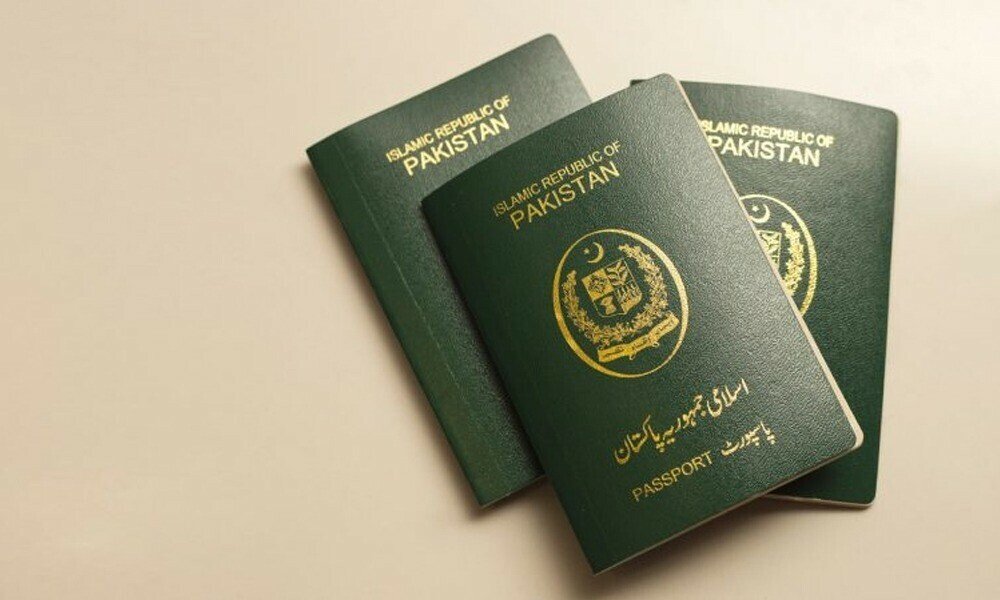
  • Pakistanis seeking asylum in foreign countries will not receive passports

    Pakistanis seeking asylum in foreign countries will not receive passports

    The federal Ministry of Interior has decided on Tuesday not to issue passports to Pakistanis who have requested asylum or are already living on asylum in foreign countries, citing security concerns.

    The ministry sent a letter to relevant authorities asking them not to issue travel documents to asylum seekers.

    According to the ministry’s notification, previously issued passports will be suspended and not renewed.

    The Director General Passports issued the notification on Interior Minister Mohsin Naqvi’s directions.

    The Foreign Ministry and other relevant authorities have also received copies of the notification.

    According to data issued by the United Nations High Commissioner for Refugees (UNHCR),  almost 40,618 Pakistanis applied for asylum in 2022.

    Most Pakistani asylum seekers are currently based in Italy, Austria, and Canada.

    Some of them are in the United States of America, as almost 1477 individuals fled away from Pakistan to the USA in 2022.

    Pakistan was the fifth most represented country, with 5342 immigrants arriving in Europe; however, the number of Pakistani asylum seekers in Greece didn’t increase from 2022 to 2023.

  • Bulgaria, Romania take first steps into Europe’s visa-free zone

    Bucharest, Romania – Bulgaria and Romania joined Europe’s vast Schengen area of free movement on Sunday, opening up travel by air and sea without border checks after a 13-year wait.

    A veto by Austria however means the new status will not apply to land routes, after Vienna expressed concerns over a potential influx of asylum seekers.

    Despite the partial membership, the lifting of controls at the two countries’ air and sea borders is of significant symbolic value.

    Admission to Schengen is an “important milestone” for Bulgaria and Romania, symbolising a “question of dignity, of belonging to the European Union”, according to foreign policy analyst Stefan Popescu.

    “Any Romanian who had to walk down a lane separate from other European citizens felt being treated differently,” he told AFP.

    Ivan Petrov, a 35-year-old Bulgarian marketing executive who lives in France, said he was enthusiastic about less stressful travelling and the time he would be able to save.

    “This is a great success for both countries, and a historic moment for the Schengen area — the largest area of free movement in the world,” EU chief Ursula von der Leyen said in a statement Saturday.

    “Together, we are building a stronger, more united Europe for all our citizens.”

    And they were 29

    With Bulgaria and Romania arriving joining Sunday, the Schengen zone will comprise 29 members — 25 of the 27 European Union member states as well as Switzerland, Norway, Iceland and Liechtenstein.

    Romania’s government said Schengen rules would apply to four sea ports and 17 airports, with the country’s Otopeni airport near the capital Bucharest serving as the biggest hub for Schengen flights.

    More staff including border police and immigration officers will be deployed to airports to “support passengers and detect those who want to take advantage to leave Romania illegally”, it added.

    Random checks will also be carried out to catch people with false documents and to combat human trafficking.

    Bulgaria and Romania both hope to fully integrate into Schengen by the end of the year, but Austria has so far relented only on air and sea routes.

    Croatia, which joined the EU after Romania and Bulgaria, beat them to becoming Schengen’s 27th member in January 2023.

    Created in 1985, the Schengen area allows more than 400 million people to travel freely without internal border controls.

    ‘Irreversible process’

    While some have reason to celebrate, truck drivers, faced with endless queues at the borders with their European neighbours, feel left out.

    Earlier this month, one of Romania’s main road transport unions the UNTRR called for “urgent measures” to get full Schengen integration, deploring the huge financial losses caused by the long waits.

    “Romanian hauliers have lost billions of euros every year, just because of long waiting times at borders,” secretary general Radu Dinescu said.

    According to the union, truckers usually wait eight to 16 hours at the border with Hungary, and from 20 to 30 hours at the Bulgarian border, with peaks of three days.

    Bulgarian businesses have also voiced their anger over the slow progress.

    “Only three percent of Bulgarian goods are transported by air and sea, the remaining 97 percent by land,” said Vasil Velev, president of the Bulgarian Industrial Capital Association (BICA).

    “So we’re at three percent in Schengen and we don’t know when we’ll be there with the other 97 percent,” he told AFP.

    Bucharest and Sofia have both said that there will be no going back.

    “There is no doubt that this process is irreversible,” Romanian Interior Minister Catalin Predoiu said this month, adding it “must be completed by 2024 with the extension to land borders”.

    ani-vs-anb/jj/js

    © Agence France-Presse

  • Pakistani passport once again least powerful

    Pakistani passport once again least powerful

    Henley & Partners‘ Passport Index has published a list portraying the world’s travel access hierarchy.

    Top on the list of countries that encourage travelling are France, Germany, Italy, Japan, Singapore, and Spain, whose citizens can visit an astounding 194 destinations without requiring arduous visa procedures. This group of countries offer passport-to-plane experience, setting the bar high for unmatched worldwide mobility.

    With access to 193 locations, Finland, South Korea, and Sweden share second place. Many visa-free or visa-on-arrival options are available to their well-travelled inhabitants, providing access to a variety of cultures and environments.

    Austria, Denmark, Ireland, and the Netherlands take third place with access to 192 destinations. These nations serve as entry points to a wide range of travel opportunities.

    The long list goes on, honouring countries that place a high priority on global connection. Among the notable entries are the United States, Canada, Greece, Switzerland, and New Zealand, all of which provide their inhabitants with an abundance of travel options.

    On the other hand, the Passport Index identifies states with more limited travel options. Afghanistan, Syria, Iraq, and Pakistan are among the least accessible, offering their passport holders entry to just 34 countries that require no visa or one upon arrival.

    The London-based company, which offers residency and citizenship consultancy services, teamed together with the International Air Transport Association to create a unique ranking that takes into account passport holders’ access to countries without a visa or with one upon arrival.

  • Actor Jamal Shah created the Dr Abdus Salam sculpture in Vienna

    Actor Jamal Shah created the Dr Abdus Salam sculpture in Vienna

    Veteran Actor and Sculptor, Jamal Shah took to his Twitter to reveal that he is the mastermind behind the creation of the sculpture of the first Pakistan’s Nobel Laureate, Dr Abdus Salam. The bust is placed at the International Atomic Energy Agency (IAEA) in Vienna, Austria.

    The sculpture of Dr Abdus Salam was unveiled at the IAEA to mark his 60th birth anniversary in September 2017.

    While talking to The Express Tribune, he revealed, “At IAEA’s headquarter of the atomic energy commission, there were almost all scientists sculptures but not of Dr Abdus Salam so I decided to make a sculpture of him. I handed over this sculpture to them and now it is present there. It is in bronze and it was specifically made to give a tribute to him. I usually don’t make portraits as my sense and style of sculpture making is different but this type of sculpture is just for him.”

  • Can only travel visa free to 31 countries, Pakistani passport ranks 4th worst in 2022

    Can only travel visa free to 31 countries, Pakistani passport ranks 4th worst in 2022

    The Pakistani passport has been placed at 4th position in the category of the world’s worst passport for international travel in a list released by the Henley Passport Index 2022.

    Afghanistan, Iraq, and Syria ranked the top 3 worst passports in the world respectively.

    Overall, the Pakistani passport ranks at 108th position in the world for the third consecutive year with visa-free or visa-on-arrival access to 31 destinations around the world.

    India climbed up seven positions and ranked at 83rd on the list this year. India had previously ranked at 90th place after slipping from 85 in the year 2021.

    East Asian and European countries as usual dominated on the passport global ranking this year as well.

    Japan and Singapore have been placed at the top of the list of powerful passports in the global ranking which allows travel visa-free to 192 destinations.

    South Korea and Germany are placed in second place with total of 190 points whereas Finland, Italy, Luxembourg, and Spain gained 189 scores which made them into third place.

    France, Netherlands, and Sweden moved up at one spot and joined Austria and Denmark in fourth place with a score of 188.

    Ireland and Portugal received total scores of 187 and placed them in fifth place, and the United States and the United Kingdom rank in at number 6.

    Since 2006, the international firm, Henley & Partners has been regularly monitoring the world’s most travel-friendly passports under the “Henley Passport Index”.

  • Spain to consider pet custody in divorce battles

    Spain to consider pet custody in divorce battles

    A Spanish court has ruled that pets are also members of the family. In divorce cases, the husband and wife must share them when they get separated.

    There was already no doubt about it among animal lovers, but now pets are officially considered a member of the family in Spain. The new law, which came into force on January 5, recognises pets for the first time as living, sentient beings and not just as objects.

    “Animals are part of the family and when a family decides to separate, the fate of the animal must be regulated with the same importance as the fate of other family members,” said lawyer Lola Garcia.

    The court said that the courts are required to consider the welfare of animals. It aims to end the legal wrangling that often occurs between couples who keep pets.

    Owners must “guarantee” the pet’s well-being, and if either spouse has a history of animal cruelty, he or she may be refused or lose custody of the animal, according to the law.

    Spain is not the first country to do so; France, Germany, Switzerland, Austria, and Portugal are among the European countries that recognise animals as sentient beings.