Tag: backlash

  • Alia Bhatt faces backlash for silence on Gaza crisis, lands on ‘Block Out 2024’ list

    Alia Bhatt faces backlash for silence on Gaza crisis, lands on ‘Block Out 2024’ list

    Bollywood superstar Alia Bhatt has joined the ranks of celebrities like Taylor Swift and Priyanka Chopra on the ‘Block Out 2024’ list, a group of entertainers and influencers being blocked by fabs for not speaking up about the Gaza genocide. Despite her recent appearances at events like the Met Gala and the Gucci Cruise show, Alia Bhatt has faced criticism for not raising her voice for Palestinians.

    The ‘Block Out 2024’ movement encourages people to unfollow and block these celebrities on social media, aiming to hit them financially by reducing their social media influence.

    Other notable names on the list include Priyanka Chopra, her husband Nick Jonas, and cricketer Virat Kohli. These celebrities have significant platforms but haven’t used them to speak out against Israel’s attacks in Gaza.

    Some big names from the West have also been added to the ‘Block Out’ list, including Kim Kardashian, Taylor Swift, Beyonce, Kylie Jenner, Zendaya, Miley Cyrus, Selena Gomez, Khloe Kardashian, Ariana Grande, Doja Cat, Demi Lovato, Lizzo, Nicki Minaj, Travis Scott, Kanye West, Katy Perry, Zac Efron, Joe Jonas, Kevin Jonas, and Justin Timberlake, among others.

    The movement gained traction after this year’s Met Gala, where celebrities flaunted expensive outfits while Rafah was being mercilessly bombed.

  • ‘Become better’; Saheefa Jabbar speaks up after facing backlash for defending Dananeer

    ‘Become better’; Saheefa Jabbar speaks up after facing backlash for defending Dananeer

    Actor and model Saheefa Jabbar Khattak has talked about how artists in the entertainment industry often face tough criticism. She shared a heartfelt message on Instagram, explaining the challenges and pressures that content creators deal with. She asked for empathy and understanding from everyone in the community.

    In her message, the actress from ‘Beti’ talked about how some artists face judgment and negativity because they quickly become famous or make certain artistic choices. “Even if I don’t like the work of many content creators, I believe that when God gives someone fame and wealth, I shouldn’t question why they have it.”

    Saheefa talked about her own experiences defending another artist who was criticized for becoming successful quickly and charging high fees. She said, “I got many direct messages from people worried about quick fame, not being a real artist, asking for too much money, and getting everything too easily.”

    Saheefa talked about how the entertainment industry changed, especially in marketing and branding after COVID-19. She said, “Influencers and content creators now have big roles in building brand images and increasing sales. We’ve seen a change where influencers are now being invited to major award shows and screenings, something that wasn’t common before.”

    The actor also said it’s important to stick to your values and respect other artists. “I may not always agree with the content someone makes. But I think every artist, YouTuber, or influencer should be honest in what they create,” Saheefa said. She also talked about the need for artists to support and respect each other, “As an artist, it’s my duty to respect other artists and help them as much as I can.”

    She added, “When you say bad things about other artists or criticize them in your posts, it’s not good.” Saheefa talked about feeling envious and frustrated when she sees others succeed. “Sometimes I feel frustrated too when I don’t get as much work as others, when I don’t see myself as successful as them, or when I don’t earn as much money. But each time, I remind myself that as a person, I can only work hard, pray, and hope for better things to come,” she said.

    The 35-year-old ended her post by telling her followers and friends to try to improve themselves instead of feeling jealous. She said, “When we see someone succeed, we can feel jealous and want what they have, and that’s normal. It’s tough to watch someone achieve what you wanted for yourself; that’s true.”

    “But let me finish by saying that as a person, you can only do your best, and you should work to improve yourself.” Her message has connected with many in the industry, leading to talks about the importance of supporting different forms of artistic expression without being judgmental.

  • Fiza Ali faces backlash over new Qawali video

    Fiza Ali faces backlash over new Qawali video

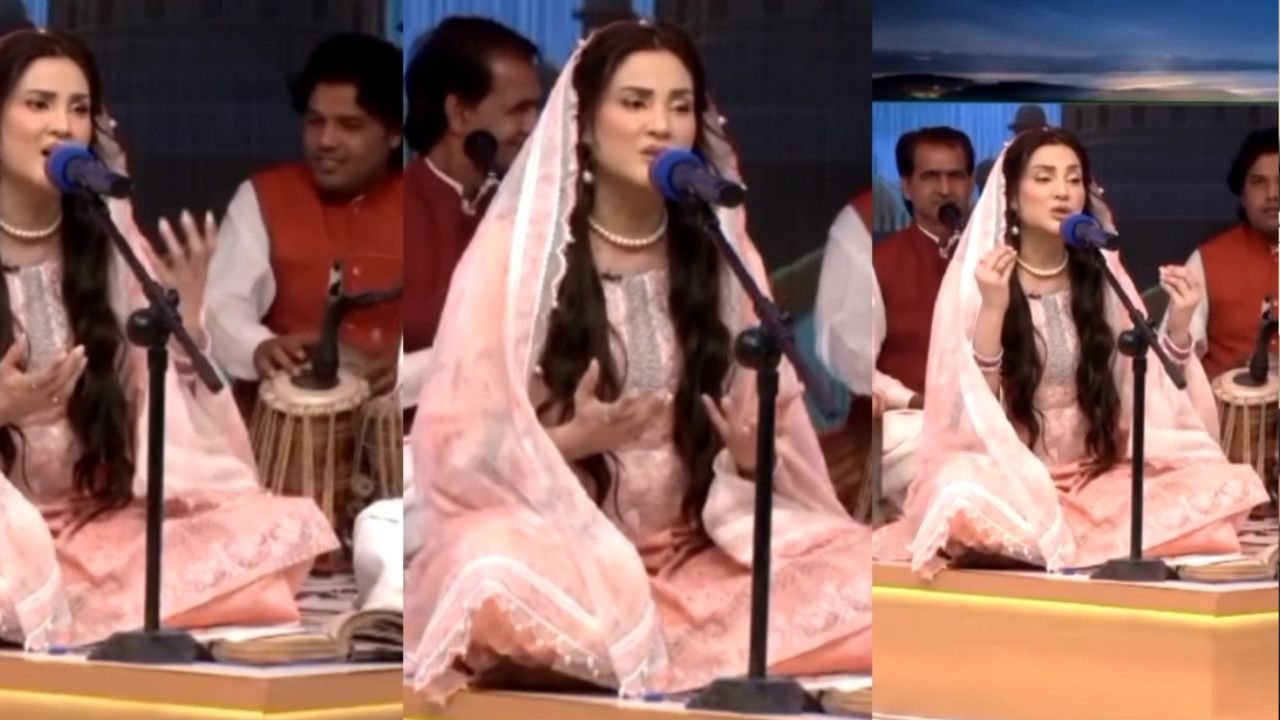
    Fiza Ali, the renowned Pakistani actress and host, has stirred up a debate with her latest Qawali rendition. Known for her versatile talents and dedication to her craft, Fiza Ali recently shared a video of herself performing ‘Tu Kuja Man Kuja’ alongside a Qawal during Ramadan transmission on 24 News HD.

    While Fiza Ali’s rendition was delivered with passion and commitment, it seems to have divided opinion among her fans. Some praised her for exploring new artistic avenues, while others criticized her style and perceived lack of proper head covering during the performance.

    The controversy has sparked a discussion on social media platforms, with fans expressing differing viewpoints on the appropriateness of Fiza Ali’s Qawali performance.

    Check out the comments on the video for more insight:

  • ‘Insensitive’: Waqar Zaka slams Nida Yasir’s claim he tried to sabotage her show

    ‘Insensitive’: Waqar Zaka slams Nida Yasir’s claim he tried to sabotage her show

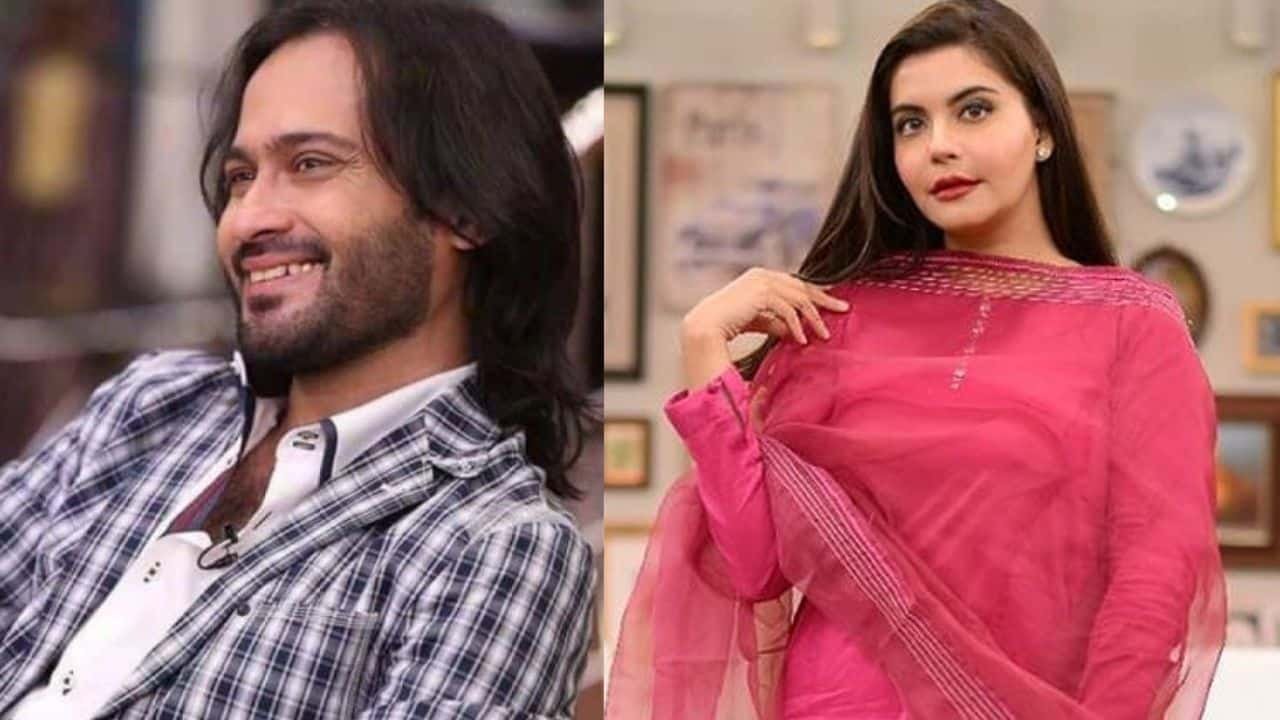
    Television presenter and cryptocurrency expert Waqar Zaka fired back at actress and morning show host Nida Yasir over her claims that he tried to sabotage her show. In a video statement posted on his social media accounts, Waqar revealed he had complained about Nida’s conduct of hosting morning shows when she invited the parents of a deceased girl who was raped and then murdered. The show was subjected to intense controversy as Nida made the parents cry by asking them invasive and hurtful questions, which caused outrage.

    Waqar said that Nida claimed the parents had themselves requested to be invited on the show in order to gain media support to grant their daughter justice. However, he refuted these claims by sharing the video of an activist interviewing the parents, who revealed they were invited by Nida, rather than the other way round.

    Waqar debunked another claim made by Nida on her show, where she claimed the family had filed an FIR after their appearance. But as Waqar shared in the clip, the activist spoke with the victim’s parents who revealed they had filed it before making their appearance on the morning show.

    Waqar shared that these revelations had created an outrage on social media, which is when in 2020 he had encouraged his followers to file a report with PEMRA, and to message Salman Iqbal, the CEO of ARY, to remove Nida as a host.

    “It is insensitive how Nida exploited a case like this for the sake of getting ratings, and lied so much that she couldn’t even apologise after getting caught later,” said Waqar. “And also remember: a host is always aware of what goes on during the show. If the host approves something, then it appears on the show.”

    Waqar further added it’s time all the elderly hosts sitting on their morning shows should now consider letting go, and giving other young people a chance. He added Nida should host a contest to see who could replace her, and revealed he had complained to Salman Iqbal that other women should be given a platform because Nida was no ‘Oprah’ and nor did she hold any philosophy in her life.

    On Saturday, Nida made headlines when as a guest on Geo’s ‘Hasna Mana Hai’, she revealed Waqar Zaka had tried to sabotage her morning show as well as her career. She added the two were on good terms during the time he worked with the channel, but his demeanour changed when he left.

    “When Waqar left ARY, he started sending emails to the channel’s management, urging them to remove me from my morning show,” she confessed.

  • Renowned Washington Post faced extreme backlash for cartoon dehumanising Palestinian children, deleted later

    Renowned Washington Post faced extreme backlash for cartoon dehumanising Palestinian children, deleted later

    Washington Post was slammed on the internet on Wednesday for a racist cartoon dehumanising the Palestinians. Right now the number of Gazans killed in Israeli airstrikes has reached 10,000. The cartoon has since been deleted, while Post has put out an editorial note.

    The offensive drawing shows a crudely drawn Arabic man labeled Hamas with three children and a woman tied around him with ropes.

    “This is the kind of anti-Palestinian racism that they think is acceptable for publication,” slammed Palestinian poet Remi Kanazi.

    Palestinian journalist Ahmed Eldin re-shared the post to point out how the racism Palestinians are enduring in the Western media is similar to how the Jews were drawn as evil with physical features that compared them to rats or cockroaches.

    “Before the Holocaust, Jews were portrayed as irrational and evil, with physical features that made them appear akin to cockroaches and rats. These images dehumanized Jews to justify their mass extermination. Now, the Western press is doing the same to Palestinians. The source of this obscene and offensive piece of propaganda masquerading as a “political cartoon” by Michael Pramirez is not a lesser-known publication, but rather the widely recognized

    @washingtonpost. Regardless of the validity of the claims regarding Hamas using human shields, the notion that thousands of children being killed can be justified or deemed acceptable as collateral damage is absolutely unacceptable. The dehumanization of Palestinians, which serves as a pretext to permit and rationalize their mass killing, is a disturbing trend that seems to have no boundaries within American discussions and debates.”

    ‘What’s more troubling than this racist depiction,” Palestinian-American poet Mohammad El-Kurd wrote. “Is that the Washington Post thinks it’s OK to kill civilians if, hypothetically, ‘terrorists’ hid behind them. Even if the “human-shields” myth was true, only those who kill civilians are responsible for the act of killing.”

    Columnist and writer Fatima Bhutto tweeted her outrage:

    “This cartoon is so anti-Muslim, so racist it boggles the mind that any newspaper could print it. Beyond which, Israel has murdered over 4,000 children- do you have absolutely no shame depicting Palestinian children in this manner? What a disgrace.”

    The Washington Post opinion editor David Shipley published an apology for the cartoon on their website and took it down:

    “A cartoon we published by Michael Ramirez on the war in Gaza, a cartoon whose publication I approved, was seen by many readers as racist. This was not my intent. I saw the drawing as a caricature of a specific individual, the Hamas spokesperson who celebrated the attacks on unarmed civilians in Israel. However, the reaction to the image convinced me that I had missed something profound, and divisive, and I regret that. Our section is aimed at finding commonalities, understanding the bonds that hold us together, even in the darkest times.”

  • ‘Sickening’: social media criticises McDonald’s Mauritius after insensitive Halloween post

    ‘Sickening’: social media criticises McDonald’s Mauritius after insensitive Halloween post

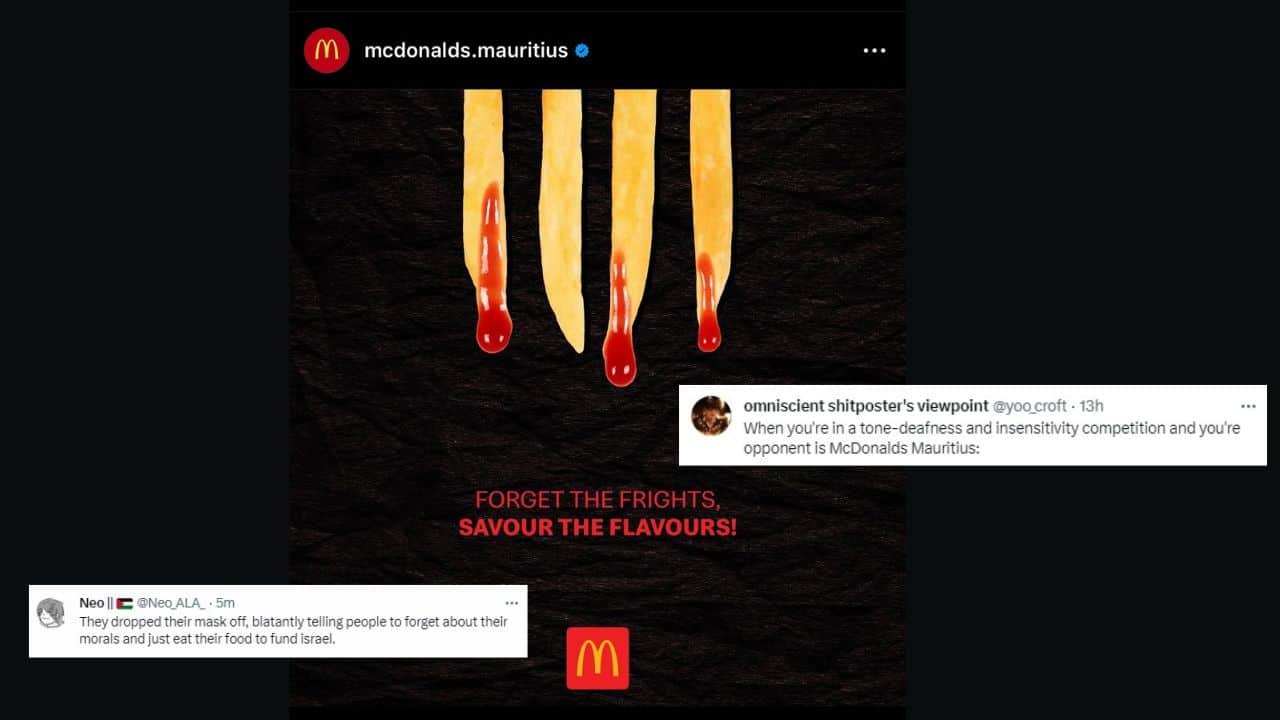
    McDonalds is facing a worldwide boycott after the fast food giant’s Israeli franchise provided free food to IDF soldiers while the Israeli army bombarded Gaza. Now the company’s Mauritius franchise has come under fire after it posted what users thought was an insensitive Halloween picture.

    In the now deleted image, fries dripping with ketchup are positioned to resemble a bloody hand. The caption reads: “Forget the freights. Savour the flavours!”

    Social media users expressed their outrage.

    Previously, the McDonald’s franchise in the UK was criticised for hiding the replies in their comments demanding the organisation to withdraw their support for Israel.

  • ‘Worse than Nazis’: Israeli TikTokers slammed for mocking Palestinian deaths

    ‘Worse than Nazis’: Israeli TikTokers slammed for mocking Palestinian deaths

    As videos and pictures show the awful impact of Israeli airstrikes over Gaza, where the death toll is set to cross 7000, an awful trend of Israeli TikTok users mocking these war crimes has emerged online.

    An Israeli TikTok user danarazmakeup is going viral on social media after her recent video showed her mocking the Palestinians for lack of access to clean water, electricity and air conditioning. In the video, she is running around using the applicants in her home while looking at the audience in a mocking manner.

    Twitter user Hadi Nasrullah shared this clip with the caption: “Disgusting. More and more Israeli influencers and content creators are participating in trends mocking Palestinians in Gaza for not having water or electricity. And you want us to feel sorry for them.”

    Several X (formerly Twitter) users criticised the Israeli TikToker by calling her “worse than Nazi’s”.

    Other videos included parents along with their children, mocking Palestinians by applauding their lack of electricity, and even comparing them to dogs.

    An Arab TikTok user Yeganeh shared a series of clips posted by Israeli users who were mocking Palestinians trauma. .

    In the comments section, several users urged everyone to public the names of these TikTok accounts so they could be reported.

  • McDonalds Pakistan, Turkey, Lebanon release statements; dissociate themselves from Israel

    On Friday, McDonalds attracted global backlash after its Israel account released statements announcing free food for the Israel Defense Force (IDF) and other soldiers. #BoycottMcdonalds began trending globally, and many twitter users declared they were no longer supporting the fast food franchise.

    READ MORE: #BoycottMcDonalds trends as the fast food giant opens five new restaurants for Israeli security forces, donates 4,000 daily meals

    Several outlets from Pakistan, Turkey and Lebanon have released statements on their Instagram accounts where they have distanced themselves from the Israeli brand.

    Pakistan’s McDonalds wrote they were not affiliated with the Israeli brand, stressing that the brand made decisions in respect with their own country.

    Meanwhile, McDonalds Turkey, in their statement, condemned the support for Israel and announced they were donating aid worth $1 million dollars to the people of Gaza.

    After several unverified reports claimed the McDonalds franchise in Lebanon was attacked and raided by Palestine supporters, the franchise posted a statement disassociating themselves from the Israeli branch.

  • What was the backlash on Aurat March’s ‘people with uterus’ post all about? An organizer explains

    What was the backlash on Aurat March’s ‘people with uterus’ post all about? An organizer explains

    Three days ago, the women rights movement Aurat March’s Karachi page uploaded a detailed statement on their Twitter account addressing the backlash surrounding the term ‘people with uteruses’. The term was used in a statement announcing a feminist baithak a few days ago, where women and people of other genders were invited to discuss the topic “Mensturation and Misogyny”.

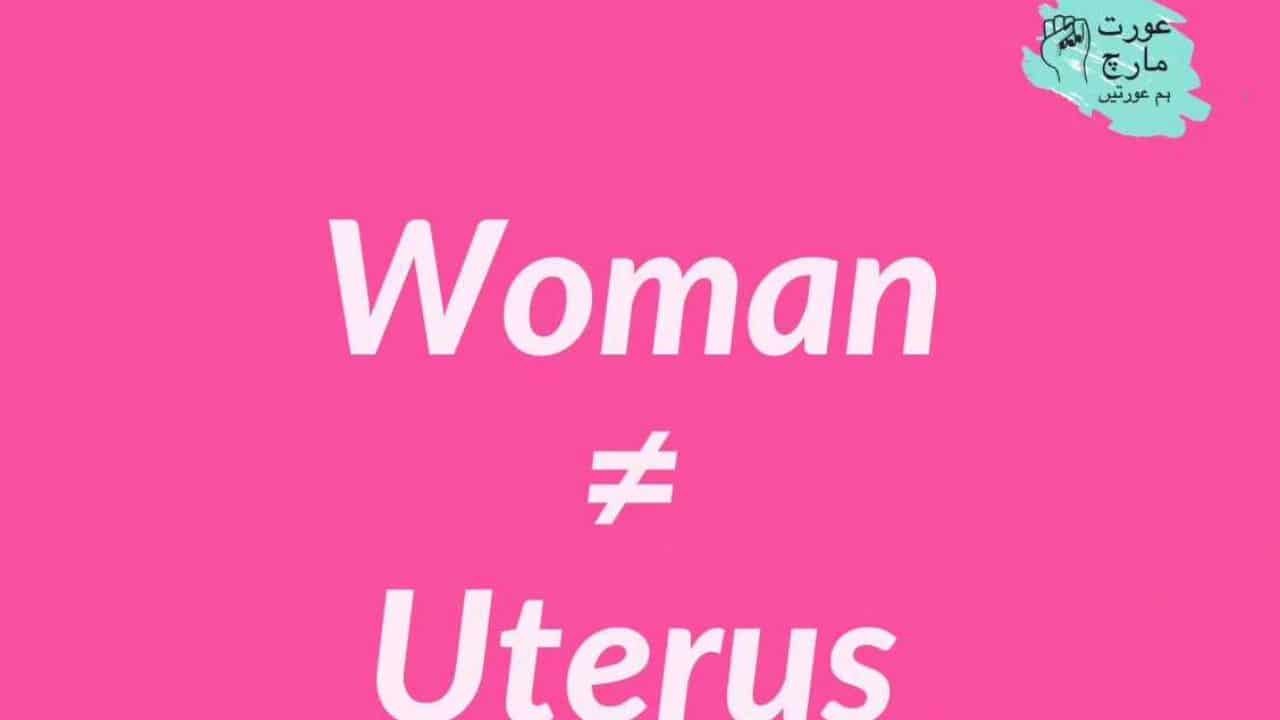
    In their statement, Aurat March explained why mensturation has less to do with gender, because it’s a biological process since the uterus, or the womb is the main organ involved in it.

    “Mensturation is a biological process, with the uterus or the womb being the main organ involved in it. Needless to say, it has to do with the sex a person is assigned at birth rather than their gender. It only makes sense, then, to call anyone who mensurates a ‘person with uterus’ or ‘mensturator’.”

    “This form of criticism revolves around the deeply ingrained, patriarchal belief that a woman’s identity is inherently tied to her uterus, other reproductive organs, and ability to conceive and bear children. It is deeply misogynist, especially in our context, where many CIS women are considered baby making machines and girls are married off at a young age (often even in their teenage) with the belief that they would bear more children, often at the cost of the girl’s health or even life.”

    In their next post, Aurat March detailed on the misogynist attitude towards periods- and how it affects every person, woman or not.

    “Given that the majority of uteruses bleed almost every month for four decades, it is crucial to realize that the misogynist attitudes towards periods affect every person who mensurates- whether woman or not. We use the word misogyny here because the patriarchy views mensuration as inherently feminine thing (and hence, as cause of inferiority); therefore, this misogyny extends also to non-binary and trans-masculine mensurators.”

    “The bottom line is that the uteruses of many women, transgender men and non-binary persons (who were assigned female at birth) have been bleeding for centuries and will continue to do so.”

    The statement was slammed by several Twitter users as misogynist towards women, with Youtubers like Muzamil stepping in to label the movement elitist. To get to the bottom of the controversy and how can we craft more spaces for women, and people from the transgender community, to talk openly about their mensuration without facing backlash, we spoke with Aurat March organiser *Rosa.

    Q. What inspired you to write this statement, and did you anticipate that there would be such backlash?

    Truth be told, we did not expect the response to be this big. Aurat March regularly hosts baithaks where we discuss our politics with the poeple but also amongst ourselves. The use of inclusive and misogyny-aware language is something we’ve been consistently using over the years. Our movement is feminist and takes pride in the fact that we stand for all genders that are suppressed under patriarchy. We think the fact the tweet started with the word “people with uteruses” is what had people read it and have it make rounds.

    Q. Given the criticism the post has received, do you feel Aurat March could have worded the statement differently or toned it down?

    No. The criticism for a feminist voice in the political space has been there since day one. People criticize us mindlessly for anything that we do. They place an unfair burden of championing every single feminist issue in the country while those same men might not have gotten off their horses of privilege to raise a single finger for the feminist cause. The criticism is bandwagon-ish, misogynistic and transphobic, and it shows how much work we have to do in terms of the discourse around menstruation, the people it impacts, and the trauma of internalized misogyny that women in Pakistan carry. The hate isn’t even necessarily centered around the statement; it’s centered around Aurat March and what it represents.

    Q. Several users, including the YouTuber Muzzamil, criticised the post saying its proof that Aurat March is an elitist movement, that doesn’t address the ongoing issues faced by women in Pakistan. Do you feel this perspective is justified? 

    We think its funny that out of all the people, Muzzamil came out to call the Aurat March an elitist movement while he sits and tweets this from Dubai. There are several tiers of responses as to how the perspective isn’t justified. 

    The burden to prove whether AM is an elitist movement is not just unfair in the first place, it’s impossible to prove as well. Our marches regularly pulls in more than half of its audience from the working class communities we work with. We go and visit these hidden, impoverished and disenfranchised communities all year round: Zia Colony, Mauripur, Orangi Town, Kausar Niazi, Mehran Town, Race Course, Shikarpur, Surjani, Ibrahim Hyderi, Lyari are only some of the names. We then arrange their transport from their communities to the march as well. 

    But not just that, all that one has to do see where our priorities lie as a movement is go through our Instagram. For the last month or so, we’ve been working with effectees from Jaranwala, raising voices and protesting for the rehabilitation, protesting at Teen Talwar for recovery of Hindu missing persons while a delegation from our team has been facing harassment and abuse from the police at Jaranwala as we speak. 

    But of course, men like Muzzamil wouldn’t see the groundwork that Aurat March has done because he’s never visited these places himself, or maybe he doesn’t have binoculars big enough that can help him see all the way from Dubai. The truth is, our politics doesn’t revolve around just creating a feminist discourse or space on twitter, but a lot of people see it that way. They like to think that politics that does not exist beyond this digital space, and we couldn’t care less about these keyboard warriors. The work that we do, impacts the people we work with and it makes a difference in their lives, and that is all that the feminist cause is at the end of the day.

    Q. The ongoing backlash surrounding menstruation can have some implications on the mental health of Pakistani women because they don’t feel its safe for them to express their concerns out loud, even on social media. How can we continue to create spaces to openly speak about the issues Pakistani women want to talk about.

    We think it’s important to clarify our politics and position in this context. We believe it’s important to see a woman beyond her uterus. In many instances, this “bachadani” holds more value than her life. Her worth is gauged up on her ability to reproduce, her identity is centered around her motherhood, and her final goal is set out to become a mother. So many women lose their lives in forced pregnancies, so many battle uterine cancer and so many see their childhoods end the moment their uteruses start bleeding, married off to a man twice or thrice her age. So of course, when AM tries to separate the woman’s identity from her uterus, people lose their minds.

    It’s funny people think ‘people with uterus’ is dehumanizing language when so many people see only a uterus when they look at a woman. To think about how this experience might not be inherent to their existence would then, of course, be thought of as radical. At that same time, it’s important to remember that many women don’t necessarily have a uterus either. Alot of them have their removed due to complications, while many are simply born without one; the language is inclusive of their womanhood and identity, too. All the while, we also acknowledge all the people that menstruate or have uteruses but might not necessarily identify as women either, such transmen or non binary folks. The movement is just as much as for them and by them as it is for any gender.

    And understandably so, it becomes difficult for a woman to voice out her concerns regarding her body on social media. When our comments section becomes places of spewing hate or become dominated by men who think they’re invited to share their opinions about women’s bodies, they drown out any chances of having an open engagement and discussion on these topics. 

  • Juggun Kazim was harassed by fans for this reason

    Juggun Kazim was harassed by fans for this reason

    Actress Juggun Kazim was a guest on Momin Saqib’s show ‘Had Kar Di’ where she criticised Pakistani audiences for turning a blind eye to toxic love stories promoting violence and sexism towards women.

    The ‘Gunah’ actress said that she had once shared a picture on her Instagram where she was kissing her husband’s cheek. The picture got her severe backlash.

    “I couldn’t understand! This was four or five years ago. I said what is everyone’s problem? That’s my husband!”

    Juggun questioned why it is appropriate to display violence on television screens but controversy ignites when romance is shown.

    Drama channels profiting off of women’s misery is often discussed by public figures, including ‘Kuch Ankahi’ writer Syed Mohammad Ahmed. In a June appearance on ‘Mazaaq Raat’, he spoke at length about television channels prioritizing viewership ratings over honest storytelling.