Tag: Bailout

  • Petroleum levy of Rs50 per liter approved in Finance Bill 2022–23

    Petroleum levy of Rs50 per liter approved in Finance Bill 2022–23

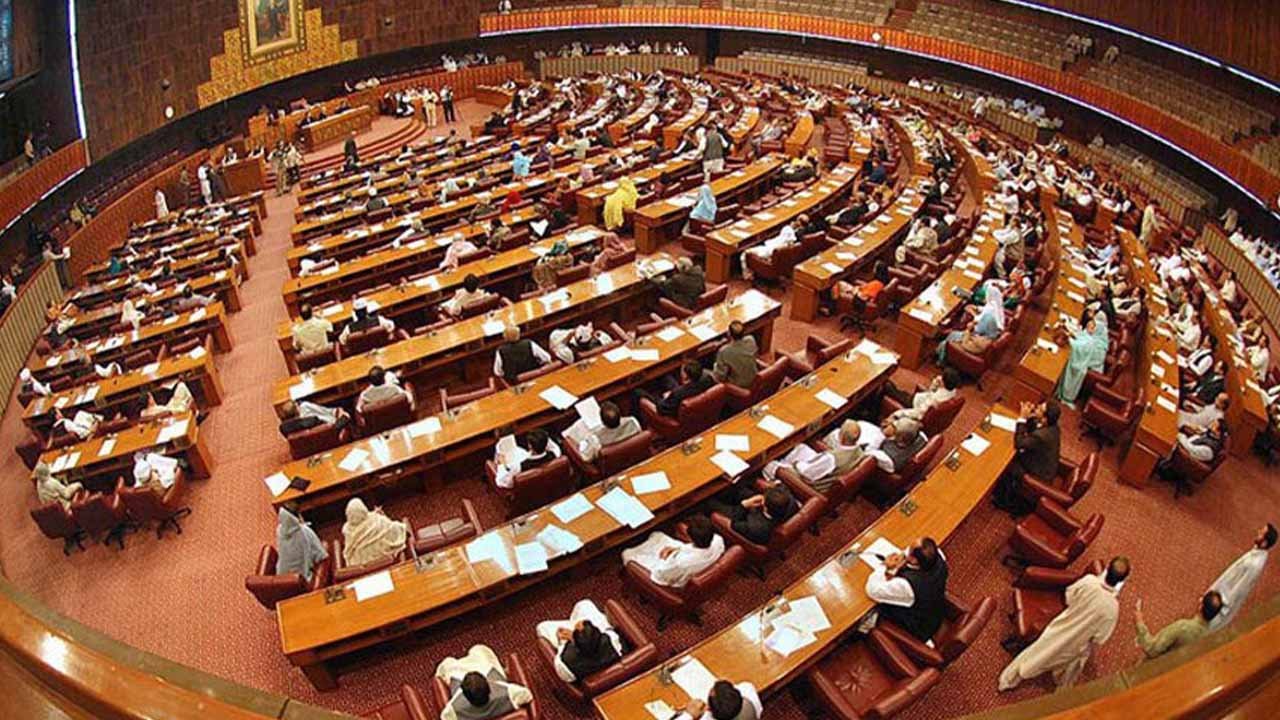
    On Wednesday, the National Assembly approved an amendment to the Finance Bill 2022 that will allow the government to increase the fuel levy to Rs50 per liter.

    During the National Assembly session held to discuss the amendments to Finance Bill 2022, Finance Minister Miftah Ismail made it clear that the amendment grants the government the authority to impose a tax of no more than Rs50 per liter. The levy will not be implemented instantly, he said.

    He went on to say that the levy had been temporarily kept at zero by the government. Throughout the upcoming fiscal year, the levy will be gradually implemented.

    According to The News, about 80 per cent of the amendments to the finance bill, according to State Minister for Finance and Revenue Ayesha Ghous Pasha, were tax-related.

    She emphasised that the government’s objective was to burden the wealthy while sparing the rest of us.

    The participants also agreed to impose a 5 per cent tax on the services of IT and software consultants in addition to the collection of sales tax through shopkeeper utility bills.

    Additionally, a change to revoke the salary class’s relief was approved. Individuals earning between zero and Rs600,000 annually would not be subject to income tax, per the initial budget proposals (where salary income exceeds 75 per cent of taxable income). The following slab would have had a nominal deduction of Rs100 per year (those earning between Rs600,000 and Rs1.2 million per year).

    With the new rates, those making between Rs0.6 and Rs1.2 million annually will now be required to pay 2.5 per cent in income tax.

    Furthermore, a 10 per cent super tax on 13 high-income sectors was approved by the National Assembly. The 10 per cent super tax on large industries was announced by Prime Minister Shehbaz Sharif on Friday in his “bid to relieve the general public of tax pressures.”

    “The revenue generated by this tax will be used to alleviate poverty in Pakistan, and it will be funded by high-income earners,” he said following a meeting with the government’s economic team.

    The tax will be levied on the cement, steel, sugar, oil and gas, fertiliser, LNG, textile, banking, automobile, beverages, chemicals, and tobacco industries. Later, Miftah Ismail, the finance minister, added airlines to the list, bringing the total to 13 sectors.

    Miftah went on to explain that the indirect tax (super tax) was intended to help the state accumulate funds under the heading of tax collection and reduce the budget deficit. He also stated that the fee was a one-time levy.

    The government’s proposed 1-4 per cent super tax on high-income individuals’ salaries was also approved by the National Assembly.

    The leadership levied a 1 per cent tax on those making up to Rs150 million annually, a 2 per cent tax on those making up to Rs200 million annually, a 3 per cent tax on those making up to Rs250 million annually, and a 4 per cent tax on those making up to Rs300 million annually.

    Additionally, a change was approved that imposes a tax on imported mobile phones that ranges from Rs100 to Rs16,000 depending on their value.

    Late Tuesday night, new amendments were added to the Finance Bill, 2022, including a potential reduction in the sales tax rate on the import of pharmaceutical raw materials from 17 per cent to 1 per cent, a tax exemption for theatres and production companies, and a change in the definition of “deemed rental income” by replacing the words “immovable properties” with “capital assets” and other changes.

    Under the revised Finance Bill 2022, the FBR also decreased the capital value tax (CVT) on vehicles from 2 per cent to 1 per cent.
  • Pakistani rupee fell by 34 per cent in FY 2021-22: Report

    Pakistani rupee fell by 34 per cent in FY 2021-22: Report

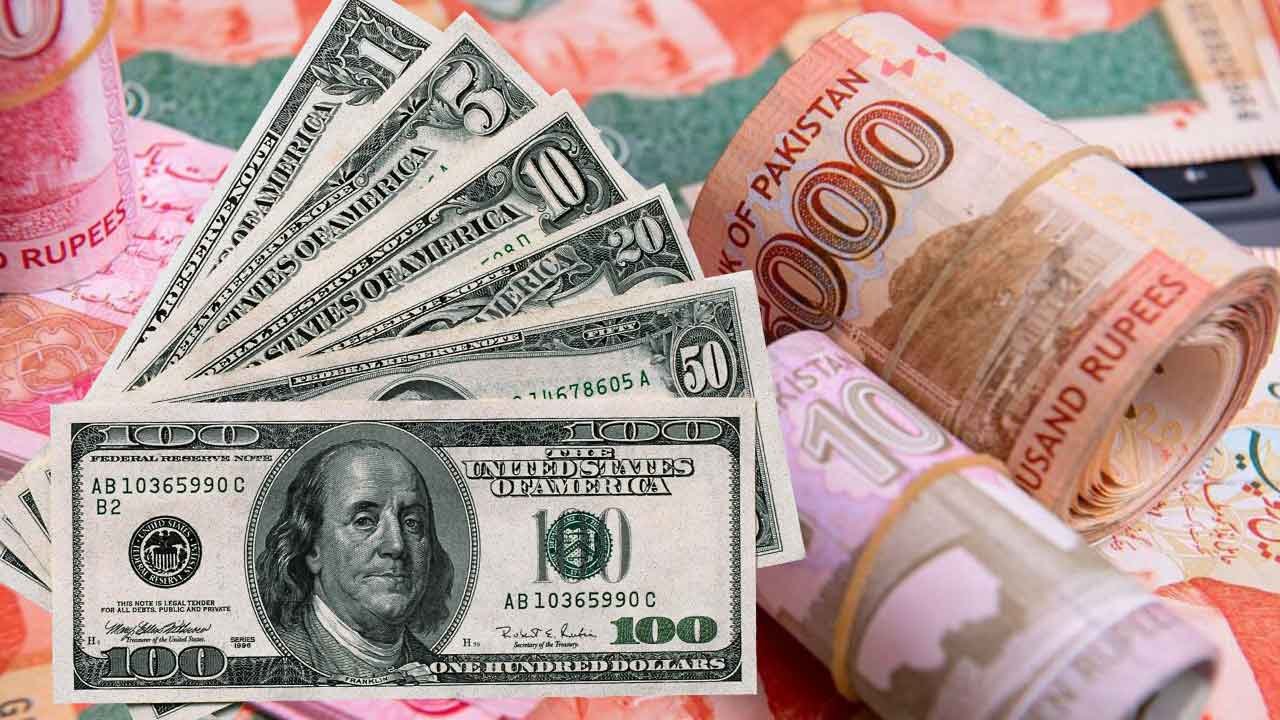
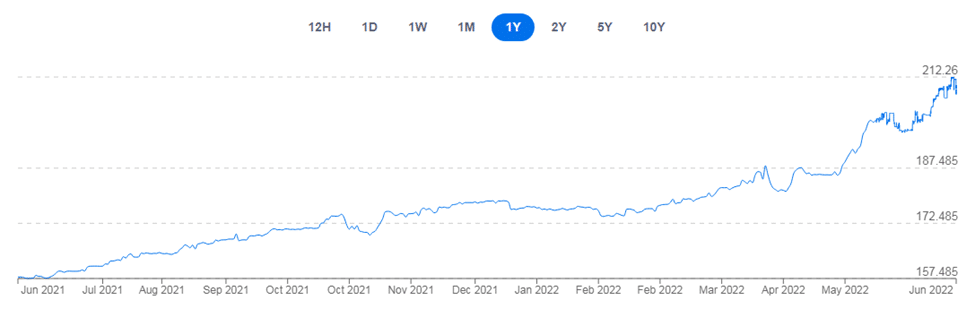
    Pakistan’s fiscal year starts on July 1st and ends on June 30th. The rupee to US dollar exchange rate was Rs158.06 at the beginning of fiscal year 2021-2022, and it reached an all-time high of Rs212.103 in the inter-bank market on June 21, 2022. This represents a depreciation of more than 34 per cent in less than a year.

    The graph below demonstrates how the PKR to USD exchange rate varied over time:

    During the fiscal year 2020-2021, the local currency plunged 17.47 per cent from Rs158.062 to Rs184.159 in 9 months, from July 1, 2022 to April 11, 2022, under the PTI regime. Since PDM took over, the rupee has lost nearly 14.31 per cent of its value in just three months.

    The table below compares PKR to dollar values over time, as well as the government in power at the time:

      PKR to Dollar Government
    July 2021 158.062 PTI
    August 2021 162.571 PTI
    September 2021 166.872 PTI
    October 2021 170.997 PTI
    November 2021 170.92 PTI
    December 2021 176.042 PTI
    January 2022 176.214 PTI
    February 2022 176.736 PTI
    March 2022 177.573 PTI
    April 2022 184.159 PTI and PDM
    May 2022 185.794 PDM
    June 2022 197.744 PDM
    June 23 2022 207.516 PDM

    Dollar demand remains strong in the market, pushing the greenback’s value higher against the rupee. The local currency is likely to remain volatile until the IMF agrees to disburse the next tranche of loans to Pakistan.

  • IMF rejects proposed tax relief for the salaried class

    IMF rejects proposed tax relief for the salaried class

    The International Monetary Fund (IMF) has rejected the government’s proposed tax cut in the Personal Income Tax (PIT) to the tune of Rs47 billion, leaving the government with no choice but to reconsider amendments in order to revive the remaining funds.

    According to The News, the Federal Board of Revenue (FBR) granted relaxation to salaried workers earning up to Rs1.2 million annually, top official sources claim that the IMF has expressed strong misgivings about the planned PIT rate.

    To assist the urban middle class, the International lender recommends that the assistance be limited to persons earning up to Rs0.2 million per month, and that tax rates in other slabs be raised afterward.

    Compensation in PTI’s tenure

    During the sixth review under the PTI-led government, the FBR offered compensation to those making up to one million rupees per month in salary in the budget for 2022-23 through Finance Bill 2022 in Parliament, which was set as a structural benchmark under the Fund agreement. If the proposed PIT rates are not adjusted, it could become a major roadblock to reaching an agreement with the IMF at the staff level.

    The international lender intended to improve tax collection by Rs125 billion by putting PIT in a progressive manner, but the government went the other way, making it impossible for both parties to get a staff-level agreement under the $6 billion Extended Fund Facility (EFF) with the current PIT proposal.

    Proposed tax for salaried class in Finance Bill 2022

    According to the Finance Bill 2022, those earning up to Rs1.2 million will pay only Rs100 in tax. Previously, those earning up to Rs800,000 per year had to pay Rs10,000, those earning up to Rs1.2 million Rs30,000, and those earning up to Rs2 million Rs120,000. According to the suggested rate, a salary employee earning Rs2 million per year will only have to pay Rs56,000.

    The tax burden for salary earners up to Rs3 million was formerly Rs282,000 per year, but now it is projected to be Rs159,000. Up to Rs4 million in salary, a salary earner had to pay Rs470,000 in income tax, but under the proposed rate, the tax payment is reduced to Rs304,000. The tax due for a salary earner earning up to Rs5 million was Rs670,000, but it was cut to Rs479,000 under the proposed rate.

    The Finance Bill 2022 recommends providing relief up to Rs one million in salary earner who had to pay Rs1.845 million in tax, but now the tax burden has been lowered to Rs1.554 million for salary income up to Rs one million per month under the proposed Finance Bill 2022. The planned tax rates were amended upward in the remaining slabs up to Rs20 million, Rs40 million, Rs60 million, and Rs80 million.

    Increased taxable limit

    The FBR increased the taxable ceiling limit from Rs600,000 to Rs1,200,000 in the Finance Bill 2022, and the number of slabs in the PIT regime was decreased from 12 to 7.

    Where the taxable income does not exceed Rs600,000, there would be no tax, according to new slabs imposed for the salaried class. A tax of Rs100 would be levied on taxable income exceeding Rs600,000 but not exceeding Rs1,200,000.

    There would be a 7 per cent tax on the amount beyond Rs1,200,000 if the taxable income exceeds Rs1,20,000 but not Rs2,400,000.

    If an individual’s taxable income is over Rs2,400,000 but not over Rs3,600,000, you would be charged Rs84,000 plus 12.5 per cent of the amount over Rs2,400,000 per year. The FBR will levy a tax of Rs234,000 plus 17.5 per cent of the amount over Rs3,600,000.

    If the taxable income is more than Rs6,000,000 but not more than Rs12,000,000, the FBR will deduct Rs654,000 plus 22.5 per cent of the amount over Rs6,000,000.

    When taxable income reaches Rs12,000,000, the FBR will assess a tax of Rs2,004,000 plus 32.5 per cent of the amount over Rs12,000,000 every year.

  • What to expect from the upcoming budget 2022-23

    What to expect from the upcoming budget 2022-23

    Pakistan is escalating efforts in order to revive the stalled loan from International Monetary Fund (IMF) programme, as the prerequisites are steadily being completed.

    The revival of the bailout will provide much-needed relief in order to keep Pakistan’s economy afloat and avoid default as Pakistani currency has plummeted 9 per cent in the last month, recording the poorest performance among Asian currencies.

    According to Geo, the key policy rate was recently raised by 150 basis points to 13.75 per cent, while the price of fuel has now risen by Rs60 a litre in less than a month and is being sold at from Rs209 to Rs212 (depending on the area).

    In an interview with a private channel, the finance minister discussed the government’s decision to raise petroleum product pricing, saying that despite the difficult decision, the government is still losing money on gasoline and diesel.

    These moves are highly affecting the masses, but they are essential as the IMF programme is crucial to fix the country’s economy. Also, petroleum prices are projected to continue to rise along with power tariff.

    Increase in income tax

    An increase in income tax is a major policy recommendation from the international lender in the approaching budget for the fiscal year 2022-23.

    All suggestions are expected to enhance Pakistan’s tax income.

    The IMF issued the following rules for Personal Income Tax (PIT) in its February conditions:

    1. Lower the number of tax bands.
    2. Cut tax credits and allowances (excluding disabled and old persons, as well as Zakat receipts).
    3. Implement special tax processes for very small taxpayers.
    4. Increase the number of people who pay taxes. As the change maintains the present PIT threshold, low-income households will be safeguarded (almost three times income per capita).

    If these policy recommendations for the forthcoming budget are enacted, the tax system will be simplified and the income tax regime will be more progressive.

    These recommendations are anticipated to increase the country’s tax revenue. It will also make the system more progressive, as people with higher incomes will be required to pay more.

    Salaried class

    The burden on the salaried class, which is already heavily under pressure, may be increased. It will make working less appealing because a large portion of the wage will be devoted to direct personal income tax.

    The IMF proposed taxing the upper-middle class and wealthy individuals with monthly incomes ranging from Rs104,000 to Rs1 million at a uniform rate of 30 per cent.

    The idea demonstrates inequality in taxation, and if approved, it might leave the majority of salaried workers worse off in the face of double-digit inflation.

    On the other hand, Federal Minister for Finance and Revenues Miftah Ismail categorically stated last month that the government would not add to the burden on the salaried class and pensioners in the coming budget. 

    According to sources, the maximum rate of 30 to 35 per cent for salaried and business class individuals earning Rs20 million per year could be increased.

    Special tax proposal for small taxpayers

    Imposing a tax on small taxpayers can overcome the long-term structural problems and correct internal and external imbalances. Our tax-to-GDP ratio has remained below 11 per cent, which is lower than regional standards.

    Two-thirds of our overall taxation is made up of indirect taxation. This level of indirect taxation is not only excessive, but it also makes the system less progressive.

    Currently, a labourer pays the same amount of GST as the country’s richest man.

    Agriculturalists and real estate barons are the most important import consumers. As a result, the lack of taxation in agricultural and real estate contributes to the underlying imbalances in the external sector.

    Low-income households

    Low-income households are expected to be protected from policy interventions after the government publishes the upcoming budget, as the Personal Income Tax (PIT) threshold of three times per capita income would stay in place.

    Genuine taxpayers can also decrease their tax payments by clever investments under the Income Tax Ordinance 2001, taking into account all of the foregoing.

    In the fiscal year 2022-23, policymakers must aim to increase the tax net and the tax-to-GDP ratio as there is no chance for the country to progress without it.

    Pakistan must pay $21 billion in foreign debt payments by next year, according to the Finance Minister, while the current account deficit is $10-12 billion.

    He said, “We will also try to tilt away from the wealthy elite towards to low incoming masses, I will impose more taxes on the wealthy, but no taxes will be levied on the salaried class”.

    The wealthy and capable must prepare to pay their fair share of taxes, or the country will soon be back on the IMF’s doorstep.