Tag: balance of payment

  • Pakistan to receive written guarantee from UAE for $1 billion loan

    Pakistan to receive written guarantee from UAE for $1 billion loan

    Pakistan is making progress towards securing a loan from the International Monetary Fund (IMF) with a $1 billion financing pledge from the United Arab Emirates (UAE) expected this week. Sources suggest that the UAE will provide written confirmation of the financing to the IMF through the Finance Secretary during the current annual meeting in Washington.

    To secure external financing for this fiscal year, the IMF has asked Pakistan to seek assurances from friendly countries and multilateral partners for funding its balance of payment gap. In addition to Saudi Arabia’s $2 billion pledge, the agreement with the IMF is also contingent on the UAE’s $1 billion commitment.

    According to sources within the Ministry of Finance, the UAE has finalised the agreement, and as soon as Pakistan receives a written guarantee from the Gulf state, the IMF will also be informed. This development follows requests from Pakistan’s Prime Minister and Finance Minister to UAE officials to complete the necessary prerequisites for the Fund.

    Pakistan is currently facing one of the most severe economic crises in its history, with consumer prices at a record high and interest rates raised to an all-time high. Due to a dollar shortage, the IMF has revised its growth forecast for Pakistan to 0.5% from the earlier estimate of 2%, causing supply chain disruptions and companies to halt production.

    The IMF is also assessing the coalition government’s proposed fuel discount for lower-income groups, which is planned to be financed by raising fuel prices for wealthier motorists. The finance minister has assured that the IMF has received all the required information.

    The finance minister had cancelled his scheduled in-person meetings with IMF officials in Washington but has repeatedly claimed that the staff-level agreement with the lender would be reached soon. Islamabad has been hosting an IMF mission since January to negotiate policy measures and secure $1.1 billion in funding for the cash-strapped economy, which is on the verge of collapse.

    The funds are part of a $6.5 billion bailout package approved by the IMF in 2019, which analysts argue is crucial for Pakistan to avoid defaulting on external payment obligations. The deal will also unlock other financing options to shore up Pakistan’s foreign exchange reserves, which have fallen to four weeks’ worth of import cover and help resolve the balance of payment crisis.
  • The recent ban on imports might barely make a dent

    The recent ban on imports might barely make a dent

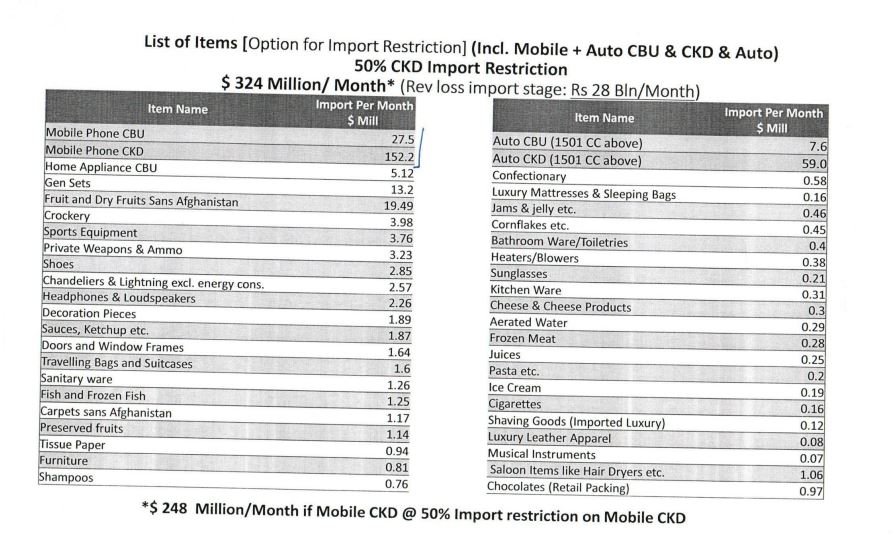
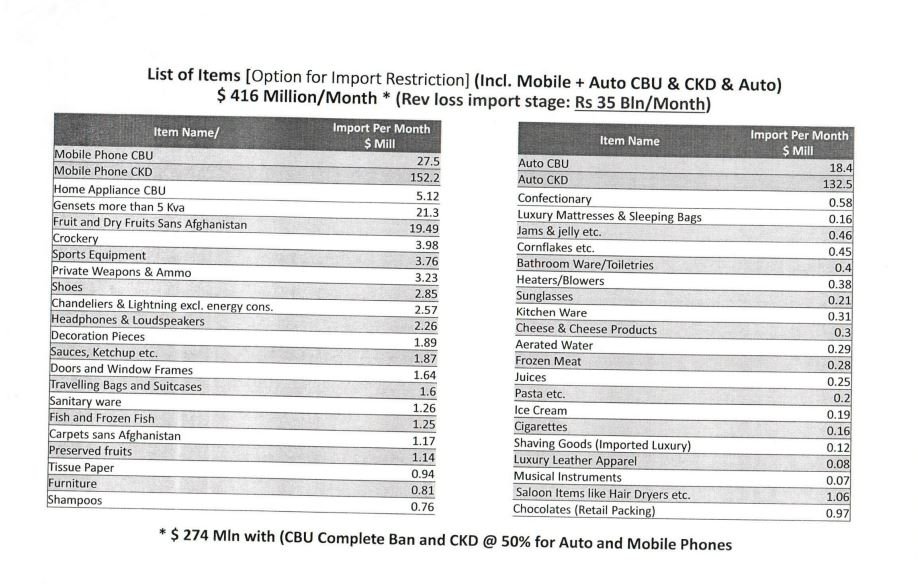
    On Thursday, May 19th, 2022, the federal cabinet issued a list of 41 items which will be banned from being imported for two months. This is in an attempt to address the current account deficit. The list of products is banned from being imported into the country, which means that essentially any shops or restaurants which rely on using these products will be forced to find local alternatives.

    These products will be banned regardless of what branding or packaging they use and only on the basis of whether the specific product is imported or not. Even products which are imported from abroad but packaged locally, will now be banned.

    Economists, university professors and business journalists took to Twitter to analyze and assess the merits and demerits of this decision. The discussion around luxury products and the fact that a lot of products which are labelled as “luxury items” are actually essential. Sanitary imports, valued at $16.4m are wrongly categorized as non-essential and although local alternatives also exist but it is definitions like these which disallow such decisions to be founded in research and expertise.

    The valuation of these imports which was published by the Pakistan Bureau of Statistics, was being quoted to ridicule the decision by many. What’s interesting to note is that most brands which appear to be entirely local, import a major chunk of their supply and will now be forced to smuggle goods instead.

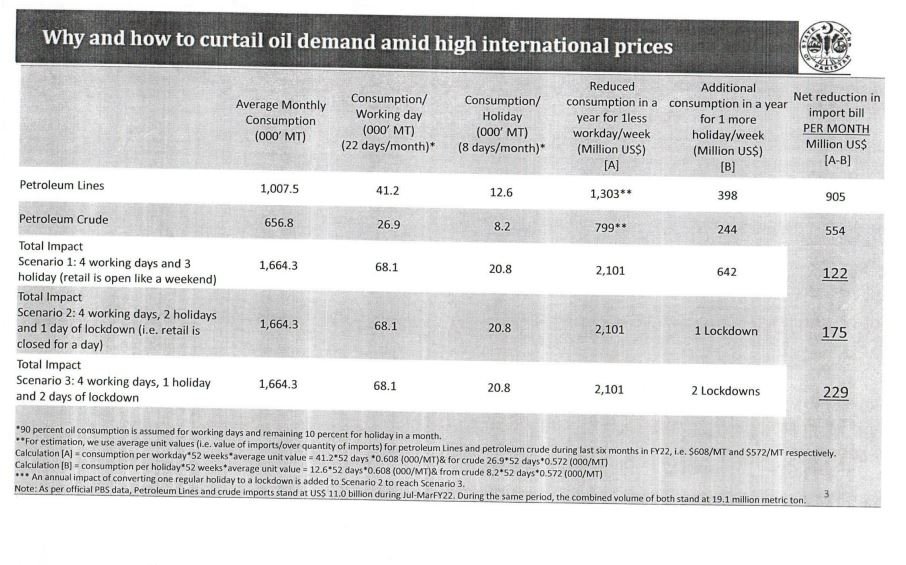
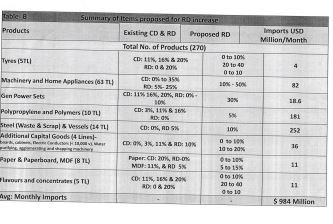
    Only from the data shared by PBS it becomes clear that for the fiscal year 2022, June to March, the total value of petroleum imports was $11 billion, while the total value of banning all these non-essential “luxury” items is a total $984 million, which forms only about 8.9% of the total value of petroleum imports.

    In conversation with Profit Magazine’s Ariba Shahid, she clarified that this would still prove to be a largely fruitless move since the most significant chunk of the import bill is still being used up to run the energy sector without any thought being given to the humongous fuel subsidies . “For a very long time the State Bank of Pakistan has been talking about how if we remove the oil component from it, the current account deficit is improving, which is true and basically means that people are not spending money to buy other items and most of the import bill is petrol and soy bean oil.”

    Economists Ammar Khan and Atif R Mian also took to Twitter to analyze this decision of “patchwork economics”. Commenting on this unsustainable gap in Pakistan’s balance of payment, on April 15th, 2022 during a discussion on Pakistan’s economy at Princeton University, he explains that for Pakistan to grow it is a necessary condition for Pakistan to deal with this problem and digs deeper into the structure of the economy. He particularly takes apart urban land reforms, the necessity to levy a capital gains tax on speculative real estate transactions and analyzes how Pakistan is not even economically stable enough to grow at the rate of India and Bangladesh and it is primarily due to the elite capture of the economy that disallows the economy to attempt to fix its loopholes.

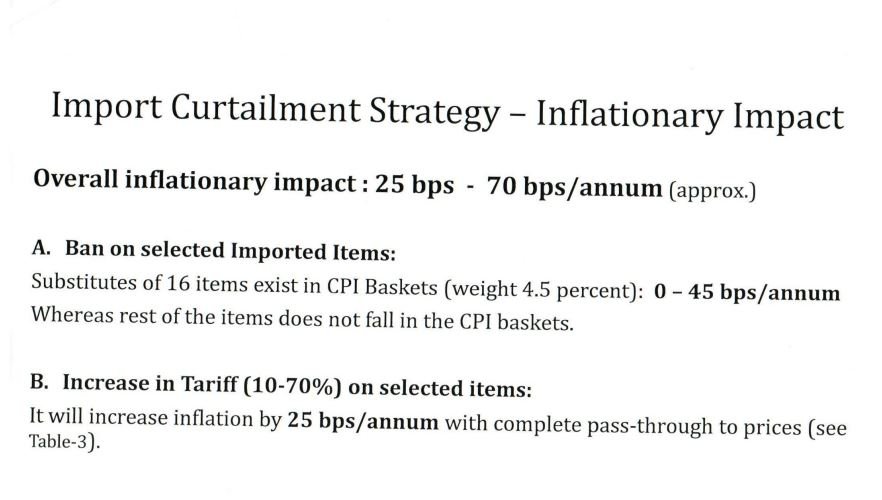
    Echoing similar sentiments, Ariba Shahid explained that due to a weaker economy, the import bill is not as significantly high due to a reduced demand pull because of a lowered purchasign power and hence banning these products will be insignificant and might barely make a dent in the current account deficit. “The need of the hour is to reverse the fuel subsidy,” says Shahid, “This decision will swell up the grey market economy and smuggling will increase.”