Tag: Balochistan

  • Nine, including four children and police official, injured in Quetta blast

    Nine, including four children and police official, injured in Quetta blast

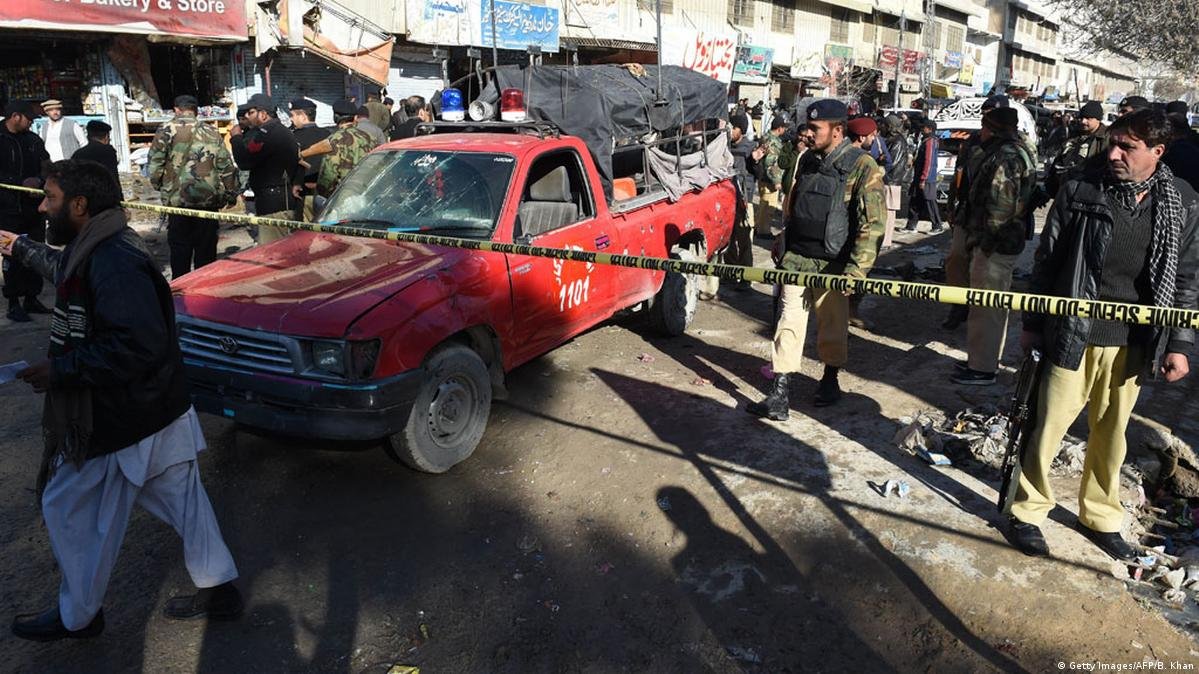
    A locally made explosive device went off near the Civil Secretariat and Commissioner Office on Quetta’s Zarghoon Road, injuring nine people, including a traffic policeman and four children.

    Senior Superintendent of Operations has said that the explosion happened in a garbage heap under the bridge on Zarghoon Road, adding that an investigation into the blast has been initiated.

    The SSP also confirmed that the injured children were ragpickers.

    Commissioner Quetta Division Muhammed Hamza Shafqaat, took to X (formerly Twitter) to urge citizens to avoid the Zarghoon Road for the next few hours.

    Terrorist attacks in Pakistan have ratched up in 2023, particularly on security and military personnel, ever since the end of a tentative truce deal with the proscribed Tehreek-e-Taliban Pakistan ended in November of 2022.

  • Missing persons commission taking salaries in lacs, haven’t solved 2,297 cases from 2011-2023: missing persons report

    Missing persons commission taking salaries in lacs, haven’t solved 2,297 cases from 2011-2023: missing persons report

    A report submitted on orders of the Supreme Court by the Missing Persons Commission has said that most of the cases of missing persons have been reported by Khyber Pakhtunkhwa followed by Balochistan.

    A total of 2297 cases of missing persons are pending while members of the commission as well as the heads are all being paid hefty salaries. The report was presented in front of the two-member commission for missing persons constituted by the Interior Ministry on the Supreme Court’s directions. It is headed by Justice (R) Javed Iqbal while the second member is the former inspector general of Khyber Pakhtunkhwa, Muhammad Sharif Virk.

    According to the information extracted by Samaa’s Sohail Rashid via Auditor General Pakistan, the highest number of 3,485 cases of missing persons were reported from Khyber Pakhtunkhwa, followed by the enforced disappearance of 2,752 citizens from Balochistan.

    The report states that the reason behind the said disappearances in KP was extremism, war, and deaths in drone attacks. Moreover, moving to another country without informing one’s family owing to a war-like situation was also a reason behind the said disappearances, as per the commission.

    Furthermore, 744 production orders were issued to produce the missing persons, while only 52 were executed. The 692 production orders issued by the commission were not even implemented by the relevant authorities, the commission reported.

    The police and sensitive institutions filed 182 requests for revision of the production orders, the report says, adding that out of the unimplemented production orders, 503 were from Khyber Pakhtunkhwa.

    From March 2011 to December 2023, 4,413 missing persons returned home, while 994 were incarcerated in various detention centres and 644 imprisoned in different jails of the country.

    From March 2011 to December 2023, bodies of 261 missing persons were found, according to the commission, which also dismissed 1,477 cases it categorized as non-enforced disappearances.

    The commission further says that the disposed of cases involved kidnapping for ransom, personal grudges or willful disappearances.

    Moreover, 260 cases from Punjab, 163 from Sindh, and 1,336 from KP are still pending in the commission as well as 468 cases from Balochistan, 55 from Islamabad and 15 from Azad Jammu and Kashmir.

    According to the report, the monthly salaries of the 35 officers and employees of the Missing Persons Commission are more than Rs1.5 million. Commission chief, Justice (r) Javed Iqbal receives a monthly salary of Rs674,000, while that of Zia Parvez, a member of the commission, is Rs829,000, as per the report.

    Commission member Justice (r) Amanullah’s salary is over Rs1.1 million, while that of Sharif Virk is Rs263,000.
    The Supreme Court has sought a response from the federal government within 20 days of receiving the report of the missing persons commission.

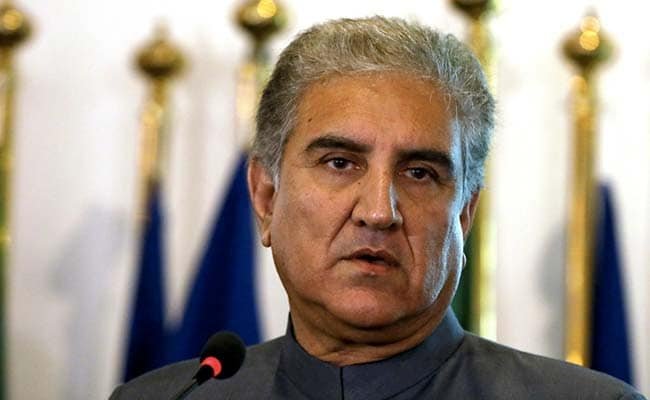
  • Shah Mahmood Qureshi’s nomination papers approved from Sindh’s Umarkot  

    Shah Mahmood Qureshi’s nomination papers approved from Sindh’s Umarkot  

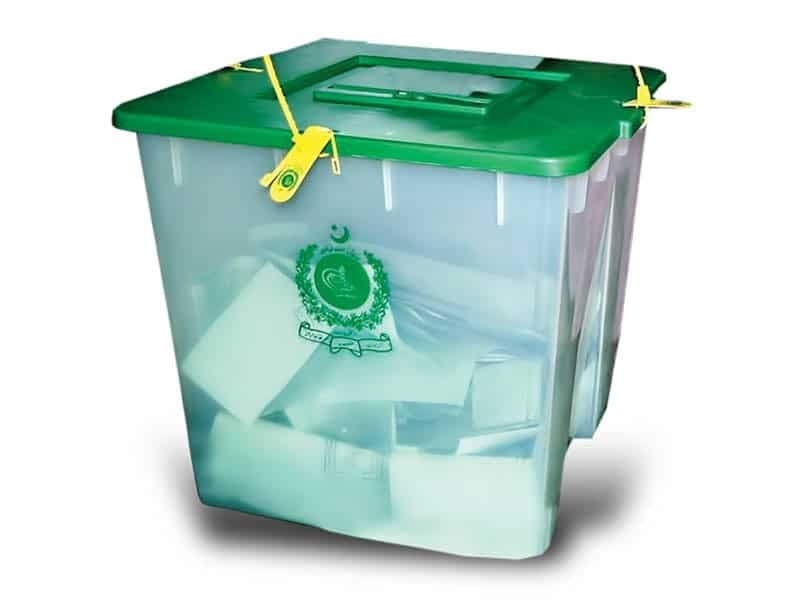
    The nomination papers of Pakistan Tehreek-e-Insaf (PTI) vice president Shah Mahmood Qureshi were approved on Friday, enabling him to contest general elections on February 8.

    An election tribunal approved the nomination papers of the PTI senior leader for the NA-214 constituency in Sindh’s Umarkot city. Shah Mahmood Qureshi’s son Zain Qureshi’s nomination papers were also approved from the same constituency.

    Numerous prominent political figures, such as Awami Muslim League (AML) chief Sheikh Rashid Ahmed, Balochistan National Party (BNP) head Akhtar Mengal, and Firdous Shamim Naqvi, have successfully obtained relief from election tribunals, as their nomination papers have been approved for the upcoming general elections scheduled for February 8, 2024.

    Various election tribunals have given their approval to the nomination papers of Sheikh Rashid, Akhtar Mengal, and PML-Zia chief Ijazul Haq and allowed them to take part in the forthcoming general election, set to take place on February 8, 2024.

    Sheikh Rashid’s nomination papers were approved from NA-56 and NA-57 constituencies while Mengal’s nomination papers were accepted from NA-264 Quetta.

    A tribunal consisting of Justice Hashim Khan Kakar and Justice Amir Nawaz Rana has overturned the returning officer’s decision to reject Mengal’s nomination papers due to the possession of a Dubai work permit (Aqama). The leader of BNP contested the rejection of his nomination papers with the representation of his counsel, Advocate Sajid Tareen.

    On the other hand, a tribunal approved the nomination papers of PML-Zia’s chief, Ijazul Haq, and allowed him to contest the election from NA-55.

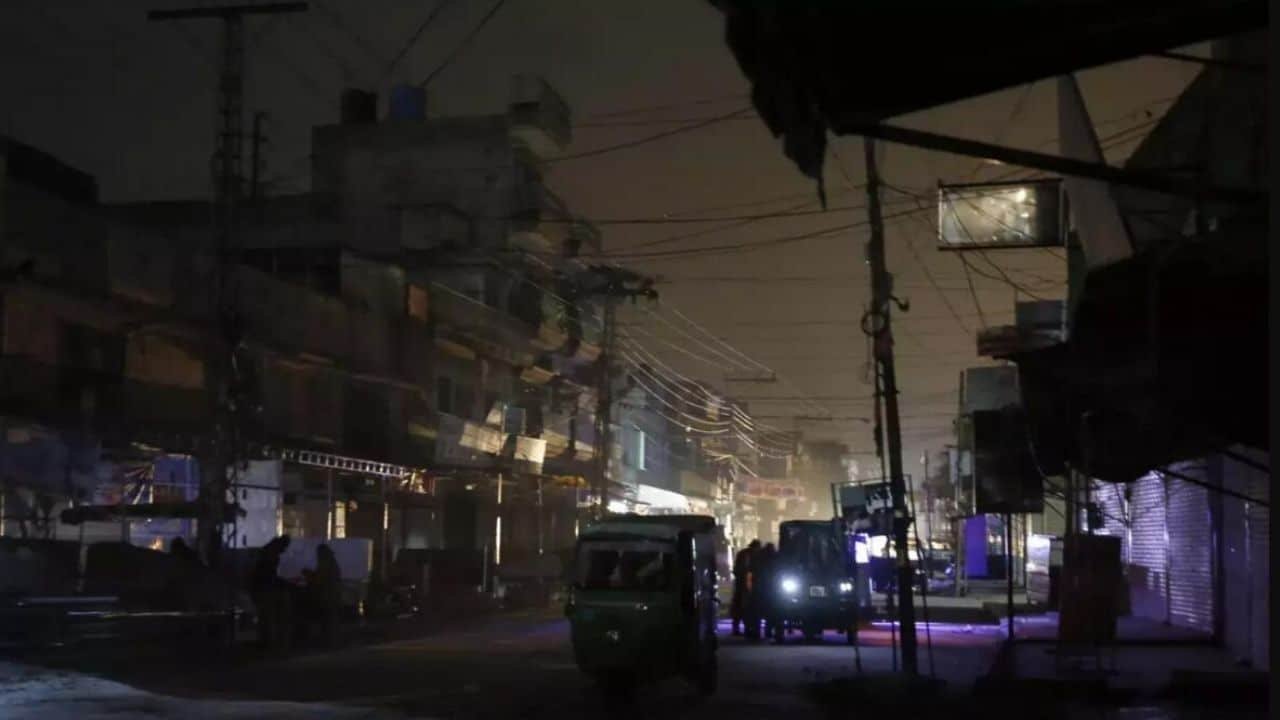
  • Why has load-shedding suddenly increased in Pakistan?

    Why has load-shedding suddenly increased in Pakistan?

    The electricity crisis has become more severe across the country with the start of the new year.

    Transmission systems were reportedly affected due to a technical fault at Guddu power plant and reduction in hydro power generation. Unannounced power outages in all power distribution companies (DISCOs), including LESCO, has made life difficult for people.

    The transmission system was affected by reduced power generation and heavy fog in the plains.

    Unannounced load shedding continues every hour in various areas of the LESCO region. Due to an increase in shortfall, the duration of load shedding in the city exceeded 12 hours.

    According to an INP from Kushmore, the breaker could not be repaired despite the passage of several hours after fire broke out in the switchyard of Guddu Thermal Power Plant following a technical fault. Sources claim that it may take 15 days to buy a new breaker.

    On the other hand, Powerhouse officials have said the alternate high transmission line also tripped due to heavy fog.

    Electricity supply to different areas of Sindh, Punjab and Balochistan remained suspended for more than five hours due to tripping of the alternative high transmission line. According to Guddu Thermal Power House officials, it is difficult to restore power from the alternate high transmission line until the sun comes out.

    Lack of electric supply for more than six hours has put a halt on businesses as well as shopkeepers, factory workers.

  • No surveys; PEMRA to take action against media channels violating ECP’s Code of Conduct

    No surveys; PEMRA to take action against media channels violating ECP’s Code of Conduct

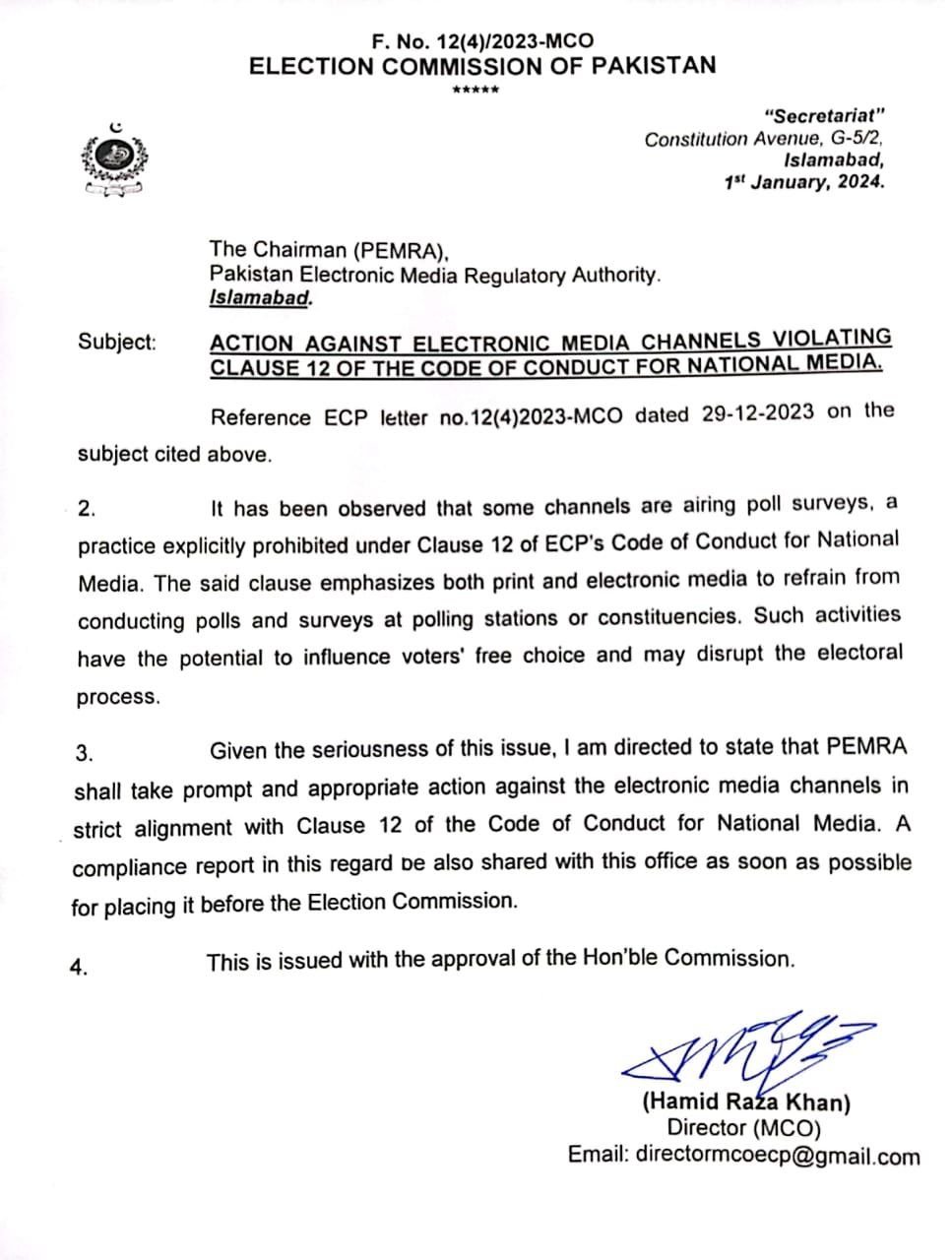
    The Election Commission of Pakistan (ECP) has officially communicated with the Pakistan Electronic Media Regulatory Authority (PEMRA), seeking strict action against media channels found violating the established code of conduct for the upcoming February 8 polls.

    The letter explicitly points out the airing of voting surveys by certain media channels. This practice, as per the ECP’s Code of Conduct for National Media, is prohibited under Clause 12.

    According to Clause 12, individuals working in print, electronic, and social media are prohibited from obstructing the election process and are required to display accreditation cards provided by the Election Commission.

    The ECP emphasized that both print and social media should refrain from conducting polls and surveys at polling stations or constituencies. The electoral watchdog stated that such activities have the potential to influence voters’ free choice and may disrupt the electoral process.

    The letter stated, “Given the seriousness of this issue, I am directed to state that PEMRA shall take prompt and appropriate action against the electronic media channels in strict alignment with Clause 12 of the Code of Conduct for National Media. A compliance report in this regard be also shared with this office as soon as possible for placing it before the Election Commission.”

    The ECP’s comprehensive 18-point code of conduct for media during elections includes provisions preventing the dissemination of content that reflects opinions prejudicial to the sovereignty, uprightness, or security of Pakistan. It also prohibits statements that could harm national solidarity or create a law and order situation.

    The regulatory framework extends to personal attacks on candidates or political parties in media content, mandating that any allegations should include comments from both sides. Monitoring responsibilities are delegated to Pemra, Pakistan Telecommunication Authority, Press Information Department, and the Cyber Wing and Digital Media Wing of the Ministry of Information and Broadcasting.

    The ECP further emphasized that these authorities are accountable for monitoring political parties’ and candidates’ coverage during election campaigns through electronic channels, print, and social media. Details of payments made by political parties and candidates must be submitted within 10 days after the poll day.

    The Election Commission of Pakistan warns that, in case of any violation of this Code of Conduct, it reserves the right to withdraw accreditation from individual journalists or media organizations. The authority to determine violations also rests with the electoral body. The media is also prohibited from airing unofficial results of a polling station until one hour after the close of the poll during the polling process coverage.

  • CDWP approves Rs7 billion for advancing Pakistan’s IT sector

    CDWP approves Rs7 billion for advancing Pakistan’s IT sector

    During the Central Development Working Party (CDWP) meeting, chaired by Deputy Chairman Planning Commission Mohammad Jehanzeb Khan, five development projects were given approval, totalling Rs13 billion, according to a press release.

    The meeting focused on projects within the information technology, health, and physical planning and housing sectors.

    Under the Ministry of Information, two projects were presented. The first, “Upgradation of Transmission Network & Replacement of Optical Fibre Cable, AJK & Gilgit Baltistan (revised),” with a budget of Rs2 billion, received approval from the CDWP.

    The second project, “Prime Minister’s Initiatives Support for IT Startups, Specialised IT Trainings, and Venture Capital (revised),” with a budget of Rs5 billion, was also granted approval.

    Furthermore, two projects from the Ministry of Law and Justice were considered and approved. The first involves the “Construction of Litigants Facilitation Centre for Litigants and Lawyers in Sector G-10/1, Islamabad,” with a budget of Rs1.86 billion. The executing agency and financing source for this project is the Capital Development Authority (CDA).

    The second project presented was the “Establishment of 93-No District Courts in Mauve Area G-11/4, Islamabad (revised),” with a budget of Rs2.23 billion.

    A project focused on skill development internships, the “Ba-ikhtiyar Naujawan Internship Program Balochistan,” worth Rs1.85 billion, was also approved by the CDWP. Notably, this project is fully funded through a World Bank loan.

  • ‘Baloch protestors can stay in Islamabad, protest, or go back home. The choice is theirs’: IHC Chief Justice

    ‘Baloch protestors can stay in Islamabad, protest, or go back home. The choice is theirs’: IHC Chief Justice

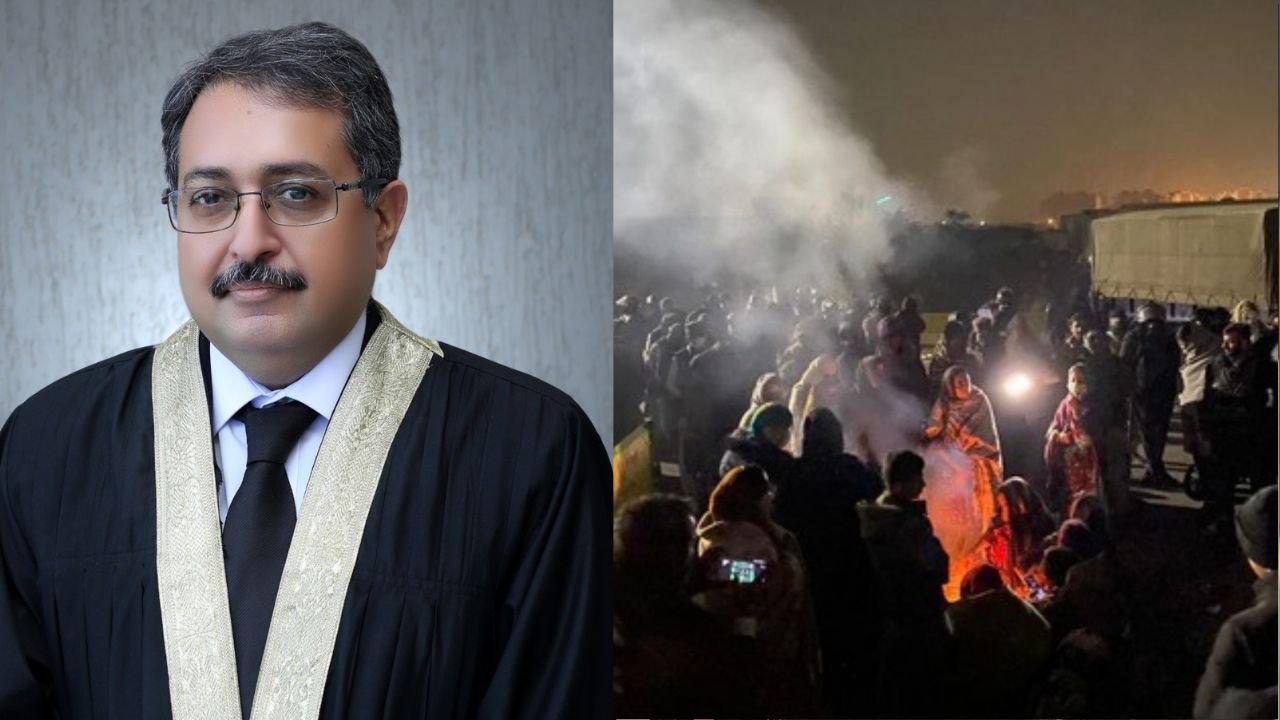
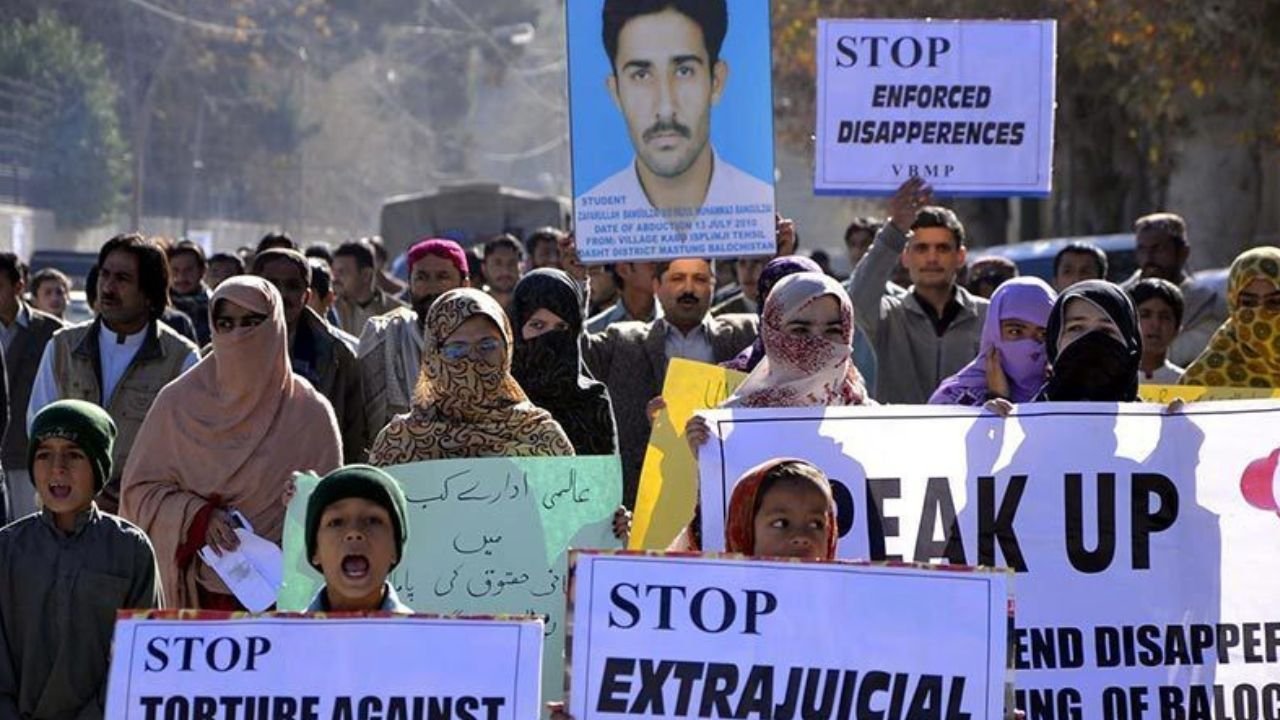
    The Islamabad High Court (IHC) raised concerns on Friday about the forced repatriation of Baloch protesters, who had experienced harsh police action the day before, back to their province.

    Chief Justice Aamer Farooq heard a petition filed by Baloch protesters against unlawful detention, questioning why they were being “forcefully” sent back to Balochistan.

    “They can stay in Islamabad, protest, or go back home. The choice is theirs,” remarked Justice Aamer Farooq

    The police used brutal force on Wednesday night to disperse and detain Baloch demonstrators in Islamabad, who were protesting against enforced disappearances and extra-judicial killings in their province.

    Over 200 protesters were taken into custody after encountering tear gas, water cannons, and police batons.

    The government later claimed that more than 90 per cent of the Baloch men and women in custody had been released, except for men “who could not be identified” by the police.

    However, during the IHC hearing on a petition seeking the release of detained Baloch protesters, it was revealed that over 50 Baloch women protesters had gone missing after police took action.

    The court instructed representatives of the protesters and their counsel to approach the Islamabad SSP (Investigation) to record their version and sought a report from the police.

    Petitioners’ counsel Attaullah Kundi and Imaan Mazari appeared before the court, explaining that the police had informed them that buses were waiting to take protesters back home.

    Kundi stated that the police chief had mentioned orders from the prime minister for the repatriation of protesters, and Baloch women were forcefully filled into buses. He further revealed that some Baloch students studying in Islamabad were also coerced into the buses.

    The court expressed displeasure and summoned IG Akbar Nasir in response. The police chief claimed to have arranged transport for the protesters, to which the court questioned why they were sent back forcefully. Chief Justice Farooq emphasized that the protesters had the choice to stay in Islamabad, protest, or go home.

    When asked how many protesters were in police custody, the IG replied that 216 Baloch men and women were at the Kohsar police station of which some had been sent on judicial remand. Out of these, 19 women were released, he added.

    Protesters at the Tarnol police station were released by the local magistrate while 162 detainees were sent on judicial remand, said IG Nasir.

    The court also asked about the number of women who were sent home, those released, and the ones staying at the hostel. It also directed the police chief to arrange a meeting of the women with their counsels.

    “You have to convince them that not one person is missing,” Justice Farooq emphasised.

    Journalist Hamid Mir and Ahmed Butt of the Human Rights Commission of Pakistan also provided insights during the hearing. Mir highlighted discrepancies in government statements, and Butt emphasized the constitutional right to protest in a democracy.

    The court directed the police chief to arrange a meeting between the detained women and their counsels and ensure transparency in the process.

    The IHC CJ further expressed displeasure over Wednesday night’s events, regretting the police action on protesters. “What kind of a society are we living in? Even if a common person is being unjust, public officeholders should always be careful,” he remarked.

    The court then instructed Kundi to oversee the entire matter and contact the IHC registrar’s office if there was a problem. It further said that all the women staying at the I-10 hostel be released.

    “I will issue a detailed order of today’s proceedings,” Justice Farooq said, adding that the next hearing would be conducted by Justice Miangul Hasan Aurangzeb.
  • Temperatures to fall further across Pakistan

    Temperatures to fall further across Pakistan

    Pakistan Meteorological Department (PMD) has predicted cold and dry weather for most parts of the country.

    Sindh is to experience a wave of cold especially in Karachi. Weather analyst Jawad Memon has said, “Mercury may drop to single digit in the suburban areas of Karachi.”

    A shallow westerly wave was affecting western Balochistan which is likely to have moved northeast. It will affect the upper parts, causing cold waves in Sindh as soon as the system moves out in the next 24 hours.

    The Met Department said that mainly cold and dry weather is expected in most plain areas of the country, while very cold and partly cloudy weather is expected in the upper parts during the next week.

    Fog is likely in upper Sindh, plain areas of Punjab and Khyber Pakhtunkhwa during morning and night, it added.

  • Sarfraz Bugti kis party kay ticket par election larrain gay?

    Sarfraz Bugti kis party kay ticket par election larrain gay?

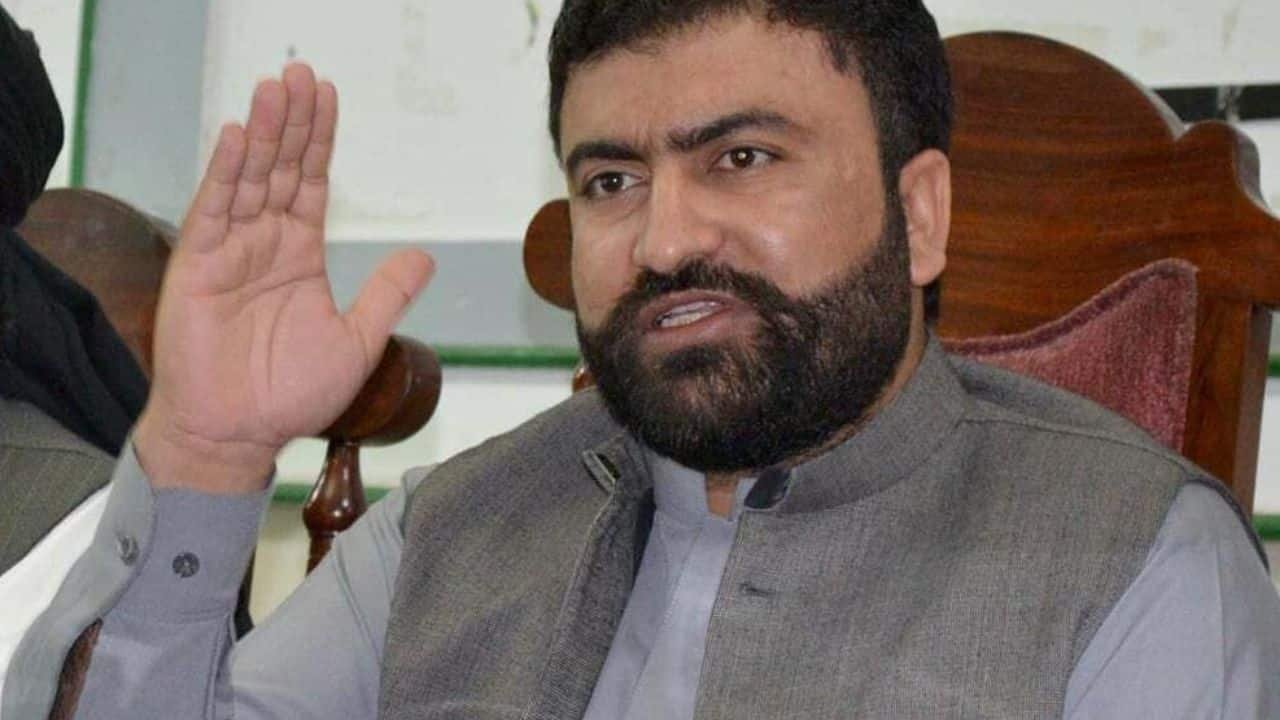
    Sarfraz Bugti, former interim interior minister, sent his resignation to caretaker Prime Minister Anwaar-ul-Haq Kakar on December 13, which was accepted Friday night.

    He cited personal reasons for stepping down from his position.

    Interior Ministry spokesperson Qadir Yar Tawana confirmed the report on Friday when contacted for the version of the ministry by Geo News.

    Close aides of Bugti said he had decided to resign from the office about two months ago to take part in the upcoming general elections. His resignation was accepted hours before the Election Commission of Pakistan (ECP) announced the schedule of the general elections in 2024.

    As per sources of Geo News, Sarfaraz Bugti resigned to contest the election on a Pakistan Muslim League-N (PML-N)’s ticket.
    They said he was expected to call on the PML-N leadership in a few days.

    He is currently associated with the Balochistan Awami Party (BAP).

    Bugti had been elected as a senator from Balochistan in 2021.

    The 42-year-old had previously served as interior minister for Balochistan after winning a seat in 2013 as an independent candidate, but later joined the Pakistan Muslim League-Nawaz (PML-N).

    In a related development, Balochistan caretaker Minister for Sports and Culture, Nawabzada Jamal Raisani and Adviser to the Chief Minister on Mines and Minerals, Mir Umair Muhammad Hasni, also resigned from the interim provincial cabinet on Friday.

  • ECP to announce election schedule on December 17

    ECP to announce election schedule on December 17

    The Election Commission of Pakistan (ECP) will announce election schedule on December 17, allowing candidates to submit their nomination papers the next day, The News has reported on Thursday.

    ECP will take 54 days to complete the process of conducting polls in the country on February 8, next year.

    Article 220 of the constitution says that once the election schedule is announced, the caretaker government is bound to support the ECP to conduct free and fair elections in the country.

    On the other hand, ECP has halted the training of district returning officers (DROs) and returning officers (ROs) designated for the forthcoming general elections set to take place on February 8 next year.

    The ECP spokesperson issued a notification saying that the Lahore High Court (LHC) had ordered the training of DROs and ROs to stop.

    Election commissioners of Punjab, Sindh, Khyber Pakhtunkhwa, and Balochistan have been notified. The training of DROs and ROs is currently in progress in Karachi, Lahore, Peshawar, and Quetta.

    Previously, the high court declined the order of the ECP appointing ROs from the bureaucracy for the upcoming general election on February 8, 2024.