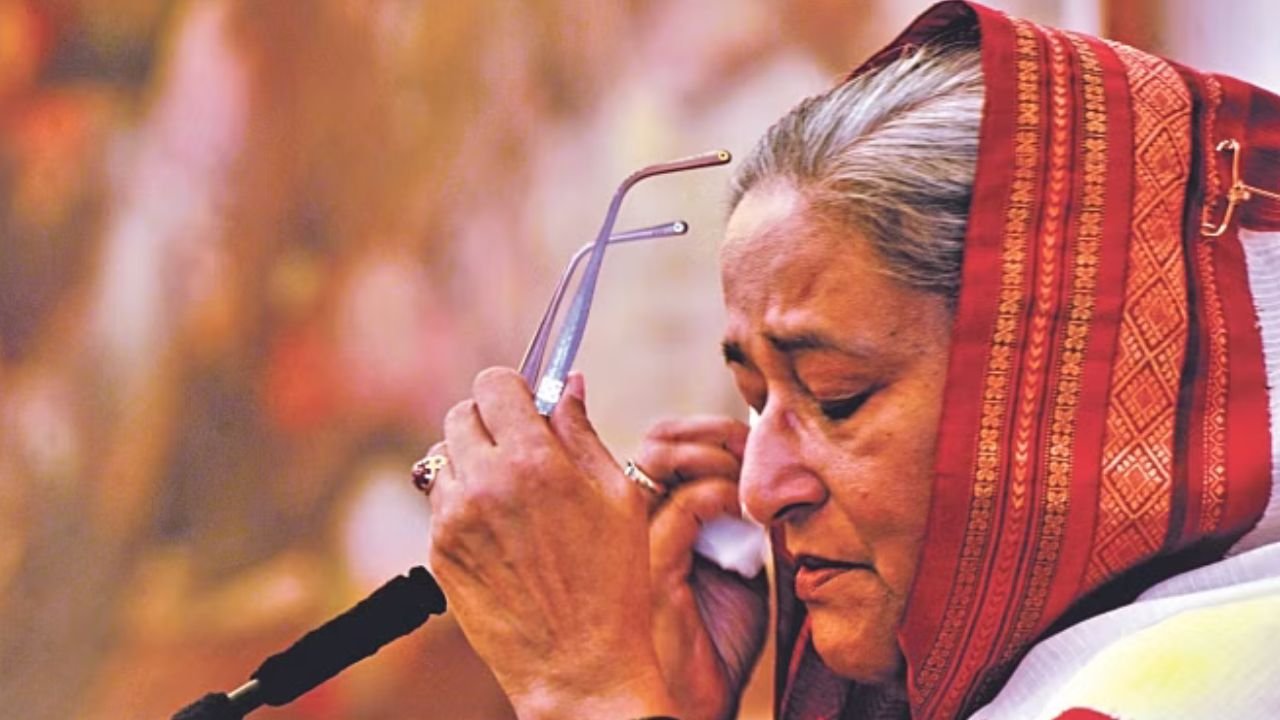
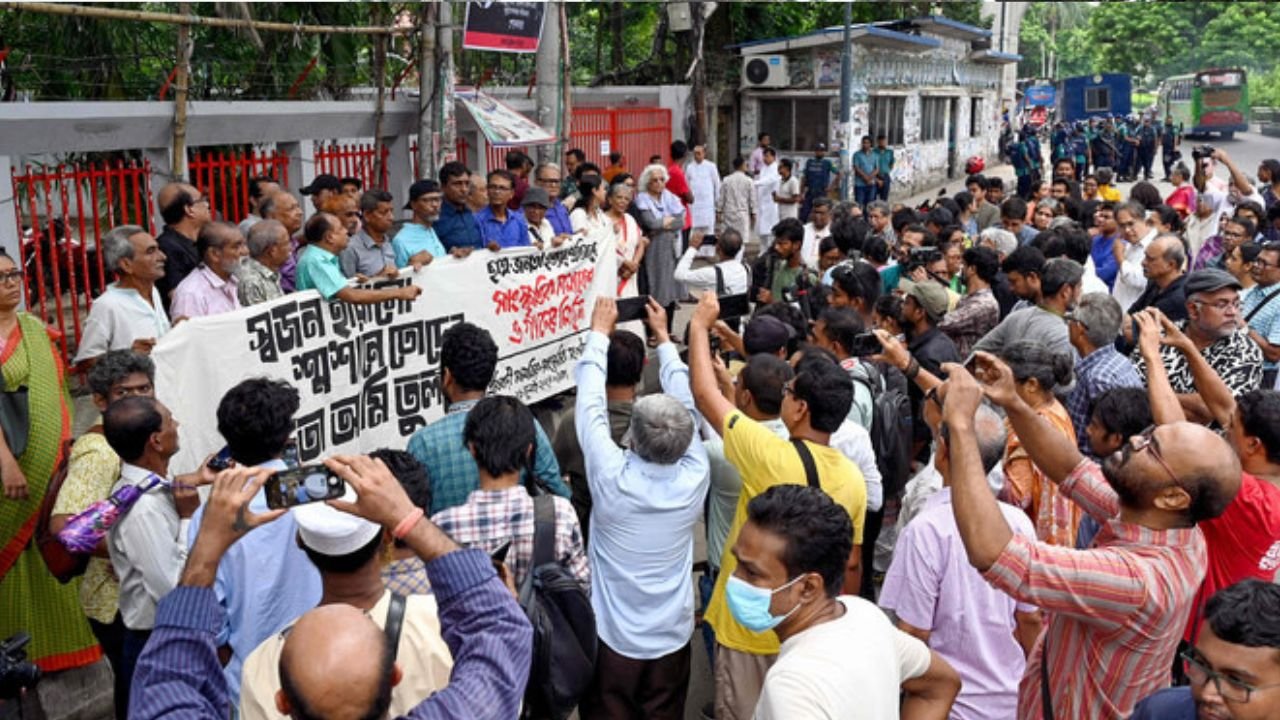
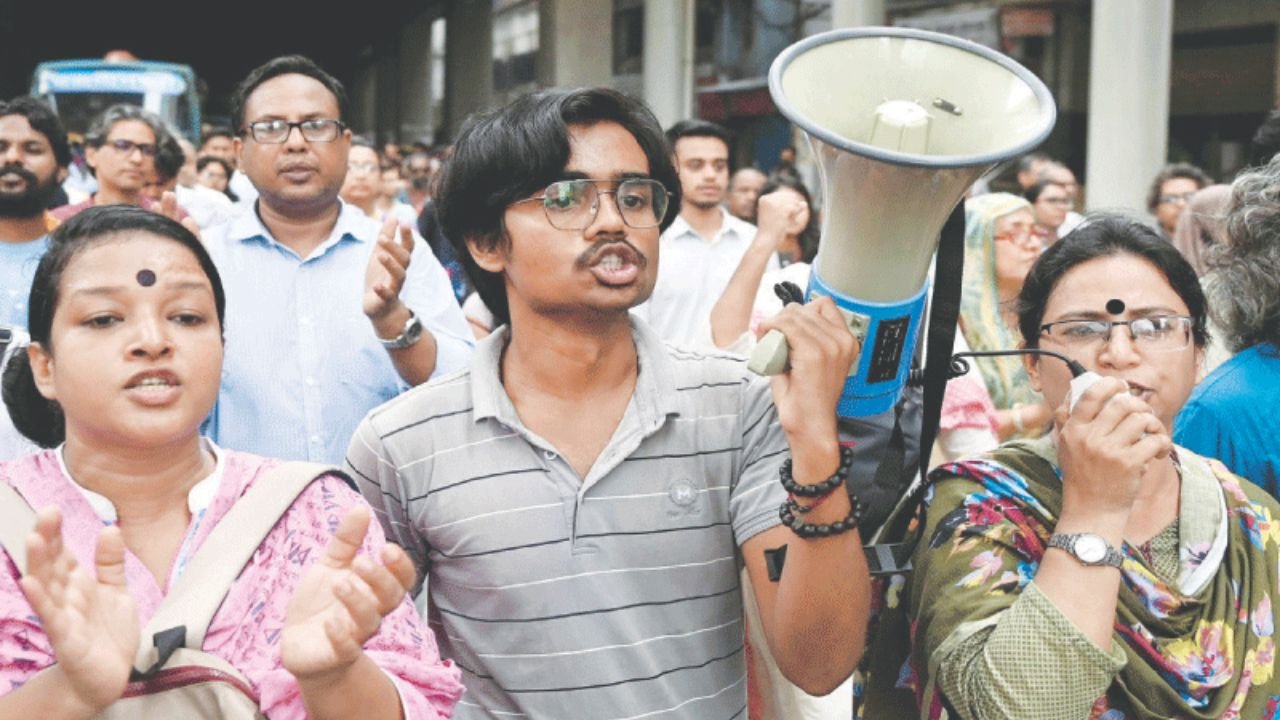
Bangladesh’s war crimes tribunal is to seek the extradition of ousted leader Sheikh Hasina from neighbouring India, its chief prosecutor has said, accusing her of carrying out “massacres”.
Weeks of student-led demonstrations in Bangladesh escalated into mass protests last month, with Hasina quitting as prime minister and fleeing by helicopter to old ally India on August 5, ending her iron-fisted 15-year rule.
“As the main perpetrator has fled the country, we will start the legal procedure to bring her back,” Mohammad Tajul Islam, chief prosecutor of Bangladesh’s International Crimes Tribunal (ICT), told reporters on Sunday.
The ICT was set up by Hasina in 2010 to probe atrocities during the 1971 independence war from Pakistan.
Hasina’s government was accused of widespread human rights abuses, including the mass detention and extrajudicial killing of her political opponents.
“Bangladesh has a criminal extradition treaty with India which was signed in 2013, while Sheikh Hasina’s government was in power,” Islam added.
“As she has been made the main accused of the massacres in Bangladesh, we will try to legally bring her back to Bangladesh to face trial”.
Hasina, 76, has not been seen in public since fleeing Bangladesh.
Her presence in India has infuriated Bangladesh. Dhaka has revoked her diplomatic passport, and the countries have a bilateral extradition treaty which would permit her to return to face criminal trial.
The iconic Jal the Band is making a comeback in Bangladesh after a 14 year absence. The band’s lead singer and composer Goher Mumtaz shared a screenshot of the band’s upcoming concerts in Bangladesh on his Instagram account.
Jal is scheduled to perform on September 27 in Dhaka at the ‘Legends of the Decade’ concert.
Fans in Bangladesh have eagerly awaited Jal’s return, and their patience is finally being rewarded. Tickets for the event, priced at Tk3050, or Pakistani rupees Rs7123. The band is expected to perform all its hits including ‘Lamhe,’ ‘Aadat,’ ‘Panchi,’ and ‘Bikhra Hoon Main’. Goher Mumtaz and Atif Aslam formed the band in 2002.
It was previously speculated that the founding members of the band, which included Farhan Saeed, a former singer and actor, would also perform at Bangladesh. The Jhok Sarkar actor posted a story on his Instagram account saying,
“To all Bangladesh fans, I keep getting requests asked if I am coming to Bangladesh in September for concert. The answer is no I am not, my picture is used blatantly though. I am not! When I will be touring Bangladesh I’ll announce it on my social media platforms. All fans are requested to spread the same.”
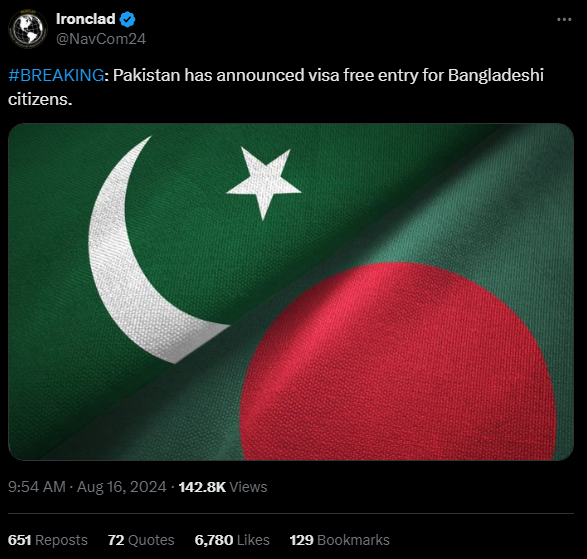
Geo Fact Check has debunked social media posts that claimed that Bangladeshi citizens have been granted visa-free entry to Pakistan after Sheikh Hasina’s government was toppled.
Geo reported that officials from the Interior Ministry and the Ministry of Information and Broadcasting confirmed that Bangladeshi citizens could not enter Pakistan visa-free.
The Interior Ministry’s Director General of Media, Qadir Yar Tiwana, clarified that Minister of Information and Broadcasting Attaullah Tarar has announced a new visa policy for many countries.
The revised policy states that only citizens of Gulf countries will be granted visa-free entry and will require only a passport to arrive at Pakistan.
Tiwana said, “Bangladeshi citizens will now need to apply for a visa on arrival and will receive an electronic visa within 24 hours.”
Bangladesh’s former Prime Minister (PM) Shiekh Hasina has accused the US of being involved in the regime change in Bangladesh. According to NDTV, before leaving the country, Hasina wanted to address the nation but couldn’t because protestors stormed her official residence.
Hasina shared details of her undelivered speech with close associates in India. A letter accessed by NDTV reveals, “I resigned so that I did not have to see the procession of dead bodies. They wanted to come to power over the dead bodies of students, but I did not allow it’’. Hasina wrote that she could have remained in power if she had “surrendered the sovereignty of Saint Martin Island and allowed America to hold sway over the Bay of Bengal.”
“I beseech the people of my land, please do not be manipulated by radicals.”
It also further added: “Maybe if I had stayed in the country, more lives would have been lost. I have removed myself. You were my strength and did not want me, so I left. I have lost, but the people of Bangladesh have won, the people for whom my father and my family died’’.
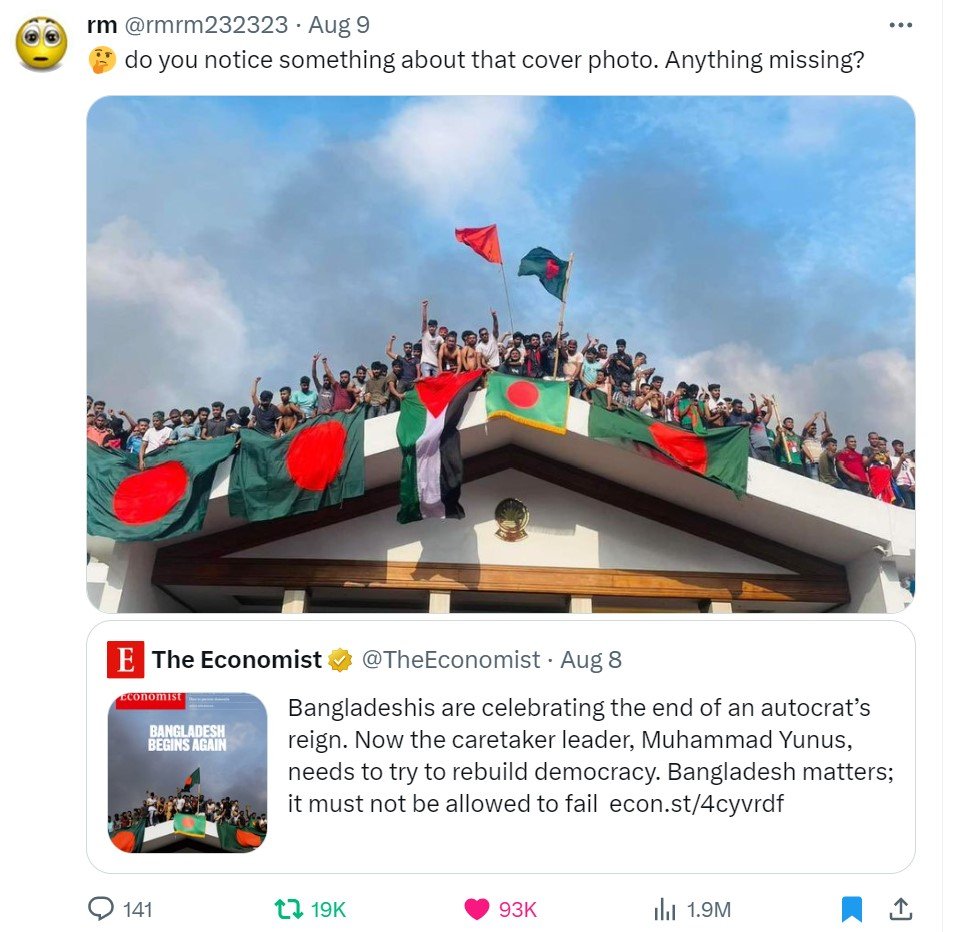
The Economist, a British weekly news magazine, published this week’s issue with a picture of the Bangladesh students’ protest on the front page of its magazine, alongside the headline, “Bangladesh Begins Again.”
However, social media users pointed out a significant difference between the pictures used by the magazine and the same pictures available on the internet. The picture that wasn’t used by The Economist had protestors raising a Palestine flag along with the Bangladesh flag.
Earlier this week, the Prime Minister of Bangladesh, Sheikh Hasina, resigned and fled the country as massive protests gripped the nation. The protests, which initially started as student protests against civil service job quotas, spiralled into demands for Hasina to quit after more than 200 people were killed in the violence.
Social media was abuzz with footage of Bangladeshi youth tearing down the statues of their country’s founding father, Sheikh Mujeeb ur Rehman, marking the end of Hasina’s almost 15 years of rule.
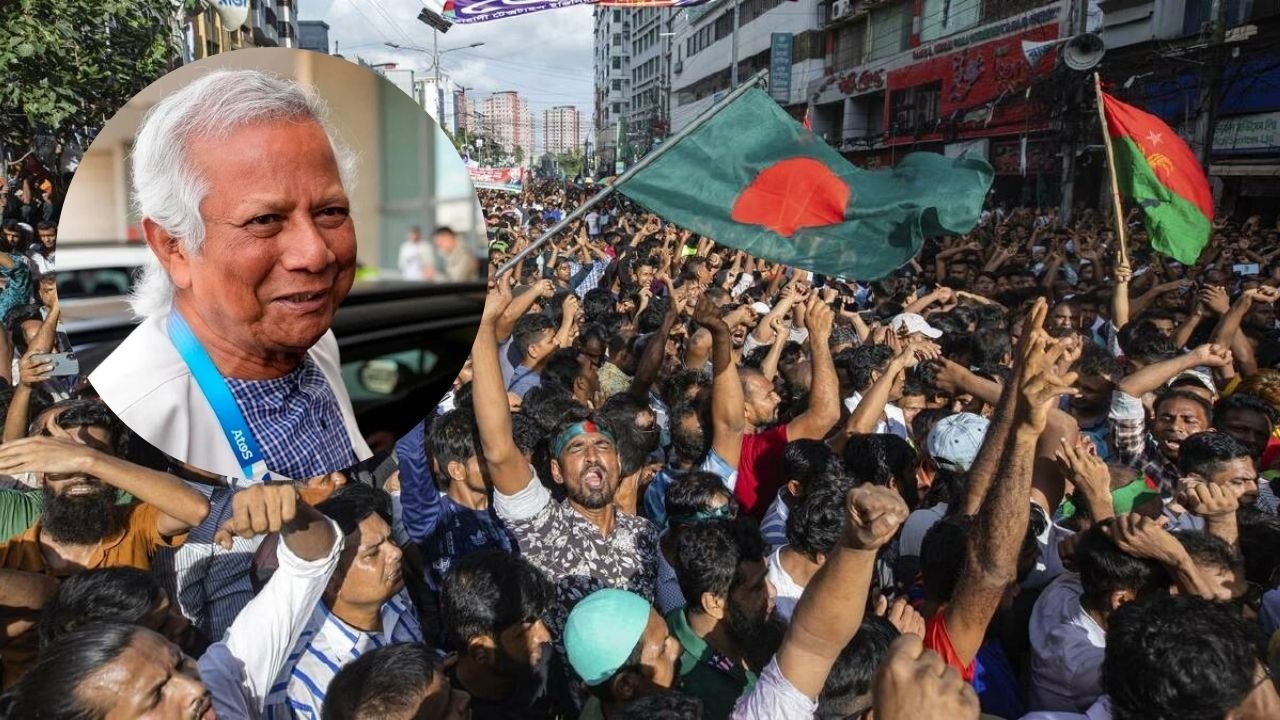
Nobel Peace Prize winner Muhammad Yunus on Thursday paid tribute to those killed in Bangladesh’s deadly protests that toppled Sheikh Hasina’s government, saying their sacrifices had brought the nation a “second independence.”
“Today is a glorious day for us,” he told reporters at the airport in Dhaka shortly after returning to the country to lead a caretaker government. “Bangladesh has created a new victory day. Bangladesh has got a second independence.”
Yunus returned to Bangladesh Thursday, landing at the capital’s airport ahead of his expected swearing in to lead a caretaker government, an AFP reporter said.
As Bangladesh grapples with the the end of a historic uprising, Pakistan extended solidarity with the country’s people and wished for peace and normalcy.
The Ministry of Foreign Office (MOFO) stated in a press release that, ‘’the government and people of Pakistan stand in solidarity with the people of Bangladesh and sincerely hope for a peaceful and swift return to normalcy’’. ‘’We are confident that the resilient spirit and unity of the Bangladeshi people will lead them towards a harmonious future,’’ the statement further stated.
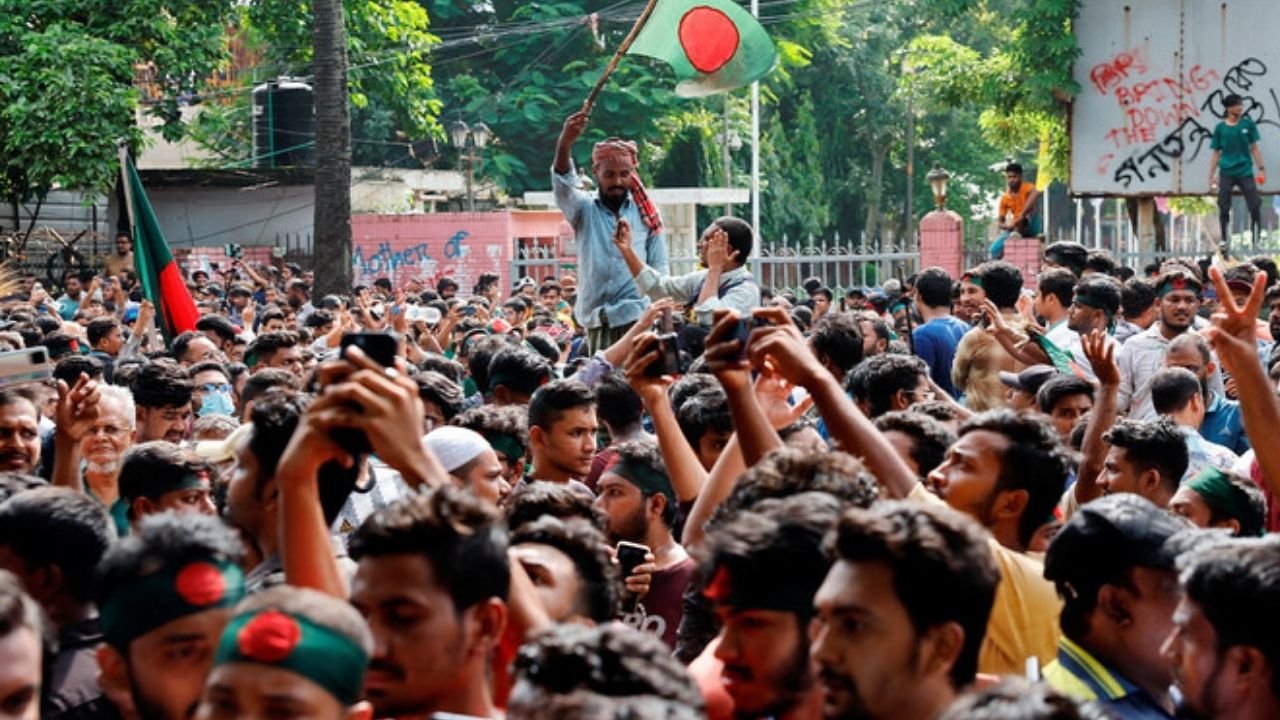
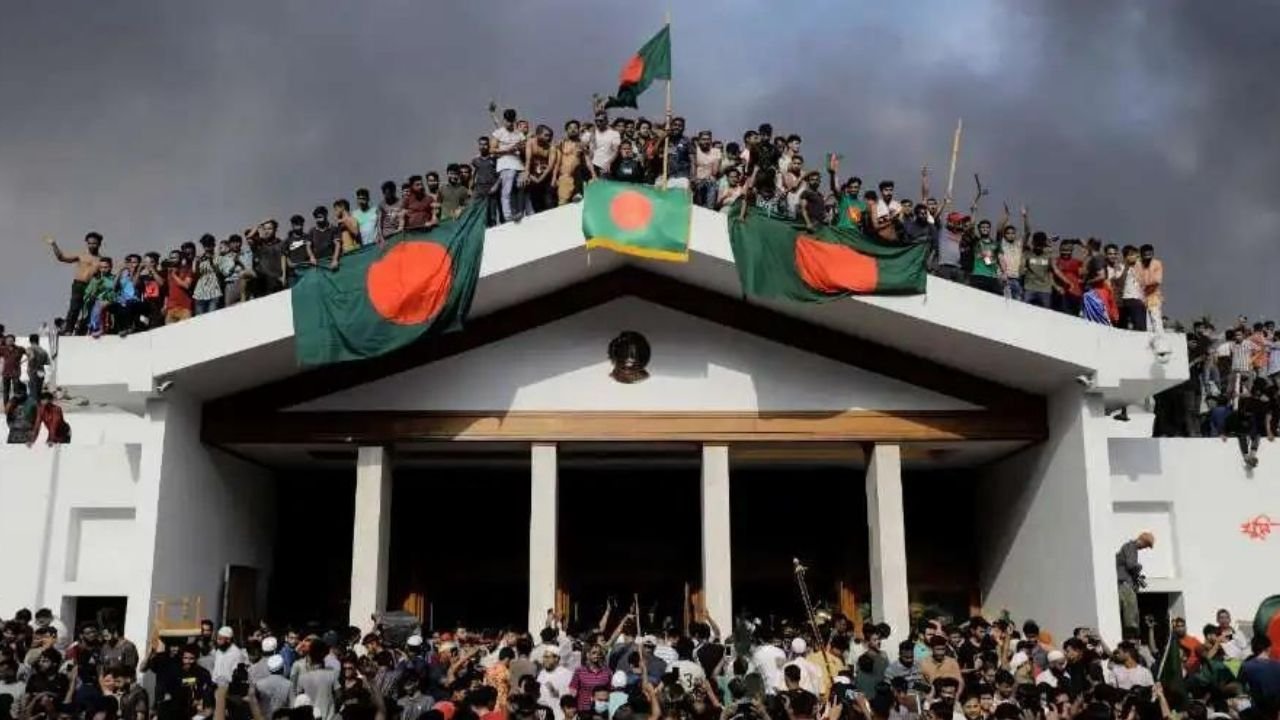
On Monday, Bangladesh’s former Prime Minister Sheikh Hasina’s 15-year rule ended when demonstrators stormed into her palace and parliament.
The Prime Minister of Bangladesh, Sheikh Hasina Wazed, resigned on Monday, fleeing the country as massive protests gripped the nation. The protests, that initially started as student protests against civil service job quotas metamorphosised into demands for Hasina to quit after more than 200 people were killed in violence.
Hasina’s son Sajeeb Wazed, the Information and Communication Technology (ICT) Advisor to the Prime Minister of Bangladesh, reacted to the developments by saying, “Bangladesh is going to become the next Pakistan.”
He also said that his mother is very disappointed in the people of Bangladesh “Because after all she’s done…after all the development.”
Siddhant Sibbal, correspondent at Wion News, asked Sajeeb whether his mother planned to return to power, to which he replied, “No, absolutely not. She is 77-years-old. This was going to be her last term, and she was going to retire after this anyway.”
The journalist asked Hasina’s son whether he had plans to join the politics of Bangladesh in future, to which he replied laughingly, “No. My family has been through this three times. After this, we are done. We are tired of saving Bangladesh. Bangladesh can handle its own problems now. It’s not our problem.”
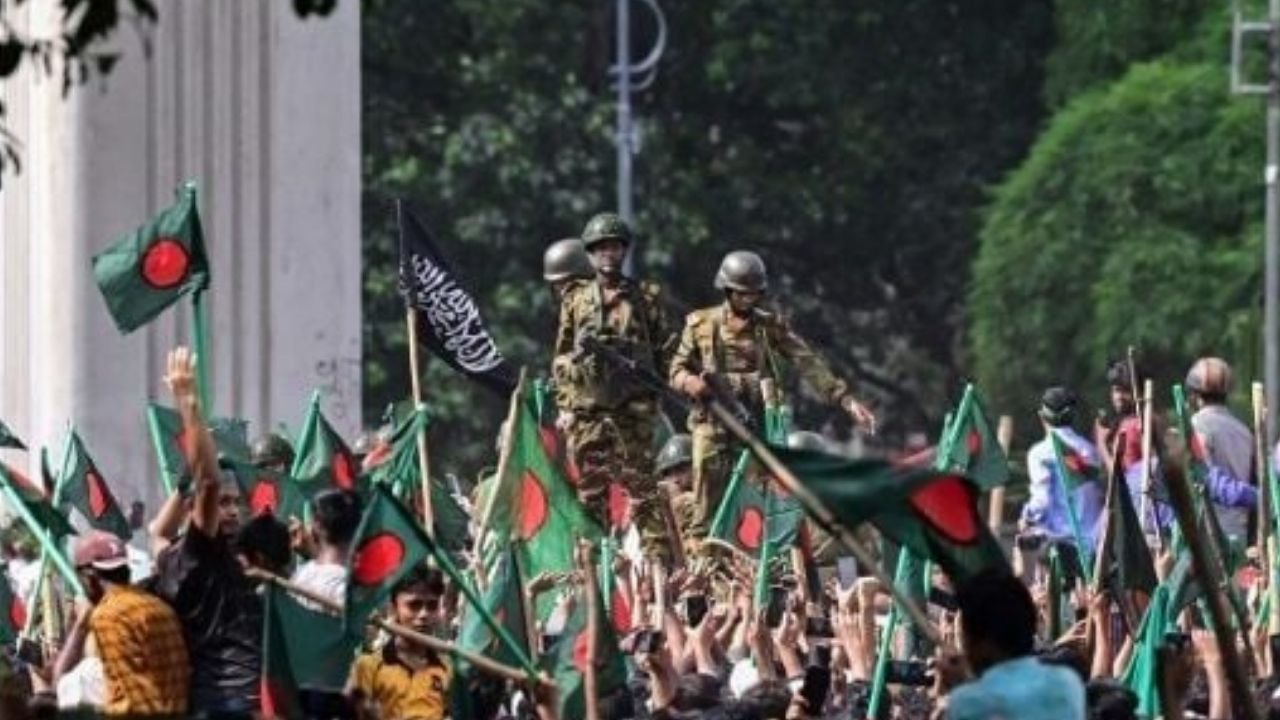
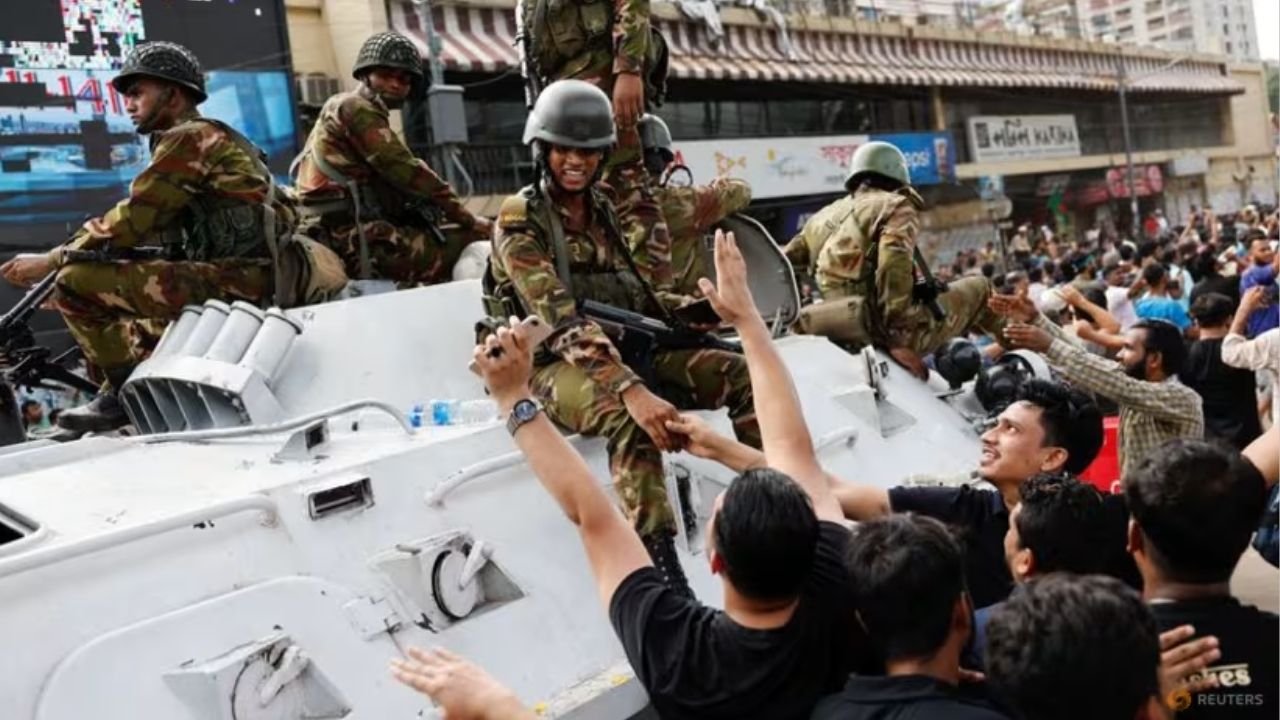
Bangladesh’s military was in control of the country on Tuesday after mass protests forced longtime ruler Sheikh Hasina to resign and flee.
Hasina, 76, had been in power since 2009 but was accused of rigging elections in January and then watched millions of people take to the streets over the past month demanding she step down.
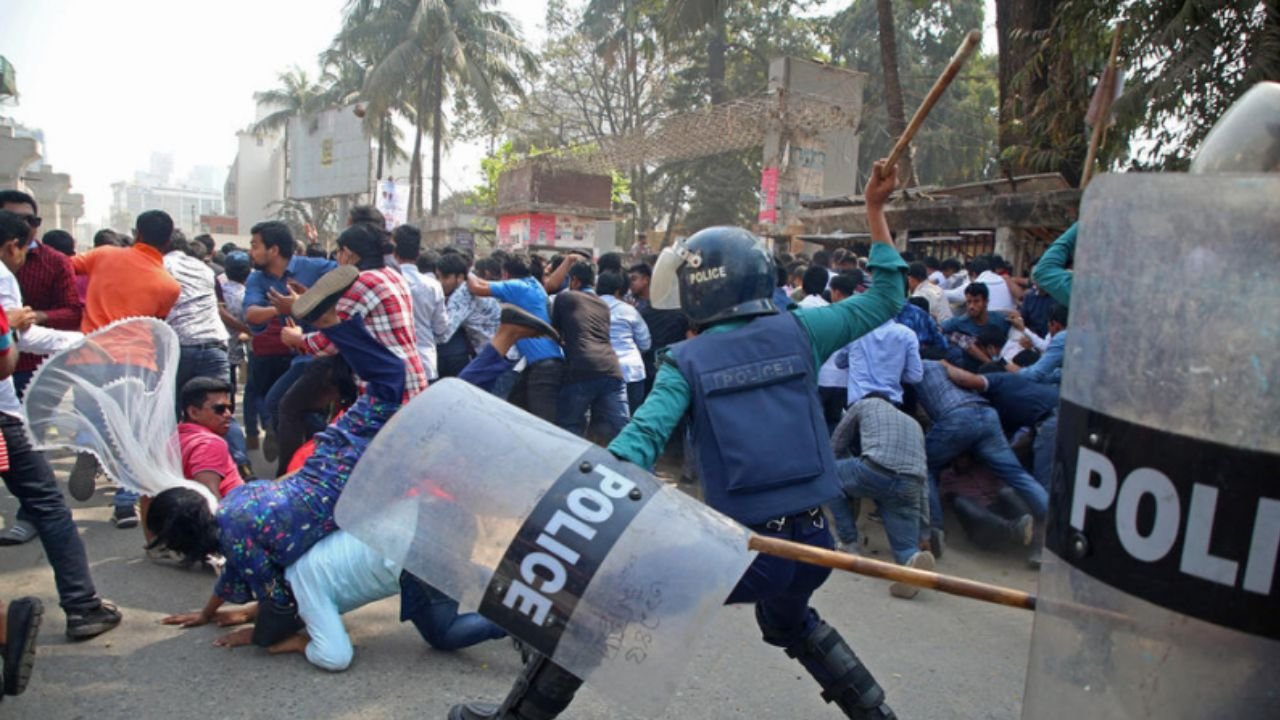
Hundreds of people died as security forces sought to quell the unrest, but the protests grew, and Hasina finally fled Bangladesh aboard a helicopter on Monday as the military turned against her.
Army chief General Waker-Uz-Zaman announced Monday afternoon on state television that Hasina had resigned and the military would form a caretaker government.
“The country has suffered a lot, the economy has been hit, many people have been killed — it is time to stop the violence,” said Waker, shortly after jubilant crowds stormed and looted Hasina’s official residence.
“I feel so happy that our country has been liberated,” said Sazid Ahnaf, 21, comparing the events to the independence war that split the nation from Pakistan more than five decades ago.
“We have been freed from a dictatorship. It’s a Bengal uprising, what we saw in 1971, and now seeing in 2024.”
But there were also scenes of chaos and anger, with police reporting at least 66 people killed on Monday as mobs launched revenge attacks on Hasina’s allies.
Protesters stormed parliament and torched TV stations, while some smashed statues of Hasina’s father, Sheikh Mujibur Rahman, the country’s independence hero.
Others set a museum dedicated to the former leader on fire, flames licking at portraits in destruction barely thinkable just hours before, when Hasina had the loyalty of the security forces under her autocratic grip.
“The time has come to make them accountable for torture,” said protester Kaza Ahmed. “Sheikh Hasina is responsible for murder.”
Offices of Hasina’s Awami League across the country were torched and looted, eyewitnesses told AFP.
The unrest began last month in the form of protests against civil service job quotas and then escalated into wider calls for Hasina to stand down.
Her government was accused by rights groups of misusing state institutions to entrench its hold on power and stamp out dissent, including through the extrajudicial killing of opposition activists.
At least 366 people died in the unrest that began in early July, according to an AFP tally based on police, government officials and doctors at hospitals.
Student protest leaders, ahead of an expected meeting with the army chief, said Tuesday that they wanted Nobel laureate and microfinance pioneer Muhammad Yunus, 84, to lead the government.
“In Dr. Yunus, we trust,” Asif Mahmud, a key leader of the Students Against Discrimination (SAD) group, wrote on Facebook.
Waker said a curfew would be lifted on Tuesday morning, with the military set to lead an interim government.
Bangladeshi President Mohammed Shahabuddin late Monday ordered the release of prisoners from the protests, as well as former prime minister and key opposition leader Khaleda Zia, 78.
Zia, who is in poor health, was jailed by her arch-rival Hasina for graft in 2018.
The president and army chief also met late Monday, alongside key opposition leaders, with the president’s press team saying it had been “decided to form an interim government immediately.”
It was not immediately clear if Waker would lead it.
Hasina’s fate was also uncertain. She fled the country by helicopter, a source close to the ousted leader told AFP.
Media in neighboring India reported Hasina had landed at a military air base near New Delhi.
A top-level source said she wanted to “transit” on to London, but calls by the British government for a UN-led investigation into “unprecedented levels of violence” put that into doubt.
There were widespread calls by protesters to ensure Hasina’s close allies remained in the country.
Bangladesh’s military said they had shut Dhaka’s international airport on Monday evening, without giving a reason.
Bangladesh has a long history of coups.
The military declared an emergency in January 2007 after widespread political unrest and installed a military-backed caretaker government for two years.
Michael Kugelman, director of the South Asia Institute at the Washington-based Wilson Center, warned that Hasina’s departure “would leave a major vacuum” and that the country was in “uncharted territory.”
“The coming days are critical,” he said.
UN Secretary-General Antonio Guterres stressed the importance of a “peaceful, orderly and democratic transition,” his spokesman said. European Union foreign policy chief Josep Borrell echoed that call.
Former colonial ruler Britain and the United States meanwhile urged “calm.”
Bangladeshi police detectives on Friday forced the discharge from the hospital of three student protest leaders blamed for deadly unrest, taking them to an unknown location, staff told AFP.
Nahid Islam, Asif Mahmud and Abu Baker Majumder are all members of Students Against Discrimination, the group responsible for organising this month’s street rallies against civil service hiring rules.
At least 195 people were killed in the ensuing police crackdown and clashes, according to an AFP count of victims reported by police and hospitals, in some of the worst unrest of Prime Minister Sheikh Hasina’s tenure.
All three were patients at a hospital in the capital, Dhaka, and at least two of them said their injuries were caused by torture in earlier police custody.
“They took them from us,” Gonoshasthaya hospital supervisor Anwara Begum Lucky said. “The men were from the Detective Branch.”
She added that she did not want to discharge the student leaders, but the police had pressured the hospital chief to do so.
The trio’s student group suspended fresh protests at the start of this week, saying they wanted the reform of government job quotas but not “at the expense of so much blood.”
The pause was due to expire earlier on Friday but the group had given no indication of its future course of action.
Three senior police officers in Dhaka all denied that the trio had been taken from the hospital and into custody on Friday.
Garment tycoon arrested
Police said on Thursday that they had arrested at least 4,000 people since the unrest began last week, including 2,500 in Dhaka.
On Friday, police said they had arrested David Hasanat, the founder and chief executive of one of Bangladesh’s biggest garment factory enterprises.
According to its website, the Viyellatex Group employs more than 15,000 people, and the Daily Star newspaper estimated its annual turnover at $400 million last year.
Dhaka Police inspector Abu Sayed Miah said Hasanat and several others were suspected of financing the “anarchy, arson and vandalism” of last week.
PM Hasina continued a tour of government buildings that had been ransacked by protesters on Friday, visiting state broadcaster Bangladesh Television, which was partly set ablaze last week.
“Find those who were involved in this,” she said, according to state news agency BSS. “Cooperate with us to ensure their punishment. I am making this call to the nation.”