Tag: bills

  • Employees getting Rs 15 billion of free electricity: Secretary Power Division

    Employees getting Rs 15 billion of free electricity: Secretary Power Division

    The Senate’s Standing Committee on Energy has been briefed by the Secretary of Power Division that 190,000 employees are being given free electricity worth 15 billion rupees annually.

    He said, “Our electricity demand for industry is about 25 percent, decreasing over time.”

    The Secretary explained that 25 million employees of 400 units received a 592 billion subsidy, which has now increased by Rs 692 billion. “244 billion was taken from industry and given to domestic consumers,” he told the Committee.

    Senator Mohsin Aziz remarked, “IPP has become a dragon, and people are on the streets.”

    The federal minister for power and energy said, “Even if we get five rupees from IPP payments, we will help poor people.”

    The minister opined that electricity theft can be reduced with privatisation and digitisation.

  • Power sector’s circular debt surpasses Rs2 trillion despite massive tariff increase 

    Power sector’s circular debt surpasses Rs2 trillion despite massive tariff increase 

    Despite raising tariffs significantly, Pakistan’s power sector debt grew to Rs2.31 trillion by June 2023, up from Rs2.25 trillion in the previous fiscal year (FY22). This increase of Rs57 billion (about 3 per cent) over 12 months is quite different from FY22 when the debt actually decreased by Rs27 billion. 

    Here’s a breakdown of the key points: 

    1. In FY22, the debt was Rs2.25 trillion, but by June 2023, it had risen to Rs2.31 trillion. 

    2. In FY22, power producers were owed Rs1,351 billion, generation companies owed Rs101 billion to fuel suppliers, and Rs800 billion was held in Pakistan Holding Limited (PHL).  

    3. In FY22-23, the debt to power producers increased to Rs1,434 billion, while the debt to PHL decreased to Rs765 billion in FY23. 

    4. In FY22, some subsidies were reduced by Rs12 billion, but in FY23, there were no subsidies left. 

    5. The interest charges on delayed payments by independent power producers (IPPs) increased to Rs105 billion in FY22 but dropped to Rs100 billion by the end of FY23. 

    6. The markup paid on IPPs’ claims by PHL increased from Rs29 billion in FY22 to Rs43 billion in FY23. 

    7. The pending generation cost, including tariff adjustments and fuel charges, decreased from Rs414 billion in FY22 to Rs250 billion in FY23. 

    8. K-Electric’s outstanding dues went from Rs107 billion in FY22 to an excess payment of Rs53 billion in FY23. 

    9. However, power distribution companies (Discos) saw their losses due to inefficiency rise from Rs133 billion to Rs160 billion in FY23. 

    Read more: Pakistan to launch digital rupee to reduce printing and distribution costs 

    In simple terms, even though the government raised tariffs to collect more money for the power sector, the debt continued to increase. This debt is owed to various power-related entities, and some subsidies and charges also changed over the years. Additionally, while some costs went down, the losses due to inefficiencies in power distribution increased. 

  • President Alvi returns 13 bills

    President Alvi returns 13 bills

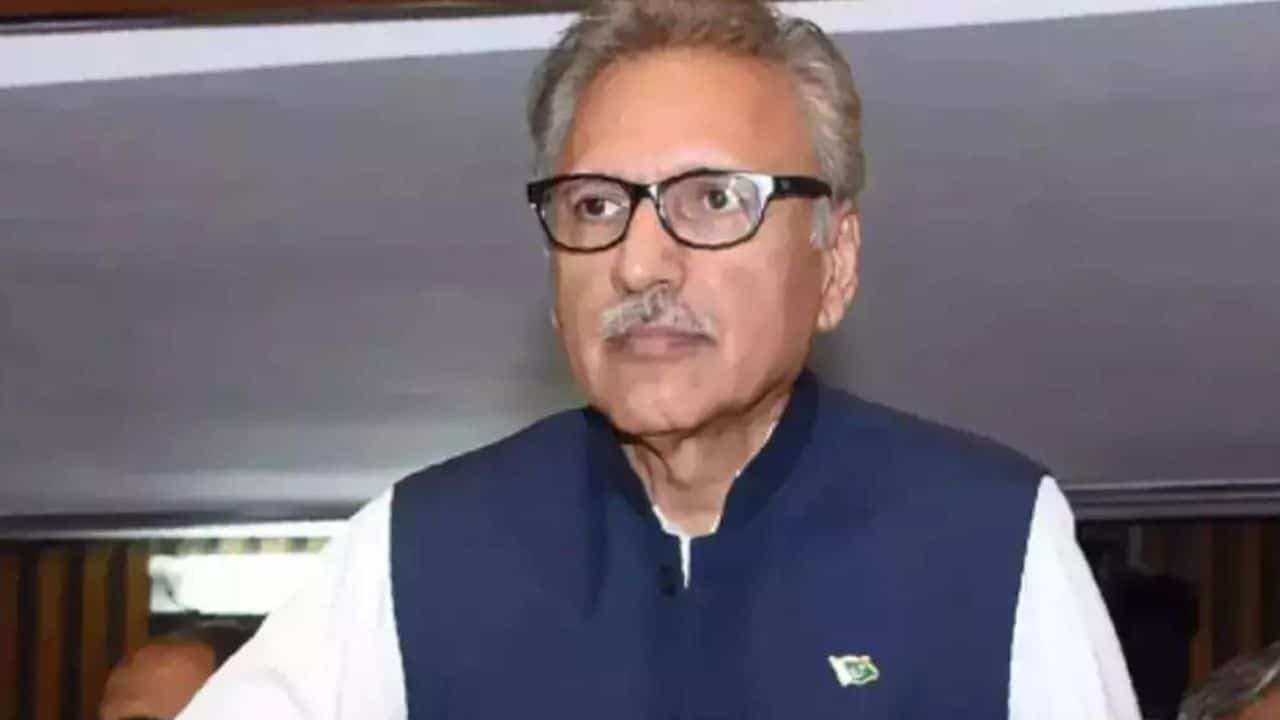
    President Dr. Arif Alvi has returned over a dozen bills for reconsideration by the parliament, resulting in an indefinite delay in their progression since a new assembly will be formed after the general elections, to be held later this year. The bills were approved by both houses of the parliament towards the end of the PML-N-led government’s term.

    Among these bills is the recently proposed amendment to the Code of Criminal Procedure, aimed at increasing penalties for those found guilty of showing disrespect to the Holy Prophet (PBUH), his companions, and other revered religious figures.

    Additional bills that have been sent back include the amendment to the Press, Newspapers, News Agencies, and Books Registration legislation, which seeks to change the term ‘federal government’ with ‘Prime Minister’ wherever mentioned in the law.

    Similarly, the Bill for the Protection of Journalists and Media Professionals aims to shift the jurisdiction over journalist protection from the Ministry of Human Rights to the Ministry of Information. The National Commission for Human Development (Amendment) Bill is also among the returned bills, proposing revisions to the functions of the National Commission for Human Development (NCHD) and changes in its administrative structure to enhance efficiency and facilitate business operations.

    Furthermore, a returned bill linked to the 2023 amendment of the Imports and Exports (Control) Bill.
    This measure addresses instances of economic difficulty and has been prompted by appeals from the business community and other sectors, seeking temporary relief from import/export-related restrictions.

    President Alvi also returned the bill related to the Higher Education Commission (HEC), which seeks to extend the term of the HEC chairman to four years.

    The remaining bills that have been sent back include amendments to the Public Sector Commission legislation, the Institute of Management Sciences Bill, the Horizon University Bill, the Federal University Bill, NFC Institute of Engineering and Technology Multan Bill, and the National Institute for Technology Bill.

  • Big power consumers to face increased tariff due to IMF conditions

    Big power consumers to face increased tariff due to IMF conditions

    The Economic Coordination Committee (ECC) of the Cabinet approved the removal of subsidies in electricity tariffs for the export-oriented sector and the Kissan package in order to meet one of the International Monetary Fund’s (IMF) preconditions for reaching a staff-level agreement.

    Federal Minister for Finance and Revenue Senator Ishaq Dar presided over the meeting, where the revenue and fiscal measures were discussed to fulfill the IMF’s demands.

    The recently concluded 10-day IMF mission in Islamabad had energy sector reforms and reducing the circular debt as the main focus of the talks. However, the IMF team left without signing an agreement and requested that Pakistan take corrective measures. The ECC meeting was convened to evaluate the situation and implement necessary steps.

    The government approved a revised Circular Debt Management Plan (CDMP) that includes quarterly tariff adjustments, a deferred fuel price adjustment, and a surcharge of Re1 per unit for large power consumers. The approved tariff hike ranges from Rs7-8 per unit until August 2023, with the consumer base tariff expected to increase from Rs15.28 per unit in June 2022 to Rs23.39 per unit by June 2023.

    According to sources, the IMF had requested the government to raise the base tariff by Rs4.06 per unit, but this request was not approved under the revised CDMP. It is yet to be determined how the IMF’s demand was incorporated into the Memorandum of Economic and Financial Policies (MEFP) that was presented to Pakistan on February 10, 2023.

    If the IMF continues to insist on a higher base tariff, it is estimated that the Pakistani authorities will have to raise the tariff by a range of Rs9 to 11 per unit.

    The government has so far protected electricity users consuming 300 units or less from a planned tariff increase. However, the revised Circular Debt Management Plan (CDMP) does not address the IMF’s demand for a higher base tariff in order to reduce the need for an additional subsidy of Rs335 billion.

    In accordance with IMF directives, the additional subsidy requirement has been reduced from Rs675 billion to Rs335 billion, and the government has indicated that it will be included as part of the circular debt management plan.

  • NEPRA okays Rs3.21 per unit hike in power tariff

    NEPRA okays Rs3.21 per unit hike in power tariff

    A quarterly adjustment of Rs3.21 per unit of power for the period of April to June 2022 has been approved by the National Electric Power Regulatory Authority (NEPRA).

    A further burden of Rs93.95 billion will be placed on energy consumers as a result of the most recent price increase. To be effective as of October 1, 2022, the authority transmitted its decision to the federal government.

    According to specifics, the prior adjustments’ time period ended on September 3, 2022. As of October 1, the electricity customers will not receive any respite as the authority implements fresh adjustments immediately following the expiration of the prior adjustment.

    For K-Electric customers, the NEPRA earlier in the day authorised a cut in power rates of Rs4.89 per unit due to a fuel cost adjustment (FCA) for August 2022.

    The notification states that, in contrast to KE’s plea for Rs4.21, the fuel cost adjustment for K-Electric customers would be reduced by Rs4.89 per unit. However, it specified that the tariff cut for July would only be valid for that particular month.

    According to the NEPRA, all consumer categories would be affected by the drop in FCA, with the exception of lifeline consumers, home consumers consuming up to 300 units, agriculture consumers, and EVCS (Electric Vehicle Charging Station).

  • New bank timings announced by SBP, Saturday will now be observed as a working day

    New bank timings announced by SBP, Saturday will now be observed as a working day

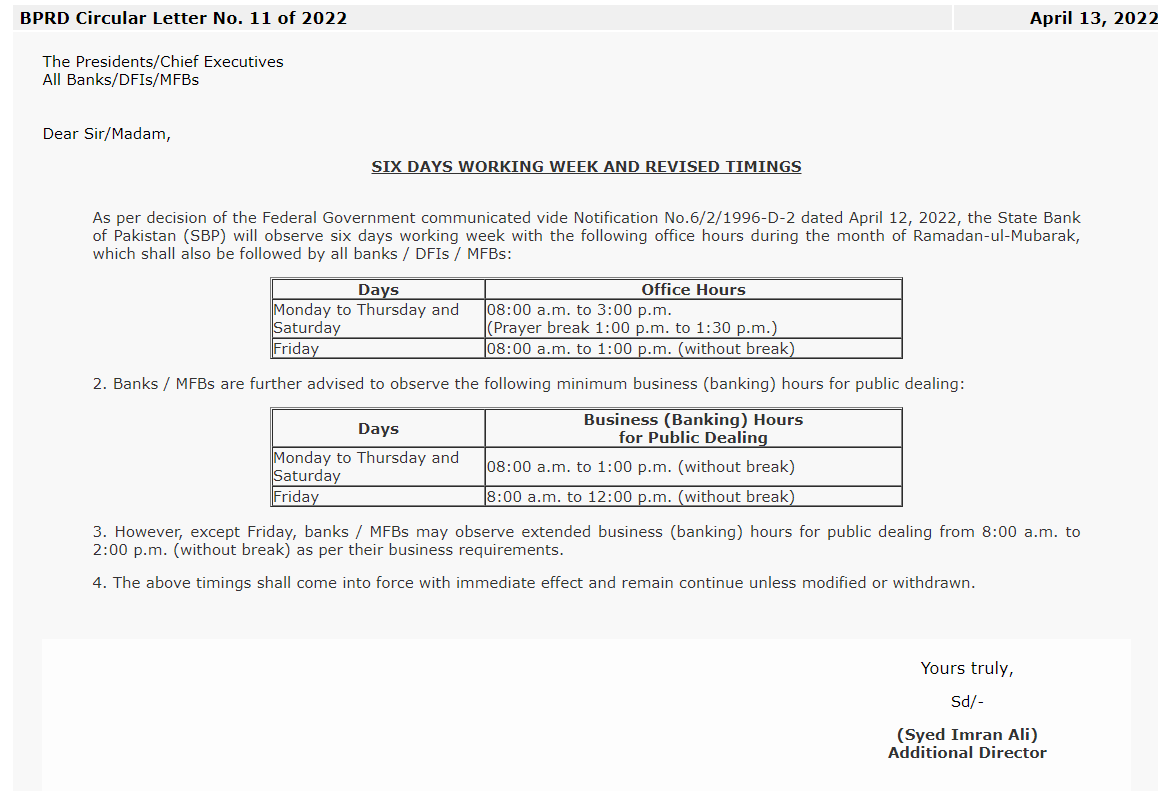
    Pursuant to the federal government’s directive issued on April 13, the State Bank of Pakistan (SBP) would observe a six-day work week with amended timings.

    During Ramzan, working hours for the central bank, development finance institutions (DFIs), microfinance banks (MFBs), and all commercial banks, are as follows:

    Monday to Thursday and Saturday from 8:00 am to 3:00 pm with a prayer break from 1:00 pm to 1:30 pm.

    Fridays: from 8:00 am to 1:00 pm without a break, according to a notification from SBP.

    Public dealing hours

    Banks and MFBs have been advised to adhere to the following public dealing business hours:

    Monday through Thursday and Saturday from 8:00 am to 1:00 pm (no break).

    Fridays from 8:00 am to 12:00 pm (no break).

    Banks and MFBs may observe longer business (banking) hours for public dealing from 8:00 am to 2:00 pm (without break) on weekdays excluding Fridays, depending on their business needs.

    The abovementioned schedule will take effect immediately and will not be changed or withdrawn unless it is amended or canceled.

  • Sindh revives student unions after three decades

    Sindh revives student unions after three decades

    The Sindh Assembly on Friday unanimously passed the Sindh Students Union Bill 2019 to revive student unions. According to the bill, a student union will be formed in every private and government educational institute.

    Students will be able to vote for or participate in the student union, according to the bill. The bill defines the student union as “a body or association of students of any educational institution by whatever name called for promoting the general interests of its members as students for academic, disciplinary, extra-curricular or other matters related to the affairs of the students in the educational institutions”.

    As per the bill, students would be able to form a union with seven to 11 student members through elections every year. The union will have representation in the institute’s syndicate, senate, and anti-harassment committee.

    The bill states that no student will be allowed to use or keep firearms on campus. The bill states that educational institutes will decide the rules and regulations related to the union two months after the bill is passed.

    During General Ziaul Haq’s military government, student unions were banned throughout the country in 1984.

  • How govt outnumbered opposition for passage of FATF-related bills during joint session

    How govt outnumbered opposition for passage of FATF-related bills during joint session

    Opposition absentees outnumbered their counterparts on the treasury benches during the joint sitting of parliament on Wednesday, which passed three bills related to the Financial Action Task Force (FATF), official records revealed Thursday.

    According to The Express Tribune, the attendance record released by the National Assembly Secretariat showed that more than two dozen opposition lawmakers did not turn up for the joint sitting, including 13 from Pakistan Muslim League-Nawaz (PML-N) and 11 from the Pakistan People’s Party (PPP).

    From the treasury side, those conspicuous for their absence were Asim Nazir, Amir Liaquat Hussain, Ahmed Hussain Dehar and Abdul Majeed Khan of the ruling Pakistan Tehreek-e-Insaf (PTI), and Chaudhry Moonis Elahi of the Pakistan Muslim League.

    In the parliamentary session, 317 members of National Assembly, out of the Lower House’s current strength of 340, were present. From the Upper House of parliament, which currently has 103 members, around 14 opposition senators were absent.

    The prominent absentees included former president Asif Zardari, who did not attend because of illness and Syed Khurshid Shah, who is in the custody of the National Accountability Bureau. Besides these two top PPP lawmakers, Sardar Akhtar Mengal of the Balochistan National Party (BNP), was also absent.

    The list also includes Amir Haider Hoti of the Awami National Party (ANP), Ali Wazir, a lawmaker from the former tribal areas, Afrin Khan of the Muttahida Majlis-e-Amal (MMA), PML-N’s Afzal Khokhar, Ahmad Raza Maneka, Ehsanul Haq Bajwa and Riaz Pirzada and the PPP’s Makhdoom Jamiluz Zaman, Amir Magsi, Khalid Loond, Roshan Junejo and Ghulam Ali Talpur.

    According to the attendance record, the senators who skipped Wednesday’s joint sitting were PML-N senators Kulsoom Parveen, Chaudhry Tanveer, Shamim Afridi, Raheela Magsi, Saleem Zia, Dilawar Khan, Yaqub Nasir and Najma Hameed.

    Other absentee senators were Talha Mahmood and Ataur Rehman of the Jamiat Ulema-e-Islam, Rubina Khalid of the PPP, Sitara Ayaz of the ANP, Ashok Kumar of the National Party (NP) and Tahir Bizenjo and Shafiq Tareen of the Pakhtunkhwa Milli Awami Party (PkMAP).

    PASSAGE OF FATF BILLS:

    Earlier, the government on Wednesday managed to pass three crucial FATF-related laws in a joint session of the parliament that was marred by the opposition’s protests.

    Prime Minister (PM) Imran Khan also attended the joint session which was chaired by National Assembly Speaker Asad Qaiser. Leader of the Opposition in the National Assembly Shehbaz Sharif, PPP chief Bilawal Bhutto-Zardari, former premier Shahid Khaqan Abbasi and others, including senators Sirajul Haq, Mushtaq Ghani and Raza Rabbani among others were also in attendance.

    After walking out in protest, opposition leaders held a joint press conference and criticised the government over the passage of FATF-related bills.

    Opposition leader Shehbaz termed today as a “black day in the history of democracy”. He said that the government “crossed red lines” today and added that “until now, the opposition cooperated with the government for the sake of Pakistan”.

    The PML-N president also said that the NA speaker had “disappointed everyone”.

    PPP chief Bilawal also lashed out at the government, saying that the vote count could have been conducted again but the treasury members were “scared of being exposed”.

    “The opposition only has one option remaining and that is [to move] a no-confidence [motion],” said Bilawal.

    Both Shehbaz and Bilawal told reporters that the opposition will come up with a strategy in the multi-party conference.