Tag: black market

  • Crackdown against $23 billion black market results in attacks on custom officials

    Crackdown against $23 billion black market results in attacks on custom officials

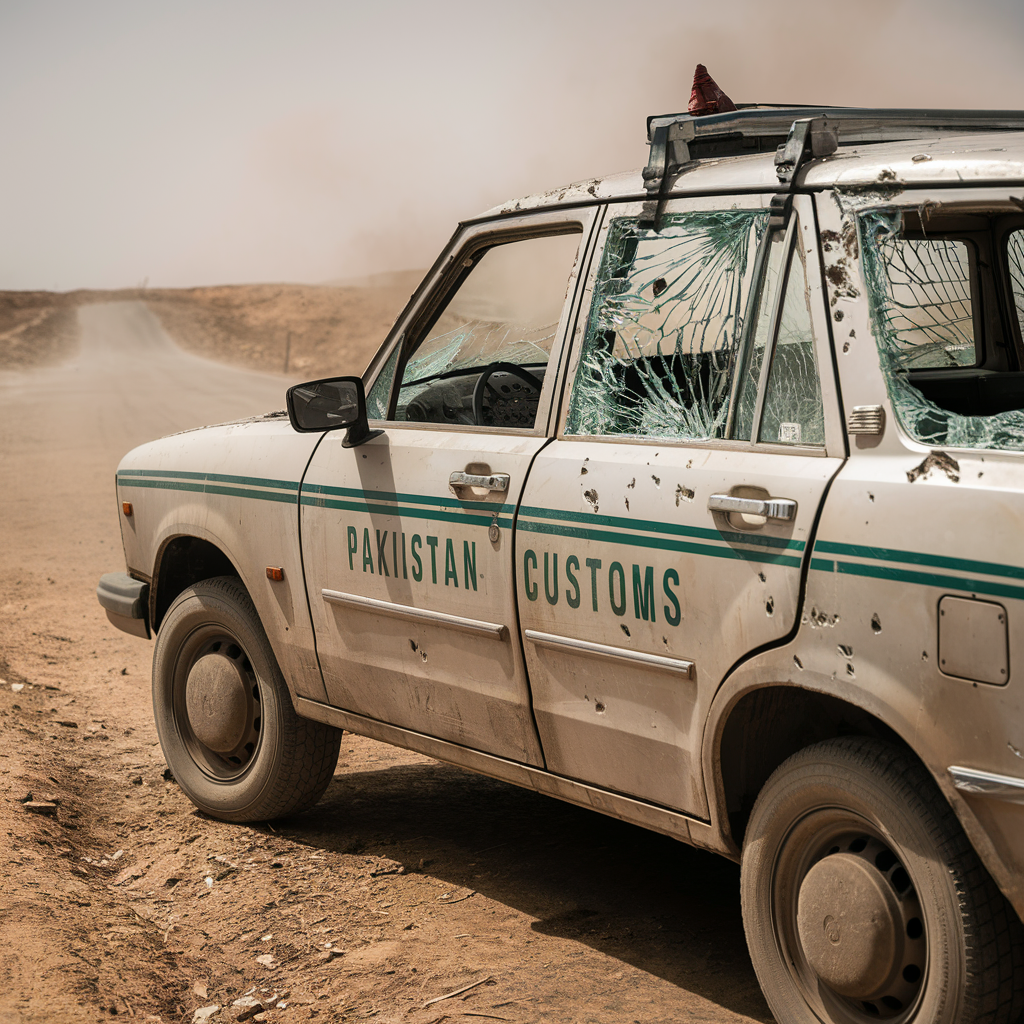
    On Saturday, three people, including two Customs officials, were murdered in an attack near Bannu Road when unknown gunmen opened fire targeting their vehicle at the Yarak toll plaza in Dera Ismail Khan district of Khyber Pakhtunkhwa.

    This is the second attack on Pakistan Customs officials in less than a week in Dera Ismail Khan.

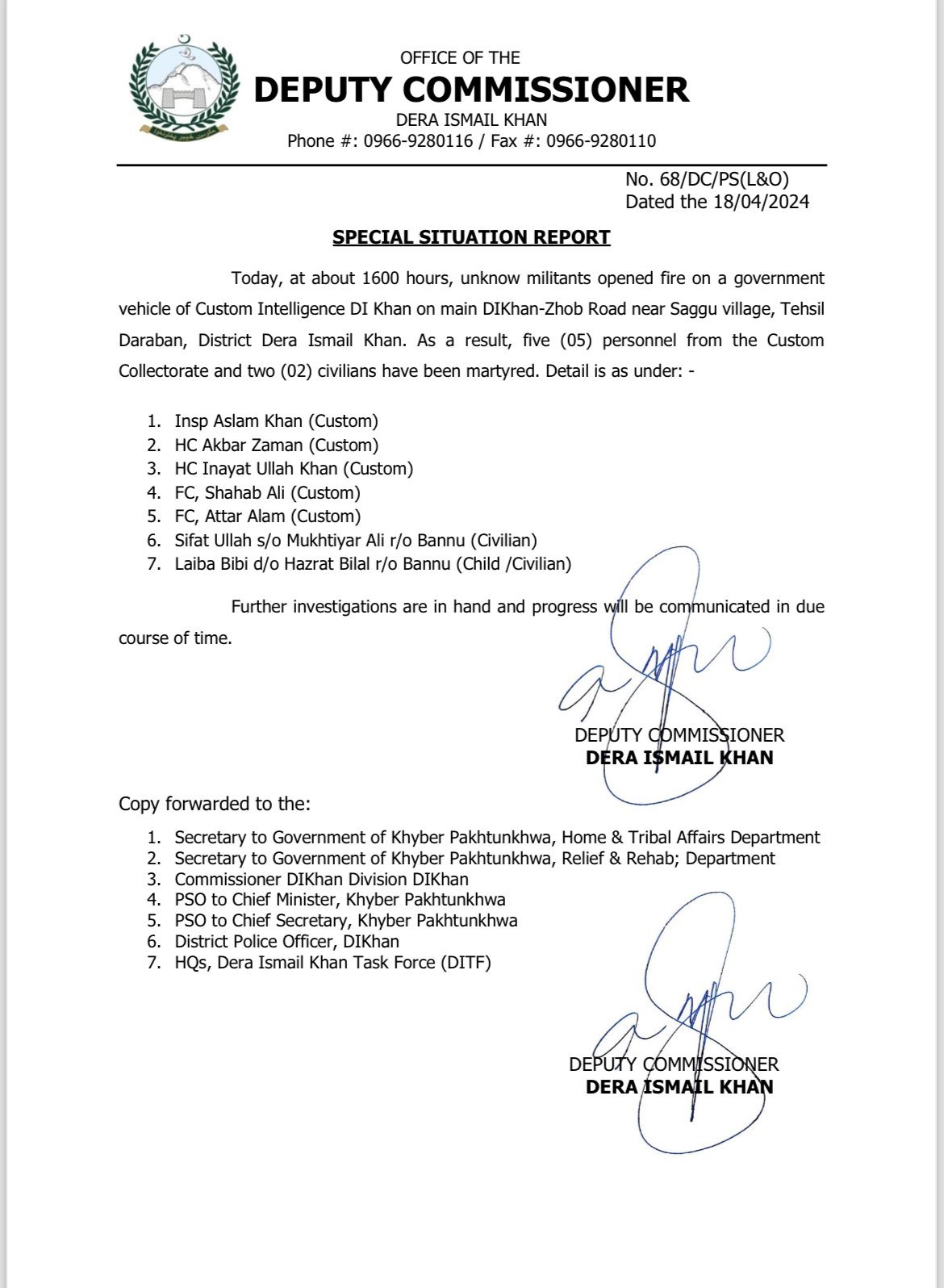
    Previously on April 18, seven people, including a child, were slain in an attack out of which five were Custom officials. Federal Board of Revenue (FBR) released a statement on X, formerly Twitter, reiterating Pakistan’s resolve to fight terrorism.
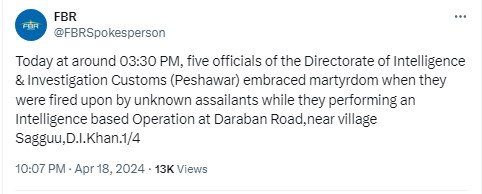
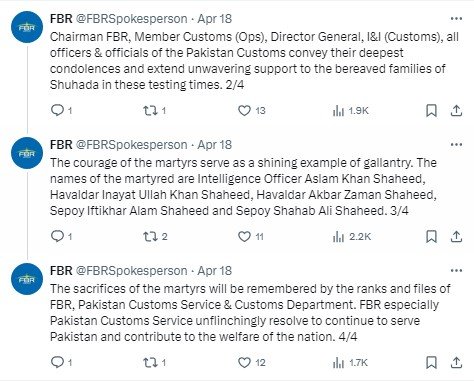
    The Khorasan Diary had reported that “Customs had tightened the noose around smuggling around this area as it was frequented by militant networks who were involved in smuggling weapons and vehicles used in attack in urban centres,” a senior customs official said.

    The special situation report of the April 18 incident was released by the Deputy Commissioner
    Moreover, Tehreek-e-Taliban Pakistan (TTP) claimed responsibility for the heinous attack.

    It should be noted that Dera Ismail Khan is an infamous route for illicit trade and smuggling as there have been many instances when the authorities have foiled bids to smuggle goods including arms, Iranian fuel and more.
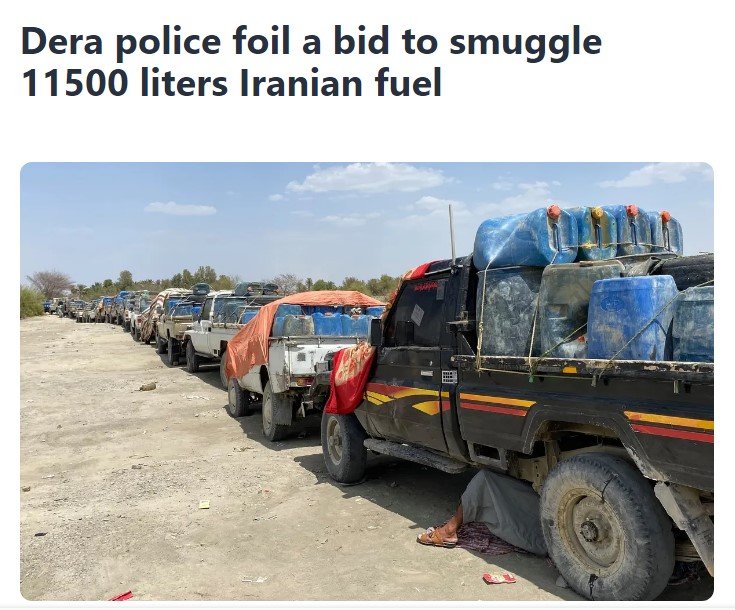
    (Image taken from APP report)

    As Pakistan navigates through tough economic waters, Prime Minister Shehbaz Sharif ordered strict action against smugglers and urged law enforcement agencies to expedite their campaigns.

    Illicit activities such as black market and smuggling cost Pakistan $23 billion per year, according to the report by ACE Money Transfer, a UK-based company.

    Previously, the caretaker administration started the anti-smuggling drive in the country to protect the feeble foreign exchange and stop the devaluation of local currency (PKR).

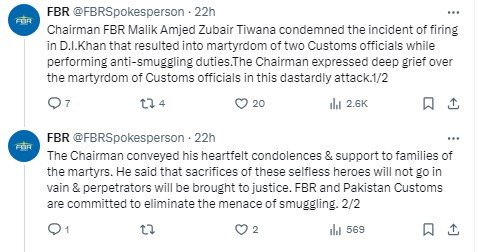
    The FBR released a statement offering condolences to the victims’ families.
  • Saudi Arabia to open first liquor store in Riyadh

    Saudi Arabia to open first liquor store in Riyadh

    Saudi Arabia is gearing up to inaugurate its maiden alcohol store in the capital city of Riyadh, exclusively catering to non-Muslim diplomats, according to a reliable source and an official document disclosed on Wednesday.

    Prospective customers will be required to register through a designated mobile app, obtain a clearance code from the foreign ministry, and adhere to monthly purchase quotas, as outlined in the document.

    This development marks a significant milestone in Saudi Arabia’s initiatives, spearheaded by Crown Prince Mohammed bin Salman, to transform the ultra-conservative Muslim nation into a hub for tourism and business. Notably, the consumption of alcohol is strictly forbidden in Islam.

    Situated in Riyadh’s Diplomatic Quarter, a locale housing embassies and diplomats, the new store will be “strictly restricted” to non-Muslims, according to the document. 

    It remains unclear whether other non-Muslim expatriates will be granted access to the establishment, given that the majority of expatriates in Saudi Arabia are Muslim workers from Asia and Egypt.

    Insiders familiar with the plans have indicated that the store is anticipated to open its doors in the coming weeks.

    Saudi Arabia has long maintained stringent laws against alcohol consumption, with penalties ranging from lashes, fines, and imprisonment to deportation. 

    As part of ongoing reforms, the practice of whipping has largely been replaced by jail sentences. Until now, alcohol has only been available through diplomatic mail or on the black market.

    According to Reuters, the Saudi government has not responded to requests for comments on the matter.

    Recent reports from state-controlled media suggest that the government is imposing new restrictions on alcohol imports within diplomatic consignments. This move is expected to bolster demand for the forthcoming alcohol store. 

    The new regulations aim to control imports and prevent the improper exchange of special goods and alcoholic beverages received by non-Muslim embassies in Saudi Arabia, as reported by the Arab News daily on Sunday.

    In recent years, Saudi Arabia, traditionally closed off to the world, has relaxed strict social codes. These changes include ending the segregation of men and women in public places, lifting the requirement for women to wear all-covering black robes (abayas), and allowing women to drive. 

    These transformations, part of Vision 2030, align with the broader goal of developing local industries, logistics hubs, and generating hundreds of thousands of jobs for Saudi nationals.

  • Rawalpindi, Islamabad residents forced to buy low-quality flour at exorbitant prices

    Rawalpindi, Islamabad residents forced to buy low-quality flour at exorbitant prices

    Residents of Rawalpindi and Islamabad are paying exorbitant prices for low-quality flour due to the poor performance of the District Food Department. The officials in charge have failed to take concrete steps to prevent smuggling and hoarding of flour, despite lip service and paperwork.

    As a result, locals are forced to pay more for flour than in any other city in the country. Dealers have hoarded ‘Atta’ and are selling a 15-kilogram bag for Rs2,300 to Rs2,650, while ‘Chakki’ owners are selling 1-kilogram ‘atta’ for Rs180 to Rs200. The price of a 20-kilogram ‘atta’ bag has reached Rs3,200 to Rs3,500 in retail shops.

    The Utility Store Corporation (USC) has resumed providing subsidized flour, but the quality is poor. The District Food Department and flour mill owners are working together to supply unhygienic flour at high prices. The department is not taking action to stop smuggling or control profiteers and hoarders, playing on both sides of the wicket.

    According to The News, District Food Controller (DFC) Hasan Nazir has admitted to a flour shortage in Rawalpindi and has written to the Secretary of Food (Punjab) to issue special permits for wheat supply. He assures the public that the ‘atta’ crisis will be resolved within weeks, and they are working to stop wheat smuggling, with over 600 wheat-filled vehicles stopped en route to Afghanistan.

    However, corrupt officials within the District Food Department are involved in wheat smuggling to Afghanistan via Torkham, and only ten vehicles are being stopped to show performance in the media while the officers let 90 vehicles go. The corrupt officials have several pending cases against them in the Anti-Corruption Establishment (ACE), Rawalpindi, and the Federal Investigation Agency (FIA).

    Despite Prime Minister Shahbaz Sharif claiming a bumper wheat crop this year, residents are struggling to afford basic necessities due to the inflated price of flour. The Punjab government has set the price of 40-kilogram wheat at Rs3,900, but owners are violating this order and selling it for Rs5,400 to Rs6,000 in Rawalpindi. The situation is dire, with many struggling to afford basic necessities due to the inflated price of flour.