Tag: blasphemy

  • Lahore woman sentenced to death for claiming to be prophet

    A woman from Lahore has been sentenced to death by a sessions court after claiming to be a prophet, Wajid Ahmad Sheikh reported for Dawn. She has been charged under section 295C of Pakistan Penal Code (PPC). The court has also fined the convict with Rs50,000.

    “It is proved beyond reasonable doubt that accused Salma Tanveer wrote and distributed the writings which are derogatory in respect of Holy Prophet Muhammad (PBUH) and she failed to prove that her case falls in exception provided by section 84 of PPC,” ruled Additional District & Sessions Judge Mansoor Ahmad Qureshi in his 22-page verdict.

    Section 84 deals with crimes committed by those who are mental.

    A case against Salma Tanveer was registered at Nisthar Colony Police Station in 2013.

    The court record shows that the FIR was lodged by the prayer leader (Khateeb) of Jamia Masjid Anwar-e-Madina in Bahadurabad neighbourhood of Lahore. The prayer leader, Qari Iftikhar Ahmad Raza, alleged that Salma Tanveer, principal of a local school, had published and distributed pamphlets in the area “whereby she denied khatam-e-nubuwat of the Holy Prophet (PBUH)”.

    The FIR alleged that the woman had used derogatory remarks and claimed “her own nubuwat”, according to the court record.

    The woman’s counsel, Mian Muhammad Ramzan, had argued that the suspect was of unsound mind at the time of occurrence. He said the magistrate concerned had ordered mental examination of the suspect, which remained pending without any fault on the part of the suspect.

    The defence counsel further argued that the comparison of writing from photocopies was not possible as tampering had been made in the photocopies of the alleged documents.

    A report by the Punjab Institute of Mental Health (PIMH) declared Salma Tanveer fit to stand trial.

    “The question, however, that arises for consideration is whether in law such abnormality can be treated as sufficient to exculpate the accused for the serious crime committed by her, even though it falls short of legal insanity,” held the judge.

    The judge ruled that the law in the country did not recognise such lesser forms of mental abnormality and the plea of diminished responsibility was not available as a defence in a criminal prosecution.

  • Guard sentenced to death for killing bank manager on blasphemy allegations

    Guard sentenced to death for killing bank manager on blasphemy allegations

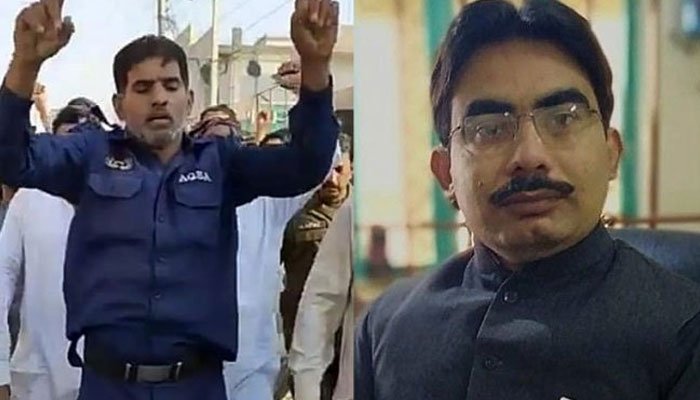
    An anti-terrorism court in Sargodha has sentenced a security guard involved in the murder of bank manager Imran Hanif to death on blasphemy allegations.

    The court also sentenced the convict to 12 years imprisonment and a fine of Rs1.15 million.

    Last year in November, security guards killed a bank manager on charges of alleged blasphemy.

    A seven-member ulema committee was formed in connection with the incident in Quaidabad area of Khushab district of Punjab. They declared that the bank manager had not committed blasphemy and this was a false accusation against him. The ulema committee declared the dead bank manager innocent.

  • LHC acquits couple sentenced to death for blasphemy

    In a landmark judgement, The Lahore High Court has acquitted a Christian couple who was on death row for seven years on the charges of alleged blasphemy.

    “I have to confess that after the justices had given their verdict I wept,” the lawyer of the acquitted couple told Catholic Charity Aid to the Church in Need (ACN).

    “There were times when I wondered if, after so long, justice would ever prevail in this case,” he added.

    The couple’s lawyer said that the case against the couple was always weak. “Who is responsible for taking eight years for justice to prevail?”

    The couple was arrested in 2013, under Section 295C on the charge of sending alleged blasphemous text messages.

  • PM wants world to look at blasphemy like Holocaust

    Prime Minister Imran Khan on Saturday urged the Western countries to outlaw rising instances of blasphemy, just as some countries restrict anti-Semitic speech or Holocaust denial.

    In a series of tweets, the prime minister condemned “extreme right politicians” in the West who “deliberately indulge” in willful and intentional provocations under the “guise of freedom of speech”.

    The premier made it clear that the government took action against TLP under the anti-terrorism law when it challenged the writ of the state and used street violence, as no one can be above the law and the country’s constitution.

    “Let me make [it] clear to people here and abroad [that] our government only took action against TLP under our anti-terrorist law when they challenged the writ of the state, used street violence and attacked the public and law enforcers. No one can be above the law and the Constitution,” the premier said in his tweets.

  • PM announces putting Labbaik’s demands, including ratification of blasphemy bill, forward in parliament

    Prime Minister (PM) Imran Khan has said that following an agreement with the hardliner Tehreek-e-Labbaik Pakistan (TLP), their demands will be put forward in the parliament.

    According to reports, the premier, in a statement, said that the government spoke to TLP, and the party has decided to extend the “deadline” given to the government from February to April 20.

    The demands put forth by TLP include the French ambassador’s deportation, ratification of the blasphemy bill, and a ban on French goods after blasphemous caricatures were published in France that had sparked protests across the Muslim world.

    Late last year, hundreds of protesters in Pakistan, most of them led by TLP leaders, had burned effigies of France’s leader and chanted anti-French slogans, as President Emmanuel Macron had tried to send a message of understanding to Muslims around the world.

    Smaller demonstrations in Lebanon, Turkey and India followed on anti-France protests across the Muslim world last week that were mostly led by Islamist groups, reported AP news agency.

    The renewed protests had come after President Macron’s interview in which he said that he understood the shock Muslims felt at caricatures depicting the Prophet Muhammad (PBUH).

    Macron was speaking with the Qatar-based Arabic TV station Al-Jazeera, where he also defended freedoms of expression and France’s secular values.

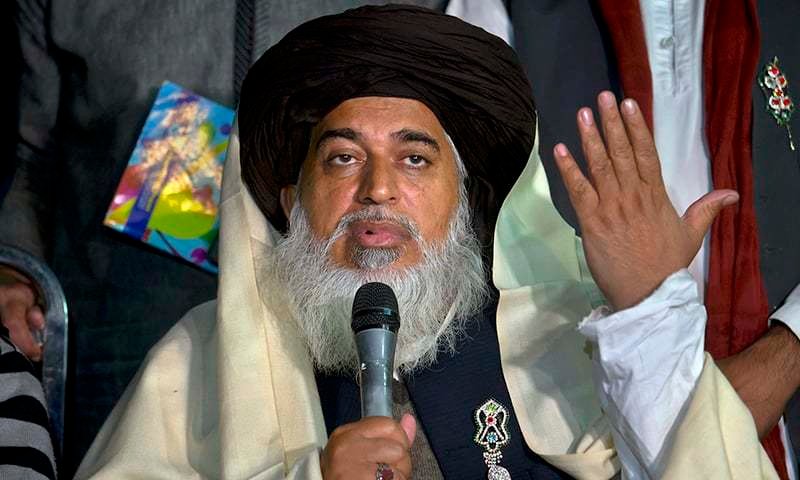
    Just days before TLP chief Khadim Rizvi’s death, the protests had also turned ugly in Rawalpindi-Islamabad.

  • Three men sentenced to death over blasphemous posts

    Three men sentenced to death over blasphemous posts

    An anti-terrorism court in Islamabad has sentenced three men to death over blasphemous posts on social media.

    The verdict was reserved in the case on Dec 15, 2020 after a four-year long trial.

    ATC judge Raja Jawad Abbas, while announcing the verdict, said the prosecution succeeded in proving its case against the accused.

    All three accused, Abdul Waheed, Rana Noman Rafaqat and Nasir Ahmed, have been found guilty, the ruling pronounced.

    A 10-year imprisonment sentence and Rs100,000 fine was also awarded to a professor, reported Geo.

    Blasphemy is a sensitive topic in Pakistan. Rights advocates have long been demanding a reform of the controversial laws, introduced by military dictator General Ziaul Haq in the 1980s.

    Human rights groups say blasphemy laws are often misused to persecute minorities or even against Muslims to settle personal rivalries. Such accusations can end up in lynchings or street vigilantism.

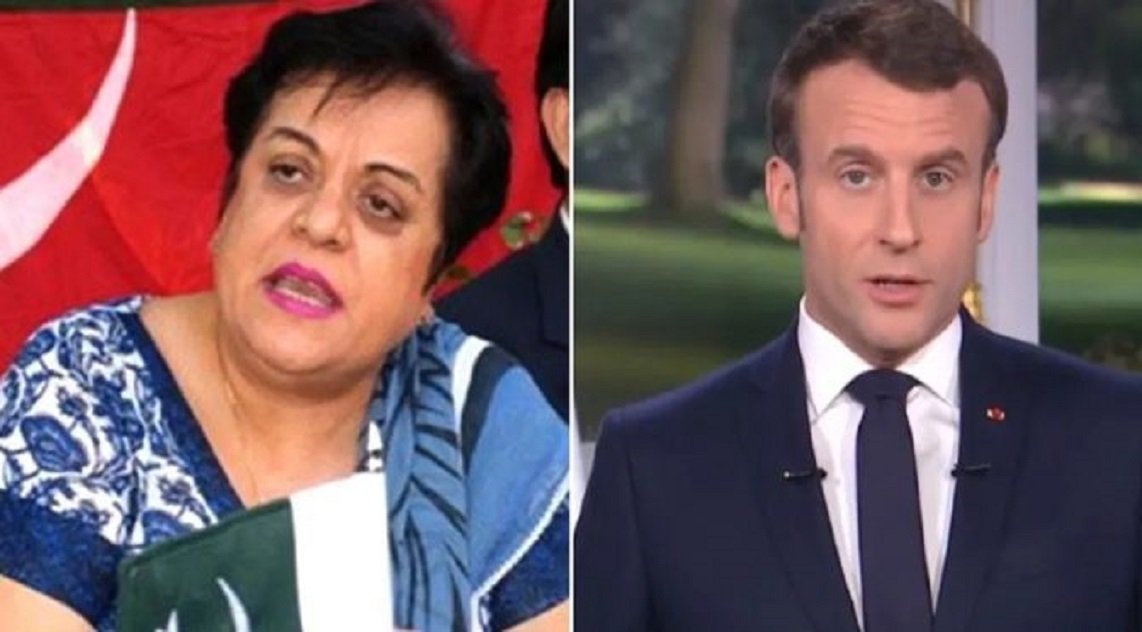
  • Shireen Mazari deletes tweet equating French president with Nazis after France strikes back

    Shireen Mazari deletes tweet equating French president with Nazis after France strikes back

    France on Sunday objected to a statement by Minister for Human Rights Shireen Mazari equating President Emmanuel Macron’s new measures to counter “Islamist separatism” in France with the anti-semitic policies of Nazi Germany, however, the issue was later resolved when both sides held dialogue after a false claim in the cited news article came to light.

    Earlier this week, Macron issued a “charter of republican values”, detailing a series of steps aimed at purging France of what he declared as “radical Islam”. One of the measures made it necessary for school-going children to wear an identification number that would be used to ensure they are attending school.

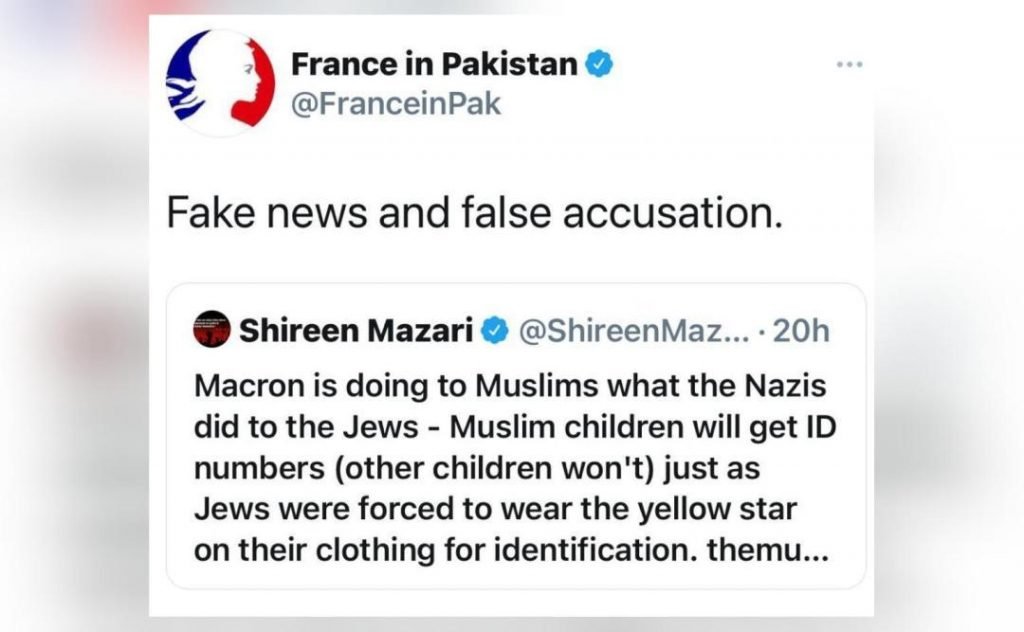
    Mazari, who apparently understood that the identification number would be issued exclusively to Muslim children, censured the move, saying through the new measures, “Macron is doing to Muslims what the Nazis did to the Jews” in Nazi Germany.

    “Muslim children will get ID numbers (other children won’t) just as Jews were forced to wear the yellow star on their clothing for identification,” she added linking to an online article.

    Responding to the tweet, the French Ministry of Europe and Foreign Affairs on Sunday issued a statement, calling the minister’s remark “insulting […] blatant lies, loaded with an ideology of hatred and violence.”

    The rather unceremonious statement asked Pakistan to “return to the path of dialogue based on respect.”

    The publication later amended the article and issued a clarification stating that the law mentioned in the article applies to all children in France, not specifically Muslim children.

    The embassy also sent a series of tweets to point out the mistakes in the article.

    In response to the French envoy’s message, Mazari deleted her tweet and issued a clarification on Twitter and admitted her mistake. “The French Envoy to Pak sent me the following message and as the article I had cited has been corrected by the relevant publication, I have also deleted my tweet on the same,” she tweeted.

    Responding to the minister’s tweet, the French Embassy thanked Mazari for the clarification and apology, and wrote that “freedom of expression and debates are essential in democracies, based on verified and accurate facts.”

    READ: ‘Stay out of our domestic affairs,’ French minister tells Pakistan and Turkey

    Macron on Wednesday unveiled the bill and asked Muslim leaders in France to agree to its instructions as part of a broad clampdown on so-called “Islamic extremism”. He gave the French Council of the Muslim Faith 15 days to work with the interior ministry.

    The bill includes measures which include: restrictions on home-schooling and harsher punishments for those who intimidate public officials on religious grounds; giving children an identification number under the law that would be used to ensure they are attending school and a ban on sharing the personal information of a person in a way that allows them to be located by people who want to harm them.

    Parents who break the law could face up to six months in jail as well as large fines, it said.

    The draft law — which Macron said will strengthen a 1905 law separating Church and state in France — will be discussed by the French cabinet on December 9.

    The new bill comes on the heels of three separate instances of terrorism following the publication of blasphemous caricatures by Charlie Hebdo, a French satirical weekly best known for vulgar irreverence, and Macron’s insistence on defending the act in the name of freedom of expression.

    Following the publication of these cartoons and Macron’s defense of it, relations between France and the Muslim world grew sour as tens of thousands of Muslims in several countries joined protests, burned effigies of Macron, chanted anti-French slogans and called for a boycott of French goods.

  • PM, army chief express condolences on death of TLP chief Rizvi

    PM, army chief express condolences on death of TLP chief Rizvi

    The demise of Tehreek-e-Labbaik Pakistan (TLP) chief Khadim Hussain Rizvi has been condoled by Prime Minister Imran Khan, Chief of Army Staff Gen Qamar Javed Bajwa among others.

    Rizvi, who rose to fame following a sit-in at Faizabad Interchange against the Pakistan Muslim League-Nawaz (PML-N) in 2018. His party also opposed the release of Aasia Bibi, a Christian woman who spent almost a decade on death row over false blasphemy accusations.

    In a tweet, the prime minister said: On the passing of Maulana Khadim Hussain Rizvi my condolences go to his family. Inna lillahi wa inna ilayhi raji’un.”

    In a tweet, the military media wing shared Gen Bajwa’s reaction to the death of the cleric. “General Qamar Javed Bajwa,#COAS, expresses heartfelt condolence on the sad demise of Allama Khadim Hussain Rizvi. “May Allah Almighty bless the departed soul in eternal peace.”

    Minister for Religious Affairs Noorul Haq Qadri also expressed grief and sorrow on the TLP chief’s death. He said: “Pakistan has lost a respected religious scholar and true admirer of the Holy Prophet (PBUH)”, adding that his “services for Islam will be remembered for long”.

    In a tweet, Jamaat-e-Islami (JI) chief Sirajul Haq expressed shock and grief over Rizvi’s sudden demise, saying his party shared the sorrow of his family members and TLP workers.

    On Thursday night, Rizvi died in Lahore supposedly due to coronavirus. Reports suggest that the cleric was suffering from the viral infection because he had high-grade fever for the past couple of days in addition to other complications.

    Rizvi is survived by his wife, two sons and three daughters.

    It may be noted here that Rizvi led a recent TLP rally in Islamabad against the blasphemous cartoons in a French magazine. Things had taken an ugly turn when participants of the protest-turned-sit-in had clashed with law enforcement personnel, resulting in over a dozen injuries.

    The law and order situation had been dealt with by the government after accepting the protesters’ demands.

  • Islamabad police book college student over alleged blasphemy

    Islamabad police book college student over alleged blasphemy

    Islamabad police have registered a case against a college student under sections 295-A and 298-A over alleged blasphemous remarks against companions of Prophet Muhammad (PBUH).

    The case registered at Shalimar police station on the complaint of a teacher. Section 295-A pertains to deliberate and malicious acts intended to outrage religious feelings of any class by insulting its religion or religious beliefs, whereas Section 298-A concerns derogatory remarks against holy personages.

    According to the FIR, some students reported the accused after they found “derogatory remarks” written on his coursebook next to the name of a certain companion of the prophet (PBUH). The students engaged in an argument with the student possessing the book, it added.

    The owner of the book hurt the religious sentiments of thousands of people and students, the FIR claimed.

    Last week, a National Bank of Pakistan (NBP) manager was gunned down by a security guard in Punjab’s Khushab district over blasphemy allegations.

    The victim, Malik Imran Hanif, was first taken to a local hospital, however, the nature of his gunshot wounds was so severe, he was shifted to Services Hospital in Lahore, where he succumbed to his injuries.

    Human rights groups say blasphemy laws are often misused to persecute minorities or even against Muslims to settle personal rivalries. Such accusations can end up in lynchings or street vigilantism.

  • National Bank manager killed by guard ‘for blasphemy’

    National Bank manager killed by guard ‘for blasphemy’

    A National Bank of Pakistan (NBP) manager has been shot by a security guard in Punjab’s Khushab district over blasphemy allegations, police reported.

    According to reports, the incident took place in in Quaidabad. The victim, Malik Imran Hanif, was first taken to a local hospital, however, the nature of his gunshot wounds was so severe, he was shifted to Services Hospital in Lahore, where he succumbed to his injuries.

    The guard who killed Hanif claims to have done so over blasphemy, but Khushab District Police Officer (r) Capt Tariq Wilayat said that it was too early to confirm this.

    According to initial reports, the two had been arguing for some time before the firing took place. Reportedly, the guard had been fired a few months back but had recently been rehired.

    The DPO felt sceptical of the guard’s blasphemy claims and said that it was likely the incident was due to personal grievances. However, a video of the incident emerged on social media, where the guard could be heard saying that the deceased manager had “insulted Prophet Muhammad (PBUH)”.

    Multiple videos of the occurrence emerged, in which the guard was seen being met with by a group of supporters, shouting slogans as they walked on the street, and then meeting the leaders of a religious group, all of whom raised slogans and addressed supporters from the rooftop of the Quaidabad Police Station.

    Another video showed the uncle of the deceased denying the guard’s claims, saying that they were Muslims, and had not insulted the Prophet (PBUH). The uncle asserted the killing was due to personal reasons.

    Human rights groups say blasphemy laws are often misused to persecute minorities or even against Muslims to settle personal rivalries. Such accusations can end up in lynchings or street vigilantism.