Tag: Brent Crude

  • Oil prices drop again on concerns over China’s economic changes

    Oil prices drop again on concerns over China’s economic changes

    In the wake of growing apprehensions over reduced oil consumption in China, a key player in the global oil market, oil prices witnessed a consecutive decline for the second day.

    The current market scenario reveals Brent crude trading at $82.16 per barrel, marking a 0.52 per cent decrease, while West Texas Intermediate crude (WTI) is trading at $77.9 per barrel, down by 0.6 per cent from the previous close.

    China, a significant oil consumer, declared its commitment to overhaul its economic development model and address industrial overcapacity concerns.

    Alongside these initiatives, China set its economic growth target for 2024 at approximately 5 per cent, a figure consistent with last year’s goal and in alignment with analysts’ predictions, according to Reuters.

    However, achieving this growth target may prove challenging this year, as analysts point out that China’s favourable base effect in 2023, resulting from the pandemic-affected 2022, may not be replicable. This potential hurdle has raised concerns and could impact investor sentiment.

    China, being the world’s largest crude importer, also announced intentions to intensify the exploration and development of oil and natural gas resources.

    Simultaneously, there is a commitment to tighten control over fossil fuel consumption, reflecting the nation’s dual focus on energy development and environmental responsibility.

    While anxieties regarding China’s demand outlook contributed to the downward pressure on oil prices, other factors provided support.

    Major oil producers’ decisions to reduce output and geopolitical tensions arising from the Israel-Gaza conflict played a role in sustaining crude prices.

    Over the weekend, the Organisation of the Petroleum Exporting Countries and its allies (OPEC+) extended their voluntary oil output cuts of 2.2 million barrels per day (bpd) into the second quarter.

    This decision aimed to bolster prices amidst global growth concerns and increased production outside the OPEC+ alliance.

  • Pakistani rupee extends winning streak against US dollar for 12th straight session

    Pakistani rupee extends winning streak against US dollar for 12th straight session

    The Pakistani rupee continued its upward trend against the US dollar for the 12th consecutive session, appreciating by 0.1 per cent in the inter-bank market on Thursday. 

    The State Bank of Pakistan reported that the rupee settled at Rs281.93, marking an increase of Re0.27. A day earlier, the rupee had experienced a slight gain, closing at Rs282.20 against the US dollar.

    In a related development, the Ministry of Finance acknowledged the persistent challenge of higher markup payments. The ministry stressed the importance of both revenue enhancement and prudent expenditure control.

    Internationally, the US dollar faced substantial losses on Thursday, poised for a yearly decline after two years of robust gains. 

    Anticipation of interest rate cuts from the Federal Reserve in the coming year influenced market sentiments. As the year concludes, limited market activity is expected until the New Year due to thin liquidity.

    The dollar index, measuring the US currency against six rivals, reached a five-month low of 100.81. It declined by 0.5 per cent on Wednesday and is on track for a 2.6 per cent decrease this year, breaking a two-year trend of strong gains. I

    Investors are closely monitoring the timing of potential interest rate cuts from the Fed, with markets indicating an 89 per cent chance of a cut in March 2024, according to the CME FedWatch tool. Futures suggest up to 158 basis points of Fed easing in the coming year.

    Oil prices, a significant indicator of currency parity, stabilised on Thursday following a previous sharp decline. 

    Concerns about shipping disruptions along the Red Sea route eased, despite escalating tensions in the Middle East. 

    Brent crude futures rose by 2 cents to $79.75 a barrel, while US WTI crude futures traded 3 cents lower at $74.08 a barrel, rebounding from a nearly 2 per cent drop on Wednesday as major shipping firms resumed operations in the Red Sea.

  • Petrol price may go down by Rs7.24 to Rs230.19 per liter

    According to industry projections, the ex-depot cost of petrol has declined by Rs7.24 per litre to Rs230.19 per litre for the upcoming fortnight from the current price of Rs237.43 per litre, as reported by The News.

    Considering recent reports, this might lead to a fall in the price of petrol by Rs7.24 per litre and diesel by Rs16.61 per litre in Pakistan at the upcoming fortnightly review if the government does not raise taxes to offset the effects of the declining worldwide market.

    Expected new prices

    In comparison to the present price of Rs247.43 per litre, the ex-depot price of diesel has fallen by Rs16.61 to Rs230.82 per litre for the upcoming two weeks.

    In comparison to the current fortnight, the ex-depot price of light diesel decreased by Rs10.87 to Rs186.41 per litre.

    Kerosene’s ex-depot price fell from Rs197.28 per litre to Rs187.82 per litre, a decrease of Rs14.20.

    The oil sector bases its prices on the current taxes levied by the government. Petroleum goods are exempt from general sales tax (GST), which is charged at a rate of Rs37.42 for petrol and Rs7.58 for diesel per litre.

    There has been a considerable decline in international oil prices, but it is unclear if the government would pass the impact through to the public or offset it by increasing taxes.

  • Global oil prices climb to highest in three weeks

    Oil prices increased on Monday as fears of limited global supply intensified, with the developing crisis in Ukraine raising the risk of more penalties from the West against Russia, the world’s leading exporter.

    Brent futures were up $1.50, or 1.3 per cent, at $113.20 a barrel, while US West Texas Intermediate futures were up 98 cents, or 0.9 per cent, at $107.93 per barrel. Both contracts surged more than 2.5 per cent on April 14, ahead of the Easter weekend holidays, on news that the European Union would phase in a ban on Russian oil imports.

    Last week, EU governments said that the bloc’s executive was working on ideas to ban Russian oil, but officials said Germany was not actively backing an immediate ban.

    Those remarks came before the Ukraine situation escalated over the weekend, with the Ukrainian military defying a Russian demand to lay down arms in the pulverised port of Mariupol on Sunday. Moscow, which refers to its efforts in Ukraine as a “special operation,” said its soldiers had nearly entirely captured the city, with no sign of a truce in sight.

    Read more: Oil prices jump following Russia’s biggest production decline

    Due to sanctions or importers voluntarily rejecting Russian shipments, the International Energy Agency has warned that around 3 million barrels per day (BPD) of Russian oil might be shut in from May onwards.

  • PM Shehbaz rejects OGRA’s proposal, petrol price to remain unchanged till April 30

    PM Shehbaz rejects OGRA’s proposal, petrol price to remain unchanged till April 30

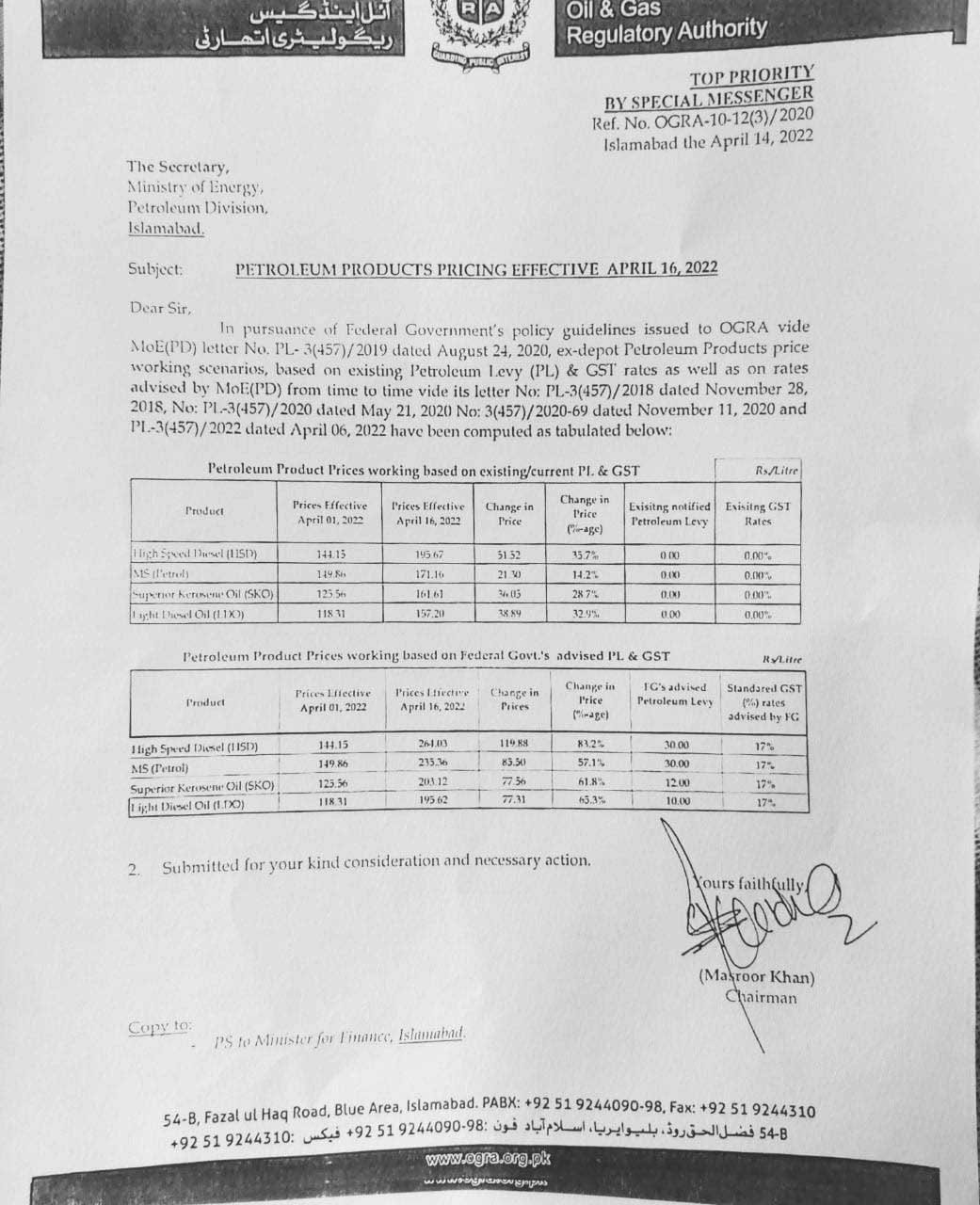
    Pakistan’s new Prime Minister (PM) Shehbaz Sharif on Friday dismissed the proposal from the Oil and Gas Regulatory Authority (OGRA) to raise the price of petroleum products for the fortnight. The recent decision is aimed at providing relief to the public affected by inflation.

    It is worth noting that the present government’s choice to maintain the same prices will oblige it to provide another substantial subsidy till the end of April 2022.

    Earlier, OGRA suggested to the Finance Division that the price of petrol be increased by Rs21.50 and that of diesel be hiked by Rs51.30 in view of the current petroleum levy and general sales tax (GST).

    Read more: Massive hike of Rs83.5 for petrol, Rs119 for diesel proposed by OGRA

    The authority also proposed a hike of Rs83.50 per liter of petrol and Rs119.88 per liter of diesel considering the federal government’s recommended petroleum levy of Rs30 and 17 per cent GST, as per the official statement.

  • Oil prices jump following Russia’s biggest production decline

    Oil prices jump following Russia’s biggest production decline

    Oil prices rose on April 13, after concerns that declining output in sanctions-hit Russia may affect supply, following the Russian announcement that peace negotiations to stop its invasion of Ukraine had reached a stalemate.

    Consequently, Brent crude futures were up 59 cents, or 0.6 per cent, to $105.23 a barrel, while West Texas Intermediate (WTI) crude futures were up 60 cents, or 0.6 per cent, to $101.20 a barrel. The previous session saw both contracts rise by more than 6%.

    On Tuesday, Russian President Vladimir Putin criticised Ukraine for the termination of peace talks and stated that Russia will not abandon its “special operation” to disarm its western neighbor.

    He stated that peace talks with Ukraine are at a stalemate, but that the seven-week operation is going as planned. In a note, ANZ oil experts stated that this raises the threat of the prolonged potential of supply disruptions in the oil sector.

    According to those familiar with the figures, Russian oil and gas extract output declined below 10 million BPD on April 11, the biggest drop since July 2020, as a result of sanctions imposed by numerous nations after Russia invaded Ukraine and logistical difficulties, which hindered business.

    This is quite serious as Russia is the world’s second-largest oil exporter.

    According to reports, Russia’s Energy Minister Nikolai Shulginov said late Tuesday that the government was willing to sell oil and oil products to “friendly countries in whatever price range,” adding that Moscow was focused on guaranteeing the oil sector’s proper functioning.

    Read more: International oil prices declined by 4%, crashing below $100 per barrel

    Meanwhile, indications of a partial relaxation of some of China’s strict COVID-19 restrictions have fueled optimistic sentiment between some market players this week.

  • International oil prices declined by 4%, crashing below $100 per barrel

    International oil prices declined by 4%, crashing below $100 per barrel

    Brent crude slid below $100 for the first time since March 16 amid plans to release huge amounts of petroleum and oil products from strategic storage, and also China’s prolonged coronavirus closure.

    Crude oil was down $4.1, or 3.99 per cent, at $98.68 per barrel. The price of US West Texas Intermediate (WTI) crude fell $4.28 a barrel, or 4.28 per cent, to $94.07 per barrel.

    The International Energy Agency (IEA) recently announced that member countries will release 60 million barrels over the next six months, with the United States matching that amount as part of its 180-million-barrel release announced in March.

    The actions are meant to make up for a shortfall of Russian crude after Moscow was extensively sanctioned for what it claims was a “special military operation” in Ukraine.

    As per JP Morgan analysts, the release of Strategic Petroleum Reserve (SPR) volumes will amount to 1.3 million barrels per day (BPD) over the next six months, enough to cover a 1 million BPD shortfall in Russian oil supplies.

    The release of strategic government oil reserves is projected to relieve some market tightness in the coming months, reducing the likelihood of oil prices rising and re-enforcing near-term supply constraints.

    While this is the largest release since the IEA stockpile was established in 1980, market participants believe it will fail to affect the principles of the oil market and will just delay further increases in production from crucial suppliers.