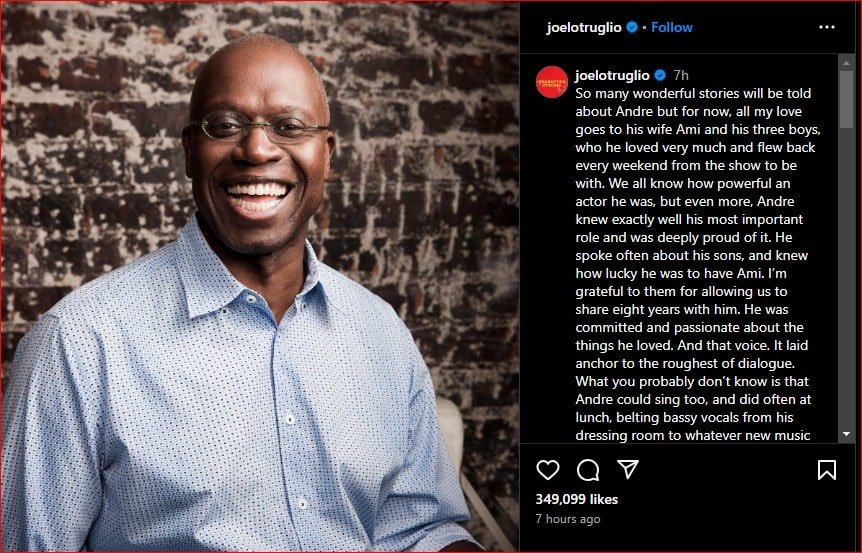
Brooklyn Nine-Nine star Andre Braugher, famously known as Captain Holt, has passed away at the age of 61.
He rose to fame with his role of a police officer in Homicide: Life On The Street, as detective Frank Pembleto, and was loved dearly among comedy fans for playing Captain Holt in the Andy Samberg-starrer sitcom.
Terry Crews, who played Lieutenant Terry Jeffords in the Golden Globe-winning series, took to his Instagram account to express disbelief in the shocking news.
“Thank you for your wisdom, your advice, your kindness and your friendship. Deepest condolences to your wife and family in this difficult time. You showed me what a life well lived looks like. Rest In Peace, Andre. I love you, man,” he wrote.
Chelsea Peretti, who played Gina, shared a picture of Andre with his portrait in police uniform and penned: “Love you ❤ ️ I will always cherish our conversations, often with me hanging in your doorway barring your exit, and the insane opportunity to be your sidekick.”
Jo Lo Truglio, aka Charles Boyle, wrote on his handle: “I miss him so much already. What an honor to work with a man who knew what it was really all about. I feel blessed and thankful. Miss you Capt Holt.”
Joel McKinnon Miller and Dirk Blocker, known as Detective Scully and Detective Hitchcock, respectively, also extended their condolences while singing praise for Andre’s talent.
“Sending love to Andre’s family and friends and all of us who had the honor of working with him,” Joel penned.
“The 9 years I was able to work with him and to just be in his presence was truly a blessing. My heartfelt condolences go out to his family,” Dirk wrote.
Melissa Fumero, who played B99’s female lead Amy Santiago, shared a picture from an old carousel she posted which featured Andre’s precinct office.
Kyra Sedgwick, the actress who played Captain Holt’s rival Captain Madelaine Wuntch, wrote on her Instagram stories, “Playing his other half in Brooklyn Nine Nine will forever be one of the highlights of my career.”
Meera has received her dose of COVID-19 vaccine in New York.
Sharing a video of herself getting the vaccine shot, Meera wrote: “Alhamdulillah, I was able to get vaccinated for COVID-19 a few days ago, while in New York.”
The actor shared that she experienced “mild symptoms including fever, headache, fatigue and body aches” after the vaccine but would still “recommend everyone to get vaccinated to keep you and your loved ones safe”.
Urging her followers to get vaccinated, Meera said: “Please don’t be scared of the vaccine, it’s only to help everyone survive from this pandemic.”
In one of the videos, Meera said that she received the Johnson & Johnson vaccine and urged her followers to take the vaccine “to keep fighting against COVID-19.”
Earlier this week, Meera was seen in a video with a man believed to be her father-in-law Raja Khalid Parvez. Parvez was driving the car while Meera thanked him for taking her to get a vaccine shot. Both of them were not wearing face masks.
Earlier, reports were rife that Meera has been admitted to a mental facility in the United States. At the time, Meera’s manager had confirmed to The Current that the actor had only gone to get vaccinated and that reports of her being admitted to a facility were completely baseless.
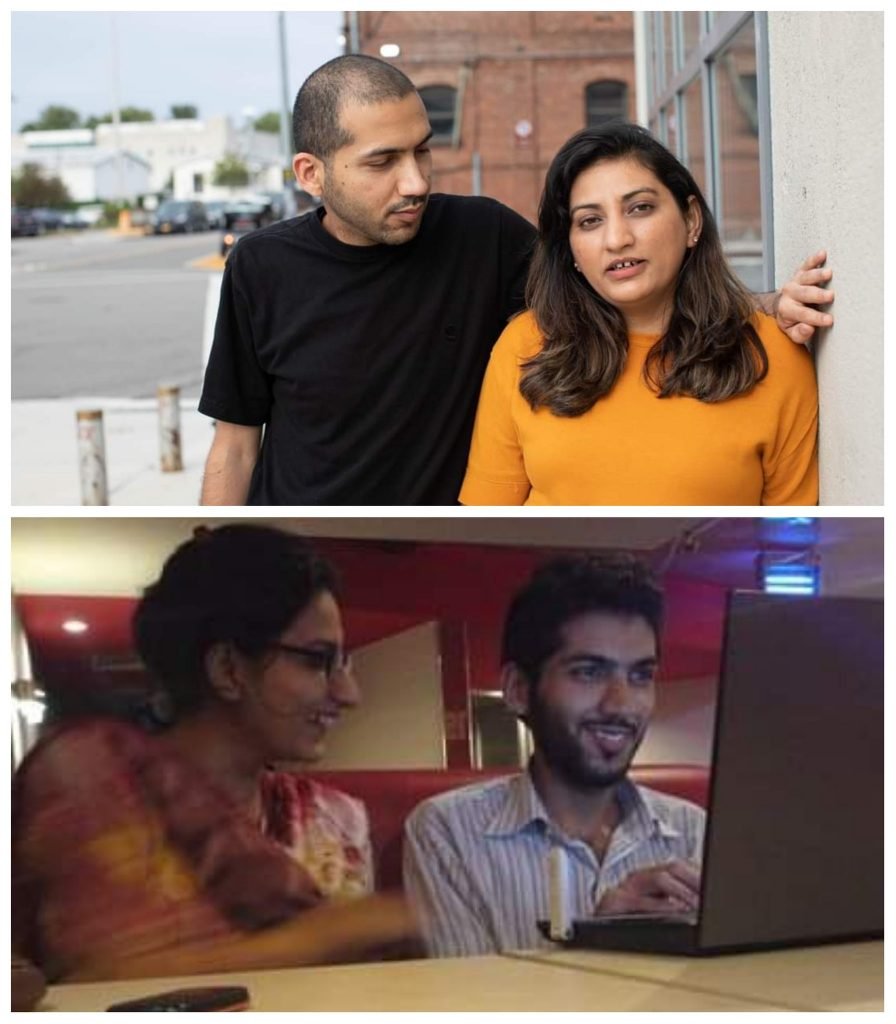
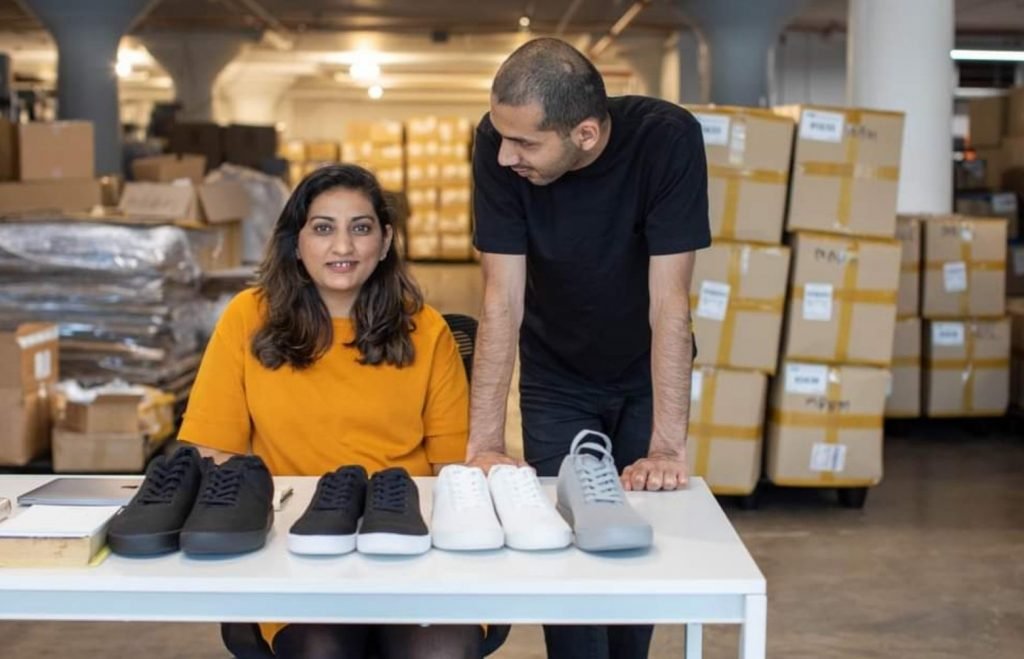
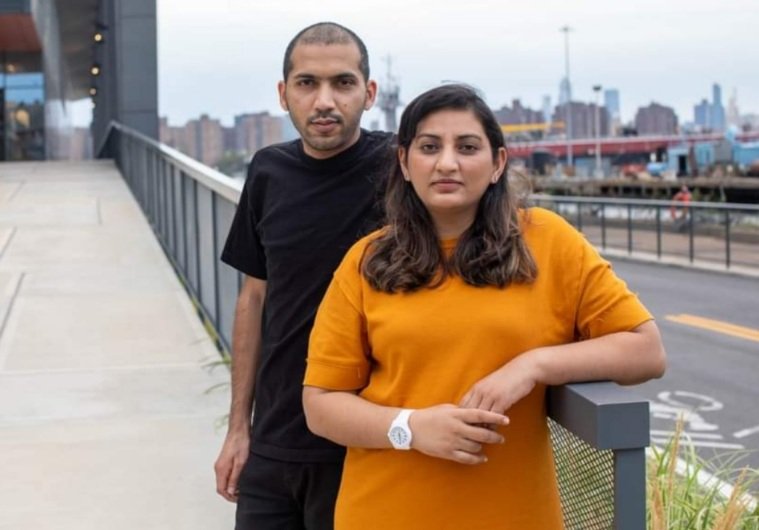
“Just two kids from a small town in Pakistan, who escaped their conservative families” is how Sidra Qasim describes herself and her husband, Waqas Ali, the power couple behind Atoms – a New York-based footwear brand known for its quarter sizes and comfortable sneakers.
However, their road to success was not an easy one. In an interview with Brandon Stanton of Humans of New York, Sidra opened up about their journey and how they set up their footwear brand.
“It’s the same story taught to every Pakistani girl. We are raised from a young age to believe that our purpose in life is to find and keep a husband,” said Sidra in the first of her 11-part interview. But even as a child, Sidra had bigger dreams, and she held on to them even as her family pressurized her to get married right out of school.
Sidra, who belongs to the small town of Okara, first met Waqas at her aunt’s house. He was one of her aunt’s students.
“We’d discuss life, and society, and human emotions. It became the only chance I had to exchange my ideas with anyone. And Waqas took my opinions seriously,” she shared.
After school, Sidra enrolled in a college and became one of the only 15 female students there. It was after she successfully produced a play to help with flood relief efforts that Waqas asked her to join him in Lahore – where he had moved to study further – and become his business partner.
“It finally felt as though my talents were being recognised, and the next day I asked for my parent’s permission. But they refused,” said Sidra.
The refusal came as a blow to Sidra, who describes lying listlessly on the couch for weeks – to the point where it scared her father. Eventually, they agreed to let her move to Lahore, where she began working with Waqas on a company called ‘Social Media Art’ which aimed to help brands establish a social media presence.
As their company struggled, Waqas and Sidra grew closer.
“We never discussed the status of our relationship, but both of us could feel a closeness. We were bonded by our journey. Both of us were defying our parents,” she said. “But after a year of rejection, we had begun to lose hope.”
A ray of hope came from unlikely quarters when Sidra and Waqas met with a group of craftsmen in the local village council of Okara.
“They were making leather shoes on the floor of a two-room workshop,” she added.
Sidra returned to the workshop again and again for a week and, in the end, the craftsmen agreed to collaborate with them.
While Waqas worked on the website, Sidra ensured that the shoes they produced met the “highest quality standards”.
“We called our collection ‘Hometown Shoes.’ And after we launched our website, the first order came in right away,” said Sidra, adding that though they made a loss on the order due to the high shipping cost to France, the couple did not give up hope.
“After a year we were selling about 50 shoes per month. We were happy to have any business at all, but it wasn’t nearly enough to survive,” said Sidra. They started a highly successful Kickstarter campaign and raised $1,07,000 in 2014 by selling over 600 pairs of shoes.
After that, Sidra and Waqas got married in a small ceremony – and immediately began to work on their application for the Y-combinator accelerator program in San Francisco. “The admissions process was more selective than Harvard, and they’d helped launch companies like Airbnb and Dropbox,” Sidra added.
Although she describes their interview as a “disaster”, they did get through and moved to the US.
Their time at Y-combinator was one of making mistakes and learning from them. “We were the only company in our group who didn’t raise money. And to make matters even worse, it had been a formal event,” said Sidra, describing Demo Day which is sort of a final exam for participants of the program. “Many of our classmates had dressed up. But none of them were wearing the shoes we had sold them.”
Doing more market research helped them understand that most people wanted shoes they could wear every day, and so Sidra and Waqas shifted their focus from formal footwear to casual.
“We researched the highest quality materials, and we put all of our findings into a document called ‘Ideal, Everyday Shoe.’ Then we gave all our notes to a talented designer. Together we built a prototype, and we called them ‘Atoms,’ because we’d gone to the atomic level in search of quality.”
It took them several months to manufacture their first collection after extensive customer feedback and market research. “By the time we were ready to launch, 45,000 people had signed up for our mailing list. On the first day of sales, our website crashed,” Sidra continued.
Their company expanded to 25 employees, but they also had to go through a round of layoffs. At the beginning of the pandemic, to stay afloat in the face of dwindling funds and investors unwilling to put in more money, Atoms expanded to making masks.
“One year later we’ve sold 500,000 of them and donated 500,000 more. Our shoe business has continued to grow, and once again investors are calling on the phone,” Sidra told Humans Of New York.
She concluded the interview by talking about the change that her business has helped brought about. She has been able to help her family back in Pakistan financially. “But more importantly I’ve provided an example,” says Sidra.
One of her younger sisters is now working as a fitness coach, the other is selling sanitary pads. But the biggest transformation, she said, has been in her mother – a school headmistress who now tells her students to be financially independent and learn technology.
“She’s telling them all the things that I needed to hear as a little girl. The road was so lonely for me, and maybe I still carry some unconscious resentment,” said Sidra.
“But my mother has apologised for not supporting me more. And consciously I have forgiven her.”
Sidra and Waqas started Atoms armed with ambition, curiosity, and a passion for making shoes. Despite coming from modest, traditionally conservative upbringings, that drive took them from Okara, Pakistan, to the closest big city—Lahore, to Silicon Valley, and then to Brooklyn, where Atoms is currently based.