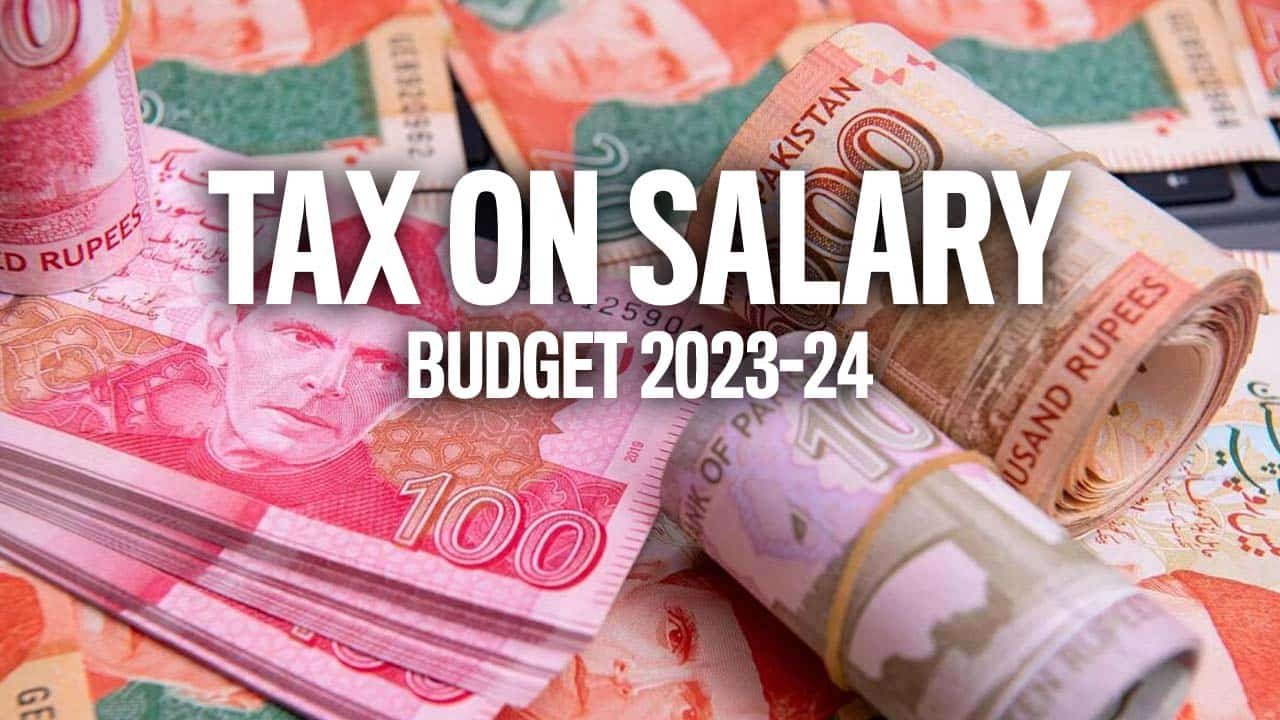
Finance Minister Ishaq Dar presented a comprehensive budget proposal of Rs14.46 trillion for the fiscal year 2023-24, emphasising an expansionary approach. One of the key highlights of the proposal was a substantial increase in the salaries of government employees, aimed at providing much-needed relief.
In order to ensure that the burden on the salaried class remained unchanged, the coalition government decided not to make any alterations to the existing tax slabs, which were approved in the previous year’s Finance Bill of 2022.
Outlined below are the tax slabs for different income brackets:
1. Income below Rs600,000 per year (Rs50,000 per month):
– No tax will be deducted.
2. Income between Rs600,000 to Rs1.2 million per year (Rs50,000 to Rs100,000 per month):
– Tax will be levied at a rate of 2.5 per cent on the amount exceeding Rs600,000.
3. Income between Rs1.2 million to Rs2.4 million per year (Rs100,000 to Rs200,000 per month):
– Tax will be levied at a rate of Rs15,000 plus 12.5 per cent on the amount exceeding Rs1.2 million.
4. Income between Rs2.4 million to Rs3.6 million per year (Rs200,000 to Rs300,000 per month):
– Tax will be levied at a rate of Rs165,000 plus 20 per cent on the amount exceeding Rs2.4 million.
5. Income between Rs3.6 million to Rs6 million per year (Rs300,000 to Rs500,000 per month):
– Tax will be levied at a rate of Rs405,000 plus 25 per cent on the amount exceeding Rs3.6 million.
6. Income between Rs6 million to Rs12 million per year (Rs500,000 to 1,000,000 per month):
– Tax will be levied at a rate of Rs1.005 million plus 32.5 per cent on the amount exceeding Rs6 million.
7. Income exceeding Rs12 million per year (exceeding Rs1,000,000 per month):
– Tax will be levied at a rate of Rs2.955 million plus 35 per cent on the amount exceeding Rs12 million.
These tax slabs have been carefully designed to ensure a fair and balanced approach to income taxation, considering various income brackets. By maintaining consistency with the previous year’s tax slabs, the government aims to alleviate the burden on the salaried class while still generating the necessary revenue for public welfare and development initiatives.
Overall, the budget proposal presented by Finance Minister Ishaq Dar reflects the government’s commitment to supporting government employees and maintaining a progressive tax system that promotes economic growth and fairness.
| Tax slabs | Annual income | Monthly income | Tax rate |
| Slab 1 | Below Rs600,000 | Below Rs50,000 | No tax deducted |
| Slab 2 | Rs600,000 – Rs1.2 million | Rs50,000 – Rs100,000 | 2.5 per cent of the amount exceeding Rs600,000 |
| Slab 3 | Rs1.2 million – Rs2.4 million | Rs100,000 – Rs200,000 | Rs15,000 + 12.5 per cent of the amount exceeding Rs1.2 million |
| Slab 4 | Rs2.4 million – Rs3.6 million | Rs200,000 – Rs300,000 | Rs165,000 + 20 per cent of the amount exceeding Rs2.4 million |
| Slab 5 | Rs3.6 million – Rs6 million | Rs300,000 – Rs500,000 | Rs405,000 + 25 per cent of the amount exceeding Rs3.6 million |
| Slab 6 | Rs6 million – Rs12 million | Rs500,000 – Rs1,000,000 | Rs1.005 million + 32.5 per cent of the amount exceeding Rs6 million |
| Slab 7 | Above Rs12 million | Above Rs1,000,000 | Rs2.955 million + 35 per cent of the amount exceeding Rs12 million |