Tag: budget

  • Moody’s warns of limited loan options for Pakistan without new IMF programme

    Moody’s warns of limited loan options for Pakistan without new IMF programme

    According to a report by Moody’s Investors Service, Pakistan’s ability to secure loans from bilateral and multilateral partners will be severely limited until a new programme is negotiated with the International Monetary Fund (IMF). The report suggests that it may only become clear whether Pakistan will join another IMF programme after the elections, which are scheduled to take place by October 2023. Furthermore, even if negotiations for a new IMF programme are successful, they are expected to take some time.

    Moody’s warns that Pakistan is unlikely to access affordable market financing from sources such as Eurobonds or commercial banks in the foreseeable future. In fiscal year 2023, the government did not issue any Eurobonds and fell significantly short of its target by raising only Rs521 billion ($2.8 billion) from commercial banks, compared to the target of Rs1.4 trillion set in the fiscal year 2022-23 budget.

    The report also highlights the high external debt repayment burden for Pakistan in the coming years, with approximately $25 billion of repayments (principal and interest) due in fiscal year 2024. Additionally, Pakistan’s foreign exchange reserves are very low at $3.9 billion as of June 2.

    Moody’s further expresses uncertainty about Pakistan’s external funding prospects for fiscal year 2024 and beyond, noting that it is not guaranteed that Pakistan will secure the $2.4 billion from the IMF as budgeted. The IMF has been in talks with Pakistan regarding the ninth tranche of a $6.5 billion bailout package, with the current programme set to expire at the end of June.

    Regarding debt rescheduling, the report mentions that the government is considering rescheduling bilateral debts but has no plans to approach the Paris Club or multilateral partners for debt rescheduling. Moody’s states that a suspension of debt service obligations only to official creditors is unlikely to have direct rating implications, as it would provide the government with additional fiscal resources for essential expenditures in health, social, and infrastructure sectors.

    Moody’s criticises Pakistan’s newly announced budget for the fiscal year 2023-24, noting that it lacks significant revenue-raising or spending-containment measures to alleviate intense government liquidity pressures. The report suggests that the deficit estimates and growth projections in the budget may be overly optimistic, given the economic stresses faced by the country, including government liquidity and external vulnerability pressures, which have been exacerbated by severe floods in August 2022, expected to impact economic activity throughout fiscal year 2024.

    The budget does provide relief measures for households and businesses, including a reduction in fuel and electricity prices, an increase in the minimum wage, and a one-time cash transfer to low-income households. However, a substantial portion of the increased expenditure is allocated to salaries and pensions for government employees, with total employee-related expenses budgeted at Rs1.2 trillion, compared to an estimated spending of Rs960 billion in fiscal year 2023. The government has also earmarked Rs2.8 trillion for grants and subsidies in fiscal year 2024, compared to an estimated Rs2 trillion in fiscal year 2023.

    Pakistan’s low revenue-to-GDP ratio is identified as a major constraint on the government’s debt affordability and debt burden. The budget aims to achieve tax revenue of Rs9.2 trillion in fiscal year 2024, representing a 28 per cent increase from the estimated Rs7.2 trillion in fiscal year 2023. However, Moody’s sees significant downside risks to this revenue projection, given the lack of significant revenue-raising measures and the current economic context.
  • Budget 2023-24: Silent Budget, Fading Democracy

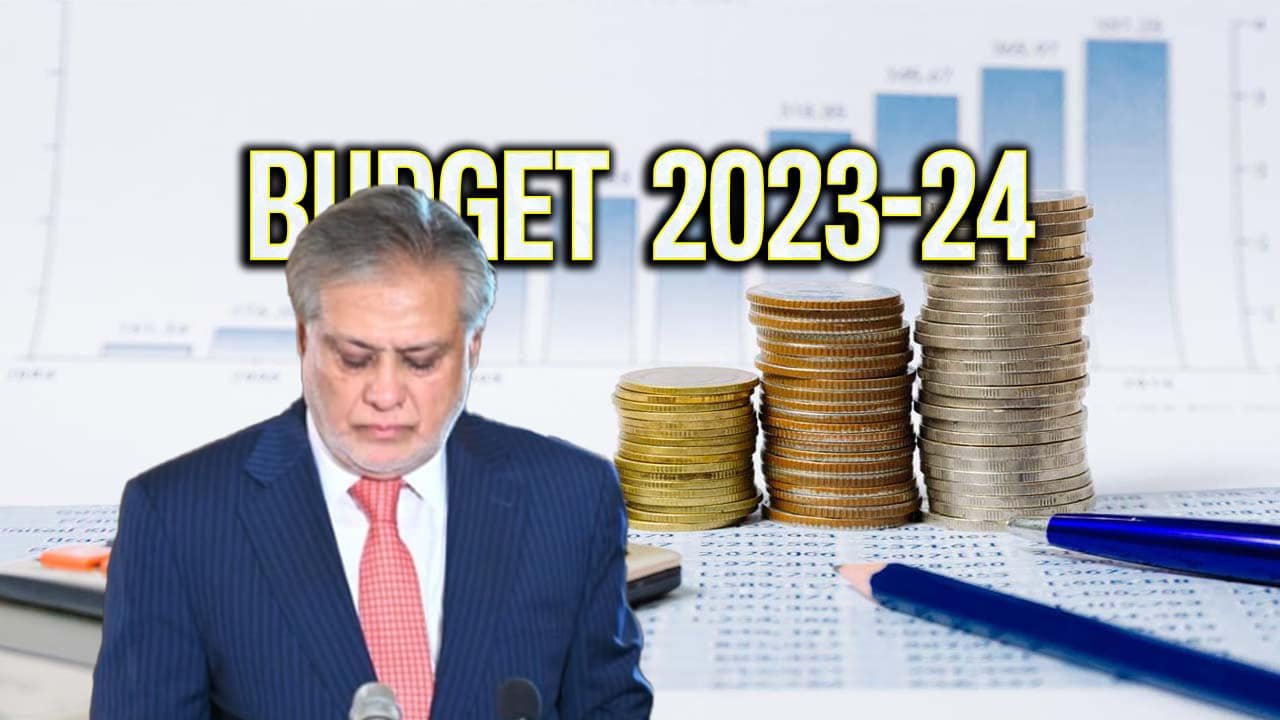
    Amidst endless political turmoil, with inflation standing at 38 per cent in May and the country teetering on the brink of default, Finance Minister Ishaq Dar presented the budget for the fiscal year 2023-24 on Friday. There was no Opposition present in parliament to suggest amendments. The budget was presented without the chaos we usually witness during budget speeches.

    Whatever semblance of Opposition we have, did criticise the coalition government for presenting a budget that appeases the International Monetary Fund (IMF). However, the chances of an IMF bailout appear slim, and if the bailout does not materialise, the threat of default is significant.

    In the next fiscal year, external payments of 25 billion dollars are required, which cannot be arranged without the IMF, as no international organisation will provide funds without the IMF’s involvement.

    It is also pertinent to mention here that no target from the previous budget was achieved. The growth target was set at 5 per cent, but it remained at 0.28 per cent, an abysmally low rate. The inflation target was set at 11.5 per cent, but it remained at 29 per cent, an astonishingly high rate.

    Budget deficit exceeded the target by Rs2.2 trillion, and the upcoming fiscal year has a tax target of Rs9.2 trillion, out of which 80 per cent, or Rs7.3 trillion, will be spent on paying interests alone.

    Pakistan Tehreek-e-Insaf (PTI) has rejected the budget, claiming that it offers no relief for the poor. Maybe if they had stayed in parliament and expressed criticism on the floor of the House, their objections could have had a stronger impact and they could have had a significant influence on shaping the budget. PTI’s criticism from outside parliament, without any actual impact, highlights the crucial role of the Opposition’s presence in such situations.

    A functioning democracy relies on the active participation of the Opposition to ensure the budget serves the interests of all citizens. The current scenario calls for a commitment to democratic values and for an Opposition that can help to effectively shape policies. The presence of Opposition in parliament is not just a symbol of a healthy democracy, it is a prerequisite for balanced decision-making, inclusive policies, and a stronger, more prosperous Pakistan.

  • Ishaq Dar to present Rs14.7 trillion budget for FY2023-24 today

    Ishaq Dar to present Rs14.7 trillion budget for FY2023-24 today

    Finance Minister Ishaq Dar is set to reveal the federal budget for the fiscal year 2023-24 today, with a proposed outlay of Rs14.7 trillion. The budget carries a higher consolidated budget deficit, exceeding 6 per cent of the GDP, and includes allocations for various targeted schemes aimed at attracting voters in the upcoming general elections.

    The government has established targets for tax collection by the Federal Board of Revenue (FBR) at Rs9.2 trillion, along with a non-tax revenue target of Rs2.7 trillion. To achieve the non-tax revenue target, the government plans to amend the finance bill, raising the petroleum development levy (PDL) from Rs50 per litre to Rs55-60 per litre. This adjustment aims to collect Rs870 billion in the next budget, as opposed to the revised estimate of Rs550 billion for the outgoing fiscal year.

    The credibility of the budgetary figures remains a concern as they are subject to change throughout the financial year. If a new government assumes power after the general elections, it will likely need to introduce a mini-budget to align economic realities with the International Monetary Fund (IMF) and secure a fresh bailout package.

    The government’s ability to satisfy the IMF on the revival of the stalled programme is yet to be seen. The continuing stalemate may endanger the diminishing foreign exchange reserves, with the State Bank of Pakistan’s reserves falling below $3.9 billion.

    Without establishing a comprehensive budgetary framework with the IMF, signing the staff-level agreement will be impossible. Fulfilling three conditions becomes crucial: securing external financing of $6 billion, presenting the next budget in accordance with IMF guidelines, and ensuring a market-based exchange rate.

    The IMF programme is scheduled to conclude on June 30, making any further extension unlikely, as stated by the finance minister during the launch of the Economic Survey for 2022-23. The need for a realistic budget for the next financial year is evident due to the lack of credibility surrounding the budgetary figures, which frequently undergo changes.

    The tenure of the Pakistan Democratic Movement (PDM)-led government is set to expire on August 12. However, the government has approved an allocation of Rs90 billion for the implementation of the SDGs Achievement Programme (SAP) in the next budget, compared to the revised allocation of Rs116 billion for the current financial year.

    Ensuring external debt servicing, which requires $25 billion, is the primary priority of the government in the next budget. How the government plans to generate such a substantial amount, considering it obtained just under $8.1 billion in the first ten months of the current fiscal year out of the total budgeted figure of $22.8 billion for external loans and grants, remains to be seen.

    The fiscal constraints present significant challenges, as the total net revenue receipts of the federal government are insufficient to meet debt servicing requirements. After transferring resources to provinces and accounting for non-tax revenue, the total net receipts of the federal government are expected to amount to Rs6.5 trillion.

    Meanwhile, total debt servicing will consume Rs7.5 trillion, resulting in a deficit of Rs1,000 billion for the federal government. Therefore, other expenditure categories, such as defense, salaries, pensions, civil government operations, subsidies, and grants to public sector enterprises, will have to be funded through borrowing.

    During the survey launch, the finance minister pledged the government’s commitment to increase salaries, pensions, and minimum wages for workers in the FY24 budget. To finance the substantial budget deficit in the next financial year, Pakistan will need to acquire domestic and foreign loans amounting to Rs7,000 to Rs7,500 billion.

    The challenges ahead do not have easy solutions, and addressing them will require profound structural reforms to navigate the economy out of its crisis mode.

  • PM Shehbaz urges Finance Ministry to ensure strict adherence to IMF guidelines in upcoming budget

    PM Shehbaz urges Finance Ministry to ensure strict adherence to IMF guidelines in upcoming budget

    In a meeting held between Prime Minister (PM) Shehbaz Sharif and Finance Minister Ishaq Dar on Tuesday, it was emphasized that the upcoming budget, scheduled to be presented on June 9, should strictly adhere to the parameters set by the International Monetary Fund (IMF).

    PM Shehbaz Sharif has expressed his optimism about reaching an agreement with the IMF, dispelling media reports suggesting a populist budget typically seen in election years.

    An informed source, who was present during the meeting, highlighted that Pakistan cannot afford to deviate from the IMF’s prescribed principles in the budget. The PM’s resolve to adhere to these guidelines was reinforced after his recent telephonic conversation with IMF Managing Director Kristalina Georgieva. It was during this conversation that PM Shehbaz Sharif personally appealed to Georgieva to revive the stalled $6.5 billion bailout package.

    The discussion between the PM and the IMF Managing Director took place due to the finance ministry’s inability to break the deadlock over loan talks in the past four months. However, the source disclosed that PM Shehbaz Sharif expressed satisfaction after his conversation with Georgieva, leading to an agreement to share the budget details with the IMF.

    Furthermore, the IMF Managing Director indicated the possibility of a revival of the programme. This positive development prompted PM Shehbaz Sharif to inform the Turkish media during his visit to Ankara that Pakistan remains hopeful of finalising a deal with the IMF this month. He assured that Pakistan had met all the required conditions and that the upcoming budget would align with the terms and conditions set forth by the IMF.

    “We are still very hopeful that the IMF programme will materialise. Our ninth review by the IMF will match all terms and conditions, and hopefully, we’ll have some good news this month,” PM Shehbaz Sharif stated during an interview with Anadolu in Ankara, where he was present for President Recep Tayyip Erdogan’s inauguration ceremony.

    According to Geo, the PM further clarified that while some actions are typically met after the board’s approval, this time, the IMF insisted on meeting those actions before granting approval. He affirmed that Pakistan has fulfilled these requirements as specified by the IMF.

    As the budget presentation approaches, all eyes are now on the Ministry of Finance, which has been tasked with ensuring strict compliance with IMF parameters. With the PM’s renewed optimism and the positive signals received from the IMF, there is a growing sense of hope that Pakistan will be able to secure the much-needed financial support to address its economic challenges.

    It remains to be seen how the upcoming budget will reflect the government’s commitment to IMF compliance and whether it will lead to a successful conclusion of negotiations with the international financial institution.

  • Govt expected to present Rs13-15 trillion budget for FY23-24 amidst economic uncertainties

    Govt expected to present Rs13-15 trillion budget for FY23-24 amidst economic uncertainties

    The government is anticipated to present a budget ranging from Rs13-15 trillion for the fiscal year 2023-24, according to a budget preview report by Topline Securities. This substantial increase is attributed to the record-high markup cost caused by the soaring interest rates. The proposed budget target of Rs9-9.2 trillion marks a 21 per cent surge compared to the current fiscal year’s target of Rs7.5 trillion.

    Notably, if implemented, the tax target for the upcoming financial year would be 29 per cent higher than the projected tax collection for the outgoing FY23. However, the brokerage house highlights the challenging nature of formulating a budget amidst stagflation and uncertainties surrounding the upcoming elections and Pakistan’s ability to bridge its external account funding gap.

    The report emphasises the prevailing nervousness in currency, bond, and stock markets due to the uncertainty surrounding the financing of the US dollar funding gap. Furthermore, it states that revenue targets have historically deviated by an average of 8 per cent from the actual targets in the past five years, and a similar trend is expected in FY24 due to the economic slowdown.

    The non-tax revenue target for FY24 is estimated at Rs2.5 trillion (2.4 per cent of GDP), compared to Rs1.6 trillion (2 per cent of GDP) for FY23. The report predicts several taxation measures, including tax on undistributed reserves, continuation of the super tax, a shift from the final tax regime to the minimum tax regime, asset/wealth tax, higher tax on non-filers, tax on rental income, and taxes on banks, tobacco, and beverages.

    Regarding development spending, the Federal Public Sector Development Programme (PSDP) is projected to amount to Rs0.9 trillion for FY24. However, due to fiscal constraints, significant cuts are expected in this area. The consolidated PSDP (federal and provincial) is anticipated to reach Rs2.6 trillion (2.5 per cent of GDP) in FY24.

    With the Pakistan Tehreek-e-Insaf (PTI) party being sidelined, there is a possibility of a weak coalition government coming to power in the upcoming elections. The report highlights the importance of an aggressive and competent new setup to tackle the ongoing economic crisis.

    To create a favorable perception, the government may set unrealistic revenue targets in order to allocate more spending in the budget. The report suggests that it is unlikely for the government to complete the current International Monetary Fund (IMF) program on time and urges Pakistan to enter another, potentially larger, IMF program.

    In light of the economic slowdown and high inflation, the government may introduce expansionary policies in the budget to appease the public, such as direct cash subsidies for the underprivileged and an increase in minimum wages. However, the brokerage firm warns against excessive spending without substantial tax collection measures.

    In terms of its impact on the stock market, the upcoming budget is expected to be neutral to positive. Sectors such as oil and gas exploration, chemicals, pharmaceuticals, consumers, tobacco, technology and communication, textile, cement, fertilizers, and oil marketing companies may experience a neutral effect. Conversely, the budget might have a neutral to negative impact on banks and autos, while steel and independent power producers could experience a neutral to positive effect, according to the research.

    As the budget is unveiled, stakeholders and citizens alike will closely monitor the government’s strategies to address the economic challenges and promote stability and growth in Pakistan.

  • Proposed increase in advance tax on vehicle registration to impact expensive car buyers

    Proposed increase in advance tax on vehicle registration to impact expensive car buyers

    With the upcoming budget just days away, the Federal Board of Revenue (FBR) is deliberating on measures to increase the advance tax on motor vehicle registration, particularly targeting non-filers. The proposed plan suggests raising the tax rate by 10 to 35 per cent based on the value of vehicles.

    Currently, the advance tax is determined by engine capacity, but significant changes are being considered for the forthcoming budget, set to be revealed in the first week of June. The Resource and Revenue Mobilisation Commission (RRMC) has recommended imposing the advance tax based on the value of the vehicle.

    As per the proposed rates, the RRMC has advised the government to impose a 2 per cent advance tax on the corporate sector and 3 per cent on the non-corporate sector for individuals listed in the active taxpayers list (ATL) for the past three years. These rates would apply to motor vehicles valued up to Rs10 million.

    For individuals, the proposed tax rate stands at 10 per cent. As for motor vehicles valued between Rs10 million and Rs30 million, the recommended tax rates are 4 per cent and 5 per cent for the corporate and non-corporate sectors, respectively, provided they are part of the ATL for the past three years.

    Moving up the value scale, vehicles valued between Rs30 million and Rs100 million would face tax rates of 6-7 per cent for the corporate and non-corporate sectors. The proposed tax rate for individuals would be increased significantly to 30 per cent.

    For vehicles valued up to Rs100 million, the proposed tax rates are 8 per cent and 10 per cent for the corporate and non-corporate sectors, respectively, for individuals present in the ATL for the past three years. Individuals falling under this category would face a tax rate of 35 per cent.

    The RRMC has also recommended subjecting the transport sector to a minimum tax regime of 3 per cent of the gross turnover, applicable to transport services provided to withholding agents. Additionally, a tax rate of 3.5 per cent would be levied on the gross amount received for the provision of carriage services by transport contractors, while oil tanker contractors would face a tax rate of 2.5 per cent.

    These proposed changes in the tax structure aim to generate increased revenue for the government and incentivize compliance with tax regulations. By targeting motor vehicle registration, the FBR hopes to enhance revenue collection and promote a fair tax system.

    It is essential to note that these proposed changes are subject to approval and implementation during the budget announcement. The FBR and RRMC are carefully evaluating the potential impact of these adjustments on various sectors and taxpayers, striving to strike a balance between revenue generation and taxpayer convenience.

  • Health activists urge govt to impose higher taxes on cigarettes for public welfare

    Health activists urge govt to impose higher taxes on cigarettes for public welfare

    Health activists and civil society organizations are calling on the government to impose higher taxes on cigarettes in the upcoming 2023-24 budget, signaling a potential increase in smoking costs for Pakistani consumers.

    Advocates argue that regular tax hikes on tobacco products, in line with the recommendations of the World Health Organization (WHO), are necessary to combat the detrimental effects of smoking in the country.

    Sanaullah Ghumman, representing Pakistan National Heart Association (PANAH), emphasised the importance of consistent taxation on cigarettes, urging the government to align with WHO guidelines. Ghumman’s plea reflects the growing concern over the devastating health consequences associated with tobacco consumption.

    Malik Imran, Country Head of the Campaign for Tobacco-Free Kids (CTFK), highlighted the impact of the government’s recent decision to raise the Federal Excise Duty (FED) on cigarettes in February 2023. This move generated an additional Rs11.3 billion in FED revenue for the fiscal year 2022-23, marking a 9.7 per cent increase from the previous year. Moreover, an extra 4.4 billion in VAT revenue was collected during the same period, representing an 11.5 per cent rise. These figures amount to a substantial boost of 15.7 billion, contributing 0.201 per cent to Pakistan’s struggling economy.

    Imran dismissed the tobacco industry’s claims of illicit trade as a diversion tactic to undermine the benefits of increased taxation. He emphasised that the economic gains resulting from higher prices indicate the viability of this approach, which aids in curbing smoking-related healthcare costs.

  • Pakistan reaffirms commitment to $6.5 billion IMF bailout, dismissing rumors of retraction

    Pakistan reaffirms commitment to $6.5 billion IMF bailout, dismissing rumors of retraction

    On Wednesday, Minister of State for Finance and Revenue, Dr Aisha Ghaus Pasha, dismissed rumours of Pakistan retracting from the anticipated $6.5 billion bailout programme with the International Monetary Fund (IMF).

    According to Geo, Pasha clarified that discussions were ongoing between the Federal Board of Revenue (FBR) and the Finance Division, emphasising that Pakistan remained engaged with the IMF. Speculation arose when reports suggested that Pakistan had taken a firm stance against the IMF and refused to share details of the upcoming budget.

    This led to concerns that the financially strained nation was reneging on the deal originally agreed upon by the Imran Khan-led Pakistan Tehreek-e-Insaf (PTI) government.

    Pasha expressed the government’s commitment to continuing the IMF programme, acknowledging the political sacrifices made by the coalition government to meet the Fund’s conditions. Negotiations with the IMF have been aimed at restarting the $6.5 billion bailout programme, which is crucial for Pakistan to avert default.

    During a meeting with journalists after the Senate Standing Committee on Finance, Pasha revealed that the coalition government would present its second budget in the first week of June, marking the second year since assuming power in April. The Finance Bill 2023-24 is scheduled to be presented in the National Assembly on June 9, while the Economic Survey 2022-23 will be released on June 8, according to sources.

    Assuring the public during the briefing, Pasha affirmed that the government would strive to alleviate the burden on the masses amidst these challenging times, as the budget figures were being finalized. However, she cautioned that the situation would remain difficult until the tax-to-GDP ratio reached double digits, emphasizing the necessity of expanding the tax base.

    The state minister disclosed the Ministry of Finance’s plan to transition from indirect taxes to direct taxes, stating that such a shift would reduce the burden on the general population. She reiterated the government’s intention to introduce direct taxes in the upcoming budget for the fiscal year 2023-24, expressing concern over the negative impact of tax concessions on the economy.

    Meanwhile, FBR Chairman Asim Ahmed briefed the committee on the capital value tax, disclosing that the revenue generated from this tax during the current financial year amounted to Rs9 billion.

    Addressing the concerns of senators regarding the implementation of capital valuation tax on domestic and foreign assets, Ahmed clarified that this measure aimed to include the wealthier individuals in the tax net. He also noted that the revenue board was registering new individuals with foreign assets while maintaining records of those already registered.

  • Pakistan moves forward with budget planning despite delayed IMF programme

    Pakistan moves forward with budget planning despite delayed IMF programme

    The government is expected to present an overall budget deficit of 5.1 per cent of the GDP for the fiscal year 2023-24, as stated in the delayed Budget Strategy Paper (BSP) to be presented before the federal cabinet. A recent report by The News highlighted that the paper will be tabled amid the government’s failure to revive the stalled International Monetary Fund (IMF) programme.

    The budget-making process has already been affected by uncertainty on both the IMF and political fronts. Nonetheless, the government has decided to present the next budget on June 9. Despite failing to reach a staff-level agreement with the IMF, the government will present the BSP for a medium-term period of three years. The proposed federal government budget deficit stands at 6.4 per cent of the GDP, while the overall deficit of the country is estimated to be lowered to 5.1 per cent of the GDP for the next financial year.

    In addition, the BSP for the upcoming fiscal year has proposed an allocation of Rs1.7 trillion for the defence budget compared to Rs1.56 trillion in the outgoing fiscal year. The overall primary surplus of budget deficit is estimated to be 0.3 per cent of the GDP for the next fiscal year, up from the previous projection of 0.2 per cent for the outgoing year.

    The Federal Board of Revenue (FBR) has been set a target of Rs9.2 trillion for the next budget, and the finance ministry suggests this is on the higher side. The FBR estimates that it could collect Rs7.2 trillion in the outgoing fiscal year against the targeted Rs7.64 trillion. In the next budget, the FBR could collect up to Rs8.6 trillion, subject to import restrictions being lifted, which could boost revenue collection. The government is projecting a GDP growth rate of 3.4 per cent for the next fiscal year, while inflation is expected to hover around 21 per cent.

    According to the IMF’s latest press briefing, the country may experience stagflation, which means low growth and higher inflation rates. If stagflation continues, it could lead to rising poverty and unemployment in Pakistan. The current account deficit is estimated to be approximately $8 billion for the next budget, and there is hope that import restrictions will be gradually lifted during the next financial year.

    The BSP has to be approved by the federal government under the Public Finance Management Act, which states that the paper must contain quantified macroeconomic and fiscal projections for the medium-term, be approved by April 15 of each year, and published on the Finance Division’s official website. Upon approval, the Finance Division will issue indicative budget ceilings to ministries and divisions.

    The minister for finance will also discuss the budget strategy paper with the Standing Committees for Finance and Revenue in the Senate and the National Assembly. The government may extend the deadline mentioned in Sub-section (1) of the PFM Act in case of an extreme requirement.

  • IMF asks for more effort from Pakistan, loan programme in jeopardy

    IMF asks for more effort from Pakistan, loan programme in jeopardy

    Despite assurances from friendly countries regarding external funds for Pakistan, the International Monetary Fund (IMF) remains unconvinced and is asking Islamabad to make additional efforts to unlock a loan programme.

    According to sources, Pakistan has been requested to present a repayment plan for a $3.7 billion loan to the IMF in June and to demonstrate stronger support from friendly nations to fulfill this obligation.

    However, the IMF has not yet accepted a proposal to exchange reserves worth between $11 to $12 billion, equivalent to two months’ revenues. The Ministry of Finance has stated that the government has imposed Rs170 billion in taxes through a mini-budget to secure a staff-level agreement with the IMF, which was initially scheduled for February 9th.

    It is noteworthy that the IMF has not included Pakistan in any agenda until May 17th. The budget-making process may also be affected if transactions with the IMF are not concluded, as funding will not be available from international financial institutions without a staff-level agreement.

    Last month, the staff-level agreement between Pakistan and the International Monetary Fund was postponed due to the lender’s new demand.

    Finance Secretary Hamid Yakoob’s meeting with the International Monetary Fund in the United States did not yield positive results as the lender requested the arrangement of $1 billion from commercial banks to unlock the loan program.

    The staff-level agreement, originally scheduled for February 9th, was delayed due to the IMF’s demands.