Tag: cattle markets

  • Eidul Azha: Govt issues guidelines for cattle market to curb Covid-19 spread

    Eidul Azha: Govt issues guidelines for cattle market to curb Covid-19 spread

    The Federal Ministry of National Health Services, Regulation, and Coordination on Tuesday issued guidelines for Eidul Azha in line with the government’s Covid-19 standard operating procedures (SOPs).

    As per reports, the document has been issued to provide health guidelines to the general public, cattle vendors and customers to control the spread of COVID-19 by practicing social distancing and  following precautionary measures at the cattle market while buying or selling a sacrificial animal.

    Guidelines for sellers:

    • Animal vendors will have to follow the following guidelines while selling an animal at the cattle market.
    • It is necessary for all animal vendors and sellers to get vaccinated with any of the available COVID-19 vaccines in the country. Those without proof of vaccination (first dose or complete course) may not be allowed to do business in the market.
    • Every seller must wear a face mask covering nose and mouth all the time.
    • The seller should wash their hands with soap and water frequently or use an alcohol-based (70%) hand sanitiser.
    • Stalls should be set up at a distance of at least two metres from each other while ensuring enough space between animals. The supporting arrangements must be made by the local authority.
    • Seller and customers should try and maintain a safe distance of two metres. 
    • Seller and customer must not shake hands and avoid any other physical contact 
    • The seller must keep a disinfection formulation with 0.5% diluted bleach or 60%-80% dilute alcohol solution to disinfect the most frequently used surfaces by customers. 
    • Each salesperson must wear gloves for touching the animals. 
    • Any seller with symptoms of cough, sore throat, fever etc., would not be allowed to sell animals in the market. They will have to arrange a replacement for themselves.
    • Each seller must ensure queue control and maintaining the advised two metres distance in his allocated space in the market/ mandii. 
    • The sellers must keep themselves aware of the updated instructions issued by the government and should strictly follow them.

    Read More: Eid ul Azha: 5 things that can only happen in Pakistan

    Guidelines for Customers:

    • The buyer must wear a surgical/medical mask properly (cover nose and mouth) at all times.
    • The customers should not go to the market/ mandii if they are feeling any flu-like symptoms, cough, sore throat or fever.
    • Sanitise hands properly before and after going to the market.
    • Buyers should also wear gloves if they plan to touch the animals.
    • People visiting the market should avoid touching the surfaces in the market unnecessarily. 
    • Maintain two metres distance from the seller or other peoplepresent in the market.
    • Follow the safety guidance provided by the local management and cooperate with the staff
    • If a customer observes non-compliance to the guidelines by the individual seller, remind them and/or report to the local authorities.
  • Eid ul Azha: Karachi woman sells cows at a cattle market

    Eid ul Azha: Karachi woman sells cows at a cattle market

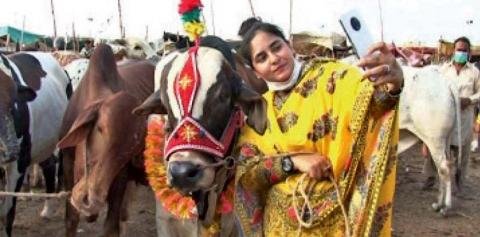
    A woman, Ayesha Ghani has been selling sacrificial cows in Karachi’s cattle market ahead of Eid-ul-Azha 2020.

    Karachi’s cattle market at Super Highway is one of the most prominent cattle markets in the country and the 21-year-old is breaking stereotypes by selling the sacrificial animals at the cattle market

    According to details, Ghani lives in Karachi and goes to the market every day, selling at least 36 of her cows, bulls and calves on sale, with a price ranging from PKR 130,000 to PKR 700,000.

    “I have raised these animals at home on my own. That’s why I have a special affection towards them”, said Ayesha Ghani.

    Ghani also sells animals online on her social media sites  ‘Desi Cows’.

    “Most buyers are looking for animals available at economical prices, while prices have increased this year due to inflation,” she said, adding that the business has affected this year amid coronavirus outbreak.

    “I have been an animal lover all my life. However, this is the first time that I am personally selling animals in the market,” she said.

    Ghani hoped that women would get encouraged to see her and get more involved in this work. However, the challenges that she faces being a woman, standing in a male-dominated market are “bound to surface at first”.

    “After all, girls do face a lot of difficulties in our society but I have taken the first step and hope to see more women and girls stepping forward,” Ghani said.

    “Today, women are second to none and they should not consider themselves inferior to anyone. We can progress in every field,” she added. 

    https://www.youtube.com/watch?v=cBxfzSMOFjk
  • Eid ul Adha: Cattle markets to operate from 6 am to 7 pm

    Eid ul Adha: Cattle markets to operate from 6 am to 7 pm

    The National Command and Control Centre (NCOC) has decided to allow cattle markets to function between 6 am to 7 pm.

    According to reports, the decision was taken in a meeting held in Lahore by Federal Minister for Planning and NCOC chief Asad Umar.

    “The movement of cattle and people between villages and cities increases the risk of the virus spreading,” said the minister, adding that better management of livestock markets was essential to prevent its spread.

    He told that about 700 cattle markets had been set-up across the country. However, the size of the markets will be small and the number of people visiting it at time will be controlled.

    The meeting reviewed the management of cattle markets and standard operating procedures (SOPs), which have been given to all relevant departments.

     No cattle markets will be allowed inside cities. Wearing masks inside the market was made compulsory and all the visitors will be screened at the entrance. Children and the elderly won’t be allowed to come to the cattle markets.